
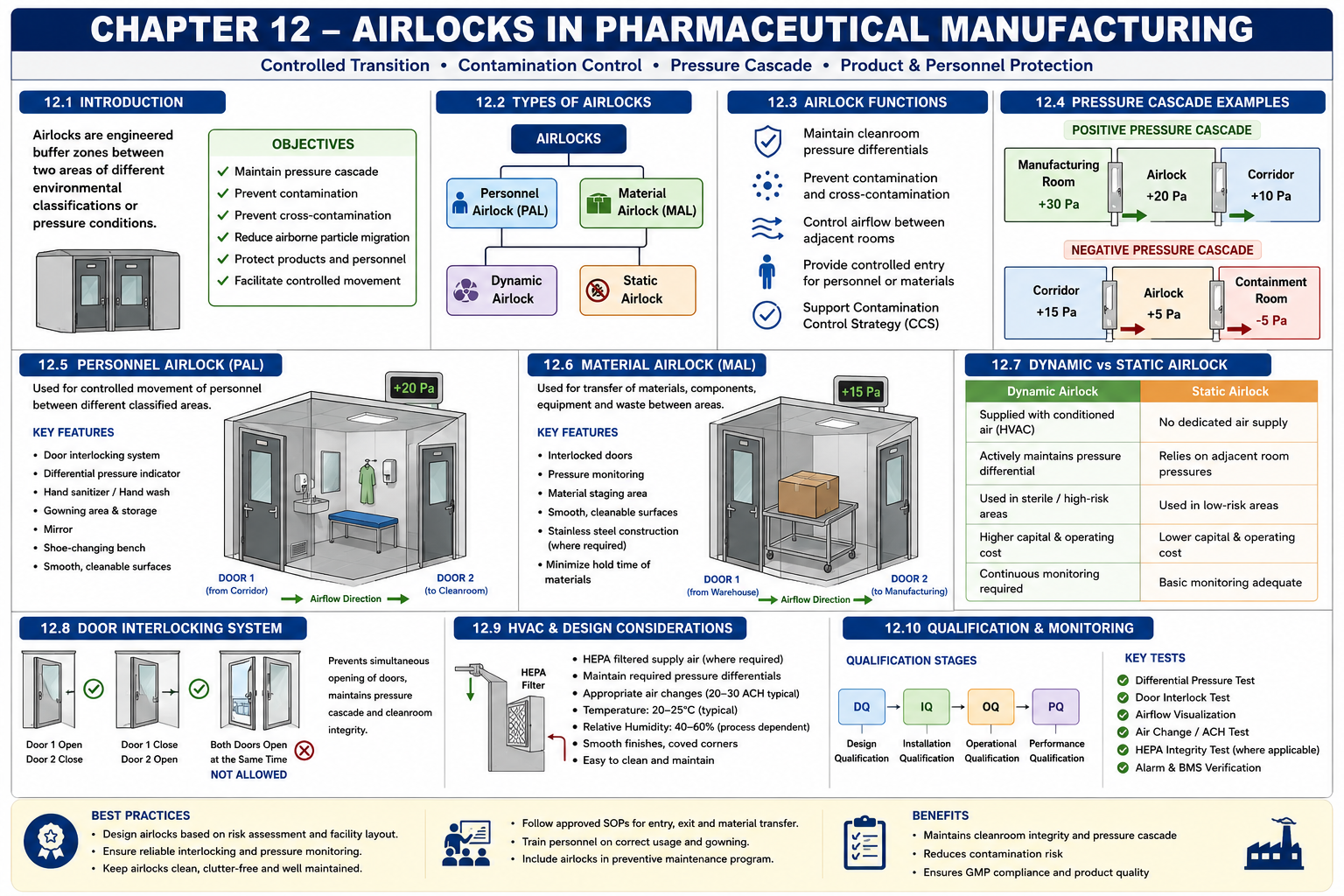
12.1 Introduction
Airlocks are one of the most important engineering controls used in pharmaceutical manufacturing facilities. They provide a controlled transition zone between two areas with different environmental classifications, pressure differentials, or contamination risks.
An airlock is much more than a passageway—it is an engineered contamination control system designed to:
- Maintain pressure cascades.
- Prevent contamination and cross-contamination.
- Protect products.
- Protect personnel.
- Minimize turbulence during door opening.
- Preserve cleanroom integrity.
Airlocks are widely used in:
- Oral Solid Dosage (OSD) facilities
- Sterile manufacturing plants
- Injectable facilities
- API manufacturing
- Biotechnology facilities
- Highly Potent API (HPAPI) facilities
- Cytotoxic manufacturing
- Packaging areas
Properly designed airlocks are essential for compliance with WHO GMP, US FDA, EU GMP Annex 1, PIC/S GMP, ISO 14644, and ISPE Baseline Guides.
12.2 Objectives of Airlocks
The primary objectives of pharmaceutical airlocks are:
- Maintain cleanroom pressure differentials.
- Control airflow between adjacent rooms.
- Prevent contamination.
- Prevent cross-contamination.
- Reduce airborne particle migration.
- Facilitate gowning and material transfer.
- Protect operators handling hazardous products.
- Support contamination control strategies (CCS).
12.3 What is an Airlock?
An airlock is an enclosed room or chamber located between two areas of different environmental classifications or pressure conditions.
It acts as a buffer zone, reducing the direct exchange of air when personnel or materials move between areas.
12.4 Types of Pharmaceutical Airlocks
Airlocks are broadly classified into:
                    AIRLOCKS
                        │
        ┌───────────────┼───────────────┐
        │                               │
 Personnel Airlock (PAL)      Material Airlock (MAL)
        │                               │
        ├───────────────┬───────────────┤
        │               │
 Dynamic Airlock   Static Airlock
12.5 Personnel Airlock (PAL)
Purpose
Personnel Airlocks are designed for the controlled movement of people between different classified areas.
Functions
- Maintain pressure cascade.
- Provide gowning/de-gowning area.
- Reduce airborne contamination.
- Prevent simultaneous opening of doors.
- Control personnel access.
Typical Features
- Door interlocking system
- Differential pressure indicator
- Hand wash basin (where appropriate)
- Hand sanitizer
- Mirror
- Gown storage cabinets
- Shoe-changing bench
- Emergency release mechanism
12.6 Material Airlock (MAL)
Purpose
Material Airlocks are designed for the transfer of raw materials, intermediates, packaging components, equipment, and waste between areas of different classifications.
Functions
- Preserve pressure differentials.
- Prevent contamination during transfer.
- Reduce unnecessary personnel movement.
- Separate clean and less-clean areas.
Typical Features
- Interlocked doors
- Pressure monitoring
- Smooth cleanable surfaces
- Stainless steel construction (where appropriate)
- Material staging shelves
- Pass-through arrangement
12.7 Dynamic Airlocks
A Dynamic Airlock is supplied with conditioned air from the HVAC system and actively maintains the required pressure differential.
Characteristics
- Continuous airflow
- Pressure-controlled
- HEPA-filtered supply air (where required)
- Connected to dedicated HVAC
- Environmental monitoring
Applications
- Sterile manufacturing
- Injectable facilities
- Grade B to Grade C transitions
- High-risk production areas
- Potent product manufacturing
12.8 Static Airlocks
A Static Airlock does not have an independent air supply but relies on adjacent room pressures to maintain airflow direction.
Characteristics
- No dedicated air supply
- Simpler construction
- Lower operating cost
- Used in lower-risk applications
Applications
- OSD manufacturing
- Packaging areas
- Warehouses
- Secondary material transfer
12.9 Airlock Classification
| Airlock Type | Typical Application | HVAC Supply | Pressure Control |
|---|---|---|---|
| Personnel Airlock | Personnel movement | Yes | Yes |
| Material Airlock | Material transfer | Yes | Yes |
| Dynamic Airlock | Sterile/high-risk areas | Dedicated | Active |
| Static Airlock | Lower-risk areas | Indirect | Passive |
12.10 Airlock Design Principles
A GMP-compliant airlock should:
- Be appropriately sized for its intended use.
- Have smooth, impervious, easy-to-clean finishes.
- Maintain validated pressure differentials.
- Include interlocked doors.
- Minimize dead spaces.
- Prevent simultaneous door opening.
- Support effective cleaning and maintenance.
12.11 Airlock Layout
Typical Personnel Airlock:
Corridor
    │
┌──────────────┐
│  Door 1      │
├──────────────┤
│ Personnel    │
│ Airlock      │
│              │
│ Gowning Area │
├──────────────┤
│  Door 2      │
└──────────────┘
    │
Manufacturing Room
12.12 Material Airlock Layout
Warehouse
      │
┌──────────────┐
│ Door 1       │
├──────────────┤
│ Material     │
│ Airlock      │
│              │
│ Transfer     │
│ Area         │
├──────────────┤
│ Door 2       │
└──────────────┘
      │
Manufacturing Room
12.13 Door Interlocking System
Door interlocking prevents both airlock doors from opening simultaneously.
Types
- Electromagnetic interlocks
- PLC-controlled interlocks
- Mechanical interlocks
- Electronic access systems
Benefits
- Maintains pressure cascade.
- Prevents uncontrolled airflow.
- Reduces contamination.
- Enhances cleanroom integrity.
12.14 Pressure Cascade in Airlocks
Airlocks are essential for maintaining airflow direction.
Positive Pressure Example
Manufacturing Room
      +30 Pa
         │
Personnel Airlock
      +20 Pa
         │
Corridor
      +10 Pa
Negative Pressure Example
Corridor
      +15 Pa
         │
Personnel Airlock
       +5 Pa
         │
Containment Room
        -5 Pa
The exact pressure values should be established through HVAC design and Quality Risk Management (QRM).
12.15 HVAC Requirements
Airlocks should be integrated with the HVAC system.
Typical Design Features
- HEPA-filtered supply air (where required)
- Pressure monitoring
- Temperature control
- Relative humidity control
- Air balancing
- Air change rate appropriate to classification
- Alarm integration with BMS
12.16 Environmental Conditions
Typical design conditions:
| Parameter | Typical Value* |
|---|---|
| Temperature | 20–25°C |
| Relative Humidity | 40–60% (process dependent) |
| Pressure Differential | 10–15 Pa between adjacent rooms |
| Air Changes | 20–30 ACH (risk-based) |
*Actual values should be based on product, process, and cleanroom classification.
12.17 Airlock Qualification
Airlocks should be included in the facility qualification program.
Qualification Stages
Design Qualification (DQ)
          │
Installation Qualification (IQ)
          │
Operational Qualification (OQ)
          │
Performance Qualification (PQ)
12.18 Qualification Tests
| Test | Purpose |
|---|---|
| Differential Pressure Test | Verify pressure cascade |
| Door Interlock Test | Verify interlocking function |
| Airflow Visualization | Confirm airflow direction |
| HEPA Integrity Test (where applicable) | Verify filter performance |
| Air Change Verification | Confirm ventilation performance |
| Recovery Test (where applicable) | Assess environmental recovery |
| Alarm Verification | Confirm alarm functionality |
12.19 Cleaning and Sanitization
Airlocks should be cleaned according to approved SOPs.
Typical Cleaning Frequency
| Area | Frequency |
|---|---|
| Floors | Daily or per shift |
| Walls | Scheduled (e.g., weekly) |
| Doors | Daily |
| Interlock Panels | As per SOP |
| Pressure Gauges | Routine cleaning |
| Ceiling | Scheduled preventive cleaning |
Cleaning agents and disinfectants should be compatible with room finishes and validated where required.
12.20 Operational Procedures
Personnel should:
- Verify pressure indicators before entry.
- Ensure the first door is fully closed before opening the second.
- Avoid unnecessary time inside the airlock.
- Follow gowning procedures.
- Report alarms or interlock failures immediately.
Material transfer procedures should include inspection, identification, and status verification.
12.21 Airlocks in Different Facilities
| Facility Type | Airlock Requirement |
|---|---|
| OSD Manufacturing | PAL and MAL |
| Sterile Manufacturing | Dynamic PAL and MAL |
| Injectable Manufacturing | Dynamic airlocks with strict environmental control |
| HPAPI Manufacturing | Containment airlocks |
| Cytotoxic Manufacturing | Negative-pressure airlocks |
| API Manufacturing | Risk-based PAL and MAL |
| Packaging | PAL and MAL where segregation is required |
12.22 Common Inspection Observations
Inspectors frequently identify:
- Simultaneous opening of both doors.
- Faulty door interlocks.
- Inadequate pressure differentials.
- Missing pressure monitoring records.
- Damaged door seals.
- Poor cleaning of airlock surfaces.
- Overcrowded airlocks.
- Use of airlocks for material storage.
- Uncontrolled personnel behavior during entry and exit.
12.23 Best Practices
- Design airlocks based on documented Quality Risk Management (QRM).
- Install reliable door interlocking systems.
- Continuously monitor differential pressures in critical areas.
- Validate airlock performance during qualification.
- Avoid using airlocks as temporary storage areas.
- Clearly define personnel and material transfer procedures.
- Include airlocks in preventive maintenance and calibration programs.
- Train personnel on correct airlock operation and gowning practices.
12.24 Case Study – Airlock Design in an OSD Tablet Facility
Facility
Oral Solid Dosage Manufacturing Plant
Airlock Arrangement
Warehouse
     │
Material Airlock
     │
Dispensing
     │
Personnel Airlock
     │
Granulation
     │
Personnel Airlock
     │
Compression
Design Parameters
| Parameter | Value |
|---|---|
| Pressure Differential | 10–15 Pa between adjacent areas |
| Air Changes | 20–25 ACH |
| Temperature | 22 ± 2°C |
| Relative Humidity | 45 ± 5% (process dependent) |
| Door Interlock | Electromagnetic |
Results
- Stable pressure cascade.
- Reduced contamination risk.
- Improved GMP compliance.
- Efficient personnel and material movement.
- Successful regulatory inspections.
12.25 Airlock Audit Checklist
| Checkpoint | Status |
|---|---|
| Personnel Airlocks (PAL) available | ☐ |
| Material Airlocks (MAL) available | ☐ |
| Door interlocking functional | ☐ |
| Pressure differentials within limits | ☐ |
| Pressure gauges calibrated | ☐ |
| Airlock cleaning records available | ☐ |
| Gowning instructions displayed | ☐ |
| Airlocks free from unnecessary storage | ☐ |
| Qualification documentation current | ☐ |
| Alarm system tested periodically | ☐ |
Chapter Summary
Airlocks are critical contamination control barriers that maintain cleanroom integrity, preserve pressure cascades, and facilitate the controlled movement of personnel and materials. Whether configured as Personnel Airlocks (PALs), Material Airlocks (MALs), dynamic airlocks, or static airlocks, they must be designed, qualified, monitored, and maintained according to product risk and regulatory expectations. Effective airlock design enhances product protection, operator safety, and GMP compliance across pharmaceutical manufacturing facilities.
Key Takeaways
- Airlocks provide controlled transitions between areas of different classifications and pressure regimes.
- Personnel Airlocks (PALs) and Material Airlocks (MALs) serve distinct but complementary contamination control functions.
- Dynamic airlocks are typically used for higher-risk and sterile applications, while static airlocks may be suitable for lower-risk operations.
- Door interlocking, pressure monitoring, HVAC integration, and qualification are essential for reliable airlock performance.
- Proper operation, maintenance, and training ensure airlocks continue to support contamination control and regulatory compliance throughout the facility lifecycle.
Next Chapter
Chapter 13 – Pass Boxes in Pharmaceutical Manufacturing, covering Static Pass Boxes, Dynamic Pass Boxes, HEPA Pass Boxes, UV Pass Boxes, design principles, airflow patterns, HVAC integration, qualification, validation, cleaning, operational procedures, GMP requirements, and selection criteria for pharmaceutical manufacturing facilities.
About the Author
Ramesh Palav is a pharmaceutical manufacturing professional with 21+ years of experience in Oral Solid Dosage manufacturing, production operations, GMP compliance, qualification, validation, QMS and operational excellence. Through Pharma Manufacturing Hub, he shares practical industry knowledge with pharmaceutical professionals, students and manufacturing leaders.