
5.1 Introduction
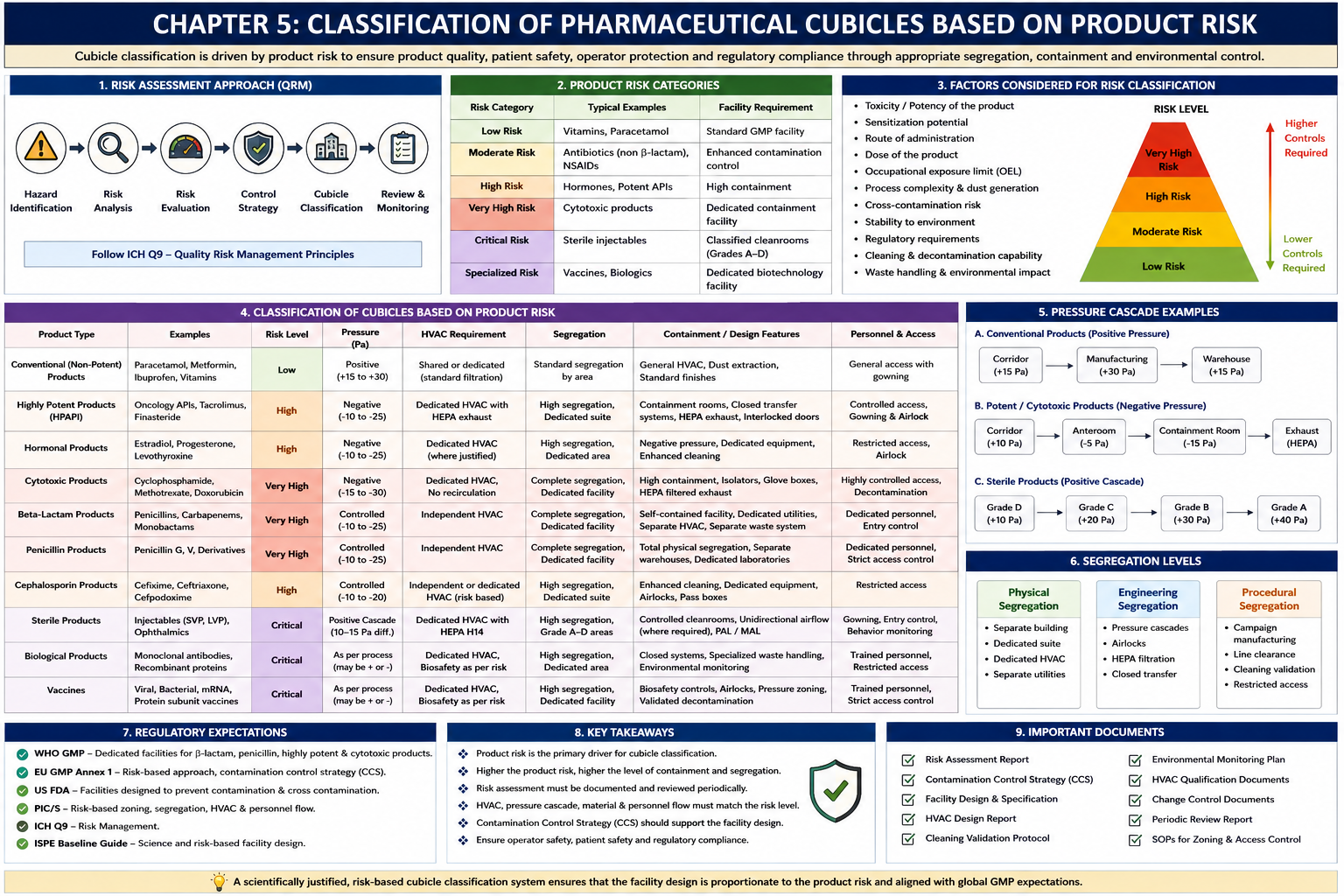
The design and classification of pharmaceutical manufacturing cubicles should always be based on a scientific, documented Quality Risk Management (QRM) approach. Not all pharmaceutical products present the same level of risk. While manufacturing conventional oral solid dosage (OSD) products may require standard GMP controls, the production of highly potent active pharmaceutical ingredients (HPAPIs), hormones, cytotoxic drugs, beta-lactam antibiotics, biological products, and sterile medicines demands significantly higher levels of containment, segregation, and environmental control.
International regulatory agencies such as the US FDA, WHO, EMA, MHRA, PIC/S, and ISPE expect manufacturers to classify manufacturing areas according to the hazards posed by the product, the manufacturing process, and the potential for contamination or cross-contamination.
A well-designed risk-based cubicle classification system protects:
- Product quality
- Patient safety
- Manufacturing personnel
- The surrounding environment
- Regulatory compliance
5.2 Quality Risk Management (QRM) Approach
The classification of pharmaceutical cubicles should be supported by a documented Quality Risk Management process in accordance with ICH Q9.
Typical Risk Assessment Process
Product Characteristics
          │
          ▼
Hazard Identification
          │
          ▼
Risk Analysis
          │
          ▼
Risk Evaluation
          │
          ▼
Selection of Engineering Controls
          │
          ▼
Cubicle Classification
          │
          ▼
Qualification & Validation
          │
          ▼
Periodic Review
5.3 Product Risk Categories
Products can generally be divided into the following categories:
| Risk Category | Typical Examples | Facility Requirement |
|---|---|---|
| Low Risk | Vitamins, Paracetamol | Standard GMP facility |
| Moderate Risk | Antibiotics (non-beta-lactam), NSAIDs | Enhanced contamination control |
| High Risk | Hormones, Potent APIs | High containment |
| Very High Risk | Cytotoxic products | Dedicated containment facility |
| Critical Risk | Sterile injectables | Classified cleanrooms (Grades A–D) |
| Specialized Risk | Vaccines, Biologics | Dedicated biotechnology facility |
5.4 Classification for Conventional (Non-Potent) Products
Conventional products include most oral solid dosage (OSD) medicines such as:
- Paracetamol
- Metformin
- Vitamin tablets
- Calcium supplements
- Ibuprofen
Typical Design Requirements
- Positive pressure manufacturing rooms
- Standard HVAC
- Controlled temperature and humidity
- Dust extraction at equipment
- Segregated material flow
- Routine environmental monitoring
Typical Facility Layout
Warehouse
     │
Dispensing
     │
Granulation
     │
Compression
     │
Coating
     │
Packaging
5.5 Classification for Highly Potent Products (HPAPI)
Highly Potent Active Pharmaceutical Ingredients (HPAPIs) can cause adverse health effects at very low exposure levels.
Examples include:
- Finasteride
- Tacrolimus
- Certain oncology APIs
Primary Risks
- Occupational exposure
- Airborne contamination
- Cross-contamination
Typical Design Requirements
- Dedicated manufacturing suites (based on risk assessment)
- Negative pressure containment
- Closed transfer systems
- Dedicated exhaust with HEPA filtration
- Airlocks with interlocked doors
- Personnel decontamination procedures
Engineering Controls
- Isolators
- Split butterfly valves
- Containment booths
- Glove boxes
- Restricted access
5.6 Classification for Hormonal Products
Hormonal products exhibit biological activity even at extremely low concentrations.
Examples:
- Estradiol
- Progesterone
- Levothyroxine
- Ethinyl Estradiol
GMP Considerations
Manufacturing should be performed in dedicated facilities or using scientifically justified containment strategies supported by toxicological and Quality Risk Management (QRM) assessments.
Facility Requirements
- Dedicated HVAC (where justified)
- Negative pressure
- Dedicated equipment (where required)
- Controlled personnel access
- Enhanced cleaning validation
5.7 Classification for Cytotoxic Products
Cytotoxic drugs are used primarily in oncology and present significant occupational hazards.
Examples:
- Cyclophosphamide
- Methotrexate
- Doxorubicin
Primary Risks
- Toxic exposure
- Reproductive hazards
- Environmental contamination
Recommended Facility Design
| Requirement | Recommendation |
|---|---|
| Facility | Dedicated containment suite |
| Pressure | Negative |
| Exhaust | HEPA filtered, no recirculation unless justified |
| Personnel Entry | Airlock with gowning |
| Material Transfer | Dedicated MAL |
| Cleaning | Specialized decontamination procedures |
5.8 Classification for Beta-Lactam Products
Beta-lactam antibiotics include:
- Penicillins
- Carbapenems
- Monobactams
These compounds can cause severe allergic reactions.
Regulatory Expectation
WHO GMP, EU GMP, and PIC/S generally require dedicated and self-contained manufacturing facilities for beta-lactam products due to the high risk of cross-contamination and sensitization.
Facility Characteristics
- Dedicated building or self-contained suite
- Independent HVAC
- Separate utilities where appropriate
- Dedicated personnel and material flow
- Dedicated waste management
5.9 Classification for Penicillin Products
Penicillin manufacturing is one of the most strictly regulated areas.
Typical Requirements
- Complete physical segregation
- Independent HVAC
- Dedicated equipment
- Separate personnel facilities
- Separate warehouses
- Dedicated laboratories where appropriate
Failure to adequately segregate penicillin manufacturing has historically resulted in serious regulatory actions.
5.10 Classification for Cephalosporin Products
Cephalosporins also present sensitization risks.
Typical examples:
- Cefixime
- Ceftriaxone
- Cefpodoxime
Manufacturing should be supported by a documented risk assessment to determine the need for dedicated facilities, equipment, HVAC, and operational controls.
5.11 Classification for Sterile Products
Sterile products require the highest level of environmental control.
Typical products:
- Injectable antibiotics
- Ophthalmic products
- Large Volume Parenterals (LVP)
- Small Volume Parenterals (SVP)
Cleanroom Classification
| Operation | EU GMP Grade |
|---|---|
| Aseptic Filling | Grade A |
| Background | Grade B |
| Solution Preparation | Grade C |
| Component Washing | Grade D |
Engineering Requirements
- HEPA H14 filtration
- Unidirectional airflow
- Continuous environmental monitoring
- Pressure cascade
- Strict gowning procedures
5.12 Classification for Biological Products
Biological products include:
- Monoclonal antibodies
- Recombinant proteins
- Cell culture products
Design Considerations
- Closed processing systems
- Dedicated HVAC where appropriate
- Controlled microbial environment
- Specialized waste treatment
- Biosafety controls aligned with organism and process risk
5.13 Classification for Vaccine Manufacturing
Vaccines involve living organisms or complex biological materials.
Examples:
- Viral vaccines
- Bacterial vaccines
- mRNA vaccines
- Protein subunit vaccines
Facility Design
- Dedicated manufacturing suites
- Biosafety measures appropriate to the organism
- Airlocks
- Pressure zoning
- Separate HVAC systems where justified
- Specialized environmental monitoring
5.14 Comparison of Facility Requirements
| Product Type | Pressure | HVAC | Segregation | Containment |
|---|---|---|---|---|
| Conventional OSD | Positive | Shared or dedicated (risk-based) | Standard | Low |
| Potent Products | Negative | Dedicated where required | High | High |
| Hormones | Negative | Dedicated where justified | High | High |
| Cytotoxic | Negative | Dedicated | Very High | Very High |
| Penicillin | Controlled | Independent | Complete | Complete |
| Cephalosporins | Controlled | Independent (risk-based) | Very High | Very High |
| Sterile Products | Positive | Dedicated | High | Product protection |
| Vaccines | Mixed (process-dependent) | Dedicated | High | High |
5.15 Segregation Requirements
Segregation may be achieved through:
Physical Segregation
- Separate buildings
- Dedicated manufacturing suites
- Dedicated HVAC systems
Procedural Segregation
- Campaign manufacturing
- Cleaning validation
- Line clearance
- Controlled scheduling
Engineering Segregation
- Pressure cascades
- Airlocks
- HEPA filtration
- Containment equipment
5.16 HVAC Considerations Based on Product Risk
| Product Risk | HVAC Requirement |
|---|---|
| Conventional Products | Standard HVAC with appropriate filtration |
| Potent Products | Dedicated HVAC with containment controls |
| Cytotoxic Products | Dedicated exhaust, HEPA filtration |
| Sterile Products | HEPA H14, unidirectional airflow where required |
| Vaccines | Specialized HVAC with biosafety considerations |
5.17 Pressure Cascade Based on Product Risk
Conventional Products
Corridor (+15 Pa)
       │
       ▼
Manufacturing (+30 Pa)
Potent Products
Corridor (+15 Pa)
       │
       ▼
Containment Room (-15 Pa relative to corridor)
Sterile Products
Grade D
    │
Grade C
    │
Grade B
    │
Grade A
Pressure differentials should typically be maintained in the range of 10–15 Pa between adjacent rooms, unless a different value is scientifically justified.
5.18 Common Inspection Observations
Inspectors frequently identify:
- Shared HVAC without documented justification.
- Inadequate segregation of sensitizing products.
- Poor pressure cascade control.
- Insufficient cleaning validation for multi-product facilities.
- Incorrect material and personnel flow.
- Inadequate containment for potent compounds.
- Lack of documented toxicological assessments supporting facility design.
5.19 Best Practices
- Base cubicle classification on documented Quality Risk Management (QRM).
- Consider toxicological, pharmacological, and process-related hazards.
- Implement Contamination Control Strategies (CCS) appropriate to product risk.
- Use dedicated facilities or equipment where required by product characteristics and regulatory expectations.
- Verify containment performance through qualification, environmental monitoring, and periodic review.
- Reassess facility classification whenever new products, processes, or equipment are introduced.
5.20 Case Study – Risk-Based Classification of a Multi-Product OSD Facility
Scenario: A facility manufactures conventional tablets, hormonal tablets, and a potent oncology product.
Risk Assessment Outcome:
| Product | Facility Decision |
|---|---|
| Conventional Tablets | Standard positive-pressure manufacturing area |
| Hormonal Tablets | Dedicated manufacturing suite with enhanced containment |
| Oncology Product | High-containment negative-pressure suite with dedicated HVAC |
Benefits Achieved:
- Reduced cross-contamination risk.
- Improved operator protection.
- Simplified cleaning validation.
- Enhanced regulatory compliance.
- Increased flexibility for multi-product manufacturing while maintaining appropriate segregation.
Chapter Summary
Product risk is the primary driver for pharmaceutical cubicle classification. Conventional products can often be manufactured in standard GMP facilities, whereas highly potent, sensitizing, cytotoxic, sterile, and biological products require progressively greater levels of segregation, containment, and environmental control. A documented Quality Risk Management (QRM) approach—supported by an effective Contamination Control Strategy (CCS)—ensures that facility design is scientifically justified, protects product quality and personnel, and meets global regulatory expectations.
Key Takeaways
- Cubicle classification should always be based on product and process risk.
- Product potency, toxicity, sensitization potential, and sterility requirements determine the required level of segregation and containment.
- Dedicated facilities or engineering controls may be necessary for high-risk products.
- HVAC design, pressure cascades, and material/personnel flows must align with the assigned risk classification.
- Regulatory expectations emphasize scientific justification, documented risk assessments, and lifecycle review of facility classifications.
Next Chapter
Chapter 6 – Cleanroom Classification in Pharmaceutical Manufacturing, covering ISO 14644, EU GMP Annex 1 Grades A–D, ISO Class 5–8, airborne particle limits, microbiological limits, cleanroom testing, qualification, environmental monitoring, and practical cleanroom design considerations.
About the Author
Ramesh Palav is a pharmaceutical professional with 20+ years of industry experience in manufacturing, GMP, quality systems, validation, compliance, and operational excellence. Through Pharma Manufacturing Hub, he shares practical insights on pharmaceutical careers, manufacturing, quality, validation, Pharma 4.0, AI, and professional development.
His goal is to help students, freshers, experienced professionals, and career-break professionals build the knowledge and skills needed to succeed in the pharmaceutical industry.