
Introduction
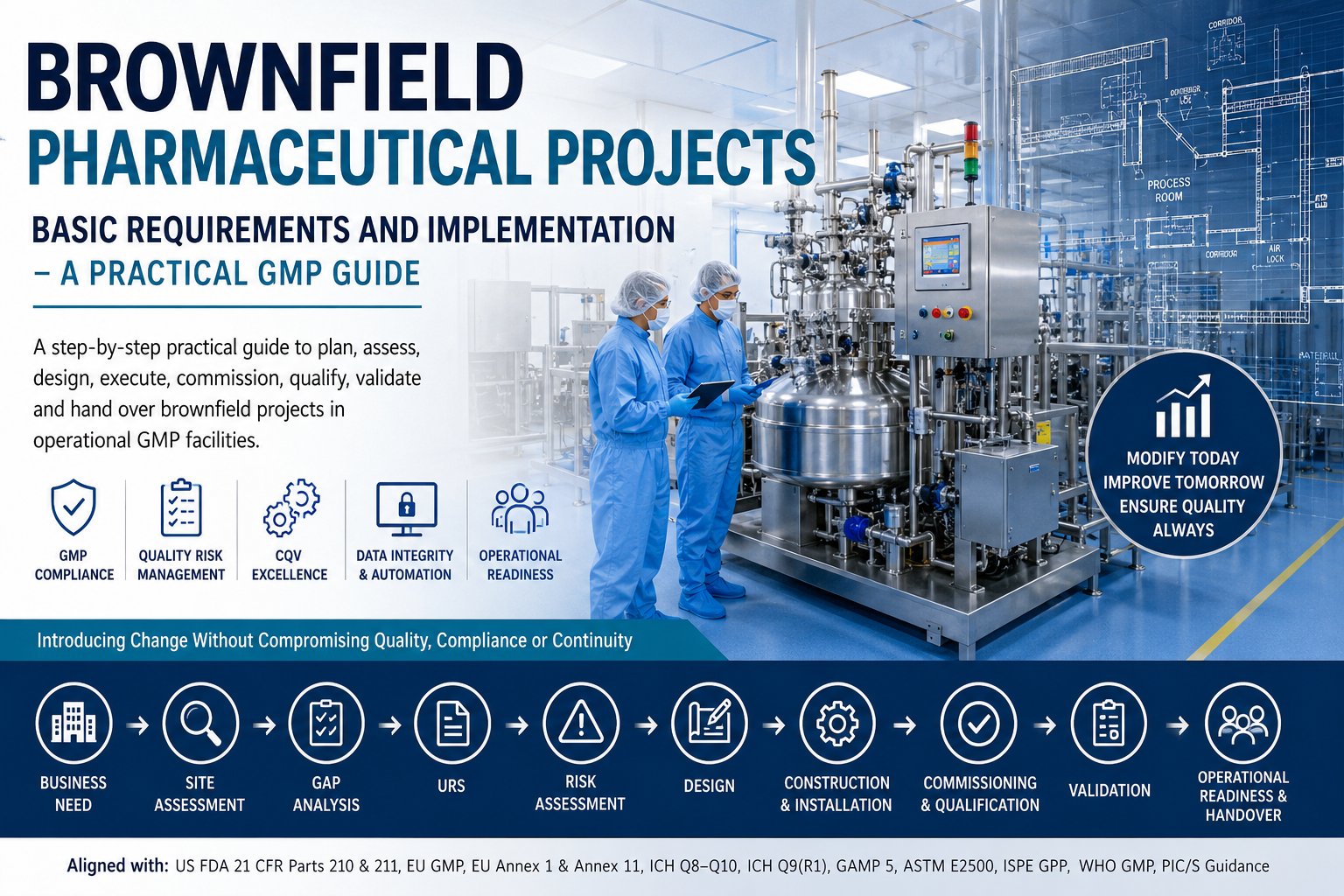
Pharmaceutical manufacturing facilities must continuously evolve to accommodate new products, increase capacity, replace aging equipment, adopt automation, improve compliance, and introduce new technologies. When these modifications are carried out within an existing facility, they are generally referred to as brownfield projects.
A brownfield pharmaceutical project involves expansion, modification, modernization, or installation within an existing manufacturing facility. Unlike a greenfield project, where a facility is developed largely from the ground up, brownfield execution must work around existing buildings, utilities, equipment, validated systems, manufacturing schedules, and GMP controls.
Typical brownfield projects include installation of a new granulator, compression machine or coating system; modification of manufacturing rooms; HVAC upgrades; utility capacity enhancement; warehouse expansion; installation of new production lines; SCADA/HMI modernization; and regulatory remediation.
The fundamental challenge is:
A brownfield project must introduce change into an existing qualified and operational GMP facility without creating unacceptable risks to product quality, patient safety, regulatory compliance, personnel safety, or ongoing manufacturing operations.
A useful overall lifecycle is:
Business Need → Site Assessment → Gap Analysis → URS → Risk Assessment → Design → Change Control → Procurement → Construction → Commissioning → Qualification → Validation → Operational Readiness → QA Release → Handover
1. Existing Facility Assessment
The first requirement is understanding the actual condition of the existing facility.
A multidisciplinary team involving Engineering, Production, QA, Validation, Maintenance, Automation/IT, EHS and Projects should assess the affected areas.
The assessment should consider the building and structural condition, manufacturing areas, personnel and material flows, HVAC, electrical distribution, Purified Water/WFI where applicable, compressed air, process gases, steam/clean steam, drainage, fire protection, automation, environmental monitoring, equipment, warehousing and IT/OT infrastructure.
Available documentation should also be reviewed, including:
- As-built layouts and drawings
- P&IDs
- HVAC drawings
- Electrical single-line diagrams
- Equipment documentation
- Qualification and validation records
- Calibration and maintenance history
- Deviations and CAPAs
- Existing change controls
One of the most important brownfield principles is:
Never rely only on old drawings. Physically verify existing site conditions before design freeze.
Undocumented field modifications are common in older facilities and can significantly affect design and execution.
2. Define Project Requirements
Once the existing condition is understood, the project requirements should be clearly established.
Requirements may originate from business capacity, product introduction, GMP remediation, process improvement, engineering upgrades, automation, EHS or future expansion.
A typical documentation hierarchy may follow:
Business Requirement → Project Scope → Basis of Design → User Requirement Specification (URS) → Functional/Design Specifications → Qualification Requirements
The URS is particularly important because it establishes what the system is expected to achieve from the user’s, process, GMP, safety and operational perspectives.
Clearly defining scope early also helps prevent scope creep, one of the major causes of brownfield schedule delays and budget escalation.
3. GMP and Engineering Gap Assessment
A formal gap assessment should compare existing conditions against the project’s intended state and applicable requirements.
Typical areas include:
- Contamination and cross-contamination controls
- HVAC zoning and pressure cascades
- Personnel and material flows
- Equipment capacity
- Utility capacity and redundancy
- Automation architecture
- Data integrity controls
- Cleaning requirements
- Maintenance accessibility
- Fire and emergency systems
- Occupational safety
Each gap should be evaluated according to criticality, compliance impact and risk.
This exercise allows the project team to distinguish between essential modifications and desirable improvements.
4. Quality Risk Management
Quality Risk Management should be embedded throughout brownfield execution.
ICH Q9(R1) provides principles for systematic assessment, control, communication and review of quality risks. Depending on the situation, tools may include FMEA, HACCP, risk ranking/filtering or structured What-if analysis.
Risks should be considered across:
Product Quality → Patient Safety → GMP Compliance → Validated Systems → Manufacturing Continuity → Personnel Safety
For example, modification of an HVAC system serving an operational manufacturing area could affect pressure differentials, temperature, relative humidity, airborne contamination, dust migration and adjacent manufacturing rooms.
Controls might therefore include temporary containment, production restrictions, differential-pressure monitoring, cleaning, environmental verification and HVAC requalification before routine manufacturing resumes.
5. Brownfield Design
Brownfield design normally requires greater coordination than greenfield design because the project must work within existing constraints.
Design teams must consider:
- Available space
- Existing structural limitations
- Equipment movement routes
- Shutdown windows
- Temporary utilities
- Construction access
- Temporary barriers
- Dust, noise and vibration
- Cleanroom protection
- Maintenance accessibility
- Personnel/material segregation
- Future expansion
3D scanning, BIM, clash detection and constructability reviews can be valuable for complex projects where justified.
Multidisciplinary design reviews involving users, engineering, QA, maintenance, validation, automation and EHS can identify problems before construction begins, when changes are generally less disruptive and less costly.
6. Change Control and GMP Governance
Modification of qualified facilities, utilities, equipment, computerized systems or validated processes should be managed through the site’s pharmaceutical quality system and applicable change-control procedure.
The impact assessment should determine potential effects on:
- Qualification and validation
- Cleaning validation
- Process validation
- Computerized systems
- SOPs and batch documentation
- Calibration
- Preventive maintenance
- Training
- Regulatory commitments
- Licenses or approvals, where applicable
QA involvement should begin during project planning—not only when qualification starts.
Early Quality participation helps establish appropriate GMP controls and qualification strategy before irreversible engineering decisions are made.
7. Construction and Execution Strategy
A practical execution sequence may be:
Site Assessment → Scope Definition → Risk Assessment → Design → Procurement → FAT → Site Preparation → Shutdown/Isolation → Installation → Commissioning → Qualification → Validation
Construction inside an operating GMP facility requires additional controls.
Depending on risk, these may include permit-to-work systems, LOTO, temporary partitions, dust containment, contractor access and gowning controls, controlled movement of tools and materials, hot-work permits, waste-removal routes, cleaning and environmental monitoring.
Construction and GMP manufacturing activities should be appropriately segregated to prevent contamination and operational interference.
8. Shutdown and Tie-In Planning
Shutdown management is one of the most critical elements of brownfield execution.
A detailed shutdown plan should identify:
- Activities and sequence
- System isolations
- LOTO requirements
- Utility interruptions
- Production impact
- Resources and responsibilities
- Contingency arrangements
- Inspection requirements
- Cleaning requirements
- Restart sequence
- Requalification requirements
Critical tie-ins involving electrical systems, HVAC, purified water, compressed air or other utilities should be carefully planned.
A delay of only a few hours in a critical tie-in can affect production schedules and project completion.
9. Commissioning, Qualification and Validation
A risk-based CQV lifecycle can follow:
URS → Design Review/DQ → FAT → SAT → Commissioning → IQ → OQ → PQ
Traditional qualification approaches and science- and risk-based approaches aligned with concepts such as ASTM E2500 may both be appropriate depending on the company’s quality system and project strategy.
Commissioning should demonstrate that systems are correctly installed, configured and capable of operating as intended.
Where properly planned, controlled and reviewed, suitable commissioning evidence may support qualification and help avoid unnecessary duplicate testing.
The qualification strategy should consider the affected:
- Facility
- Equipment
- HVAC
- Utilities
- Automation/computerized systems
- Cleaning validation
- Process validation
Requirements should remain traceable from the URS through design, testing and final acceptance.
10. Automation and Data Integrity
Modern brownfield projects frequently involve modifications to PLC, SCADA, HMI, BMS, EMS, MES or other computerized systems.
Changes require formal assessment of functionality, GMP impact and data integrity.
Depending on system use, considerations may include:
- User access and roles
- Audit trails
- Electronic records
- Electronic signatures where applicable
- Backup and restoration
- Cybersecurity/security controls
- Time synchronization
- Data retention
- Interfaces
- Disaster recovery
Applicable expectations may include 21 CFR Part 11, EU GMP Annex 11 and GAMP 5 principles, depending on system scope and intended use.
11. Operational Readiness and Handover
Mechanical completion does not mean GMP readiness.
Before routine operation, the organization should confirm that relevant readiness requirements have been completed.
These commonly include approved qualification documentation, punch-list management, deviation resolution, calibration, preventive maintenance, spare parts, SOP approval, training, updated as-built drawings, equipment manuals, validation assessments and change-control completion.
QA should provide the required release or approval for GMP use according to the site’s Pharmaceutical Quality System.
This integrated process is often described as Operational Readiness.
12. Common Brownfield Project Failures
Recurring causes of brownfield problems include inaccurate drawings, inadequate site surveys, late QA involvement, weak risk assessments, uncontrolled scope expansion, insufficient shutdown planning, overlooked utility capacity, poor contractor control, incomplete commissioning and premature qualification.
Another serious problem is retrospective documentation—performing activities first and attempting to reconstruct GMP evidence later.
These weaknesses can result in deviations, repeated testing, requalification, production losses, schedule delays, increased costs and potential regulatory observations.
The project philosophy should therefore be:
Plan → Assess Risk → Execute Under Control → Document Concurrently → Verify → Release
13. Ten Critical Success Factors
Successful brownfield execution depends on several fundamentals:
- Perform a detailed existing-facility assessment.
- Establish a clear project scope and URS.
- Apply risk-based decision-making.
- Involve QA, Production, Engineering, Validation, Automation and EHS early.
- Physically verify existing site conditions.
- Develop a robust shutdown and tie-in strategy.
- Integrate commissioning and qualification.
- Maintain effective change control.
- Plan operational readiness from project initiation.
- Maintain complete lifecycle documentation and requirements traceability.
Conclusion
Brownfield pharmaceutical projects are significantly more than construction, equipment installation or engineering modifications.
They represent controlled changes to an existing GMP manufacturing system.
The greatest challenge is not simply installing new equipment—it is ensuring that the modification does not adversely affect existing products, qualified systems, manufacturing continuity, data integrity, contamination controls, personnel safety or regulatory compliance.
Successful pharmaceutical brownfield projects therefore require the coordinated application of engineering, Quality Risk Management, change control, commissioning and qualification, validation, EHS, operational readiness and production-continuity planning.
When these disciplines are integrated from concept through final handover, a brownfield project can achieve its business objectives while maintaining the fundamental expectations of pharmaceutical manufacturing:
Product Quality. Patient Safety. Data Integrity. GMP Compliance. Reliable Operations.
About the Author
Ramesh Palav is a pharmaceutical professional with 20+ years of industry experience in manufacturing, GMP, quality systems, validation, compliance, and operational excellence. Through Pharma Manufacturing Hub, he shares practical insights on pharmaceutical careers, manufacturing, quality, validation, Pharma 4.0, AI, and professional development.
His goal is to help students, freshers, experienced professionals, and career-break professionals build the knowledge and skills needed to succeed in the pharmaceutical industry.
Pingback: Pharmaceutical Greenfield Project: Complete Guide