Table of Contents
- Introduction
- Artificial Intelligence (AI) in Cleaning Validation
- Machine Learning Applications
- Internet of Things (IoT)
- Real-Time Monitoring
- Process Analytical Technology (PAT)
- Digital Twin Technology
- Electronic Batch Records (EBR)
- Predictive Cleaning Validation
- AI Use Cases
- Technology Comparison
- Future Digital Workflow
- Best Practices
- Key Takeaways
- Continue to Part 5C
Introduction
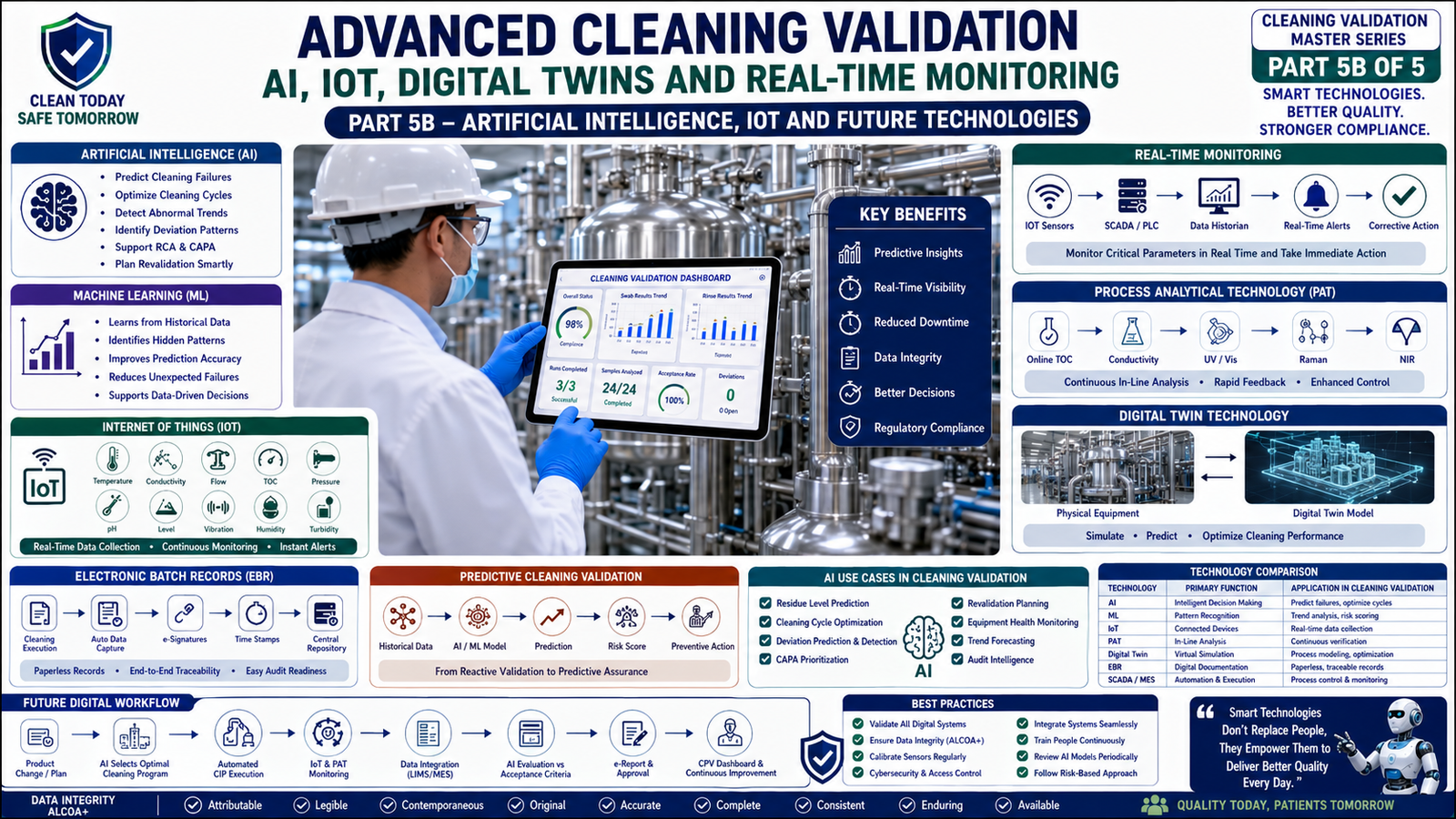
Cleaning Validation has evolved from a paper-based compliance activity into a digitally connected lifecycle process. While Pharma 4.0 establishes the digital foundation, emerging technologies such as Artificial Intelligence (AI), Machine Learning (ML), Internet of Things (IoT), Digital Twins, and Process Analytical Technology (PAT) are enabling pharmaceutical manufacturers to predict, optimize, and continuously improve cleaning performance.
Rather than relying solely on historical validation data, manufacturers can now leverage real-time information from equipment, sensors, laboratory systems, and manufacturing execution platforms to support faster decisions and proactive quality management.
These technologies not only enhance regulatory compliance but also improve operational efficiency, reduce downtime, minimize manual intervention, and strengthen contamination control strategies.
Artificial Intelligence (AI) in Cleaning Validation
What is AI?
Artificial Intelligence refers to computer systems capable of analyzing large datasets, recognizing patterns, making predictions, and supporting decision-making.
In pharmaceutical cleaning validation, AI acts as a decision-support tool by processing historical and real-time data to identify risks and optimization opportunities.
AI Applications
AI can assist in:
- Predicting cleaning failures
- Optimizing cleaning cycle duration
- Detecting abnormal residue trends
- Identifying recurring deviations
- Supporting root cause investigations
- Prioritizing revalidation activities
- Improving scheduling
- Reducing equipment downtime
AI does not replace validation professionals—it augments decision-making with data-driven insights.
Machine Learning Applications
Machine Learning (ML), a subset of AI, learns from historical data to improve predictions over time.
Typical inputs include:
- Swab results
- Rinse sample data
- Cleaning duration
- Equipment utilization
- Product characteristics
- Detergent concentration
- Water temperature
- Conductivity
- TOC values
- Microbial counts
As more data becomes available, ML models become increasingly accurate.
Example
A facility has five years of cleaning validation data.
An ML model identifies that:
- Low cleaning water temperature
- Extended production campaigns
- High-potency products
consistently increase residue levels.
The system alerts operators before cleaning begins, allowing preventive adjustments that reduce the risk of validation failures.
Internet of Things (IoT)
What is IoT?
The Internet of Things (IoT) connects equipment, sensors, and software systems, enabling continuous data collection and communication.
In cleaning validation, IoT provides real-time visibility into cleaning parameters.
Typical IoT Sensors
- Temperature sensors
- Pressure sensors
- Flow meters
- Conductivity sensors
- TOC analyzers
- pH sensors
- Turbidity sensors
- Humidity sensors
- Vibration sensors
- Tank level sensors
These sensors continuously monitor critical cleaning parameters and automatically transmit data to centralized systems.
Benefits
- Continuous monitoring
- Reduced manual recording
- Faster deviation detection
- Improved traceability
- Better equipment utilization
- Real-time alarms
Real-Time Monitoring
Traditional validation relies on periodic sampling.
Real-time monitoring enables continuous observation of cleaning performance.
Typical parameters monitored include:
| Parameter | Monitoring Method |
|---|---|
| Water Temperature | Digital sensor |
| Conductivity | Inline conductivity meter |
| Flow Rate | Flow transmitter |
| Detergent Concentration | Automated analyzer |
| TOC | Online TOC analyzer |
| Pressure | Pressure transmitter |
| Cleaning Time | PLC/MES |
| CIP Sequence | SCADA |
Real-time monitoring allows immediate corrective actions if parameters move outside validated ranges.
Process Analytical Technology (PAT)
PAT is a framework promoted by the US FDA to design, analyze, and control pharmaceutical manufacturing processes.
In cleaning validation, PAT enables:
- Continuous monitoring
- Automated process control
- Faster verification
- Improved reproducibility
- Reduced variability
PAT supports the shift from end-product testing toward real-time process assurance.
PAT Examples
- Online TOC monitoring
- Inline conductivity measurement
- Automated detergent concentration monitoring
- UV spectroscopy
- Raman spectroscopy
- Near-Infrared (NIR) analysis
These technologies reduce dependence on offline laboratory testing.
Digital Twin Technology
A Digital Twin is a virtual representation of physical equipment that continuously receives operational data from the real system.
For cleaning validation, a Digital Twin can simulate:
- Fluid flow
- Spray coverage
- Residue removal
- Cleaning cycle duration
- Water consumption
- Energy utilization
This allows engineers to optimize cleaning procedures without interrupting production.
Practical Example
A Digital Twin of a tablet coating pan predicts poor spray coverage around internal baffles.
Engineers modify spray nozzle orientation based on the simulation, improving cleaning effectiveness before executing the physical validation study.
Electronic Batch Records (EBR)
Electronic Batch Records integrate manufacturing and cleaning documentation into a single digital platform.
EBRs automatically capture:
- Product information
- Equipment identification
- Cleaning SOP version
- Cleaning parameters
- Operator identity
- Electronic signatures
- Time stamps
- Sampling activities
This eliminates duplicate documentation and improves inspection readiness.
Predictive Cleaning Validation
Traditional validation identifies failures after they occur.
Predictive validation uses AI and analytics to forecast potential failures before they happen.
Examples include:
- Predicting residue accumulation
- Forecasting cleaning cycle performance
- Identifying equipment requiring maintenance
- Estimating revalidation requirements
- Predicting microbial growth risk
Predictive validation supports proactive quality management and reduces unplanned downtime.
AI Use Cases
| Use Case | Benefit |
|---|---|
| Residue Prediction | Early identification of contamination risks |
| Cleaning Cycle Optimization | Reduced cleaning time and water usage |
| Deviation Detection | Faster investigations |
| Trend Analysis | Improved lifecycle management |
| CAPA Prioritization | Focus on high-risk issues |
| Revalidation Planning | Risk-based scheduling |
| Equipment Performance Monitoring | Improved reliability |
| Audit Preparation | Faster document retrieval and analysis |
Technology Comparison
| Technology | Primary Function | Cleaning Validation Application |
|---|---|---|
| AI | Predictive analytics | Failure prediction |
| Machine Learning | Pattern recognition | Trend analysis |
| IoT | Connected sensors | Real-time monitoring |
| PAT | Inline analysis | Continuous verification |
| Digital Twin | Virtual simulation | Cleaning optimization |
| SCADA | Equipment control | Cleaning sequence monitoring |
| MES | Manufacturing execution | Workflow integration |
| LIMS | Laboratory management | Automated analytical data |
| EBR | Electronic documentation | Paperless records |
Future Digital Workflow
Production Completed
        │
        ▼
AI Selects Cleaning Program
        │
        ▼
Automatic CIP Execution
        │
        ▼
IoT Sensors Monitor Parameters
        │
        ▼
PAT Confirms Cleaning Performance
        │
        ▼
Digital Twin Predicts Optimization Opportunities
        │
        ▼
Laboratory Results Imported Automatically
        │
        ▼
AI Reviews Acceptance Criteria
        │
        ▼
Electronic Validation Report Generated
        │
        ▼
CPV Dashboard Updated
Best Practices
✔ Validate AI-supported computerized systems.
✔ Maintain robust data integrity controls.
✔ Use AI to support—not replace—scientific judgment.
✔ Verify sensor calibration regularly.
✔ Integrate IoT with validated automation systems.
✔ Protect systems through strong cybersecurity measures.
✔ Periodically review AI model performance.
✔ Train personnel in digital technologies.
Key Takeaways
- AI enhances decision-making through predictive analytics.
- Machine Learning identifies hidden trends in cleaning validation data.
- IoT enables continuous monitoring of critical cleaning parameters.
- PAT supports real-time process assurance.
- Digital Twins optimize cleaning procedures before execution.
- Electronic Batch Records improve traceability and compliance.
- Predictive validation helps prevent failures rather than simply detecting them.
- Pharma 4.0 technologies strengthen lifecycle management and regulatory compliance.
Looking Ahead
In the final article of this series, Part 5C, we will explore:
- Sustainability and Green Cleaning
- Risk-Based Continued Verification
- Future Regulatory Trends
- Digital Maturity Roadmap
- Implementation Challenges
- Best Practices for Pharma 4.0 Adoption
- Frequently Asked Questions (FAQs)
- Key Takeaways
- Final Conclusion
- Internal Links to All Five Articles
- Regulatory References
- LinkedIn Post
- Social Media Caption
- Featured Image Prompt
- Infographic Prompt
This concluding section will bring together the entire Cleaning ValidaPharma 4.0, AI and Future Technologies in Cleaning Validation.tion Master Series, providing a comprehensive roadmap for building modern, inspection-ready, and digitally enabled cleaning validation programs.
About the Author
Ramesh Palav is a pharmaceutical manufacturing and quality professional with 21+ years of industry experience across pharmaceutical manufacturing, GMP, qualification and validation, QMS, compliance, CSV, audits, and operational excellence. With hands-on experience in OSD manufacturing, digital transformation and Pharma 4.0, he is passionate about strengthening pharmaceutical education, developing industry-ready talent, and promoting collaboration between academia and the pharmaceutical industry.