Sustainability, Future Roadmap, FAQs, Conclusion and Publication Assets
Cleaning Validation Master Series
✔ Part 1 – Cleaning Validation in Pharmaceutical Manufacturing: Complete Beginner’s Guide
✔ Part 2 – Risk Assessment and Acceptance Criteria
✔ Part 3 – Cleaning Validation Protocol, Sampling and Analytical Methods
✔ Part 4 – Executing Cleaning Validation and Maintaining Continued Verification
✔ Part 5A – Pharma 4.0, Digital Validation and Data Integrity
✔ Part 5B – AI, IoT, Digital Twins and Real-Time Monitoring
Current: Part 5C – Sustainability, Future Roadmap and Conclusion
Table of Contents
- Sustainability in Cleaning Validation
- Green Cleaning Technologies
- Risk-Based Continued Verification
- Future Regulatory Trends
- Digital Maturity Roadmap
- Implementation Challenges
- Best Practices
- Frequently Asked Questions (FAQs)
- Key Takeaways
- Conclusion
- Continue Reading
- Regulatory References
- Featured Image Prompt
- Infographic Prompt
- LinkedIn Post
- Social Media Caption
- Image Alt Text
Sustainability in Cleaning Validation
The future of pharmaceutical manufacturing extends beyond regulatory compliance. Organizations are increasingly expected to reduce their environmental impact while maintaining product quality and patient safety.
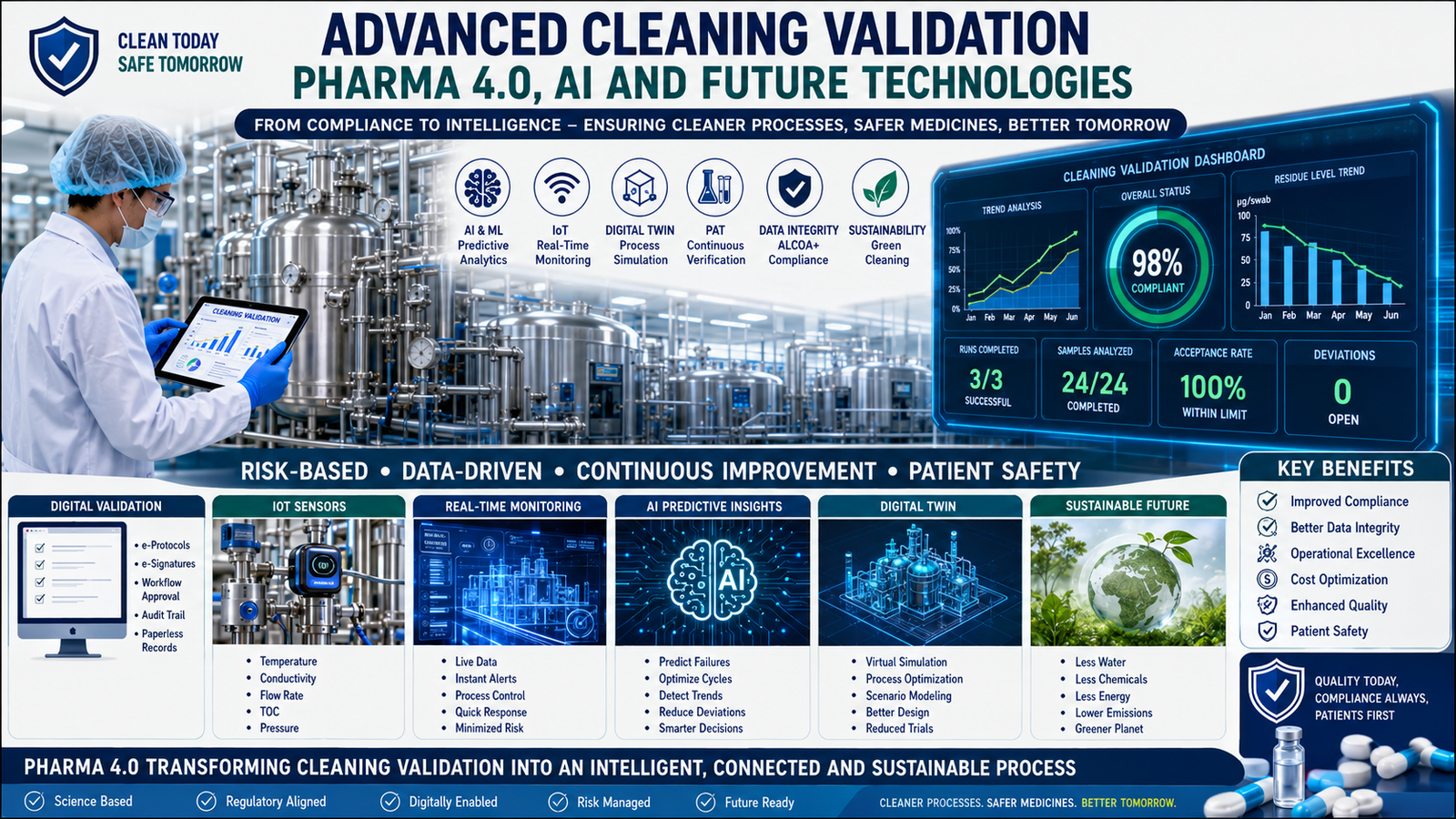
Cleaning validation plays a significant role in sustainability by optimizing the use of:
- Water
- Cleaning chemicals
- Energy
- Steam
- Compressed air
- Wastewater treatment resources
A sustainable cleaning validation program balances regulatory compliance, operational efficiency, and environmental responsibility.
Sustainability Objectives
Modern pharmaceutical companies aim to:
- Reduce water consumption.
- Minimize chemical usage.
- Lower carbon emissions.
- Optimize cleaning cycle duration.
- Reduce wastewater generation.
- Improve equipment utilization.
- Increase process efficiency.
- Support ESG (Environmental, Social and Governance) initiatives.
Green Cleaning Technologies
Green cleaning focuses on reducing environmental impact without compromising cleaning effectiveness.
Examples include:
- Biodegradable detergents
- Low-foaming cleaning agents
- Water-saving Clean-in-Place (CIP) systems
- Automated rinse optimization
- Heat recovery systems
- Energy-efficient pumps
- Smart water recycling
- Closed-loop cleaning systems
These technologies contribute to lower operating costs while supporting sustainability goals.
Practical Example
A pharmaceutical manufacturer implemented an optimized CIP program using inline conductivity sensors and automated rinse endpoint detection.
Results included:
| Improvement | Outcome |
|---|---|
| Water Consumption | Reduced by 28% |
| Cleaning Time | Reduced by 18% |
| Steam Usage | Reduced by 20% |
| Detergent Consumption | Reduced by 15% |
| Annual Operating Cost | Significantly Lower |
The cleaning process remained fully compliant with validated acceptance criteria while improving environmental performance.
Risk-Based Continued Verification
Traditional cleaning validation often relied on scheduled revalidation.
Future cleaning validation programs will increasingly adopt Risk-Based Continued Verification, where ongoing monitoring determines the need for additional validation activities.
Key monitoring parameters include:
- Cleaning trend data
- Swab residue results
- Rinse sample results
- Equipment utilization
- Product risk profile
- Deviation history
- CAPA effectiveness
- AI-generated predictive insights
This approach allows organizations to focus resources on higher-risk areas while maintaining confidence in validated cleaning processes.
Future Regulatory Trends
Global regulatory agencies continue to promote lifecycle management, science-based decision-making, and digital transformation.
Emerging regulatory expectations include:
- Increased reliance on Health-Based Exposure Limits (HBEL)
- Greater use of Quality Risk Management (ICH Q9(R1))
- Digital validation records
- Real-time process monitoring
- Stronger data integrity controls
- Lifecycle-based validation
- Enhanced cybersecurity for computerized systems
- Increased use of Process Analytical Technology (PAT)
- AI-supported decision-making with appropriate human oversight
Organizations that proactively adopt these practices are likely to be better prepared for future inspections and evolving regulatory expectations.
Digital Maturity Roadmap
Organizations progress through different levels of digital maturity.
| Stage | Characteristics |
|---|---|
| Level 1 | Paper-based cleaning validation |
| Level 2 | Electronic documentation |
| Level 3 | Integrated digital quality systems |
| Level 4 | Real-time monitoring and analytics |
| Level 5 | AI-enabled predictive cleaning validation |
| Level 6 | Autonomous optimization with human oversight |
The roadmap should be aligned with business objectives, regulatory requirements, and organizational readiness.
Implementation Challenges
Digital transformation introduces new opportunities, but also practical challenges.
Common implementation challenges include:
- Legacy equipment integration
- Data standardization
- Cybersecurity risks
- Employee training
- System validation
- High initial investment
- Organizational change management
- Vendor qualification
- Regulatory expectations
- Long-term maintenance
A phased implementation strategy supported by risk assessment is generally more effective than attempting a complete transformation in a single step.
Best Practices
✔ Adopt a lifecycle approach to cleaning validation.
✔ Base acceptance criteria on scientific and toxicological data.
✔ Integrate AI and digital tools with validated quality systems.
✔ Maintain compliance with 21 CFR Part 11 and EU Annex 11.
✔ Apply ALCOA+ principles to all electronic records.
✔ Monitor cleaning performance continuously.
✔ Review trends and KPIs periodically.
✔ Train personnel in digital technologies and data integrity.
✔ Strengthen cybersecurity for computerized systems.
✔ Promote continuous improvement across the validation lifecycle.
Frequently Asked Questions (FAQs)
1. Will Artificial Intelligence replace Validation Engineers?
No. AI is intended to support decision-making by analyzing large datasets and identifying trends. Final scientific decisions should remain under qualified human oversight.
2. What is the biggest advantage of Pharma 4.0?
Pharma 4.0 enables integrated, data-driven manufacturing that improves quality, efficiency, traceability, and compliance.
3. Is Digital Twin technology widely used today?
Digital Twin adoption is increasing, particularly in large pharmaceutical organizations and advanced manufacturing facilities, although implementation varies by company and application.
4. Why is data integrity important?
Reliable data ensures that cleaning validation decisions are based on complete, accurate, and trustworthy information. It is also a core expectation during regulatory inspections.
5. Can AI predict cleaning failures?
AI can identify patterns associated with increased risk and provide predictive insights, but its outputs should be verified and used alongside scientific expertise.
6. Does every company need IoT sensors?
Not necessarily. The level of digitalization should be based on process complexity, business needs, and a documented risk assessment.
7. What is the future of cleaning validation?
The future is expected to include greater use of real-time monitoring, predictive analytics, integrated quality systems, and sustainable cleaning technologies.
8. Which regulations support digital validation?
Key references include:
- US FDA 21 CFR Part 11
- EU GMP Annex 11
- ICH Q9(R1)
- WHO GMP
- PIC/S GMP
- ISPE Pharma 4.0™ guidance
9. How often should digital systems be reviewed?
Organizations should perform periodic reviews based on risk, system criticality, software updates, cybersecurity assessments, and change management activities.
10. How should companies begin their Pharma 4.0 journey?
Start by assessing current processes, identifying high-value digital opportunities, implementing validated systems incrementally, and investing in workforce training.
Key Takeaways
- Cleaning validation is evolving from a compliance activity to an intelligent lifecycle process.
- Sustainability should be integrated into cleaning validation strategies.
- AI, IoT, Digital Twins, and PAT enhance monitoring and decision-making but require proper validation and governance.
- Risk-based continued verification supports efficient lifecycle management.
- Data integrity and cybersecurity remain essential for digital systems.
- Continuous improvement is central to maintaining compliance and operational excellence.
Conclusion
Cleaning validation has undergone a remarkable transformation—from paper-based documentation and fixed acceptance criteria to a comprehensive lifecycle approach supported by Quality Risk Management, digital technologies, and continuous verification.
As pharmaceutical manufacturing embraces Pharma 4.0, organizations have an opportunity to build smarter, more connected, and more sustainable cleaning validation programs. Technologies such as Artificial Intelligence, Machine Learning, IoT, Process Analytical Technology, Digital Twins, and integrated quality systems can improve efficiency, strengthen contamination control, and support better decision-making when implemented within a validated and well-governed framework.
However, technology alone does not ensure compliance. Success depends on combining innovation with robust scientific principles, strong quality systems, qualified personnel, effective risk management, and a culture of continuous improvement.
By applying the concepts presented throughout this five-part series, pharmaceutical professionals can develop cleaning validation programs that not only satisfy current GMP expectations but are also adaptable to future regulatory and technological developments.
About the Author
Ramesh Palav is a pharmaceutical manufacturing and quality professional with 21+ years of industry experience across pharmaceutical manufacturing, GMP, qualification and validation, QMS, compliance, CSV, audits, and operational excellence. With hands-on experience in OSD manufacturing, digital transformation and Pharma 4.0, he is passionate about strengthening pharmaceutical education, developing industry-ready talent, and promoting collaboration between academia and the pharmaceutical industry.