
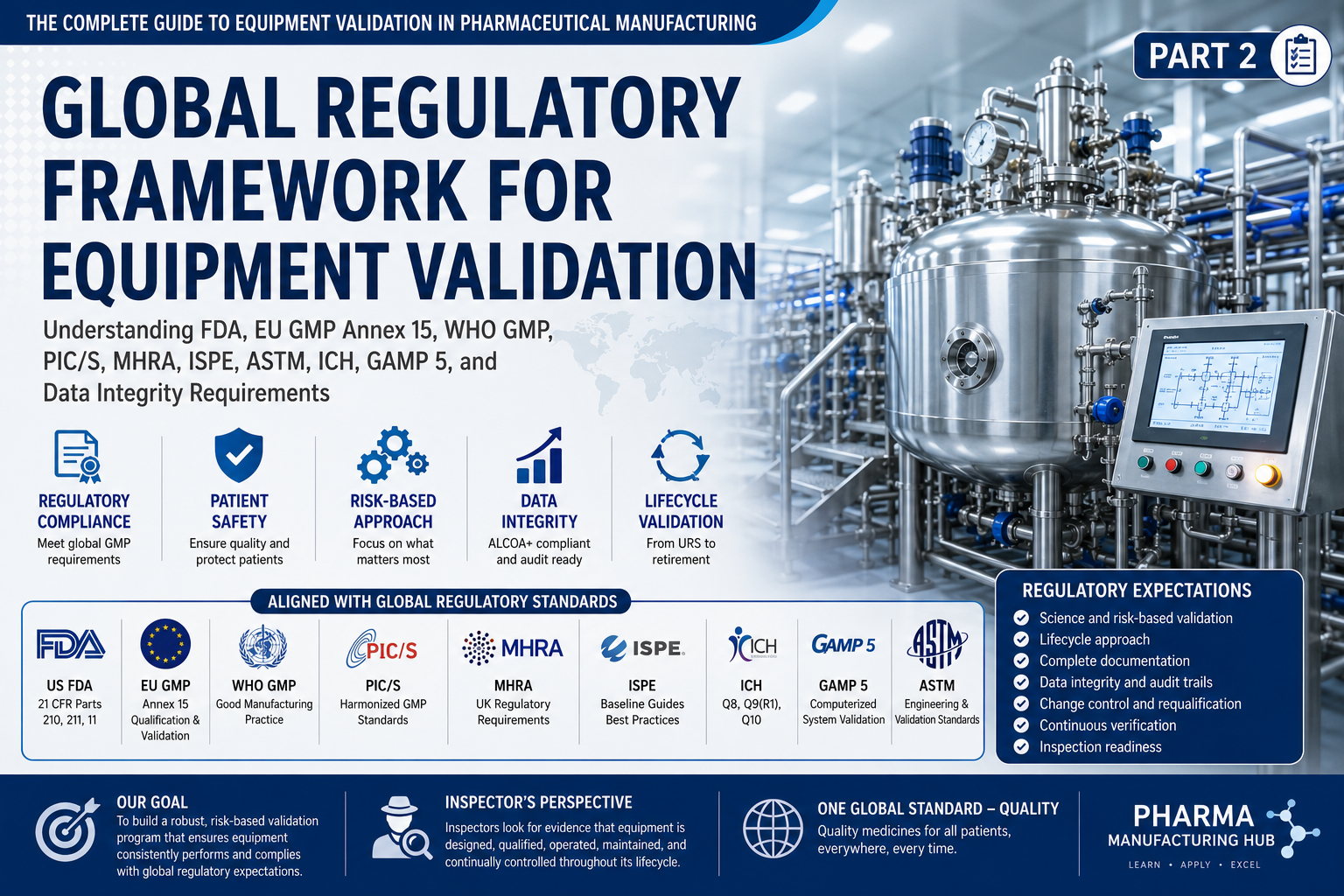
Understanding FDA, EU GMP Annex 15, WHO GMP, PIC/S, MHRA, ISPE, ASTM, ICH, GAMP 5, and Data Integrity Requirements
Series: Part 2 of 20
Introduction
Equipment validation in pharmaceutical manufacturing is governed by a comprehensive framework of international regulations, guidelines, and industry best practices. Although agencies such as the U.S. Food and Drug Administration (FDA), European Medicines Agency (EMA), Medicines and Healthcare products Regulatory Agency (MHRA), World Health Organization (WHO), and Pharmaceutical Inspection Co-operation Scheme (PIC/S) publish different documents, they share a common objective:
To ensure that pharmaceutical manufacturing equipment is scientifically designed, properly qualified, consistently operated, and maintained in a validated state to produce safe, effective, and high-quality medicines.
Modern regulatory expectations have shifted from a traditional “one-time validation” approach to a science-based, risk-based, lifecycle validation strategy. Manufacturers are expected to demonstrate continuous control over equipment performance using documented evidence, risk management principles, and quality systems.
This article explores the major global regulations, explains their impact on equipment qualification, and highlights what inspectors expect during regulatory audits.
Why Regulatory Compliance Matters
Equipment validation is not merely a technical engineering activity—it is a regulatory requirement. Failure to comply can result in:
- FDA Form 483 observations
- Warning Letters
- Product recalls
- Import alerts
- Consent decrees
- Suspension of manufacturing licenses
- Loss of market authorization
- Damage to company reputation
A robust validation program protects both patients and the business.
Evolution of Equipment Validation
The philosophy of equipment validation has evolved significantly over the past three decades.
| Era | Focus |
|---|---|
| 1980s | Documentation-driven qualification |
| 1990s | IQ, OQ, PQ methodology |
| 2000s | Risk-based validation and lifecycle concepts |
| 2010s | Quality Risk Management (ICH Q9), Data Integrity, GAMP 5 |
| Today | Pharma 4.0, Continuous Verification, Digital Validation, AI-assisted lifecycle management |
Regulators now expect manufacturers to justify qualification activities based on scientific rationale and patient risk rather than applying identical testing to every piece of equipment.
Global Regulatory Landscape
The following organizations influence pharmaceutical equipment validation:
| Organization | Primary Focus |
|---|---|
| US FDA | Drug manufacturing regulations and inspections |
| EMA | European medicines regulation |
| EU GMP | Good Manufacturing Practice for Europe |
| MHRA | UK GMP inspections |
| WHO | International GMP guidance |
| PIC/S | Harmonized GMP inspection standards |
| ICH | Pharmaceutical quality guidelines |
| ISPE | Industry best practices |
| ASTM | Engineering and validation standards |
| GAMP 5 | Validation of computerized systems |
Together, these references form the foundation of a globally compliant validation program.
US FDA Requirements
The FDA regulates pharmaceutical manufacturing through the Code of Federal Regulations (CFR).
Key Regulations
21 CFR Part 210
Current Good Manufacturing Practice (CGMP) in Manufacturing, Processing, Packing, or Holding of Drugs.
21 CFR Part 211
Current Good Manufacturing Practice for Finished Pharmaceuticals.
Key expectations include:
- Equipment must be of appropriate design.
- Equipment must be suitably located.
- Construction materials must prevent contamination.
- Equipment must be cleaned and maintained.
- Written procedures must exist.
- Qualification records must be retained.
- Calibration must be documented.
- Preventive maintenance must be implemented.
21 CFR Part 11
Applies where equipment uses electronic records or electronic signatures.
Requirements include:
- Secure user access
- Audit trails
- Electronic signatures
- Data backup
- System validation
- Change management
- Record retention
FDA Equipment Validation Expectations
FDA inspectors typically evaluate:
- Validation Master Plan (VMP)
- User Requirement Specification (URS)
- Risk Assessments
- Design Qualification (DQ)
- FAT and SAT records
- IQ, OQ, and PQ protocols
- Traceability Matrix
- Calibration records
- Preventive Maintenance
- Change Controls
- Deviations and CAPA
- Training records
- Data Integrity controls
The FDA expects evidence that equipment remains in a validated state throughout its operational lifecycle.
EU GMP Annex 15
Annex 15 is one of the most important documents governing qualification and validation in Europe.
It introduces the lifecycle approach, emphasizing:
- Quality Risk Management
- Scientific justification
- Validation planning
- Qualification stages
- Continuous verification
- Periodic review
- Change control
- Requalification
Annex 15 reinforces that qualification activities should be proportionate to the criticality of the equipment.
WHO GMP Guidance
The WHO GMP Technical Report Series provides guidance for manufacturers supplying medicines globally, particularly in emerging markets.
WHO expectations include:
- Qualified manufacturing equipment
- Documented protocols
- Validated utilities
- Calibration programs
- Preventive maintenance
- Personnel training
- Equipment cleaning verification
- Risk management
- Lifecycle maintenance
WHO places strong emphasis on reproducibility, documentation, and patient safety.
PIC/S Guide to GMP
PIC/S harmonizes GMP inspection standards across participating regulatory authorities.
Its recommendations include:
- Science-based qualification
- Risk-based validation
- Effective documentation
- Data integrity
- Lifecycle management
- Computerized system validation
- Continuous monitoring
- Inspection readiness
PIC/S guidance often aligns closely with EU GMP.
MHRA Expectations
The UK MHRA focuses on:
- Equipment lifecycle management
- Data Integrity (ALCOA+)
- Computerized systems
- Validation documentation
- Calibration
- Change control
- Audit trail review
- Supplier qualification
- Preventive maintenance
- Periodic review
Inspectors frequently examine whether companies maintain equipment in a validated state rather than relying solely on historical qualification records.
ISPE Baseline Guides
The International Society for Pharmaceutical Engineering (ISPE) publishes industry-recognized best practices.
Key guidance includes:
- Baseline Guide Volume 5 – Commissioning & Qualification
- Risk-Based Commissioning and Qualification
- Good Engineering Practices (GEP)
- Lifecycle Validation
- Validation Master Planning
Although ISPE guides are not regulations, they are widely accepted by regulators as representing current industry practice.
ASTM Standards
ASTM International develops engineering standards relevant to pharmaceutical qualification.
Examples include:
- Risk-based qualification methodologies
- Validation documentation formats
- Statistical evaluation
- Process verification
- Engineering acceptance testing
ASTM standards support scientifically justified validation activities.
ICH Quality Guidelines
ICH Q8 – Pharmaceutical Development
Promotes:
- Quality by Design (QbD)
- Understanding of manufacturing processes
- Identification of Critical Quality Attributes (CQAs)
- Identification of Critical Process Parameters (CPPs)
Equipment should be designed and qualified to consistently support these quality attributes.
ICH Q9(R1) – Quality Risk Management
Introduces systematic risk management throughout the equipment lifecycle.
Key principles include:
- Risk identification
- Risk analysis
- Risk evaluation
- Risk control
- Risk communication
- Risk review
Common tools:
- FMEA
- HACCP
- Fault Tree Analysis
- Risk Matrix
ICH Q10 – Pharmaceutical Quality System
ICH Q10 integrates equipment validation into the Pharmaceutical Quality System (PQS).
It emphasizes:
- Lifecycle management
- Management review
- Knowledge management
- Continuous improvement
- CAPA
- Change management
- Process performance monitoring
GAMP 5
Good Automated Manufacturing Practice (GAMP 5) applies to computerized equipment.
It advocates:
- Scalable validation
- Supplier assessment
- Risk-based testing
- Software lifecycle
- Configuration management
- Electronic records
- Cybersecurity
- Data integrity
- Periodic review
GAMP 5 is especially important for PLC, SCADA, MES, and other automated systems.
Good Engineering Practice (GEP)
Good Engineering Practice forms the foundation for successful qualification.
Key elements include:
- Proper design
- Correct material selection
- Utility sizing
- Hygienic construction
- Accessibility for cleaning and maintenance
- Safety features
- Documentation control
Well-executed GEP reduces qualification issues later in the project.
Data Integrity Expectations
Regulators increasingly focus on data integrity.
The ALCOA+ principles require that data be:
- Attributable
- Legible
- Contemporaneous
- Original
- Accurate
- Complete
- Consistent
- Enduring
- Available
Equipment software should support secure user access, audit trails, backup, disaster recovery, and electronic record protection.
Lifecycle Validation
Modern guidance emphasizes that qualification does not end after PQ.
The validated state must be maintained through:
- Routine monitoring
- Calibration
- Preventive maintenance
- Change control
- Deviation management
- CAPA
- Periodic review
- Requalification when required
Comparison of Major Regulatory Guidance
| Aspect | FDA | EU GMP Annex 15 | WHO | PIC/S | ISPE |
|---|---|---|---|---|---|
| Lifecycle approach | ✔ | ✔ | ✔ | ✔ | ✔ |
| Risk-based qualification | ✔ | ✔ | ✔ | ✔ | ✔ |
| Data Integrity | ✔ | ✔ | ✔ | ✔ | ✔ |
| Computerized systems | ✔ | ✔ | ✔ | ✔ | ✔ |
| Continuous verification | ✔ | ✔ | Recommended | ✔ | ✔ |
| Change control | ✔ | ✔ | ✔ | ✔ | ✔ |
| Requalification | ✔ | ✔ | ✔ | ✔ | ✔ |
Inspector’s Perspective
During an inspection, regulators often ask:
- Is there an approved Validation Master Plan?
- Is the URS complete and traceable?
- Was risk assessment performed before qualification?
- Are IQ, OQ, and PQ protocols scientifically justified?
- Are deviations documented and investigated?
- Are calibration and maintenance current?
- Is equipment operated within validated ranges?
- Are changes assessed through formal change control?
- Is electronic data protected and reviewable?
Being able to answer these questions confidently demonstrates a mature validation program.
Expert Tips
Expert Tip 1: Align qualification protocols with both regulatory requirements and Good Engineering Practices to avoid redundant testing.
Expert Tip 2: Maintain a traceability matrix linking URS requirements to DQ, FAT, SAT, IQ, OQ, and PQ tests. This is frequently reviewed during inspections.
Expert Tip 3: Treat data integrity as part of equipment validation, especially for automated systems using PLCs, SCADA, MES, or electronic batch records.
Common Pitfalls
Avoid these common regulatory compliance issues:
- Using outdated regulatory guidance
- Incomplete risk assessments
- Poorly defined acceptance criteria
- Weak supplier qualification
- Inadequate documentation of deviations
- Missing audit trail reviews
- Failure to maintain calibration schedules
- Uncontrolled software changes
- Lack of periodic review
- Assuming qualification is complete after PQ
Frequently Asked Questions (FAQs)
1. Which regulation is most important for equipment validation?
No single regulation is sufficient. A globally compliant program typically aligns with FDA, EU GMP Annex 15, WHO GMP, PIC/S, ICH, and relevant industry guidance such as ISPE and GAMP 5.
2. Is ISPE guidance mandatory?
No. ISPE publications are industry best practices rather than regulations, but they are widely recognized by regulatory authorities.
3. When does 21 CFR Part 11 apply?
Whenever equipment creates, stores, or manages electronic records or electronic signatures used for GMP activities.
4. What is the purpose of Annex 15?
It provides guidance on qualification and validation using a lifecycle and risk-based approach.
5. Why is ICH Q9(R1) important?
It establishes the principles of Quality Risk Management, ensuring qualification activities are proportionate to the risk posed to product quality and patient safety.
6. What is GAMP 5 used for?
It provides guidance on validating computerized systems such as PLCs, SCADA, MES, and automation software.
7. How often should regulatory guidance be reviewed?
Companies should routinely monitor updates from regulatory agencies and assess their impact through formal quality systems.
8. What do inspectors value most?
Inspectors consistently value scientific justification, complete documentation, effective risk management, robust change control, and evidence that equipment remains in a validated state.
Key Takeaways
- Global equipment validation is governed by FDA, EU GMP, WHO, PIC/S, MHRA, ICH, ISPE, ASTM, and GAMP 5 guidance.
- Modern expectations emphasize lifecycle management, science-based validation, and risk-based decision-making.
- Data integrity and computerized system validation are integral to contemporary qualification programs.
- Regulatory inspections focus on documented evidence that equipment is designed, qualified, operated, maintained, and continually controlled.
- A harmonized validation strategy ensures compliance across multiple international markets.
Coming Up in Part 3
User Requirement Specification (URS) and Design Qualification (DQ): Building the Foundation for Successful Equipment Validation
In Part 3, we will examine how to develop robust User Requirement Specifications, perform comprehensive Design Qualification reviews, assess vendors, establish traceability, define acceptance criteria, and create the engineering foundation for successful IQ, OQ, and PQ execution.
About the Author
Ramesh Palav is a pharmaceutical manufacturing and quality professional with 21+ years of industry experience across pharmaceutical manufacturing, GMP, qualification and validation, QMS, compliance, CSV, audits, and operational excellence. With hands-on experience in OSD manufacturing, digital transformation and Pharma 4.0, he is passionate about strengthening pharmaceutical education, developing industry-ready talent, and promoting collaboration between academia and the pharmaceutical industry.