
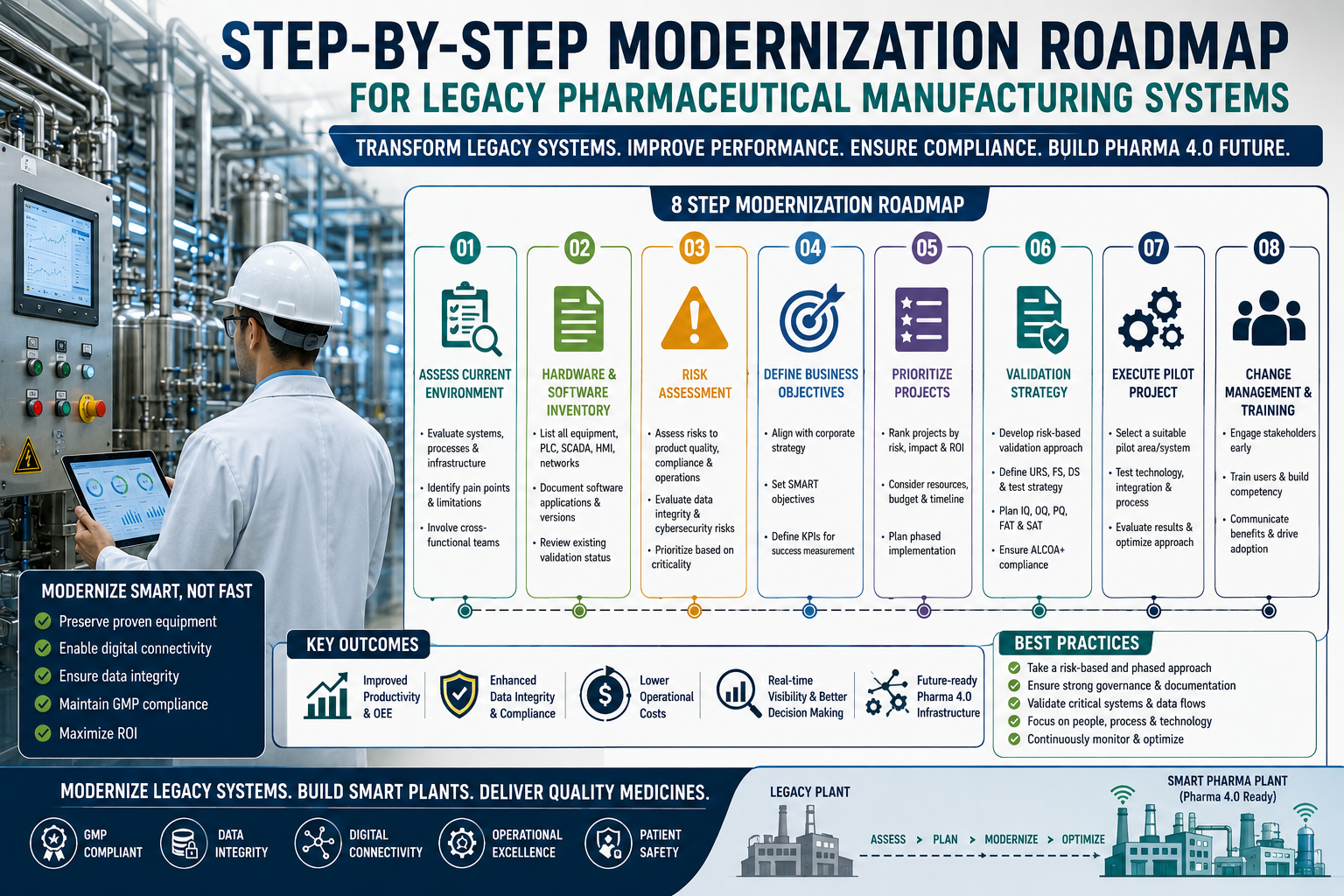
In Part 1, we explored the challenges associated with legacy systems and the practical strategies pharmaceutical organizations use to keep aging equipment reliable, compliant, and productive. While these systems continue to support critical manufacturing operations, achieving the goals of Pharma 4.0 requires a structured modernization approach rather than isolated technology upgrades.
Successful digital transformation is not about replacing every machine or implementing the latest technology overnight. Instead, it involves developing a clear roadmap that aligns business objectives, regulatory requirements, operational priorities, and technology investments. By following a phased and risk-based approach, pharmaceutical manufacturers can modernize legacy systems while maintaining GMP compliance, minimizing production disruptions, and maximizing return on investment.
The following roadmap outlines the key stages that leading pharmaceutical companies follow when transforming legacy manufacturing environments into connected, data-driven, and future-ready facilities.
Step 1: Assess the Current Manufacturing Environment
Every modernization initiative should begin with a comprehensive assessment of the existing manufacturing landscape. This assessment provides a clear understanding of the plant’s current capabilities, limitations, and opportunities for improvement.
Organizations should evaluate:
- Production equipment age and condition
- PLC, SCADA, and HMI platforms
- Utility control systems
- Existing MES or ERP connectivity
- Paper-based versus electronic processes
- Cybersecurity maturity
- Data integrity risks
- Validation status
- Maintenance performance
- Regulatory observations and audit findings
A cross-functional team consisting of production, engineering, automation, quality assurance, IT, validation, and maintenance professionals should participate in this assessment. Their collective expertise ensures that modernization priorities reflect both operational needs and regulatory expectations.
The outcome of this step is a clear baseline that supports informed decision-making and realistic project planning.
Step 2: Develop a Complete Hardware and Software Inventory
Many pharmaceutical facilities have expanded over decades through equipment additions, process upgrades, and acquisitions. As a result, organizations often lack a complete and up-to-date inventory of automation assets.
Creating a detailed inventory is essential before any modernization effort begins. The inventory should include:
Equipment Information
- Manufacturing equipment
- Packaging lines
- Utility systems
- Laboratory instruments
- Warehouse automation
- Environmental monitoring systems
Automation Components
- PLC models
- SCADA software versions
- HMI platforms
- Communication protocols
- Network infrastructure
- Industrial PCs
- Servers
Software Applications
- MES
- ERP
- LIMS
- eQMS
- eDMS
- Historian software
- Custom-developed applications
Validation Documentation
- URS
- Functional Specifications
- Design Specifications
- IQ/OQ/PQ Reports
- Risk Assessments
- SOPs
- Change Controls
Maintaining a centralized asset inventory simplifies lifecycle management, vendor support planning, and future upgrade activities.
Step 3: Perform a Comprehensive Risk Assessment
Not every legacy system presents the same level of business or compliance risk. Modernization priorities should therefore be determined using a structured, risk-based methodology.
Organizations should evaluate risks related to:
Product Quality
Could equipment failure impact product quality or patient safety?
Regulatory Compliance
Does the system support current GMP expectations?
Are audit trails available?
Is electronic data secure?
Data Integrity
Can records be modified without authorization?
Is data backed up?
Is information readily retrievable during inspections?
Cybersecurity
Is the operating system supported?
Are security patches available?
Can unauthorized users access the system?
Business Continuity
Would equipment failure stop production?
How long would recovery take?
Are spare parts available?
Risk assessments help management prioritize modernization investments based on business value rather than equipment age alone.
Step 4: Define Clear Business Objectives
Technology should never be implemented simply because it is available. Every modernization initiative should support measurable business goals.
Common objectives include:
- Improving Overall Equipment Effectiveness (OEE)
- Reducing equipment downtime
- Increasing manufacturing capacity
- Strengthening data integrity
- Enhancing regulatory compliance
- Improving production visibility
- Reducing manual documentation
- Supporting electronic batch records
- Increasing operational efficiency
- Lowering maintenance costs
- Improving decision-making through real-time analytics
Defining measurable objectives ensures that modernization projects deliver tangible business benefits rather than isolated technology improvements.
Step 5: Prioritize Modernization Projects
Large pharmaceutical facilities may operate hundreds of legacy systems, making simultaneous modernization impractical. Instead, organizations should prioritize projects based on risk, business impact, and available resources.
Typical prioritization criteria include:
- Criticality to product quality
- Production bottlenecks
- Frequency of equipment failures
- Regulatory observations
- Cybersecurity vulnerabilities
- Maintenance costs
- Availability of vendor support
- Integration requirements
- Return on investment (ROI)
For example, connecting a high-volume tablet compression line to an MES platform may provide significantly greater value than upgrading a rarely used support system.
A phased implementation strategy minimizes operational disruption while allowing organizations to learn from early modernization projects.
Step 6: Develop a Robust Validation Strategy
Validation remains one of the most important considerations during pharmaceutical modernization projects. Any changes affecting computerized systems must be planned and documented in accordance with applicable regulatory requirements and company procedures.
A successful validation strategy should address:
- User Requirements Specification (URS)
- Functional and Design Specifications
- Risk Assessments
- Supplier Qualification
- Factory Acceptance Testing (FAT)
- Site Acceptance Testing (SAT)
- Installation Qualification (IQ)
- Operational Qualification (OQ)
- Performance Qualification (PQ)
- Data Migration Verification
- Electronic Records Review
- Cybersecurity Testing
- Regression Testing
- Training Documentation
- Validation Summary Reports
Applying a risk-based Computer System Validation (CSV) approach ensures that validation efforts focus on functions that directly impact product quality, patient safety, and data integrity.
Step 7: Execute a Pilot Modernization Project
Rather than upgrading an entire manufacturing facility simultaneously, successful pharmaceutical companies often begin with a pilot project. A pilot provides an opportunity to validate technical solutions, refine implementation methodologies, and demonstrate business value before large-scale deployment.
Suitable pilot candidates include:
- A tablet compression machine
- A packaging line
- An HVAC monitoring system
- A purified water generation system
- A warehouse automation process
During the pilot phase, organizations should evaluate:
- Integration performance
- Operator acceptance
- System reliability
- Data accuracy
- Validation effectiveness
- Cybersecurity controls
- Production impact
Lessons learned from the pilot can then be incorporated into subsequent modernization phases, reducing project risk and improving implementation efficiency.
Step 8: Establish Effective Change Management and Employee Engagement
Technology alone does not guarantee successful digital transformation. People remain the most important factor in modernization initiatives.
Employees may initially resist change due to concerns about new technologies, altered work processes, or increased responsibilities. Effective change management helps overcome these challenges by fostering communication, collaboration, and confidence.
Organizations should:
- Communicate project objectives clearly.
- Involve end users during system design and testing.
- Provide role-specific training for operators, engineers, QA personnel, and maintenance teams.
- Update Standard Operating Procedures (SOPs) and work instructions.
- Encourage feedback and continuous improvement throughout implementation.
When employees understand the benefits of modernization and feel empowered to contribute, adoption rates improve significantly, and projects are more likely to achieve long-term success.
Summary
Modernizing legacy pharmaceutical manufacturing systems requires far more than replacing outdated equipment. It demands a strategic, risk-based roadmap that integrates engineering expertise, quality assurance, validation, information technology, operational technology, and regulatory compliance.
By systematically assessing current systems, developing comprehensive asset inventories, performing risk assessments, defining measurable business objectives, prioritizing investments, establishing robust validation strategies, executing pilot projects, and engaging employees throughout the transformation journey, pharmaceutical organizations can modernize confidently while maintaining operational continuity and GMP compliance.
Rather than viewing legacy systems as barriers to innovation, leading manufacturers are transforming them into valuable digital assets that support improved productivity, enhanced data integrity, stronger cybersecurity, and sustainable operational excellence.
Coming Up in Next
we will explore the technologies enabling legacy systems to remain relevant in the era of Pharma 4.0, including Industrial IoT (IIoT), OPC UA, Edge Computing, Digital Twins, Artificial Intelligence (AI), Predictive Maintenance, Cloud Analytics, Manufacturing Execution Systems (MES), eQMS, eDMS, Data Historians, and Industrial Gateways. We will also discuss key regulatory expectations, including 21 CFR Part 11, EU Annex 11, GAMP 5 (Second Edition), WHO GMP, PIC/S GMP, and risk-based Computer System Validation (CSV), highlighting how these frameworks support successful modernization while ensuring inspection readiness and long-term compliance.
About the Author
Ramesh Palav is a seasoned professional in GxP Quality, Computer System Validation (CSV), Data Integrity, and Pharmaceutical IT Compliance. He has extensive experience in implementing and managing GxP computerized systems, risk-based validation, audit trails, data integrity, and regulatory compliance. Through his articles and professional insights, he aims to share practical knowledge and help pharmaceutical and life-sciences professionals strengthen quality, compliance, and data integrity.