
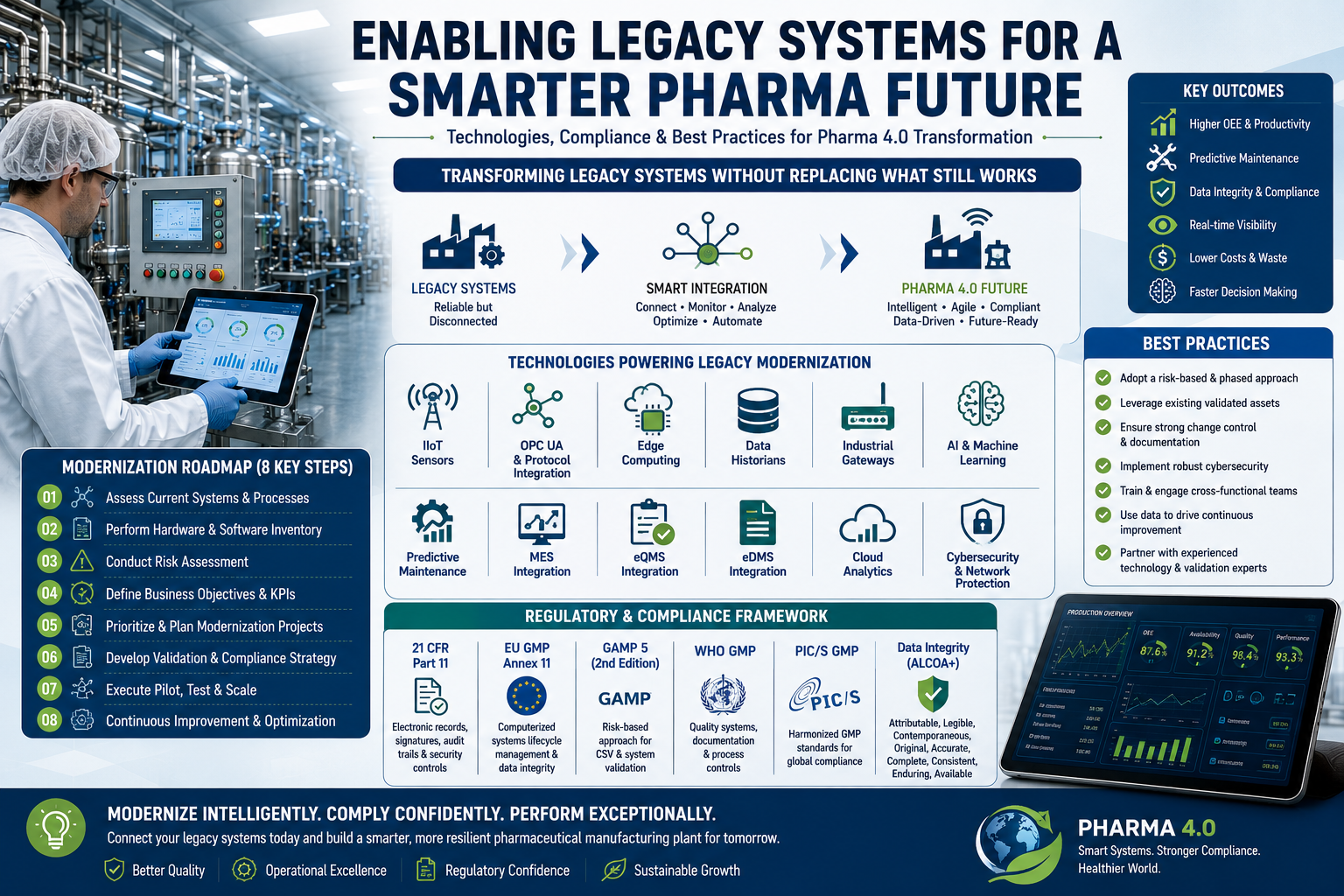
In Part 2A, we discussed a structured modernization roadmap that helps pharmaceutical organizations transform legacy manufacturing systems while maintaining operational continuity and regulatory compliance. The next phase of this journey focuses on the technologies that enable legacy equipment to remain productive in the era of Pharma 4.0. Instead of replacing reliable assets, manufacturers are increasingly integrating modern digital technologies that enhance connectivity, data visibility, operational efficiency, and compliance.
At the same time, modernization must align with stringent regulatory requirements governing computerized systems, electronic records, data integrity, and validation. Successful digital transformation therefore requires both technological innovation and a robust compliance framework.
Technologies Helping Legacy Systems Stay Relevant
Modern pharmaceutical manufacturing is increasingly driven by intelligent technologies that extend the life and value of existing equipment. These technologies create a bridge between legacy assets and next-generation digital manufacturing systems.
1. Industrial Internet of Things (IIoT)
The Industrial Internet of Things (IIoT) has become one of the most effective methods for modernizing legacy pharmaceutical equipment without major hardware replacement.
Wireless or wired sensors can be installed on existing machines to monitor parameters such as:
- Temperature
- Vibration
- Pressure
- Humidity
- Motor current
- Energy consumption
- Machine utilization
- Environmental conditions
This real-time operational data enables engineering teams to monitor equipment health continuously rather than relying solely on periodic inspections. IIoT also supports predictive maintenance, energy optimization, and improved Overall Equipment Effectiveness (OEE), allowing organizations to maximize the performance of validated legacy assets.
2. OPC UA and Industrial Communication Standards
One of the biggest challenges with older pharmaceutical equipment is the lack of standardized communication. Open Platform Communications Unified Architecture (OPC UA) has emerged as a preferred solution for securely connecting legacy machines with modern manufacturing systems.
OPC UA enables seamless communication between:
- PLCs
- SCADA systems
- MES platforms
- ERP systems
- Data historians
- Cloud applications
- Industrial gateways
By implementing standardized communication protocols, pharmaceutical manufacturers eliminate many manual data transfers and establish reliable, real-time information exchange across the plant.
3. Edge Computing
Traditionally, production data was processed only within central servers or enterprise systems. Edge Computing changes this approach by processing information closer to the manufacturing equipment itself.
Benefits include:
- Faster decision-making
- Reduced network traffic
- Improved system responsiveness
- Better operational resilience
- Lower latency
For pharmaceutical manufacturing, edge devices can perform local analytics, equipment monitoring, alarm management, and preliminary data validation before transmitting critical information to enterprise systems.
4. Artificial Intelligence and Machine Learning
Artificial Intelligence (AI) is becoming an increasingly valuable tool for extracting insights from legacy manufacturing data. Rather than controlling validated processes directly, AI is commonly used to support operational decision-making.
Examples include:
- Predicting equipment failures
- Detecting abnormal process trends
- Optimizing production scheduling
- Forecasting maintenance requirements
- Improving energy efficiency
- Supporting root cause investigations
Machine Learning algorithms continuously improve prediction accuracy as additional operational data becomes available, enabling proactive maintenance and more informed manufacturing decisions.
5. Predictive Maintenance
Traditional maintenance programs are generally based on fixed schedules or reactive repairs after equipment failures occur. Predictive maintenance represents a significant advancement by using equipment condition data to determine when maintenance activities are actually required.
Predictive maintenance combines:
- IIoT sensors
- Data historians
- AI analytics
- Machine learning
- Maintenance management systems
This approach reduces unexpected downtime, extends equipment life, lowers maintenance costs, and improves production availability without compromising validated system performance.
6. Manufacturing Execution Systems (MES)
A Manufacturing Execution System serves as the operational bridge between enterprise planning systems and shop-floor manufacturing equipment.
Modern MES solutions provide:
- Electronic Batch Records (EBR)
- Real-time production monitoring
- Material genealogy
- Equipment status visibility
- Electronic work instructions
- Production scheduling
- Performance dashboards
- Batch traceability
Even when production equipment remains unchanged, connecting legacy assets to an MES significantly enhances manufacturing visibility and operational control.
7. Digital Quality Systems (eQMS and eDMS)
Quality management has evolved from paper-intensive documentation toward fully electronic quality systems.
An integrated eQMS typically manages:
- Deviations
- CAPA
- Change Control
- Risk Management
- Training
- Audit Management
- Supplier Quality
Meanwhile, eDMS platforms provide controlled management of SOPs, validation documents, specifications, protocols, reports, and quality records.
Integrating legacy manufacturing operations with digital quality systems reduces documentation errors, strengthens traceability, and improves inspection readiness.
8. Data Historians and Industrial Gateways
Data historians automatically collect, archive, and analyze production information from legacy equipment over extended periods.
Benefits include:
- Process trend analysis
- Root cause investigations
- Performance benchmarking
- Regulatory reporting
- Equipment utilization analysis
Industrial gateways complement historians by converting proprietary machine protocols into standardized communication formats, enabling older equipment to participate in modern digital ecosystems without extensive hardware modifications.
Regulatory Expectations for Modernization
Technology implementation alone does not guarantee successful modernization. Pharmaceutical companies must ensure that every upgrade complies with global regulatory expectations governing computerized systems and electronic records.
1. US FDA 21 CFR Part 11
When legacy systems are connected to digital platforms, organizations must ensure that electronic records and electronic signatures remain trustworthy, reliable, and equivalent to paper records.
Modernized systems should include:
- User authentication
- Secure audit trails
- Electronic signatures
- Controlled access
- Record protection
- Backup and recovery procedures
Compliance with 21 CFR Part 11 is essential for maintaining data integrity and supporting regulatory inspections.
2. EU GMP Annex 11
Annex 11 establishes expectations for computerized systems used in pharmaceutical manufacturing.
Key principles include:
- Lifecycle management
- Risk-based validation
- Security management
- Data accuracy
- Business continuity
- Incident management
- Supplier assessment
- Periodic system review
Modernization projects should demonstrate that upgraded systems remain validated throughout their operational lifecycle.
3. GAMP 5 (Second Edition)
The latest edition of GAMP 5 emphasizes scalable, risk-based approaches for computerized system validation and modern software development practices.
Organizations should apply GAMP principles by:
- Defining intended system use.
- Performing quality risk management.
- Leveraging supplier documentation where appropriate.
- Focusing validation on patient safety, product quality, and data integrity.
- Managing changes throughout the system lifecycle.
This approach reduces unnecessary validation effort while maintaining regulatory confidence.
4. WHO GMP and PIC/S GMP
Global pharmaceutical manufacturers frequently supply multiple international markets, making compliance with WHO GMP and PIC/S expectations increasingly important.
Both emphasize:
- Data integrity
- Computerized system control
- Documentation
- Risk management
- Personnel competence
- Equipment qualification
- Continuous improvement
Modernization initiatives should therefore align with internationally recognized GMP principles to support global regulatory acceptance.
5. Risk-Based Computer System Validation (CSV)
Modern CSV focuses on validating what is critical rather than documenting everything equally.
Risk-based CSV prioritizes:
- Product quality
- Patient safety
- Data integrity
- Critical system functionality
- Regulatory compliance
This approach enables organizations to modernize efficiently while maintaining scientifically justified validation activities and reducing unnecessary documentation.
Building a Sustainable Pharma 4.0 Foundation
The most successful pharmaceutical companies recognize that digital transformation is a continuous journey rather than a single project. Legacy systems will continue to play an important role for many years, but their value can be significantly enhanced through intelligent integration with modern digital technologies.
By combining IIoT, OPC UA, Edge Computing, AI, MES, eQMS, eDMS, predictive maintenance, and secure industrial communication, manufacturers can transform isolated equipment into connected production assets that support real-time visibility, improved operational performance, and enhanced regulatory compliance.
Equally important is maintaining a strong compliance framework through adherence to 21 CFR Part 11, EU Annex 11, GAMP 5 Second Edition, WHO GMP, PIC/S GMP, and risk-based Computer System Validation principles.
Organizations that successfully integrate technology, compliance, and operational excellence will be well positioned to maximize the value of their legacy investments while advancing toward fully connected, intelligent, and future-ready Pharma 4.0 manufacturing environments.
About the Author
Ramesh Palav is a seasoned professional in GxP Quality, Computer System Validation (CSV), Data Integrity, and Pharmaceutical IT Compliance. He has extensive experience in implementing and managing GxP computerized systems, risk-based validation, audit trails, data integrity, and regulatory compliance. Through his articles and professional insights, he aims to share practical knowledge and help pharmaceutical and life-sciences professionals strengthen quality, compliance, and data integrity.