
Introduction
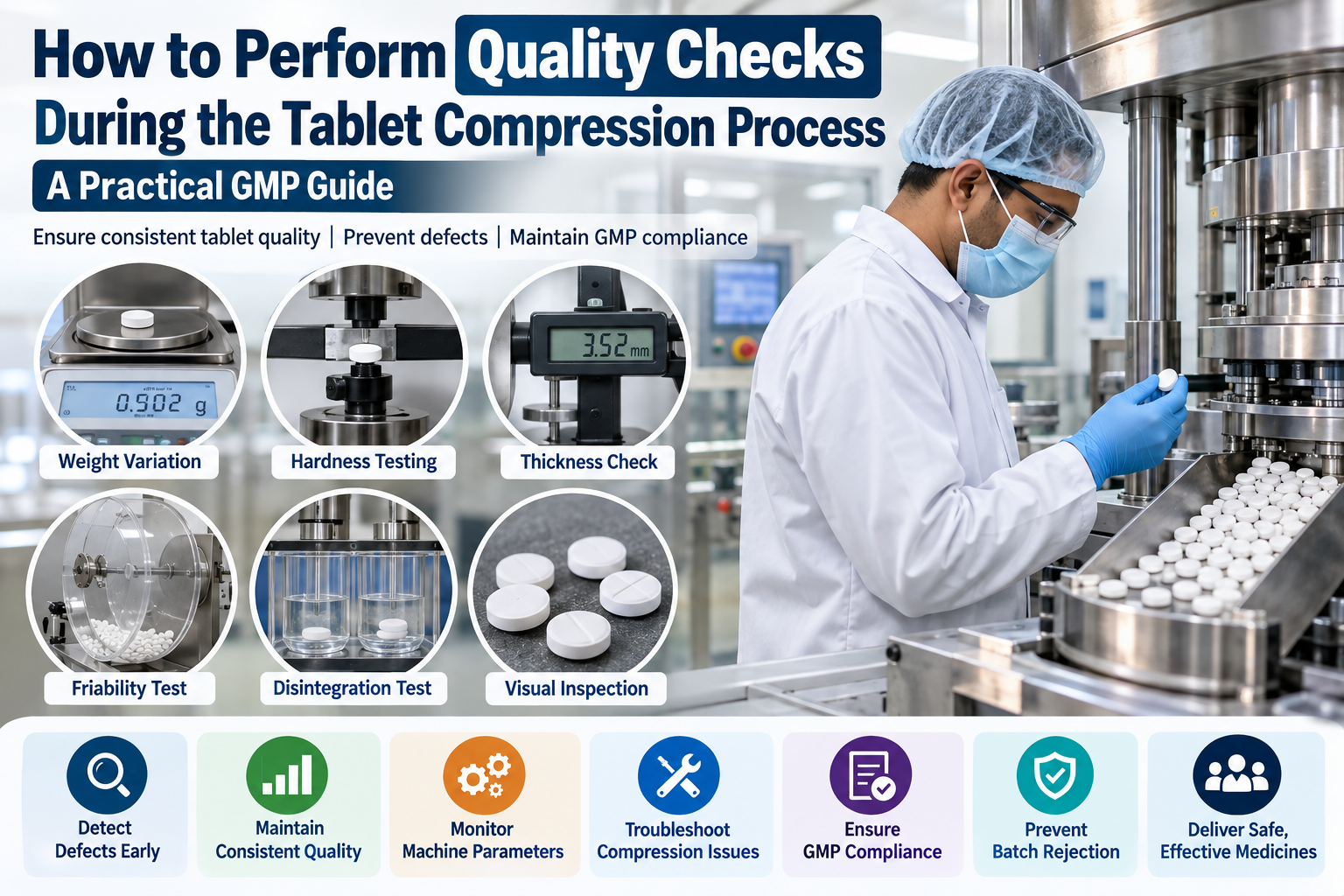
Tablet compression is one of the most critical stages in oral solid dosage (OSD) pharmaceutical manufacturing. Even when granulation has been completed successfully, variations during compression can affect tablet weight, hardness, thickness, friability, disintegration, appearance, and overall product quality.
In a production environment, the challenge is not simply to manufacture tablets at the required speed. The real objective is to maintain consistent quality throughout the batch while ensuring that the compression process remains under control and complies with approved manufacturing procedures.
Several factors can influence tablet quality, including granule flow properties, moisture content, particle-size distribution, compression force, turret speed, feeder performance, and punch-and-die condition. A change in any of these factors may produce a quality problem if it is not identified and addressed promptly.
For example, a compression machine may initially produce tablets within the approved weight limits, but inconsistent granule flow or feeder performance can cause tablet weight to fluctuate as production continues. If the variation is not detected during in-process monitoring, a significant quantity of tablets may be affected before the problem becomes apparent.
Quality checks during tablet compression help identify process variations early, support timely investigation, and ensure that the tablets produced meet the approved quality requirements.
This practical guide explains the major in-process quality checks, testing methods, common compression defects, troubleshooting approaches, documentation requirements, and GMP practices followed during tablet compression.
1. What Is the Tablet Compression Process?
Tablet compression is the operation in which a measured quantity of powder or granules is compressed inside a die cavity using upper and lower punches to form a tablet of the required shape, dimensions, and mechanical strength.
A typical rotary tablet compression process involves the following stages:
- Feeding: Granules are supplied to the tablet press hopper and feeding system.
- Die filling: Granules enter the die cavities in a controlled quantity.
- Pre-compression: Where provided, an initial compression stage helps remove entrapped air and prepares the powder bed for main compression.
- Main compression: The granules are compressed to form tablets with the required physical characteristics.
- Ejection: The lower punch rises and the tablet is removed from the die.
- Tablet inspection: Tablets are examined and sampled for the applicable in-process quality checks.
The performance of each stage affects the quality of the final tablet. Effective monitoring therefore requires more than checking the finished tablet alone; it also requires observation of the machine, material behaviour, process parameters, and emerging trends.
2. Objectives of Quality Checks During Tablet Compression
The purpose of tablet compression in-process quality control is to verify that the process remains within its approved operating conditions and produces tablets that meet established requirements.
The main objectives are:
- Weight consistency: Ensure tablets contain the intended quantity of formulation, using tablet weight as an appropriate in-process indicator.
- Mechanical strength: Confirm that tablets have suitable breaking force and resistance to handling.
- Dimensional consistency: Monitor thickness and other applicable dimensions.
- Physical integrity: Detect capping, lamination, sticking, picking, chipping, and other defects.
- Performance monitoring: Assess disintegration, friability, or other parameters when required by the approved procedure.
- Process control: Identify abnormal trends in machine settings, feeder performance, and tablet characteristics.
- GMP compliance: Maintain complete, accurate, and traceable records of testing and corrective actions.
- Waste prevention: Detect problems early to reduce unnecessary rejects, rework, and potential batch impact.
These checks should be planned according to the product, equipment, process validation, approved specifications, and site procedures.
3. Essential Quality Checks During Tablet Compression
The tests performed during compression depend on the product, dosage form, manufacturing process, and approved control strategy. Some checks are performed routinely at defined intervals, while others are performed at startup, after adjustments, following stoppages, or according to specific product requirements.
3.1 Tablet Weight Variation
Tablet weight is one of the most important in-process parameters monitored during compression. Consistent tablet weight provides an indication of consistent die filling, although it does not independently prove content uniformity or drug content.
Purpose: To verify that individual tablet weights and average tablet weight remain within the approved limits.
Testing method:
- Collect a representative sample according to the approved sampling procedure.
- Use a calibrated or verified balance suitable for the required weighing accuracy.
- Weigh individual tablets when required and calculate the average weight.
- Compare individual and average weights with the approved product-specific criteria.
- Record the results and investigate any abnormal variation.
The average tablet weight is calculated as:
Average weight = Total weight of tablets \ Number of tablets
For example, if 20 tablets have a combined weight of 10,000 mg, the average tablet weight is:
10,000\20=500mg
This is an illustrative calculation, not an acceptance criterion.
Common causes of weight variation:
- Poor granule flow or segregation.
- Inconsistent die filling.
- Improper feeder operation or settings.
- Changes in turret speed.
- Variations in granule size, density, or moisture.
- Low hopper level or inconsistent material supply.
- Worn or damaged tooling.
Practical troubleshooting: If tablet weights begin to fluctuate, check the material supply, hopper level, feeder condition, granule flow, and relevant machine settings. Examine the trend rather than relying on a single result. Any adjustment should follow the approved procedure, and the potentially affected production interval should be assessed according to site requirements.
3.2 Tablet Hardness or Breaking Force
Tablet hardness testing measures the force required to break a tablet under specified test conditions. The term breaking force is technically preferable because the result depends on tablet dimensions, geometry, and the test method.
Purpose: To assess whether tablets have adequate mechanical strength for handling, transfer, packaging, and subsequent use.
Testing method:
- Collect the specified number of tablets.
- Check the status of the hardness tester.
- Position each tablet correctly in the instrument.
- Measure the breaking force using the approved method.
- Record and evaluate the results against the approved limits.
Factors affecting hardness include:
- Main compression force.
- Granule moisture and compressibility.
- Binder concentration and distribution.
- Particle-size distribution.
- Lubricant type and mixing time.
- Turret speed and dwell time.
- Punch and die condition.
A tablet that is too soft may be vulnerable to chipping or abrasion. Excessive compression, however, can cause other problems, including delayed disintegration or changes in dissolution behaviour.
Practical example: If tablet hardness decreases while tablet weight remains stable, investigate compression force, granule properties, lubrication, and tooling condition. Do not assume that increasing compression force is automatically the correct solution.
Hardness is not a substitute for disintegration or dissolution testing. Each test evaluates a different characteristic, and the applicable requirements must be met independently.
3.3 Tablet Thickness
Tablet thickness is the distance between the tablet’s upper and lower surfaces, measured using an appropriate instrument.
Purpose: To maintain dimensional consistency and support downstream operations such as coating, dedusting, handling, and packaging.
Testing method:
Use a suitable calibrated or verified thickness gauge or other approved measuring instrument. Measure the tablets according to the specified method and compare the results with the approved dimensional limits.
Thickness can be influenced by:
- Compression force.
- Fill depth and the quantity of material in the die.
- Granule compressibility.
- Tablet weight.
- Punch geometry and tooling condition.
- Material characteristics and machine settings.
A change in thickness should be evaluated alongside tablet weight and hardness. For example, an increase in thickness accompanied by reduced hardness may indicate a change in compression conditions or material behaviour. The combination of results is often more useful than any single measurement.
3.4 Tablet Friability
Friability evaluates a tablet’s tendency to lose mass through abrasion, impact, or mechanical handling under specified test conditions.
Purpose: To assess the physical robustness of tablets during handling, transfer, and packaging.
General testing approach:
- Select and prepare the sample according to the applicable approved method.
- Determine the initial sample mass.
- Place the tablets in the specified friability apparatus.
- Operate the instrument using the prescribed conditions.
- Remove the tablets, handle them as specified, and determine the final mass.
- Calculate the percentage mass loss and compare the result with the applicable requirement.
The general calculation is:
Friability (\%)}= Wi-Wf \ Wi x 100
Where:
- W_i = initial sample mass
- W_f = final sample mass
Common causes of excessive friability:
- Insufficient bonding within the tablet.
- Inappropriate compression conditions.
- Granules with unsuitable moisture or particle-size characteristics.
- Formulation or binder-related issues.
- Excessive lubrication or other material-related factors.
- Tooling problems.
Do not apply a universal acceptance limit to every tablet product. Use the applicable pharmacopoeial requirement, approved specification, and product-specific procedure.
3.5 Disintegration
Disintegration testing evaluates the time required for a tablet to break down into particles under specified test conditions.
Purpose: To confirm that the tablet’s disintegration behaviour meets the applicable requirement.
During compression, disintegration testing may be included in routine in-process monitoring, periodic checks, or investigations, depending on the approved control strategy.
Factors that may affect disintegration include:
- Compression force and tablet porosity.
- Disintegrant type, quantity, and distribution.
- Binder concentration.
- Lubricant level and mixing duration.
- Granule properties and formulation characteristics.
For instance, if tablets show increasing hardness and slower disintegration, the compression settings and formulation-related factors should be reviewed together.
Disintegration does not replace dissolution testing. The two tests have different purposes, and the required testing frequency must be established by approved procedures.
3.6 Visual Inspection and Physical Defects
Visual inspection is a simple but valuable way to identify emerging problems during compression. Operators and in-process quality personnel should know how to recognise defects and report them promptly.

Capping
The upper or lower portion of a tablet separates from the main body. Possible causes include air entrapment, unsuitable granule properties, inadequate bonding, and tooling-related factors. Investigate material characteristics, pre-compression where available, and machine conditions.

Lamination
A tablet separates into two or more layers. Investigate trapped air, elastic recovery, formulation properties, and compression conditions.

Sticking and picking
Sticking occurs when material adheres to punch faces or die surfaces. Picking is a related defect in which material is pulled from the tablet surface, sometimes leaving an impression or surface damage. Review granule moisture, formulation properties, tooling cleanliness, and punch-face condition.

Chipping and cracking
Chipping involves the loss of small portions of a tablet, often at the edges. Cracking refers to visible splits or fractures. Investigate tablet strength, tooling condition, ejection, transfer, and handling.

Mottling and double impression
Mottling appears as uneven colour distribution and may be related to formulation or upstream blending and granulation. Double impression occurs when a punch with a marking rotates or moves after initial contact, producing a duplicated imprint.
Other findings requiring attention include broken tablets, deformed shapes, black spots, and suspected foreign matter.
When an unexplained defect or contamination is observed, do not simply remove the visibly affected tablets and continue. Notify the appropriate personnel, document the observation, and follow the approved procedure to determine the potential extent and impact.
3.7 Metal Detection and Foreign-Matter Control
Where metal detection is part of the approved manufacturing process, the equipment must be operated and challenged according to the site’s procedures.
Quality controls may include:
- Verification of detector status and settings.
- Performance checks using specified test pieces.
- Confirmation that the rejection mechanism operates correctly.
- Verification and documentation of reject handling.
- Investigation of repeated alarms or unexplained metal detections.
- Appropriate line clearance and foreign-matter prevention.
Metal detection is not a substitute for equipment inspection, good housekeeping, or prevention of contamination at the source. Follow the approved process flow to determine where metal detection occurs and which controls apply to the compression stage.
3.8 Machine Parameter Monitoring
Monitoring machine parameters helps identify process changes before they produce a large quantity of defective tablets.
| Parameter | Why it matters |
|---|---|
| Pre-compression force | Helps assess the initial consolidation stage where applicable. |
| Main compression force | Influences tablet formation and mechanical strength. |
| Turret speed | Affects production rate and available compression time. |
| Feeder speed | Influences consistent die filling, depending on machine design and material behaviour. |
| Fill depth | Controls the amount of material entering the die cavity. |
| Ejection force | May indicate ejection problems, sticking, or other mechanical/material issues. |
| Machine alarms | Can reveal abnormal operation or equipment-related problems. |
Where electronic monitoring is available, trend data can support timely investigation. However, an apparently normal machine parameter does not automatically establish that the resulting tablets meet every quality requirement.
3.9 Tooling and Equipment Checks
Punches and dies directly influence tablet shape, dimensions, appearance, and the performance of the compression process.
Before and during production, verify the correct tooling identification and examine the tooling for wear, damage, contamination, and other abnormalities according to approved procedures.
Tooling problems can cause:
- Chipped or damaged tablet edges.
- Poorly formed embossing.
- Sticking and picking.
- Changes in tablet dimensions.
- Abnormal noise or mechanical problems.
Equipment cleanliness, maintenance status, lubrication controls, and the condition of critical components should also be verified. Lubricants used for equipment maintenance must be controlled to prevent unintended product contamination.
3.10 Environmental and Material-Related Checks
Granule characteristics can change the behaviour of the compression process even when the machine settings remain unchanged.
Important factors include:
- Moisture content: May affect flow, compressibility, sticking, and tablet strength.
- Particle-size distribution: Can influence segregation, die filling, and compact formation.
- Flow properties: Poor or inconsistent flow may cause tablet weight variation.
- Room temperature and relative humidity: May influence moisture-sensitive materials and sticking, depending on the formulation.
- Material handling: Improper transfer or prolonged exposure may affect material consistency.
Environmental and material checks should be based on the product’s known sensitivities and approved requirements. Do not change material moisture or environmental conditions without an authorised and scientifically justified approach.
4. Step-by-Step Procedure for In-Process Quality Checks
A consistent checking procedure helps prevent missed observations and undocumented adjustments.
- Verify line clearance. Confirm that the area and equipment are clean and free from materials, labels, and documents belonging to a previous product or batch.
- Confirm product and batch details. Check the approved BMR, product identity, batch number, and applicable manufacturing instructions.
- Verify tooling and equipment. Confirm that the correct punches and dies are installed and that equipment status is acceptable.
- Check instruments. Verify the calibration or verification status of balances, hardness testers, thickness gauges, and other applicable instruments.
- Confirm startup conditions. Review approved machine settings and perform the specified startup checks.
- Collect representative samples. Follow the approved sampling plan, including checks after startup, adjustments, or stoppages where required.
- Perform the specified tests. Conduct the applicable weight, hardness, thickness, visual, and other in-process checks.
- Compare results with approved limits. Assess individual results, averages, and trends where relevant.
- Record results immediately. Enter results in the required records with appropriate identification and traceability.
- Respond to abnormalities. Inform the responsible personnel, assess potentially affected material, document the event, and obtain required authorisation before resuming or continuing operations where applicable.
The frequency of each test must be defined by the approved BMR, SOPs, validation strategy, and relevant quality requirements. There is no single sampling frequency that is suitable for every product and compression machine.
5. Example of an In-Process Quality Control Table
The following table illustrates how compression quality checks can be organised. It is a general training example, not a replacement for an approved product-specific control plan.
| Quality parameter | Purpose | Test method / instrument | Acceptance criteria | Action if out of limit |
|---|---|---|---|---|
| Tablet weight | Assess weight consistency | Calibrated balance | Approved weight limits | Investigate die filling, feeder performance, and material flow |
| Breaking force | Assess mechanical strength | Hardness tester | Approved breaking-force range | Review compression conditions, formulation, and tooling |
| Thickness | Assess dimensional consistency | Thickness gauge | Approved dimensional limits | Check compression settings, weight, and tooling |
| Friability | Assess resistance to abrasion | Friabilator | Applicable approved requirement | Investigate tablet bonding, material properties, and compression |
| Disintegration | Assess breakdown time | Disintegration tester | Applicable approved requirement | Investigate compression conditions and formulation factors |
| Appearance | Detect physical defects | Visual inspection | Approved appearance requirements | Identify defect, notify responsible personnel, and investigate |
| Machine parameters | Confirm process stability | Machine display or control system | Approved operating ranges | Investigate alarms, parameter trends, and equipment condition |
| Metal detection, where applicable | Detect specified metallic contaminants | Approved detector and test pieces | Approved performance requirements | Stop or control the process as required and investigate the detection |
Actual acceptance criteria, sample sizes, test methods, and frequency must be established in the applicable controlled documents. Pharmacopoeial requirements may apply in addition to internal specifications.
6. Common Tablet Compression Defects and Troubleshooting
A defect observed during compression may have more than one cause. The correct approach is to investigate the evidence before changing machine settings.
| Observed defect | Possible causes | Recommended investigation | Corrective and preventive measures |
|---|---|---|---|
| Fluctuating tablet weight | Poor flow, inconsistent die filling, feeder problems | Review weight trends, hopper level, granules, and feeder operation | Restore consistent material feeding and follow the approved adjustment procedure |
| Capping | Air entrapment, unsuitable granules, weak interparticulate bonding | Examine defect pattern, granule properties, and compression conditions | Correct the confirmed cause and verify tablet quality |
| Lamination | Entrapped air, elastic recovery, material characteristics | Inspect tablet cross-sections and review process settings | Optimise the approved process based on investigation findings |
| Sticking | Moisture, formulation properties, tooling condition | Inspect punch faces and review material and environmental data | Correct the identified cause and verify tooling condition |
| Picking | Material adhering to punch lettering or face | Examine punch tips and the location of the defect | Clean or replace tooling as authorised and investigate material properties |
| Low hardness | Reduced compression, material variation, excess lubrication | Compare force trends, weight, granule properties, and hardness | Correct the verified cause within approved operating limits |
| Excessive thickness | Inconsistent compression, weight variation, tooling issues | Compare thickness with weight and breaking force | Check fill depth, compression conditions, and tooling |
| High friability | Weak bonding, formulation issues, unsuitable compression | Review friability results, hardness, and granule properties | Investigate the underlying cause and verify effectiveness |
| Colour variation | Blend variation, segregation, upstream processing issues | Review granulation, blending, and material records | Investigate the source and follow the applicable quality procedure |
| Black spots or foreign matter | Contamination, equipment wear, material contamination | Examine samples, equipment, and material-handling records | Control potentially affected material and investigate the source |
A practical troubleshooting principle
Suppose tablets begin showing capping after the turret speed is increased. It may be tempting to reduce speed immediately and assume the problem is solved. However, the investigation should also consider air entrapment, granule properties, pre-compression settings, and the characteristics of the formulation.
Any change must remain within approved operating conditions. After an authorised adjustment, verify the relevant quality attributes and document the action as required. A defect disappearing temporarily does not necessarily establish that its root cause has been eliminated.
7. Handling Out-of-Specification and Out-of-Trend Results
In-process quality checks are valuable only when abnormal results trigger an appropriate response.
An out-of-specification (OOS) result is a result that does not meet an established specification or acceptance criterion. An out-of-trend (OOT) result is a result that may remain within the specification but deviates meaningfully from the expected pattern or historical behaviour.
For example, tablet weight may remain within the approved limits while gradually moving towards one boundary. This trend may justify investigation before an actual specification failure occurs.
When an abnormal result is detected:
- Respond promptly. Inform the responsible supervisor and IPQC or QA personnel according to the approved procedure.
- Control the process. Stop, hold, or otherwise control the operation as required by the site’s procedures and the risk presented by the result.
- Identify potentially affected material. Establish the relevant production interval since the last acceptable check and identify material requiring assessment or segregation.
- Verify the result appropriately. Check for possible sampling, instrument, calculation, or procedural issues without repeating tests merely to obtain a passing result.
- Investigate the cause. Review material properties, machine settings, equipment condition, process history, and related test results.
- Document the investigation. Record the event, observations, decisions, and corrective actions in the appropriate controlled records.
- Implement CAPA where justified. Establish corrective and preventive actions based on the investigation and assess their effectiveness.
- Obtain the required authorisation. Resume or continue the process only in accordance with the applicable procedure and authorised decision-making process.
An OOS result should not be dismissed simply because a subsequent measurement passes. The investigation must follow the site’s approved OOS and deviation procedures. Similarly, an OOT observation should be assessed according to its significance and the product’s control strategy.
8. Documentation and GMP Compliance
Accurate documentation establishes what happened during manufacturing, which checks were performed, what the results were, and how abnormalities were handled.
The following records may be applicable during tablet compression:
- Batch Manufacturing Record and in-process control records.
- Equipment setup and line-clearance records.
- Machine parameter and alarm records.
- Instrument calibration or verification records.
- Tooling identification and inspection records.
- Deviation, investigation, and CAPA records.
- Maintenance and equipment breakdown records.
- Relevant material status and traceability records.
- Applicable electronic records and audit trails.
Documentation should follow ALCOA+ data integrity principles: records should be attributable, legible, contemporaneous, original, and accurate, along with the additional expectations of completeness, consistency, endurance, and availability.
For example, if a compression operator observes a sudden change in tablet weight, the relevant observation, notification, actions, and results must be recorded according to the approved procedure. Entries should not be reconstructed from memory later or altered without the required traceability.
For computerised compression systems, electronic records, user access, audit trails, and data retention must be managed according to the applicable validated system and site procedures.
GMP compliance is not demonstrated by acceptable tablets alone. It also requires reliable evidence that manufacturing was performed under controlled conditions and that deviations were appropriately assessed.
9. Roles and Responsibilities During Tablet Compression
Clear responsibilities help ensure that abnormalities are identified and handled without delay.
| Role | Key responsibilities |
|---|---|
| Compression operator | Operate the machine according to approved instructions, perform assigned checks, observe defects, and report abnormalities |
| Production supervisor | Monitor operations, review process trends, ensure required checks are completed, and coordinate investigation |
| Production officer or manager | Maintain process control, ensure adherence to procedures, review recurring issues, and coordinate improvement activities |
| IPQC personnel | Perform or verify assigned quality checks, document results, and escalate abnormal findings |
| Quality Assurance | Oversee the quality system, assess deviations, review investigations, and provide approvals according to assigned authority |
| Engineering and maintenance | Maintain equipment condition, investigate mechanical problems, and document maintenance activities |
Responsibilities may overlap depending on the site’s organisational structure. Testing, investigation, process adjustment, and batch-release authority must remain consistent with approved procedures and assigned responsibilities.
10. Practical Shop-Floor Case Study: Tablet Weight Fluctuation
The following is an illustrative example for training purposes, not an actual industry incident.
During a tablet compression operation, an operator notices that tablet weights are gradually fluctuating. The latest measurements remain close to the approved limits, but the variation is greater than observed earlier in the batch.
Step 1: Identify the trend
The operator records the results and informs the production supervisor and IPQC. The team reviews previous measurements to establish when the variation began.
Step 2: Control potentially affected production
Following the approved procedure, the team determines whether production should be stopped or otherwise controlled. Tablets manufactured since the last acceptable check are assessed for potential impact, with segregation or hold measures applied where required.
Step 3: Investigate the possible causes
The investigation includes:
- Checking hopper level and consistency of material supply.
- Examining feeder operation and settings.
- Reviewing granule flow and any available material-property data.
- Checking turret speed and relevant compression settings.
- Reviewing machine alarms and equipment condition.
- Comparing individual and average tablet weights.
The investigation identifies inconsistent material feeding as a likely contributor. The team confirms the cause through appropriate checks rather than relying on the initial assumption.
Step 4: Implement the authorised correction
The responsible personnel correct the confirmed issue in accordance with the approved procedure. Any required adjustment is documented, and the affected interval remains under assessment.
Step 5: Verify the process
Representative samples are collected according to the approved procedure. Tablet weight and other relevant quality attributes are checked, and the results are reviewed to establish whether the process has returned to an acceptable state.
Step 6: Document and close the event
The investigation, material assessment, corrective actions, verification results, and required approvals are recorded. If a recurring or systemic issue is identified, CAPA may be initiated.
Key learning: Early identification of a trend can prevent a minor process variation from developing into a larger quality event. Effective response requires reliable data, investigation, documented action, and appropriate authorisation.
11. Best Practices for Consistent Compression Quality
Consistent tablet quality depends on the combined performance of the material, equipment, process, people, and quality system.
The following practices help maintain control:
Standardise routine checks. Use approved sampling plans and clearly defined acceptance criteria. Ensure operators understand when checks are required and how to report abnormal results.
Monitor trends, not just individual results. Trending tablet weight, hardness, thickness, and machine parameters can reveal emerging variation before a specification limit is breached.
Maintain tooling and equipment. Follow preventive maintenance schedules, inspect punches and dies, and investigate repeated sticking, ejection problems, or unusual noise.
Control material variability. Monitor granule properties that are relevant to the formulation, especially where changes can affect flow and compressibility.
Train operators in defect recognition. Practical training should cover common compression defects, appropriate escalation, and the limits of operator-authorised adjustments.
Maintain accurate records. Record results and actions promptly, ensuring traceability throughout the batch.
Use deviations to improve the process. Investigate recurring issues, implement justified CAPA, and assess whether the actions have reduced recurrence.
Review performance periodically. Appropriate analysis of rejection rates, downtime, process variation, and recurring defects can support continuous improvement without compromising GMP requirements.
The goal is not merely to achieve a passing result at each check. It is to establish a stable, well-understood compression process that consistently produces tablets meeting their approved requirements.
12. Frequently Asked Questions (FAQs)
1. What quality checks are performed during tablet compression?
Common checks include tablet weight, hardness or breaking force, thickness, visual appearance, and machine parameter monitoring. Friability and disintegration may also be included in the in-process control strategy. The exact tests depend on the product and approved procedures.
2. How frequently should tablet weight be checked?
The frequency must follow the approved BMR, SOP, and applicable control strategy. Checks may be required at startup, at defined intervals during production, and after specified interventions or stoppages. A single frequency should not be assumed for all products.
3. What are the main causes of tablet weight variation?
Common causes include inconsistent die filling, poor granule flow, segregation, feeder problems, variations in material properties, and unsuitable machine settings. Troubleshooting should consider both material behaviour and equipment performance.
4. What is the difference between tablet hardness and friability?
Hardness testing measures the force required to break a tablet under specified conditions. Friability evaluates the tablet’s tendency to lose mass through abrasion and impact. Both provide useful but different information about mechanical integrity.
5. Why does capping occur during tablet compression?
Capping occurs when the upper or lower portion of a tablet separates from the main body. Potential causes include air entrapment, inadequate bonding, formulation characteristics, granule properties, and compression conditions. The cause should be established through investigation.
6. Can increasing compression force solve every tablet defect?
No. Increasing compression force may improve certain strength-related issues, but it can also contribute to delayed disintegration or other undesirable effects. Defects such as sticking, picking, and capping may require investigation of material properties, tooling, and other process conditions.
7. What should be done if tablet weight is out of limit?
Follow the approved procedure immediately. Notify the responsible personnel, control the process as required, identify potentially affected tablets, investigate the cause, document the event, and obtain the required authorisation before resuming operations.
8. Who is responsible for in-process quality checks?
Operators, Production, and IPQC personnel have defined responsibilities for performing, monitoring, or verifying assigned checks. QA oversees the relevant quality-system activities. Specific responsibilities depend on the site’s approved procedures.
9. Why is compression force monitoring useful?
Compression force monitoring can help identify changes in the compression process and support investigation of tablet strength variation, capping, or other defects. It complements, rather than replaces, physical tablet testing.
10. What records should be maintained during tablet compression?
Relevant records may include BMR entries, in-process test results, machine settings, equipment and instrument status, tooling records, alarms, deviations, investigations, CAPA, and applicable electronic records.
11. Does acceptable tablet hardness guarantee acceptable dissolution?
No. Hardness measures mechanical breaking force, whereas dissolution evaluates drug release under specified test conditions. Acceptable hardness alone does not establish that dissolution requirements are met.
12. What is the difference between in-process testing and finished-product testing?
In-process testing monitors material and product characteristics during manufacturing so that process variations can be identified and managed. Finished-product testing evaluates the applicable release specifications using approved methods. The two activities serve different purposes and do not automatically replace one another.
13. Key Takeaways
- Tablet compression quality depends on material properties, equipment performance, tooling, and process settings.
- Tablet weight, hardness, thickness, and visual appearance are important in-process checks.
- Friability, disintegration, and other tests must be performed according to the approved product-specific control strategy.
- Compression force should not be adjusted without considering its effect on other quality attributes.
- Abnormal results require timely escalation, appropriate investigation, and documented decisions.
- Accurate BMR entries and ALCOA+ data integrity practices support GMP compliance.
- Trend monitoring, operator training, preventive maintenance, and effective CAPA help maintain consistent product quality.
Conclusion
Quality control during tablet compression requires a combination of routine testing, process monitoring, equipment checks, and sound technical judgement. A tablet may appear acceptable during visual inspection, yet still fail to meet its weight, mechanical strength, dimensional, or performance requirements. For this reason, no single test can provide a complete assessment of tablet quality.
From a manufacturing perspective, the most effective approach is to identify changes early, understand the relationship between material properties and machine performance, and investigate abnormalities before they affect a larger portion of the batch.
Equally important is the discipline of following approved procedures, recording results accurately, and ensuring that process adjustments and decisions are properly authorised.
The objective of good tablet compression practice is not simply to produce tablets at the required speed. It is to maintain a controlled, repeatable process that consistently delivers tablets meeting their approved quality requirements and protects patient safety.
For Production, IPQC, and QA professionals, a well-designed in-process control strategy is one of the most practical tools for achieving that objective.
References
1. FDA — Q6A: Specifications, Test Procedures and Acceptance Criteria for New Drug Substances and New Drug Products Useful for understanding in-process testing, hardness, friability, and product specifications. Read FDA Q6A guidance.

FDA
2. FDA — Oral Solid Dosage Forms: Pre/Post Approval Issues Discusses in-process testing during compression, including tablet weight, hardness, moisture, and disintegration. Read FDA inspection guide.
FDA
3. FDA — Questions and Answers on Current Good Manufacturing Practice: Production and Process Controls Provides regulatory context for sampling, in-process testing, and production controls. Read FDA CGMP guidance.
FDA
4. USP–NF General Chapter 〈1216〉 — Tablet Friability Reference for the friability assessment of compressed, uncoated tablets. Read USP Tablet Friability chapter.
USP
5. USP–NF General Chapter 〈1217〉 — Tablet Breaking Force Relevant to tablet mechanical strength and breaking-force testing. Read USP Tablet Breaking Force chapter.
USP
6. USP–NF General Chapter 〈905〉 — Uniformity of Dosage Units Relevant to dosage-unit uniformity. It helps explain why tablet weight monitoring alone does not necessarily establish uniformity of active ingredient content. Read USP Uniformity of Dosage Units chapter.
USP
7. FDA — Dosage Form Drug Manufacturers: Current Good Manufacturing Practices Provides additional context on production and process controls, equipment, and in-process testing. Read FDA CGMP inspection guide.
About the author
Ramesh Palav is a pharmaceutical manufacturing professional with 21 years of experience in oral solid dosage manufacturing, including tablet granulation, compression, coating, GMP compliance, qualification, validation, and quality systems. Through Pharma Manufacturing Hub, he shares practical manufacturing knowledge, shop-floor insights, and guidance for pharmaceutical professionals.