
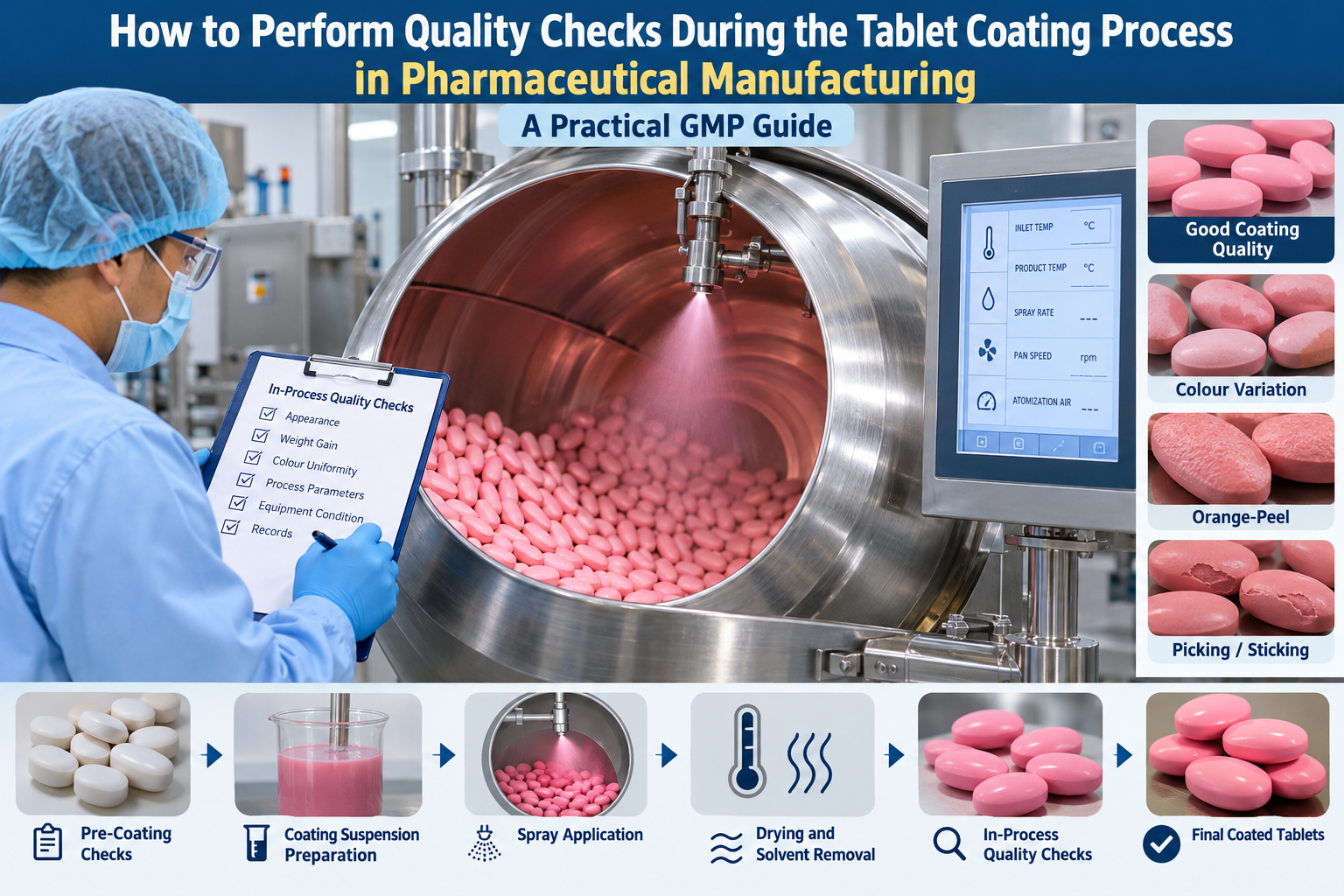
Learn quality checks during tablet coating, critical process parameters, common coating defects, troubleshooting, and GMP documentation practices.
1. Introduction
Tablet coating is a critical operation in oral solid dosage (OSD) manufacturing. Although coating may appear to be a finishing step, its effect on product quality can extend well beyond the tablet’s appearance.
A properly applied coating can improve swallowability, mask an unpleasant taste, protect the tablet core, support product identification, and provide the functional properties required for modified drug release when applicable. The coating must be suitable for the formulation and must perform according to the approved product requirements.
The quality checks during tablet coating process help manufacturing personnel identify developing problems before they affect a large portion of the batch. Uneven colour, picking, sticking, inadequate coating weight gain, poor logo definition, and non-uniform coating distribution can result from several interacting factors, including spray application, drying capacity, tablet-bed movement, formulation characteristics, and equipment condition.
A batch may look acceptable during a quick visual inspection but still fail a relevant product specification. For example, an attractive film-coated tablet does not, by itself, demonstrate acceptable dissolution performance or establish that a modified-release coating is functioning correctly.
Effective tablet coating quality control therefore requires disciplined process monitoring, representative sampling, documented decisions, and verification against approved requirements.
2. Understanding the Pharmaceutical Tablet Coating Process
In conventional film coating, a coating solution or suspension is applied to moving tablets as a thin film. Liquid is distributed over the tablet surfaces while the drying system removes the solvent or moisture, allowing the coating to form.
The operation generally involves five stages:
- Preheating and tablet-bed preparation: The core tablets are loaded, the bed is brought to the required operating condition, and tablet movement is established.
- Coating preparation: The coating material is dispensed, mixed, and filtered where specified by the approved procedure.
- Spray application: Spray guns deliver the coating liquid to the moving tablet bed.
- Drying: Process air and exhaust conditions support appropriate drying and film formation.
- Final drying, cooling, and discharge: The process is completed according to the approved recipe, followed by cooling and controlled discharge where applicable.
The balance between liquid application and drying is particularly important. Excessive liquid deposition relative to the available drying capacity can promote sticking, picking, and twinning. Conversely, droplets that dry before adequately reaching the tablet surface may contribute to roughness or spray-drying defects.
Before starting, Production should verify equipment cleanliness, line clearance, equipment status labels, availability of approved documents, material identity, and the readiness of critical instruments. The approved batch manufacturing record (BMR) and applicable standard operating procedures (SOPs) should be available at the point of operation.
3. Pre-Coating Quality Checks
Pre-coating checks establish whether the cores, materials, equipment, and process documentation are suitable for the operation.
Core tablet quality
Inspect the uncoated tablets for visible cracks, chips, broken edges, excessive dust, surface damage, and other abnormalities. Check tablet weight, hardness, friability, disintegration, or other relevant attributes according to the approved product procedure.
Core quality matters because coating cannot reliably correct a damaged or unsuitable tablet. For example, weak tablet edges may chip during movement in the pan, leaving defects that become more noticeable after coating.
Coating material and suspension preparation
Verify the coating material’s identity, approved status, quantity, batch details, and expiry or retest status, as applicable. Confirm that the preparation follows the approved formulation and mixing instructions.
Where required, verify suspension appearance, mixing consistency, viscosity, filtration, and permitted hold time. Suspensions should remain adequately mixed throughout the operation when specified, because settling or agglomeration may affect colour distribution and coating delivery.
Equipment and instrument readiness
Confirm the cleanliness status of the coating pan, spray guns, nozzles, solution delivery lines, filters, exhaust system, and associated components. Check for blocked nozzles, damaged seals, leakage, and abnormal equipment conditions.
Temperature, pressure, airflow, and other critical instruments should have valid calibration or verification status as applicable. Review the approved recipe, validated operating ranges, sampling requirements, and relevant safety precautions before authorizing the start.
The exact pre-coating tests and acceptance criteria depend on the formulation, approved specifications, validated process, and site procedures.
4. Critical Quality Checks During Tablet Coating
4.1 Tablet appearance
Appearance is one of the most useful immediate indicators of coating performance.
Inspect representative samples for colour uniformity, surface smoothness, gloss where applicable, logo definition, and visible defects such as picking, sticking, twinning, mottling, roughness, peeling, or cracking.
Compare the samples with approved visual standards or reference samples where available. Use consistent lighting and examination conditions so that changes can be identified reliably.
If an abnormality appears, record the observation and notify the responsible supervisor and IPQA personnel. Avoid making an immediate recipe change without assessing the defect, process history, and approved adjustment procedure.
4.2 Tablet coating weight gain
Coating weight gain indicates the increase in tablet mass attributable to the coating operation. It helps assess whether the intended amount of coating has been applied.
A basic calculation is:
Percentage weight gain
Mean coated tablet weight-Mean core tablet weight\Mean core tablet weight\100
For example, if the mean core tablet weight is 250 mg and the mean coated tablet weight is 257.5 mg, the calculated weight gain is 3%.
This example illustrates the calculation only; it is not a recommended acceptance limit.
Use representative samples and the sampling and weighing method specified in the approved procedure. Account for the method’s limitations, including sampling variability and moisture-related mass changes where relevant.
Weight gain should be assessed against the approved target and permitted range. A satisfactory average does not necessarily prove uniform coating distribution across individual tablets or throughout the batch.
4.3 Colour uniformity
Check for colour variation between tablets, across the tablet bed where accessible, and between samples collected at specified stages.
Mottling or uneven colour may be associated with inconsistent suspension mixing, variation in spray distribution, inadequate drying, pigment dispersion issues, or differences in the core surface.
When variation appears, assess suspension preparation and agitation, nozzle condition, spray pattern, delivery-system performance, airflow, and tablet-bed movement before concluding the cause.
4.4 Process temperatures
Monitor product or tablet-bed temperature, inlet air temperature, exhaust temperature, and other specified measurements according to the equipment design and approved process.
Inlet temperature describes the condition of the incoming air; it does not necessarily represent the temperature experienced by the tablets. Tablet-bed temperature is influenced by heat transfer, evaporation, airflow, spray rate, and other operating conditions.
If a reading moves outside its approved range, assess the duration and magnitude of the excursion, instrument reliability, and potential impact on product quality. Record the event and follow the site’s deviation procedure.
4.5 Spray rate and atomization
Spray rate determines how quickly liquid reaches the tablet bed. It must remain compatible with the process’s drying capacity.
Excessive liquid application can leave tablets too wet and increase the likelihood of sticking, picking, and twinning. An unsuitable or excessively low spray rate may affect process efficiency and film formation, depending on the formulation and equipment.
Atomization air pressure and spray pattern influence droplet formation and distribution. A blocked nozzle, incorrect gun alignment, unstable pressure, or damaged nozzle can produce uneven deposition.
Verify these conditions using the approved operating instructions and equipment-specific checks. Any adjustment should remain within authorized operating limits.
4.6 Pan speed and tablet-bed movement
The pan should provide adequate tablet mixing so that tablets receive reasonably uniform exposure to the spray zone.
Insufficient movement may cause uneven exposure and local overwetting. Excessive mechanical stress can contribute to chipping or damage, particularly when core tablets are fragile.
Observe tablet-bed movement using the approved method. Investigate unusual noise, vibration, inconsistent bed movement, or changes following equipment interruptions.
4.7 Airflow and drying conditions
Airflow supports heat transfer and removal of evaporated moisture or solvent. Inadequate drying can promote overwetting and adhesion, while unsuitable drying conditions can contribute to premature droplet drying or poor film formation.
Monitor the specified airflow, inlet and exhaust conditions, and humidity where required. Check exhaust filters and system performance if the readings or drying behaviour change unexpectedly.
4.8 Suspension condition and delivery system
Where the coating is a suspension, verify mixing consistency and the absence of unacceptable settling or agglomeration. Check viscosity when specified, together with filter condition, solution-line integrity, and pump performance.
Intermittent delivery, leaks, air ingress, or inconsistent flow may cause local differences in coating deposition.
4.9 Sampling frequency and response
Sampling frequency must follow the approved BMR, control strategy, and validated procedure. There is no single sampling interval that is appropriate for every coating process.
At startup, during routine operation, following a significant interruption when required, and at completion, perform the checks defined by the approved procedure. Additional sampling may be appropriate when an abnormality is identified, provided it is authorized and documented.
5. In-Process Quality Control Checklist
The following is a practical framework. Adapt it to the approved BMR, product specifications, equipment design, and site procedures before use.
| Checkpoint | Attribute or parameter | Method | Acceptance criteria/reference | Frequency | Responsible function | Action if out of limit |
|---|---|---|---|---|---|---|
| Before start | Core tablet appearance and integrity | Visual inspection | Approved core specification | As per BMR/SOP | Production/IPQA | Hold start; assess and escalate |
| Before start | Core weight and other applicable tests | Approved test method | Product specification | As specified | Production/QC/IPQA | Investigate and resolve before proceeding |
| Before start | Coating material status | Label and document verification | Approved material requirements | Each relevant material issue | Production/Dispensing | Do not use unverified material |
| Before start | Equipment cleanliness and readiness | Checklist and status verification | Cleaning SOP and equipment procedure | Each batch/startup | Production/Engineering | Stop and resolve discrepancies |
| Before start | Instrument status | Calibration/status review | Calibration procedure and approved recipe | Before use, as required | Production/Engineering | Do not rely on an unverified critical reading |
| Startup | Temperature, spray delivery, pressure, airflow, pan speed | Equipment displays and approved checks | Validated process ranges | As defined in BMR | Production | Assess, record, and notify supervisor/IPQA |
| Routine coating | Appearance and coating defects | Representative visual inspection | Approved visual standards/specification | As defined in BMR | Production/IPQA | Contain affected material and investigate |
| Routine coating | Weight gain | Approved sampling and weighing method | Approved target and limits | As defined in BMR | Production/IPQA/QC, as assigned | Assess trend and follow deviation procedure |
| Routine coating | Suspension condition and spray pattern | Observation and equipment checks | Approved preparation and operating procedure | As specified | Production | Restore control only through authorized actions |
| Intermediate/following interruption | Relevant quality attributes and process status | Approved checks and sampling plan | BMR, SOP, validated process | When required by procedure | Production/IPQA | Assess potential batch impact |
| End of process | Final appearance and weight gain | Approved inspection and test methods | Product-specific requirements | As specified | Production/IPQA/QC | Segregate or hold for assessment |
| Final batch review | Parameters, results, deviations, reconciliation | BMR and supporting-record review | Approved batch documentation | Every batch | Production/QA | Resolve discrepancies before disposition |
6. Common Tablet Coating Defects and Troubleshooting
A visible defect can have more than one cause. Troubleshooting should therefore begin with evidence collection rather than changing multiple parameters simultaneously.
| Defect | Appearance and possible contributing factors | Investigation and corrective/preventive measures |
|---|---|---|
| Picking and sticking | Film or material adheres to other tablets or equipment; may be associated with overwetting, unsuitable drying, or tacky formulation behaviour | Inspect affected surfaces, spray delivery, drying conditions, and tablet movement. Correct only within approved limits. |
| Twinning | Two tablets adhere together, often at contact surfaces | Assess overwetting, tablet shape, bed movement, and drying capacity. Verify the approved spray and pan settings. |
| Orange-peel appearance | Uneven, dimpled, or textured surface | Examine droplet formation, viscosity where relevant, atomization, spray distance, and drying behaviour. |
| Mottling | Uneven colour or patches | Check suspension mixing, pigment dispersion, nozzle performance, spray distribution, and drying consistency. |
| Rough coating | Grainy or coarse surface | Investigate spray drying, atomization, suspension condition, nozzle blockage, and material preparation. |
| Spray-drying defects | Dried particles or a powdery surface caused by droplets drying before adequate deposition | Review spray pattern, atomization, airflow, temperature, and spray-to-bed interaction. |
| Peeling or flaking | Film separates from the core or breaks away | Assess core surface condition, formulation compatibility, film formation, drying, and any relevant adhesion studies. |
| Cracking or chipping | Cracks, broken film, or damaged tablet edges | Examine core integrity, coating flexibility, mechanical stress, film thickness, and handling conditions. |
| Logo bridging or loss of embossing clarity | Coating fills or obscures engraved details | Assess spray deposition, coating application, formulation behaviour, and logo geometry. |
| Excessive weight gain | Coated tablet mass exceeds the approved target or range | Verify weighing method, core weight basis, spray delivery, process duration, and documented interruptions. |
| Inadequate weight gain | Coating application is below the approved target or range | Check coating quantity, spray delivery, process completion, reconciliation, and sampling representativeness. |
| Non-uniform distribution | Uneven coverage between tablets or across surfaces | Assess pan movement, gun alignment, nozzle condition, spray pattern, airflow, and suspension consistency. |
Important: Do not release a batch simply because a defect becomes less visible after a process adjustment. Determine the extent of the affected material and assess all relevant quality attributes under QA oversight.
7. Illustrative Shop-Floor Case Study: Uneven Colour Distribution
This is a hypothetical training example, not a real batch investigation or a claim of personal experience.
Observation
During routine film coating, the operator and IPQA personnel notice that some sampled tablets have a darker colour than others. The observation is recorded against the relevant batch and process stage.
Immediate containment
The operator informs the production supervisor and IPQA. The team follows the approved procedure for pausing or controlling the operation, where required, and identifies the potentially affected material. The batch is not assumed acceptable simply because most tablets look uniform.
Investigation
The team reviews:
- Spray-gun alignment and spray-pattern condition.
- Nozzle condition and any evidence of partial blockage.
- Suspension mixing and evidence of settling.
- Inlet, exhaust, and tablet-bed temperature trends.
- Airflow and drying behaviour.
- Pan speed and tablet-bed movement.
- Process interruptions and relevant batch-record entries.
The investigation identifies a partially obstructed spray nozzle, confirmed through an authorized equipment inspection. The obstruction had affected spray distribution. Other potential contributors are assessed and documented rather than automatically dismissed.
Corrective and preventive action
The equipment is restored under the applicable procedure. The spray system is checked before authorized continuation, and the team evaluates the affected tablets and process history under QA oversight.
Preventive actions include reviewing nozzle inspection practices, operator training, and maintenance checks. Effectiveness is verified through documented inspection results and subsequent process observations according to the approved CAPA plan.
The final batch disposition is based on the investigation, applicable specifications, and QA review—not visual improvement alone.
8. GMP Documentation and Data Integrity
Tablet coating quality depends on reliable records as much as on equipment performance. The batch record should provide a traceable account of what happened during the operation.
Record the actual process parameters required by the BMR, in-process sampling and results, equipment and instrument status, coating material details, relevant process interruptions, authorized interventions, yield, rejected tablets, and reconciliation where applicable.
Entries should be made contemporaneously by authorized personnel. Corrections to paper records should follow the site’s procedure, preserving the original entry and documenting the correction appropriately. Electronic records must be managed under the applicable system controls.
The ALCOA+ principles provide a useful framework for trustworthy data:
- Attributable: The person or system responsible is identifiable.
- Legible: Records remain readable.
- Contemporaneous: Information is recorded when the activity occurs.
- Original: The original record or an appropriately controlled true copy is retained.
- Accurate: Information reflects what actually occurred.
- Complete, Consistent, Enduring, and Available: Records remain complete, logically consistent, protected, and retrievable.
Undocumented parameter changes, unexplained discrepancies, or retrospective entries undermine the ability to reconstruct the batch history and may create GMP concerns. Any discrepancy should be escalated and assessed under the site’s procedures.
9. Deviation Investigation and CAPA
When a coating parameter exceeds its approved limit or an in-process test fails, the response should be prompt and controlled.
- Notify: Inform the production supervisor and IPQA/QA according to the site’s escalation procedure.
- Contain: Control the operation and identify potentially affected material. Segregate or place the batch on hold when required by the procedure and risk assessment.
- Assess impact: Determine the affected time window, process stage, quantity, relevant tablets, and potential effects on product quality.
- Investigate: Review trends, equipment condition, material preparation, sampling results, process history, and operator observations.
- Identify root cause: Use an appropriate method such as a cause-and-effect analysis or 5 Whys, supported by evidence.
- Implement CAPA: Define corrective action, preventive measures, ownership, and completion dates through the approved system.
- Verify effectiveness: Check whether the action prevents recurrence using predefined, documented criteria.
QA should participate according to the site’s quality system and decision-making responsibilities. Any reprocessing or rework must follow approved procedures and applicable regulatory requirements. A potentially affected batch must not be released solely because its appearance improves after adjustment.
10. Key Performance Indicators for Coating Operations
KPIs help identify recurring problems and improvement opportunities. They should use standardized site definitions and consistent data sources.
| KPI | Example calculation | Practical use |
|---|---|---|
| First-pass acceptance rate | Batches accepted at first review without a defined rework/reprocessing event ÷ total batches assessed × 100 | Measures first-pass process performance under a clearly defined site rule |
| Coating defect rate | Tablets classified as defective under the defined inspection method ÷ tablets inspected × 100 | Tracks visible defects and process trends |
| Coating yield | Reconciled acceptable coated-tablet output ÷ defined theoretical or input quantity × 100 | Evaluates material conversion and losses |
| Reconciliation | Accounted-for material quantity ÷ total quantity requiring reconciliation × 100 | Identifies unexplained losses or discrepancies |
| Batch cycle time | Defined coating-operation end time minus defined start time | Tracks operational efficiency |
| Deviation rate | Coating-related deviations ÷ defined number of batches or coating operations | Tracks process-control issues |
| Repeat-defect rate | Defined recurring defects after corrective action ÷ relevant defects or batches reviewed × 100 | Helps evaluate recurrence and CAPA effectiveness |
These formulas are examples of possible site definitions, not universal standards. For yield, reconciliation, and acceptance metrics, define how rejects, samples, process losses, and reprocessing are treated. A KPI cannot replace an approved product specification or justify acceptance of a failing batch.
11. Best Practices for Consistent Coating Quality
Consistent coating performance comes from controlling the complete operation, not from relying on a single parameter.
- Train operators: Ensure personnel understand the coating recipe, equipment response, defect recognition, escalation, and documentation requirements.
- Maintain spray systems: Include nozzle inspection, gun alignment, pump and line checks, and appropriate preventive maintenance.
- Control recipes: Use approved product-specific settings and documented authorization for changes.
- Monitor trends: Review process parameters, weight gain, appearance results, yield losses, and recurring deviations.
- Maintain suspension quality: Follow approved mixing, filtration, and hold-time requirements.
- Verify cleaning: Confirm cleaning effectiveness and equipment readiness before the next batch.
- Strengthen communication: Production, IPQA, QC, Engineering, Validation, and QA should share relevant observations and investigation findings.
- Use risk-based improvement: Review recurring defects and process variability to identify opportunities for controlled optimization and, where required, revalidation.
12. Frequently Asked Questions
1. Which quality checks are essential during tablet coating?
Typical checks include tablet appearance, weight gain, relevant process temperatures, spray rate, atomization conditions, pan speed, airflow, suspension condition, and equipment performance. The approved BMR determines the required checks for each product.
2. How is tablet coating weight gain monitored?
Representative core and coated-tablet samples are weighed using the approved method. Percentage weight gain is calculated relative to the mean core weight and compared with the approved product target and limits.
3. What causes uneven colour distribution?
Possible contributors include inconsistent suspension mixing, pigment dispersion problems, partial nozzle blockage, poor spray distribution, unsuitable drying conditions, and inconsistent tablet-bed movement. Investigation should establish the cause for the specific event.
4. What is the difference between picking and sticking?
Picking generally refers to coating material being pulled away from a tablet surface, sometimes leaving a visible defect. Sticking refers to tablets adhering to one another or to equipment surfaces. The terms may overlap in practice, so the physical defect and evidence should be documented clearly.
5. Why is tablet-bed temperature important?
It affects the balance between liquid deposition, evaporation, and film formation. A suitable temperature range helps the coating dry and form as intended without promoting overwetting or premature drying.
6. How can orange-peel appearance be investigated?
Review the surface texture alongside spray rate, atomization, suspension viscosity where specified, nozzle condition, spray pattern, and drying conditions. Confirm the contributing cause before implementing an authorized correction.
7. What should an operator do when a coating parameter exceeds its approved limit?
Follow the approved escalation procedure, inform the supervisor and IPQA/QA, document the event, and control potentially affected material. Do not independently make unauthorized changes or assume the batch remains acceptable.
8. How should coating defects be documented and investigated?
Record the defect, time or process stage, relevant observations, sampling results, equipment conditions, and any authorized intervention. Investigate the extent and potential impact, establish a supported root cause, and document CAPA and effectiveness verification where applicable.
9. Is visual inspection alone sufficient to establish coating quality?
No. Visual inspection is useful for appearance and visible defects but cannot independently establish every quality attribute. Weight gain, relevant physical tests, finished-product testing, and functional performance assessments may also be required by the approved product control strategy.
10. How do validated process parameters support consistent coating performance?
Validated process parameters provide an established operating range supported by documented evidence that the process can consistently produce acceptable results. Routine monitoring helps confirm that the process remains controlled. Changes outside approved controls require the applicable assessment and authorization.
13. Conclusion
Quality checks during tablet coating are essential for maintaining consistent appearance, coating distribution, process performance, and compliance with approved product requirements. Effective control depends on trained operators, suitable equipment conditions, representative sampling, timely investigation, and complete GMP documentation.
The most reliable approach is to identify abnormalities early, investigate their causes systematically, and make only authorized, evidence-based adjustments. Production efficiency matters, but it must remain aligned with product quality and patient safety.
Consistent tablet coating quality is achieved by controlling the complete process and verifying the finished product against its approved requirements—not simply by producing tablets that look attractive.
14. Regulatory and Technical References
The following official sources provide the GMP and quality-system framework relevant to coating operations. They establish general expectations for controlled manufacturing, documentation, quality oversight, and risk management; they do not prescribe one universal coating recipe or a universal sampling interval.
- US FDA — 21 CFR Part 211: Current Good Manufacturing Practice for Finished Pharmaceuticals
https://www.ecfr.gov/current/title-21/chapter-I/subchapter-C/part-211
Relevant provisions include production and process controls, equipment, laboratory controls, batch records, and investigations of discrepancies. - European Commission — EudraLex Volume 4: EU Guidelines for Good Manufacturing Practice
https://health.ec.europa.eu/medicinal-products/eudralex/eudralex-volume-4_en
Relevant sections include Chapter 1 (Pharmaceutical Quality System), Chapter 3 (Premises and Equipment), Chapter 4 (Documentation), Chapter 5 (Production), and Chapter 6 (Quality Control). Applicable requirements depend on the product and regulatory framework. - World Health Organization — WHO Good Manufacturing Practices for Pharmaceutical Products: Main Principles, TRS 986, Annex 2
https://www.who.int/publications/m/item/trs986-annex2
Provides general GMP principles for pharmaceutical manufacturing and quality assurance. - International Council for Harmonisation — ICH Quality Guidelines
https://www.ich.org/page/quality-guidelines
ICH Q9(R1), Quality Risk Management, supports systematic assessment of risks to product quality. ICH Q10, Pharmaceutical Quality System, provides a framework for managing quality across the product lifecycle. - FDA — Questions and Answers on Current Good Manufacturing Practice Requirements
https://www.fda.gov/drugs/guidances-drugs/questions-and-answers-current-good-manufacturing-practice-requirements
Provides additional clarification on selected CGMP topics.
Always consult the current applicable regulations, relevant pharmacopeial requirements, approved marketing authorization, product specifications, validated process documentation, and site SOPs when defining actual coating controls.
About the Author – Ramesh Palav
Ramesh Palav is the founder of Pharma Manufacturing Hub and a pharmaceutical manufacturing professional with over 21 years of experience in Oral Solid Dosage (OSD) manufacturing, particularly Granulation, Compression, and Coating. His expertise includes GMP compliance, quality management systems, equipment qualification, process validation, CSV, CAPA, deviation investigation, root cause analysis, and operational excellence.
Through Pharma Manufacturing Hub, he shares practical industry knowledge, technical guidance, and GMP best practices to help pharmaceutical professionals, students, and aspiring industry leaders strengthen their technical skills and manufacturing knowledge.