1. Introduction
For decades, a successful career in pharmaceutical manufacturing relied on a clear foundation: strong functional technical knowledge, strict adherence to Good Manufacturing Practices (GMP), and an understanding of unit operations. If you understood wet granulation, tablet compression Parameters, high-performance liquid chromatography (HPLC) troubleshooting, or environmental monitoring, you had a durable foundation for a multi-decade career.
That foundation remains mandatory, but it is no longer sufficient.
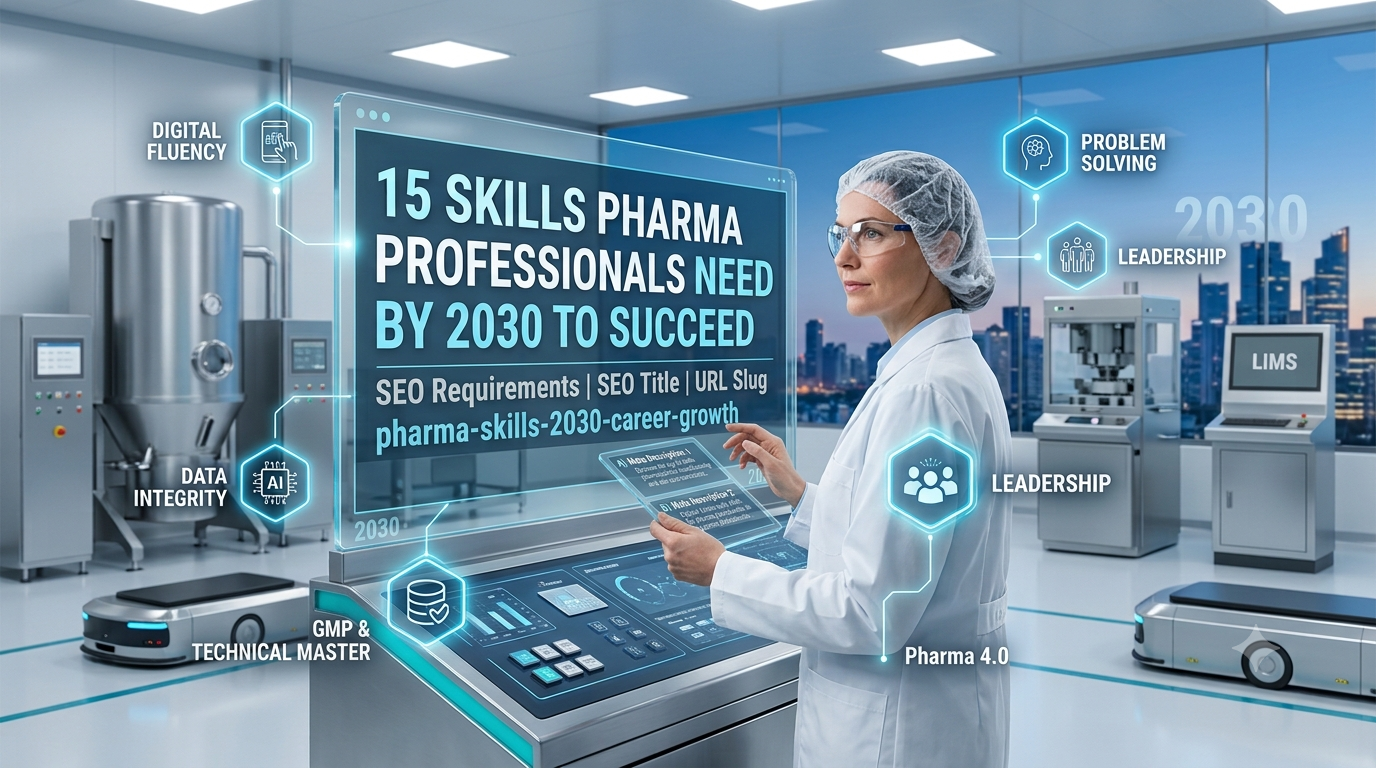
By 2030, the operational baseline of the pharmaceutical industry will look fundamentally different. Connected equipment, automated batch release, machine-learning-driven deviation analyses, and real-time process monitoring are transitioning from forward-looking pilot projects to standard facility design requirements.
The core definition of expertise is shifting. The future pharma professional will not be defined only by what they know, but by how effectively they can apply technology, data, quality thinking and leadership to solve real problems.
Whether you operate on the shop floor, manage a quality control laboratory, oversee facility engineering, or lead site operations, navigating the next decade requires expanding your skill set beyond functional execution into digital fluency, risk-based decision-making, and cross-disciplinary leadership.
2. Why Pharma Skills Are Changing
The pharmaceutical industry has historically moved cautiously when adopting new operational models, driven by legitimate patient safety concerns and strict regulatory boundaries. However, several compounding forces are accelerating structural change across manufacturing plants, quality units, and supply chains:
- Digital Transformation & Pharma 4.0: The integration of Industrial Internet of Things (IIoT) devices, Manufacturing Execution Systems (MES), and automated material handling means plant operators and managers interact more with software dashboards and data streams than manual logbooks.
- Artificial Intelligence and Advanced Analytics: AI algorithms are increasingly deployed to detect process drift in continuous manufacturing, predict equipment failure before mechanical breakdown, and streamline complex Quality Management System (QMS) reviews.
- Data Integrity & Regulatory Rigor: Regulatory bodies such as the US FDA, EMA, WHO, and PIC/S have elevated data integrity expectations. Modern inspections evaluate not just physical records, but database architecture, audit trail review procedures, and user privilege setups across computerized systems.
- Operational Excellence Under Margin Pressure: The rise of complex biologics, personalized medicines, and competitive generic pricing requires facilities to operate with minimal waste, higher First Time Right (FTR) rates, and compressed batch changeover times.
- Evolution of the Workforce: As experienced subject matter experts retire, implicit process knowledge must be codified into institutional systems. Mid-career professionals and site leaders must lead cross-functional teams that span traditional operations, data science, and computerized system validation.
These changes alter daily work routines. A production supervisor line clearance now involves verifying electronic batch record (EBR) signatures and system interlocks. A Quality Assurance (QA) investigator analyzing a tablet weight variation deviation relies as much on statistical process control (SPC) data trends as visual machine inspection.
3. The 15 Skills Pharma Professionals Need by 2030
  ┌─────────────────────────────────────────────────────────────────────────┐
  │                 CORE PHARMA SKILL MATRIX FOR 2030                       │
  ├──────────────────────────────────┬──────────────────────────────────────┤
  │ TECHNICAL & COMPLIANCE FOUNDATION│ DIGITAL & DATA FLUENCY               │
  │ • GMP & Regulatory Knowledge     │ • Digital & Pharma 4.0 Literacy      │
  │ • Process Validation & QMS       │ • AI & Machine Learning Application  │
  │ • Quality Risk Management (ICH)  │ • Data Integrity & ALCOA+ Analytics  │
  │ • Cybersecurity Awareness        │ • Advanced Root Cause Analysis       │
  ├──────────────────────────────────┼──────────────────────────────────────┤
  │ OPERATIONAL & BUSINESS EXECUTION │ LEADERSHIP & STRATEGIC VISION        │
  │ • Lean, Six Sigma & Operational  │ • Cross-Functional Collaboration     │
  │   Excellence                     │ • Adaptive Leadership & Coaching     │
  │ • Business & Financial Acumen    │ • Technical Writing & Communication  │
  │ • Continuous Learning Agility    │ • Strategic Thinking & Site Leadership│
  └──────────────────────────────────┴──────────────────────────────────────┘
SKILL 1 — Strong GMP and Regulatory Knowledge
1. What it Means
Fundamental compliance knowledge covering US FDA (21 CFR Parts 210/211), EU GMP (EudraLex Volume 4), WHO guidelines, and PIC/S standards. It encompasses ALCOA+ data integrity principles, risk-based compliance, and maintaining continuous inspection readiness across manufacturing and testing operations.
2. Why it Matters by 2030
Technology evolves, but regulatory mandates for safety, identity, strength, quality, and purity remain absolute. Future regulators will inspect advanced digital facilities with the same rigor applied to manual sites, evaluating how digital tools comply with fundamental GMP principles.
3. Real-World Application
During an FDA inspection of an automated Oral Solid Dosage (OSD) facility, inspectors focus heavily on audit trails for the computerized tablet press control system. A QA professional with strong regulatory depth doesn’t just present the SOP; they demonstrate how user access levels prevent unauthorized parameter adjustments and how batch record audit trail reviews are systematically executed before batch release.
4. How to Develop It
- Study current FDA 483 observations, warning letters, and EU GMP updates regularly.
- Participate in site self-inspections and mock audits.
- Review regional regulatory guidance documents (e.g., PIC/S guidance on data integrity).
5. Career Advantage
Provides the baseline compliance authority required for quality decision-making, establishing you as a reliable subject matter expert (SME) during regulatory audits.
SKILL 2 — Digital and Pharma 4.0 Literacy
1. What it Means
Practical working knowledge of modern digital infrastructure in pharmaceutical manufacturing, including Manufacturing Execution Systems (MES), SCADA/HMI control layers, Laboratory Information Management Systems (LIMS), electronic Quality Management Systems (eQMS), and electronic Document Management Systems (eDMS).
2. Why it Matters by 2030
Paper-based batch records and manual lab logs are being systematically replaced. Professionals do not need to write software code, but they must understand system architectures, data flows between equipment and enterprise systems, and how electronic controls influence daily operations.
3. Real-World Application
A production manager transitioning a fluid bed dryer process from paper records to an MES works directly with CSV engineers to define exact workflow steps, parameter tolerance limits, and mandatory operator check-points within the software interface.
4. How to Develop It
- Engage directly in system implementations, User Requirement Specification (URS) drafting, or end-user testing for software tools.
- Take introductory courses on industrial automation, SCADA networks, and database structures.
- Shadow system administrators during routine configuration updates.
5. Career Advantage
Bridges the gap between traditional manufacturing operations and IT teams, positioning you to lead facility modernization projects.
SKILL 3 — Artificial Intelligence and Generative AI Literacy
1. What it Means
Understanding how Artificial Intelligence (AI) and Machine Learning (ML) can be responsibly deployed in pharmaceutical environments—from predictive maintenance and deviation trend analysis to automated document drafting—while maintaining human oversight and computerized system validation compliance.
2. Why it Matters by 2030
AI tools can evaluate thousands of batch data points, environmental records, and historical deviation logs in seconds. Professionals who know how to prompt, verify, and govern AI tools will resolve operational issues faster than those relying solely on manual review.
3. Real-World Application
Instead of manually sifting through two years of environmental monitoring out-of-trend (OOT) events across three cleanroom suites, a QC manager uses an validated AI-driven analytical dashboard to identify specific seasonal humidity correlations, drafting targeted corrective actions based on verified statistical patterns.
┌────────────────────────────────────────────────────────────────────────┐
│                   RESPONSIBLE AI IMPLEMENTATION WORKFLOW               │
├─────────────────┬──────────────────┬──────────────────┬────────────────┤
│   Data Source   │   AI Processing  │  Human Oversight │ Regulatory     │
│                 │                  │                  │ Verification   │
│  Validated      │  Pattern         │  SME Review &    │ Audit Trail    │
│  Historical     │  Detection &     │  Verification    │ & Final Quality│
│  Data (LIMS/QMS)│  Trend Analysis  │  of Recommendations Sign-off       │
└─────────────────┴──────────────────┴──────────────────┴────────────────┘
4. How to Develop It
- Learn the basics of prompt engineering and structured query approaches.
- Understand the regulatory guidelines surrounding AI/ML in drug development and manufacturing (such as FDA discussion papers on AI in manufacturing).
- Participate in internal AI pilot programs for document searching or data summaries.
5. Career Advantage
Distinguishes you as an innovative problem-solver capable of leveraging modern technologies to reduce cycle times and improve decision accuracy.
SKILL 4 — Data Integrity and Data Literacy
1. What it Means
The ability to generate, review, analyze, and protect data throughout its lifecycle in accordance with ALCOA+ principles (Attributable, Legible, Contemporaneous, Original, Accurate + Complete, Consistent, Enduring, Available). It includes moving from simple data collection to meaningful data interpretation.
2. Why it Matters by 2030
Data integrity failures remain a leading cause of regulatory enforcement actions globally. Simultaneously, manufacturing facilities generate vast volumes of process data that remain underutilized if teams lack the literacy to interpret statistical trends.
3. Real-World Application
An analytical lab supervisor performing a secondary data review does not simply check if the final assay calculation meets specifications. They review the full chromatographic audit trail, integration parameters, injection sequences, and system suitability trends to confirm raw data integrity before signing off.
4. How to Develop It
- Master statistical process control tools (Control Charts, Process Capability indices like Cpk/Ppk).
- Complete detailed training on 21 CFR Part 11 and EU Annex 11 requirements.
- Conduct hands-on audit trail reviews across laboratory instrumentation (HPLC, GC) and production line controllers.
5. Career Advantage
Makes you indispensable to quality leadership by ensuring manufacturing records withstand intense regulatory scrutiny while driving data-based process improvements.
SKILL 5 — Analytical and Problem-Solving Skills
1. What it Means
Structured, methodical approaches to root cause investigation using recognized quality tools such as 5 Why Analysis, Fishbone (Ishikawa) Diagrams, Failure Mode and Effects Analysis (FMEA), Fault Tree Analysis (FTA), and Pareto analysis.
2. Why it Matters by 2030
Regulatory agencies increasingly penalize superficial deviation investigations that fail to identify true root causes, leading to recurring deviations and production downtime.
3. Real-World Application
When tablet capping unexpectedly occurs during a high-speed compression run, a structured investigator avoids jumping to conclusions about binder quantity. They apply an FMEA framework, systematically evaluating punch tip wear, compression force curves, pre-compression settings, and room relative humidity to isolate the primary contributing factors.
4. How to Develop It
- Lead complex deviation investigations outside your immediate functional area.
- Complete certification in root cause analysis (RCA) or Lean Six Sigma frameworks.
- Practice writing clear, evidence-backed investigation reports with verifiable rationale.
5. Career Advantage
Establishes a reputation as a dependable troubleshooter who eliminates recurring operational failures rather than simply documenting them.
SKILL 6 — Process Validation and Qualification Knowledge
1. What it Means
A comprehensive understanding of the lifecycle approach to validation—from User Requirement Specifications (URS), Design Qualification (DQ), Factory/Site Acceptance Testing (FAT/SAT), to Installation, Operational, and Performance Qualification (IQ/OQ/PQ), Process Validation (Stage 1, 2, and 3 Continued Process Verification), Cleaning Validation, and Computer System Validation (CSV).
┌────────────────────────────────────────────────────────────────────────┐
│                   VALIDATION LIFECYCLE APPROACH                        │
├────────────────────────┬──────────────────────┬────────────────────────┤
│       STAGE 1          │       STAGE 2        │        STAGE 3         │
│    Process Design      │ Process Qualification│ Continued Process Verif│
│                        │                      │                        │
│ • Design of Experiments│ • Facility/Equip Qual│ • Statistical Trending │
│ • CPP & CQA Definition │ • Process Perf Qual  │ • Ongoing CPV Reviews  │
│ • Scale-up Studies     │   (PPQ / Validation) │ • Change Control Review│
└────────────────────────┴──────────────────────┴────────────────────────┘
2. Why it Matters by 2030
Validation is no longer a static, one-time exercise involving three validation batches. It is a continuous, lifecycle process requiring ongoing statistical evaluation to confirm process control throughout the commercial life of a product.
3. Real-World Application
A validation specialist working on a wet granulation line setup establishes a Continued Process Verification (CPV) plan. Instead of relying on annual product quality reviews, they set up automated statistical tracking of impeller power consumption, drying endpoint temperatures, and final blend uniformity across every commercial batch.
4. How to Develop It
- Study ICH Q8 (Pharmaceutical Development), Q10 (Pharmaceutical Quality System), and FDA Process Validation Guidance.
- Participate in commissioning, qualification, and validation (CQV) protocol execution for new facility equipment.
- Learn fundamental data collection protocols for computer system validation (GAMP 5 guidelines).
5. Career Advantage
Provides deep cross-functional visibility into engineering, production, and quality, making you a strong candidate for technical services and engineering management roles.
SKILL 7 — Quality Risk Management (QRM)
1. What it Means
Applying structured risk management principles according to ICH Q9 (R1) across product lifecycles, manufacturing processes, facility utility designs, change controls, and deviation assessments.
2. Why it Matters by 2030
Modern compliance relies on risk-based decision-making. Operating under rigid, blanket rules across every minor process detail creates inefficiency; understanding true risk to product quality and patient safety allows resources to be focused where risk is highest.
3. Real-World Application
When proposing a minor modification to an automated secondary packaging line, an engineering lead uses a structured Risk Assessment matrix. They demonstrate to QA that the modification does not affect critical contact surfaces, vision system inspection capabilities, or primary container integrity, establishing a justified, streamlined validation scope.
4. How to Develop It
- Read and apply ICH Q9 (R1) guidelines to daily decisions.
- Facilitate risk assessment workshops (e.g., FMEA sessions) with production, maintenance, and quality teams.
- Practice documenting transparent risk acceptance rationales backed by physical or historical process data.
5. Career Advantage
Enables you to make balanced, defensible quality decisions that protect patient safety without imposing unnecessary operational friction.
SKILL 8 — Operational Excellence and Lean Manufacturing
1. What it Means
Mastery of continuous improvement methodologies including Overall Equipment Effectiveness (OEE) optimization, 5S, Kaizen, Value Stream Mapping, changeover time reduction (SMED), downtime analysis, and Right First Time (RFT) principles.
2. Why it Matters by 2030
As production facilities face tight delivery schedules and rising material costs, manufacturing plants must optimize throughput, eliminate operational waste, and cut downtime without compromising compliance.
3. Real-World Application
A tablet compression shift manager analyzes continuous OEE losses on a high-speed press. By applying Single-Minute Exchange of Die (SMED) principles during tooling changeovers and standardizing cleaning procedures, the line reduces changeover duration from 6 hours to 3.5 hours, increasing weekly site production capacity.
4. How to Develop It
- Earn a Lean Six Sigma Green Belt or Black Belt certification.
- Map a daily manufacturing workflow at your facility and identify non-value-added steps.
- Track key performance metrics (OEE, yield loss, deviation rates) and initiate targeted improvement projects.
5. Career Advantage
Demonstrates clear business value by converting compliance and technical knowledge into measurable productivity gains and cost reductions.
SKILL 9 — Leadership and People Management
1. What it Means
The ability to guide, motivate, coach, and manage cross-functional teams, resolve inter-departmental conflicts, delegate effectively, and manage organizational change in a regulated technical environment.
2. Why it Matters by 2030
Technical brilliance alone does not build operational success. Modern pharmaceutical plants rely on interconnected teams; leaders must bridge operational priorities, regulatory boundaries, and varying technical background skill levels.
3. Real-World Application
During a high-pressure batch release deadline, a quality issue arises requiring additional analytical testing. A skilled production lead manages tension between manufacturing schedule demands and QA compliance holds by organizing a structured technical alignment meeting, setting clear expectations, and supporting the team through a disciplined root cause evaluation.
┌────────────────────────────────────────────────────────────────────────┐
│                   BALANCING OPERATIONAL TENSIONS                       │
├───────────────────────────────────┬────────────────────────────────────┤
│   PRODUCTION DEMANDS              │     QUALITY COMPLIANCE             │
│  • Schedule Adherence             │  • Thorough Investigation          │
│  • Output Targets                 │  • Defensible Technical Rationale  │
│  • Resource Allocation            │  • Patient Safety Protection       │
├───────────────────────────────────┴────────────────────────────────────┤
│                        LEADERSHIP SYNTHESIS                            │
│  Collaborative problem-solving, transparent evidence review, and       │
│  risk-based decision alignment.                                        │
└────────────────────────────────────────────────────────────────────────┘
4. How to Develop It
- Take ownership of cross-functional team initiatives or task forces.
- Seek formal leadership and people management coaching.
- Practice active listening, constructive feedback delivery, and structured conflict resolution.
5. Career Advantage
Prepares technical specialists for transition into supervisory, managerial, and executive site leadership positions.
SKILL 10 — Technical Writing and Communication
1. What it Means
The capability to write precise, unambiguous, and compliant technical documents—such as Standard Operating Procedures (SOPs), Master Batch Records (MBRs), deviation investigation reports, CAPA plans, and qualification protocols—and to present complex technical data clearly to stakeholders and regulators.
2. Why it Matters by 2030
Poorly written documentation causes human errors, regulatory audit observations, and internal delays. Regulatory inspectors evaluate your operations primarily through your written records; clarity and objective language are essential.
3. Real-World Application
A QA investigation author writes a CAPA report following an out-of-specification (OOS) dissolution result. Instead of writing vague statements like “operator error occurred during media preparation,” they document the precise measurement steps, identify the specific missing calibration step, and define an updated SOP workflow with objective verification checks.
4. How to Develop It
- Study well-written historical investigation reports and regulatory responses at your company.
- Eliminate subjective adverbs and ambiguous terminology from your professional writing.
- Take technical writing workshops tailored to FDA/EMA compliance environments.
5. Career Advantage
Ensures your work is recognized, trusted, and easily understood by executive management, internal auditors, and regulatory inspectors.
SKILL 11 — Cross-Functional Collaboration
1. What it Means
Working effectively across organizational boundaries—connecting Production, QA, QC, Engineering, Validation, Regulatory Affairs, Supply Chain, IT, and CSV teams to achieve common site goals.
2. Why it Matters by 2030
Siloed departmental operations lead to operational friction, delayed project execution, and recurring compliance issues. Modern pharmaceutical processes demand unified, end-to-end execution across technology, engineering, and quality boundaries.
3. Real-World Application
During the introduction of a continuous granulation technology line, a validation manager leads an integrated workgroup consisting of an IT/CSV engineer, a process maintenance mechanic, a QA reviewer, and a tablet production operator. This collaborative approach addresses hardware interlocks, software audit trails, and operator workflow constraints before physical line installation begins.
4. How to Develop It
- Volunteer for inter-departmental task forces, capital project deployment teams, or site audit preparations.
- Spend time shadowing colleagues in adjacent departments to understand their operational constraints.
- Establish regular alignment meetings between production line staff and supporting lab personnel.
5. Career Advantage
Expands your site-wide visibility and marks you as an adaptable professional capable of managing complex, plant-wide initiatives.
SKILL 12 — Cybersecurity and Digital Compliance Awareness
1. What it Means
Understanding basic cybersecurity practices, system security management, identity access control, network segmentation, and system recovery protocols within digitally connected OT (Operational Technology) and IT environments.
2. Why it Matters by 2030
As manufacturing plants deploy IIoT sensors, smart devices, and cloud-connected analytical instruments, facilities face increased vulnerability to cyber threats, ransomware, and unauthorized database access. Cybersecurity is now a fundamental component of GMP data integrity and business continuity.
3. Real-World Application
An automation engineer setting up new environmental monitoring sensors works alongside site IT security to ensure equipment utilizes secure authentication protocols, resides on a segmented OT network, and cannot be accessed via unauthorized remote connections.
4. How to Develop It
- Complete training on OT/IT security standards (such as ISA/IEC 62443).
- Understand site-level disaster recovery and business continuity plans for computerized systems.
- Follow strict access management principles: enforce unique user credentials, eliminate shared login accounts, and review system privilege matrices regularly.
5. Career Advantage
Protects critical site assets and positions you ahead of industry trends as digital risk management becomes standard in regulatory inspections.
SKILL 13 — Continuous Learning and Adaptability
1. What it Means
Proactively acquiring new knowledge, keeping pace with evolving regulatory guidance, adapting to new digital tools, and maintaining a growth mindset across your career lifecycle.
2. Why it Matters by 2030
The pace of technological and regulatory change means static knowledge degrades rapidly. Professionals who rely exclusively on how things were done five years ago risk falling behind as automated and digitized processes become standard practice.
3. Real-World Application
An experienced production manager with 15 years of manual batch manufacturing experience actively enrolls in site-sponsored training programs covering electronic batch records, basic data visualization software, and automated process analytical technology (PAT).
4. How to Develop It
- Dedicate time weekly to reading industry journals, ISPE publications, and regulatory updates.
- Attend industry webinars, technical seminars, and professional association meetings (ISPE, PDA).
- Obtain professional certifications in specialized areas like CSV, Quality Auditing, or Lean Six Sigma.
5. Career Advantage
Ensures ongoing career resilience, versatility, and employability across shifting market conditions and technical transitions.
SKILL 14 — Business and Financial Understanding
1. What it Means
Understanding how operational, technical, and quality decisions impact financial performance—including Cost of Poor Quality (COPQ), overall manufacturing costs, yield losses, CAPEX/OPEX planning, and Return on Investment (ROI).
2. Why it Matters by 2030
Technical decisions carry direct financial consequences. Senior management prioritizes technical investments and process improvements that demonstrate clear risk mitigation alongside measurable financial returns.
3. Real-World Application
A plant engineering manager proposing a $200,000 upgrade for an automated visual tablet inspection system presents a clear business case: demonstrating how the system reduces batch rejection rates by 1.8%, lowers manual sorting labor costs, and yields a full return on investment within 14 months.
4. How to Develop It
- Partner with site finance teams to understand cost-of-goods-sold (COGS) breakdowns for your facility’s product lines.
- Evaluate the true financial cost of facility downtime, deviations, scrap rates, and re-work events.
- Incorporate cost-benefit analysis and ROI projections into capital budget requests.
5. Career Advantage
Translates technical proposals into compelling business language, making it easier to secure project approval and leadership support.
SKILL 15 — Strategic Thinking and Future Leadership
1. What it Means
The capacity to look beyond day-to-day operational firefighting and consider long-term site objectives, multi-year technology roadmaps, workforce development strategies, risk mitigation plans, and evolving regulatory trends.
2. Why it Matters by 2030
Site management requires leaders who can navigate complex long-term transitions—such as upgrading legacy facilities, managing site digital transformations, or restructuring quality systems—without interrupting product supply.
3. Real-World Application
A Head of Quality developing a 3-year site readiness plan evaluates upcoming regulatory changes in environmental monitoring and data integrity. They systematically schedule software upgrades, budget for lab automation tools, and institute staff upskilling plans well ahead of regulatory enforcement deadlines.
4. How to Develop It
- Participate in site strategy sessions, long-term master planning, and capital project roadmapping.
- Study industry benchmarks, technology roadmaps, and global supply chain trends.
- Mentor junior colleagues, building talent pipelines to ensure operational continuity.
5. Career Advantage
Differentiates functional experts from strategic organizational leaders, paving the way for Site Head, Operations Director, and VP-level roles.
4. Skill Priority Matrix
| Skill | Why It Matters by 2030 | Who Needs It Most | Priority Level |
| Strong GMP & Regulatory Knowledge | Compliance remains the fundamental licence to operate. | All Pharma Professionals | Essential |
| Digital & Pharma 4.0 Literacy | Operational systems are shifting from paper to connected platforms. | Production, QA, Engineering, CSV | Essential |
| Data Integrity & Data Literacy | Regulatory scrutiny focuses heavily on electronic data flows. | QA, QC, CSV, Production | Essential |
| Analytical & Problem-Solving Skills | Prevents recurring deviations and expensive production downtime. | Production, QA, QC, Engineering | Essential |
| Cross-Functional Collaboration | Complex digital and automated processes require multi-team execution. | All Departments & Managers | Essential |
| Quality Risk Management (ICH Q9) | Enables defensible, risk-based operational and compliance decisions. | QA, Validation, Regulatory, Operations | High Priority |
| Process Validation & Qualification | Shift toward continuous, lifecycle process verification models. | Validation, Engineering, QA, Production | High Priority |
| Technical Writing & Communication | Clear documentation protects audit readiness and operational accuracy. | QA, QC, Production, Regulatory | High Priority |
| Leadership & People Management | Drives team execution, change adoption, and operational alignment. | Managers, Supervisors, Team Leads | High Priority |
| Continuous Learning & Adaptability | Protects long-term individual employability amid technological shifts. | All Pharma Professionals | High Priority |
| AI & Generative AI Literacy | Accelerates data analysis, investigation drafting, and trending. | QA, QC, Operations, IT | Developing |
| Operational Excellence (Lean/Six Sigma) | Controls production costs, eliminates waste, and boosts capacity. | Production, Engineering, Operational Excellence | Developing |
| Cybersecurity & Digital Compliance | Connected facilities create cyber risk to operations and data. | IT, CSV, Engineering, Automation | Developing |
| Business & Financial Understanding | Connects technical and quality execution to site profitability. | Department Heads, Managers, Site Leaders | Developing |
| Strategic Thinking & Leadership | Prepares leaders to steer facilities through multi-year industry changes. | Senior Managers, Site Leadership | Developing |
5. How to Build These Skills: A Realistic Development Roadmap
┌────────────────────────────────────────────────────────────────────────┐
│                   CAREER SKILL DEVELOPMENT ROADMAP                     │
├───────────────────┬───────────────────┬────────────────┬───────────────┤
│    0–6 MONTHS     │    6–12 MONTHS    │   1–2 YEARS    │   2–4 YEARS   │
│                   │                   │                │               │
│ • Master ALCOA+   │ • Lead Complex    │ • Obtain LSS   │ • Lead Major  │
│   Principles      │   Deviations      │   Green Belt   │   Digital or  │
│ • Shadow Audit    │ • Participate in  │ • Manage Cross-│   CAPEX Proj  │
│   Trail Reviews   │   Risk Assessments│   Functional   │ • Drive Site  │
│ • Complete Basic  │ • Learn Basic Data│   Teams        │   Strategy &  │
│   Software Prep   │   Analytics Tools │ • Take System  │   Long-term   │
│   (MES/LIMS)      │   (Control Charts)│   Ownership    │   Roadmaps    │
└───────────────────┴───────────────────┴────────────────┴───────────────┘
Developing these skills requires a deliberate, step-by-step approach balanced alongside daily work responsibilities:
Phase 1: 0–6 Months (Foundation Building)
- Focus: Master data integrity principles (ALCOA+) and digital system basics used in your immediate workplace.
- Actions: Shadow secondary data reviews, participate actively in routine equipment qualification tasks, and complete fundamental coursework in data integrity and computerized systems compliance.
Phase 2: 6–12 Months (Practical Application)
- Focus: Expand analytical problem-solving and quality risk management skills.
- Actions: Lead at least two multi-departmental deviation investigations utilizing 5 Why or Fishbone tools. Participate in formal Risk Assessment (FMEA) sessions for site change controls.
Phase 3: 1–2 Years (Cross-Functional Capability)
- Focus: Operational excellence, cross-functional project leadership, and data analytics.
- Actions: Enroll in a Lean Six Sigma Green Belt program. Take a lead technical role in a software rollout, validation project, or equipment installation involving MES, LIMS, or automated line technology.
Phase 4: 2–4 Years (Strategic Leadership & Mastery)
- Focus: Strategic thinking, business acumen, site leadership, and digital technology integration.
- Actions: Lead site-level continuous improvement initiatives, manage department operational budgets, sponsor digital technology pilots, and mentor early-career professionals.
6. Skills Emphasis Across Career Levels
Skill priorities evolve as you progress from individual execution to organizational leadership:
┌────────────────────────────────────────────────────────────────────────┐
│               SKILL EMPHASIS ACROSS CAREER STAGES                      │
├────────────────────────────────────────────────────────────────────────┤
│ FRESHERS / ENTRY LEVEL (0-2 Yrs)                                       │
│ ████████████████████████████████ Core GMP, SOPs, Data Integrity Basics │
├────────────────────────────────────────────────────────────────────────┤
│ EARLY CAREER (2-5 Yrs)                                                 │
│ ████████████████████████████ Digital Systems, Validation, RCA Tools    │
├────────────────────────────────────────────────────────────────────────┤
│ MID CAREER (5-10 Yrs)                                                  │
│ ████████████████████████ Cross-Functional Leadership, QRM, Lean/OEE    │
├────────────────────────────────────────────────────────────────────────┤
│ SENIOR PROFESSIONALS (10-15 Yrs)                                       │
│ ██████████████████ Business Acumen, Change Management, System Strategy │
├────────────────────────────────────────────────────────────────────────┤
│ SITE LEADERSHIP (15+ Yrs)                                              │
│ ██████████ Strategic Vision, Long-Term Workforce Planning, Site Governance│
└────────────────────────────────────────────────────────────────────────┘
- Freshers & Early Career (0–2 Years): Focus intensely on core GMP compliance, precise documentation practices, learning automated shop-floor systems (MES/LIMS), and mastering basic analytical problem-solving.
- Early-to-Mid Career (2–5 Years): Develop deeper knowledge in process validation, computer system validation, root cause analysis tools, and structured quality risk assessment methods.
- Mid-Career Professionals (5–10 Years): Shift emphasis toward team leadership, cross-functional project coordination, Lean/Six Sigma execution, advanced statistical process control, and technical writing.
- Senior Professionals (10–15 Years): Prioritize change management, business and financial understanding (COGS/ROI), advanced digital transformation deployment, and talent development.
- Site Leadership & Executives (15+ Years): Focus on multi-year technology strategy, regulatory strategy, site governance, financial optimization, enterprise risk management, and organizational culture.
7. Essential Skills by Pharma Function
Different operational functions require specific primary skill focus areas:
- Production & Manufacturing: Digital/MES literacy, operational excellence (SMED, OEE), root cause analysis, cross-functional coordination, and basic automation understanding.
- Quality Assurance (QA): Quality Risk Management (ICH Q9), data integrity auditing, computer system validation oversight, advanced investigation writing, and regulatory standard interpretation.
- Quality Control (QC): LIMS automation, chromatographic data integrity, statistical analytical trending, out-of-specification (OOS) investigation methods, and lab lean efficiency.
- Validation & Qualification: Continuous Process Verification (CPV), lifecycle validation protocols, GAMP 5 computer system validation, data analytics, and utility engineering principles.
- Engineering & Maintenance: Predictive maintenance analytics, SCADA/PLC control networks, OT cybersecurity basics, equipment OEE optimization, and capital project delivery.
- Regulatory Affairs: Global regulatory interpretation, risk-based filing approaches, lifecycle strategy, cross-functional documentation review, and digital dossier standards.
- CSV & Digital Transformation: GAMP 5 guidance, data architecture, cloud compliance protocols, cybersecurity integration, user access management, and business process mapping.
- Supply Chain & Logistics: Supply chain visibility tools, cold-chain temperature monitoring analytics, business finance, inventory optimization, and vendor quality management.
- Research & Development / Tech Transfer: Scale-up validation, Quality by Design (QbD) principles, process analytical technology (PAT), technology transfer protocols, and data modeling.
8. Common Career Mistakes to Avoid
- Relying Exclusively on Years of Experience: Assuming that having 15 years of routine experience guarantees career advancement, without actively updating your skills in digital systems or data analytics.
- Avoiding Digital and AI Technologies: Treating software platforms, automated tools, and data dashboards as “IT issues” rather than core operational responsibilities.
- Neglecting Data Integrity Principles: Focusing strictly on physical product outcomes while failing to thoroughly review electronic records, audit trails, and system access controls.
- Working in Departmental Silos: Focusing entirely on internal team targets while neglecting how your department’s outputs impact downstream quality, validation, or compliance teams.
- Weak Technical Documentation Skills: Producing vague, poorly structured deviation reports or CAPAs that fail to explain technical facts clearly to internal auditors and regulatory inspectors.
- Ignoring Financial and Business Realities: Proposing technical or engineering changes without considering the cost impact, return on investment, or overall business viability.
- Stopping Professional Education: Failing to keep up with updated global regulatory guidelines (FDA, EMA, ICH), industry white papers, and modern manufacturing practices.
9. Conclusion
Succeeding in the pharmaceutical manufacturing industry by 2030 does not require becoming an expert programmer, data scientist, or automation designer overnight.
The most successful professionals will build a balanced combination of capabilities:
Future Success = Technical Expertise + GMP Compliance + Digital Fluency + Problem Solving +Leadership
Traditional functional expertise and strict adherence to GMP principles remain the essential foundation of pharmaceutical manufacturing. However, overlaying that foundation with digital literacy, structured problem-solving skills, data integrity awareness, and collaborative leadership creates a adaptable professional profile.
By assessing your current capabilities against these 15 skills, identifying functional development gaps, and executing a practical, step-by-step career development plan, you can ensure your expertise remains relevant, valued, and impactful in the years ahead.
References
- US FDA: Human Drug CGMP Notes & Guidance Documents
- European Medicines Agency (EMA): EudraLex – Volume 4 – Good Manufacturing Practice (GMP) guidelines
- International Council for Harmonisation (ICH): ICH Q9 (R1) Quality Risk Management Guidance
- International Society for Pharmaceutical Engineering (ISPE): GAMP 5 Guide: A Risk-Based Approach to Compliant GxP Computerized Systems
- PIC/S (Pharmaceutical Inspection Co-operation Scheme): Good Practices for Data Management and Integrity in Regulated GMP/GDP Environments
About the Author
Ramesh Palav is a Senior Pharmaceutical Manufacturing Professional, GMP Practitioner, and Operational Excellence Leader with over 20 years of hands-on experience in Oral Solid Dosage (OSD/tablet) manufacturing, facility commissioning, qualification, validation, Quality Management Systems (QMS), and digital plant transformations. He writes regularly on pharmaceutical engineering, compliance, and career development for Pharma Manufacturing Hub.