
1. Introduction
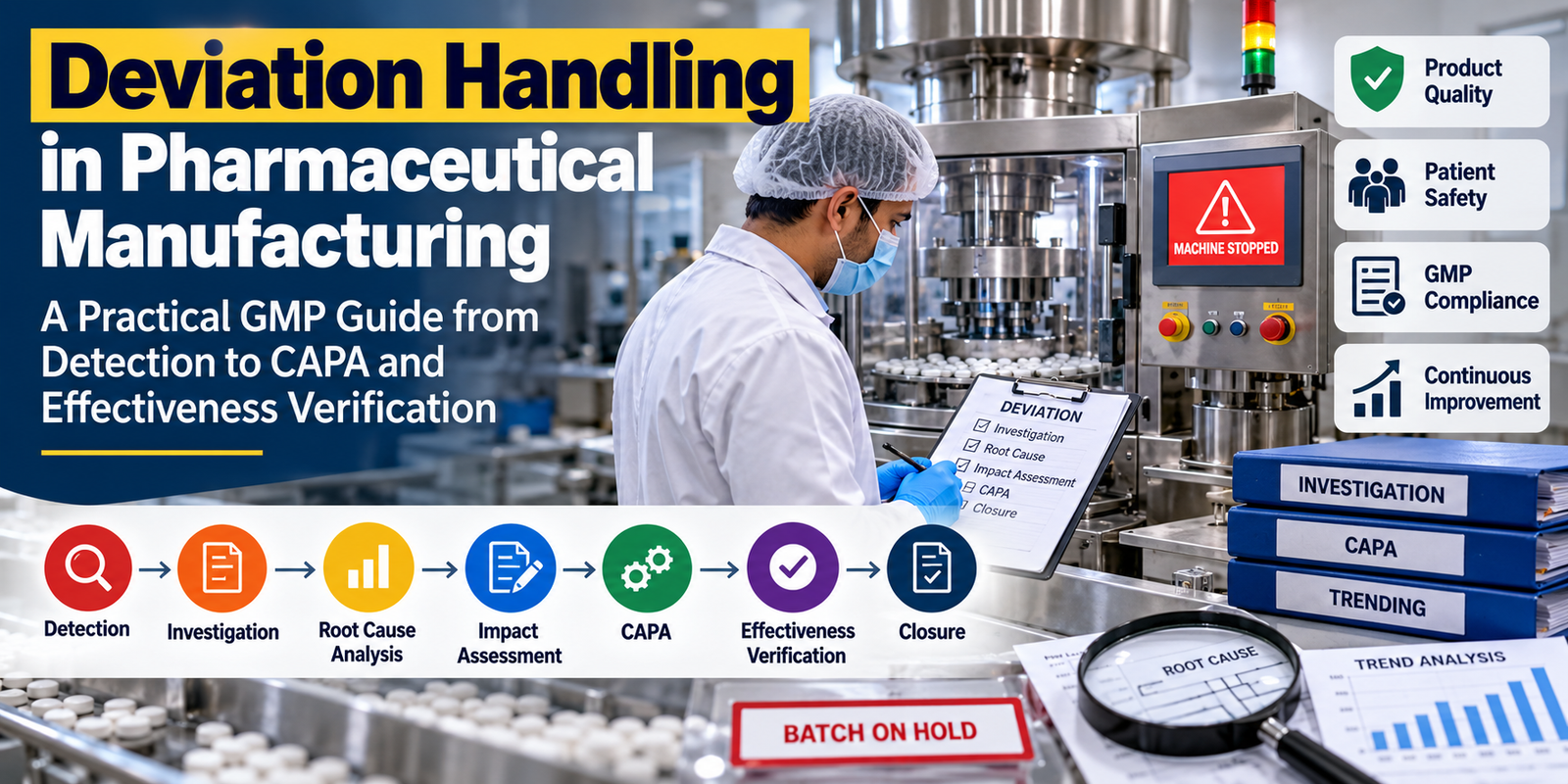
A tablet compression batch is running normally when the machine suddenly stops.
The operator checks the HMI and sees a repeated feeder motor alarm. The machine is restarted once, but the alarm returns. After troubleshooting, the machine is finally brought back into operation. The total stoppage time is 42 minutes.
At first glance, this may look like an equipment problem.
But from a GMP perspective, several questions immediately arise:
- Was the stoppage within the established operating or validated conditions?
- Was the product exposed to any risk during the stoppage?
- Was the hopper or feeder condition affected?
- Was the batch kept under appropriate control?
- Did the event affect any critical process parameter?
- Was any material added, removed or handled outside the approved procedure?
- Was the event recorded contemporaneously?
- Could similar events have occurred in previous batches?
- Does the equipment history show a recurring problem?
- Is a deviation required?
This is where effective deviation management begins.
A deviation is not simply a form that QA opens after something goes wrong. It is part of the pharmaceutical quality system used to understand departures from approved or established requirements, assess their potential impact, determine why they occurred and, where necessary, implement actions to prevent recurrence.
A well-managed deviation connects what happened on the shop floor with the broader quality system.
The sequence should ultimately lead from:
Detection → Immediate Action → Documentation → Assessment → Investigation → Root Cause → Impact Assessment → CAPA → Effectiveness Verification → Closure → Trending
The purpose is not to find someone to blame.
The purpose is to understand what happened, determine whether product quality or data integrity could have been affected, identify the real cause and strengthen the process where necessary.
EU GMP Chapter 1 explicitly expects deviations from established procedures to be documented and explained, significant deviations with potential quality impact to be investigated, and investigations to use a structured approach aimed at determining root cause. It also states that the level of effort and documentation should be commensurate with risk.
2. What is a Deviation in Pharmaceutical Manufacturing?
In practical GMP terms, a deviation is an unplanned departure from an approved procedure, established process, specification, instruction, validated condition, established limit or other approved requirement.
The exact definition and classification should always follow the organization’s approved Deviation Management SOP and pharmaceutical quality system.
A deviation may occur during manufacturing, packaging, testing, engineering, validation, computerized-system operation, documentation or other GMP activities.
Examples include:
- A manufacturing parameter exceeding an approved operating range
- An equipment failure during processing
- An HVAC differential-pressure excursion
- An unexpected interruption in a manufacturing step
- Use of equipment outside an approved condition
- A documentation error affecting GMP records
- An unexpected environmental-condition excursion
- A utility failure
- An unplanned interruption in a computerized system
- An incorrect material status or handling condition
- Failure to follow an approved SOP
- An unexpected cleaning-process event
Planned and unplanned deviations
Some organizations distinguish between planned deviations and unplanned deviations.
A planned deviation is an approved, controlled departure from an established requirement before the activity takes place, where the organization’s procedure permits such a mechanism.
An unplanned deviation occurs unexpectedly during execution.
The terminology and approval mechanism can vary between pharmaceutical companies. A planned deviation should never become a convenient way of bypassing an established GMP requirement.
Critical, major and minor deviations
Many pharmaceutical organizations classify deviations according to their potential impact, commonly using categories such as:
- Critical
- Major
- Minor
However, these categories are not universally defined by one global classification scheme for every company. The actual criteria should come from the site’s approved procedure and applicable regulatory framework.
The fundamental principle is risk-based classification.
A deviation that appears technically small may still have significant quality implications if it affects a critical process parameter, product-contact surface, data integrity or validated state.
3. Where Can Pharmaceutical Deviations Occur?
Deviation management is not limited to Production.
A mature quality system recognizes deviations across the entire operation.
Manufacturing
Examples include:
- Granulation endpoint excursion
- Compression parameter excursion
- Unexpected machine stoppage
- Coating temperature excursion
- Incorrect processing time
- Yield outside established expectation
Equipment
Examples include:
- Equipment failure
- Alarm malfunction
- Unexpected shutdown
- Use outside qualified condition
- Calibration-related discrepancy
- Preventive-maintenance failure
Facilities and utilities
Examples include:
- HVAC pressure excursion
- Temperature/humidity excursion
- Purified Water system abnormality
- Compressed-air failure
- Clean-steam issue
- Differential-pressure excursion
Materials
Examples include:
- Material identity discrepancy
- Incorrect material status
- Material issued incorrectly
- Unexpected material-condition problem
Documentation
Examples include:
- Missing entry
- Incorrect contemporaneous entry
- Incomplete record
- Uncontrolled document use
- Incorrect recording of a critical parameter
Computerized systems and data integrity
Examples include:
- SCADA/HMI alarm-data issue
- Electronic-record discrepancy
- Audit-trail concern
- Unauthorized or unexplained data modification
- System interruption affecting GMP records
FDA’s data-integrity guidance describes audit trails as chronological, computer-generated records that allow reconstruction of events involving creation, modification or deletion of electronic records.
4. Why Deviation Management Matters
The purpose of deviation management is broader than documentation.
An effective system protects:
Patient safety
The first concern is whether the event could affect the patient.
Product quality
A deviation may influence identity, strength, purity, quality, safety or other critical quality attributes.
Process control
Recurring deviations may indicate that the process is not operating in a sufficiently controlled state.
Data integrity
A deviation involving electronic records may have implications beyond the physical manufacturing event.
GMP compliance
Repeated poorly investigated deviations can expose weaknesses in the pharmaceutical quality system.
Continuous improvement
Deviation data can reveal opportunities for equipment reliability, process capability, procedural improvement and training.
The objective is therefore not merely to close a deviation.
The objective of deviation management is to understand why the event occurred, assess its impact and prevent recurrence where appropriate.
This philosophy is consistent with the pharmaceutical quality-system approach described in ICH Q10, where CAPA, change management and process/product monitoring are integrated elements of the quality system.
5. The Complete Deviation Lifecycle
A practical deviation lifecycle can be represented as:
Detection
↓
Immediate Action
↓
Deviation Recording
↓
Initial Assessment
↓
Risk Classification
↓
Investigation
↓
Root Cause Analysis
↓
Impact Assessment
↓
CAPA
↓
QA Review
↓
Approval
↓
Implementation
↓
Effectiveness Verification
↓
Closure
↓
Trending
Every stage has a purpose.
A common weakness in pharmaceutical organizations is treating these stages as administrative steps rather than connected scientific activities.
6. Deviation Detection and Immediate Actions
The first few minutes after a deviation can be extremely important.
Consider a compression machine that unexpectedly stops.
The operator should not immediately restart the machine repeatedly simply to get the batch moving.
The first question should be:
What is the current status of the product, equipment and process?
Depending on the situation and applicable SOP, immediate actions may include:
- Stop the activity if continuation could increase risk.
- Secure the equipment.
- Identify the product and batch status.
- Segregate or place material/batch on appropriate hold where required.
- Inform the responsible supervisor and QA.
- Record the actual event.
- Preserve relevant evidence.
- Preserve electronic information.
- Avoid undocumented adjustments or interventions.
The operator should record what was actually observed.
For example:
“At 14:22, compression machine stopped and feeder motor alarm appeared on HMI. Machine was not restarted. Production supervisor and QA were informed.”
This is much stronger than:
“Machine malfunctioned and was corrected.”
The first statement describes an observation.
The second already contains an interpretation.
Preserve evidence
Depending on the event, evidence may include:
- HMI screen information
- Alarm history
- SCADA records
- Equipment logbook
- BMR/BPR entries
- Photographs where permitted
- Samples
- Maintenance records
- Environmental data
- Electronic audit trails
- Calibration information
Never modify the event record to make the situation appear normal.
If an electronic record is relevant, its original information and applicable audit-trail information should be preserved according to the system’s controls and procedures.
7. Initial Deviation Assessment
Once the deviation is initiated, the initial assessment should establish facts.
A useful starting framework is:
What happened?
Describe the event objectively.
When did it happen?
Record date, time and duration.
Where did it happen?
Identify room, equipment, line or system.
Which product and batch were involved?
Identify the exact scope.
What process step was running?
For example:
- Granulation
- Compression
- Coating
- Packing
- Cleaning
Which approved requirement was not met?
This is critical.
A deviation should be connected to a specific requirement, procedure, parameter, limit or established condition.
What was the immediate condition of the product?
Was the material exposed?
Was the batch stopped?
Was it under controlled conditions?
Could quality be affected?
This question should be addressed scientifically, not simply assumed.
8. Deviation Classification and Risk Assessment
The initial assessment should support appropriate classification.
A risk assessment may consider:
- Severity
- Occurrence
- Detectability
Some organizations calculate an RPN (Risk Priority Number). Others use qualitative risk matrices or other approved methodologies.
There is no requirement that every pharmaceutical company use the same mathematical model.
The important point is that the approach should be scientifically justified, documented and consistent with the site’s quality-risk-management procedure.
Critical deviation
A critical deviation may involve a potentially serious impact on:
- Patient safety
- Product quality
- Data integrity
- Critical GMP requirements
Major deviation
A major deviation may have a significant potential impact and generally requires a detailed investigation.
Minor deviation
A minor deviation may have limited impact and no significant effect on product quality or patient safety.
Again, the classification criteria must come from the organization’s approved quality system.
ICH Q9 provides the broader framework for applying quality risk management principles to pharmaceutical quality decisions. Risk management should help determine the level of effort and formality appropriate to the issue rather than becoming a purely numerical exercise.
9. Deviation Investigation
This is where the quality of the entire deviation process is determined.
A good investigation answers five basic questions:
What happened?
Why did it happen?
What was affected?
How far does the impact extend?
What should be done to prevent recurrence?
9.1 Define the problem clearly
Avoid:
“Machine problem occurred.”
Use:
“Compression machine stopped for 42 minutes during Batch XYZ after repeated feeder motor alarms were displayed on the HMI.”
The second statement provides:
- Equipment
- Duration
- Batch
- Process
- Observable event
It gives the investigation team a starting point.
9.2 Collect evidence
The investigation should be evidence-driven.
Depending on the event, review:
- BMR/BPR
- Equipment logbooks
- Equipment alarm history
- SCADA/HMI data
- Electronic records
- Audit trails
- SOPs
- Training records
- Preventive-maintenance records
- Breakdown history
- Calibration records
- Qualification records
- Validation documents
- Change controls
- Previous deviations
- CAPA records
- Environmental monitoring data
- Laboratory results
- Material records
- Personnel interviews
The investigation should not start with the conclusion.
It should start with evidence.
9.3 Establish a timeline
A timeline often exposes relationships that are not obvious from the initial deviation description.
For example:
13:45 – Batch compression started
14:22 – Feeder motor alarm occurred
14:23 – Machine stopped
14:25 – Supervisor informed
14:31 – QA informed
14:40 – Maintenance inspection started
14:52 – Motor connection inspected
15:03 – Fault identified
15:10 – Corrective maintenance completed
15:18 – Machine restart
15:25 – Process verification completed
This timeline provides a factual basis for the investigation.
9.4 Interview personnel without creating a blame culture
Operators often know details that cannot be obtained from records.
A good interviewer asks:
“What did you observe?”
rather than:
“Why did you make this mistake?”
The first question encourages factual information.
The second may immediately create defensiveness.
The purpose of an interview is to reconstruct the event, not to force a predetermined root cause.
9.5 Review historical information
One of the most frequently missed parts of deviation investigation is historical review.
Ask:
- Has this equipment had the same alarm before?
- Have similar deviations occurred?
- Has this product shown the same issue?
- Has the same operator or shift been associated with similar events?
- Was there a previous CAPA?
- Was a similar change implemented?
- Has maintenance history shown recurring failure?
A deviation that occurs five times should not be treated as five unrelated events.
It may represent one systemic problem.
10. Root Cause Analysis
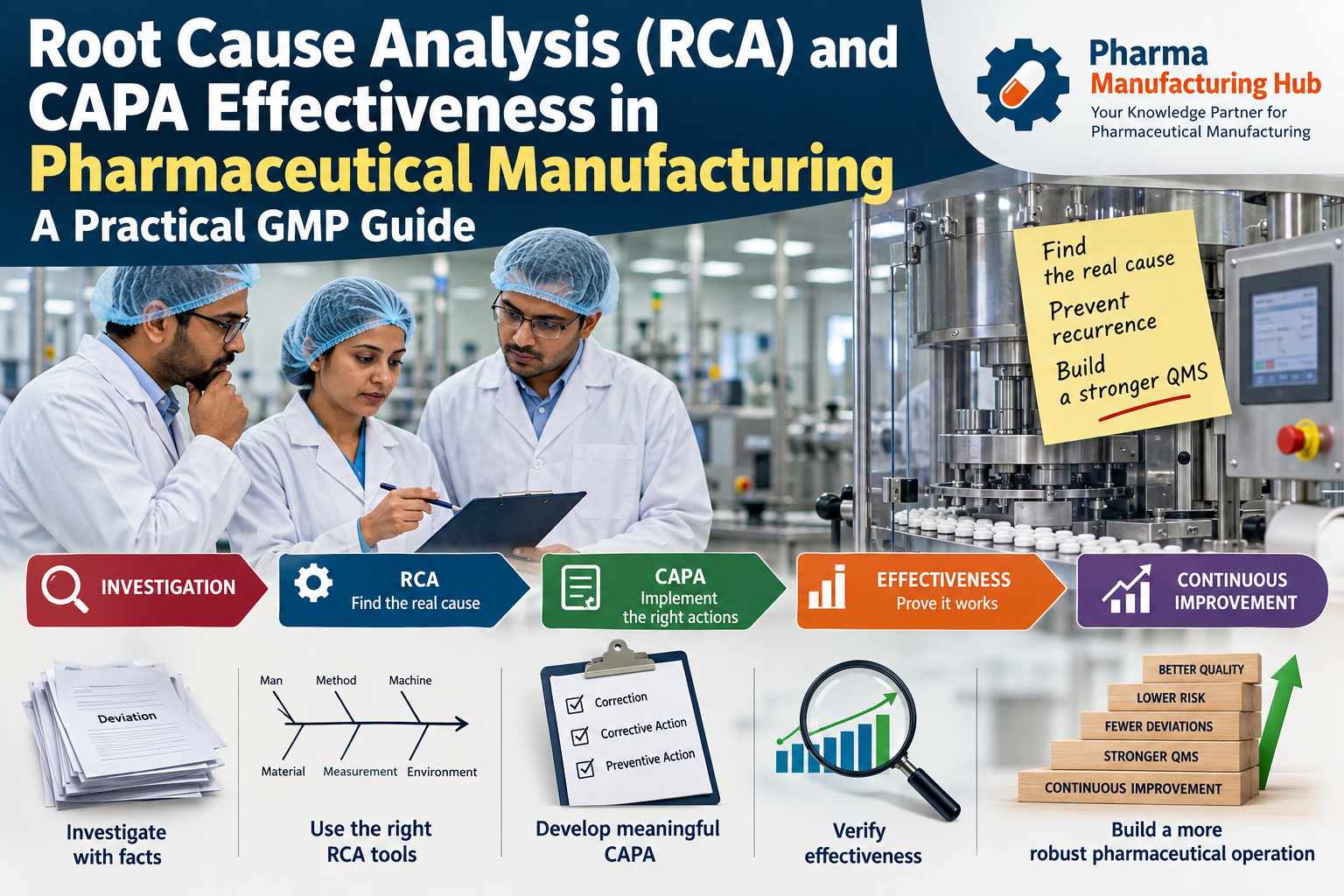
Root cause analysis is often the weakest part of deviation investigations.
A common investigation conclusion is:
“Operator error.”
That may describe what happened at the human-performance level, but it does not necessarily explain why the system allowed the error to occur.
A useful hierarchy is:
Symptom → Immediate Cause → Root Cause → Systemic Cause
Consider tablet weight variation.
Symptom
Tablet weight variation was observed.
Immediate cause
Compression force/feed conditions became unstable.
Further question
Why did the process become unstable?
Perhaps the feeder condition was poor.
Further question
Why was the feeder condition poor?
Perhaps preventive maintenance did not identify the developing condition.
Further question
Why did preventive maintenance not identify it?
Perhaps the maintenance inspection criterion was not sufficiently sensitive.
Now the investigation is moving from operator behavior toward the system.
Practical RCA tools
5 Why
Useful for relatively straightforward causal chains.
Fishbone/Ishikawa
Useful for organizing possible causes under categories such as:
- Man
- Machine
- Method
- Material
- Measurement
- Environment
Fault Tree Analysis
Useful when multiple combinations of failures could produce an event.
Pareto analysis
Useful for recurring deviations where a small number of causes may account for a large proportion of events.
Process mapping
Useful when the event involves handoffs or multiple process steps.
Trend analysis
Useful when investigating recurrence.
FMEA
FMEA can help understand potential failure modes and risks, particularly when evaluating process or equipment risks. It should not automatically be used as a substitute for investigating an actual event.
Important principle
Operator error should not automatically be accepted as the root cause.
If an operator made an error, investigate why.
Possible contributing factors include:
- Inadequate training
- Poorly written SOP
- Ambiguous instruction
- Similar-looking controls
- Excessive workload
- Poor equipment design
- Inadequate line clearance
- Inadequate supervision
- Poor human-machine interface
- Inadequate process understanding
- Inadequate maintenance
- Weak procedural controls
The objective is not to remove accountability.
It is to understand the complete causal chain.
11. Impact Assessment
Root cause and impact assessment are different questions.
Root cause asks: Why did it happen?
Impact assessment asks: What could have been affected?
The impact assessment should consider:
Product
Could there be an impact on:
- Identity?
- Strength?
- Quality?
- Purity?
- Safety?
- Efficacy?
- Critical quality attributes?
Batch
Determine whether the impact is limited to:
- A portion of the batch
- The entire batch
- Previous batches
- Subsequent batches
Equipment
Could the equipment remain unsuitable or inadequately controlled?
Process
Was the validated or established process state affected?
Validation status
Could the event challenge an established validated condition?
Cleaning
Could cleaning status or cross-contamination controls be affected?
Data integrity
Could electronic records have been lost, modified, overwritten or rendered unreliable?
Other products
Could other products manufactured on the same equipment be affected?
This is where experienced investigators add significant value.
A deviation involving one batch may reveal a broader issue.
12. CAPA After a Deviation
CAPA should address the identified problem at the appropriate level.
Three concepts should be clearly separated.
Correction
An immediate action that addresses the observed condition.
Example: Replace a failed feeder motor.
Corrective action
An action intended to eliminate the cause of an identified problem and prevent recurrence.
Example: Revise preventive-maintenance inspection criteria after identifying an inadequate inspection method as a contributing root cause.
Preventive action
An action intended to prevent occurrence or recurrence of similar problems where applicable to the quality-system framework.
Example: Evaluate equivalent feeder systems across other compression machines and implement a common inspection standard where justified.**
Terminology and CAPA structure may vary among quality systems, but the underlying principle is that actions should address the cause and risk appropriately.
WHO describes CAPA as part of a systematic approach to investigating discrepancies and addressing their causes, with actions related to the risk, size and nature of the problem.
Why “retraining” is often a weak CAPA
Suppose an operator misses a critical process check because the SOP contains an ambiguous instruction.
The CAPA:
“Retrain the operator.”
does not address the document weakness.
Similarly, if an equipment failure results from inadequate preventive maintenance, training the operator is unlikely to prevent recurrence.
Retraining can be appropriate where a genuine knowledge or competency gap is demonstrated.
It should not become the automatic CAPA for every human-performance event.
13. CAPA Effectiveness Verification
A CAPA being implemented does not automatically mean it is effective.
This distinction is essential.
Suppose the CAPA is:
“Revise preventive-maintenance procedure and train maintenance personnel.”
That confirms implementation.
But how will effectiveness be demonstrated?
Possible criteria include:
- No recurrence over a defined number of batches
- Reduction in equipment alarms
- Reduction in repeat deviations
- Improved process performance
- Improved equipment reliability
- No recurrence during a defined monitoring period
- Successful audit of the revised process
The effectiveness criterion should be defined when the CAPA is established.
For example:
“Review feeder-related breakdowns for the next six commercial batches and confirm that no recurrence of the identified failure mode occurs.”
The monitoring period should be scientifically justified rather than selected merely to close the CAPA quickly.
14. Deviation Closure
QA closure should confirm that the investigation is complete and adequately supported.
Before closure, the organization should verify, as applicable:
- Event description is complete
- Immediate actions are documented
- Investigation is scientifically justified
- Evidence has been reviewed
- Root cause is supported by evidence
- Contributing causes have been considered
- Product impact is assessed
- Batch impact is assessed
- CAPA is appropriate
- CAPA implementation is documented
- Effectiveness requirements are satisfied
- Required approvals are complete
Overdue deviations can become a quality-system concern, particularly where delays are recurring or investigations are repeatedly extended without adequate justification.
The objective should not be “close before the due date.”
The objective should be:
Complete a scientifically sound investigation within an appropriate and controlled timeframe.
EU GMP Chapter 1 specifically links investigation effort and documentation to risk and calls for effective measures to ensure CAPA activity is timely and effective.
15. Common Mistakes in Deviation Handling
1. Delayed deviation initiation
Problem: The event is discovered but documented much later.
Better approach: Record the event as soon as reasonably practicable according to the site’s procedure.
2. Incomplete event description
Problem: “Machine stopped.”
Better approach: Record what, when, where, duration and relevant conditions.
3. Starting with assumptions
Problem: Investigation begins with “operator error.”
Better approach: Collect evidence before forming the conclusion.
4. Blaming the operator
Problem: The investigation stops at human error.
Better approach: Examine procedure, training, equipment, workload, interface and system controls.
5. Weak RCA
Problem: “Equipment failure” is recorded as root cause.
Better approach: Determine the actual failure mechanism and why existing controls did not prevent or detect it.
6. Ignoring historical deviations
Problem: The current event is treated as isolated.
Better approach: Search historical records for similar events.
7. Poor impact assessment
Problem: Only the current batch is considered.
Better approach: Evaluate previous, current and subsequent potentially affected batches/products.
8. CAPA limited to retraining
Problem: Training is used for every human-performance deviation.
Better approach: Match CAPA to the demonstrated root cause.
9. Failure to check similar equipment
Problem: One machine is corrected without assessing equivalent systems.
Better approach: Conduct a justified horizontal assessment.
10. No effectiveness verification
Problem: CAPA is closed immediately after implementation.
Better approach: Establish measurable effectiveness criteria.
11. Poor documentation
Problem: Evidence exists but is not adequately documented.
Better approach: Make the investigation reconstructable.
12. Ignoring data integrity
Problem: Electronic records are not reviewed even though the event involves a computerized system.
Better approach: Assess relevant audit trails, electronic records and system data.
13. Repeated investigation extensions
Problem: Extensions become routine.
Better approach: Plan investigation activities, escalate obstacles and justify unavoidable extensions.
14. Treating recurring deviations independently
Problem: Five similar deviations produce five separate investigations.
Better approach: Trend the events and determine whether a systemic CAPA is required.
16. Five Practical Pharmaceutical Deviation Examples
Example 1: Compression Machine Stoppage
Event
Compression machine stopped for 42 minutes because of repeated feeder motor alarms.
Immediate Action
Machine stopped and batch status assessed. QA and Engineering informed. Relevant HMI and equipment records preserved.
Investigation
Review:
- HMI alarm history
- Maintenance records
- Equipment logbook
- BMR
- Previous breakdowns
- Motor condition
- Preventive-maintenance records
Root Cause
Investigation identifies progressive motor deterioration that was not detectable through the existing preventive-maintenance inspection method.
Impact Assessment
Assess product exposure during stoppage, compression parameters, material condition and batch quality.
CAPA
Improve inspection methodology and revise preventive-maintenance criteria where justified.
Effectiveness Check
Monitor feeder-related failures over a defined number of subsequent batches and confirm no recurrence of the identified failure mode.
Example 2: Granulation Endpoint Excursion
Event
Granulation endpoint parameter exceeded the established process range.
Immediate Action
Stop further processing and notify QA. Identify material processed during the excursion.
Investigation
Review:
- Granulator records
- Process parameters
- Operator entries
- Equipment condition
- Sensor calibration
- Recipe settings
- Historical batches
Root Cause
Investigation determines whether the excursion resulted from equipment, sensor, recipe, procedural or process-control factors.
Impact Assessment
Assess granule properties and downstream impact on compression and finished-product quality.
CAPA
Address the demonstrated cause rather than simply retraining the operator.
Effectiveness
Monitor subsequent granulation batches for recurrence and relevant process-performance indicators.
Example 3: Coating Temperature Excursion
Event
Inlet or product temperature moves outside the approved operating range.
Immediate Action
Assess product status and stabilize the process according to approved procedures.
Investigation
Review:
- Temperature trends
- HVAC condition
- Heater performance
- Airflow
- Spray parameters
- Operator actions
- Equipment alarms
Root Cause
Determine whether the cause is equipment, control-system, utility, recipe or procedural.
Impact Assessment
Assess possible impact on coating appearance, weight gain, moisture-related attributes and other relevant product characteristics.
CAPA
Address the confirmed cause.
Effectiveness
Review temperature trends across subsequent batches.
Example 4: HVAC Differential-Pressure Excursion
Event
Room differential pressure falls below the established operating requirement.
Immediate Action
Assess room and material status, stop or continue activities according to approved procedures and inform QA/Engineering.
Investigation
Review:
- BMS/HVAC trends
- AHU performance
- Door-opening history
- Filter condition
- Pressure sensors
- Calibration
- Maintenance records
Impact Assessment
Consider the duration, room classification, activities occurring during the event and contamination-control implications.
CAPA
Address the confirmed HVAC or control-system cause.
Effectiveness
Monitor pressure performance and verify stable operation over the defined period.
Example 5: SCADA/HMI Electronic Record Issue
Event
A manufacturing SCADA/HMI system fails to retain or display a relevant alarm record.
Immediate Action
Protect the batch and preserve available electronic information. Notify QA, Engineering/Automation and the system owner.
Investigation
Review:
- Audit trail
- Alarm history
- System logs
- Backup data
- Server status
- Network events
- User activity
- System configuration
- Previous similar events
Root Cause
Determine whether the problem originated from software, hardware, configuration, network, user access or another system component.
Impact Assessment
Assess whether the missing information affects the ability to reconstruct the manufacturing event and whether any GMP record has been compromised.
CAPA
Correct the technical/systemic cause and evaluate whether other systems or records require assessment.
Effectiveness
Verify successful data capture and review after implementation, including appropriate system records and audit-trail functionality.
Electronic records require particular care because data-integrity expectations include maintaining reliable and reconstructable records. FDA guidance specifically discusses the role of audit trails in reconstructing electronic-record history.
17. Deviation vs Change Control vs OOS vs OOT vs Incident
These quality systems should not be treated as interchangeable.
| System | Primary purpose |
|---|---|
| Deviation | Management of an unplanned departure from an approved or established requirement |
| Change Control | Controlled assessment and implementation of a planned change |
| OOS | Investigation of a laboratory result outside an established specification |
| OOT | Assessment of a result or trend that is unexpected relative to historical/process expectations, even when within specification |
| Incident | Event managed under the organization’s incident procedure and requiring assessment according to the nature of the event |
| CAPA | Actions addressing identified causes or systemic quality risks |
There can be overlap.
For example, a deviation investigation may identify the need for a formal change control. An OOS investigation may identify a laboratory deviation. A recurring incident may result in CAPA.
The applicable system should therefore be determined according to the organization’s procedures and the actual nature of the event.
18. Regulatory Expectations
Deviation management sits within the broader pharmaceutical quality system.
US FDA
US GMP requirements include investigation of unexplained discrepancies and failures associated with batches or components. FDA continues to cite inadequate investigations as a significant CGMP deficiency in inspection and enforcement activity. For example, recent FDA warning letters have cited failures to thoroughly investigate unexplained discrepancies under 21 CFR 211.192.
This reinforces a practical lesson:
An investigation should be evidence-based rather than a justification for a predetermined conclusion.
EU GMP
EU GMP Chapter 1 states that deviations from established procedures should be documented and explained, significant deviations with potential quality impact should be investigated, and a structured approach should be used to determine root cause. It also connects CAPA effectiveness with timely and risk-appropriate quality-system management.
WHO GMP
WHO describes GMP as a quality-assurance system intended to ensure medicinal products are consistently produced and controlled according to appropriate quality standards. Its GMP framework emphasizes defined, validated and documented manufacturing and control processes.
ICH Q9
ICH Q9 provides the quality-risk-management framework used to support science- and risk-based decisions.
ICH Q10
ICH Q10 integrates CAPA, change management and process/product monitoring within the pharmaceutical quality system and emphasizes maintaining a state of control and continual improvement.
PIC/S
PIC/S GMP principles are widely used as a reference framework by pharmaceutical inspectors and manufacturers and are closely aligned with international GMP expectations.
Data Integrity
For deviations involving computerized systems, the investigation should consider the reliability and reconstructability of electronic records. FDA’s data-integrity guidance discusses audit trails and the importance of preventing data from being lost or obscured.
Regulatory requirements and interpretation can vary by jurisdiction, product, manufacturing authorization and applicable market. Companies should always assess the applicable requirements for the products and markets concerned.
19. Deviation Trending and Quality Metrics
A deviation system becomes much more valuable when individual records are converted into organizational knowledge.
Useful metrics include:
- Total number of deviations
- Critical/Major/Minor distribution
- Department-wise deviations
- Product-wise deviations
- Equipment-wise deviations
- Process-wise deviations
- Recurrence rate
- Average closure time
- Number of overdue deviations
- Top root causes
- CAPA recurrence
- CAPA effectiveness rate
For example, suppose a site records:
- 32 equipment-related deviations
- 18 documentation deviations
- 12 process deviations
- 8 HVAC deviations
The number alone is not enough.
Management should ask:
Which equipment is contributing most?
Which failure modes repeat?
Are deviations concentrated on a particular process?
Did previous CAPAs work?
Are the same root causes appearing under different deviation numbers?
This is where deviation management becomes an operational-excellence tool.
Trending can feed:
- Management review
- CAPA
- Preventive maintenance
- Training strategy
- Process improvement
- Validation review
- Quality risk assessment
- Audit preparation
- Continuous improvement initiatives
20. Digital Deviation Management
Many pharmaceutical companies are moving from paper-based systems to electronic quality-management platforms.
Modern eQMS platforms can support:
- Electronic deviation initiation
- Workflow routing
- Electronic approvals
- Automated escalation
- CAPA linkage
- Investigation tracking
- Due-date monitoring
- Dashboard reporting
- Trend analysis
- Electronic signatures
- Audit trails
- Quality metrics
Integration with other systems can add significant value.
Examples include:
MES ↔ eQMS
Manufacturing events can potentially be connected to deviation workflows.
LIMS ↔ eQMS
Laboratory events and investigations can be linked.
ERP ↔ eQMS
Material and batch information can be connected.
SCADA/HMI ↔ eQMS
Equipment alarms and process events can provide investigation evidence.
However, digitization does not automatically improve investigation quality.
A poorly designed electronic workflow can simply make a poor paper process faster.
The quality of:
- Data
- Workflow
- System configuration
- User roles
- Audit trails
- Validation
- Procedures
- Investigation methodology
still matters.
21. How AI Could Transform Deviation Management
AI has significant potential in deviation management, but it should support qualified personnel rather than replace scientific and QA judgment.
Potential applications include:
Automatic deviation categorization
AI could identify whether an event is likely related to equipment, process, documentation, material, facility or another category.
Similar-event detection
An AI system could compare a new deviation with historical records and identify potentially similar events.
Investigation support
AI could help investigators locate:
- Similar deviations
- Previous CAPAs
- Equipment history
- Related change controls
- Historical trends
Root-cause hypothesis generation
AI could propose possible causal pathways for investigators to evaluate.
The key word is hypothesis.
An AI-generated explanation should not automatically become the approved root cause.
CAPA support
AI could suggest possible CAPA approaches based on historical cases and identified causes.
These suggestions require qualified review.
Recurrence prediction
Historical data could potentially be analyzed to identify equipment, products or processes with elevated recurrence risk.
Document review
AI can potentially identify missing information, inconsistent dates, incomplete investigation logic or unsupported conclusions.
But several controls are essential.
Data integrity
AI must work with trustworthy source data.
Model validation
Where AI functionality becomes part of a regulated computerized system or influences GxP decisions, the applicable validation and assurance strategy must be carefully assessed.
Human oversight
Qualified personnel remain responsible for the final quality decision.
Explainability
Investigators and QA should be able to understand why an AI system produced a recommendation when that recommendation influences a GMP decision.
Audit trail
Relevant system activity must remain appropriately traceable.
GxP governance
AI should operate within the pharmaceutical quality system, applicable procedures and risk-based controls.
The future is therefore unlikely to be “AI investigates deviations without humans.”
A more realistic model is:
Human Investigator + Trusted Data + AI-Assisted Analysis + QA Oversight
22. 15 Practical Deviation Interview Questions and Answers
1. What is a deviation?
A deviation is an unplanned departure from an approved or established requirement, procedure, process, parameter or condition, managed according to the organization’s quality system.
2. What is the first action when a deviation occurs?
First protect the product, process and personnel as applicable. Stop or control the activity where required, assess product/equipment status, inform the appropriate personnel and document the actual event.
3. Should every equipment breakdown be treated as a deviation?
Not automatically. The event should be assessed against applicable procedures, established limits, GMP impact and the site’s deviation criteria.
4. What is the difference between correction and corrective action?
Correction addresses the immediate problem. Corrective action addresses the cause of an identified problem to prevent recurrence.
5. Is operator error always the root cause?
No. Operator error may be an immediate cause or contributing factor. The investigation should determine why the system allowed the error to occur.
6. What documents should be reviewed during an investigation?
Depending on the event: BMR/BPR, SOPs, equipment logbooks, electronic records, alarm history, training, maintenance, calibration, qualification, validation, previous deviations, CAPA and change controls.
7. Why is historical review important?
It helps determine whether the event is isolated or recurring and whether previous CAPAs were effective.
8. What is impact assessment?
It is the systematic evaluation of whether and to what extent the deviation could affect product, batch, equipment, process, validation status, data integrity or other products/batches.
9. Why is retraining often an inadequate CAPA?
Because training does not correct equipment, procedure, design, process or system weaknesses unless the investigation demonstrates that training was actually the root cause.
10. What is deviation effectiveness?
It means demonstrating that the actions taken have achieved their intended outcome and that the identified problem has not recurred within the defined monitoring criteria.
11. What is a recurring deviation?
A deviation that repeats the same or sufficiently similar failure mode, cause or condition and may indicate inadequate previous corrective action or a systemic problem.
12. What should be checked for a SCADA-related deviation?
Review system logs, alarm history, audit trails where applicable, user activity, configuration, backups, system health, network information and relevant manufacturing records.
13. Can a deviation lead to change control?
Yes. If the investigation determines that a permanent change to equipment, process, software, procedure or another controlled element is required, the applicable change-control process may be initiated.
14. What is the difference between OOS and deviation?
OOS relates specifically to a laboratory result outside an established specification. A deviation concerns an unplanned departure from an approved or established requirement. An OOS investigation may itself identify a deviation or another quality-system issue.
15. What is the most important principle in deviation investigation?
Follow the evidence rather than the assumption.
A strong investigation explains what happened, why it happened, what was affected and what will prevent recurrence.
23. Practical Deviation Investigation Checklist
Use the following as a practical investigation checklist.
Event
☐ Event identified
☐ Immediate action taken
☐ QA informed
☐ Product/batch status assessed
☐ Equipment/system status secured
☐ Deviation initiated
Initial assessment
☐ Initial risk assessment completed
☐ Classification assigned according to SOP
☐ Applicable procedure/requirement identified
☐ Potential product impact assessed
Investigation
☐ Evidence collected
☐ BMR/BPR reviewed
☐ Equipment records reviewed
☐ Electronic data reviewed where applicable
☐ Alarm history reviewed
☐ SOP reviewed
☐ Training records reviewed
☐ Maintenance records reviewed
☐ Calibration records reviewed
☐ Qualification/validation status reviewed where relevant
☐ Historical deviations reviewed
☐ Change controls reviewed where relevant
☐ Timeline established
☐ Personnel interviewed where necessary
RCA and impact
☐ Immediate cause identified
☐ Contributing factors evaluated
☐ Root cause scientifically justified
☐ Product impact assessed
☐ Batch impact assessed
☐ Previous/subsequent batches assessed
☐ Other products/equipment assessed where appropriate
☐ Data-integrity impact assessed where applicable
CAPA
☐ Correction completed
☐ Corrective action defined
☐ Preventive/systemic action considered
☐ CAPA approved
☐ CAPA implemented
☐ Effectiveness criteria established
☐ Effectiveness verified
Closure
☐ Investigation report complete
☐ Supporting evidence attached
☐ QA review completed
☐ Required approvals completed
☐ Deviation closed
☐ Trend updated
24. Frequently Asked Questions
What is deviation handling in pharmaceutical manufacturing?
Deviation handling is the controlled process used to document, assess, investigate and resolve an unplanned departure from an approved or established pharmaceutical manufacturing requirement.
What are the main steps in deviation investigation?
The typical lifecycle includes detection, immediate action, documentation, initial assessment, risk classification, investigation, root cause analysis, impact assessment, CAPA, effectiveness verification, QA review, closure and trending.
What is a GMP deviation?
A GMP deviation is a departure from an established GMP-related procedure, requirement, process condition or approved instruction that requires assessment according to the organization’s quality system.
What is root cause analysis in pharma?
Root cause analysis is a structured investigation used to determine the underlying cause or causes that allowed a quality event to occur, rather than stopping at the immediate symptom.
Is operator error a root cause?
Not necessarily. Operator error may be an immediate cause, but the investigation should determine whether procedural, training, equipment, process-design, workload or system factors contributed to the event.
What is CAPA in the pharmaceutical industry?
CAPA is a quality-system mechanism used to address identified problems and their causes through appropriate corrective and preventive actions, with effectiveness assessed where required.
What is deviation risk assessment?
Deviation risk assessment evaluates the potential severity, likelihood and detectability or other risk factors associated with an event to determine the appropriate level of investigation and action.
How long should a deviation remain open?
The timeframe should be defined or controlled by the organization’s procedure and should be appropriate to the complexity and risk of the investigation. Delays should be justified and controlled.
What is deviation trending?
Deviation trending is the analysis of deviation data over time to identify recurring problems, departments, products, equipment, processes or root causes that may require systemic action.
Can AI be used for deviation investigation?
AI can assist with tasks such as historical-event comparison, trend analysis, document review and investigation support. Final GMP decisions should remain under appropriate qualified human oversight and within the applicable quality-system controls.
25. Key Takeaways
- A deviation should be documented promptly and objectively.
- Immediate action should protect the product, process and data while the investigation begins.
- Do not start with a predetermined root cause. Follow the evidence.
- Operator error should not automatically be accepted as the root cause.
- Impact assessment is as important as root cause analysis.
- Historical deviations should be reviewed to identify recurrence.
- CAPA should address the demonstrated cause, not simply provide a convenient action.
- CAPA implementation is not the same as CAPA effectiveness.
- Electronic records and data integrity must be considered whenever computerized systems are involved.
- Deviation trending converts individual failures into organizational learning.
The strongest pharmaceutical organizations do not measure the quality of their deviation system only by how quickly deviations are closed.
They look at whether investigations are scientifically sound, whether root causes are meaningful, whether CAPAs actually work and whether recurrence is reducing.
A deviation is not simply a quality record.
It is a signal from the manufacturing process.
The right response is to understand that signal.
A good deviation investigation does not search for someone to blame. It searches for the reason the system allowed the event to occur and establishes effective actions to prevent recurrence.
References
- U.S. FDA — 21 CFR 211.192, Production Record Review — Investigation of unexplained discrepancies and batch-related failures. Legal Information Institute
- European Commission — EU GMP, Volume 4, Chapter 1: Pharmaceutical Quality System — Deviations, investigations, root cause analysis and CAPA. Public Health
- ICH Q9(R1) — Quality Risk Management — Quality-risk-management principles and tools. European Medicines Agency (EMA)
- ICH Q10 — Pharmaceutical Quality System — CAPA, change management, monitoring and continual improvement. U.S. Food and Drug Administration
- U.S. FDA — Data Integrity and Compliance With Drug CGMP: Questions and Answers — Data integrity, electronic records and audit trails. U.S. Food and Drug Administration
- ICH — Quality Guidelines — Official repository for ICH pharmaceutical quality guidelines. ICH
- EMA — ICH Q9(R1) Quality Risk Management — European regulatory reference for pharmaceutical quality-risk management.
About the Author
Ramesh Palav is a pharmaceutical manufacturing professional with extensive experience in OSD/tablet manufacturing, GMP compliance, qualification and validation, QMS, CAPA, deviation management, audits, computerized system validation and continuous improvement.
His professional experience covers pharmaceutical manufacturing operations including granulation, compression and coating, along with equipment, facility and utility qualification, validation, documentation, regulatory compliance and manufacturing excellence initiatives.
Through Pharma Manufacturing Hub, he shares practical knowledge on pharmaceutical manufacturing, GMP, quality systems, validation, digital transformation, operational excellence and career development for pharmaceutical profession