
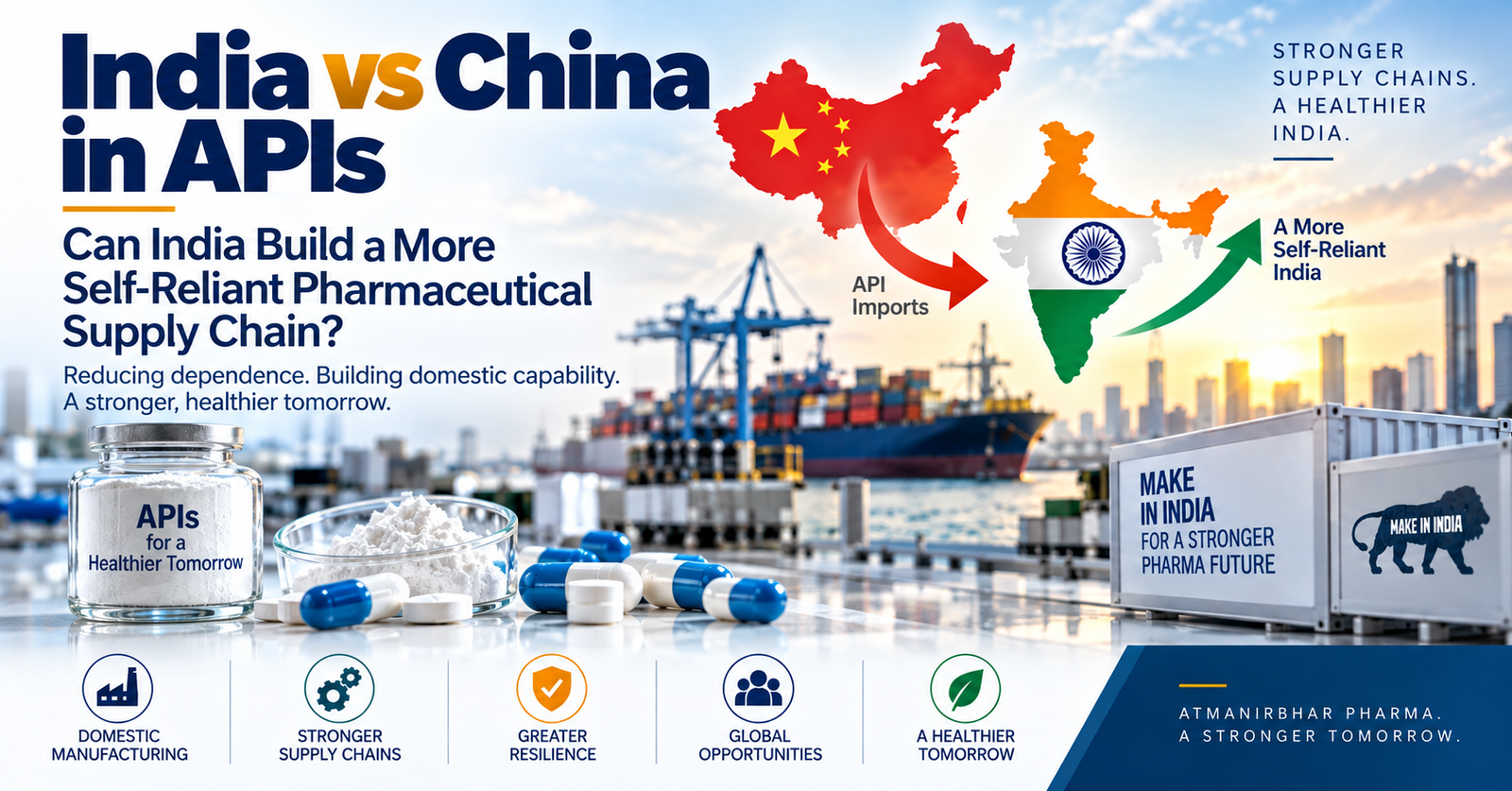
India’s pharmaceutical industry has built a global reputation for affordable medicines. But behind many of those medicines lies a supply chain in which China still plays a dominant role. The next phase of India’s pharma story may depend on how successfully that dependence can be reduced.
India is often described as the “pharmacy of the world.”
The description is justified.
Indian pharmaceutical companies supply medicines to markets across the globe, with a particularly strong position in generic formulations. The country has developed large-scale manufacturing capabilities, a deep scientific talent pool and an extensive network of formulation plants, contract manufacturers and exporters.
But there is an uncomfortable contradiction behind this success.
India is exceptionally strong in finished medicines, yet it continues to depend heavily on imports for several pharmaceutical raw materials.
And the largest source of those imports is China.
According to the Government of India, during FY2024-25, India imported around US$4.35 billion worth of 200 categories of APIs, bulk drugs and drug intermediates. China accounted for approximately 73.7% of those imports by value.
That number should not be interpreted as meaning that 73.7% of all APIs used by India come from China. It refers specifically to the government’s identified basket of 200 API, bulk-drug and drug-intermediate categories.
The distinction is important.
But the strategic message is still clear.
India’s pharmaceutical manufacturing ecosystem remains significantly exposed to Chinese supply chains.
The question now is whether India can change that equation.
The problem began long before today’s geopolitical tensions
India’s dependence on Chinese pharmaceutical raw materials did not appear overnight.
Over several decades, the economics of pharmaceutical manufacturing changed.
Chinese manufacturers developed enormous production capacity for chemicals, intermediates and APIs. Scale, integrated chemical supply chains, comparatively competitive costs and infrastructure helped Chinese companies become major global suppliers.
At the same time, Indian manufacturers increasingly focused on formulations.
The result was an interesting division of labour.
India became exceptionally competitive in finished medicines.
China became extremely competitive in many upstream pharmaceutical inputs.
For pharmaceutical companies, the economics were difficult to ignore.
Why invest heavily in an API plant when an established supplier can provide the material at a competitive price?
For years, that model worked.
Then the world changed.
COVID-19 exposed the vulnerability
The pandemic demonstrated what happens when global pharmaceutical supply chains are disrupted.
Factory shutdowns, logistics problems, transportation restrictions and uncertainty around international trade created concerns about the availability of critical raw materials.
For India, the issue was particularly sensitive because pharmaceutical manufacturing depends on a continuous supply of APIs, intermediates and key starting materials.
A formulation plant cannot continue producing medicines indefinitely if critical inputs are unavailable.
This transformed API dependence from a procurement issue into a pharmaceutical-security issue.
The Government of India has explicitly identified risks including single-source vulnerability, price volatility and predatory pricing associated with excessive dependence on imports.
That is why the API debate today is fundamentally different from the debate of ten or fifteen years ago.
It is no longer simply about cost.
It is about resilience.
China remains difficult to replace
There is another reality that needs to be acknowledged.
India cannot simply decide to stop importing APIs from China.
That would neither be commercially practical nor strategically sensible.
China has built a formidable pharmaceutical manufacturing ecosystem.
It has chemical intermediates.
It has upstream raw-material suppliers.
It has large-scale plants.
It has manufacturing clusters.
It has infrastructure.
And, importantly, it has developed supply chains that can often compete aggressively on price.
Rebuilding an equivalent ecosystem in India will require significant capital and time.
The objective therefore should not be described as “ending imports from China.”
A more realistic objective is:
Reduce excessive concentration, develop domestic capabilities in critical products and create multiple reliable sources of supply.
That is a much more achievable—and strategically sound—goal.
India has already started rebuilding the API base
The encouraging part of this story is that India is not starting from zero.
The Government’s Production Linked Incentive (PLI) Scheme for Bulk Drugs was specifically designed to encourage domestic manufacturing of 41 identified critical KSMs, drug intermediates and APIs.
The scheme has a budgetary outlay of ₹6,940 crore.
The latest government data show substantial progress.
By December 2025:
- 48 greenfield projects had been approved.
- Actual investment had reached approximately ₹4,814 crore against a committed investment of ₹4,329.95 crore.
- Domestic manufacturing capacity of approximately 56,800 tonnes per year had been established for 28 critical products.
- Cumulative sales had reached approximately ₹2,720 crore, including exports of ₹527.96 crore.
These numbers are important because they show that the policy is moving beyond announcements.
Factories are being built.
Capacity is being created.
Products are entering commercial production.
The question is whether this momentum can continue after the initial incentive-driven phase.
The first signs of import substitution are visible
The government reported in August 2026 that production had commenced for 18 APIs under the bulk-drug PLI programme, including products such as Penicillin G, Clavulanic Acid, Atorvastatin, Levofloxacin, Telmisartan, Lopinavir, Carbamazepine, Oxcarbazepine and Diclofenac Sodium.
This is significant.
It demonstrates that domestic manufacturing can return in areas where India had become highly dependent on imports.
But the objective should not simply be to replace one shipment from China with one shipment manufactured in India.
The real opportunity is to rebuild the industrial ecosystem around the API.
That means developing:
KSMs → intermediates → APIs → formulations → quality systems → analytical capabilities → logistics.
Without the upstream layers, API manufacturing can remain vulnerable to imported inputs.
The next challenge: KSMs and intermediates
This is perhaps the most overlooked part of the discussion.
An API plant does not exist in isolation.
It depends on starting materials and intermediates.
If an Indian company manufactures an API locally but imports a critical intermediate from a single overseas supplier, part of the vulnerability simply moves one step upstream.
That is why genuine self-reliance requires a deeper manufacturing chain.
The country needs capabilities across the entire sequence.
Key Starting Materials
These form the foundation of many chemical processes.
Drug Intermediates
These sit between the starting materials and the final API.
APIs
These are the active pharmaceutical ingredients incorporated into finished medicines.
Formulations
The API ultimately becomes a tablet, capsule, injection, suspension or another dosage form.
The stronger each layer becomes, the more resilient the overall pharmaceutical supply chain becomes.
Bulk Drug Parks could change the economics
Another important component of India’s strategy is the development of Bulk Drug Parks.
The government has approved three parks in Andhra Pradesh, Gujarat and Himachal Pradesh.
The programme is intended to provide common infrastructure such as utilities, effluent treatment, waste management, warehouses and other facilities that can reduce the infrastructure burden for manufacturers.
This approach makes economic sense.
API manufacturing can be infrastructure-intensive.
Power, steam, water, effluent treatment and waste management can represent significant operating and capital costs.
A well-designed pharmaceutical manufacturing cluster can therefore offer advantages that an isolated factory may struggle to achieve.
But the success of these parks will ultimately depend on execution.
Land alone does not create an API ecosystem.
The parks need reliable utilities, competitive operating costs, environmental infrastructure, logistics connectivity and a strong network of suppliers.
The economics will determine the winner
This is where India’s challenge becomes particularly difficult.
Strategic importance does not automatically make a product commercially viable.
If domestic API production costs significantly more than imports, pharmaceutical companies will naturally face pressure to source the cheaper option.
Government incentives can help close the gap during the early stages.
But incentives cannot permanently compensate for structural cost disadvantages.
Indian manufacturers therefore need to focus on productivity.
The winning API plants will likely be those that can achieve:
- High plant utilisation
- Efficient batch cycles
- Strong yield
- Lower solvent consumption
- Energy efficiency
- Process automation
- Effective solvent recovery
- Lower waste generation
- Reliable quality
- Competitive labour productivity
In other words, Atmanirbhar Bharat will ultimately need to become economically competitive Bharat.
Chemistry alone will not be enough
Modern API manufacturing is changing.
The next generation of plants will need much stronger integration of technology.
Continuous manufacturing, process analytical technology, advanced process control, automation and data analytics can all contribute to better productivity and consistency.
Digitalisation can also improve visibility across production.
Imagine an API facility where:
- Process parameters are monitored in real time.
- Deviations are detected earlier.
- Energy consumption is measured batch by batch.
- Yield losses are analysed systematically.
- Equipment performance is tracked continuously.
- Quality trends are visible before they become failures.
That is where Industry 4.0 becomes more than a technology buzzword.
It becomes a manufacturing advantage.
Fermentation-based APIs are a different challenge
Chemical-synthesis APIs and fermentation-based APIs should not be treated as the same manufacturing problem.
Fermentation requires a different infrastructure, process expertise and scale economics.
The Government itself has noted challenges affecting bulk-drug PLI implementation, including high utility costs and the longer gestation period associated with fermentation-based bulk drugs.
This matters because several strategically important pharmaceutical products depend on fermentation-based technologies.
Building capacity in these areas requires patience.
A company cannot necessarily build a fermentation plant today and expect immediate commercial maturity.
The process requires biological optimisation, scale-up, contamination control, downstream processing and reliable utilities.
This is one area where India will need long-term industrial thinking rather than short-term investment expectations.
Is China still going to dominate?
In many categories, probably yes—for some time.
The objective should not be to pretend otherwise.
Chinese pharmaceutical manufacturers have significant advantages in scale and supply-chain integration.
India will have to identify where domestic production delivers the greatest strategic value.
That means asking a different question:
Which pharmaceutical inputs are too strategically important to leave heavily concentrated in a single external source?
Those products deserve priority.
Critical antibiotics.
Essential medicines.
High-volume APIs.
Products with limited global suppliers.
Products vulnerable to geopolitical disruption.
Products where supply interruptions could quickly affect public health.
That is where domestic capacity can have the greatest strategic impact.
The opportunity for Indian pharma companies
The API transition is not only a government policy story.
It is also a business opportunity.
Indian pharmaceutical companies that successfully develop competitive API capabilities could gain advantages beyond domestic sales.
They could potentially become alternative global suppliers.
The opportunity becomes even more attractive when combined with India’s formulation strength.
A company that can manufacture:
KSM → intermediate → API → formulation
has significantly more control over its supply chain than a company dependent on multiple external suppliers.
Vertical integration could therefore become an increasingly important strategic advantage.
CDMOs could play an important role
The next phase may also create opportunities for Indian CDMOs.
Smaller pharmaceutical companies may not want to build dedicated API facilities.
International companies may want a second manufacturing source.
Established formulation companies may want greater supply security.
This creates demand for specialised manufacturing partners.
Indian CDMOs that can demonstrate:
- Regulatory compliance
- Reliable scale-up
- Process-development expertise
- Consistent quality
- Cost competitiveness
- Multi-product manufacturing flexibility
could benefit from the diversification of global pharmaceutical supply chains.
The global conversation around “China plus one” is therefore relevant to India.
But India will need to offer more than geography.
It must offer reliability.
Quality will decide whether India wins
There is no value in replacing imported API with domestically manufactured API if quality and consistency are compromised.
India’s pharmaceutical industry has learned this lesson repeatedly.
The future of API manufacturing will require strong adherence to GMP, data integrity, analytical controls, validation and robust quality-management systems.
The ambition should not be:
“Made in India.”
It should be:
“Made in India, trusted globally.”
That is a much higher standard.
The pharmaceutical supply chain of the future
The most resilient pharmaceutical supply chain will probably not be completely domestic.
Nor should it be.
Global pharmaceutical manufacturing depends on international trade.
The smarter model is diversification.
India should have:
Domestic capacity + multiple international suppliers + strategic inventory + strong supplier qualification + transparent supply-chain visibility.
That approach provides resilience without unnecessarily sacrificing economic efficiency.
The lesson from COVID-19 was not that globalisation had failed.
The lesson was that excessive concentration creates vulnerability.
What happens after the PLI schemes?
This may be the most important question for policymakers and industry leaders.
Government incentives can help establish manufacturing.
But once incentives decline, the plants must compete in the real market.
That means the industry needs to prepare now.
The next stage should focus on:
- Scale
- Process efficiency
- Technology adoption
- Energy competitiveness
- Supply-chain integration
- Export development
- Product diversification
- Quality maturity
The Government has already indicated that the bulk-drug PLI scheme will not be extended beyond its approved framework, citing concerns that an extension could disproportionately benefit non-performers.
That makes the next phase particularly important.
The industry must increasingly stand on its own economics.
India does not need to replace China overnight
This is perhaps the most important conclusion.
The debate is sometimes framed as:
India vs China.
That is too simplistic.
The real competition is between different manufacturing models.
China has built an integrated, cost-efficient chemical and pharmaceutical supply chain.
India has built an extraordinarily strong formulation and generic-drug ecosystem.
The opportunity is to connect India’s upstream and downstream capabilities.
If India can strengthen KSMs, intermediates and APIs while maintaining its existing strengths in formulations, regulatory capabilities and global distribution, the country could create a much more complete pharmaceutical manufacturing ecosystem.
That would be strategically valuable not only for India but for global pharmaceutical supply chains.
The next decade could be decisive
India’s pharmaceutical industry has already demonstrated that it can compete globally.
The next challenge is deeper.
Can India manufacture more of what its pharmaceutical industry depends upon?
Can it make critical APIs economically?
Can it develop the infrastructure needed for complex chemical and fermentation processes?
Can it attract long-term private investment?
Can it create globally competitive API manufacturers rather than companies that survive only because of incentives?
Can it build supply chains that remain competitive after government support reduces?
Those are the questions that will determine the outcome.
From “pharmacy of the world” to “pharmaceutical manufacturing powerhouse”
India does not need to abandon its relationship with global suppliers.
It needs to reduce unnecessary vulnerability.
A resilient Indian pharmaceutical industry should be capable of sourcing globally when that makes economic sense while maintaining domestic capacity for strategically important products.
That balance is achievable.
The progress already visible under the bulk-drug PLI programme provides evidence that domestic manufacturing can be rebuilt when policy, capital and industry capability come together. The Government reported that by March 2026, 18 APIs under the programme had commenced production, while the broader programme had created capacity across 28 critical products.
But the journey is far from complete.
The real test will come when Indian API manufacturers have to compete without extraordinary policy support.
If they can do that, India will have achieved something much more significant than import substitution.
It will have created a stronger, deeper and more resilient pharmaceutical manufacturing base.
And that could ultimately change India’s position in the global pharmaceutical supply chain.
The future may not be about choosing between India and China.
It may be about building an India capable of standing confidently on its own—while becoming an even more valuable partner to the world.
Reference
https://www.pib.gov.in/PressReleasePage.aspx?PRID=2222528&lang=2®=48&utm_source=chatgpt.com
https://www.pib.gov.in/PressReleasePage.aspx?PRID=2237413&lang=1®=3&utm_source=chatgpt.com
https://www.pib.gov.in/PressReleasePage.aspx?PRID=2246068&lang=2®=48&utm_source=chatgpt.com
https://www.pib.gov.in/PressReleasePage.aspx?PRID=2295928&lang=1®=1&utm_source=chatgpt.com
https://www.pib.gov.in/PressReleasePage.aspx?PRID=2295928&lang=1®=1&utm_source=chatgpt.com
https://www.pib.gov.in/PressReleasePage.aspx?PRID=2295938&lang=1®=1&utm_source=chatgpt.com
About the Author
Ramesh Palav is a pharmaceutical industry professional and writer with a strong interest in pharma manufacturing, APIs, supply chain, operational excellence, Industry 4.0, and emerging industry trends. Through his articles, he shares practical insights and perspectives on the evolving Indian and global pharmaceutical industry.