
By Ramesh Palav | Pharmaceutical Industry & Manufacturing Perspective
For years, obesity was treated largely as a lifestyle problem.
That narrative is changing.
The rapid adoption of GLP-1 medicines has turned obesity into one of the most closely watched pharmaceutical markets in the world. What began as a breakthrough in diabetes treatment has evolved into a much larger commercial opportunity spanning obesity management, metabolic health, peptide manufacturing, injectable formulations, drug-delivery devices and pharmaceutical supply chains.
India is now entering an important phase of this transformation.
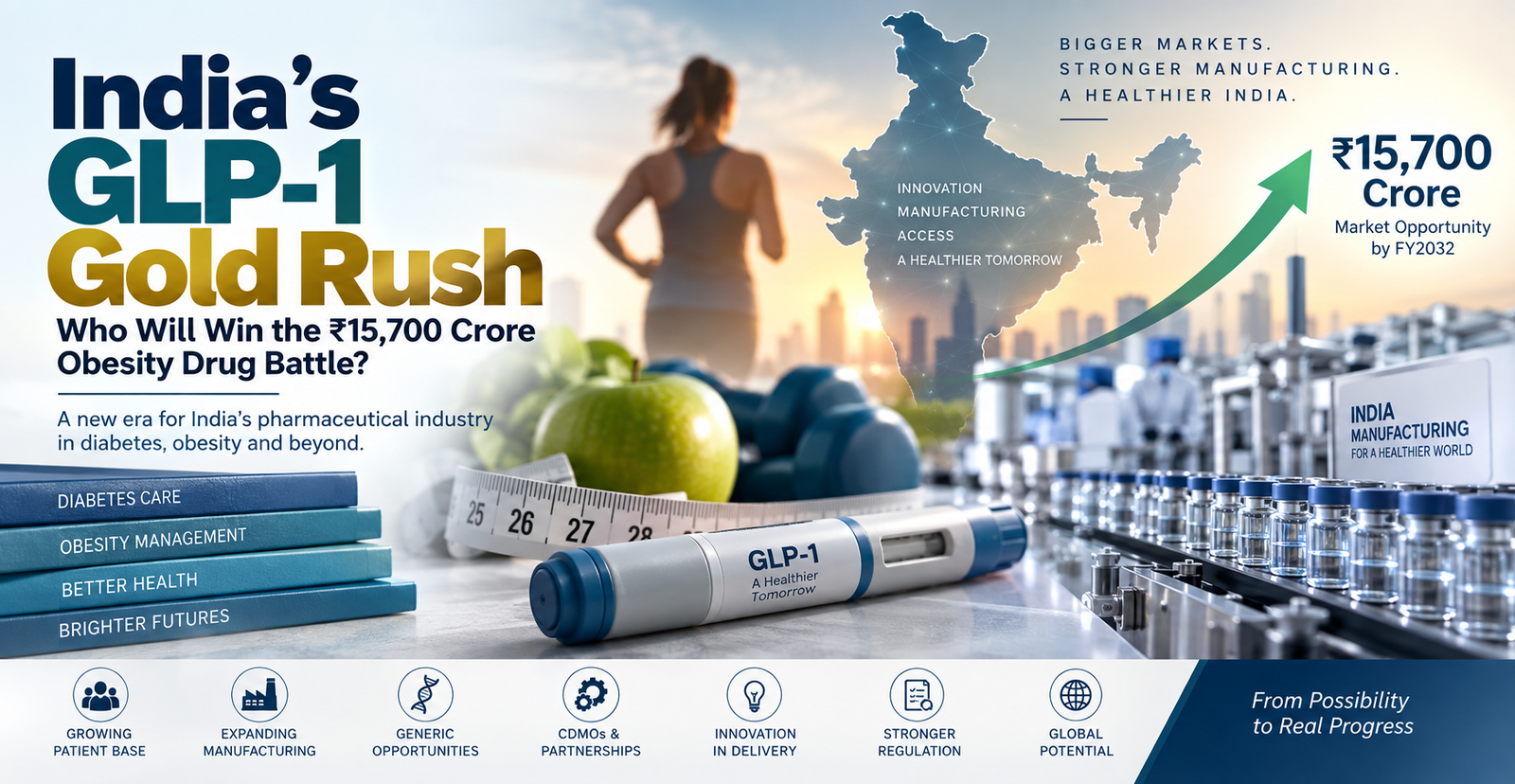
Industry estimates suggest that India’s GLP-1 market could expand to approximately ₹15,700 crore by FY2032, representing a dramatic increase from today’s relatively small base. The opportunity is attracting established pharmaceutical companies, emerging specialty players, contract manufacturers and companies with capabilities in peptides and complex injectables.
But there is a bigger question behind the headline numbers:
Can India’s pharmaceutical industry build the manufacturing ecosystem required to support the GLP-1 boom?
The answer will determine who captures the largest share of this emerging market.
The GLP-1 story is bigger than weight loss
GLP-1 medicines work by mimicking the action of glucagon-like peptide-1, a naturally occurring hormone involved in glucose regulation, appetite and satiety.
The first major commercial applications were in diabetes. The conversation changed dramatically when clinical evidence demonstrated substantial weight-loss benefits with some GLP-1 and related medicines.
That changed the commercial landscape.
Patients began looking at these medicines not simply as another diabetes therapy, but as a potential long-term treatment for obesity and metabolic disease.
For pharmaceutical companies, that creates an unusually large market opportunity.
India has several characteristics that make the country particularly important:
- A large diabetes population
- Rising obesity and overweight prevalence
- Increasing awareness of obesity as a chronic disease
- A large domestic pharmaceutical manufacturing base
- Strong capabilities in generic medicines
- A growing biotechnology and peptide ecosystem
- A large pool of scientific and manufacturing talent
- Increasing interest in complex and specialty formulations
The opportunity therefore extends well beyond selling a finished injection.
It begins much earlier in the supply chain.
The real opportunity starts with the molecule
One of the most important aspects of the GLP-1 opportunity is that these are not conventional small-molecule generics.
Peptide medicines require specialised capabilities.
The manufacturing journey can involve peptide synthesis, purification, analytical characterisation, formulation development, sterile manufacturing, fill-finish and sophisticated delivery systems.
Each stage brings its own technical and quality requirements.
This is where India’s traditional strength in generic pharmaceuticals meets a new manufacturing challenge.
India has decades of experience manufacturing tablets, capsules, injectables and other dosage forms at scale. But scaling peptide-based medicines introduces another level of complexity.
The winners will therefore not necessarily be the companies with the largest traditional generic portfolios.
They may be the companies that can successfully combine:
peptide capability + formulation expertise + sterile manufacturing + regulatory strength + scale.
That combination is difficult to build.
Why the market could become very large
The most interesting aspect of India’s GLP-1 opportunity is the potential expansion of the patient base.
Today, affordability remains a significant barrier.
Innovator GLP-1 therapies can be expensive for Indian patients, particularly because obesity treatment often requires long-term therapy.
The economics could change significantly as additional products enter the market.
Generic and locally manufactured alternatives have the potential to reduce treatment costs and make these medicines accessible to a much larger population.
This creates a classic pharmaceutical-market dynamic:
Lower price → greater affordability → broader patient adoption → higher volumes → greater manufacturing scale.
If that cycle develops as expected, the market could expand rapidly.
The projected ₹15,700 crore market by FY2032 should therefore not be viewed merely as a sales forecast.
It represents the potential creation of an entirely new pharmaceutical ecosystem.
Mounjaro, Wegovy and the changing competitive landscape
The global GLP-1 market is being shaped by major products from companies including Eli Lilly and Novo Nordisk.
In India, tirzepatide products such as Mounjaro have generated substantial interest, while semaglutide-based therapies have established an important position in diabetes and obesity treatment.
But the Indian market is unlikely to remain dominated indefinitely by a small number of premium-priced products.
Patent landscapes, regulatory approvals and local development programmes will gradually change the competitive environment.
Once more manufacturers enter, competition is likely to move from simply having a product to answering four questions:
How much does it cost?
How reliably can it be manufactured?
What quality can be demonstrated consistently?
Can the company scale quickly enough to meet demand?
That is where the Indian pharmaceutical industry’s manufacturing advantage could become particularly important.
India’s peptide manufacturing challenge
Here is where the GLP-1 opportunity becomes much more interesting from an industry perspective.
Demand can grow much faster than manufacturing capacity.
A company may have a successful formulation, regulatory approval and a strong sales organisation, but if it cannot secure adequate peptide API supply, the commercial opportunity becomes irrelevant.
The industry therefore needs capacity at multiple levels.
1. Peptide API
Peptide APIs require specialised chemistry, purification and analytical capabilities.
The manufacturing process can be considerably more demanding than conventional APIs.
Companies need appropriate reactors, purification systems, process controls and analytical infrastructure.
2. Formulation
The peptide API must then be converted into a stable pharmaceutical formulation.
This requires formulation expertise and robust control of critical quality attributes.
3. Sterile manufacturing
Many current GLP-1 products are injectable.
That makes sterile manufacturing and aseptic processing critical parts of the supply chain.
4. Fill-finish
The product has to be filled accurately and consistently into its final container.
This sounds straightforward.
It is not.
High-volume sterile fill-finish capacity is already a strategic capability, and GLP-1 demand could increase pressure on available capacity.
5. Delivery devices
The pharmaceutical product is only one part of the patient experience.
Pens, cartridges and other delivery systems become increasingly important as the market develops.
This opens another opportunity for Indian companies.
The hidden winners could be CDMOs
The GLP-1 story is often presented as a battle between pharmaceutical brands.
That misses an important part of the value chain.
Contract development and manufacturing organisations could become some of the biggest beneficiaries.
Why?
Because not every pharmaceutical company will want to build an entire peptide manufacturing ecosystem internally.
A smaller or mid-sized pharmaceutical company may prefer to outsource:
- Peptide API manufacturing
- Process development
- Formulation development
- Analytical development
- Sterile manufacturing
- Fill-finish
- Device integration
This is precisely where specialised CDMOs can create value.
The opportunity is particularly attractive for companies that can move beyond commodity contract manufacturing and develop genuine capabilities in complex molecules.
The GLP-1 boom could therefore accelerate a broader transformation in India’s CDMO sector—from cost-based outsourcing toward technology-driven partnerships.
But manufacturing capacity is only half the equation
There is another issue that deserves more attention: quality.
The pharmaceutical industry has learned repeatedly that rapid demand growth can create pressure on manufacturing systems.
When a market suddenly expands, companies may be tempted to focus heavily on capacity addition.
But GLP-1 products will require consistent quality throughout the manufacturing lifecycle.
That means companies will need strong systems covering:
- Process validation
- Analytical method validation
- Data integrity
- Supplier qualification
- Change control
- Cleaning validation
- Aseptic assurance
- Stability programmes
- Deviation management
- CAPA effectiveness
In other words, the GLP-1 opportunity is not simply a capacity race.
It is a capacity-plus-quality race.
The companies that understand this early are likely to have a significant advantage.
Will lower prices democratise obesity treatment?
This may ultimately become the most important question for the Indian market.
Obesity treatment has historically faced a major affordability challenge.
If GLP-1 medicines remain expensive, adoption will largely be concentrated among higher-income patients.
If competition substantially reduces prices, the addressable population could become dramatically larger.
This creates an interesting paradox.
Individual product margins may come under pressure as competition increases.
But the overall market could become much larger.
For Indian pharmaceutical companies accustomed to competing in high-volume, price-sensitive generic markets, this model is familiar.
The difference is that GLP-1 manufacturing is considerably more complex.
Companies will therefore have to find the right balance between:
price, scale, quality and manufacturing efficiency.
Regulation will become increasingly important
The rapid growth of GLP-1 medicines also creates regulatory challenges.
These products are powerful medicines, and their popularity has created interest beyond conventional prescription channels.
Online availability, inappropriate promotion, counterfeit products and unsupervised use can create risks.
As the market expands, regulators will have to balance two competing objectives:
ensuring access while protecting patients.
For pharmaceutical companies, that means compliance cannot be treated as a commercial afterthought.
Responsible promotion, pharmacovigilance, prescription controls and product traceability will become increasingly important.
Companies that build strong compliance systems from the beginning will be better positioned as the market matures.
The next battlefield: oral GLP-1 medicines
The injectable market is only the beginning.
The pharmaceutical industry is also pursuing oral approaches to GLP-1 therapy.
If effective oral GLP-1 products become widely available, they could change patient acceptance dramatically.
For some patients, avoiding injections could remove one of the psychological barriers associated with treatment.
It could also create another manufacturing challenge.
Oral peptide medicines are technically difficult because peptides can be degraded in the gastrointestinal tract and may have poor absorption.
Successful oral GLP-1 technology could therefore represent a significant pharmaceutical-development achievement.
For Indian companies, this could be another opportunity to move from conventional generic manufacturing toward complex drug delivery and differentiated formulations.
Who are likely to be the winners?
It is too early to declare individual winners with certainty.
But the likely winners can be identified by capability.
The first group: peptide specialists
Companies that can manufacture high-quality peptide APIs at scale will occupy a strategically important position.
The second group: complex-injectable manufacturers
GLP-1 demand will increase the importance of sterile manufacturing and fill-finish capabilities.
The third group: specialty pharmaceutical companies
Companies with strong endocrinology, diabetes, obesity and metabolic-health franchises will have an advantage in commercialising these therapies.
The fourth group: CDMOs
Specialised outsourcing partners could capture significant value as multiple pharmaceutical companies enter the market.
The fifth group: device manufacturers
Drug delivery will become increasingly important as pens and other sophisticated delivery systems become mainstream.
The sixth group: companies with strong regulatory capabilities
As competition increases, regulatory execution could become a differentiator.
The market will not reward companies simply because they can produce a peptide.
It will reward companies that can reliably produce, regulate, commercialise and scale the product.
The bigger strategic question for Indian pharma
There is a tendency to describe every new pharmaceutical opportunity as another chance for India to become the “pharmacy of the world.”
The GLP-1 opportunity deserves a more nuanced interpretation.
India already has enormous pharmaceutical manufacturing capability.
The question is whether that capability can move further up the value chain.
Can Indian companies develop proprietary peptide technologies?
Can they build world-class peptide API facilities?
Can CDMOs develop deep expertise in complex molecules?
Can domestic companies compete globally in obesity and metabolic medicines?
Can India develop the complete ecosystem—from peptide chemistry to formulation, device technology and commercialisation?
If the answer is yes, GLP-1s could become much more than another generic-drug opportunity.
They could become a catalyst for the next generation of Indian pharmaceutical manufacturing.
The road to ₹15,700 crore
The projected ₹15,700 crore market is an attractive number.
But the real story is what happens underneath it.
Every additional patient creates demand for API.
Every additional prescription creates demand for formulation.
Every additional injection creates demand for sterile capacity.
Every additional device creates demand for specialised manufacturing.
Every additional product creates demand for analytical testing, packaging, logistics and pharmacovigilance.
That is why the GLP-1 opportunity should be viewed as an ecosystem rather than a single drug category.
The companies that capture the value will not necessarily be the ones with the loudest brands.
They may be the companies quietly building the infrastructure behind the market.
India’s moment—but not a guaranteed victory
India has several advantages.
It has pharmaceutical manufacturing scale.
It has a deep talent pool.
It has an established generic-drug ecosystem.
It has growing expertise in biotechnology and complex manufacturing.
But none of these guarantees success.
GLP-1 manufacturing will demand investment, technical expertise, regulatory discipline and patience.
The industry will also have to manage intense price competition once multiple products reach the market.
That combination could separate genuine long-term players from companies chasing a short-term opportunity.
The final question
The GLP-1 revolution is already changing the global pharmaceutical industry.
India now has an opportunity to participate in that transformation—not simply as a low-cost supplier, but as a manufacturing and innovation hub for the next generation of metabolic medicines.
The prize is potentially enormous.
But the real winners will be determined not by who launches first.
They will be determined by who can manufacture at scale, maintain quality, control costs, navigate regulation and continue innovating when the market becomes crowded.
The ₹15,700 crore opportunity may therefore be only the beginning.
The bigger opportunity could be India’s emergence as a global centre for peptide medicines, complex injectables, drug-delivery technologies and metabolic-health manufacturing.
And that is a much bigger story than weight-loss drugs.
Author’s Perspective
The GLP-1 opportunity should be watched closely by pharmaceutical manufacturers, API companies, CDMOs, formulation companies, device manufacturers and investors.
The next five years could determine which Indian companies merely participate in the GLP-1 market—and which ones build capabilities that remain valuable long after the current obesity-drug boom has matured.