
Learning from Deviations, Regulatory Observations, and Best Practices to Build a World-Class Equipment Validation Program
Series: Part 14 of 20
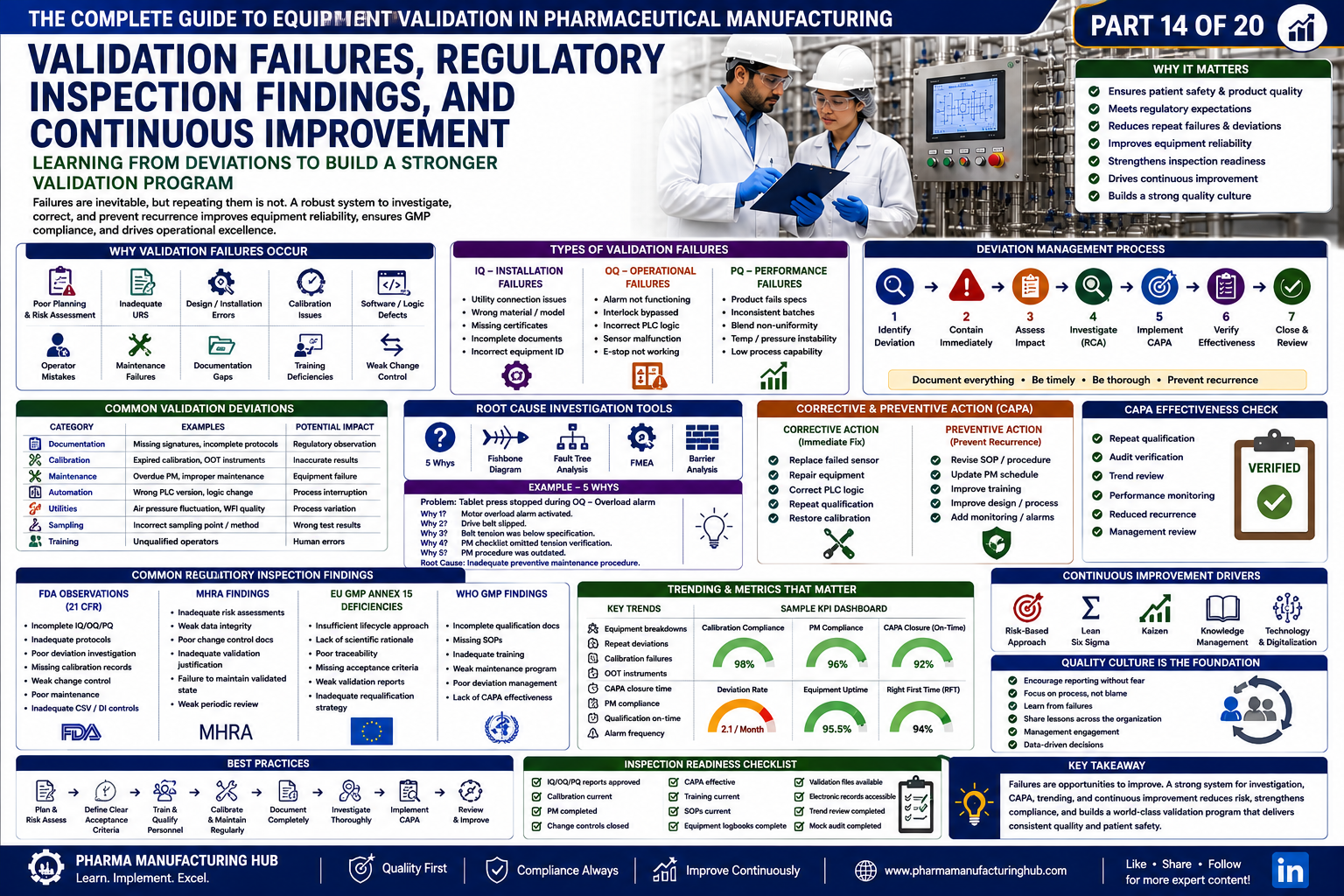
Introduction
Even the most robust pharmaceutical manufacturing facilities occasionally experience validation failures, deviations, or regulatory observations. What distinguishes high-performing organizations from others is not the absence of failures, but how effectively they identify, investigate, correct, and prevent recurrence.
Global regulatory authorities—including the US FDA, EMA, MHRA, WHO, PIC/S, and Health Canada—expect pharmaceutical manufacturers to have a mature Pharmaceutical Quality System (PQS) capable of managing validation failures using a science-based, risk-based approach.
Validation failures should never be viewed as isolated events. Instead, they provide valuable opportunities to strengthen equipment reliability, improve documentation, enhance training, optimize maintenance programs, and continuously improve manufacturing processes.
This article explores common validation failures, regulatory inspection findings, deviation management, root cause investigation, CAPA implementation, inspection readiness, and continuous improvement strategies used by leading pharmaceutical companies.
Why Validation Failures Occur
Equipment qualification failures typically arise from one or more of the following:
- Poor planning
- Inadequate URS
- Weak risk assessment
- Design deficiencies
- Installation errors
- Calibration issues
- Operator mistakes
- Software defects
- Maintenance failures
- Documentation gaps
- Poor change control
- Inadequate training
Most failures are preventable through strong lifecycle management.
Validation Failure Lifecycle
Validation Failure
        │
        ▼
Deviation Identification
        │
        ▼
Immediate Containment
        │
        ▼
Impact Assessment
        │
        ▼
Root Cause Investigation
        │
        ▼
Corrective Action
        │
        ▼
Preventive Action (CAPA)
        │
        ▼
Effectiveness Verification
        │
        ▼
Management Review
Types of Validation Failures
1. Installation Failures (IQ)
Examples:
- Incorrect utility connections
- Wrong material of construction
- Missing calibration certificates
- Incomplete documentation
- Incorrect equipment identification
- Missing drawings
2. Operational Failures (OQ)
Typical failures:
- Alarm not functioning
- Interlock bypassed
- Incorrect PLC logic
- Sensor malfunction
- Operating range exceeded
- Emergency stop failure
3. Performance Failures (PQ)
Examples:
- Product fails specifications
- Inconsistent batch performance
- Blend non-uniformity
- Tablet weight variation
- Temperature instability
- Low process capability
Common Validation Deviations
Frequently observed deviations include:
| Category | Example |
|---|---|
| Documentation | Missing signatures |
| Calibration | Expired calibration |
| Maintenance | Overdue PM |
| Automation | Incorrect PLC version |
| Utilities | Air pressure fluctuation |
| Software | Unauthorized configuration change |
| Sampling | Incorrect sampling location |
| Training | Operator not qualified |
Each deviation should be documented, investigated, and risk assessed.
Deviation Management Process
A structured deviation process should include:
- Deviation identification
- Immediate containment
- Notification
- Investigation
- Root cause analysis
- Risk assessment
- CAPA
- Effectiveness verification
- Closure
- Trending
Timely closure is essential for maintaining GMP compliance.
Root Cause Investigation
A robust investigation seeks the underlying cause rather than merely correcting the symptom.
Common tools include:
- 5 Whys
- Fishbone (Ishikawa) Diagram
- Fault Tree Analysis
- FMEA
- Barrier Analysis
Example – 5 Whys
Problem: Tablet press stopped unexpectedly during OQ.
- Why? → Motor overload alarm activated.
- Why? → Drive belt slipped.
- Why? → Belt tension was below specification.
- Why? → Preventive maintenance checklist omitted tension verification.
- Why? → PM procedure was outdated.
Root Cause: Inadequate preventive maintenance procedure.
Corrective and Preventive Action (CAPA)
Corrective Action
Addresses the immediate issue.
Example:
- Replace failed sensor.
- Repeat calibration.
- Correct PLC logic.
- Repair equipment.
Preventive Action
Prevents recurrence.
Example:
- Revise SOP.
- Update maintenance schedule.
- Retrain personnel.
- Improve design.
- Add redundant monitoring.
CAPA Effectiveness
CAPA is not complete until effectiveness is verified.
Typical effectiveness checks include:
- Repeat qualification testing
- Audit verification
- Trend review
- Performance monitoring
- Reduced recurrence
- Management review
FDA Inspection Findings
Common FDA observations related to equipment validation include:
- Incomplete IQ/OQ/PQ documentation
- Inadequate validation protocols
- Failure to investigate deviations
- Missing calibration records
- Weak change control
- Poor equipment maintenance
- Inadequate software validation
- Incomplete audit trail reviews
- Deficient data integrity controls
Strong documentation and lifecycle management help minimize these observations.
MHRA Inspection Findings
Typical MHRA concerns include:
- Incomplete risk assessments
- Weak data integrity practices
- Poor change control documentation
- Inadequate validation justification
- Failure to maintain validated state
- Weak periodic review program
EU GMP Annex 15 Deficiencies
Common deficiencies include:
- Insufficient lifecycle approach
- Lack of scientific rationale
- Poor traceability
- Missing acceptance criteria
- Weak validation reports
- Inadequate requalification strategy
WHO GMP Inspection Findings
WHO inspectors commonly identify:
- Incomplete qualification documentation
- Missing SOPs
- Inadequate training records
- Weak maintenance programs
- Poor deviation management
- Lack of CAPA effectiveness verification
Preventing Regulatory Observations
Organizations should:
- Follow approved validation procedures.
- Maintain complete documentation.
- Perform routine internal audits.
- Trend deviations and CAPA.
- Review equipment performance.
- Conduct management reviews.
- Train personnel regularly.
- Perform periodic qualification reviews.
Inspection readiness should be a continuous process rather than a one-time activity.
Validation Trending
Trending identifies recurring problems before they become major compliance issues.
Typical trends include:
- Equipment breakdown frequency
- Repeat deviations
- Calibration failures
- OOT instruments
- CAPA closure time
- Alarm frequency
- Maintenance compliance
- Qualification completion
Trend analysis supports continual improvement.
Continuous Improvement
Modern Pharmaceutical Quality Systems promote continuous improvement using:
- Lean Manufacturing
- Six Sigma
- Kaizen
- Operational Excellence
- Quality Risk Management
- Knowledge Management
- Digital monitoring
- Predictive analytics
Continuous improvement strengthens equipment reliability and compliance.
Quality Culture
A strong quality culture encourages:
- Reporting deviations without fear.
- Learning from failures.
- Cross-functional collaboration.
- Management engagement.
- Continuous learning.
- Accountability.
- Data-driven decisions.
Organizations with a mature quality culture generally experience fewer recurring validation failures.
Inspection Readiness Checklist
Before an inspection, verify:
- IQ, OQ, PQ reports approved.
- Calibration current.
- Preventive maintenance completed.
- Change controls closed.
- CAPA effective.
- Training current.
- SOPs current.
- Equipment logbooks complete.
- Validation files readily available.
- Electronic records accessible.
Routine self-inspections can help identify gaps before regulatory audits.
Example Case Study
Equipment
Fluid Bed Dryer
Failure
High product moisture during PQ.
Investigation
- Airflow below specification.
- Differential pressure increased.
- Filter partially blocked.
Root Cause
Preventive maintenance interval was too long.
Corrective Action
- Replace filter.
- Repeat PQ batch.
Preventive Action
- Reduce PM interval.
- Add differential pressure trend review.
- Update maintenance SOP.
Outcome
Subsequent qualification batches met all acceptance criteria with stable drying performance.
Documentation Requirements
Validation failure records should include:
- Deviation Report
- Investigation Report
- Risk Assessment
- Root Cause Analysis
- CAPA
- Effectiveness Verification
- Management Review
- Updated SOPs (if applicable)
- Requalification Records
- Closure Approval
Inspector’s Perspective
Regulatory inspectors typically assess:
- How quickly deviations are identified.
- Whether investigations identify true root causes.
- Whether CAPA addresses systemic issues.
- Whether repeat failures occur.
- Whether management reviews quality trends.
- Whether lessons learned are shared across the organization.
Inspectors recognize that failures can occur; the expectation is that they are managed effectively, documented thoroughly, and used to drive continual improvement.
Expert Tips
Expert Tip 1: Focus investigations on identifying the true root cause rather than assigning blame. Sustainable improvements come from strengthening systems, not individuals.
Expert Tip 2: Trend validation failures, deviations, and CAPA data quarterly. Patterns often reveal opportunities to improve maintenance, training, or qualification strategies before they lead to regulatory observations.
Expert Tip 3: Conduct mock inspections and internal audits using FDA, EU GMP, and WHO inspection approaches. Regular practice improves confidence and exposes documentation gaps before official inspections.
Common Pitfalls
Avoid these frequent mistakes:
- Closing deviations without identifying the true root cause.
- Implementing corrective actions without preventive measures.
- Delaying CAPA closure.
- Ignoring recurring minor deviations.
- Poor documentation of investigations.
- Failing to evaluate validation impact after failures.
- Lack of effectiveness verification.
- Inadequate communication of lessons learned across departments.
Frequently Asked Questions (FAQs)
1. What is the difference between a deviation and a validation failure?
A deviation is any departure from an approved procedure or expected result. A validation failure is a deviation that affects qualification objectives or demonstrates that acceptance criteria were not met.
2. Why is root cause analysis important?
Root cause analysis identifies the underlying reason for a failure, enabling effective corrective and preventive actions rather than temporary fixes.
3. What is the purpose of CAPA?
CAPA ensures that identified issues are corrected, prevented from recurring, and verified for effectiveness.
4. Should qualification be repeated after a validation failure?
It depends on the nature of the failure and its impact. Additional qualification or partial requalification may be required after corrective actions are implemented.
5. What do inspectors expect during investigations?
Inspectors expect timely investigations, objective root cause analysis, scientifically justified CAPA, documented effectiveness verification, and management oversight.
6. How can recurring validation failures be reduced?
By strengthening risk assessments, preventive maintenance, training, change control, documentation, and trend analysis.
7. Why is trend analysis valuable?
Trend analysis helps identify recurring issues, supports proactive decision-making, and demonstrates continual improvement.
8. Is continuous improvement a regulatory expectation?
Yes. ICH Q10 and modern GMP principles emphasize continual improvement as a key element of an effective Pharmaceutical Quality System.
Key Takeaways
- Validation failures should be viewed as opportunities to strengthen quality systems and improve equipment reliability.
- A structured process for deviation management, root cause investigation, CAPA, and effectiveness verification is essential for maintaining GMP compliance.
- Regular trend analysis, internal audits, management reviews, and a strong quality culture help reduce recurring failures and improve inspection readiness.
- Organizations that integrate continual improvement into equipment lifecycle management are better positioned to meet regulatory expectations and consistently deliver high-quality pharmaceutical products.
Coming Up in Part 15
Validation Metrics, Digital Equipment Validation, and Pharma 4.0: Measuring Performance and Transforming Equipment Qualification
In Part 15, we will explore Key Performance Indicators (KPIs) for equipment validation—such as Right First Time (RFT), Equipment Uptime, Qualification Completion Rate, Deviation Rate, CAPA Closure Time, Calibration Compliance, Preventive Maintenance Compliance, OEE, MTBF, and MTTR—along with Digital Validation, Artificial Intelligence (AI), Machine Learning, IoT, Digital Twins, Predictive Maintenance, Electronic Validation, Cloud Validation, Remote FAT, Continuous Monitoring, and Pharma 4.0 technologies that are reshaping the future of pharmaceutical equipment qualification.
About the Author
Ramesh Palav is a pharmaceutical professional with 20+ years of industry experience in manufacturing, GMP, quality systems, validation, compliance, and operational excellence. Through Pharma Manufacturing Hub, he shares practical insights on pharmaceutical careers, manufacturing, quality, validation, Pharma 4.0, AI, and professional development.
His goal is to help students, freshers, experienced professionals, and career-break professionals build the knowledge and skills needed to succeed in the pharmaceutical industry.