
Part 4
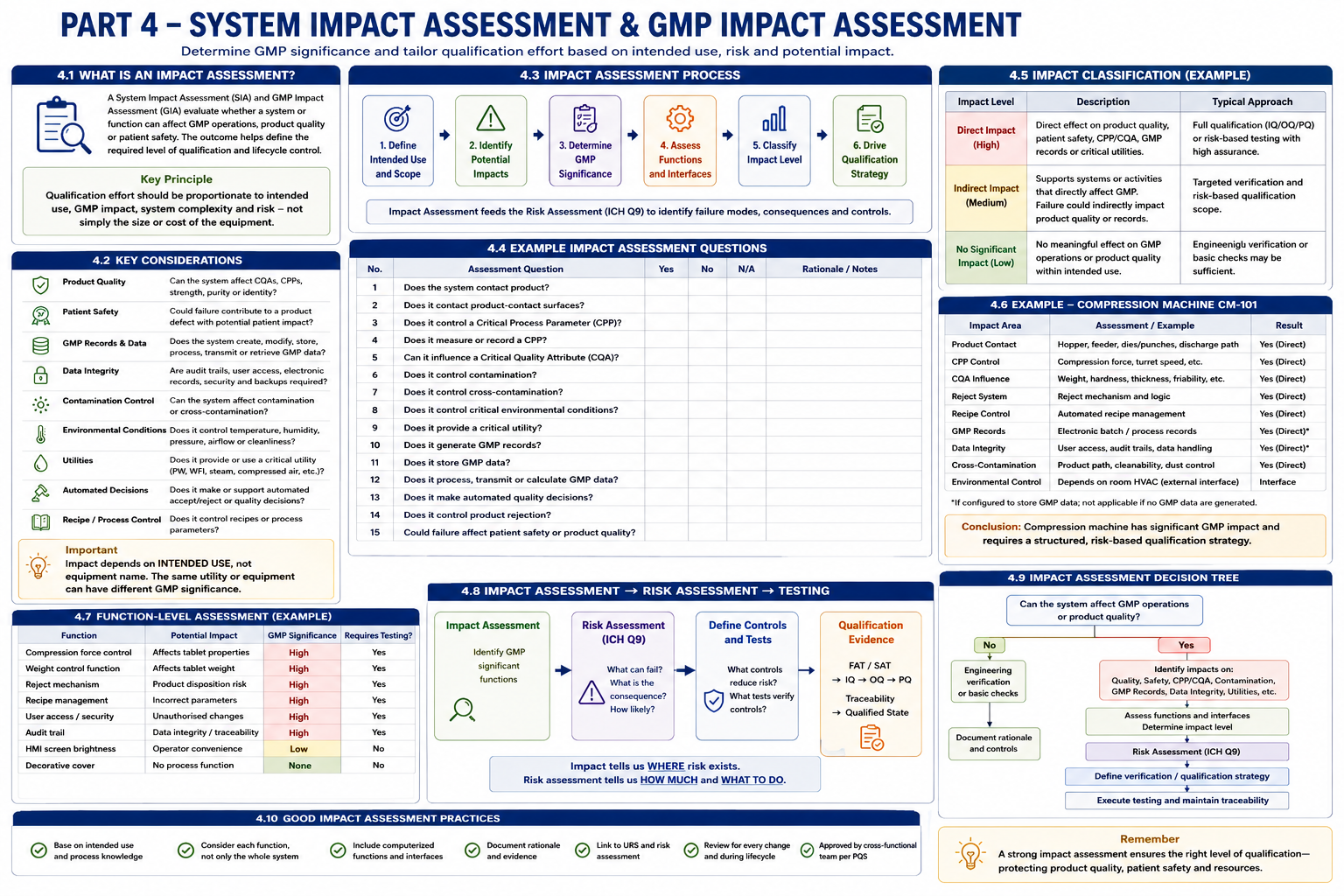
4.1 Introduction
Not every facility, utility, equipment item, instrument, or computerized function in a pharmaceutical plant presents the same GMP risk.
A tablet compression machine, purified-water system, production-room HVAC system, office printer, and administrative air conditioner clearly do not warrant identical qualification strategies.
A structured System Impact Assessment (SIA) and/or GMP Impact Assessment (GIA) helps determine:
Can this system affect product quality, patient safety, GMP compliance, process control, critical records, or data integrity—and, if so, how?
The answer provides an important basis for deciding:
- whether formal qualification is required;
- qualification depth;
- critical functions requiring verification;
- risk-assessment scope;
- supplier documentation requirements;
- FAT/SAT strategy;
- IQ/OQ/PQ scope;
- computerized-system assessment;
- calibration requirements;
- maintenance strategy;
- change-control expectations;
- periodic review/requalification needs.
The key principle is:
Qualification effort should be proportionate to intended use, GMP impact, system complexity, and risk—not merely to the physical size or cost of the equipment.
4.2 What Is a System Impact Assessment?
A System Impact Assessment is a structured evaluation of a system’s intended use and functions to determine whether the system can affect GMP-regulated operations or the quality of the manufactured product.
The assessment should consider the actual function of the system, not simply its equipment name.
For example:
Compressed air used for office pneumatic tools
and
compressed air directly contacting pharmaceutical product
are both “compressed-air systems,” but their GMP significance is very different.
Therefore:
System name does not determine GMP impact. Intended use does.
4.3 What Is a GMP Impact Assessment?
A GMP Impact Assessment evaluates whether a system, subsystem, component, or function can affect GMP requirements.
Potential areas include:
- product quality;
- patient safety;
- product identity;
- strength;
- purity;
- quality;
- CPPs;
- CQAs;
- contamination/cross-contamination controls;
- critical environmental conditions;
- GMP records;
- electronic records;
- data integrity;
- critical utilities.
The assessment supports a defensible decision about the required level of qualification and lifecycle control.
4.4 SIA vs GMP Impact Assessment
Organizations may use different terminology.
Some companies use:
System Impact Assessment
Others use:
GMP Impact Assessment
Others combine them into:
System/GMP Impact Assessment
The precise document title is less important than the underlying assessment.
A practical distinction is:
| Assessment | Primary Question |
|---|---|
| System Impact Assessment | What does this system affect? |
| GMP Impact Assessment | Does that impact have GMP significance? |
| Quality Risk Assessment | What can fail, what are the consequences, and what controls/testing are needed? |
These activities should work together.
4.5 Position in the Qualification Lifecycle
A practical sequence is:
Business Need
↓
System Definition
↓
Intended Use
↓
URS
↓
System/GMP Impact Assessment
↓
Quality Risk Assessment
↓
Design / DQ
↓
FAT / SAT
↓
IQ / OQ / PQ
↓
Traceability
↓
Qualification Summary
↓
GMP Release
The impact assessment should therefore be completed early enough to influence the qualification strategy.
4.6 Why Impact Assessment Is Important
Without impact assessment, organizations frequently make one of two mistakes.
Mistake 1 — Under-qualification
A system with significant GMP impact receives insufficient verification.
Examples:
- computerized recipe control ignored;
- critical utility treated as ordinary engineering service;
- reject mechanism not challenged;
- environmental-control system inadequately tested.
Mistake 2 — Over-qualification
Systems with little or no GMP significance receive unnecessary validation documentation.
Consequences include:
- excessive protocols;
- duplicated testing;
- increased project cost;
- delayed startup;
- large document-maintenance burden;
- qualification resources diverted from higher-risk systems.
A risk-based impact assessment helps avoid both extremes.
4.7 Fundamental Assessment Principle
The assessment should begin with:
What is the intended use of this system?
Then ask:
What could the system influence during that intended use?
Then:
Does that influence have GMP significance?
Finally:
What level of assurance is appropriate?
This creates:
Intended Use → Potential Impact → GMP Significance → Risk → Qualification Strategy
4.8 Define the System Before Assessing Impact
Before conducting an impact assessment, establish the system boundary.
For example:
Tablet Compression System
Incoming Product
       ↓
Product Hopper
       ↓
Feeder
       ↓
Compression Zone
       ↓
Tablet Discharge
       ↓
Deduster
       ↓
Metal Detector
       ↓
Downstream Transfer
Supporting functions may include:
PLC
 ↓
HMI
 ↓
Recipe Management
 ↓
Alarm System
 ↓
Audit Trail
 ↓
Electronic Records
 ↓
Network / Data Interface
The assessment should determine whether these are:
- part of one qualified system;
- separately qualified systems;
- external supporting systems;
- interfaces requiring verification.
4.9 Impact on Product Quality
A system should be assessed for its potential effect on product quality.
Questions include:
- Does it contact the product?
- Does it transform the product?
- Does it control a process step?
- Does it measure an important process parameter?
- Does it accept/reject product?
- Does it influence contamination?
- Does it provide a critical processing environment?
Example
A tablet compression machine directly performs the compression process.
Failure could potentially affect:
- tablet weight;
- hardness;
- thickness;
- content uniformity indirectly through weight/process control;
- physical integrity.
It therefore warrants significant qualification attention.
4.10 Impact on Patient Safety
Ultimately, pharmaceutical quality systems protect the patient.
Ask:
Could failure of this system contribute to a product defect with potential patient impact?
Examples could include failures affecting:
- dose;
- contamination;
- product identity;
- critical environmental control;
- sterile barrier integrity where relevant;
- incorrect labeling;
- product mix-up.
Patient impact should not be used as a vague label. The potential failure pathway should be understood.
4.11 Product Identity
Systems can affect product identity through:
- material identification;
- recipe selection;
- barcode verification;
- label control;
- serialization;
- line clearance;
- material routing.
Example
If an automated system selects a manufacturing recipe, inappropriate recipe selection could create an identity or processing risk.
This makes recipe control potentially GMP significant.
4.12 Strength
Equipment or systems may influence product strength through their effect on:
- material quantity;
- dispensing;
- blending;
- compression weight;
- fill volume;
- dosing.
Example
An automated dispensing system delivering an incorrect quantity of active material may directly affect final product strength.
4.13 Purity
Potential purity impact includes:
- contamination;
- cross-contamination;
- residues;
- cleaning failures;
- unsuitable product-contact materials;
- contaminated utilities.
Systems requiring assessment may therefore include:
- process equipment;
- HVAC;
- water systems;
- clean steam;
- compressed gases;
- cleaning systems.
4.14 Product Quality
The assessment should consider the full quality impact rather than only direct product contact.
For example, an HVAC system may not physically touch tablets, but it may control:
- temperature;
- humidity;
- pressure differentials;
- airborne contamination;
- dust migration.
Thus:
Absence of direct product contact does not automatically mean absence of GMP impact.
4.15 Impact on Critical Process Parameters
Ask whether the system:
- controls a CPP;
- measures a CPP;
- records a CPP;
- calculates a CPP;
- alarms when a CPP deviates;
- automatically adjusts a CPP.
Examples might include:
- granulation impeller speed;
- drying temperature;
- compression force;
- coating spray rate.
A system controlling a CPP will normally warrant appropriate verification of that function.
4.16 Impact on Critical Quality Attributes
Systems may influence CQAs directly or indirectly.
For a compression process, relevant quality attributes may include:
- tablet weight;
- hardness;
- thickness;
- friability;
- dissolution;
- content uniformity.
The impact assessment should use process knowledge to understand which equipment functions can affect those attributes.
4.17 Impact on GMP Records
Modern pharmaceutical equipment frequently creates GMP-relevant records.
Examples:
- batch reports;
- parameter records;
- alarm history;
- audit trails;
- recipe records;
- electronic logbooks;
- process trends.
The assessment should therefore ask:
Does the system create, modify, store, process, transmit, or retrieve GMP-relevant information?
If yes, computerized-system and data-integrity considerations may apply.
4.18 Data Integrity Impact
A system may have significant GMP impact even if it does not directly contact the product.
For example, a computerized system may:
- store critical process parameters;
- control recipes;
- calculate results;
- generate reports;
- record deviations;
- determine acceptance/rejection.
Impact assessment should therefore consider whether failure or manipulation of data could affect:
- product-quality decisions;
- batch disposition;
- traceability;
- regulatory records.
4.19 Environmental Conditions
Facilities and HVAC systems may influence product quality through:
- temperature;
- relative humidity;
- pressure differential;
- airflow;
- filtration;
- room classification where applicable.
Example
An HVAC system supporting a humidity-sensitive tablet compression room may have GMP impact even though air is not deliberately used as a process material.
4.20 Cross-Contamination
Assess whether system failure could contribute to:
- product carryover;
- dust migration;
- mix-up;
- environmental contamination;
- cleaning failure.
Relevant systems may include:
- HVAC;
- dust extraction;
- process equipment;
- transfer systems;
- cleaning systems;
- containment systems.
4.21 Utility Impact
Utilities should be assessed according to intended use.
Potential GMP utilities include:
- Purified Water;
- WFI;
- clean steam;
- compressed air;
- nitrogen;
- process gases;
- vacuum where relevant;
- HVAC.
Questions include:
- Does the utility contact product?
- Does it contact a product-contact surface?
- Is it used during cleaning?
- Does it control a critical process condition?
- Could utility quality affect product quality?
4.22 Direct-, Indirect-, and No-Impact Concepts
Some pharmaceutical organizations use classifications such as:
Direct Impact
A system has a direct effect on product quality or a GMP-critical function.
Potential examples:
- compression machine;
- blender;
- granulator;
- product-contact water system.
Indirect Impact
A system supports another system that has direct GMP impact.
Potential examples depend on facility architecture and company methodology.
No Impact
The system has no meaningful GMP impact within its intended use.
Examples may include:
- administrative office equipment;
- office comfort systems;
- non-GMP landscaping systems.
Important qualification point
These terms are risk-management/industry-practice classifications, not universal regulatory categories that every pharmaceutical company must use.
4.23 Impact Classification Should Not Be Based on Equipment Name
Consider compressed air.
Example A
Compressed air → pneumatic actuator
No product contact.
The GMP impact may be indirect or limited depending on failure consequences.
Example B
Compressed air → direct product contact
Now utility quality can directly affect product.
The same utility type has different GMP significance.
Therefore:
Classification follows use, not nomenclature.
4.24 System-Level vs Function-Level Assessment
A major improvement over simplistic qualification is to assess not only the entire system but also individual functions.
Consider a tablet compression machine.
| Function | Potential Impact |
|---|---|
| Compression force control | Product quality |
| Weight-control function | Product quality |
| Reject mechanism | Product disposition |
| Recipe management | Process control |
| Audit trail | Data integrity |
| HMI screen brightness | Generally low GMP impact |
| Decorative panel | No meaningful GMP impact |
This allows qualification to focus testing where it matters.
4.25 Practical System Impact Assessment Questions
A practical assessment can use questions such as:
| No. | Assessment Question | Yes/No | Rationale |
|---|---|---|---|
| 1 | Does the system contact product? | ||
| 2 | Does it contact product-contact surfaces? | ||
| 3 | Does it control a CPP? | ||
| 4 | Does it measure/record a CPP? | ||
| 5 | Can it influence a CQA? | ||
| 6 | Does it control contamination? | ||
| 7 | Does it control cross-contamination? | ||
| 8 | Does it provide critical environmental conditions? | ||
| 9 | Does it generate GMP records? | ||
| 10 | Does it store GMP data? | ||
| 11 | Does it modify/process GMP data? | ||
| 12 | Does it make automated quality decisions? | ||
| 13 | Does it control product rejection? | ||
| 14 | Does it control recipe parameters? | ||
| 15 | Could failure affect patient safety/product quality? |
A “Yes” does not automatically determine the entire qualification scope. It identifies an area requiring further evaluation.
4.26 Practical GMP Impact Assessment Template
Document Header
Document Title: System/GMP Impact Assessment
System Name: __________
System ID: __________
Location: __________
Department: __________
URS Reference: __________
Project Number: __________
Assessment Number: __________
Revision: __________
Section 1 — System Description
Describe:
- system purpose;
- process served;
- major components;
- operating principle;
- interfaces;
- utilities;
- computerized functions.
Section 2 — Intended Use
The intended use of the system is:
Section 3 — System Boundary
Included:
Excluded:
Interfaces:
4.27 Detailed Impact Assessment Table
| No. | Impact Area | Question | Y/N/NA | Rationale | Further Assessment? |
|---|---|---|---|---|---|
| 1 | Product | Direct product contact? | |||
| 2 | Quality | Can affect CQA? | |||
| 3 | Process | Controls CPP? | |||
| 4 | Process | Measures CPP? | |||
| 5 | Contamination | Controls contamination? | |||
| 6 | Cross-contamination | Controls product segregation? | |||
| 7 | Environment | Controls critical conditions? | |||
| 8 | Utility | Provides GMP utility? | |||
| 9 | Data | Generates GMP data? | |||
| 10 | Data | Stores GMP records? | |||
| 11 | Data | Processes/calculates GMP data? | |||
| 12 | Automation | Controls recipe? | |||
| 13 | Automation | Makes automated decisions? | |||
| 14 | Product | Controls reject function? | |||
| 15 | Patient | Could failure affect patient safety? |
4.28 Example — Tablet Compression Machine
System
Tablet Compression Machine CM-101
Intended Use
Compression of pharmaceutical blends into tablets within approved process operating ranges.
Assessment
| Impact Area | Assessment | Result |
|---|---|---|
| Product contact | Hopper, feeder, dies/punches and discharge path | Yes |
| CPP control | Compression/turret-related controls as applicable | Yes |
| CQA influence | Weight, hardness, thickness etc. depending on process | Yes |
| Reject control | Reject mechanism | Yes |
| Recipe control | Automated recipe functionality | Yes |
| GMP records | Electronic batch/process records if configured | Conditional/Yes |
| Data integrity | User access/audit trail/data handling | Yes where GMP data are used |
| Cross-contamination | Product-contact path/cleanability | Yes |
| Environmental control | Primarily external HVAC dependency | Interface |
Conclusion
The compression machine has significant GMP impact and requires a structured, risk-based qualification strategy.
4.29 Impact Assessment Should Drive Risk Assessment
Impact assessment tells us:
Where GMP significance exists.
Risk assessment then asks:
What could fail within those areas, how significant would that failure be, and what controls/testing are required?
Example:
Impact Assessment
Reject mechanism affects product disposition.
↓
Risk Assessment
Failure mode:
Rejected tablet remains in accepted-product stream.
↓
Potential effect:
Nonconforming product could proceed downstream.
↓
Control:
Reject mechanism + confirmation/control logic
↓
Qualification:
Challenge test during FAT/OQ as justified
This demonstrates the relationship between SIA/GIA and FMEA.
4.30 Impact Assessment and URS
Impact assessment should also influence URS criticality.
Example:
URS-045
The machine shall provide an automatic reject mechanism for defined reject conditions.
Impact assessment:
Product-quality/product-disposition impact = Yes
Risk assessment:
Reject failure assessed as significant
Verification:
FAT/OQ challenge
Thus:
URS → Impact → Risk → Test
4.31 Impact Assessment and DQ
During DQ, the team should verify that design features adequately address the identified GMP impacts.
Example:
Impact:
Unauthorized recipe changes could affect product quality.
DQ should evaluate:
- user roles;
- recipe permissions;
- parameter controls;
- change traceability;
- system architecture.
DQ therefore becomes more meaningful when based on prior impact and risk assessment.
4.32 Impact Assessment and FAT
High-impact functions may be prioritized for FAT.
Examples:
- recipe control;
- alarm/interlock logic;
- reject mechanism;
- sequence controls;
- user access.
FAT provides an early opportunity to identify deficiencies before shipment.
4.33 Impact Assessment and IQ
IQ should focus installation verification on elements relevant to the intended use.
Potential examples:
- product-contact materials;
- critical instruments;
- software versions;
- utilities;
- safety systems;
- network configuration;
- as-built documentation.
4.34 Impact Assessment and OQ
OQ should particularly challenge high-impact functions.
For a compression machine:
- compression controls;
- operating limits;
- alarms;
- interlocks;
- reject mechanism;
- recipes;
- user access;
- power recovery;
- audit trail where applicable.
The impact assessment therefore helps prevent meaningless OQ protocols containing dozens of low-value checks while overlooking critical controls.
4.35 Impact Assessment and PQ
PQ should focus on whether the system performs effectively under routine or appropriately simulated operating conditions.
The impact/risk assessment can help determine:
- loads;
- operating ranges;
- challenging conditions;
- sampling needs;
- performance acceptance criteria.
4.36 Risk-Based Qualification Scope
A useful model is:
Higher GMP impact + higher risk
→ Greater assurance
→ More rigorous design review
→ More challenge testing
→ Stronger traceability
→ More lifecycle oversight
Lower GMP impact + lower risk
→ Simplified verification
→ Engineering evidence may be sufficient
→ Reduced qualification documentation where justified
This is not permission to skip required controls.
It means applying effort proportionately.
4.37 Leveraging Supplier Evidence
Impact assessment helps determine whether supplier evidence may be suitable.
For example:
Low-risk physical characteristic
Vendor dimensional certificate may be sufficient after appropriate review.
Critical site-dependent interlock
Vendor FAT alone may not be sufficient.
Site verification may still be required.
Critical computerized function
Supplier testing may potentially be leveraged if:
- test scope is adequate;
- configuration is relevant;
- evidence is controlled;
- results are traceable;
- changes after testing are assessed.
4.38 Impact Assessment and Computerized Systems
For PLC/HMI/SCADA-controlled equipment, assess computerized functions separately.
| Function | GMP Impact Question |
|---|---|
| Login | Does it prevent unauthorized actions? |
| Recipe | Can changes affect process parameters? |
| Alarm | Does it warn of critical conditions? |
| Audit trail | Does it record GMP-relevant actions? |
| Report | Is report used for GMP decisions? |
| Backup | Could loss compromise GMP records? |
| Interface | Could transfer failure corrupt/miss data? |
| Clock | Is timestamp accuracy GMP relevant? |
This function-based approach is generally more useful than simply stating:
“PLC system is GMP critical.”
4.39 Impact Assessment and Data Integrity
Consider the data lifecycle:
Data Generation
↓
Processing
↓
Recording
↓
Review
↓
Storage
↓
Retrieval
↓
Archiving/Retention
The assessment should identify which system functions participate in this lifecycle.
This helps determine the need for:
- access control;
- audit trails;
- backup;
- restore;
- retention;
- security;
- time synchronization;
- data review.
4.40 Impact Assessment and Utilities
A utility assessment should examine the point of use.
Purified Water
Potential direct impact because it may be:
- formulation ingredient;
- cleaning medium;
- rinse medium.
Compressed Air
Impact depends on whether it:
- contacts product;
- contacts product-contact surfaces;
- only operates actuators.
Nitrogen
Impact depends on whether it:
- provides inert product environment;
- contacts product;
- only serves engineering purposes.
Again:
Use determines impact.
4.41 Impact Assessment and HVAC
HVAC impact depends on the area served and the process.
Assessment may consider:
- room classification;
- exposed product;
- temperature sensitivity;
- humidity sensitivity;
- dust control;
- pressure cascade;
- contamination/cross-contamination control.
An office HVAC system should not automatically receive the same qualification strategy as a manufacturing HVAC system.
4.42 Impact Assessment and Facility Systems
Facility impact assessment may consider:
- manufacturing rooms;
- dispensing rooms;
- sampling areas;
- airlocks;
- pass boxes;
- warehouses;
- personnel/material flows.
Questions include:
- Is exposed product present?
- Are environmental conditions critical?
- Is segregation required?
- Is pressure differential important?
- Could failure cause contamination or mix-up?
4.43 Common Impact Assessment Mistakes
1. Everything classified as critical
This eliminates meaningful risk differentiation.
2. Nothing classified as critical
This indicates inadequate understanding of process and GMP risk.
3. Classification based on equipment cost
Expensive does not automatically mean GMP critical.
4. Classification based on equipment name
Impact depends on intended use.
5. Product contact used as the only criterion
Systems without direct product contact can have major GMP impact.
6. Computerized functions ignored
Electronic controls and records may carry significant risk.
7. No written rationale
A checkbox without justification provides weak evidence.
8. Assessment completed after qualification
This creates retrospective justification rather than risk-based planning.
4.44 Weak vs Strong Impact Assessment
Weak
| Question | Answer |
|---|---|
| Product impact? | Yes |
| GMP impact? | Yes |
| Qualification required? | Yes |
This provides almost no rationale.
Strong
| Function | Potential Impact | Rationale | Follow-up |
|---|---|---|---|
| Compression force | Product quality | Can influence tablet properties | Risk assessment/OQ |
| Reject system | Product disposition | Failure may retain rejected tablets | FMEA + challenge |
| Recipe control | Process | Incorrect parameters may be applied | CSV/OQ |
| User access | Data/process control | Unauthorized changes possible | Access testing |
| Cosmetic cover | None | No process/GMP function | Engineering verification |
The second approach supports actual qualification decisions.
4.45 Impact Assessment Approval
Typical participants may include:
- Production/User;
- Engineering;
- Validation/CQV;
- QA;
- Automation/IT;
- QC where relevant;
- EHS where relevant.
A typical responsibility model is:
| Function | Typical Responsibility |
|---|---|
| User | Define intended use |
| Engineering | Define technical system |
| Validation | Facilitate impact assessment |
| QA | GMP review/approval according to PQS |
| Automation/IT | Assess computerized functions |
| EHS | Assess relevant safety/environmental aspects |
Actual responsibilities must follow the company’s PQS.
4.46 Change Control and Impact Assessment
Impact assessment should not disappear after initial qualification.
When a change occurs, reassess impact.
Example:
Change
HMI software upgraded.
↓
Questions
Does it affect:
- recipes?
- alarms?
- user roles?
- audit trails?
- data storage?
- reports?
- interfaces?
↓
Qualification Impact
Determine required regression/requalification testing.
Thus the same risk-based logic supports lifecycle management.
4.47 Requalification and Impact Assessment
Suppose a compression-machine feeder motor is replaced with an equivalent approved component.
The organization should not automatically repeat every IQ/OQ/PQ test.
Instead:
Change
↓
Impact Assessment
↓
Affected functions
↓
Risk Assessment
↓
Targeted verification
↓
Requalification conclusion
This makes requalification scientifically justified.
4.48 Inspector Perspective
An inspector may ask:
How did you decide this system required qualification?
A strong response should show:
- intended use;
- impact assessment;
- documented rationale;
- risk assessment;
- qualification strategy.
The inspector may then ask:
Why was this function considered critical?
Evidence should demonstrate its relationship to:
- product quality;
- CPP/CQA;
- GMP record;
- contamination control;
- patient risk;
- data integrity.
Another question may be:
Why did you not test this function during OQ?
The organization should be able to show that:
- it had no relevant GMP impact; or
- it was verified elsewhere; or
- supplier/commissioning evidence was appropriately leveraged; or
- the chosen verification method was scientifically justified.
4.49 Potential Inspection Red Flags
Red flags include:
- impact assessment dated after IQ/OQ;
- every system classified identically;
- no documented rationale;
- computerized functions absent;
- no relationship to URS;
- no relationship to risk assessment;
- no traceability to qualification testing;
- copied assessments from unrelated equipment;
- assessment not updated after major change.
4.50 Practical Decision Tree
Define Intended Use
        ↓
Define System Boundary
        ↓
Can the system affect GMP operations?
        │
   ┌────┴────┐
   │         │
  NO        YES
   │         │
Engineering  ↓
Controls   Identify Impact
             ↓
      Product Quality?
      Patient Safety?
      CPP/CQA?
      Contamination?
      Environment?
      GMP Records?
      Data Integrity?
      Utilities?
             ↓
       Assess Functions
             ↓
      Quality Risk Assessment
             ↓
      Define Critical Aspects
             ↓
     Define Verification Strategy
             ↓
 FAT / SAT / IQ / OQ / PQ
      as appropriate
             ↓
        Traceability
             ↓
      Qualified State
4.51 Worked Example — Compression Machine
Consider requirement:
URS-CM-056
The machine shall automatically reject tablets meeting predefined reject conditions.
Step 1 — Impact Assessment
Function:
Automatic rejection
Potential impact:
Product disposition
Conclusion:
GMP significant.
Step 2 — Risk Assessment
Failure mode:
Reject mechanism fails to remove the identified tablet.
Potential consequence:
Nonconforming tablet could enter the accepted-product stream.
Step 3 — Risk Control
Design includes:
- reject mechanism;
- reject logic;
- appropriate indication;
- reject confirmation where designed.
Step 4 — Verification Strategy
DQ: Review reject-system design.
FAT: Challenge reject operation.
IQ: Verify installed reject-system components/configuration.
OQ: Challenge defined reject conditions in installed state.
Step 5 — Traceability
URS-CM-056
↓
GIA-018
↓
RA-022
↓
DS-067
↓
FAT-08.6
↓
IQ-07.3
↓
OQ-12.4
↓
RTM
↓
Verified
This is the practical purpose of an impact assessment: it converts an equipment function into a documented, risk-based verification strategy.
4.52 Recommended System/GMP Impact Assessment Form
A. Identification
| Field | Information |
|---|---|
| System Name | |
| System ID | |
| Department | |
| Location | |
| Project | |
| URS Reference | |
| Assessment Number | |
| Revision |
B. Intended Use
Describe the intended GMP use.
C. System Boundary
List:
- included components;
- excluded components;
- interfaces;
- supporting utilities.
D. Impact Assessment
Assess:
- product contact;
- product quality;
- CPPs;
- CQAs;
- contamination;
- cross-contamination;
- environmental control;
- GMP records;
- electronic records;
- data integrity;
- automated decisions;
- utilities.
E. Computerized Function Assessment
Assess:
- PLC;
- HMI;
- SCADA;
- recipes;
- alarms;
- audit trails;
- user access;
- backup/restore;
- interfaces.
F. Classification
Document the company’s applicable classification and rationale.
G. Qualification Strategy
Identify required activities, potentially:
- DQ;
- FAT;
- SAT;
- commissioning;
- IQ;
- OQ;
- PQ;
- CSV/CSA activities;
- supplier evidence;
- calibration.
H. Conclusion
Based on the intended use and documented assessment, the system is classified as __________ according to the approved company methodology. The following qualification/verification activities are required: __________.
I. Approval
- User
- Engineering
- Validation
- Automation/IT where relevant
- QA
- Other applicable SMEs
4.53 Final Impact Assessment Checklist
System Understanding
- □ Intended use documented
- □ System boundaries established
- □ Interfaces identified
- □ Process understood
Product/Process Impact
- □ Product contact evaluated
- □ Product-quality impact evaluated
- □ Patient-safety pathway considered
- □ CPP impact evaluated
- □ CQA influence evaluated
- □ Reject/accept decisions evaluated
Contamination
- □ Contamination risk considered
- □ Cross-contamination considered
- □ Cleaning impact evaluated
- □ Environmental control evaluated
Utilities
- □ Utility contact assessed
- □ Critical utility functions identified
- □ Point-of-use impact considered
Computerized Systems
- □ PLC assessed
- □ HMI assessed
- □ SCADA assessed where applicable
- □ Recipe controls assessed
- □ User access assessed
- □ Audit trail applicability assessed
- □ Electronic records assessed
- □ Backup/restore needs assessed
- □ Interfaces assessed
- □ Data integrity considered
Qualification Strategy
- □ GMP-significant functions identified
- □ Risk assessment required/linked
- □ DQ scope identified
- □ FAT scope identified
- □ SAT scope identified
- □ IQ scope identified
- □ OQ scope identified
- □ PQ scope identified
- □ Supplier evidence strategy considered
- □ Traceability requirements established
Lifecycle
- □ Change-control implications defined
- □ Requalification considerations identified
- □ Periodic-review requirements considered
- □ Assessment approved according to PQS
Part 4 — Key Takeaway
System/GMP Impact Assessment should answer much more than:
“Is this equipment GMP critical—Yes or No?”
A mature assessment establishes:
What the system does → What it can affect → Why that impact matters → Which functions are GMP significant → What risks require control → What qualification evidence is necessary.
The preferred evidence chain becomes:
Intended Use → System Boundary → GMP Impact → Critical Functions → Quality Risk Assessment → Design Controls → Risk-Based Testing → Traceability → Qualified State
This provides the foundation for Part 5 — Quality Risk Assessment, where the identified GMP-impacting functions are converted into specific failure modes, risks, controls, and qualification tests using approaches such as ICH Q9(R1), FMEA, severity/occurrence/detectability, RPN limitations, critical-aspect assessment, and risk-based testing.
About the Author
Ramesh Palav is a pharmaceutical professional with 20+ years of industry experience in manufacturing, GMP, quality systems, validation, compliance, and operational excellence. Through Pharma Manufacturing Hub, he shares practical insights on pharmaceutical careers, manufacturing, quality, validation, Pharma 4.0, AI, and professional development.
His goal is to help students, freshers, experienced professionals, and career-break professionals build the knowledge and skills needed to succeed in the pharmaceutical industry.