
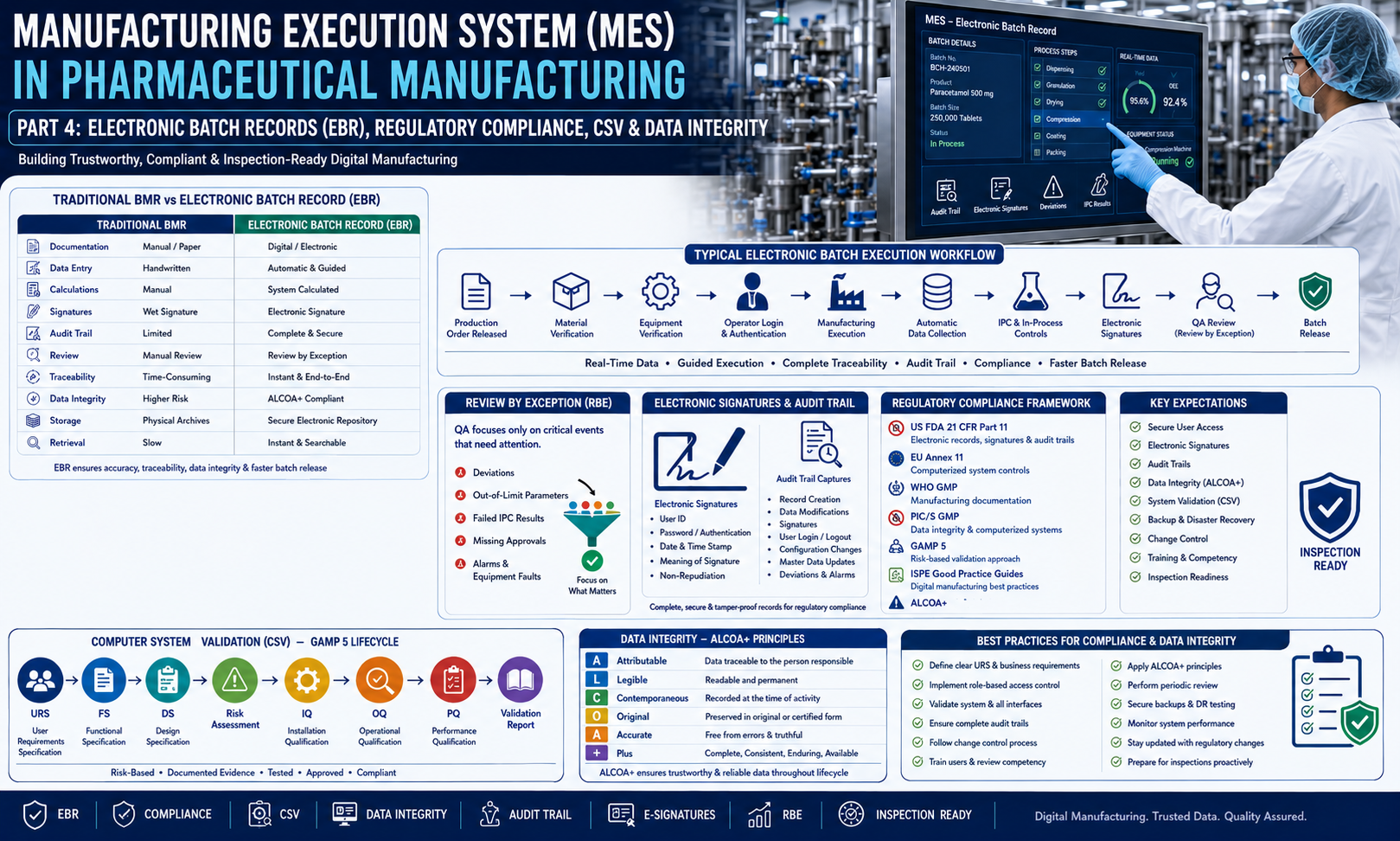
Part 4: Electronic Batch Records (EBR), Regulatory Compliance, Computer System Validation (CSV), and Data Integrity
Executive Summary
A successful Manufacturing Execution System (MES) implementation is not measured solely by digitalization—it is measured by its ability to produce compliant, reliable, secure, and inspection-ready electronic records.
Electronic Batch Records (EBR), Computer System Validation (CSV), and Data Integrity are the foundation of every regulatory-compliant MES implementation. Global regulatory agencies expect pharmaceutical manufacturers to demonstrate that computerized systems consistently perform as intended, protect data integrity, maintain complete audit trails, and ensure electronic records are trustworthy throughout their lifecycle.
This part of the guide explores how MES supports compliance with 21 CFR Part 11, EU Annex 11, WHO GMP, PIC/S, GAMP 5, ISPE Good Practice Guides, and ALCOA+ principles while enabling faster batch release and inspection readiness.
Table of Contents
- Electronic Batch Records (EBR)
- Traditional BMR vs Electronic Batch Record
- Review by Exception (RBE)
- Digital Signatures & Audit Trails
- Regulatory Compliance Framework
- Computer System Validation (CSV)
- Validation Documentation
- Data Integrity (ALCOA+)
- User Access & Cybersecurity
- Backup & Disaster Recovery
- Regulatory Inspection Readiness
- Best Practices
- Key Takeaways
1. What is an Electronic Batch Record (EBR)?
An Electronic Batch Record (EBR) is the digital equivalent of a traditional paper Batch Manufacturing Record (BMR). It captures every manufacturing activity electronically in real time, ensuring complete traceability, accuracy, and compliance throughout the batch lifecycle.
An EBR automatically records:
- Production Order Number
- Product Name
- Batch Number
- Manufacturing Date
- Equipment Used
- Raw Material Details
- Operator Actions
- Critical Process Parameters (CPPs)
- In-Process Control (IPC) Results
- Environmental Conditions (where integrated)
- Deviations
- Electronic Signatures
- Audit Trail
- Final Batch Status
Unlike paper records, an EBR minimizes manual data entry and provides a secure, searchable, and inspection-ready record.
2. Traditional Batch Record vs Electronic Batch Record
| Feature | Paper Batch Record | Electronic Batch Record (EBR) |
|---|---|---|
| Documentation | Manual | Fully Digital |
| Data Entry | Handwritten | Automatic & Guided |
| Calculations | Manual | System Calculated |
| Signatures | Wet Signature | Electronic Signature |
| Audit Trail | Limited | Automatic |
| Review | Manual | Review by Exception |
| Traceability | Time-Consuming | Instant |
| Data Integrity | Higher Risk | Stronger Protection |
| Storage | Physical Archives | Secure Electronic Repository |
| Retrieval | Slow | Immediate |
3. Typical Electronic Batch Execution Workflow
Production Order Released
          │
          ▼
Material Verification
          │
          ▼
Equipment Verification
          │
          ▼
Operator Login & Authentication
          │
          ▼
Manufacturing Execution
          │
          ▼
Automatic Data Collection
          │
          ▼
In-Process Controls (IPC)
          │
          ▼
Electronic Signatures
          │
          ▼
QA Review
          │
          ▼
Electronic Batch Release
This workflow reduces documentation effort while ensuring every manufacturing step is verified before progression.
4. Review by Exception (RBE)
One of the most valuable capabilities of an MES is Review by Exception (RBE).
Instead of reviewing every page of a batch record manually, quality personnel focus only on events that require attention, such as:
- Deviations
- Alarm conditions
- Out-of-limit process parameters
- Failed IPC results
- Missing approvals
- Unauthorized actions
- Equipment faults
Benefits
- Faster batch review
- Reduced QA workload
- Shorter batch release time
- Improved compliance
- Greater focus on critical quality events
5. Electronic Signatures
Electronic signatures are legally recognized within validated systems when implemented in accordance with applicable regulations.
A compliant electronic signature typically includes:
- User ID
- Password or secure authentication
- Date & Time Stamp
- Meaning of Signature (Review, Approval, Execution, Verification)
- Permanent linkage to the record
Electronic signatures ensure accountability and support data integrity by preventing unauthorized changes.
6. Audit Trails
An audit trail is a secure, computer-generated, time-stamped record of actions performed within the system.
Typical audit trail events include:
- Record creation
- Data modifications
- Electronic signatures
- User logins/logouts
- Configuration changes
- Recipe revisions
- Master data updates
- System alarms
- User account changes
A complete audit trail allows investigators and inspectors to reconstruct the history of a record without ambiguity.
7. Regulatory Compliance Framework
A pharmaceutical MES should support compliance with the following:
| Regulation / Guidance | MES Support |
|---|---|
| US FDA 21 CFR Part 11 | Electronic records & signatures |
| EU Annex 11 | Computerized system controls |
| WHO GMP | Manufacturing documentation |
| PIC/S GMP | Data integrity & computerized systems |
| GAMP 5 | Risk-based validation |
| ISPE Good Practice Guides | Digital manufacturing best practices |
| ALCOA+ | Data integrity principles |
Compliance is achieved through a combination of system design, validation, procedural controls, and user training.
8. US FDA 21 CFR Part 11
21 CFR Part 11 establishes the requirements for trustworthy and reliable electronic records and electronic signatures.
Key MES capabilities include:
- Secure user authentication
- Electronic signatures
- Audit trails
- Record protection
- Access control
- Time-stamped entries
- Record retention
- Data backup
- Change control
The objective is to ensure electronic records are equivalent in trustworthiness to paper records.
9. EU Annex 11
EU Annex 11 provides requirements for computerized systems used in GMP-regulated activities.
Key expectations include:
- Risk management
- System validation
- Data integrity
- Access management
- Audit trails
- Business continuity
- Disaster recovery
- Periodic review
- Supplier assessment
MES implementations should be aligned with these expectations throughout the system lifecycle.
10. Computer System Validation (CSV)
Computer System Validation demonstrates, through documented evidence, that an MES consistently performs as intended and complies with regulatory requirements.
Validation Lifecycle
User Requirements Specification (URS)
              │
              ▼
Functional Specification (FS)
              │
              ▼
Design Specification (DS)
              │
              ▼
Risk Assessment
              │
              ▼
Installation Qualification (IQ)
              │
              ▼
Operational Qualification (OQ)
              │
              ▼
Performance Qualification (PQ)
              │
              ▼
Validation Report
              │
              ▼
Periodic Review
Validation should follow a risk-based approach and include all configured functionality, interfaces, and security controls.
11. Key Validation Documents
A typical MES validation package includes:
- Validation Plan
- User Requirements Specification (URS)
- Functional Specification (FS)
- Design Specification (DS)
- Configuration Specification
- Interface Specification
- Risk Assessment
- Traceability Matrix
- IQ Protocol
- OQ Protocol
- PQ Protocol
- Test Scripts
- Validation Summary Report
- Change Control Records
- Periodic Review Reports
These documents provide evidence that the system is fit for its intended use.
12. Traceability Matrix
A Traceability Matrix links user requirements to system design, testing, and validation activities.
Example:
| URS Requirement | FS Reference | Test Case | Status |
|---|---|---|---|
| Electronic Signature | FS-015 | OQ-032 | Passed |
| Audit Trail | FS-021 | OQ-044 | Passed |
| Barcode Verification | FS-030 | PQ-012 | Passed |
This ensures every critical requirement has been verified.
13. Data Integrity and ALCOA+
Regulatory agencies expect manufacturing data to follow the ALCOA+ principles.
ALCOA+
- Attributable – Linked to the individual who performed the action.
- Legible – Readable throughout the record lifecycle.
- Contemporaneous – Recorded at the time the activity occurred.
- Original – Maintained in its original or certified form.
- Accurate – Free from errors and supported by controls.
Additional expectations (+):
- Complete
- Consistent
- Enduring
- Available
MES supports these principles through automatic data capture, audit trails, controlled workflows, and secure record retention.
14. User Management & Access Control
Access to the MES should be based on clearly defined user roles.
Typical roles include:
- Operator
- Supervisor
- Production Manager
- QA Reviewer
- QA Approver
- Maintenance Engineer
- Automation Engineer
- System Administrator
- IT Support
Access should follow the principle of least privilege, ensuring users can perform only the functions necessary for their responsibilities.
15. Password Policies
Strong authentication practices include:
- Unique user IDs
- Complex passwords
- Password expiration
- Account lockout after repeated failed attempts
- Multi-factor authentication (where appropriate)
- Session timeout
- Secure password storage
These controls reduce the risk of unauthorized system access.
16. Backup & Disaster Recovery
An effective MES implementation should include documented backup and recovery procedures.
Best practices include:
- Scheduled automated backups
- Secure off-site storage
- Backup verification
- Disaster recovery testing
- Business continuity planning
- Defined Recovery Time Objective (RTO)
- Defined Recovery Point Objective (RPO)
Regular testing demonstrates that critical manufacturing data can be restored when needed.
17. Cybersecurity
As MES becomes increasingly connected, cybersecurity is essential.
Recommended controls:
- Network segmentation
- Firewalls
- Secure remote access
- Endpoint protection
- Security patch management
- Vulnerability assessments
- Intrusion detection
- Event monitoring
- Incident response procedures
Cybersecurity should be considered throughout the system lifecycle and coordinated with IT and OT teams.
18. Regulatory Inspection Readiness
During inspections, regulators commonly evaluate:
- System validation status
- User access management
- Audit trail review
- Electronic signatures
- Data integrity controls
- Backup and recovery procedures
- Change control
- Training records
- Deviation management
- Periodic reviews
Organizations should ensure documentation is current and personnel are trained to explain how the MES supports GMP operations.
19. Best Practices
- Develop a comprehensive URS before vendor selection.
- Apply a risk-based validation approach.
- Configure audit trails for all critical activities.
- Implement role-based access controls.
- Review audit trails periodically.
- Validate all system interfaces.
- Maintain complete change control records.
- Perform regular backups and recovery tests.
- Train users before go-live and after major updates.
- Conduct periodic reviews to confirm the system remains in a validated state.
- Monitor regulatory updates and assess their impact on the MES.
- Integrate cybersecurity into the validation and maintenance strategy.
Key Takeaways
- Electronic Batch Records (EBR) provide secure, accurate, and traceable digital manufacturing documentation.
- Review by Exception (RBE) enables QA teams to focus on critical events, reducing batch review effort and accelerating product release.
- Compliance with 21 CFR Part 11, EU Annex 11, WHO GMP, PIC/S, GAMP 5, and ISPE guidance requires validated computerized systems, secure electronic signatures, audit trails, and robust data integrity controls.
- Computer System Validation (CSV) ensures the MES consistently performs as intended throughout its lifecycle.
- Applying ALCOA+, role-based access control, cybersecurity measures, and effective backup strategies helps maintain inspection readiness and protects the integrity of pharmaceutical manufacturing data.
Coming in Part 5
The final part of this comprehensive guide will cover:
- Benefits of MES with measurable KPIs
- MES Implementation Challenges & Mitigation Strategies
- Leading MES Vendors (Siemens Opcenter, Körber PAS-X, Rockwell PharmaSuite, Emerson Syncade, AVEVA, Honeywell)
- MES Implementation Roadmap
- Project Timelines & Critical Success Factors
- Real-World Pharmaceutical Case Study
- ROI Analysis
- Future of MES (AI, Digital Twins, IIoT, Cloud MES, Edge Computing, Autonomous Manufacturing)
- 25+ Expert FAQs
- Implementation, Validation & Regulatory Compliance Checklists
- Glossary of MES Terminology
- Acronyms Table
- Final Conclusion and Key Takeaways
About the Author
Ramesh Palav is a seasoned professional in GxP Quality, Computer System Validation (CSV), Data Integrity, and Pharmaceutical IT Compliance. He has extensive experience in implementing and managing GxP computerized systems, risk-based validation, audit trails, data integrity, and regulatory compliance. Through his articles and professional insights, he aims to share practical knowledge and help pharmaceutical and life-sciences professionals strengthen quality, compliance, and data integrity.