
Last reviewed: September 2026
Finding the right pharma jobs in India requires more than uploading a CV to one job portal and waiting for a call. The pharmaceutical industry offers opportunities across production, quality assurance, quality control, research and development, regulatory affairs, supply chain, engineering, clinical research, pharmacovigilance, medical affairs, sales and management—but each function requires a different job-search strategy.
For freshers, the biggest challenge is identifying realistic entry-level opportunities and demonstrating employability without substantial industry experience. For experienced professionals, the challenge is usually different: identifying the right companies, targeting appropriate positions, presenting measurable achievements and reaching the right recruiters or hiring managers.
This guide provides a practical, step-by-step strategy for finding pharmaceutical jobs in India, improving your CV and LinkedIn profile, networking with recruiters, preparing for interviews and avoiding recruitment scams.
Important: Job vacancies change frequently. The recommendations below explain how to search effectively; candidates should verify any specific vacancy on the employer’s official career page before applying.
Quick Answer: How Can I Find Pharma Jobs in India?
A successful pharmaceutical job search generally follows this process:
- Choose your target function and position.
- Identify companies and locations that match your profile.
- Create a role-specific, ATS-friendly CV.
- Optimize your LinkedIn profile.
- Use multiple job-search channels rather than one portal.
- Search official pharmaceutical company career pages.
- Build relationships with recruiters and employees.
- Apply selectively and track every application.
- Prepare specifically for technical and behavioral interviews.
- Verify recruiters and offers before sharing sensitive information or accepting a position.
The key is targeted applications + networking + company research + continuous skill development, rather than simply sending hundreds of identical applications.
1. Understanding the Indian Pharmaceutical Job Market
The Indian pharmaceutical industry covers a broad employment ecosystem, including:
- API manufacturing
- Formulations
- Generic medicines
- Specialty pharmaceuticals
- Biologics and biotechnology
- Contract manufacturing
- CDMOs
- CROs
- Clinical research
- Pharmaceutical R&D
- Quality operations
- Regulatory affairs
- Supply chain
- Pharmaceutical engineering
- Sales and marketing
- Medical affairs
- Pharmacovigilance
Pharmaceutical manufacturing is highly regulated. Knowledge of GMP, documentation, quality systems and regulatory expectations therefore becomes particularly valuable for candidates seeking manufacturing and quality positions. WHO describes GMP as a quality-assurance system designed to ensure medicinal products are consistently produced and controlled according to appropriate quality standards.
For candidates targeting regulated manufacturing environments, this means that a CV saying only “knowledge of GMP” is weaker than one demonstrating how the candidate has actually applied GMP principles.
For example:
Weak:
Knowledge of GMP and documentation.
Stronger:
Experience in GMP-compliant manufacturing documentation, batch record review, deviation investigation and CAPA implementation.
The second version communicates practical experience rather than simply listing a keyword.
2. Types of Pharma Jobs in India
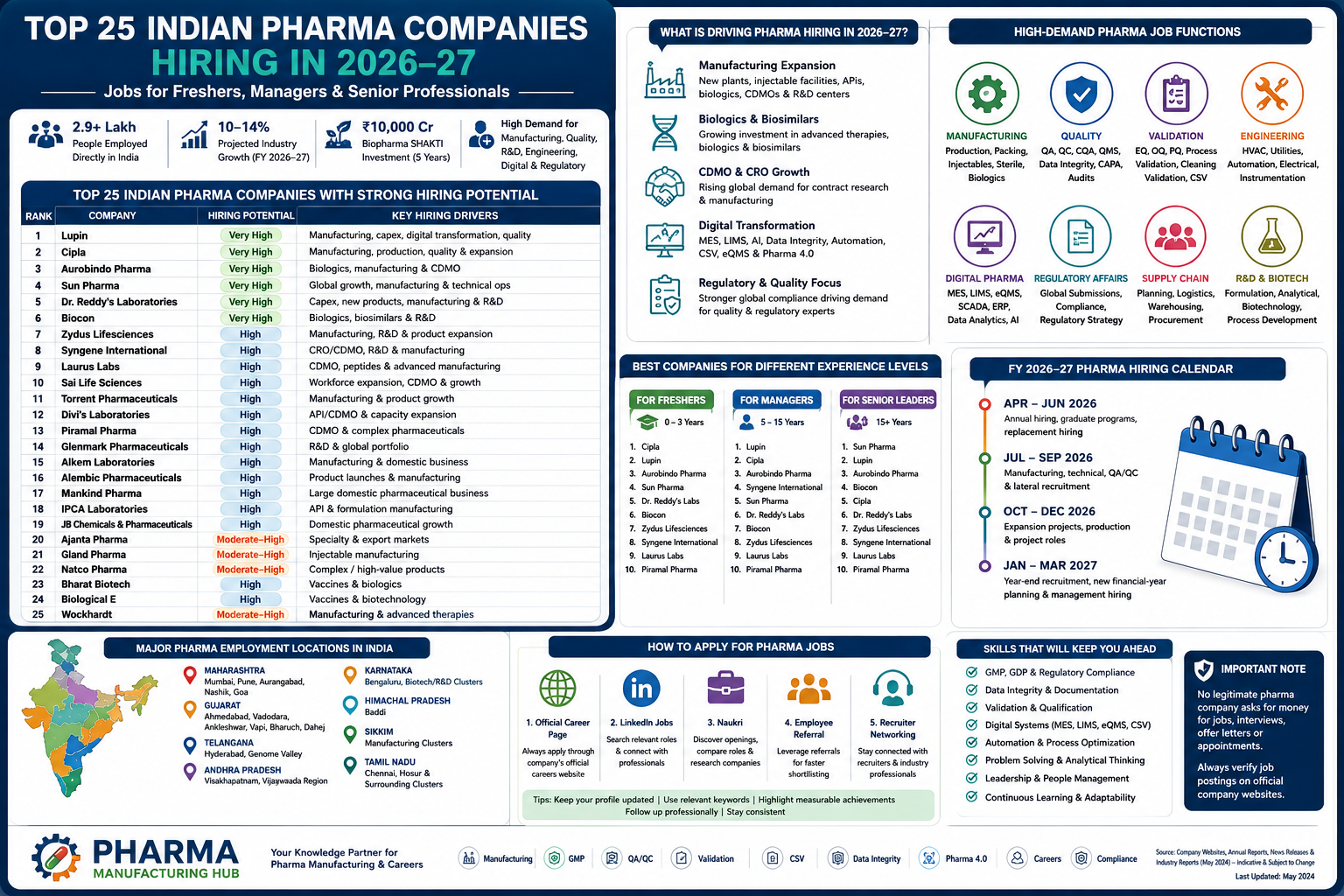
The pharmaceutical sector provides career opportunities across several functions.
Major Pharmaceutical Career Paths
| Function | Typical Roles | Important Skills |
|---|---|---|
| Production | Executive, Officer, Manager, Head | GMP, manufacturing, documentation, people management |
| Quality Assurance | Executive, Manager, QA Head | QMS, deviations, CAPA, audits, change control |
| Quality Control | Analyst, Executive, Manager | Analytical testing, instruments, OOS/OOT |
| R&D | Research Associate, Scientist, Manager | Formulation, analytical development, experimentation |
| Regulatory Affairs | Executive, Associate, Manager | Regulatory submissions, dossiers, compliance |
| Validation | Validation Executive, Manager | Process, cleaning, equipment validation |
| Engineering | Engineer, Maintenance Manager | Utilities, HVAC, equipment, qualification |
| Supply Chain | Planner, SCM Executive, Manager | Planning, inventory, ERP/SAP |
| Warehouse | Officer, Executive, Manager | GDP, inventory, material management |
| Clinical Research | CRA, Clinical Research Associate, Manager | GCP, clinical operations, documentation |
| Pharmacovigilance | PV Associate, Scientist, Manager | Case processing, safety reporting |
| Medical Affairs | Medical Executive, MSL, Manager | Scientific communication, medical knowledge |
| Sales & Marketing | MR, Area Manager, Product Manager | Sales, communication, product knowledge |
| EHS | Executive, Manager, Head | Safety, environmental compliance, risk management |
| Project Management | Project Manager, Program Manager | Planning, cross-functional coordination |
| Operations | Plant Manager, Operations Head | Manufacturing, productivity, leadership |
WHO’s pharmaceutical quality guidance spans development, manufacturing, quality control, inspection, distribution and post-marketing activities, reflecting how broad the pharmaceutical value chain is.
3. Qualification vs Suitable Pharma Roles
Your qualification should influence your initial job-search strategy, but it should not completely determine your career.
| Qualification | Potential Entry-Level Areas |
|---|---|
| D.Pharm | Pharmacy operations, dispensing, selected sales/support roles |
| B.Pharm | Production, QA, QC, regulatory support, sales, supply chain and selected clinical roles |
| M.Pharm | R&D, formulation, analytical development, QA, QC, regulatory, academia and specialized roles |
| Pharm.D | Clinical pharmacy, pharmacovigilance, medical information, clinical research and selected medical roles |
| B.Sc./M.Sc. | QC, analytical laboratories, microbiology, research and selected manufacturing/support roles |
| Engineering | Pharmaceutical engineering, maintenance, utilities, automation, validation and manufacturing support |
| MBA | Pharma sales, marketing, supply chain, business development, operations and management roles |
Always check the individual job description because eligibility requirements differ between employers.
4. The 7-Step Pharma Job Search Strategy
Step 1 — Define Your Target Role
Before searching, answer five questions:
- What function do I want?
- What level am I targeting?
- Which locations can I work in?
- Which industries or product categories interest me?
- What salary/CTC range is realistic for my experience?
Instead of searching:
Pharma jobs
search for:
Production Manager pharmaceutical manufacturing Pune
or:
QA Executive pharma B.Pharm Hyderabad
or:
Production Planning Manager pharmaceutical Goa
Why this matters
Broad searches produce large numbers of irrelevant vacancies. Specific searches improve the quality of opportunities you see.
Common mistake
Applying for Production, QA, QC, Sales, Regulatory and Supply Chain jobs simultaneously without a coherent career direction can make your profile appear unfocused.
5. Step 2 — Identify Target Pharmaceutical Companies
Create a list of approximately 20–40 target companies rather than applying randomly.
Divide your target list into:
Tier 1 — Preferred Employers
Companies where you particularly want to work.
Tier 2 — Strong Alternatives
Organizations offering relevant roles and good career prospects.
Tier 3 — Development Opportunities
Smaller or specialized companies where you can acquire valuable experience.
Research:
- Products
- Manufacturing locations
- Therapeutic areas
- Regulatory markets
- Company size
- Career pages
- Recent business developments
- Relevant departments
- Locations
- Required skills
Don’t restrict your search only to famous pharmaceutical companies. CDMOs, CROs, API manufacturers, biotech companies and specialized manufacturers can provide excellent career opportunities.
6. Step 3 — Build a Pharma-Specific Resume
Your CV should be customized for the position.
A strong pharmaceutical resume normally includes:
Professional Headline
Example:
Pharmaceutical Production Manager | GMP Manufacturing | Production Planning | Lean Manufacturing | Operational Excellence
Career Summary
Summarize:
- Years of experience
- Core function
- Dosage/product experience
- Manufacturing exposure
- Leadership responsibilities
- Major achievements
Core Competencies
Include relevant keywords such as:
- GMP
- Production Planning
- CAPA
- Deviation Management
- Change Control
- OOS/OOT
- Process Validation
- Batch Documentation
- Audit Readiness
- QMS
- Lean Manufacturing
- ERP/SAP
Quantify Achievements
Instead of:
Responsible for production.
Use:
Managed daily production planning and execution across multiple manufacturing lines while coordinating manpower, materials, equipment availability and changeovers to meet production schedules.
Where truthful, add measurable results:
Reduced changeover time by X%.
Improved schedule adherence from X% to Y%.
Reduced manufacturing deviations by X%.
Never invent numbers simply to make a CV look impressive.
7. Understanding ATS-Friendly Resumes
Many organizations use Applicant Tracking Systems (ATS) or other digital recruitment workflows to screen and organize applications.
An ATS-friendly CV should:
- Use standard headings
- Contain relevant job-specific keywords
- Avoid excessive graphics
- Avoid complicated tables where they interfere with parsing
- Use consistent formatting
- Spell out important abbreviations at least once
- Match genuine skills to the job description
Example
If a job description repeatedly mentions:
Production Planning, GMP, CAPA, SAP, manpower planning and changeover management
and you genuinely possess those skills, make sure they appear naturally in your CV.
Do not insert keywords that you cannot discuss during an interview.
8. Fresher Resume Strategy
For pharma jobs for freshers, the CV should focus on potential rather than pretending to have industry experience.
Highlight:
- Academic qualifications
- Internship
- Industrial training
- Projects
- Laboratory skills
- Relevant subjects
- Certifications
- GMP knowledge
- Software skills
- Communication skills
- Academic achievements
Example fresher profile
B.Pharm graduate with academic exposure to pharmaceutical manufacturing, GMP principles, quality control testing and pharmaceutical documentation, seeking an entry-level opportunity in Production/QA/QC.
9. Experienced Professional Resume Strategy
Experienced candidates should focus on business impact and responsibilities.
For each position, describe:
What you managed → What you improved → What result you achieved.
For example:
Managed production planning and execution across multiple manufacturing areas, coordinating manpower, materials, equipment availability and cross-functional requirements to achieve scheduled production.
This is considerably stronger than:
Responsible for production activities.
10. Step 4 — Search Multiple Job Channels
Do not depend on a single platform.
Major Job Platforms
Useful channels include:
The best approach is not to ask “Which is the single best pharma job portal?” but rather:
Which combination of job portals, company career pages and networking channels gives me the best access to my target roles?
11. Search Pharmaceutical Company Career Pages
This is one of the most important strategies that candidates frequently overlook.
Search:
Company Name + Careers
or:
Company Name + Jobs + India
Always verify the final vacancy through the employer’s official website where possible.
Company career pages can be particularly useful for:
- Experienced professionals
- Specialized technical roles
- Management positions
- R&D
- Regulatory affairs
- Manufacturing
- Quality
- Engineering
- Corporate positions
12. Step 5 — Use LinkedIn Strategically
LinkedIn should not be treated merely as an online CV.
Use it for:
- Job searches
- Recruiter identification
- Employee networking
- Industry discussions
- Company research
- Referrals
- Professional visibility
LinkedIn Profile Checklist
☑ Professional photograph
☑ Strong headline
☑ Detailed About section
☑ Updated experience
☑ Relevant skills
☑ Certifications
☑ Education
☑ Projects
☑ Recommendations
☑ Relevant Featured content
☑ Open to Work settings, if appropriate
13. Examples of Strong LinkedIn Headlines
Production Professional
Pharmaceutical Production Manager | GMP Manufacturing | Production Planning | Operational Excellence | Team Leadership
QA Professional
Pharmaceutical QA Professional | QMS | CAPA | Deviations | Change Control | GMP Compliance
QC Professional
Pharmaceutical QC Professional | Analytical Testing | HPLC | OOS/OOT | GMP | Quality Control
R&D Professional
Pharmaceutical R&D Professional | Formulation Development | Scale-Up | QbD | Technology Transfer
Fresher
B.Pharm Graduate | Pharmaceutical Manufacturing & GMP | Seeking Entry-Level Pharma Opportunities
Production Planning Professional
Pharmaceutical Production Planning Professional | Scheduling | Capacity Planning | SAP/ERP | Supply Chain Coordination
Senior Manager
Pharmaceutical Manufacturing Leader | Production Operations | GMP Compliance | Productivity | People & Plant Management
14. Step 6 — Network With Pharma Professionals
Many candidates send applications but never build professional relationships.
Networking can help you learn about:
- Upcoming opportunities
- Employee referrals
- Recruiters
- Hiring teams
- Industry trends
- Required skills
- Company culture
Networking does not mean asking everyone:
“Sir, give me a job.”
Instead, establish a professional connection.
LinkedIn Connection Request
Hello [Name], I am a pharmaceutical professional with experience in [function]. I came across your profile while researching opportunities in the pharmaceutical industry. I would be pleased to connect and learn from your professional experience.
After Connection
Thank you for connecting. I am currently exploring opportunities in [function/location] and noticed your experience with [company/area]. If you come across a relevant opening matching my background, I would appreciate being considered.
15. Step 7 — Apply Strategically and Track Everything
Don’t measure success by the number of applications alone.
A better approach is:
Relevant application → networking → referral → interview preparation → follow-up.
Maintain a job-search tracker.
| Company | Position | Location | Date Applied | Recruiter | Status | Follow-up | Interview | Result |
|---|---|---|---|---|---|---|---|---|
| Company A | Production Manager | Pune | 05-Sep | Recruiter | Applied | 12-Sep | — | — |
| Company B | QA Manager | Hyderabad | 06-Sep | HR | Shortlisted | 10-Sep | 15-Sep | — |
This prevents missed follow-ups and allows you to identify which application strategies produce results.
16. Effective Job-Portal Search Strings
Use combinations of role + industry + location + experience/qualification.
Production
"Pharma Production Manager""Pharmaceutical Production Manager""Production Head Pharma""Pharma Manufacturing Manager""Production Manager" pharmaceutical
QA
"QA Manager Pharma""Quality Assurance Manager" pharmaceutical"Pharmaceutical QA""QA Executive Pharma"
QC
"QC Manager Pharmaceutical""Quality Control Executive Pharma""Pharmaceutical QC""QC Analyst Pharma"
Freshers
"B.Pharm Fresher Jobs""M.Pharm Jobs""Pharma Fresher""Pharmaceutical Jobs Fresher"
Location Searches
"Pharma Jobs Goa""Pharma Jobs Maharashtra""Pharma Jobs Pune""Pharma Jobs Mumbai""Pharma Jobs Hyderabad""Pharma Jobs Ahmedabad""Pharma Jobs Bengaluru"
Where a platform supports Boolean searching, combinations such as:
"Production Manager" AND pharma AND Pune
can make searches more precise.
17. How Freshers Should Search for Pharma Jobs
Freshers should avoid limiting themselves to job titles containing the word “pharmacist.”
Depending on qualification and employer requirements, explore:
- Production Trainee
- QA Trainee
- QC Trainee
- Research Associate
- Manufacturing Associate
- Regulatory Affairs Associate
- Clinical Research Associate
- Pharmacovigilance Associate
- Medical Information Associate
- Sales Trainee
- Warehouse/Documentation roles
- Laboratory roles
What Freshers Should Do
1. Accept learning-oriented entry positions
Your first job is often about building:
- GMP experience
- Documentation skills
- Manufacturing exposure
- Quality-system knowledge
- Industry discipline
2. Don’t reject a good learning opportunity simply because the first salary is not ideal.
However, salary should still be evaluated against location, responsibilities, working conditions and career growth.
3. Build technical knowledge
Study:
- GMP
- GDP
- SOPs
- CAPA
- Deviations
- Change Control
- Data Integrity
- Basic validation concepts
WHO guidance emphasizes that pharmaceutical quality depends on appropriately defined, validated, reviewed and documented processes—not simply final-product testing.
18. How Experienced Professionals Should Search
Experienced candidates should use a more selective approach.
Instead of applying to 100 unrelated jobs, create a target profile:
Role + Experience + Function + Industry + Location + Company Type
For example:
Production Manager + 12 years + Oral Solid Dosage + GMP + Maharashtra
or:
QA Manager + 10 years + USFDA-regulated manufacturing + Hyderabad
Highlight Your Differentiators
Experienced candidates should emphasize:
- Team size managed
- Production capacity
- Products/dosage forms
- Regulatory markets
- Audit experience
- Productivity improvements
- Cost reduction
- Yield improvement
- Deviation reduction
- Changeover improvement
- Technology transfer
- New product introduction
- Digitalization
- Cross-functional leadership
19. How to Approach Pharmaceutical Recruiters
A recruiter receives many messages every day. Your message should therefore be brief.
LinkedIn Message
Subject: Pharma Manufacturing Opportunity – [Your Function]
Hello [Name],
I am a [designation] with [X] years of experience in [specific pharmaceutical function]. My experience includes [2–3 relevant areas].I am currently exploring opportunities in [location/role]. If you are handling relevant positions matching my background, I would be grateful to be considered.
Regards,
[Name]
Keep the email short and attach a clearly named CV:
Ramesh_Palav_Pharma_Production_Manager_CV.pdf
Avoid filenames such as:
finalresume_new_latest_updated2.pdf
20. How to Request an Employee Referral
A referral request should not sound like an entitlement.
Hello [Name],
I noticed an opening for [Position] at [Company] that closely matches my experience in [area]. I am interested in applying and believe my background in [specific skills] is relevant.If you are comfortable referring me or guiding me on the appropriate application process, I would greatly appreciate your support.
Thank you.
21. Pharma Interview Preparation
Getting the interview is only half the process.
Your preparation should include company knowledge + technical knowledge + role-specific examples + behavioral questions.
Core Technical Topics
Depending on your role, revise:
- GMP
- WHO-GMP
- cGMP
- Data Integrity
- CAPA
- Deviations
- Change Control
- OOS
- OOT
- Validation
- Qualification
- SOPs
- Batch Manufacturing Records
- Good Documentation Practices
- Risk Management
- Audit Readiness
- Process Validation
- Cleaning Validation
- QbD
WHO’s current pharmaceutical guidance includes dedicated material covering GMP, quality risk management, validation, data integrity, technology transfer and other areas relevant to pharmaceutical manufacturing and quality professionals.
22. Role-Specific Interview Preparation
Production
Prepare for questions on:
- Production planning
- Batch execution
- Manpower
- Equipment utilization
- Yield
- Productivity
- Changeovers
- Deviations
- GMP
- Documentation
- Capacity planning
- Shift management
- OEE
QA
Prepare:
- QMS
- CAPA
- Deviations
- Change control
- Audits
- Batch release
- Documentation
- Risk management
- Data integrity
QC
Prepare:
- HPLC
- GC
- UV
- Dissolution
- Analytical methods
- OOS
- OOT
- Stability
- Method validation
R&D
Prepare:
- Formulation development
- Preformulation
- QbD
- DoE
- Scale-up
- Technology transfer
- Stability
- Analytical development
Supply Chain
Prepare:
- Forecasting
- MRP
- Inventory
- Capacity planning
- Procurement
- ERP/SAP
- Production scheduling
- Supply-demand coordination
Managers
Prepare examples demonstrating:
- Leadership
- Conflict resolution
- Productivity improvement
- Cost reduction
- People development
- Audit management
- Crisis management
- Strategic planning
23. How to Evaluate a Pharma Job Offer
Do not select a job based only on CTC.
| Factor | What to Check |
|---|---|
| CTC | Fixed vs variable |
| Location | Relocation and cost of living |
| Role | Actual responsibilities |
| Shift | General/rotational |
| Career growth | Promotion opportunities |
| Company stability | Business outlook |
| Work environment | Culture and management |
| Benefits | Insurance, bonus, PF, gratuity |
| Notice period | Joining requirements |
| Learning | Technical exposure |
| Job security | Stability |
| Reporting structure | Manager/department |
A simple decision framework
Score each offer from 1–5 for:
Salary + Role + Growth + Learning + Location + Stability + Management + Work-life considerations
This makes the decision more objective.
24. How to Identify Fake Pharma Job Offers
Job seekers can become vulnerable to recruitment fraud, particularly when they are urgently looking for employment.
Warning Signs
Be extremely cautious when someone:
- Demands money before an interview
- Requests a registration fee
- Demands a security deposit
- Requires payment for an offer letter
- Guarantees employment
- Promises an unusually high salary with minimal qualification
- Uses suspicious email addresses
- Refuses to identify the employer
- Communicates exclusively through WhatsApp
- Requests banking credentials
- Requests unnecessary financial information
- Sends an unverified offer letter
- Pressures you to transfer money immediately
Golden Rule
Never pay someone simply because they claim that payment is required to obtain a job.
Verify the recruiter, employer and vacancy independently.
The safest approach is to locate the vacancy on the company’s official website and contact the organization through independently verified contact information.
25. Location-Wise Pharma Career Opportunities in India
India has several important pharmaceutical and life-science employment clusters.
Maharashtra
Mumbai / Thane / Navi Mumbai
Potential opportunities include:
- Corporate pharma
- Sales and marketing
- Regulatory
- Quality
- Manufacturing
- Supply chain
- Clinical research
- Medical affairs
Pune
Strong areas can include:
- Manufacturing
- R&D
- Engineering
- Quality
- Clinical research
- Biotechnology
- Pharmaceutical services
Chhatrapati Sambhajinagar
Opportunities can be associated with:
- Manufacturing
- Formulations
- Production
- QA/QC
- Engineering
Goa
Pharmaceutical manufacturing creates opportunities in:
- Production
- QA
- QC
- Engineering
- Maintenance
- Warehouse
- EHS
- Supply chain
Gujarat
Important pharmaceutical locations include:
- Ahmedabad
- Vadodara
- Ankleshwar
- Bharuch
- Vapi
Opportunities span API manufacturing, formulations, chemicals, quality, engineering and related services.
Telangana
Hyderabad and surrounding pharmaceutical clusters provide opportunities across:
- API manufacturing
- Formulations
- Biotech
- R&D
- Clinical research
- Quality
- Regulatory
Karnataka
Bengaluru provides opportunities across:
- Biotech
- R&D
- Clinical research
- Medical technology
- Pharmaceuticals
- Data and technology-enabled life sciences
Other Important Locations
Also consider:
- Chennai
- Visakhapatnam
- Delhi-NCR
- Baddi
- Chandigarh region
- Indore
- Sikkim
Important: A pharmaceutical cluster does not mean every company in that region is hiring at any given time. Always verify current vacancies.
26. Skills That Improve Pharma Employability
Core Technical Skills
Highly useful areas include:
- GMP
- Regulatory compliance
- Data integrity
- QMS
- CAPA
- Root Cause Analysis
- Risk Management
- Validation
- Documentation
- Audit management
Digital Skills
Increasingly useful:
- Advanced Excel
- ERP/SAP
- Data analysis
- Digital documentation
- Reporting dashboards
- Data visualization
- Basic automation concepts
Manufacturing Skills
Particularly valuable for production professionals:
- Lean Manufacturing
- Six Sigma
- OEE
- Capacity planning
- Production scheduling
- Changeover optimization
- Waste reduction
- Productivity improvement
Leadership Skills
At managerial levels:
- People management
- Communication
- Conflict resolution
- Decision-making
- Project management
- Cross-functional leadership
- Coaching and development
27. Pharma Function vs Key Skills
| Function | Important Skills |
|---|---|
| Production | GMP, planning, OEE, productivity, leadership |
| QA | QMS, CAPA, deviations, audits, change control |
| QC | Analytical testing, OOS/OOT, instruments |
| R&D | Formulation, QbD, DoE, scale-up |
| Regulatory | Dossiers, submissions, regulations |
| Supply Chain | Planning, inventory, ERP, forecasting |
| Engineering | Utilities, HVAC, maintenance, qualification |
| Clinical Research | GCP, clinical documentation, study operations |
| Pharmacovigilance | Safety reporting, case processing |
| Sales | Product knowledge, communication, territory management |
28. The 30-Day Pharma Job Search Plan
Week 1 — Build Your Foundation
Day 1–2
Define:
- Target role
- Target industry
- Target locations
- Minimum acceptable role
- Preferred companies
Day 3–4
Update your CV.
Day 5
Optimize LinkedIn.
Day 6
Create job alerts.
Day 7
Prepare your target-company list.
Target: 20–40 companies.
Week 2 — Start the Search
Every working day:
- Check major job portals
- Review company career pages
- Search LinkedIn
- Save relevant vacancies
- Apply to suitable positions
- Identify recruiters
Target: 5–10 high-quality applications per week initially, rather than indiscriminate mass applications.
Week 3 — Networking
Target:
- 10–15 professional connections
- 5–10 recruiter/employee messages
- 2–5 referral requests
- Continued targeted applications
Do not send the same generic message to everyone.
Week 4 — Interview & Optimization
Focus on:
- Technical revision
- Mock interviews
- Company research
- STAR-format examples
- Salary preparation
- Follow-ups
- CV optimization based on response rate
At the end of 30 days, evaluate:
Applications → Responses → Shortlists → Interviews → Offers
If applications are high but interviews are low, improve your CV and targeting.
If interviews are high but offers are low, improve interview preparation.
29. Common Pharma Job-Search Mistakes
1. Applying Everywhere
More applications do not automatically mean more interviews.
2. Using One CV for Every Role
A Production Manager CV should not be identical to a QA Manager CV.
3. Ignoring Company Career Pages
Some opportunities may only be visible through employer recruitment channels.
4. Poor LinkedIn Profile
Recruiters may search your LinkedIn profile after seeing your application.
5. Not Quantifying Achievements
Experienced candidates should show impact.
6. Applying Without Reading Requirements
Don’t apply simply because the job title sounds attractive.
7. Not Preparing Technical Topics
Pharma interviews frequently require role-specific technical knowledge.
8. Focusing Only on Salary
A slightly higher CTC can be unattractive if the role provides poor career growth, excessive relocation costs or limited learning.
9. Failing to Follow Up
Professional follow-up demonstrates interest.
10. Falling for Recruitment Scams
Never assume a recruitment message is legitimate simply because it contains a company logo.
30. Job Search Channel Comparison
| Channel | Best For | Advantages | Limitations |
|---|---|---|---|
| Experienced + networking | Recruiters, networking, jobs | Competitive | |
| Naukri | Broad Indian market | Large job database | High application volume |
| Indeed | Broad searches | Simple search | Quality varies |
| Foundit | General recruitment | Job discovery | Variable pharma coverage |
| TimesJobs | General jobs | Established platform | Variable activity |
| Company Career Page | Target companies | Direct application | Requires regular checking |
| Employee Referral | Relevant positions | Stronger internal visibility | Requires networking |
| Recruitment Agency | Specialized hiring | Access to recruiters | Need verification |
| Professional Network | Hidden opportunities | Relationship-based | Takes time |
31. Frequently Asked Questions
1. How can I find pharma jobs in India?
Use a combination of major job portals, LinkedIn, official company career pages, employee referrals, professional networking and specialized recruitment channels. Target jobs that genuinely match your qualification and experience.
2. Which website is best for pharma jobs?
There is no single best website for everyone. LinkedIn, Naukri, Indeed, Foundit and TimesJobs can all be useful. For specific employers, the official company career page should also be checked.
3. How can freshers get pharmaceutical jobs?
Build a strong CV around education, internships, projects, technical knowledge and relevant skills. Search for trainee, associate and entry-level positions rather than only experienced roles.
4. How can I get a pharma job without experience?
Look for internships, trainee positions, apprenticeships and entry-level roles. Build relevant GMP, documentation, laboratory or functional knowledge before applying.
5. Which pharma jobs are suitable for B.Pharm graduates?
Depending on the employer, B.Pharm graduates may find opportunities in production, QA, QC, regulatory support, sales, supply chain, clinical research and other pharmaceutical functions.
6. Which jobs are available after M.Pharm?
M.Pharm graduates can explore R&D, formulation development, analytical development, QA, QC, regulatory affairs, clinical research, academia and specialized technical positions.
7. How can experienced pharma professionals find better jobs?
Define a specific target position, identify suitable companies, quantify achievements, use networking and referrals, optimize LinkedIn and approach recruiters directly.
8. How can I contact pharma recruiters?
Use LinkedIn or verified company recruitment contacts. Keep your message short and explain your experience, target role and location.
9. Is LinkedIn useful for pharmaceutical jobs?
Yes. It can be useful for job discovery, professional networking, recruiter visibility, company research and referrals.
10. How do I apply directly to pharma companies?
Visit the company’s official website, locate the Careers/Jobs section and apply through the organization’s designated recruitment process.
11. How can I identify fake pharma recruitment offers?
Check whether the vacancy exists on the employer’s official website, independently verify the recruiter’s identity and never pay money simply to obtain employment.
12. Which pharmaceutical skills are valuable?
GMP, QMS, data integrity, CAPA, deviation management, validation, regulatory knowledge, analytical skills, ERP/SAP, Excel, leadership and communication can all be valuable depending on the function.
13. How can I get a production job in a pharma company?
Develop GMP and manufacturing knowledge, understand production documentation, equipment and processes, and search specifically for Production Executive, Manufacturing Executive, Production Officer, Production Manager and related positions.
14. How can I move from one pharma function to another?
Identify transferable skills and acquire the technical knowledge required for the target function. For example, a production professional moving toward QA should build knowledge of QMS, deviations, CAPA, change control and audits.
15. How should I prepare for a pharma interview?
Study the company, understand the job description, revise relevant technical topics, prepare examples from your experience and practice explaining your achievements clearly.
32. Final Pharma Job Search Checklist
Use this checklist every time you begin a serious job search:
- ☐ Define target role
- ☐ Identify target locations
- ☐ Update resume
- ☐ Customize CV for important positions
- ☐ Optimize LinkedIn
- ☐ Create job alerts
- ☐ Identify target companies
- ☐ Visit official career pages
- ☐ Search LinkedIn
- ☐ Search major job portals
- ☐ Network with recruiters
- ☐ Seek employee referrals
- ☐ Apply strategically
- ☐ Track applications
- ☐ Prepare for technical interviews
- ☐ Research companies before interviews
- ☐ Follow up professionally
- ☐ Verify recruiters
- ☐ Never pay for a job
- ☐ Evaluate offers based on total career value
Conclusion
Finding pharma jobs in India is most effective when job searching is treated as a structured professional project rather than a random application exercise.
For freshers, the priority should be building employability, gaining relevant exposure and entering the industry through realistic entry-level opportunities. For experienced professionals, the emphasis should shift toward specialization, measurable achievements, leadership, networking, targeted applications and career progression.
The strongest strategy combines a role-specific CV, an optimized LinkedIn profile, multiple job-search channels, direct company applications, professional networking, referrals and focused interview preparation.
Most importantly, don’t measure your job search simply by the number of applications submitted. Measure the complete funnel:
Relevant Jobs → Quality Applications → Recruiter Responses → Shortlists → Interviews → Offers
Pharmaceutical careers are built over years. A job that provides strong GMP exposure, technical knowledge, regulatory experience, leadership opportunities or measurable achievements can sometimes be more valuable for long-term career growth than a slightly higher initial salary.
And always remember: verify the employer and vacancy independently, and never pay money simply to obtain a job.
External Resources
For readers who want to deepen their technical knowledge, the article can reference:
- WHO Pharmaceutical GMP guidance — GMP principles and pharmaceutical quality.
- WHO Pharmaceutical Production Guidelines — Production, GMP, validation, data integrity and related guidance.
- WHO Quality Assurance of Pharmaceuticals – Volume 1 — Good practices and regulatory guidance.
- WHO Quality Assurance of Pharmaceuticals – Volume 2 — GMP and inspection guidance.
- CDSCO Guidance Documents — Indian regulatory guidance from the Central Drugs Standard Control Organization.
- LinkedIn Jobs — Professional networking and job discovery.
- Naukri — Indian job-search platform.
- Indeed India — Job search and career resources.
- Foundit India — Job-search platform.
- TimesJobs — Job-search platform.
Editorial note: The regulatory sources above are especially useful for demonstrating E-E-A-T because they allow readers to verify technical concepts such as GMP, quality systems, validation and regulatory compliance against authoritative primary sources. WHO’s current pharmaceutical guidance also includes recent material on areas such as continuous manufacturing, sterile products, data integrity and technology transfer.
About the Author
Ramesh Palav is a pharmaceutical industry professional with extensive experience in pharmaceutical manufacturing, production planning, operations and cross-functional management. Through his industry experience and practical understanding of GMP, pharmaceutical manufacturing and operational excellence, he shares actionable insights on pharma careers, job opportunities, manufacturing, quality, production and industry trends.
His goal is to help pharmaceutical professionals, freshers and experienced candidates build stronger careers through practical, reliable and industry-focused information.