
Part 16
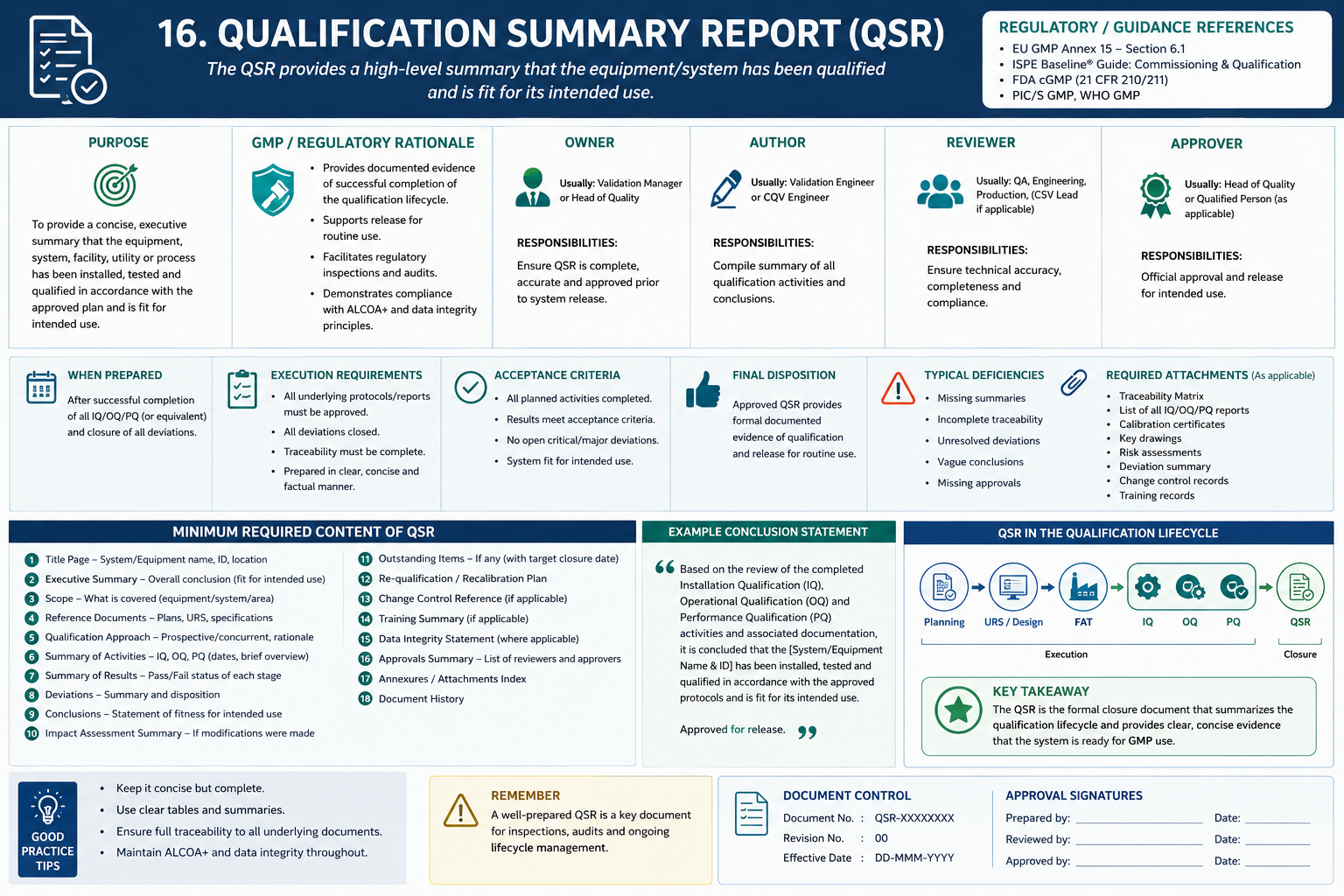
The Qualification Summary Report (QSR) is the principal lifecycle-closure document used to consolidate, assess, and conclude whether qualification evidence supports the intended qualified state of a facility, utility, equipment, or system.
The Part 16 will cover:
Objective → Scope → Equipment/System → Protocols Executed → Test Summary → Deviations → Open Items → CAPAs → Change Controls → Acceptance-Criteria Status → Traceability Status → Outstanding Risks → Restrictions/Limitations → Conclusion → Recommended Qualified State → QA Disposition → Release for GMP Use where applicable.
It also requires a critical distinction:
Successful protocol execution alone does not automatically mean the system is suitable for GMP use.
16.1 What Is a Qualification Summary Report?
A Qualification Summary Report is a controlled document that consolidates and evaluates the completed qualification lifecycle and provides a documented conclusion regarding qualification status.
It should answer the central question:
Does the totality of qualification evidence demonstrate that the equipment/system is fit for its defined intended use, subject to any documented restrictions or outstanding actions?
The QSR therefore goes beyond simply reporting that IQ, OQ, and PQ were executed.
16.2 Position of the QSR in the Qualification Lifecycle
Your source places the QSR near the end of the qualification lifecycle:
Business / Process Need
        ↓
System Definition
        ↓
URS
        ↓
GMP / System Impact Assessment
        ↓
Quality Risk Assessment
        ↓
Design & DQ
        ↓
Supplier Assessment
        ↓
FAT
        ↓
Installation
        ↓
SAT / Commissioning
        ↓
IQ
        ↓
OQ
        ↓
PQ
        ↓
Traceability Review
        ↓
Deviation / Punch-List Closure
        ↓
QUALIFICATION SUMMARY REPORT
        ↓
SOP + Training Readiness
        ↓
QA / GMP Release
        ↓
Routine Operation
This sequence is explicitly reflected in the complete qualification workflow required by the master source.
16.3 QSR Is More Than a Protocol Summary
A weak report may state:
IQ — Passed
OQ — Passed
PQ — Passed
Equipment Qualified.
This is insufficient as a comprehensive lifecycle assessment.
A stronger QSR asks:
- Were all required qualification activities completed?
- Were applicable requirements tested?
- Were predefined acceptance criteria met?
- Were deviations adequately investigated?
- Were retests justified?
- Were changes controlled?
- Are critical risks adequately controlled?
- Is traceability complete?
- Are open items acceptable?
- Are restrictions required?
- Are SOPs and training ready for GMP operation?
- Is the system actually suitable for its intended GMP use?
16.4 Fundamental QSR Evidence Model
URS / Intended Use
       +
Risk Assessment
       +
DQ
       +
FAT / SAT
       +
IQ / OQ / PQ
       +
Raw Data
       +
Deviations / Retests
       +
Change Controls
       +
Traceability
       +
Residual Risk
       +
Operational Readiness
       ↓
QUALIFICATION SUMMARY REPORT
       ↓
Qualification Recommendation
       ↓
QA Disposition
       ↓
GMP Release where applicable
This aligns with the master source’s critical qualification principle:
Intended Use → Requirements → Risks → Design → Critical Aspects → Verification/Testing → Deviations → Traceability → Qualified State → Lifecycle Control.
16.5 Purpose of the QSR
The QSR should provide a concise but complete assessment of the qualification program.
Its functions include:
Consolidation
Bring together qualification evidence generated across multiple lifecycle documents.
Assessment
Evaluate whether the evidence collectively supports the intended qualified state.
Exception Review
Evaluate deviations, failures, open items, CAPAs and changes.
Traceability Confirmation
Confirm that applicable requirements have been addressed.
Risk Review
Evaluate outstanding/residual qualification risks.
Qualification Recommendation
Recommend an appropriate qualification status.
Release Support
Support QA/GMP release where applicable.
16.6 Recommended QSR Structure
A practical structure based on the source is:
| Section | Content |
|---|---|
| 1 | Document Control |
| 2 | Objective |
| 3 | Scope |
| 4 | Equipment/System Identification |
| 5 | Background/Intended Use |
| 6 | Qualification Strategy |
| 7 | Documents/Protocols Executed |
| 8 | Test Summary |
| 9 | Acceptance-Criteria Status |
| 10 | Deviations/Discrepancies |
| 11 | Retesting |
| 12 | Open Items/Punch List |
| 13 | CAPA |
| 14 | Change Controls |
| 15 | Traceability Status |
| 16 | Outstanding/Residual Risks |
| 17 | SOP/Training Readiness |
| 18 | Restrictions/Limitations |
| 19 | Overall Assessment |
| 20 | Conclusion |
| 21 | Recommended Qualified State |
| 22 | QA Disposition |
| 23 | GMP Release where applicable |
| 24 | Approvals |
| 25 | Attachments |
The source specifically requires the major elements listed in Part 16; the expanded organization above is a practical handbook structure rather than a source-prescribed mandatory format.
16.7 Document Control
The report should be uniquely identifiable.
Typical fields may include:
| Field | Example |
|---|---|
| Document Title | Qualification Summary Report |
| Equipment | Tablet Compression Machine |
| Equipment ID | TCM-01 |
| Document No. | QSR-TCM-001 |
| Revision | 00 |
| Department | Production |
| Location | Compression Room ___ |
| Project | ______ |
Document numbering and revision conventions should follow the company’s PQS.
16.8 Objective
The objective should state what the QSR is intended to conclude.
Example
The objective of this Qualification Summary Report is to summarize and assess the qualification activities performed for the identified tablet compression machine and determine whether the available documented evidence supports the recommended qualified state for its defined intended use.
The objective should not predetermine the conclusion.
16.9 Scope
Define exactly what the report covers.
Potentially include:
- equipment/system;
- subsystems;
- qualification stages;
- computerized functions;
- utilities;
- interfaces;
- applicable project/change.
Also define exclusions where necessary.
16.10 Example Scope
This report summarizes the qualification lifecycle for Tablet Compression Machine TCM-01, including applicable DQ, FAT, SAT, IQ, OQ and PQ activities, associated deviations, change controls, traceability and qualification closure status.
Where a related system is qualified separately, identify that boundary.
For example:
The facility HVAC system is qualified under a separate qualification package and is outside the direct scope of this report.
16.11 Equipment/System Identification
The QSR should clearly identify the asset being assessed.
Recommended fields:
| Item | Details |
|---|---|
| Equipment/System Name | ______ |
| Equipment ID | ______ |
| Manufacturer | ______ |
| Model | ______ |
| Serial Number | ______ |
| Location | ______ |
| Department | ______ |
| Software Version | ______ where applicable |
| PLC/HMI Version | ______ where applicable |
| Configuration Version | ______ where applicable |
This prevents ambiguity about what qualified configuration the conclusion applies to.
16.12 Intended Use
The QSR should remain linked to intended use.
Qualification is not simply:
“The machine works.”
The question is:
Does the machine work appropriately for its defined intended GMP use?
For example, the intended use of a tablet compression machine may define the relevant:
- manufacturing operation;
- operating range;
- product-contact arrangement;
- automation functions;
- control strategy;
- GMP data functions.
The exact intended use should be taken from the approved project documentation.
16.13 Qualification Strategy Summary
Briefly summarize the qualification strategy applied.
For example:
Qualification was performed using a lifecycle and risk-based approach incorporating approved requirements, impact/risk assessment, design verification, supplier/site testing and IQ/OQ/PQ verification as applicable.
Where supplier evidence was leveraged, the QSR should make this visible rather than implying every test was repeated at site.
16.14 Protocols Executed
Your source specifically requires the QSR to identify the protocols executed.
A useful table is:
| No. | Document | Document No. | Revision | Execution Status |
|---|---|---|---|---|
| 1 | DQ | DQ-TCM-001 | 00 | Complete |
| 2 | FAT | FAT-TCM-001 | 00 | Complete |
| 3 | SAT | SAT-TCM-001 | 00 | Complete |
| 4 | IQ | IQ-TCM-001 | 00 | Complete |
| 5 | OQ | OQ-TCM-001 | 00 | Complete |
| 6 | PQ | PQ-TCM-001 | 00 | Complete |
Only lifecycle documents actually applicable to the system should be listed.
16.15 Document Status
For each document, consider whether it is:
- approved;
- executed;
- reviewed;
- complete;
- superseded;
- open;
- not applicable.
A protocol being “executed” does not necessarily mean all associated issues are closed.
16.16 Test Summary
The QSR should provide an overview of qualification testing.
Example:
| Qualification Stage | Planned Tests | Executed | Passed Initially | Failed Initially | Retested | Final Acceptable |
|---|---|---|---|---|---|---|
| IQ | 25 | 25 | 24 | 1 | 1 | 25 |
| OQ | 42 | 42 | 39 | 3 | 3 | 42 |
| PQ | 6 | 6 | 6 | 0 | 0 | 6 |
This is more transparent than simply writing:
IQ/OQ/PQ = PASS.
16.17 Do Not Hide Initial Failures
Suppose:
OQ Test 17 — Initial Fail
DEV-014 raised
Correction completed
OQ Test 17-R1 — Pass
The QSR should reflect this history.
Do not summarize:
“OQ-17 Passed.”
without appropriate visibility of the associated deviation/retest.
Part 14 and Part 15 of the source explicitly emphasize retaining failed results and controlling retesting.
16.18 Acceptance-Criteria Status
The source specifically requires the QSR to evaluate acceptance-criteria status.
The report should determine whether applicable predefined criteria were:
- met initially;
- met after justified corrective action/retest;
- not met;
- not applicable with justification;
- unresolved.
16.19 Acceptance-Criteria Summary
| Status | Number |
|---|---|
| Criteria met initially | ___ |
| Criteria met after retest | ___ |
| N/A with justification | ___ |
| Open | ___ |
| Not met | ___ |
The report should explain significant exceptions.
16.20 Why “All Tests Completed” Is Not Enough
A test can be completed and still fail.
Therefore:
Execution completion ≠ Acceptance
The QSR should distinguish between:
- test executed;
- result reviewed;
- acceptance criterion met;
- deviation resolved;
- requirement verified.
16.21 Deviations
Your source explicitly requires deviations to be summarized in the QSR.
A practical deviation table:
| Deviation | Protocol/Test | Description | Impact | Action/Retest | Final Status |
|---|---|---|---|---|---|
| DEV-001 | IQ-012 | ___ | ___ | ___ | Closed |
| DEV-002 | OQ-017 | ___ | ___ | OQ-017-R1 | Closed |
| DEV-003 | PQ-004 | ___ | ___ | ___ | Open/Closed |
16.22 Deviation Summary Should Be Meaningful
Avoid:
Three deviations occurred. All closed.
Instead summarize:
- what failed;
- why it mattered;
- what investigation concluded;
- what action was taken;
- whether retesting occurred;
- whether residual qualification impact remains.
The detailed investigation remains in the deviation record; the QSR provides the lifecycle-level assessment.
16.23 Retest Summary
Where retesting occurred, summarize:
Original Test → Failure → Deviation → Correction → Retest → Result
Example:
| Original Test | Deviation | Cause/Disposition | Retest | Final |
|---|---|---|---|---|
| OQ-017 | DEV-014 | Controlled correction | OQ-017-R1 | Pass |
This demonstrates that qualification was not simply repeated until a passing result appeared.
16.24 Open Items
Your source specifically requires open items to be addressed.
Examples might include:
- punch-list items;
- documentation actions;
- minor engineering items;
- outstanding CAPAs;
- pending procedural actions.
Every open item should be evaluated for its effect on qualification and release.
16.25 Open-Item Assessment
| Item | Description | GMP Impact | Qualification Impact | Due Date/Owner | Release Impact |
|---|---|---|---|---|---|
| OI-001 | ___ | None/Low/etc. | ___ | ___ | ___ |
| OI-002 | ___ | ___ | ___ | ___ | ___ |
Do not allow an open-item list to become a parking area for unresolved critical failures.
16.26 Critical vs Noncritical Open Items
Consider two examples.
Example A
Cosmetic external-panel label replacement pending.
Potentially low qualification impact if equipment identity and GMP operation remain unaffected.
Example B
Automatic reject mechanism not fully verified.
Potentially significant because a critical functional requirement remains unresolved.
The QSR should distinguish these situations.
16.27 CAPAs
The source requires CAPAs to be summarized.
A CAPA may arise from:
- significant qualification deviation;
- repeated failure;
- systemic design issue;
- documentation-system weakness;
- training weakness.
Not every qualification deviation necessarily requires a CAPA.
16.28 CAPA Summary
| CAPA | Origin | Action | Qualification Impact | Status |
|---|---|---|---|---|
| CAPA-001 | DEV-014 | ___ | ___ | Closed |
| CAPA-002 | Trend | ___ | ___ | Open |
Where a CAPA remains open, the QSR should evaluate whether qualification/release can proceed with that condition.
16.29 Change Controls
Qualification often identifies or intersects with changes.
Examples:
- PLC logic modification;
- component replacement;
- sensor change;
- alarm setpoint change;
- HMI modification;
- utility modification.
Your source specifically requires change controls to be addressed in the QSR.
16.30 Change-Control Summary
| Change Control | Description | Qualification Impact | Verification | Status |
|---|---|---|---|---|
| CC-001 | PLC modification | OQ regression required | OQ-RG-01 | Closed |
| CC-002 | Sensor replacement | IQ/OQ impact | IQ-RT-02/OQ-RT-03 | Closed |
The QSR should demonstrate that qualification reflects the final controlled configuration.
16.31 Final Configuration Is Critical
Imagine:
OQ successfully completed on Software Version 1.0.
Then before release:
Software Version 1.1 installed.
If the QSR simply states:
“OQ Passed”
without assessing Version 1.1, the conclusion may no longer apply to the current configuration.
Therefore:
Qualification evidence must correspond to the configuration proposed for release.
16.32 Traceability Status
The source specifically requires the QSR to assess traceability status.
The report should confirm whether applicable requirements have appropriate lifecycle evidence.
A useful reconciliation is:
| Requirement Status | Count |
|---|---|
| Total applicable requirements | ___ |
| Verified | ___ |
| Verified after deviation/retest | ___ |
| N/A with justification | ___ |
| Partially verified | ___ |
| Open | ___ |
16.33 Critical Requirement Review
Particular attention should be given to:
- GMP-critical requirements;
- safety-critical requirements;
- data-integrity requirements;
- critical process-control requirements.
The QSR should not recommend an unrestricted qualified state if a critical requirement remains unresolved without an appropriately justified disposition.
16.34 Outstanding Risks
Your source specifically requires outstanding risks to be evaluated.
Qualification may reduce risk but not necessarily eliminate every risk.
The QSR should therefore ask:
What residual/outstanding risks remain after qualification?
and:
Are those risks adequately controlled for the proposed intended use?
16.35 Residual Risk Table
| Risk ID | Original Risk | Control | Verification | Residual Status | Acceptable? |
|---|---|---|---|---|---|
| RA-005 | Interlock failure | Interlock design | OQ-017 | Controlled | Yes |
| RA-009 | Unauthorized access | Role controls | OQ-SEC-03 | Controlled | Yes |
| RA-014 | ___ | ___ | ___ | Open | Assessment required |
The organization’s approved risk methodology should govern acceptance.
16.36 Restrictions and Limitations
Your source specifically requires the QSR to identify restrictions/limitations.
Possible restrictions might include:
- limited operating range;
- specific configuration;
- approved product family only;
- temporary procedural control;
- excluded function;
- restricted software functionality.
Restrictions should not be used to disguise unresolved critical deficiencies.
16.37 Example — Restricted Qualified State
Suppose the machine was successfully qualified between:
20–60 rpm
but its design maximum is:
80 rpm
If 60–80 rpm was not qualified for GMP use, the QSR might recommend qualification only within the demonstrated range.
The release documentation and SOP/recipe controls should remain consistent with that limitation.
16.38 SOP Readiness
The source’s later Part 26 requires SOPs that may need to be available before GMP release, including operation, cleaning, setup/changeover, preventive maintenance, calibration, breakdown handling, alarm response, access management, backup/restore, audit-trail review, data handling, recipe management, logbooks and change control.
Therefore, qualification completion should be considered alongside operational readiness.
16.39 Training Readiness
The source also requires training status to be considered before PQ and routine GMP operation.
Potential training groups include:
- operators;
- engineering;
- maintenance;
- QA;
- administrators;
- automation personnel.
A technically qualified machine operated by untrained personnel is not automatically ready for routine GMP operation.
16.40 Why Successful Protocol Execution Alone Is Not Enough
This is the central principle explicitly required in Part 16.
Consider:
IQ = Pass
OQ = Pass
PQ = Pass
Can the system automatically be released?
Not necessarily.
Other lifecycle elements may remain unresolved.
16.41 Example — Protocols Pass but Traceability Is Incomplete
Suppose:
- IQ passed;
- OQ passed;
- PQ passed;
but:
URS-DI-014 — Backup restoration requirement has no qualification evidence.
The protocol status may appear satisfactory while requirement coverage remains incomplete.
The QSR should identify this gap.
16.42 Example — Protocols Pass but Change Is Unassessed
Suppose:
OQ completed successfully.
After OQ:
PLC program modified.
No documented qualification-impact assessment is performed.
The original OQ result may not adequately represent the configuration proposed for release.
16.43 Example — Protocols Pass but Critical Deviation Is Open
Suppose:
OQ passed after most testing.
However:
Critical reject-function deviation remains unresolved.
The QSR cannot simply ignore the open deviation because the overall protocol completion percentage is high.
16.44 Example — Protocols Pass but SOPs Are Missing
Suppose equipment qualification is technically complete, but:
- cleaning SOP is not approved;
- operating SOP is not approved;
- access-management procedure is unavailable.
Qualification status and GMP operational release therefore need to be distinguished.
16.45 Example — Protocols Pass but Training Is Incomplete
PQ may have been performed by trained qualification personnel, but routine operators remain untrained.
The equipment may have technical qualification evidence while routine GMP operation is not yet ready.
16.46 Qualification Completion vs GMP Release
These are related but distinct decisions.
Qualification Completion
Asks:
Has the required qualification evidence been satisfactorily completed and assessed?
GMP Release
Asks more broadly:
Is the system ready and authorized for its intended GMP operation under the required controls?
The source explicitly places:
Qualification Summary Report → SOP + Training Readiness → QA/GMP Release → Routine Operation.
16.47 Recommended Qualified State
Your source requires the QSR to define a recommended qualified state.
Possible company-defined dispositions might include:
Qualified
Evidence supports intended use.
Qualified With Defined Restrictions
Evidence supports only a documented operating scope.
Qualification Incomplete
Additional evidence/actions required.
Not Qualified
Evidence does not support intended use.
The exact terminology should follow the company’s PQS.
16.48 Qualified With Restrictions
This disposition requires particular care.
Example:
Equipment is recommended as qualified for operation within the demonstrated 20–60 rpm range. Operation above 60 rpm is outside the qualified scope pending approved additional qualification.
The restriction should propagate into:
- SOP;
- recipe;
- training;
- operational controls;
- change control.
16.49 Qualification Incomplete
This may be appropriate when:
- required testing remains open;
- critical deviations remain unresolved;
- traceability is incomplete;
- significant risk remains unassessed;
- configuration is not controlled.
The report should clearly state what remains necessary.
16.50 Conclusion
The conclusion should integrate the entire body of evidence.
It should not simply say:
All protocols passed. Equipment qualified.
Instead it should consider:
- qualification scope;
- executed protocols;
- acceptance criteria;
- deviations;
- retesting;
- open items;
- CAPA;
- changes;
- traceability;
- residual risk;
- restrictions.
16.51 Example QSR Conclusion
Based on review of the qualification activities within the defined scope, including applicable protocol execution, recorded test results, deviations, justified retesting, change controls, requirement traceability and outstanding-risk assessment, the available documented evidence supports the recommended qualification status stated in this report, subject to any restrictions or actions specifically identified herein.
The actual conclusion should reflect the real qualification evidence rather than use predetermined wording.
16.52 QA Disposition
Your source specifically requires QA disposition.
QA’s role should be defined by the company’s PQS.
QA assessment may include confirmation that:
- qualification package is complete;
- significant deviations are appropriately dispositioned;
- retesting is justified;
- change controls are addressed;
- traceability is acceptable;
- outstanding risks are evaluated;
- restrictions are defined;
- the recommended qualified state is supported.
16.53 QA Should Not Merely Count Signatures
QA review should challenge the evidence.
Questions include:
Does the conclusion follow from the data?
Are critical failures resolved?
Is the current configuration the tested configuration?
Are requirements traceable?
Are outstanding risks acceptable?
Are restrictions clearly controlled?
The QSR is therefore an important quality decision document.
16.54 Release for GMP Use
The source specifically requires release for GMP use where applicable.
Release may require consideration of more than qualification testing.
A practical readiness model is:
Qualification Complete
        +
Critical Deviations Resolved/
Appropriately Dispositioned
        +
Traceability Complete
        +
Risk Acceptable
        +
Calibration Ready
        +
PM Ready
        +
SOPs Approved
        +
Training Complete
        +
Data/Access Controls Ready
where applicable
        ↓
QA / GMP RELEASE
        ↓
ROUTINE GMP OPERATION
The exact release mechanism is company-specific.
16.55 GMP Release Checklist
Qualification
- □ DQ completed where applicable
- □ FAT/SAT appropriately addressed
- □ IQ completed
- □ OQ completed
- □ PQ completed where applicable
- □ Qualification summary completed
Exceptions
- □ Deviations assessed
- □ Failed tests investigated
- □ Retests justified
- □ Critical open items resolved
- □ CAPAs appropriately addressed
- □ Changes assessed
Traceability/Risk
- □ Critical URS requirements verified
- □ Traceability completed
- □ Outstanding risks evaluated
- □ Restrictions documented
Operational Readiness
- □ SOPs approved
- □ Personnel trained
- □ Calibration program established
- □ Preventive maintenance established
- □ Logbooks available where required
- □ Access controls established where applicable
- □ Backup/restore controls established where applicable
Approval
- □ QSR approved
- □ QA disposition complete
- □ GMP release documented where required
These elements align with the source’s final inspection-readiness checklist and release workflow.
16.56 QSR Approval
A practical approval table may be:
| Function | Name | Signature | Date |
|---|---|---|---|
| Prepared By — Validation/CQV | |||
| Engineering Review | |||
| Production Review | |||
| Automation/IT Review where applicable | |||
| QA Approval |
Actual responsibilities depend on the company’s PQS.
16.57 Recommended QSR Attachments
Depending on system complexity, useful attachments may include:
- protocol execution summary;
- deviation summary;
- retest summary;
- open-item list;
- CAPA summary;
- change-control summary;
- traceability matrix;
- residual-risk assessment;
- qualification document index;
- GMP release checklist.
Avoid unnecessarily duplicating complete controlled documents if references provide adequate traceability.
16.58 Practical QSR Summary Dashboard
| Category | Status |
|---|---|
| URS | Approved |
| Risk Assessment | Complete |
| DQ | Complete |
| FAT | Complete/Leveraged as justified |
| SAT | Complete |
| IQ | Complete |
| OQ | Complete |
| PQ | Complete where applicable |
| Deviations | Closed/Dispositioned |
| Retesting | Reviewed |
| Change Controls | Assessed |
| Traceability | Complete |
| Critical Requirements | Verified |
| Residual Risks | Acceptable/Dispositioned |
| SOPs | Ready |
| Training | Ready |
| Restrictions | None / Defined |
| Recommended Status | Qualified / Restricted / Incomplete |
| QA Disposition | ______ |
| GMP Release | ______ |
16.59 Example — Tablet Compression Machine QSR
Consider the tablet compression machine used throughout the handbook.
The qualification package might contain:
URS-TCM-001
     ↓
Risk Assessment
     ↓
DQ-TCM-001
     ↓
FAT-TCM-001
     ↓
SAT-TCM-001
     ↓
IQ-TCM-001
     ↓
OQ-TCM-001
     ↓
PQ-TCM-001
     ↓
Traceability Matrix
     ↓
QSR-TCM-001
     ↓
QA/GMP Release
The source specifically requires the later worked example to follow:
URS → Impact Assessment → Risk Assessment → DQ → FAT → SAT → IQ → OQ → PQ → Traceability → Summary Report → GMP Release.
16.60 Tablet Compression Machine — Critical Function Review
The QSR might summarize evidence relating to source-required critical tests such as:
- compression force;
- pre-compression force;
- turret speed;
- fill depth;
- tablet-weight control;
- feeder operation;
- main motor;
- lubrication;
- guards;
- interlocks;
- emergency stop;
- reject mechanisms;
- metal-detector interface where applicable;
- alarms;
- recipe management;
- user access;
- audit trail;
- electronic records;
- power failure/recovery;
- data backup where applicable.
The QSR need not repeat every raw result but should provide or reference sufficient evidence to support its conclusion.
16.61 Example Critical-Function Summary
| Critical Function | Requirement | Evidence | Deviation | Final Status |
|---|---|---|---|---|
| Compression force | URS-CM-001 | OQ-005/PQ-002 | None | Verified |
| Turret speed | URS-CM-003 | OQ-008 | None | Verified |
| Guard interlock | URS-CM-007 | OQ-014 | DEV-004 | Verified after retest |
| Emergency stop | URS-CM-008 | OQ-015 | None | Verified |
| User access | URS-DI-002 | OQ-022 | None | Verified |
| Audit trail | URS-DI-004 | OQ-024 | None | Verified |
| Backup/restore | URS-DI-007 | OQ-027 | None | Verified |
These references are illustrative and would need to match the actual controlled package.
16.62 Example QSR Deviation Assessment
Suppose the guard interlock failed initially.
The QSR should show:
OQ-014 → Initial Failure → DEV-004 → Investigation → Controlled Correction → OQ-014-R1 → Pass → Traceability Updated
Then assess whether:
- related interlocks were affected;
- regression testing was required;
- residual risk remains.
This preserves the qualification story.
16.63 Example — Change Before Release
Suppose a PLC change is made after OQ.
The QSR should not automatically recommend release.
The sequence should be:
PLC Change
   ↓
Change Control
   ↓
GMP/Qualification Impact
   ↓
Risk Assessment
   ↓
Required Regression Testing
   ↓
Successful Verification
   ↓
Updated Traceability
   ↓
QSR Assessment
   ↓
Release Decision
This connects directly with Part 17 of the source, which addresses qualification impact from changes.
16.64 Common QSR Deficiencies
| Deficiency | Concern |
|---|---|
| QSR only says IQ/OQ/PQ passed | No lifecycle assessment |
| Initial failures omitted | Qualification history incomplete |
| Deviations listed without impact | Final suitability uncertain |
| Open items not assessed | Release risk unclear |
| CAPAs ignored | Systemic actions may remain |
| Changes not summarized | Tested configuration may differ |
| Traceability not reviewed | Requirements may remain unverified |
| Residual risks not assessed | Qualified-state rationale incomplete |
| Restrictions omitted | Operation may exceed demonstrated scope |
| SOP readiness ignored | GMP operational readiness incomplete |
| Training ignored | Routine operation may be uncontrolled |
| Automatic GMP release after PQ | Qualification and release decisions conflated |
| Generic conclusion | Evidence does not clearly support decision |
16.65 Inspector Perspective — “Show Me the Qualification Summary”
The inspector’s intent is likely to understand:
How did the organization conclude that the equipment/system was qualified?
Strong evidence should allow navigation from:
QSR → Qualification Protocols → Deviations → Raw Evidence → Traceability → Final Decision
The QSR should function as the roadmap to the complete qualification package.
16.66 Inspector Perspective — “Were There Any Failures?”
A strong response does not attempt to create the impression that qualification was perfect.
Instead:
“Three qualification discrepancies occurred. Each was documented, investigated and assessed. Two required controlled corrective action and retesting. The associated evidence and final disposition are summarized in the QSR.”
The source’s inspection section specifically anticipates questions such as:
- Show me the deviation.
- Who approved the re-test?
- What raw data supports this result?
- How were qualification failures investigated?
16.67 Inspector Perspective — “How Do You Know All URS Requirements Were Tested?”
The expected evidence is the Traceability Matrix.
The QSR should be able to reference:
URS → Risk → Design → FAT/SAT → IQ/OQ/PQ → SOP/Control → Final Status
This is the traceability model explicitly required in Part 12.
16.68 Inspector Perspective — “Which Configuration Was Released?”
For automated equipment, the QSR should make the final configuration clear.
Potential evidence includes:
- PLC version;
- HMI version;
- SCADA version;
- firmware;
- configuration record;
- approved change history.
A QSR based on an obsolete configuration is not a reliable release basis.
16.69 Inspector Perspective — “What Remained Open?”
A strong response identifies open items transparently and explains:
- classification;
- GMP impact;
- qualification impact;
- risk;
- owner;
- due date;
- why release was or was not affected.
Potential red flag:
“There were some punch-list items, but we don’t know what they were.”
16.70 Inspector Perspective — “Who Released the Equipment?”
The organization should be able to show:
- QSR approval;
- QA disposition;
- GMP release record where applicable;
- date of release;
- applicable restrictions.
The source explicitly requires QA/GMP release before routine operation in its end-to-end lifecycle.
16.71 Qualification Closure Decision Tree
All Planned Qualification
Activities Complete?
       │
   ┌───┴───┐
   NO     YES
   │        ↓
Do Not   Acceptance Criteria
Close    Satisfied?
            │
        ┌───┴───┐
        NO     YES
        │        ↓
   Investigate  Deviations
                Dispositioned?
                    │
                ┌───┴───┐
                NO     YES
                │        ↓
             Do Not   Changes
             Close    Assessed?
                         │
                     ┌───┴───┐
                     NO     YES
                     │        ↓
                  Assess   Traceability
                           Complete?
                               │
                           ┌───┴───┐
                           NO     YES
                           │        ↓
                        Resolve   Residual Risk
                                  Acceptable?
                                      │
                                  ┌───┴───┐
                                  NO     YES
                                  │        ↓
                               Do Not   Restrictions/
                               Release  Controls Defined?
                                           ↓
                                      QSR Conclusion
                                           ↓
                                      QA Disposition
                                           ↓
                                    GMP Release where
                                        applicable
16.72 Recommended QSR Conclusion Categories
A practical decision model may be:
| Status | Meaning |
|---|---|
| Qualified | Evidence supports intended use |
| Qualified with Restrictions | Evidence supports defined limited use |
| Qualification Incomplete | Additional work required |
| Not Qualified | Evidence does not support intended use |
These categories are practical examples; the source does not mandate this exact terminology.
16.73 QSR Readiness Checklist
Document Package
- □ URS approved
- □ Impact assessment complete
- □ Risk assessment complete
- □ DQ complete where applicable
- □ FAT/SAT addressed
- □ IQ complete
- □ OQ complete
- □ PQ complete where applicable
Test Evidence
- □ All planned tests reconciled
- □ Actual results available
- □ Raw data retained
- □ Acceptance criteria reviewed
- □ Failed tests identified
- □ Retests justified
Exceptions
- □ Deviations summarized
- □ Investigations complete
- □ CAPAs assessed
- □ Open items assessed
- □ Punch-list status reviewed
Changes
- □ Qualification-related changes identified
- □ Final configuration established
- □ Required regression/requalification completed
Traceability/Risk
- □ Traceability matrix complete
- □ Critical requirements verified
- □ Outstanding risks evaluated
- □ Residual risk acceptable
- □ Restrictions defined
Operational Readiness
- □ Applicable SOPs approved
- □ Required training completed
- □ Calibration program ready
- □ Preventive maintenance ready
- □ Access/data controls ready where applicable
Closure
- □ Conclusion supported
- □ Recommended qualified state defined
- □ QA disposition complete
- □ GMP release documented where applicable
This aligns with the source’s final documentation-quality checklist, which specifically requires deviations to be resolved or appropriately dispositioned, retests justified, traceability completed, outstanding risks evaluated, SOPs approved, training completed, summary report approved and QA release documented where required.
16.74 Master Qualification Summary Report Template
QUALIFICATION SUMMARY REPORT
1. Document Information
System/Equipment: __________________________
Equipment ID: ______________________________
Location: __________________________________
Report No.: ________________________________
Revision: __________________________________
2. Objective
3. Scope
4. Equipment/System Description
5. Intended Use
6. Qualification Strategy
7. Qualification Documents Executed
| Document | Number | Revision | Status |
|---|---|---|---|
| DQ | |||
| FAT | |||
| SAT | |||
| IQ | |||
| OQ | |||
| PQ |
8. Test Summary
| Stage | Planned | Executed | Initial Failures | Retests | Final Status |
|---|---|---|---|---|---|
| IQ | |||||
| OQ | |||||
| PQ |
9. Deviations
10. Open Items
11. CAPAs
12. Change Controls
13. Acceptance-Criteria Status
14. Traceability Status
15. Outstanding/Residual Risks
16. SOP/Training Readiness
17. Restrictions/Limitations
18. Overall Assessment
19. Conclusion
20. Recommended Qualified State
□ Qualified
□ Qualified with Restrictions
□ Qualification Incomplete
□ Not Qualified
21. QA Disposition
22. GMP Release
□ Released where applicable
□ Not Released
□ Released with documented restrictions
23. Approval
| Function | Name | Signature | Date |
|---|---|---|---|
| Prepared By | |||
| Reviewed By | |||
| Engineering | |||
| Production | |||
| QA |
16.75 QSR Executive Summary Example
A useful executive summary might state:
Qualification activities for the identified equipment/system were reviewed against the approved qualification scope and applicable requirements. The assessment included executed qualification protocols, acceptance-criteria status, deviations and retesting, change controls, requirement traceability, open items and outstanding risks. The resulting qualification recommendation and any applicable restrictions are documented in this report for QA disposition and subsequent GMP-release consideration.
This wording intentionally avoids assuming the system passed before the evidence has been assessed.
16.76 QSR Quality Test
Before approving a QSR, ask five questions:
1. Completeness
Did we perform everything required by the approved qualification strategy?
2. Compliance
Did the evidence satisfy the applicable predefined acceptance criteria?
3. Exceptions
Do we understand and appropriately disposition every significant failure, deviation and change?
4. Traceability
Can every critical applicable requirement be traced to adequate evidence?
5. Fitness for Intended Use
Does the total body of evidence actually support the proposed qualified state?
If these questions cannot be answered satisfactorily, the QSR may not be ready for closure.
16.77 Golden Rule of the Qualification Summary Report
The purpose of the QSR is not to prove that qualification paperwork has been completed; it is to make a documented, evidence-based determination of what the completed qualification package actually demonstrates.
Therefore:
IQ Pass + OQ Pass + PQ Pass ≠ Automatic GMP Release
The broader decision requires consideration of:
Requirements + Risks + Tests + Raw Evidence + Deviations + Retesting + Changes + Traceability + Residual Risk + Restrictions + Operational Readiness + QA Disposition
16.78 Part 16 — Key Takeaway
The source requires the Qualification Summary Report to integrate:
Objective → Scope → Equipment/System → Protocols Executed → Test Summary → Deviations → Open Items → CAPAs → Change Controls → Acceptance-Criteria Status → Traceability Status → Outstanding Risks → Restrictions/Limitations → Conclusion → Recommended Qualified State → QA Disposition → Release for GMP Use where applicable.
A strong QSR should therefore establish a defensible closure chain:
Qualification Plan/Requirements → Risk → DQ/FAT/SAT → IQ/OQ/PQ → Raw Evidence → Deviations/Retests → Change Controls → Traceability → Residual Risk → QSR → Qualification Recommendation → SOP/Training Readiness → QA/GMP Release
Most importantly:
Successful execution of individual qualification protocols demonstrates only that those protocols were executed and their results were obtained. The final decision on fitness for intended GMP use requires assessment of the complete qualification lifecycle and the state of control proposed for routine operation.
Next — Part 17: Change Control
The next part requires detailed evaluation of qualification impact arising from:
Component replacement, instrument replacement, PLC changes, software upgrades, HMI/SCADA modifications, recipe changes, utility changes, equipment relocation, process changes, capacity changes, new products, new operating ranges and material-of-construction changes.
The required decision model is:
Change → GMP Impact → Risk Assessment → Qualification Impact → Required Testing → Documentation Update → Approval → Implementation → Verification → Closure.
About the Author
Ramesh Palav is a pharmaceutical professional with 20+ years of industry experience in manufacturing, GMP, quality systems, validation, compliance, and operational excellence. Through Pharma Manufacturing Hub, he shares practical insights on pharmaceutical careers, manufacturing, quality, validation, Pharma 4.0, AI, and professional development.
His goal is to help students, freshers, experienced professionals, and career-break professionals build the knowledge and skills needed to succeed in the pharmaceutical industry.