
Part 11
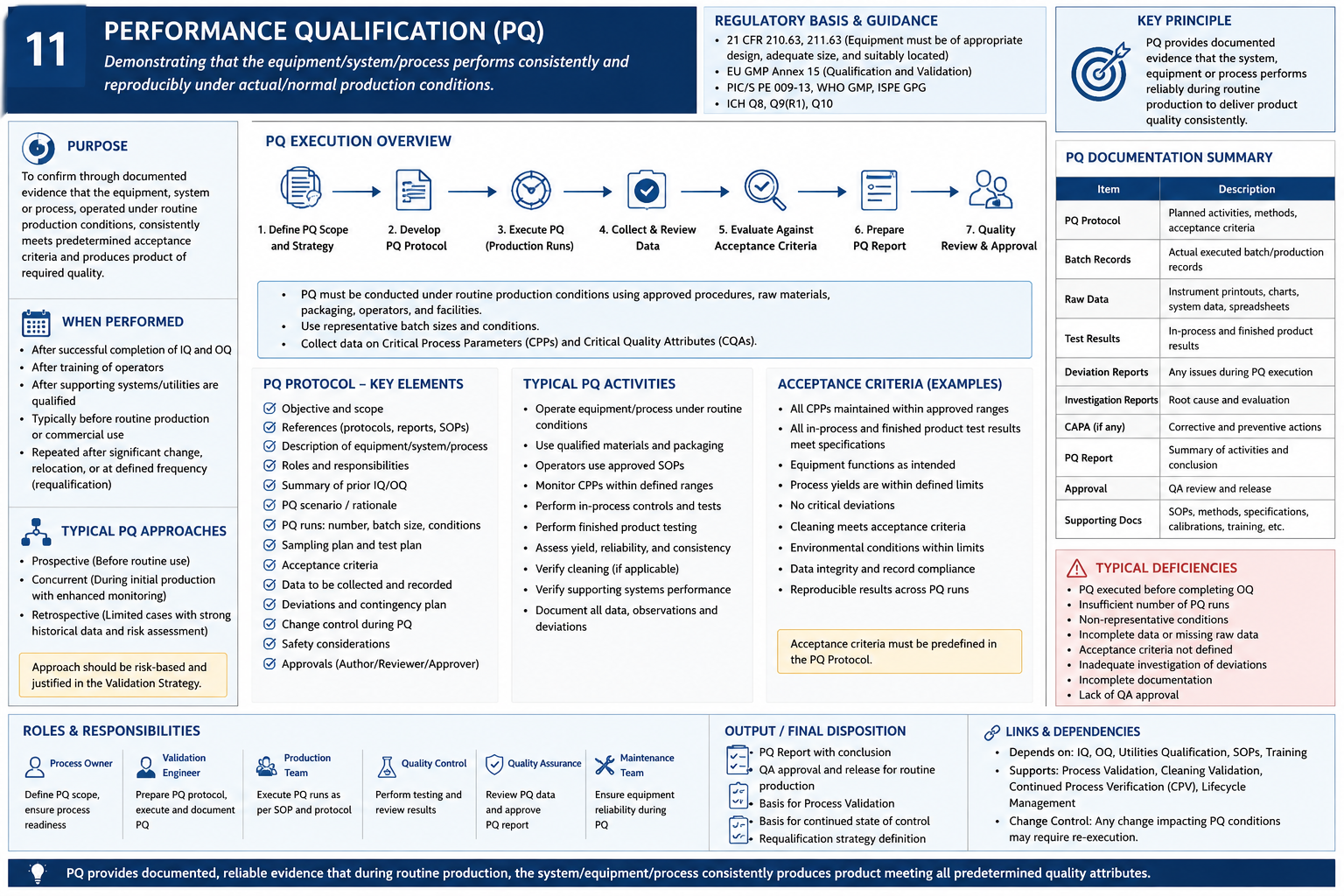
The lifecycle is:
URS → Risk Assessment → DQ → FAT → SAT → IQ → OQ → PQ → Traceability → Qualification Summary → GMP Release
The fundamental PQ question is:
Can the qualified equipment/system perform effectively and reproducibly for its intended use under actual or appropriately simulated routine operating conditions?
11.1 What Is Performance Qualification?
Performance Qualification (PQ) provides documented evidence that equipment or a system, operating within its qualified state and using approved procedures, can perform effectively and reproducibly under conditions representative of intended routine use.
In simplified terms:
IQ asks:
Is it installed correctly?
OQ asks:
Does it operate correctly throughout the qualified operating range?
PQ asks:
Can it reliably perform its intended function under routine operating conditions?
11.2 Purpose of PQ
PQ bridges the gap between:
Equipment functionality
and
Routine operational performance
A system may successfully pass OQ yet still require evidence that it performs reliably when challenged by realistic:
- materials;
- loads;
- operators;
- operating procedures;
- operating conditions;
- production durations;
- equipment configurations.
11.3 Qualification Lifecycle
URS
 │
 ▼
Risk Assessment
 │
 ▼
Design / DQ
 │
 ▼
FAT
 │
 ▼
SAT / Commissioning
 │
 ▼
IQ
 │
 ▼
OQ
 │
 ▼
┌─────────────────────┐
│         PQ          │
└─────────────────────┘
 │
 ▼
Traceability Review
 │
 ▼
Qualification Summary
 │
 ▼
QA / GMP Release
 │
 ▼
Routine Operation
 │
 ▼
Lifecycle Monitoring
This follows the broader evidence chain required by your source:
Intended Use → Requirements → Risks → Design → Critical Aspects → Verification/Testing → Deviations → Traceability → Qualified State → Lifecycle Control.
11.4 IQ vs OQ vs PQ
| Qualification Stage | Fundamental Question | Primary Focus |
|---|---|---|
| IQ | Is it installed correctly? | Installation |
| OQ | Does it operate as designed? | Function/range |
| PQ | Does it perform reproducibly for intended use? | Performance |
| Process Validation | Can the manufacturing process reproducibly deliver product meeting predetermined requirements? | Process/product |
This distinction becomes particularly important when equipment PQ and process validation overlap.
11.5 PQ Is Not Simply Another OQ
OQ may deliberately challenge:
- minimum settings;
- maximum settings;
- alarms;
- interlocks;
- failures;
- abnormal conditions.
PQ normally moves toward:
- actual use;
- routine procedures;
- trained operators;
- representative materials;
- representative loads;
- intended operating conditions.
Therefore:
OQ demonstrates operational capability. PQ demonstrates intended-use performance.
11.6 Regulatory/GMP Principle
PQ should be based on a lifecycle and risk-based approach rather than being treated as an isolated protocol.
The qualification package should establish:
Requirement → Risk → Design → Installation → Operation → Performance → Qualified State
PQ acceptance criteria should be established before execution and should be based on approved:
- URS;
- specifications;
- process requirements;
- equipment requirements;
- risk assessment;
- development knowledge;
- established technical criteria.
Do not invent acceptance limits during execution.
11.7 When Is PQ Required?
The extent of PQ depends on:
- equipment intended use;
- GMP impact;
- process impact;
- equipment complexity;
- product interaction;
- risk assessment;
- existing validation strategy.
PQ may be particularly important where equipment performance can directly affect:
- product quality;
- process consistency;
- dosage-unit characteristics;
- mixing;
- drying;
- compression;
- coating;
- filling;
- packaging;
- inspection.
11.8 Systems Where PQ May Look Different
PQ is not identical for every system.
Examples:
Manufacturing Equipment
Performance may be demonstrated using:
- actual product;
- placebo;
- representative material;
- justified surrogate.
HVAC
PQ may involve environmental performance under defined operating/occupancy states.
Water Systems
Qualification may involve phased sampling and monitoring.
Automated Systems
Operational/CSV testing may establish most functionality, with performance evidence integrated into process use.
Therefore:
Do not mechanically apply one PQ template to every pharmaceutical system.
11.9 Risk-Based PQ
PQ scope should be determined using quality risk management.
Ask:
- What is the equipment’s intended use?
- Which performance attributes are critical?
- What could cause performance failure?
- Which operating conditions represent routine use?
- Which loads/configurations are most challenging?
- Which conditions need direct PQ evidence?
- Which risks are already adequately controlled by IQ/OQ?
- What evidence is necessary to demonstrate reproducibility?
11.10 PQ Inputs
Typical inputs include:
- approved URS;
- risk assessment;
- DQ;
- FAT/SAT evidence;
- IQ report;
- OQ report;
- equipment specifications;
- process requirements;
- approved SOPs;
- operating ranges;
- load configurations;
- equipment manuals;
- development/engineering information;
- sampling requirements;
- approved PQ protocol.
11.11 PQ Prerequisites
Before PQ execution, confirm as applicable:
- □ IQ completed
- □ OQ completed
- □ Critical IQ/OQ deviations closed
- □ Equipment in qualified configuration
- □ Required utilities qualified/available
- □ Critical instruments calibrated
- □ Approved PQ protocol available
- □ Operating procedures approved
- □ Cleaning procedures available
- □ Setup/changeover procedures available
- □ Operators trained
- □ Required materials available
- □ Material status acceptable
- □ Sampling plan approved
- □ Acceptance criteria predefined
- □ Test equipment calibrated
- □ Software/configuration baseline controlled
- □ Open items assessed for PQ impact
The source also specifically requires training status to be considered before PQ and routine GMP operation.
11.12 Approved Procedures
PQ should normally be executed using procedures representative of routine operation.
Applicable SOPs may include:
- operation;
- setup;
- cleaning;
- assembly;
- disassembly;
- changeover;
- material loading;
- parameter setting;
- sampling;
- alarm response.
The purpose is important:
PQ should evaluate the intended operating system—not an artificial method that will never be used after qualification.
11.13 Trained Operators
Operators performing PQ should be appropriately trained for their assigned tasks.
Training may include:
- equipment operation;
- relevant SOP;
- safety;
- cleaning;
- material handling;
- electronic system operation;
- data recording;
- GMP/GDP requirements.
PQ should not depend solely on a vendor engineer operating the machine if routine operation will be performed by site production personnel.
11.14 Operator Variability
Where scientifically relevant, PQ may consider normal operator variation.
For example:
Operator A → Run 1
Operator B → Run 2
Operator C → Run 3
This is not universally required.
It may be valuable when performance depends significantly on operator:
- setup;
- loading;
- adjustment;
- assembly;
- intervention.
11.15 Production Materials
PQ may use actual production materials where appropriate.
Advantages include representation of:
- flow properties;
- bulk density;
- compressibility;
- particle characteristics;
- equipment loading;
- material/equipment interaction.
However, use should be consistent with the qualification/process-validation strategy.
11.16 Justified Substitute Materials
Your source explicitly permits consideration of production materials or justified substitutes.
A surrogate or placebo may be appropriate when scientifically justified.
The justification should consider whether the substitute adequately represents relevant characteristics such as:
- flow;
- density;
- viscosity;
- particle size;
- moisture;
- compressibility;
- adhesion;
- equipment loading.
Do not state simply:
“Placebo used instead of product.”
Document why the placebo is representative of the challenge being evaluated.
11.17 Material Selection Strategy
A useful decision model is:
Can actual production material be appropriately used?
                │
        ┌───────┴───────┐
       Yes              No
        │                │
Use representative   Identify substitute
production material       │
                          ▼
                  Scientifically representative?
                      ┌───┴───┐
                     Yes      No
                      │        │
                  Document   Reassess
                  rationale   strategy
11.18 Normal Operating Range
OQ may establish a broad qualified equipment range.
PQ should normally demonstrate performance within conditions representative of intended use.
Example:
OQ-qualified speed
20–80 rpm
Intended routine operation
35–55 rpm
PQ may focus on representative routine/process conditions and justified challenging conditions rather than mechanically repeating the complete OQ range.
11.19 Load Configuration
PQ should consider whether equipment performance depends on load.
Examples:
- blender load;
- granulator batch size;
- fluid-bed dryer load;
- coating-pan load;
- tablet hopper load;
- capsule-filling load.
Load configurations should be selected based on intended use and risk.
11.20 Minimum Load
Minimum load can sometimes be challenging.
Examples:
Blender
Low load may alter mixing dynamics.
Coating Machine
Low tablet-bed depth may alter spray/drying behavior.
Fluid Bed Dryer
Low material load may change airflow behavior.
Therefore, minimum-load qualification should be considered when scientifically relevant.
11.21 Maximum Load
Maximum load may challenge:
- motor capacity;
- mixing;
- drying;
- compression feed;
- coating;
- airflow;
- temperature control;
- cycle time.
Where maximum load is part of intended use and performance is load-dependent, PQ should consider it.
11.22 Nominal Load
A nominal or routine load demonstrates performance under expected normal production conditions.
A possible load strategy is:
Minimum → Routine/Nominal → Maximum
But this should not be adopted automatically.
The correct strategy is:
Scientifically justified representative and challenging loads.
11.23 Worst-Case Conditions
Your master framework specifically requires worst-case conditions where justified.
Worst-case conditions may involve:
- minimum load;
- maximum load;
- difficult material;
- longest run;
- highest throughput;
- lowest throughput;
- challenging equipment configuration.
Worst case should be based on risk and science.
11.24 Worst Case Is Not Always Maximum
This distinction is important.
Maximum ≠ automatically worst case.
For example:
- minimum blender load might be more difficult than maximum load;
- low coating load may be more difficult than high load;
- low throughput may challenge some detection systems differently from high throughput.
Therefore, identify the condition that creates the greatest risk to the specific performance attribute being tested.
11.25 Worst-Case Rationale
A useful table:
| Variable | Range | Potential Challenge | Selected PQ Condition | Rationale |
|---|---|---|---|---|
| Batch load | Min–Max | Mixing/performance | _____ | _____ |
| Speed | Qualified range | Material handling | _____ | _____ |
| Throughput | Min–Max | Feed/control | _____ | _____ |
| Run duration | Short–Long | Heat/wear/stability | _____ | _____ |
11.26 Reproducibility
PQ should provide evidence of consistent performance.
The central concept is:
Can the equipment repeatedly achieve the required performance rather than doing so successfully only once?
Evidence may involve:
- repeated runs;
- repeated cycles;
- multiple loads;
- repeated measurements;
- statistically evaluated data where appropriate.
11.27 Number of PQ Runs
A fixed number of PQ runs should not be invented as a universal rule.
The number should be justified considering:
- equipment type;
- risk;
- variability;
- intended use;
- existing knowledge;
- process-validation strategy;
- applicable company procedures.
The important question is:
Is there enough evidence to demonstrate consistent and reproducible performance?
11.28 Why “Always Three Runs” Can Be Weak
A common legacy approach is:
PQ = three successful runs.
Three may be appropriate in some qualification strategies.
But the scientific question remains:
Why are three runs sufficient for this equipment, risk and performance characteristic?
The qualification rationale should drive the number rather than tradition alone.
11.29 PQ Sampling
Sampling should be designed to detect relevant performance variability.
The plan should define:
- what is sampled;
- where;
- when;
- how much;
- how frequently;
- who samples;
- test method;
- acceptance criteria.
11.30 Sampling Locations
Sampling may consider:
- beginning;
- middle;
- end;
- different equipment locations;
- different discharge locations;
- different process stages.
Selection depends on equipment and the performance question.
11.31 Sampling Frequency
Sampling frequency should reflect:
- risk;
- expected variability;
- run duration;
- equipment behavior;
- process knowledge.
Avoid arbitrary sampling plans without rationale.
11.32 Sampling Plan Example
| Stage | Sampling Location | Time | Quantity | Test | Acceptance |
|---|---|---|---|---|---|
| Beginning | Defined | T1 | ___ | Defined test | Specification |
| Middle | Defined | T2 | ___ | Defined test | Specification |
| End | Defined | T3 | ___ | Defined test | Specification |
Actual sampling must be equipment/process specific.
11.33 Acceptance Criteria
PQ acceptance criteria should be:
- predefined;
- measurable;
- scientifically justified;
- linked to intended use;
- linked to risk;
- supported by applicable specifications.
Sources may include:
- URS;
- process requirements;
- equipment specification;
- product/process development knowledge;
- approved procedures;
- applicable quality specifications.
11.34 Poor Acceptance Criteria
Weak:
“Machine shall perform satisfactorily.”
Why weak?
Because “satisfactorily” is subjective.
Better:
Define measurable performance criteria for the specific equipment function being evaluated.
11.35 Acceptance Criteria Should Not Be Created After Seeing Results
Unacceptable approach:
Execute PQ
↓
Observe results
↓
Choose acceptance criterion that results meet
This undermines the prospective nature of qualification.
Instead:
Define → Approve → Execute → Compare → Conclude
11.36 Statistical Considerations
Your source requires statistical considerations where appropriate rather than statistics for every PQ.
Potential tools include:
- mean;
- range;
- standard deviation;
- coefficient of variation;
- confidence intervals;
- trend analysis;
- capability analysis where justified.
The method should answer the performance question.
11.37 Statistics Should Add Meaning
Do not calculate statistics merely to make a qualification report look sophisticated.
For example:
If PQ generates only a few discrete functional observations, complex statistical analysis may provide little value.
If PQ generates many measurements across time, load, or location, statistical evaluation may help demonstrate:
- variability;
- stability;
- reproducibility;
- trends.
11.38 PQ Protocol Structure
A practical PQ protocol may contain:
- Document title
- Document number
- Revision
- Equipment/system identification
- Objective
- Scope
- References
- Definitions
- Responsibilities
- System description
- PQ prerequisites
- Approved procedures
- Training verification
- Material selection
- Material justification
- Load/configuration strategy
- Critical performance attributes
- Operating conditions
- Worst-case rationale
- Sampling plan
- Test methods
- Acceptance criteria
- Statistical methodology
- Test scripts
- Raw-data requirements
- Deviations
- Retesting
- Traceability
- PQ conclusion
- Final disposition
This also aligns with the source’s broader protocol requirements, which call for predefined methodology, acceptance criteria, data-recording requirements, deviations, change control, retesting, summary, and approval.
11.39 Standard PQ Test Script Format
Each significant test may use:
Test ID
PQ-XXX-001
Objective
Define what performance characteristic is being demonstrated.
Prerequisites
Define required conditions.
Material
Identify product/placebo/surrogate.
Load
Identify test load.
Operating Parameters
Record applicable settings.
Sampling Plan
Define sampling.
Test Method
Provide executable steps.
Expected Result
Define expected performance.
Actual Result
Record observations/data.
Acceptance Criteria
Define objective requirements.
Statistical Evaluation
Where applicable.
Evidence
Raw data/test reports/printouts.
Status
PASS / FAIL
Executed By
Reviewed By
11.40 PQ Run Matrix
A useful run matrix may look like:
| Run | Material | Load | Configuration | Operator | Critical Condition | Result |
|---|---|---|---|---|---|---|
| PQ-01 | Representative | Minimum | A | Operator 1 | Defined | |
| PQ-02 | Representative | Nominal | A | Operator 2 | Routine | |
| PQ-03 | Representative | Maximum | A | Operator 3 | Defined |
This is only an example.
The actual matrix must be justified.
11.41 Equipment PQ vs Process Validation
This is one of the most important distinctions required by your master prompt.
Equipment PQ
Focuses primarily on:
Can the qualified equipment perform its intended equipment function consistently?
Process Validation
Focuses primarily on:
Can the manufacturing process reproducibly deliver product meeting predetermined quality requirements?
The two may overlap in practice.
11.42 Where Equipment PQ Ends
Equipment PQ generally ends when sufficient documented evidence demonstrates that the qualified equipment/system:
- performs its intended function;
- operates under representative conditions;
- handles applicable loads;
- performs reproducibly;
- meets predefined equipment performance criteria.
The focus remains primarily on:
Equipment fitness for intended use.
11.43 Where Process Validation Begins
Process validation becomes central when the primary question becomes:
Does the manufacturing process consistently produce output meeting predefined product/process requirements?
The emphasis shifts toward:
- CPPs;
- CQAs;
- process variability;
- product quality;
- batch reproducibility;
- process-control strategy.
11.44 PQ and Process Validation Can Overlap
The boundary is not always a sharp line.
For some manufacturing equipment:
Equipment PQ + Process Performance Qualification/Process Validation
may be integrated.
For example, commercial-scale product batches might simultaneously provide evidence regarding:
- equipment performance;
- process performance;
- product quality.
The protocol and validation strategy should clearly define the purpose of the data.
11.45 Avoid Terminology Confusion
Different organizations may use terms differently.
For example, “PQ” might mean:
- equipment performance qualification;
- process performance qualification;
- part of process validation.
Therefore, every protocol should clearly define:
What is being qualified or validated?
What evidence is being generated?
What release decision will the evidence support?
11.46 Tablet Compression Machine — PQ Example
Your master framework uses a tablet compression machine as the complete equipment qualification example and requires the lifecycle to progress through URS, risk assessment, DQ, FAT, SAT, IQ, OQ, PQ, traceability, summary report and GMP release.
A compression-machine PQ may evaluate equipment performance under representative conditions.
Potential areas include:
- material feeding;
- turret operation;
- compression stability;
- pre-compression;
- main compression;
- fill-depth control;
- weight-control functionality;
- reject-system performance;
- sustained operation;
- equipment stoppages;
- alarm/interlock behavior during realistic operation.
11.47 Compression Machine PQ Strategy
A potential strategy is:
Qualified Compression Machine
          ↓
Approved PQ Protocol
          ↓
Trained Operators
          ↓
Representative Material
          ↓
Defined Tooling / Configuration
          ↓
Defined Load
          ↓
Approved Operating Parameters
          ↓
PQ Run
          ↓
Sampling
          ↓
Performance Evaluation
          ↓
Acceptance Criteria
          ↓
Repeatability / Reproducibility
          ↓
PQ Conclusion
11.48 Tablet Compression PQ Parameters
Potential equipment-related parameters include:
- turret speed;
- feeder speed;
- fill depth;
- pre-compression force;
- main compression force;
- machine throughput;
- tablet-weight control response;
- reject performance.
Parameters should come from the approved qualification/process strategy.
11.49 Potential Tablet Attributes
Where product or representative material is used, measurements may include attributes relevant to demonstrating equipment performance.
Depending on the purpose, these might include:
- tablet weight;
- weight variation;
- thickness;
- hardness;
- physical appearance.
However, when the objective expands into demonstrating that the manufacturing process reproducibly produces drug product meeting CQAs, the activity may be entering or overlapping with process validation.
This boundary should be explicitly defined.
11.50 Example Compression Machine PQ Matrix
| Attribute | Purpose | Sampling | Acceptance Basis |
|---|---|---|---|
| Machine throughput | Equipment performance | Defined intervals | Approved requirement |
| Turret speed | Operating consistency | Continuous/interval | Qualified range |
| Compression control | Equipment control | Defined intervals | Approved criteria |
| Weight-control function | Equipment performance | Defined samples | Approved requirement |
| Reject mechanism | Segregation performance | Defined challenge | Approved requirement |
| Equipment stoppage | Reliability | Entire run | Approved criteria |
11.51 Example PQ Test — Sustained Compression Run
Test ID
PQ-CM-001
Objective
Demonstrate that the tablet compression machine can operate consistently under the defined representative production condition for the specified PQ duration/load.
Prerequisites
- IQ approved;
- OQ approved;
- required calibration current;
- approved SOP available;
- operators trained;
- material released/approved for PQ use;
- equipment cleaned and status verified.
Method
- Assemble machine according to approved procedure.
- Verify tooling/configuration.
- Load approved PQ material.
- Select approved recipe/settings.
- Start machine.
- Establish defined operating condition.
- Record critical machine parameters.
- Collect samples according to approved sampling plan.
- Record alarms, stops and interventions.
- Continue until defined run/load completion.
- Evaluate results.
Acceptance Criteria
Performance shall comply with the predefined PQ criteria established in the approved protocol.
Evidence
- machine records;
- parameter records;
- sampling results;
- electronic records where applicable;
- executed protocol.
11.52 Example Data Table
| Time | Turret Speed | Feeder Speed | Compression Parameter | Throughput | Observation |
|---|---|---|---|---|---|
| Start | |||||
| T1 | |||||
| T2 | |||||
| T3 | |||||
| End |
Actual parameters and frequencies should be predefined.
11.53 Minimum-Load Example
Suppose a blender has an approved intended load range.
PQ may ask:
Can the blender achieve its required equipment performance at the minimum intended load?
Minimum load may be selected because mixing dynamics can be more challenging.
The justification should be documented before execution.
11.54 Maximum-Load Example
For a fluid-bed dryer:
Can the equipment perform adequately at the maximum intended material load?
The maximum load may challenge:
- airflow;
- heating capacity;
- drying time;
- pressure;
- filter loading.
The specific PQ criteria should derive from intended use.
11.55 Coating Machine Example
PQ considerations may include:
- minimum/maximum pan load;
- drum speed;
- spray-system performance;
- inlet-air control;
- exhaust performance;
- atomization;
- sustained operation.
When coating quality attributes become the primary focus, equipment PQ may overlap with process validation.
11.56 Blender Example
PQ may evaluate:
- load handling;
- speed;
- timer;
- discharge;
- repeatability;
- minimum/maximum load where justified.
Blend uniformity testing using actual formulation can be part of a broader process-validation strategy rather than purely equipment qualification.
Define the boundary prospectively.
11.57 Fluid Bed Dryer Example
Equipment PQ might evaluate:
- load handling;
- airflow performance;
- temperature control;
- filter operation;
- repeatability;
- sustained operation.
When the primary objective becomes demonstrating consistent product moisture or another CQA under the manufacturing process, process validation considerations become more prominent.
11.58 Metal Detector PQ Example
PQ may use certified/controlled challenge pieces or other approved challenge methodology.
Potential challenges may consider:
- defined contaminant/test type;
- specified challenge size;
- product condition;
- position;
- throughput;
- reject function.
Acceptance criteria must come from approved requirements and validated/qualified detection strategy.
11.59 Checkweigher PQ Example
Potential PQ considerations include:
- operating throughput;
- representative packages;
- weight range;
- reject function;
- repeated challenge;
- sustained operation.
Performance criteria should be predefined.
11.60 PQ Reproducibility Table
| Run | Configuration | Load | Key Result | Acceptance | Status |
|---|---|---|---|---|---|
| PQ-01 | A | Minimum | _____ | _____ | |
| PQ-02 | A | Nominal | _____ | _____ | |
| PQ-03 | A | Maximum | _____ | _____ |
Where multiple runs are used, evaluate not only whether each passed but also whether the results demonstrate reasonable consistency.
11.61 Variability Assessment
PQ should look for:
- run-to-run variation;
- beginning-to-end variation;
- operator variation;
- load-dependent variation;
- equipment drift;
- recurring interventions;
- recurring alarms.
A series of individually passing results may still reveal an adverse trend worth investigating.
11.62 Trend Evaluation
Example:
PQ Run 1 → Pass
PQ Run 2 → Pass
PQ Run 3 → Pass
This alone is not the entire assessment.
Ask:
Did performance remain stable?
Did results progressively approach an acceptance limit?
Did intervention frequency increase?
Did alarms recur?
Qualification should evaluate the pattern, not merely count passes.
11.63 Interventions During PQ
All significant interventions should be documented.
Examples:
- machine adjustment;
- feeder adjustment;
- tooling adjustment;
- cleaning intervention;
- alarm reset;
- material refill;
- equipment stop/restart.
The assessment should determine whether interventions are:
- routine;
- expected;
- abnormal;
- performance affecting.
11.64 Equipment Stops
Record applicable:
- planned stops;
- unplanned stops;
- duration;
- reason;
- recovery;
- material impact.
Frequent unplanned stops may indicate that equipment is technically functional but not demonstrating acceptable routine performance.
11.65 PQ Deviations
PQ deviations may include:
- equipment failure;
- acceptance-criteria failure;
- sampling error;
- operator error;
- material issue;
- unexpected alarm;
- parameter excursion;
- test-method deviation;
- missing data.
The source requires qualification deviations to follow a controlled lifecycle:
Observation → Documentation → Initial Assessment → Impact Assessment → Investigation → Root Cause where required → CAPA/Correction → Re-test → QA Assessment → Closure.
11.66 Can PQ Continue After a Deviation?
The answer depends on impact.
PQ may potentially continue when:
- safety is not compromised;
- product/data integrity is not compromised;
- continued execution does not obscure the investigation;
- unaffected tests remain scientifically valid;
- continuation is appropriately authorized.
PQ should be stopped or affected testing suspended when continuing could:
- compromise safety;
- invalidate data;
- obscure root cause;
- damage equipment;
- compromise material/product;
- make interpretation impossible.
11.67 PQ Failure
A PQ failure means:
The predefined performance expectation was not demonstrated.
It does not automatically mean:
The equipment must be permanently rejected.
The appropriate sequence is:
Failure
↓
Deviation
↓
Investigation
↓
Root Cause where required
↓
Impact Assessment
↓
Correction/CAPA
↓
Requalification Strategy
↓
Approved Retest
↓
Final Assessment
11.68 Do Not Repeat Until Pass
Unacceptable practice:
PQ-1 Fail → Adjust → Repeat → Fail → Adjust → Repeat → Pass → Report only final Pass.
Correct practice:
Retain all original data and document the complete investigation/retest history.
The source specifically identifies discarding failed results and repeating tests until they pass without investigation as unacceptable documentation practices.
11.69 Retesting
Retesting should be:
- scientifically justified;
- authorized;
- linked to the deviation;
- appropriately scoped;
- documented.
Ask:
Does only the failed test require repetition, or does the failure affect the validity of the entire PQ run?
The answer should come from impact assessment.
11.70 Change During PQ
If equipment or software requires modification during PQ:
Stop/Assess → Change Control → Risk Assessment → Implement → Verify → Determine IQ/OQ/PQ Impact → Resume under approved strategy
Do not allow uncontrolled vendor or engineering changes during PQ.
11.71 PQ Raw Data
Raw data may include:
- equipment printouts;
- parameter records;
- electronic records;
- sample results;
- laboratory results;
- alarm logs;
- intervention logs;
- run records;
- calculations;
- statistical analysis.
All data should remain traceable to the applicable PQ run.
11.72 Good Documentation Practices
PQ records should be:
- attributable;
- legible;
- contemporaneous;
- original/true copy as applicable;
- accurate;
- complete;
- consistent;
- enduring;
- available.
The source explicitly requires ALCOA+ principles and contemporaneous GMP documentation throughout qualification execution.
11.73 PQ Traceability
PQ should link performance evidence back to the original requirement/risk where applicable.
Example:
| URS | Risk | IQ | OQ | PQ | Final Status |
|---|---|---|---|---|---|
| URS-010 | RA-04 | IQ-05 | OQ-08 | PQ-01 | Pass |
| URS-021 | RA-10 | IQ-12 | OQ-15 | PQ-03 | Pass |
| URS-025 | RA-12 | IQ-15 | OQ-18 | PQ-05 | Pass |
The broader traceability model required by your source is:
URS → Risk Assessment → Design → FAT/SAT → IQ → OQ → PQ → SOP/Control → Final Qualification Status.
11.74 PQ Responsibilities
A typical responsibility model:
| Function | Typical PQ Responsibility |
|---|---|
| Production | Operation/material handling |
| Engineering | Technical equipment support |
| Validation/CQV | Protocol/test coordination |
| QA | GMP oversight/approval per PQS |
| QC | Testing where applicable |
| Automation | Automated-system support |
| Maintenance | Equipment support |
| Vendor | Technical support where required |
Actual responsibility depends on the company’s Pharmaceutical Quality System.
11.75 PQ RACI Example
| Activity | Production | Engineering | Validation | QA | QC | Automation |
|---|---|---|---|---|---|---|
| PQ Strategy | C | C | R | A/C | C | C |
| Protocol | C | C | R | A | C | C |
| Equipment Setup | R | C | C | I | I | C |
| Execution | R | C | R | C | C | C |
| Sampling | R/C | I | C | C | R/C | I |
| Testing | I | I | C | C | R | I |
| Deviations | C | C | R | A | C | C |
| Data Evaluation | C | C | R | C/A | R/C | C |
| PQ Report | C | C | R | A | C | C |
R = Responsible, A = Accountable, C = Consulted, I = Informed.
11.76 PQ Report
A comprehensive PQ report should contain:
- Objective
- Scope
- Equipment/system identification
- Protocol reference
- Prerequisite status
- Material used
- Material justification
- Operators
- Load configurations
- Operating parameters
- PQ runs performed
- Sampling
- Test results
- Statistical evaluation where applicable
- Deviations
- Investigations
- Retests
- Change controls
- Traceability status
- Outstanding items
- Overall conclusion
- Qualification recommendation
- Approval
11.77 PQ Summary Table
| PQ Run | Load | Operating Condition | Acceptance Criteria | Result | Deviations | Status |
|---|---|---|---|---|---|---|
| PQ-01 | Minimum | Defined | Met/Not Met | _____ | _____ | |
| PQ-02 | Nominal | Routine | Met/Not Met | _____ | _____ | |
| PQ-03 | Maximum | Defined | Met/Not Met | _____ | _____ |
Do not reduce the entire PQ conclusion to this table; evaluate overall performance and reproducibility.
11.78 Final PQ Assessment
The final assessment should answer:
Were all planned tests executed?
Yes / No
Were acceptance criteria met?
Yes / No / Deviations resolved
Were representative conditions covered?
Yes / No
Was reproducibility demonstrated?
Yes / No
Were deviations resolved?
Yes / No
Are residual risks acceptable?
Yes / No
Is the equipment fit for intended use?
Yes / No / Restricted
11.79 Final Release Decision
Possible PQ dispositions include:
Qualified
All applicable PQ requirements satisfactorily demonstrated.
Qualified With Defined Restrictions
Only where scientifically justified, formally documented, risk assessed and approved.
Example:
Equipment qualified for a defined load range only.
Not Qualified
Critical performance requirements not demonstrated.
PQ completion alone should not bypass the site’s final qualification/release process.
11.80 PQ Completion Does Not Automatically Mean GMP Release
The source’s lifecycle explicitly places additional activities after PQ:
PQ → Traceability Review → Deviation/Punch-List Closure → Qualification Summary Report → SOP + Training Readiness → QA/GMP Release → Routine Operation.
Therefore, successful PQ is important but does not automatically equal final GMP release.
11.81 GMP Release Prerequisites
Before final release, assess:
- qualification protocols complete;
- deviations appropriately closed/dispositioned;
- traceability complete;
- critical open items closed;
- SOPs approved;
- personnel trained;
- calibration program active;
- preventive maintenance active;
- software/configuration controlled;
- required validation activities complete;
- qualification summary approved.
11.82 Qualification Summary
After PQ, the complete qualification package should be reviewed holistically.
The question is no longer:
Did PQ pass?
It becomes:
Does the complete lifecycle evidence demonstrate that the system is fit for intended GMP use?
This distinction is central to inspection-ready qualification.
11.83 Maintaining the Qualified State
PQ is not the end of lifecycle control.
After release, qualified status depends on controls including:
- calibration;
- preventive maintenance;
- change control;
- deviations;
- CAPA;
- breakdown management;
- periodic review;
- requalification;
- software/configuration control.
Your source specifically requires these lifecycle elements to be evaluated during periodic review.
11.84 Requalification Triggers
Potential triggers include:
- major maintenance;
- equipment relocation;
- critical-component replacement;
- software modification;
- capacity change;
- new operating range;
- repeated failures;
- adverse trends;
- significant process change.
The requalification scope should be risk based rather than automatically repeating the complete original PQ.
11.85 Example — Capacity Increase
Original PQ:
Equipment qualified for load range A–B.
Proposed operation:
New load C, outside the previously qualified range.
Required approach:
Change Control
↓
GMP Impact Assessment
↓
Risk Assessment
↓
Qualification Impact Assessment
↓
Required IQ/OQ/PQ/Process Validation Activities
↓
Approval
Do not assume equipment capability automatically means qualified capability.
11.86 Example — Equipment Relocation
If a compression machine is moved:
Assess:
- installation;
- utilities;
- leveling;
- electrical connections;
- extraction;
- interfaces;
- calibration;
- functional performance.
The resulting qualification may involve selected:
IQ → OQ → PQ
based on risk.
11.87 Common PQ Deficiencies
| Deficiency | Concern |
|---|---|
| PQ performed before OQ completion | Qualification sequence compromised |
| Untrained operators | Routine-use representation weak |
| Unapproved procedures used | PQ not representative of controlled operation |
| Substitute material without justification | Performance relevance uncertain |
| No load rationale | Worst-case conditions may be missed |
| Only one convenient condition tested | Intended-use range inadequately represented |
| “Three runs” with no rationale | Weak scientific justification |
| Sampling plan arbitrary | Variability may not be detected |
| Acceptance criteria vague | Pass/fail subjective |
| Acceptance limits created after execution | Retrospective qualification |
| Statistics applied without purpose | False impression of scientific rigor |
| Deviations ignored | Qualification conclusion unreliable |
| Failed runs discarded | Data-integrity concern |
| Equipment PQ confused with process validation | Scope and conclusion unclear |
| PQ pass treated as automatic GMP release | Lifecycle closure incomplete |
11.88 Inspector Perspective — PQ Conditions
An inspector may ask:
Why did you select these conditions for PQ?
A strong evidence chain is:
Intended Use
↓
Operating Range
↓
Risk Assessment
↓
Load/Material Assessment
↓
Representative/Worst-Case Selection
↓
Approved PQ Protocol
↓
Executed Evidence
11.89 Inspector Perspective — Number of Runs
An inspector may ask:
Why were these runs sufficient to demonstrate reproducible performance?
Strong response characteristics:
- scientific rationale;
- equipment knowledge;
- risk assessment;
- variability considerations;
- previous knowledge where applicable;
- predefined protocol.
Weak response:
“We always perform three batches.”
11.90 Inspector Perspective — Substitute Material
An inspector may ask:
Why was placebo used instead of production material?
Strong evidence should demonstrate that the substitute appropriately represents the relevant equipment challenge.
The answer should not simply be:
“It was cheaper.”
11.91 Inspector Perspective — Worst Case
An inspector may ask:
How did you identify the worst-case load?
Strong response:
Equipment characteristics → Process knowledge → Risk assessment → Load analysis → Documented rationale
Potential red flag:
“Maximum load is always worst case.”
11.92 Inspector Perspective — PQ Failure
An inspector may ask:
Show me all unsuccessful PQ runs.
The organization should be able to provide:
Original Raw Data → Deviation → Investigation → Root Cause/Assessment → CAPA/Correction → Approved Retest → Retest Data → Final Disposition
Failed qualification evidence should not disappear from the record.
11.93 Inspector Perspective — PQ vs Process Validation
An inspector may ask:
Was this study equipment qualification or process validation?
The organization should clearly explain:
- study objective;
- equipment function evaluated;
- process/product attributes evaluated;
- protocol classification;
- acceptance criteria;
- relationship to process-validation strategy.
Ambiguous terminology should not result in ambiguous scientific purpose.
11.94 Best Practices
A mature PQ program should:
- start from intended use;
- use approved procedures;
- use appropriately trained personnel;
- select representative materials;
- justify substitutes;
- evaluate relevant load configurations;
- justify worst-case conditions;
- define acceptance criteria prospectively;
- use scientifically justified sampling;
- evaluate reproducibility;
- use statistics where meaningful;
- document all interventions;
- retain failed results;
- investigate deviations;
- maintain traceability;
- clearly distinguish equipment PQ from process validation;
- formally assess readiness for GMP release.
11.95 PQ Inspection-Readiness Checklist
Before Execution
- □ Approved PQ protocol
- □ URS available
- □ Risk assessment available
- □ IQ complete
- □ OQ complete
- □ Critical deviations closed
- □ Equipment configuration controlled
- □ Critical instruments calibrated
- □ Approved SOPs available
- □ Operators trained
- □ Material identified
- □ Substitute material scientifically justified where used
- □ Loads/configurations defined
- □ Worst-case rationale documented
- □ Sampling plan approved
- □ Acceptance criteria predefined
- □ Statistical methodology defined where applicable
During Execution
- □ Approved procedure followed
- □ Actual operating parameters recorded
- □ Material identity recorded
- □ Load recorded
- □ Operator identified
- □ Samples traceable
- □ Raw data retained
- □ Interventions documented
- □ Equipment stops documented
- □ Alarms documented
- □ Deviations raised contemporaneously
- □ GDP requirements followed
Data Evaluation
- □ All samples accounted for
- □ Acceptance criteria evaluated
- □ Run-to-run variability reviewed
- □ Beginning/middle/end variation assessed where relevant
- □ Load effects assessed
- □ Operator effects assessed where relevant
- □ Trends reviewed
- □ Statistical analysis completed where applicable
- □ Unexpected results investigated
Before Closure
- □ All planned PQ runs completed
- □ All deviations dispositioned
- □ Retests justified
- □ Failed data retained
- □ Change controls assessed
- □ Traceability updated
- □ Residual risks evaluated
- □ PQ report prepared
- □ Qualification conclusion documented
- □ Final release requirements identified
- □ QA approval obtained according to PQS
11.96 PQ Decision Tree
PQ Execution Complete
        │
        ▼
All Planned Runs Completed?
     ┌──┴──┐
    No    Yes
     │      │
 Assess    ▼
 Reason   Acceptance Criteria Met?
          ┌────┴────┐
         No        Yes
          │          │
      Deviation      ▼
          │     Reproducibility
      Investigation  Demonstrated?
          │        ┌──┴──┐
      Correction   No    Yes
          │         │      │
       Retest    Assess    ▼
          │      Cause   Open Items?
          └─────────┐    ┌──┴──┐
                    │   Yes    No
                    │    │      │
                    │  Assess   ▼
                    │  Impact  PQ Acceptable
                    │    │      │
                    └────┴──────┘
                         │
                         ▼
               Qualification Summary
                         │
                         ▼
                    GMP Release
11.97 Golden Rule of PQ
PQ should not merely prove that the equipment can run. It should provide objective evidence that the qualified equipment can perform its intended function consistently and reproducibly under actual or scientifically justified simulated routine-use conditions.
11.98 Part 11 — Key Takeaway
Performance Qualification completes the core IQ–OQ–PQ equipment qualification sequence by moving from installation and functionality to demonstrated performance.
A strong PQ establishes:
1. Operational Readiness — Approved procedures and appropriately trained operators are available.
2. Representative Conditions — Actual production materials or scientifically justified substitutes are used.
3. Load Capability — Relevant routine, minimum, maximum, or otherwise challenging loads are evaluated based on risk.
4. Worst-Case Justification — Challenging conditions are scientifically identified rather than arbitrarily assumed.
5. Reproducibility — Equipment demonstrates consistent performance rather than a single successful run.
6. Sampling Adequacy — Sampling locations, timing, frequency and quantity are justified for the performance question.
7. Prospective Acceptance Criteria — Requirements are established before execution.
8. Appropriate Statistics — Statistical methods are used when they materially help evaluate variability and reproducibility.
9. Transparent Deviation Management — Failures, interventions, changes and retests remain fully documented.
10. Clear Lifecycle Boundary — Equipment PQ is distinguished from, or deliberately integrated with, process validation.
The qualification evidence chain is now:
URS → Risk Assessment → DQ → FAT → SAT → IQ Installed Baseline → OQ Functional Baseline → PQ Performance Evidence → Traceability → Qualification Summary → QA/GMP Release → Lifecycle Control
Part 12 as the Traceability Matrix, requiring a practical model of URS → Risk Assessment → Design → FAT/SAT → IQ → OQ → PQ → SOP/Control → Final Qualification Status, including unique requirement numbering, critical-requirement traceability, identification of untested requirements, change impact, inspection readiness, and an example traceability matrix.
About the Author
Ramesh Palav is a pharmaceutical professional with 20+ years of industry experience in manufacturing, GMP, quality systems, validation, compliance, and operational excellence. Through Pharma Manufacturing Hub, he shares practical insights on pharmaceutical careers, manufacturing, quality, validation, Pharma 4.0, AI, and professional development.
His goal is to help students, freshers, experienced professionals, and career-break professionals build the knowledge and skills needed to succeed in the pharmaceutical industry.