Part 3B-1: Lean Manufacturing & Process Optimization Fundamentals – Eliminating Waste and Maximizing Value
A Professional Guide for Pharmaceutical Manufacturing Excellence
Table of Contents
- Introduction to Lean Manufacturing
- Evolution of Lean Manufacturing
- Lean Manufacturing in the Pharmaceutical Industry
- Lean Principles
- The Eight Wastes (TIMWOODS)
- Value Stream Mapping (VSM)
- Kaizen and Continuous Improvement
- Standard Work
- 5S Workplace Organization
- Visual Management
- Gemba Walks
- Lean KPIs
- Pharmaceutical Case Study
- GMP & Regulatory Considerations
- Lean Implementation Roadmap
- Best Practices
- Key Takeaways
1. Introduction to Lean Manufacturing
Pharmaceutical manufacturers operate in an increasingly competitive and highly regulated environment where organizations must simultaneously improve quality, productivity, compliance, and cost efficiency. Traditional manufacturing approaches often tolerate non-value-added activities that increase lead time, operating costs, and production complexity.
Lean Manufacturing is a systematic methodology focused on delivering maximum customer value while eliminating activities that do not add value. Originating from the Toyota Production System (TPS), Lean has evolved into a globally accepted philosophy applied across pharmaceutical manufacturing to improve Overall Equipment Effectiveness (OEE), reduce waste, and support operational excellence.
In pharmaceutical facilities, Lean is not about increasing speed at the expense of quality; it is about designing efficient, standardized, and compliant processes that consistently deliver safe and effective medicines.
2. Evolution of Lean Manufacturing
Lean Manufacturing emerged through the Toyota Production System, emphasizing waste elimination, continuous improvement, and respect for people. Over time, Lean principles have been integrated with:
- Six Sigma
- Total Productive Maintenance (TPM)
- Operational Excellence (OpEx)
- Industry 4.0
- Pharma 4.0
- Quality by Design (QbD)
- Continuous Process Verification (CPV)
Today, Lean Manufacturing is recognized as a strategic enabler for improving OEE, reducing costs, and maintaining GMP compliance.
3. Lean Manufacturing in the Pharmaceutical Industry
Unlike discrete manufacturing sectors, pharmaceutical production must comply with strict regulatory requirements while ensuring patient safety. Lean initiatives therefore focus on eliminating operational waste without compromising validated processes or product quality.
Benefits of Lean in Pharma
- Improved OEE
- Reduced production lead time
- Lower manufacturing costs
- Reduced work-in-process (WIP)
- Enhanced equipment utilization
- Improved inventory management
- Better production scheduling
- Reduced deviations
- Increased regulatory compliance
- Faster batch release
- Improved employee engagement
4. The Five Lean Principles
4.1 Define Value
Value is defined from the customer’s perspective.
In pharmaceutical manufacturing, value includes:
- Safe medicines
- Consistent quality
- Regulatory compliance
- On-time delivery
- Reliable supply
- Competitive pricing
Activities that do not contribute to these outcomes should be evaluated for elimination or improvement.
4.2 Map the Value Stream
A Value Stream Map (VSM) identifies every step required to transform raw materials into finished pharmaceutical products.
The objective is to distinguish:
- Value-added activities
- Non-value-added activities
- Necessary regulatory activities
4.3 Create Continuous Flow
Continuous flow minimizes interruptions between process steps.
Examples include:
- Improved material movement
- Balanced production lines
- Reduced waiting time
- Optimized equipment sequencing
4.4 Establish Pull Production
Production is driven by actual customer demand rather than forecasts alone.
Benefits:
- Reduced inventory
- Lower obsolescence
- Improved responsiveness
- Better production planning
4.5 Pursue Perfection
Lean is based on continuous improvement rather than one-time projects.
Organizations should continuously identify opportunities to eliminate waste and enhance performance.
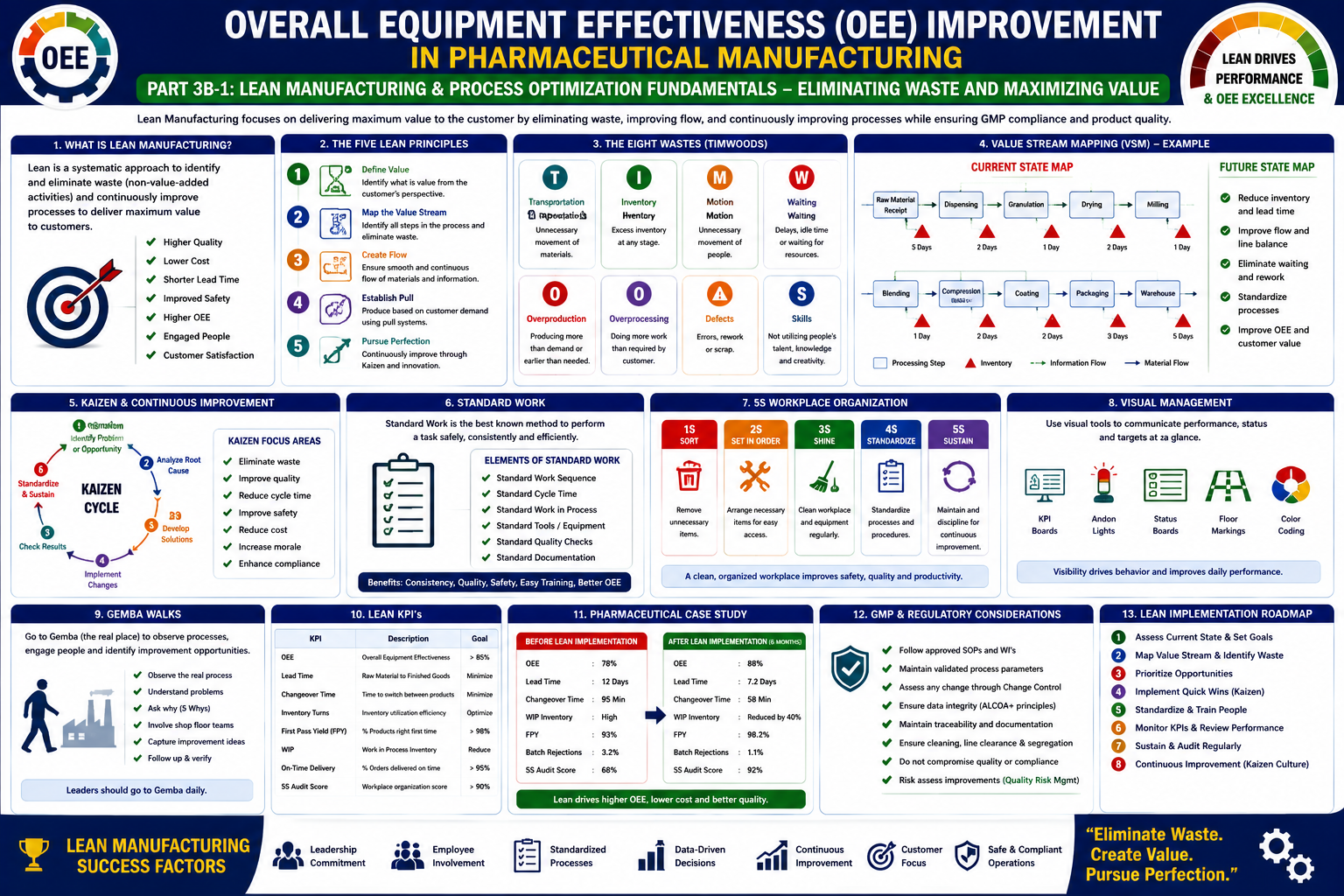
5. The Eight Wastes (TIMWOODS)
The acronym TIMWOODS represents the eight forms of waste commonly found in manufacturing.
5.1 Transportation
Unnecessary movement of materials between operations.
Examples:
- Excessive warehouse transfers
- Multiple handling of raw materials
- Long travel distances between production areas
Improvement Strategies
- Optimize facility layout.
- Use point-of-use storage.
- Streamline material flow.
5.2 Inventory
Excess inventory ties up capital and increases storage requirements.
Examples:
- Excess raw materials
- High work-in-process
- Overstocked packaging components
Risks
- Expiry
- Damage
- Mix-ups
- Increased carrying costs
5.3 Motion
Unnecessary movement of personnel.
Examples:
- Searching for tools
- Walking long distances
- Repeated bending or reaching
- Inefficient workstation design
5.4 Waiting
Idle time caused by delays.
Examples:
- Waiting for QA clearance
- Waiting for maintenance
- Waiting for materials
- Waiting for line clearance
- Waiting for equipment availability
5.5 Overproduction
Producing more than customer demand.
Examples:
- Excess batch sizes
- Unnecessary safety stock
- Duplicate production campaigns
Consequences:
- Increased inventory
- Storage costs
- Product expiry risk
5.6 Overprocessing
Performing unnecessary work beyond customer or regulatory requirements.
Examples:
- Duplicate documentation
- Excessive inspections
- Repeated cleaning without risk justification
- Redundant approvals
5.7 Defects
Products requiring rework or rejection.
Examples:
- Tablet weight variation
- Coating defects
- Incorrect labeling
- Packaging failures
- Failed quality tests
Defects increase costs and reduce OEE.
5.8 Skills (Unused Human Potential)
Failing to utilize employees’ knowledge and expertise.
Examples:
- Ignoring operator improvement ideas
- Limited cross-functional collaboration
- Insufficient training opportunities
Encouraging employee participation is fundamental to Lean culture.
6. Value Stream Mapping (VSM)
Value Stream Mapping is a visual tool used to analyze the flow of materials and information across the manufacturing process.
Objectives
- Identify waste
- Reduce lead time
- Improve flow
- Optimize inventory
- Enhance communication
- Support continuous improvement
Example: Tablet Manufacturing
Current State
Raw Material Receipt
↓
Dispensing
↓
Granulation
↓
Drying
↓
Milling
↓
Blending
↓
Compression
↓
Coating
↓
Packaging
↓
Warehouse
During mapping, identify:
- Processing time
- Waiting time
- Inventory levels
- Transportation distances
- Inspection points
- Information flow
Future State
After improvement:
- Reduced waiting
- Improved synchronization
- Shorter lead times
- Lower WIP inventory
- Balanced production flow
7. Kaizen and Continuous Improvement
Kaizen means “change for the better” and emphasizes continuous, incremental improvements driven by employees at all levels.
Kaizen Cycle
- Identify opportunity
- Analyze current state
- Develop improvement ideas
- Implement changes
- Measure results
- Standardize successful practices
- Repeat
Pharmaceutical Examples
- Reducing tablet changeover time
- Improving line clearance efficiency
- Optimizing cleaning procedures
- Simplifying batch documentation
- Reducing material handling
8. Standard Work
Standard Work defines the best known method for performing a task safely, consistently, and efficiently.
Components
- Standard operating sequence
- Standard cycle time
- Standard inventory
- Standard equipment settings
- Standard documentation
Benefits
- Reduced variation
- Improved quality
- Easier training
- Better compliance
- Simplified troubleshooting
- Consistent performance
9. 5S Workplace Organization
5S is a foundational Lean tool for creating organized, efficient, and safe workplaces.
1. Sort (Seiri)
Remove unnecessary items.
2. Set in Order (Seiton)
Arrange tools and materials for easy access.
3. Shine (Seiso)
Clean equipment and workplace regularly.
4. Standardize (Seiketsu)
Develop standardized cleaning and organization procedures.
5. Sustain (Shitsuke)
Maintain discipline through audits, training, and continuous improvement.
Pharmaceutical Benefits
- Improved safety
- Faster changeovers
- Reduced contamination risk
- Better equipment condition
- Easier inspections
- Enhanced GMP compliance
10. Visual Management
Visual Management enables rapid understanding of process status.
Examples
- OEE dashboards
- Andon lights
- Equipment status boards
- Color-coded tooling
- Floor markings
- Production tracking boards
- Cleaning status indicators
- Calibration labels
- Maintenance tags
Benefits include quicker decision-making and improved communication.
11. Gemba Walks
“Gemba” refers to the place where value is created—the production floor.
Regular Gemba Walks by production, engineering, quality, and maintenance leaders help:
- Observe actual processes
- Identify waste
- Engage employees
- Verify adherence to standards
- Capture improvement opportunities
A successful Gemba Walk focuses on understanding the process rather than assigning blame.
12. Lean KPIs
Monitoring the right Key Performance Indicators supports Lean implementation.
| KPI | Description |
|---|---|
| OEE | Overall Equipment Effectiveness |
| Lead Time | Total time from order to finished product |
| Cycle Time | Time required to complete one production cycle |
| Changeover Time | Time to switch between products |
| Inventory Turns | Frequency of inventory utilization |
| Work-in-Process (WIP) | Inventory between process steps |
| On-Time Delivery | Percentage of orders delivered as scheduled |
| First Pass Yield (FPY) | Products meeting specifications without rework |
| Kaizen Suggestions | Improvement ideas submitted by employees |
| 5S Audit Score | Workplace organization compliance |
Regular KPI reviews help sustain continuous improvement efforts.
13. Pharmaceutical Case Study
Scenario
A solid dosage manufacturing facility experienced excessive lead times and high work-in-process inventory.
Initial Findings
- Long material travel distances
- Multiple storage locations
- Excessive waiting between operations
- Duplicate documentation reviews
- Poor workstation organization
Lean Improvement Actions
- Conducted Value Stream Mapping.
- Implemented 5S across production areas.
- Standardized work instructions.
- Introduced visual management boards.
- Reduced unnecessary material movement.
- Launched weekly Kaizen events.
Results After Six Months
| Metric | Before | After |
|---|---|---|
| Lead Time | 12 days | 8 days |
| WIP Inventory | High | Reduced by 35% |
| Changeover Time | 95 min | 68 min |
| OEE | 80% | 88% |
| Employee Improvement Suggestions | 12/year | 145/year |
14. GMP & Regulatory Considerations
Lean initiatives must always operate within the framework of pharmaceutical regulations.
Key principles include:
- Preserve validated process parameters.
- Maintain approved SOPs.
- Evaluate process changes through change control.
- Ensure traceability of documentation.
- Prevent cross-contamination.
- Maintain line clearance procedures.
- Verify cleaning effectiveness.
- Comply with ALCOA+ data integrity principles.
- Document all improvements.
15. Lean Implementation Roadmap
| Phase | Activities |
|---|---|
| 1 | Assess current manufacturing performance and baseline KPIs |
| 2 | Conduct Value Stream Mapping |
| 3 | Identify waste using TIMWOODS |
| 4 | Prioritize improvement opportunities |
| 5 | Implement 5S and Visual Management |
| 6 | Standardize work methods |
| 7 | Launch Kaizen improvement events |
| 8 | Monitor Lean KPIs and OEE |
| 9 | Sustain improvements through audits and leadership reviews |
16. Best Practices
- Engage employees at all organizational levels.
- Focus on eliminating waste without compromising GMP.
- Use data-driven decision-making.
- Standardize successful improvements.
- Integrate Lean with TPM, Six Sigma, and OEE initiatives.
- Promote cross-functional collaboration.
- Conduct regular Gemba Walks.
- Celebrate improvement achievements.
- Review KPIs consistently.
- Foster a culture of continuous learning and innovation.
17. Key Takeaways
- Lean Manufacturing is a proven methodology for improving productivity, quality, and operational efficiency by eliminating waste while maintaining regulatory compliance.
- The Five Lean Principles and the Eight Wastes (TIMWOODS) provide a structured framework for identifying and removing non-value-added activities across pharmaceutical operations.
- Tools such as Value Stream Mapping (VSM), Kaizen, Standard Work, 5S, Visual Management, and Gemba Walks enable sustainable improvements in process flow, equipment utilization, and employee engagement.
- Lean initiatives support higher Overall Equipment Effectiveness (OEE), shorter lead times, reduced inventory, lower operating costs, and enhanced GMP compliance.
- Successful Lean implementation requires leadership commitment, employee participation, standardized processes, and continuous measurement through relevant KPIs.
Coming in Part 3B-2: Advanced Process Optimization
The next section will cover advanced techniques to maximize manufacturing performance, including:
- Line Balancing and Capacity Optimization
- Theory of Constraints (TOC)
- Statistical Process Control (SPC)
- Process Capability Analysis (Cp and Cpk)
- Cycle Time Reduction
- Throughput Optimization
- Batch Size Optimization
- Overall Line Efficiency (OLE)
- Digital Process Analytics
- AI-Driven Process Optimization
- Real-World Pharmaceutical Case Studies
- Implementation Roadmap, Templates, and Best Practices for world-class pharmaceutical manufacturing performance.
About the Author
Ramesh Palav is a seasoned professional in GxP Quality, Computer System Validation (CSV), Data Integrity, and Pharmaceutical IT Compliance. He has extensive experience in implementing and managing GxP computerized systems, risk-based validation, audit trails, data integrity, and regulatory compliance. Through his articles and professional insights, he aims to share practical knowledge and help pharmaceutical and life-sciences professionals strengthen quality, compliance, and data integrity.