Ultra-Performance Liquid Chromatography (UPLC) has transformed pharmaceutical analysis by delivering faster separations, higher sensitivity, and superior resolution compared to conventional High-Performance Liquid Chromatography (HPLC). As pharmaceutical products become increasingly complex and regulatory expectations continue to evolve, UPLC has become a preferred analytical technique in research and development, quality control (QC), quality assurance (QA), stability studies, impurity profiling, and method validation.
UPLC enables pharmaceutical laboratories to analyze samples more efficiently while consuming less solvent and generating highly reproducible results. Its ability to detect trace impurities and degradation products makes it an indispensable analytical tool in modern GMP-regulated laboratories.
What is UPLC?
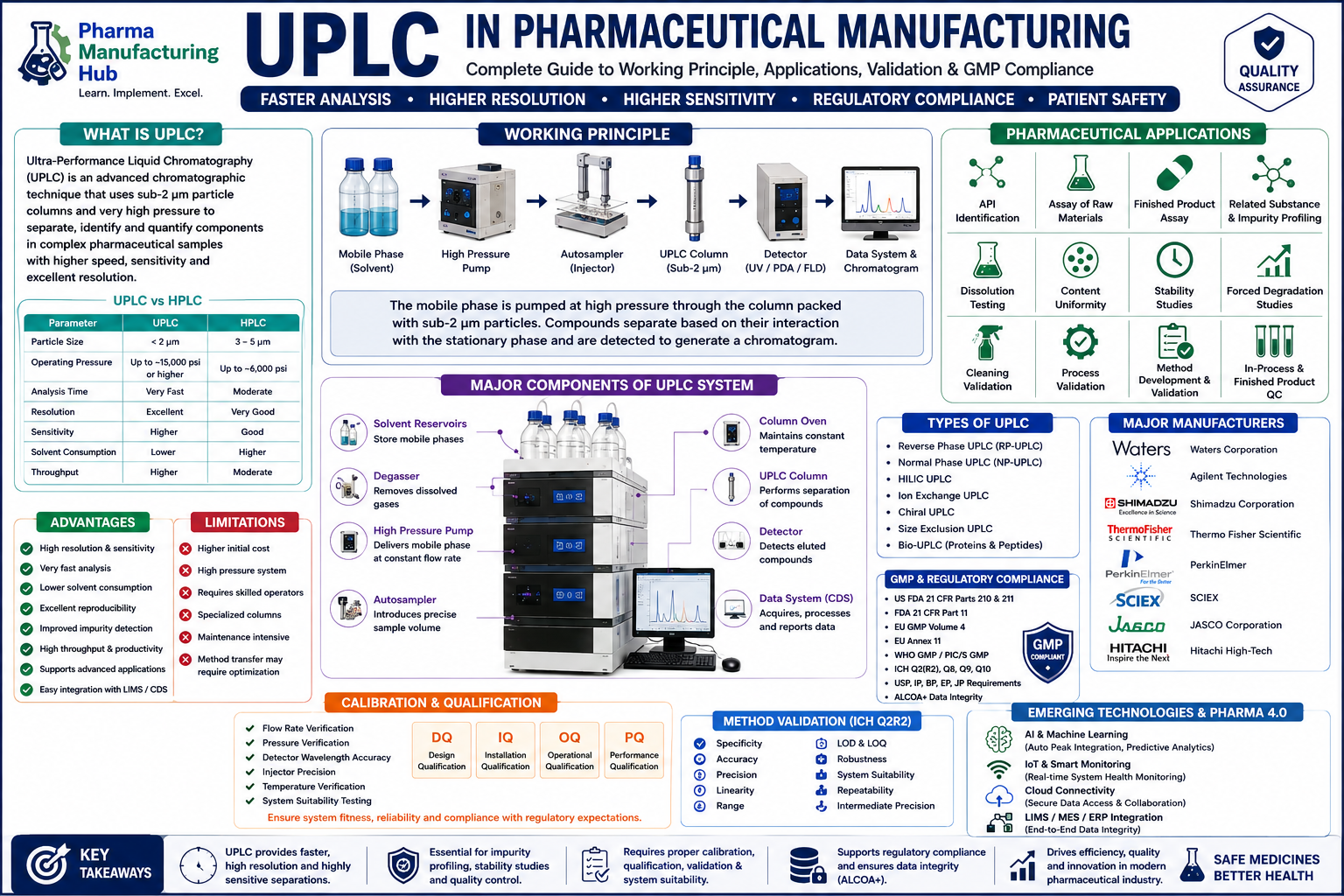
Ultra-Performance Liquid Chromatography (UPLC) is an advanced chromatographic technique that operates on the same separation principle as HPLC but utilizes sub-2 µm particle columns and very high operating pressures (up to approximately 15,000 psi or higher, depending on the system).
The smaller particle size significantly improves chromatographic efficiency, allowing:
- Faster analysis
- Better peak resolution
- Increased sensitivity
- Improved reproducibility
- Lower solvent consumption
UPLC is particularly valuable for pharmaceutical applications requiring high throughput, excellent precision, and enhanced impurity detection.
Working Principle
UPLC separates compounds according to their interaction between a stationary phase packed inside a chromatographic column and a mobile phase delivered at high pressure.
The analytical process follows these steps:
- The mobile phase is prepared, filtered, and degassed.
- High-pressure pumps deliver the mobile phase at a constant flow rate.
- An autosampler injects a precise volume of sample.
- The sample enters a UPLC column packed with sub-2 µm particles.
- Components separate according to polarity, molecular interactions, and affinity for the stationary phase.
- The detector measures each separated compound.
- Chromatography software generates a chromatogram displaying retention time, peak area, peak height, and concentration.
Because of the smaller particle size and optimized flow dynamics, UPLC provides significantly higher chromatographic efficiency than conventional HPLC.
Major Components of a UPLC System
A pharmaceutical UPLC system consists of:
- Mobile Phase Reservoirs
- Vacuum Degasser
- Binary or Quaternary High-Pressure Pumps
- Autosampler
- Column Oven
- UPLC Analytical Column
- Detector (UV, PDA, Fluorescence, MS Compatible)
- Chromatography Data System (CDS)
- Computer with Compliance Software
Each component is designed to operate under very high pressures while maintaining analytical precision and reproducibility.
UPLC Columns
UPLC columns are specially designed for high-pressure operation.
Typical characteristics include:
- Particle size: 1.7–1.9 µm
- Column length: 30–150 mm
- Internal diameter: 2.1–4.6 mm
- High mechanical strength
- Excellent separation efficiency
Common stationary phases include:
- C18
- C8
- Phenyl
- Cyano
- HILIC
- Ion Exchange
Types of UPLC
Pharmaceutical laboratories commonly use:
- Reverse Phase UPLC (RP-UPLC)
- Normal Phase UPLC
- HILIC UPLC
- Ion Exchange UPLC
- Chiral UPLC
- Size Exclusion UPLC
- Bio-UPLC for proteins and peptides
Among these, Reverse Phase UPLC is the most widely used for pharmaceutical analysis.
Pharmaceutical Applications
UPLC supports nearly every stage of pharmaceutical development and manufacturing.
Major applications include:
- API Identification
- Assay of Raw Materials
- Finished Product Assay
- Related Substance Analysis
- Impurity Profiling
- Dissolution Testing
- Stability Studies
- Forced Degradation Studies
- Cleaning Validation
- Residual Solvent Studies (with suitable methods)
- Process Validation
- Method Development
- Analytical Method Validation
- Technology Transfer
- In-Process Quality Control (IPQC)
- Finished Product Quality Control (FPQC)
- Biological Sample Analysis
Its high sensitivity makes UPLC particularly useful for low-level impurity detection and stability-indicating methods.
UPLC vs HPLC
| Parameter | UPLC | HPLC |
|---|---|---|
| Particle Size | <2 µm | 3–5 µm |
| Operating Pressure | Up to ~15,000 psi or higher | Typically up to ~6,000 psi |
| Analysis Time | Very Fast | Moderate |
| Resolution | Excellent | Very Good |
| Solvent Consumption | Lower | Higher |
| Sensitivity | Higher | Good |
| Throughput | Higher | Moderate |
Major Manufacturers
Several leading analytical instrument manufacturers offer pharmaceutical-grade UPLC systems.
Major manufacturers include:
- Waters Corporation
- Agilent Technologies
- Shimadzu
- Thermo Fisher Scientific
- PerkinElmer
- SCIEX
- JASCO
- Hitachi High-Tech
These systems support advanced automation, high-resolution separations, and regulatory-compliant data management.
Calibration and Qualification
Routine calibration and qualification ensure reliable analytical performance.
Typical calibration activities include:
- Pump Flow Rate Verification
- Pressure Verification
- Detector Wavelength Accuracy
- Injector Precision
- Temperature Verification
- Gradient Accuracy
- System Pressure Leak Test
Every pharmaceutical UPLC system should undergo:
- Design Qualification (DQ)
- Installation Qualification (IQ)
- Operational Qualification (OQ)
- Performance Qualification (PQ)
Routine System Suitability Testing (SST) is performed before sample analysis to confirm that the chromatographic system meets validated performance requirements.
Analytical Method Validation
UPLC analytical methods should be validated according to ICH Q2(R2).
Typical validation parameters include:
- Specificity
- Accuracy
- Precision
- Repeatability
- Intermediate Precision
- Linearity
- Range
- Limit of Detection (LOD)
- Limit of Quantitation (LOQ)
- Robustness
- System Suitability
Validated methods provide confidence that analytical results are accurate, reliable, and reproducible.
GMP and Regulatory Compliance
UPLC laboratories must comply with international pharmaceutical regulations, including:
- US FDA 21 CFR Parts 210 & 211
- FDA 21 CFR Part 11
- EU GMP Volume 4
- EU Annex 11
- WHO GMP
- PIC/S GMP
- ICH Q2(R2)
- ICH Q8
- ICH Q9
- ICH Q10
- USP, IP, BP, EP, and JP requirements
Modern UPLC software supports:
- Electronic Records
- Electronic Signatures
- Audit Trails
- User Authentication
- Role-Based Access
- Secure Data Storage
- Backup and Recovery
- ALCOA+ Data Integrity Compliance
These capabilities simplify regulatory inspections and improve laboratory compliance.
Advantages
UPLC provides several significant advantages over traditional HPLC:
- Extremely fast analysis
- Higher chromatographic resolution
- Greater analytical sensitivity
- Reduced solvent consumption
- Lower operating costs over time
- Excellent reproducibility
- Improved impurity detection
- Higher laboratory productivity
- Suitable for complex pharmaceutical formulations
- Seamless integration with Laboratory Information Management Systems (LIMS) and Chromatography Data Systems (CDS)
Limitations
Despite its benefits, UPLC also has some limitations:
- Higher initial instrument cost
- Specialized high-pressure columns required
- Greater maintenance requirements
- Methods often require optimization when transferring from HPLC
- High-purity solvents and well-prepared samples are essential
- Requires trained analysts and validated procedures
Emerging Technologies
Modern UPLC platforms are increasingly integrated with Artificial Intelligence (AI), Machine Learning, Internet of Things (IoT), and Pharma 4.0 technologies.
Advanced chromatography software can:
- Monitor instrument health
- Predict maintenance requirements
- Detect abnormal chromatographic trends
- Automate peak integration
- Generate audit-ready reports
- Support electronic workflows
Cloud-enabled chromatography systems allow secure collaboration across multiple manufacturing sites and seamless integration with LIMS, MES, ERP, and Electronic Laboratory Notebooks (ELN). AI-driven analytics improve method optimization, anomaly detection, and data review, supporting more efficient pharmaceutical quality systems.
Conclusion
Ultra-Performance Liquid Chromatography (UPLC) represents the next generation of liquid chromatography and has become a critical analytical tool in modern pharmaceutical manufacturing. Its ability to provide rapid separations, superior sensitivity, outstanding resolution, and excellent reproducibility enables pharmaceutical laboratories to perform high-quality analytical testing with greater efficiency than conventional HPLC.
From API assay and impurity profiling to dissolution testing, stability studies, cleaning validation, and process validation, UPLC supports every stage of the pharmaceutical product lifecycle. Combined with robust qualification, method validation, computerized data management, and compliance with global GMP regulations, UPLC strengthens pharmaceutical quality systems and regulatory readiness.
As the pharmaceutical industry embraces digital transformation, AI, cloud computing, and Pharma 4.0, UPLC will continue to evolve into a smarter, more connected analytical platform, enabling predictive quality assurance, faster decision-making, and continuous improvement. For pharmaceutical scientists, QC analysts, validation engineers, and regulatory professionals, mastering UPLC is essential for delivering safe, effective, and high-quality medicines while meeting the expectations of global health authorities.