
Introduction
The pharmaceutical industry operates in one of the most highly regulated and quality-driven environments in the world. Every activity performed within a pharmaceutical organization—from raw material receipt to product distribution—has a direct or indirect impact on product quality, patient safety, regulatory compliance, and business continuity.
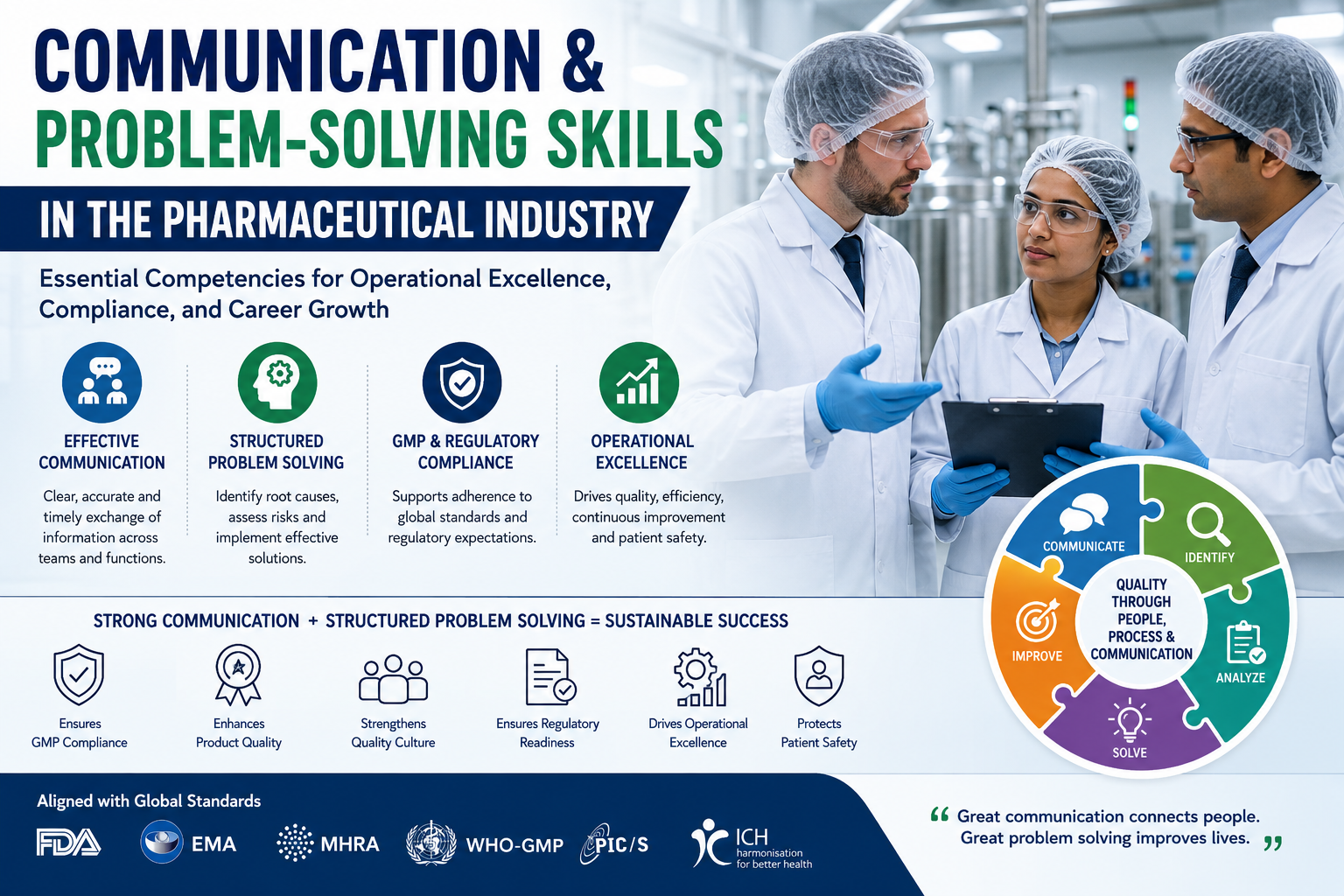
While technical knowledge, scientific expertise, and regulatory understanding are critical, they alone are not sufficient for success in today’s pharmaceutical environment. Organizations increasingly recognize that communication skills and problem-solving abilities are equally important competencies that determine operational effectiveness, compliance performance, and career progression.
Regulatory agencies including the US FDA, EMA, MHRA, WHO-GMP, PIC/S, and ICH consistently emphasize quality culture, knowledge management, risk management, investigation effectiveness, and cross-functional collaboration. All of these depend heavily on effective communication and structured problem-solving.
In modern pharmaceutical manufacturing, communication failures can lead to deviations, batch rejections, data integrity concerns, compliance observations, and patient safety risks. Similarly, weak problem-solving approaches often result in recurring issues, ineffective CAPAs, and operational inefficiencies.
Developing strong communication and problem-solving skills is therefore essential for pharmaceutical professionals at every level—from fresh graduates entering the industry to senior leaders responsible for organizational excellence.
Understanding Communication Skills in Pharma
Definition and Significance
Communication refers to the effective exchange of information, ideas, instructions, feedback, and knowledge between individuals, teams, and organizations.
In pharmaceutical manufacturing, communication ensures:
- Consistent product quality
- GMP compliance
- Effective investigations
- Regulatory readiness
- Operational efficiency
- Patient safety
Verbal Communication
Verbal communication includes:
- Shift handovers
- Team discussions
- Production meetings
- Audit interactions
- Training sessions
- Regulatory discussions
Example:
A production supervisor must clearly communicate process parameters, equipment status, and pending activities to the next shift to prevent manufacturing errors.
Written Communication
Written communication is especially important because pharmaceutical operations are heavily documentation-driven.
Examples include:
- SOPs
- Batch Manufacturing Records (BMR)
- Deviation reports
- Investigation reports
- CAPAs
- Change controls
- Validation protocols
- Regulatory submissions
The GMP principle states:
“If it is not documented, it did not happen.”
Non-Verbal Communication
Non-verbal communication includes:
- Body language
- Eye contact
- Professional behavior
- Workplace conduct
During audits and inspections, professional non-verbal communication significantly influences perceptions of quality culture.
Active Listening
Active listening involves:
- Understanding information correctly
- Asking clarifying questions
- Confirming instructions
- Avoiding assumptions
Many manufacturing errors occur because employees hear instructions but fail to fully understand them.
Digital Communication in Modern Pharma Operations
Digital transformation has expanded communication channels through:
- Electronic Quality Management Systems (eQMS)
- MES platforms
- ERP systems
- Digital dashboards
- Collaboration software
- Electronic batch records
Pharma 4.0 environments rely heavily on real-time digital communication for decision-making.
Importance of Effective Communication in Pharmaceutical Operations
Shift Handovers
Shift handovers are among the most critical communication events.
Information shared includes:
- Equipment status
- Process deviations
- Maintenance activities
- Pending operations
- Quality concerns
Poor handovers frequently contribute to manufacturing errors.
Cross-Functional Coordination
Departments that must collaborate include:
- Production
- QA
- QC
- Engineering
- Warehouse
- Supply Chain
- Regulatory Affairs
Effective communication prevents delays and misunderstandings.
Batch Manufacturing Activities
Production personnel must communicate:
- Process parameters
- Material availability
- Equipment readiness
- Quality approvals
Any communication gap can affect product quality.
Investigations and Deviations
Successful investigations require accurate communication among:
- Production teams
- QA personnel
- QC analysts
- Engineering departments
Incomplete communication often leads to incorrect root cause identification.
Audits and Inspections
Regulators evaluate:
- Personnel knowledge
- Consistency of responses
- Quality culture
- Investigation effectiveness
Strong communication demonstrates organizational control.
Vendor and Customer Interactions
Communication is essential for:
- Supplier qualification
- Technical discussions
- Complaint management
- Product recalls
Regulatory Communications
Interactions with regulators require:
- Clarity
- Accuracy
- Transparency
- Timeliness
Poor communication can escalate regulatory concerns.
Communication Challenges in Pharmaceutical Manufacturing
Departmental Silos
Many organizations struggle with information barriers between departments.
Common consequences include:
- Delayed investigations
- Repeated deviations
- Inefficient CAPAs
Misinterpretation of Instructions
Unclear instructions may result in:
- Process errors
- Documentation mistakes
- Compliance issues
Documentation Errors
Examples include:
- Missing entries
- Incorrect calculations
- Incomplete records
- Ambiguous statements
Language Barriers
Global pharmaceutical operations often involve multicultural workforces.
Language differences can affect:
- Training effectiveness
- SOP understanding
- Investigation quality
Ineffective Reporting Systems
Poor reporting structures delay:
- Escalations
- Decision-making
- Risk mitigation
Communication Gaps During Emergencies
Critical situations require rapid communication.
Examples:
- Utility failures
- Equipment breakdowns
- Product contamination events
- Product recalls
Problem-Solving Skills in Pharma
Definition and Importance
Problem-solving is the systematic process of identifying, analyzing, and resolving issues while preventing recurrence.
In pharmaceutical manufacturing, effective problem-solving supports:
- GMP Compliance
- Product Quality
- Patient Safety
- Continuous Improvement
Critical Thinking
Critical thinking enables professionals to:
- Evaluate evidence objectively
- Avoid assumptions
- Challenge conclusions
Root Cause Analysis (RCA)
RCA identifies the fundamental cause of a problem rather than addressing symptoms.
Effective RCA prevents recurring deviations.
Risk-Based Decision Making
ICH Q9 emphasizes Quality Risk Management (QRM).
Decisions should be based on:
- Probability
- Severity
- Detectability
Analytical Thinking
Analytical thinking involves:
- Data evaluation
- Trend analysis
- Pattern recognition
Data-Driven Problem Solving
Modern pharmaceutical organizations increasingly use:
- Statistical analysis
- Process monitoring
- Data visualization
- Predictive analytics
Common Problems Faced in Pharmaceutical Manufacturing
Equipment Breakdowns
Examples:
- Compression machine failure
- Coating pan malfunction
- HVAC system breakdown
Impact:
- Production downtime
- Batch delays
Process Deviations
Examples:
- Parameter excursions
- Procedure non-compliance
- Material handling issues
OOS Results
Out-of-Specification results require formal investigation according to regulatory expectations.
OOT Results
Out-of-Trend results may indicate emerging process problems.
Batch Failures
Potential causes:
- Process variability
- Equipment issues
- Human errors
Documentation Errors
Examples:
- Incorrect entries
- Missing signatures
- Data inconsistencies
Data Integrity Concerns
Regulators place strong emphasis on:
- ALCOA+
- Audit trails
- Electronic records
Environmental Monitoring Excursions
Potential contamination events require immediate assessment.
Supply Chain Disruptions
Challenges include:
- Raw material shortages
- Transportation delays
- Supplier quality issues
Structured Problem-Solving Methodologies Used in Pharma
Root Cause Analysis (RCA)
RCA identifies underlying causes rather than symptoms.
Benefits:
- Sustainable solutions
- Effective CAPAs
- Reduced recurrence
5 Why Analysis
A simple but powerful technique involving repeated questioning.
Example:
Problem: Tablet weight variation.
Why? Compression force fluctuated.
Why? Sensor malfunctioned.
Why? Preventive maintenance was overdue.
Root cause identified.
Fishbone (Ishikawa) Diagram
Analyzes causes under categories:
- Man
- Machine
- Material
- Method
- Measurement
- Environment
CAPA (Corrective and Preventive Action)
CAPA is a cornerstone of GMP quality systems.
Corrective Action:
Addresses existing issues.
Preventive Action:
Prevents future recurrence.
PDCA (Plan-Do-Check-Act)
A continuous improvement framework:
- Plan
- Do
- Check
- Act
Failure Mode and Effects Analysis (FMEA)
Used for proactive risk assessment.
Evaluates:
- Severity
- Occurrence
- Detectability
Risk Management Approaches
Supported by ICH Q9 principles.
Lean and Six Sigma Techniques
Focus on:
- Waste reduction
- Process capability
- Variation control
Role of Communication During Problem Solving
Communication plays a vital role throughout investigations.
Escalation Procedures
Timely escalation ensures rapid containment.
Incident Reporting
Accurate reporting captures critical facts.
Cross-Functional Investigations
Successful investigations require collaboration among multiple departments.
CAPA Implementation
Communication ensures:
- Accountability
- Timely completion
- Effectiveness verification
Regulatory Reporting
Significant quality events may require regulator notification.
Management Reviews
Leadership reviews support continuous improvement.
Real-Life Pharmaceutical Case Studies
Case Study 1: Batch Deviation Investigation
Issue:
Granulation moisture exceeded limits.
Investigation:
Cross-functional team reviewed process data.
Root Cause:
Humidity sensor calibration drift.
CAPA:
Enhanced calibration frequency.
Outcome:
No recurrence observed.
Case Study 2: Equipment Failure During Manufacturing
Issue:
Tablet compression machine stopped unexpectedly.
Investigation:
Engineering review identified worn bearings.
CAPA:
Revised preventive maintenance schedule.
Outcome:
Improved equipment reliability.
Case Study 3: OOS Laboratory Investigation
Issue:
Assay result below specification.
Investigation:
Laboratory review identified sample preparation error.
CAPA:
Retraining and procedural enhancement.
Outcome:
Improved analytical consistency.
Case Study 4: Audit Observation Resolution
Issue:
Repeated documentation deficiencies observed.
Investigation:
Training effectiveness found inadequate.
CAPA:
Competency-based training program implemented.
Outcome:
Reduced documentation errors significantly.
Case Study 5: Data Integrity Issue Management
Issue:
Audit trail discrepancies identified.
Investigation:
Access controls were inadequately managed.
CAPA:
Strengthened user management controls.
Outcome:
Improved compliance and inspection readiness.
Impact of Poor Communication and Weak Problem-Solving
Consequences include:
Product Quality Risks
Potential product defects and quality failures.
Regulatory Observations
Increased likelihood of:
- FDA Form 483 observations
- MHRA findings
- GMP deficiencies
Warning Letters
Persistent failures may trigger regulatory enforcement.
Batch Rejection
Quality failures result in significant financial losses.
Production Delays
Ineffective issue resolution disrupts schedules.
Customer Complaints
Poor communication may worsen complaint handling.
Business and Reputation Loss
Reputation damage can have long-term consequences.
Building Strong Communication Skills
Professional Email Writing
Best Practices:
- Clear subject lines
- Concise language
- Action-oriented content
- Professional tone
Effective Meeting Participation
- Prepare in advance
- Share relevant information
- Focus on outcomes
Presentation Skills
Pharma professionals should effectively present:
- Investigations
- CAPAs
- Trends
- Project updates
Technical Report Writing
Reports should be:
- Accurate
- Objective
- Data-driven
- Regulatory compliant
Active Listening Techniques
- Ask questions
- Confirm understanding
- Summarize discussions
Conflict Resolution
Successful teams address disagreements professionally and constructively.
Developing Strong Problem-Solving Abilities
Continuous Learning
Stay updated on:
- GMP regulations
- Investigation methodologies
- Industry best practices
Analytical Thinking
Practice evaluating data objectively.
Data Interpretation
Understand:
- Process trends
- Statistical tools
- Quality metrics
Investigation Techniques
Develop expertise in:
- RCA
- CAPA
- FMEA
- Risk assessments
Team-Based Problem Solving
Complex issues often require multidisciplinary expertise.
Decision-Making Under Pressure
Pharmaceutical professionals must make timely decisions while maintaining compliance.
Communication and Problem-Solving Skills Required for Pharma Career Growth
Freshers
Focus on:
- Learning GMP communication
- Documentation practices
- Basic investigations
Supervisors
Need strong coordination and issue-resolution capabilities.
Managers
Must lead cross-functional teams and strategic problem solving.
Plant Heads
Require organizational communication and operational leadership skills.
Quality Leaders
Must drive quality culture and compliance excellence.
Regulatory Professionals
Need exceptional written and verbal communication for agency interactions.
Role of Digital Transformation and Pharma 4.0
Digital Collaboration Tools
Enable real-time communication across sites.
Electronic Quality Management Systems (eQMS)
Improve:
- Investigations
- CAPAs
- Change controls
AI-Driven Investigations
Artificial intelligence can identify hidden patterns and support RCA.
Data Analytics for Problem Solving
Advanced analytics improve decision-making accuracy.
Smart Manufacturing Communication Systems
Connected systems facilitate faster issue detection and response.
Best Practices for Pharmaceutical Organizations
Communication Culture
Encourage openness, transparency, and accountability.
Employee Training Programs
Regular soft-skills training should complement technical training.
Leadership Involvement
Leaders should model effective communication behaviors.
Knowledge Sharing Systems
Promote organizational learning.
Continuous Improvement Initiatives
Integrate communication and problem-solving into improvement programs.
Future Trends
AI-Assisted Communication
AI tools will support document creation, reporting, and knowledge sharing.
Predictive Problem-Solving
Advanced analytics will predict issues before occurrence.
Digital Workplaces
Collaborative digital environments will become standard.
Smart Quality Systems
Integrated quality platforms will enhance compliance and efficiency.
Pharma 4.0 Integration
Automation, AI, IoT, and analytics will transform pharmaceutical operations.
Conclusion
Communication and problem-solving skills have become indispensable competencies in the modern pharmaceutical industry. While technical expertise remains essential, organizations increasingly recognize that sustainable GMP compliance, operational excellence, and regulatory readiness depend on how effectively people communicate and solve problems.
Strong communication supports accurate documentation, effective investigations, successful audits, cross-functional collaboration, and quality culture development. Structured problem-solving methodologies such as Root Cause Analysis (RCA), CAPA Management, FMEA, PDCA, and risk-based decision-making help organizations identify issues systematically, prevent recurrence, and continuously improve operations.
For pharmaceutical professionals, mastering Communication Skills in Pharma and Problem Solving in the Pharmaceutical Industry creates a strong foundation for career advancement—from entry-level roles to leadership positions. For organizations, these competencies strengthen Product Quality, Patient Safety, Regulatory Compliance, Operational Excellence, and Business Sustainability.
As Pharma 4.0 technologies continue to reshape the industry, communication and problem-solving will evolve through AI-assisted systems, predictive analytics, smart manufacturing, and digital quality ecosystems. However, the fundamental principle will remain unchanged: organizations that communicate effectively and solve problems systematically will be best positioned to achieve GMP Compliance, Quality Culture Excellence, Pharmaceutical Leadership Success, and long-term competitive advantage in the global healthcare landscape.
About the Author
Ramesh Palav is a GxP Compliance and Computer System Validation (CSV) professional with experience in pharmaceutical manufacturing, quality systems, data integrity, and digital transformation. He is passionate about helping organizations adopt compliant, efficient, and practical digital solutions while maintaining regulatory expectations and patient safety.