Table of Contents
- Introduction
- Evolution of Cleaning Validation
- What is Pharma 4.0?
- Digital Transformation in Cleaning Validation
- Electronic Validation Systems
- Digital Validation Lifecycle
- Electronic Documentation
- 21 CFR Part 11
- EU Annex 11
- Data Integrity (ALCOA+)
- Practical Industrial Example
- Benefits of Digital Cleaning Validation
- Best Practices
- Summary Table
- Continue to Part 5B
Introduction
Cleaning Validation has traditionally relied on paper-based protocols, handwritten records, manual calculations, spreadsheets, and offline analytical reports. While these methods have supported regulatory compliance for decades, they are increasingly challenged by the complexity of modern pharmaceutical manufacturing.
Today’s manufacturing facilities generate enormous volumes of data from equipment, automation systems, laboratory instruments, environmental monitoring, and quality systems. Managing this information manually can be time-consuming, error-prone, and difficult to review during inspections.
The pharmaceutical industry is now embracing Pharma 4.0, a digital transformation initiative promoted by organizations such as ISPE, alongside regulatory expectations from the US FDA, EMA, MHRA, WHO-GMP, and PIC/S. Pharma 4.0 integrates digital technologies, automation, advanced analytics, and connected systems to improve product quality, operational efficiency, and patient safety.
Cleaning Validation is one of the areas benefiting most from this transformation. Digital workflows, electronic records, and automated data capture reduce human error while providing faster decision-making and improved regulatory compliance.
Evolution of Cleaning Validation
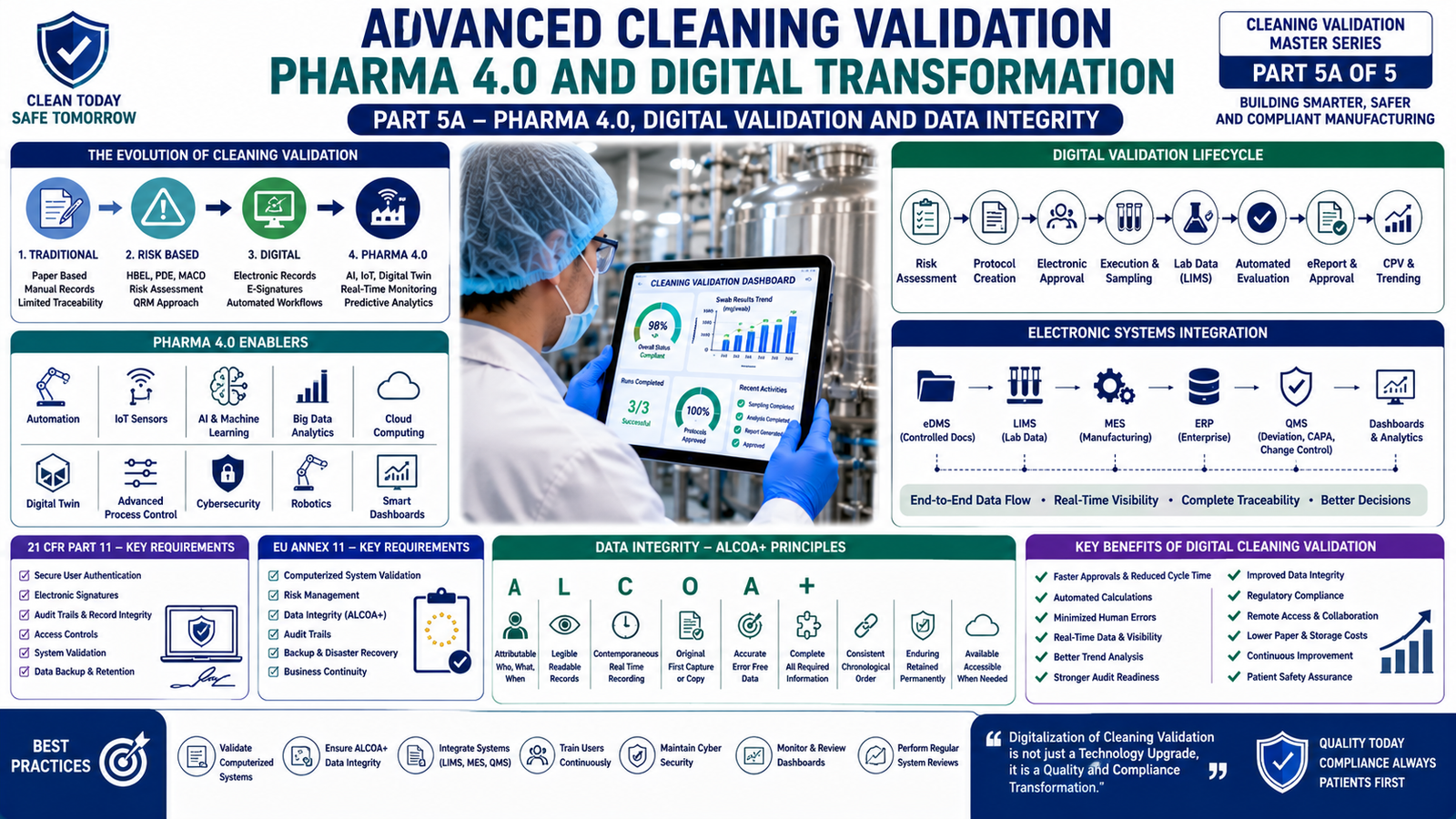
Cleaning validation has evolved significantly over the past three decades.
| Generation | Primary Characteristics |
|---|---|
| Traditional | Paper records, manual calculations, visual inspections |
| Risk-Based | HBEL, PDE, MACO, Quality Risk Management |
| Digital | Electronic protocols, e-signatures, automated workflows |
| Pharma 4.0 | AI, IoT, Digital Twins, predictive analytics, real-time monitoring |
Modern organizations are moving beyond compliance toward intelligent, data-driven validation programs.
What is Pharma 4.0?
Pharma 4.0 is the application of Industry 4.0 principles to pharmaceutical manufacturing.
It combines:
- Automation
- Digitalization
- Artificial Intelligence
- Internet of Things (IoT)
- Cloud Computing
- Big Data Analytics
- Robotics
- Cybersecurity
- Data Integrity
- Continuous Process Verification
The objective is to create connected manufacturing systems that improve quality while reducing manual intervention.
Pharma 4.0 Principles
Pharma 4.0 emphasizes:
- Intelligent manufacturing
- Data-driven decision-making
- Lifecycle management
- Continuous monitoring
- Predictive quality
- Digital quality systems
- Human-machine collaboration
- Patient-centric manufacturing
Cleaning Validation naturally aligns with these principles because it depends on accurate data collection, trend analysis, and lifecycle management.
Digital Transformation in Cleaning Validation
Digital transformation replaces paper-based activities with integrated electronic systems.
Examples include:
- Electronic validation protocols
- Digital approval workflows
- Electronic signatures
- Automated sample tracking
- Laboratory information management systems (LIMS)
- Electronic document management systems (eDMS)
- Manufacturing Execution Systems (MES)
- Enterprise Resource Planning (ERP) integration
These technologies improve efficiency, reduce transcription errors, and provide complete audit trails.
Traditional vs. Digital Cleaning Validation
| Traditional Approach | Digital Approach |
|---|---|
| Paper protocols | Electronic protocols |
| Manual calculations | Automated calculations |
| Handwritten approvals | Electronic signatures |
| Separate systems | Integrated platforms |
| Manual trending | Automated dashboards |
| Limited traceability | End-to-end traceability |
| Offline records | Real-time access |
Digital systems significantly reduce administrative workload while improving data quality.
Electronic Validation Systems
Electronic validation systems manage the complete validation lifecycle.
Typical capabilities include:
- Protocol authoring
- Version control
- Workflow approvals
- Electronic signatures
- Automated notifications
- Deviation management
- CAPA integration
- Report generation
- Audit trails
- Dashboard reporting
These systems help organizations standardize validation activities across multiple manufacturing sites.
Typical Digital Architecture
A modern digital cleaning validation ecosystem may include:
| System | Function |
|---|---|
| eDMS | Controlled documents |
| LIMS | Laboratory data management |
| MES | Manufacturing execution |
| ERP | Resource planning |
| QMS | Deviations, CAPA, Change Control |
| SCADA | Equipment monitoring |
| Historian | Process data storage |
| Analytics Platform | Trend analysis and reporting |
Integration between these systems supports end-to-end visibility and faster investigations.
Digital Validation Lifecycle
A digital cleaning validation process typically follows this workflow:
Risk Assessment
        │
        ▼
Electronic Protocol Creation
        │
        ▼
Workflow Approval
        │
        ▼
Cleaning Execution
        │
        ▼
Digital Sample Collection
        │
        ▼
Automatic Laboratory Data Import
        │
        ▼
Automated Acceptance Evaluation
        │
        ▼
Electronic Validation Report
        │
        ▼
Continued Process Verification Dashboard
This lifecycle minimizes manual data entry and strengthens traceability.
Electronic Documentation
Electronic documentation is replacing paper records across pharmaceutical manufacturing.
Common electronic documents include:
- Validation protocols
- Validation reports
- SOPs
- Risk assessments
- Change controls
- CAPA records
- Training records
- Calibration certificates
- Equipment logs
Electronic systems improve document retrieval during regulatory inspections and support global collaboration.
21 CFR Part 11
The US FDA’s 21 CFR Part 11 establishes requirements for electronic records and electronic signatures.
Cleaning validation systems must ensure:
- Secure user authentication
- Electronic signatures
- Audit trails
- Record integrity
- Controlled access
- Backup and recovery
- Data retention
- Change history
Organizations using electronic validation systems must validate these systems to demonstrate compliance.
EU Annex 11
EU GMP Annex 11 provides similar requirements for computerized systems used in pharmaceutical manufacturing.
Key expectations include:
- System validation
- Risk management
- Data integrity
- User access control
- Audit trails
- Electronic records
- Business continuity
- Disaster recovery
Annex 11 complements 21 CFR Part 11 and supports global harmonization.
Data Integrity (ALCOA+)
Reliable data is fundamental to digital cleaning validation.
Regulators expect all electronic records to comply with ALCOA+ principles.
| Principle | Description |
|---|---|
| Attributable | Data linked to the individual performing the activity |
| Legible | Readable throughout the record lifecycle |
| Contemporaneous | Recorded at the time of the activity |
| Original | First recorded or certified true copy |
| Accurate | Free from errors |
| Complete | Includes all relevant data |
| Consistent | Chronological and standardized |
| Enduring | Preserved throughout retention period |
| Available | Accessible when required |
Data integrity failures remain one of the most common findings during regulatory inspections.
Practical Industrial Example
A global pharmaceutical manufacturer replaced paper-based cleaning validation documentation with an integrated digital validation platform.
The new system enabled:
- Electronic protocol approvals
- Barcode-based sample tracking
- Automatic transfer of HPLC results from LIMS
- Real-time cleaning validation dashboards
- Electronic report generation
- Complete audit trails
As a result, the organization reduced documentation review time, improved traceability, minimized transcription errors, and strengthened inspection readiness.
Benefits of Digital Cleaning Validation
| Benefit | Impact |
|---|---|
| Faster approvals | Reduced validation cycle time |
| Automated calculations | Fewer manual errors |
| Electronic signatures | Improved compliance |
| Integrated data | Better decision-making |
| Real-time dashboards | Faster trend analysis |
| Audit trails | Stronger inspection readiness |
| Remote access | Improved collaboration |
| Lifecycle visibility | Enhanced continuous improvement |
Best Practices
✔ Validate computerized systems before use.
✔ Ensure compliance with 21 CFR Part 11 and EU Annex 11.
✔ Implement role-based access controls.
✔ Maintain complete audit trails.
✔ Integrate validation with QMS and LIMS.
✔ Train users on electronic systems.
✔ Periodically review cybersecurity risks.
✔ Monitor data integrity continuously.
Summary Table
| Digital Element | Purpose |
|---|---|
| Pharma 4.0 | Intelligent manufacturing |
| Electronic Validation | Paperless execution |
| eDMS | Controlled documentation |
| LIMS | Laboratory data management |
| MES | Manufacturing execution |
| 21 CFR Part 11 | Electronic record compliance |
| EU Annex 11 | Computerized system requirements |
| ALCOA+ | Data integrity framework |
Looking Ahead
Digital validation is only the beginning of the next generation of cleaning validation. Emerging technologies such as Artificial Intelligence (AI), Machine Learning, IoT Sensors, Digital Twins, Process Analytical Technology (PAT), and predictive analytics are enabling manufacturers to move from reactive cleaning validation toward intelligent, self-optimizing systems.
In Part 5B, we will explore:
- Artificial Intelligence in Cleaning Validation
- Machine Learning Applications
- IoT Sensors
- Real-Time Monitoring
- Digital Twin Technology
- Process Analytical Technology (PAT)
- Electronic Batch Records (EBR)
- Predictive Cleaning Validation
- AI Use Cases
- Technology Comparison Table
- Future Digital Workflows
Continue to Part 5B → Artificial Intelligence, IoT and Future Technologies
About the Author
Ramesh Palav is a pharmaceutical manufacturing and quality professional with 21+ years of industry experience across pharmaceutical manufacturing, GMP, qualification and validation, QMS, compliance, CSV, audits, and operational excellence. With hands-on experience in OSD manufacturing, digital transformation and Pharma 4.0, he is passionate about strengthening pharmaceutical education, developing industry-ready talent, and promoting collaboration between academia and the pharmaceutical industry.