
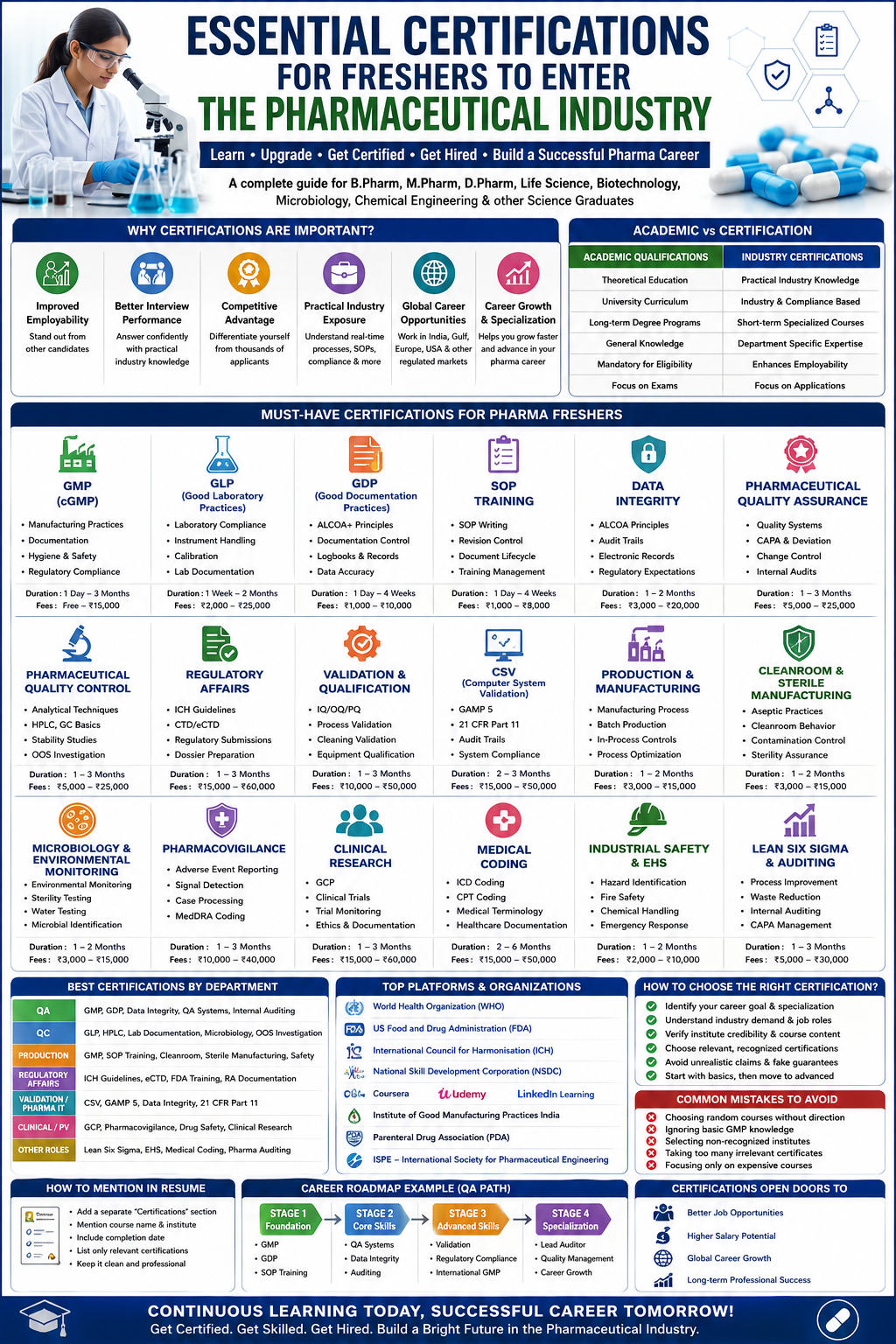
The pharmaceutical industry is one of the fastest-growing and most regulated industries in the world. With increasing global demand for medicines, vaccines, biologics, medical devices, and healthcare services, pharmaceutical companies are continuously seeking skilled professionals who not only possess academic qualifications but also demonstrate practical industry knowledge and regulatory awareness.
For freshers entering the pharmaceutical sector, certifications have become an important factor in employability, interview selection, and career growth. Today’s pharmaceutical companies expect candidates to understand concepts such as GMP, data integrity, quality systems, documentation practices, validation, compliance, and regulatory requirements even at entry level.
Whether a fresher wants to build a career in manufacturing, production, quality assurance, quality control, microbiology, validation, pharmacovigilance, regulatory affairs, clinical research, or medical coding, industry-recognized certifications can significantly improve job opportunities.
This article provides a comprehensive guide to the most valuable certifications for pharmaceutical industry freshers, including eligibility, duration, costs, recognized institutes, career benefits, and how to choose the right certification based on career goals.
Why Certifications Are Important for Pharmaceutical Industry Freshers
Academic degrees such as B.Pharm, M.Pharm, D.Pharm, B.Sc., M.Sc., Biotechnology, or Chemical Engineering provide theoretical knowledge. However, pharmaceutical industries operate under strict regulatory systems that require practical understanding of compliance, quality systems, SOPs, and documentation.
Most freshers struggle during interviews because they lack exposure to:
- GMP environments
- Pharmaceutical documentation
- Regulatory expectations
- Industrial processes
- Validation systems
- Data integrity requirements
- Audit practices
Certifications bridge this gap between academic education and industrial expectations.
Major Benefits of Pharma Certifications
1. Improved Employability
Certifications help recruiters identify candidates with industry readiness. Candidates with GMP, QA, QC, or regulatory certifications often receive preference during hiring.
2. Better Interview Performance
Certified candidates can confidently answer questions related to:
- SOPs
- GMP principles
- Batch manufacturing records
- Data integrity
- QA documentation
- Validation concepts
- Deviation handling
3. Competitive Advantage
Thousands of graduates enter the pharmaceutical industry every year. Certifications differentiate candidates from competitors.
4. Practical Industry Exposure
Many certification programs include:
- Industrial case studies
- Documentation exercises
- Audit simulations
- Regulatory guidance
- Real-world pharmaceutical examples
5. Better Opportunities in MNCs
Multinational pharmaceutical companies prefer candidates familiar with:
- US FDA guidelines
- EU GMP
- WHO GMP
- ICH guidelines
- Data integrity compliance
6. Career Direction
Certifications help freshers decide specialization areas such as:
- QA
- QC
- Regulatory affairs
- Validation
- Clinical research
- Pharmacovigilance
- Medical coding
Academic Qualifications vs Industry Certifications
| Academic Qualification | Industry Certification |
|---|---|
| Provides theoretical education | Provides practical industrial knowledge |
| University curriculum based | Industry and compliance based |
| Long-term degree programs | Short-term specialized courses |
| General pharmaceutical knowledge | Department-specific expertise |
| Mandatory for eligibility | Enhances employability |
| Focus on exams | Focus on practical applications |
| Limited industrial exposure | Industry-oriented learning |
Both academic qualifications and certifications are important for building a successful pharmaceutical career.
Types of Pharmaceutical Certifications
1. Mandatory Certifications
These are highly recommended for almost all pharma freshers.
Examples:
- GMP
- GDP
- SOP training
- Data integrity
- Documentation practices
2. Recommended Certifications
Useful for specific departments.
Examples:
- QA certifications
- QC certifications
- Validation training
- Regulatory affairs programs
3. Value-Added Certifications
Helpful for career growth and international opportunities.
Examples:
- Lean Six Sigma
- CSV
- Pharmaceutical auditing
- ISPE training
- PDA certifications
Online vs Offline Certifications
| Online Certifications | Offline Certifications |
|---|---|
| Flexible learning | Classroom interaction |
| Affordable | Higher practical exposure |
| Self-paced | Direct trainer guidance |
| Suitable for working professionals | Networking opportunities |
| Widely available globally | Better industrial workshops |
| Cost-effective | Sometimes preferred for hands-on roles |
Best Choice for Freshers
A combination of:
- Online theoretical certification
- Offline industrial training
is often the most effective approach.
Free vs Paid Certifications
| Free Certifications | Paid Certifications |
|---|---|
| Basic introductory knowledge | Detailed professional training |
| Limited practical depth | Comprehensive learning |
| Good for beginners | Better recruiter recognition |
| Often self-paced | Sometimes include projects |
| Ideal for awareness | Better placement support |
Indian vs International Certifications
| Indian Certifications | International Certifications |
|---|---|
| Affordable | Globally recognized |
| Suitable for Indian pharma industry | Useful for US/EU/Gulf opportunities |
| Local regulatory understanding | International compliance exposure |
| Easier accessibility | Higher cost |
| Strong for domestic jobs | Strong for multinational careers |
Essential GMP Certifications
GMP (Good Manufacturing Practices)
GMP is the foundation of pharmaceutical manufacturing.
What GMP Certification Covers
- Pharmaceutical manufacturing systems
- Hygiene practices
- Documentation control
- SOP compliance
- Contamination prevention
- Quality systems
- Batch manufacturing processes
Ideal Candidates
- B.Pharm freshers
- Production aspirants
- QA/QC freshers
- Diploma holders
Duration
- 1 day to 3 months
Approximate Fees
- Free to ₹15,000
Recommended Platforms
- WHO training modules
- ISPE
- Udemy
- Coursera
- GMP India institutes
Career Benefits
Useful for:
- India
- Gulf countries
- WHO-GMP plants
- USFDA-approved facilities
cGMP Certifications
Current Good Manufacturing Practices (cGMP) focus on modern regulatory expectations.
Key Topics
- Quality risk management
- Data integrity
- Compliance systems
- Electronic documentation
- Validation concepts
- Regulatory inspections
Best For
- QA professionals
- Manufacturing roles
- Regulatory affairs aspirants
Industry Demand
Highly preferred in:
- MNC pharmaceutical companies
- Injectable manufacturing
- API manufacturing
- Sterile plants
GLP (Good Laboratory Practices) Certifications
GLP is essential for laboratory and research functions.
Covers
- Laboratory compliance
- Analytical documentation
- Instrument handling
- Sample management
- Calibration practices
- Laboratory investigations
Ideal Candidates
- QC freshers
- Microbiology graduates
- Analytical chemistry students
- R&D aspirants
Duration
- 1 week to 2 months
Approximate Fees
- ₹2,000 to ₹25,000
GDP (Good Documentation Practices) Certifications
Documentation errors are among the most common observations during audits.
Topics Covered
- ALCOA+ principles
- Correct entries
- Error corrections
- Batch records
- Logbooks
- Controlled documentation
Importance
Extremely valuable for:
- QA
- Production
- QC
- Warehouse
- Regulatory departments
SOP Training Certifications
SOP training teaches candidates how pharmaceutical procedures are controlled.
Includes
- SOP writing
- SOP revision control
- Document lifecycle
- Training management
- Deviation handling
Benefits
Helps freshers understand real industrial workflow.
Data Integrity Certifications
Data integrity is one of the most critical pharmaceutical compliance areas.
Key Concepts
- ALCOA principles
- Electronic records
- Audit trails
- Regulatory expectations
- Data governance
Useful For
- QA
- QC
- CSV
- Validation
- IT compliance
Highly Preferred By
- USFDA-regulated companies
- European pharma firms
- Sterile manufacturing facilities
Pharmaceutical Quality Assurance Certifications
QA is among the most preferred departments in the pharmaceutical industry.
QA Certification Covers
- Change control
- CAPA
- Deviations
- Investigations
- Audit systems
- Validation overview
- Documentation systems
Best Certifications for QA Freshers
Recommended Courses
- GMP & QA certification
- Pharmaceutical Quality Systems
- QA documentation training
- Internal auditing training
Ideal Platforms
- ISPE
- PDA
- GMP India
- Coursera
- LinkedIn Learning
Pharmaceutical Quality Control Certifications
QC departments focus on testing and laboratory analysis.
QC Certification Topics
- HPLC basics
- GC basics
- Analytical techniques
- Stability studies
- Laboratory documentation
- OOS investigations
Best Certifications for QC Freshers
- GLP certification
- HPLC training
- Analytical instrumentation
- Microbiology QC training
Preferred Candidates
- B.Sc.
- M.Sc.
- B.Pharm
- Biotechnology graduates
Regulatory Affairs Certifications
Regulatory Affairs (RA) professionals handle product registrations and regulatory submissions.
Covers
- CTD/eCTD
- ICH guidelines
- Regulatory submissions
- FDA regulations
- Dossier preparation
Best For
- M.Pharm students
- B.Pharm graduates
- Life science graduates
Career Scope
Excellent opportunities in:
- India
- Europe
- US
- Gulf markets
Validation & Qualification Certifications
Validation professionals ensure systems and equipment perform consistently.
Topics Covered
- IQ/OQ/PQ
- Process validation
- Cleaning validation
- Equipment qualification
- Utility validation
Best Certifications for Validation Roles
- Validation master plan training
- Equipment qualification
- Process validation certification
High Demand Areas
- Injectable manufacturing
- API plants
- Biopharmaceutical companies
CSV (Computer System Validation) Certifications
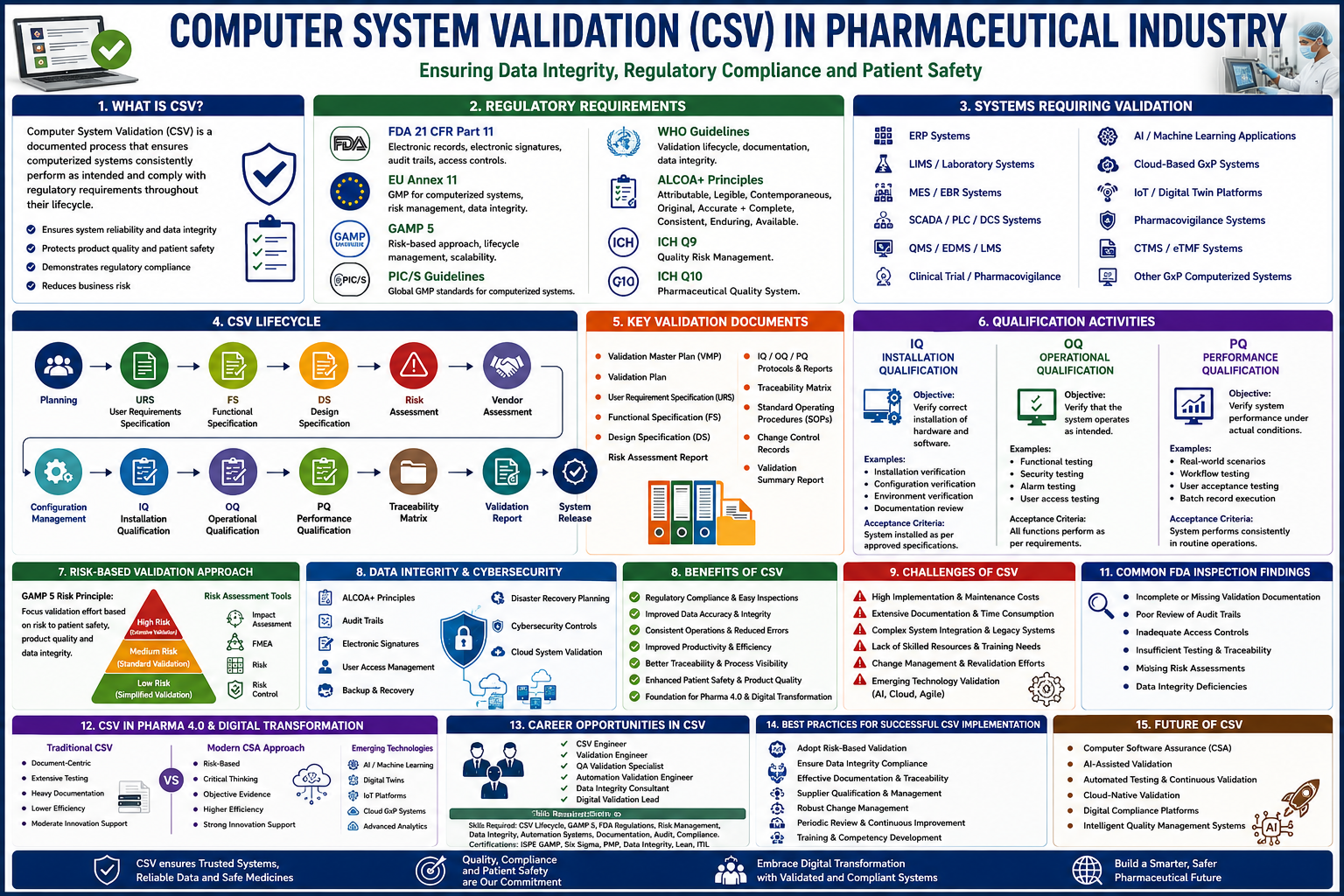
CSV is increasingly important due to digital pharmaceutical operations.
Covers
- GAMP 5
- Electronic systems validation
- Audit trails
- Software compliance
- 21 CFR Part 11
Ideal Candidates
- Pharma IT professionals
- Validation aspirants
- Engineering graduates
- Computer science graduates
Global Demand
Highly valuable for multinational pharmaceutical companies.
Production & Manufacturing Certifications
Production professionals handle pharmaceutical manufacturing operations.
Topics Covered
- Granulation
- Compression
- Coating
- Sterile filling
- Manufacturing SOPs
- Process controls
Best Certifications for Production Roles
- GMP manufacturing
- Production process training
- Cleanroom behavior
- Sterile manufacturing
Cleanroom & Sterile Manufacturing Certifications
Sterile manufacturing requires specialized training.
Includes
- Aseptic practices
- Gowning procedures
- Cleanroom classifications
- Contamination control
- Sterility assurance
Valuable For
- Injectable manufacturing
- Vaccine production
- Biologics manufacturing
Microbiology & Environmental Monitoring Certifications
Microbiology plays a critical role in sterile manufacturing.
Topics
- Environmental monitoring
- Water testing
- Sterility testing
- Microbial identification
- Aseptic sampling
Best For
- Microbiology graduates
- QC microbiology aspirants
- Sterile manufacturing professionals
Pharmacovigilance Certifications
Pharmacovigilance focuses on drug safety monitoring.
Covers
- Adverse event reporting
- Signal detection
- Case processing
- MedDRA coding
- Drug safety databases
Best Candidates
- Pharmacy graduates
- Life science graduates
- Biotechnology students
Global Opportunities
Excellent opportunities in:
- India
- Europe
- US pharmacovigilance firms
Clinical Research Certifications
Clinical research is a rapidly growing sector.
Topics Covered
- GCP
- Clinical trial phases
- Ethics committees
- Trial documentation
- Monitoring processes
Best Certifications
- Clinical Research Associate training
- GCP certification
- Clinical data management
Medical Coding Certifications
Medical coding is highly suitable for life science and pharmacy graduates.
Includes
- ICD coding
- CPT coding
- Medical terminology
- Healthcare documentation
Best International Certifications
- CPC certification
- CCS certification
Industry Demand
Strong demand in:
- Healthcare BPOs
- US healthcare companies
- Medical billing firms
Drug Regulatory Affairs Certifications
Drug regulatory affairs certifications help candidates understand international submissions.
Topics
- ANDA
- DMF
- eCTD
- Regulatory pathways
- Labeling requirements
Industrial Safety & EHS Certifications
Safety is a major focus in pharmaceutical manufacturing.
Covers
- Hazard identification
- Fire safety
- Chemical handling
- PPE systems
- Emergency response
Best For
- Production personnel
- Engineering graduates
- Manufacturing aspirants
Lean Six Sigma for Pharma
Lean Six Sigma improves operational efficiency.
Benefits
- Process improvement
- Waste reduction
- Productivity enhancement
- Quality improvement
Certification Levels
- Yellow Belt
- Green Belt
- Black Belt
Best For
- Production
- QA
- Operations management
Pharmaceutical Auditing Certifications
Auditing skills are highly valuable in QA and compliance roles.
Topics
- Internal audits
- Supplier audits
- Regulatory inspections
- Audit observations
- CAPA management
Preferred By
- QA departments
- Compliance teams
- Multinational companies
Best Certifications by Department
Best Certifications for QA Freshers
| Certification | Importance |
|---|---|
| GMP & cGMP | Essential |
| GDP | Highly recommended |
| Data Integrity | Very important |
| Pharmaceutical QA | Core requirement |
| Internal Auditing | Value-added |
Best Certifications for QC Freshers
| Certification | Importance |
|---|---|
| GLP | Essential |
| HPLC Training | Highly valuable |
| Laboratory Documentation | Important |
| Microbiology | Useful |
| OOS Investigation | Value-added |
Best Certifications for Production Roles
| Certification | Importance |
|---|---|
| GMP | Essential |
| SOP Training | Important |
| Cleanroom Practices | Valuable |
| Sterile Manufacturing | High demand |
| Industrial Safety | Recommended |
Best Certifications for Regulatory Affairs
| Certification | Importance |
|---|---|
| ICH Guidelines | Essential |
| eCTD | Important |
| FDA Regulatory Training | Highly valuable |
| RA Documentation | Recommended |
Best Certifications for Pharma IT & Validation
| Certification | Importance |
|---|---|
| CSV | Essential |
| GAMP 5 | Highly valuable |
| Data Integrity | Critical |
| 21 CFR Part 11 | Important |
Recommended Certification Platforms and Organizations
World Health Organization (WHO)
WHO provides excellent GMP and pharmaceutical quality guidance resources.
US FDA
FDA training materials help candidates understand regulatory expectations.
International Council for Harmonisation (ICH)
ICH guidelines are essential for regulatory affairs and QA professionals.
National Skill Development Corporation (NSDC)
Government-recognized pharmaceutical training programs in India.
Coursera
Offers:
- GMP courses
- Drug development programs
- Clinical research courses
Udemy
Affordable beginner-friendly pharmaceutical training.
LinkedIn Learning
Professional short courses with industry relevance.
Institute of Good Manufacturing Practices India
Popular for:
- GMP
- QA
- Documentation
- Regulatory compliance training
Parenteral Drug Association (PDA)
Globally respected organization for sterile manufacturing and quality systems.
ISPE
Highly respected for:
- Validation
- GMP
- Pharmaceutical engineering
- Regulatory systems
Approximate Certification Costs
| Certification Type | Approximate Fees |
|---|---|
| Basic GMP Courses | Free – ₹5,000 |
| QA/QC Certifications | ₹5,000 – ₹30,000 |
| Validation Courses | ₹10,000 – ₹50,000 |
| Regulatory Affairs | ₹15,000 – ₹60,000 |
| Clinical Research | ₹20,000 – ₹80,000 |
| International Certifications | ₹25,000 – ₹2,00,000 |
How to Choose the Right Certification
Step 1: Identify Career Goal
Choose specialization:
- QA
- QC
- Production
- Regulatory affairs
- Validation
- Pharmacovigilance
- Clinical research
Step 2: Understand Industry Demand
Research:
- Hiring trends
- Skill shortages
- Growth sectors
Step 3: Verify Institute Credibility
Check:
- Industry recognition
- Trainer expertise
- Course reviews
- Placement support
Step 4: Avoid Unrealistic Claims
Be cautious of:
- “100% job guarantee”
- Extremely short advanced programs
- Non-recognized certificates
Common Mistakes Freshers Make While Selecting Courses
1. Choosing Random Certifications
Many students select courses without career planning.
2. Focusing Only on Expensive Courses
High fees do not always mean high value.
3. Ignoring Basic GMP Knowledge
Advanced certifications without GMP basics are ineffective.
4. Selecting Non-Recognized Institutes
Industry reputation matters significantly.
5. Taking Too Many Courses
Recruiters value relevant certifications more than excessive certificates.
How to Mention Certifications in a Pharma Resume
Best Resume Format
Certifications Section Example
Certifications
- GMP & GDP Certification – ISPE
- Pharmaceutical QA Training – Coursera
- Data Integrity Certification – Udemy
- GLP & Laboratory Documentation – GMP India
Tips
- Mention only relevant certifications
- Add certification completion dates
- Highlight internationally recognized programs
- Keep resume concise
How Certifications Help During Interviews
Certified candidates often perform better in interviews because they understand:
- Real industrial terminology
- Compliance expectations
- SOP systems
- Documentation practices
- Audit readiness
Common Interview Questions Certifications Help Answer
- What is GMP?
- Explain ALCOA principles.
- What is CAPA?
- What is deviation?
- Difference between QA and QC?
- What is IQ/OQ/PQ?
- What is data integrity?
Pharma Career Roadmap Using Certifications
Example Roadmap for QA Career
Stage 1
- GMP
- GDP
- SOP training
Stage 2
- QA systems
- Data integrity
- Auditing
Stage 3
- Validation
- Regulatory compliance
- International GMP
Example Roadmap for QC Career
Stage 1
- GLP
- Documentation practices
Stage 2
- HPLC
- Instrumentation
Stage 3
- OOS investigations
- Stability studies
Example Roadmap for Regulatory Affairs
Stage 1
- GMP basics
- ICH guidelines
Stage 2
- CTD/eCTD
Stage 3
- International regulatory submissions
Certifications Preferred by Pharmaceutical Recruiters
Recruiters commonly prefer certifications related to:
- GMP
- Data integrity
- QA documentation
- GLP
- Validation
- Regulatory affairs
- Pharmacovigilance
- Clinical research
MNC recruiters especially value:
- International compliance understanding
- FDA awareness
- ICH knowledge
- Documentation skills
Certifications Useful for Campus Placements
Students appearing for campus interviews should prioritize:
- GMP certification
- GDP training
- SOP training
- QA basics
- GLP
- Communication skills
These certifications significantly improve confidence during placement drives.
Hiring Trends in the Pharmaceutical Industry
Current hiring trends indicate strong demand for:
- QA professionals
- Regulatory affairs specialists
- Validation engineers
- Pharmacovigilance associates
- Sterile manufacturing professionals
- Data integrity experts
- Clinical research associates
Freshers with practical certifications are often shortlisted faster than candidates with only academic qualifications.
Industry Insights for Freshers
Skills Pharma Companies Expect
- GMP awareness
- Documentation skills
- Communication ability
- Compliance mindset
- Basic technical understanding
- Problem-solving approach
What Recruiters Look For
- Willingness to learn
- Certification relevance
- Practical understanding
- Professional attitude
- Industry awareness
Actionable Recommendations for Freshers
If You Are Completely New
Start with:
- GMP
- GDP
- SOP training
If You Want QA Career
Focus on:
- QA systems
- Data integrity
- Auditing
If You Want QC Career
Focus on:
- GLP
- HPLC
- Laboratory practices
If You Want Regulatory Affairs
Learn:
- ICH guidelines
- CTD/eCTD
- FDA basics
If You Want Validation or Pharma IT
Take:
- CSV
- GAMP 5
- Data integrity
Conclusion
The pharmaceutical industry is becoming increasingly competitive, technology-driven, and compliance-focused. Academic qualifications alone are often not sufficient to secure strong entry-level opportunities. Certifications have become an essential tool for freshers to improve employability, strengthen technical knowledge, and gain industry-relevant skills.
Certifications in GMP, GDP, GLP, QA, QC, data integrity, validation, regulatory affairs, pharmacovigilance, clinical research, and pharmaceutical documentation can significantly enhance career prospects for fresh graduates.
For beginners, the highest-value certifications usually include:
- GMP
- GDP
- SOP training
- Data integrity
- QA/QC fundamentals
As careers progress, advanced certifications in validation, regulatory affairs, Lean Six Sigma, CSV, auditing, and international compliance can open doors to multinational pharmaceutical companies and global opportunities.
Freshers should strategically choose certifications based on career goals, industry demand, and long-term professional growth. Instead of collecting random certificates, candidates should build a structured learning roadmap aligned with their desired department and specialization.
Continuous learning is one of the most important success factors in the pharmaceutical industry. Professionals who continuously upgrade their knowledge, understand global regulations, and develop practical skills are more likely to achieve long-term career success in this rapidly evolving sector.
About the Author
Ramesh Palav is a pharmaceutical manufacturing professional with 21+ years of experience in Oral Solid Dosage manufacturing, production operations, GMP compliance, qualification, validation, QMS and operational excellence. Through Pharma Manufacturing Hub, he shares practical industry knowledge with pharmaceutical professionals, students and manufacturing leaders.