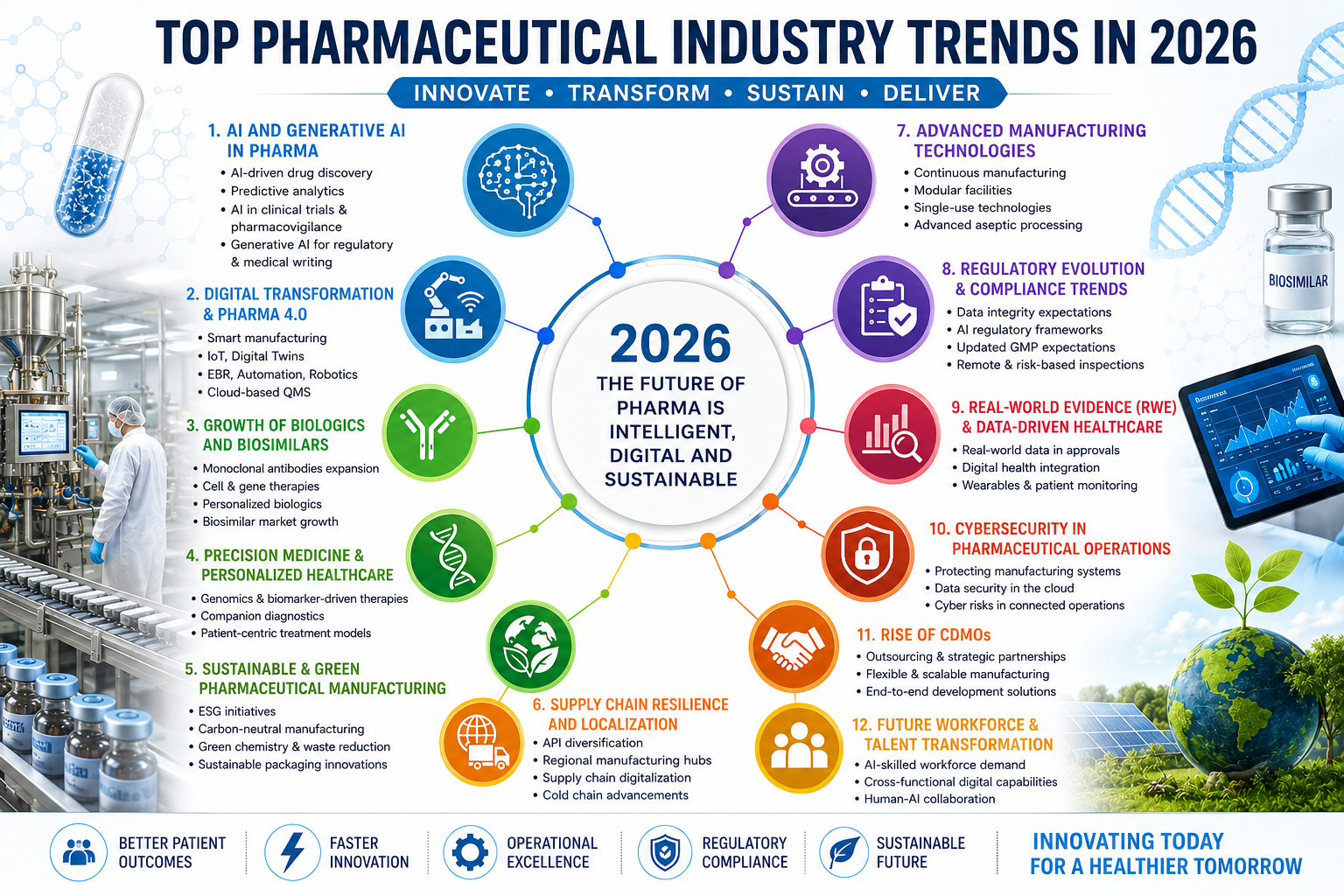
The global pharmaceutical industry is entering one of the most transformative periods in its history. In 2026, the convergence of artificial intelligence, advanced manufacturing technologies, precision medicine, digital transformation, sustainability initiatives, and evolving regulatory expectations is fundamentally reshaping how pharmaceutical companies discover, develop, manufacture, and deliver medicines.
The modern pharmaceutical landscape is no longer driven solely by scientific innovation. Today, competitive advantage increasingly depends on data intelligence, digital agility, operational resilience, regulatory adaptability, and patient-centric healthcare models. Organizations that successfully integrate emerging technologies with strategic business transformation are expected to lead the next era of pharmaceutical growth.
From AI-powered drug discovery platforms to continuous manufacturing systems, cloud-based quality management, smart factories, and personalized medicine, the pharmaceutical industry trends of 2026 are creating unprecedented opportunities for innovation and efficiency. At the same time, companies face growing challenges related to cybersecurity, supply chain disruptions, regulatory scrutiny, sustainability demands, and workforce transformation.
As healthcare systems worldwide evolve toward precision therapeutics, digital healthcare integration, and value-based care models, pharmaceutical companies must rapidly modernize operations while maintaining compliance, product quality, and patient safety.
This article explores the most important pharmaceutical industry trends in 2026 and provides strategic insights into how organizations can remain competitive in the rapidly changing global healthcare ecosystem.
1. Artificial Intelligence (AI) and Generative AI in Pharmaceuticals
Artificial Intelligence has become one of the most influential drivers of pharmaceutical innovation in 2026. AI technologies are now integrated across the entire pharmaceutical value chain, including drug discovery, clinical development, manufacturing, quality assurance, pharmacovigilance, regulatory documentation, and commercial operations.
AI-Driven Drug Discovery
Traditional drug discovery timelines often require more than 10 years and billions of dollars in investment. AI-driven platforms are dramatically accelerating this process by identifying promising molecular targets, predicting drug interactions, and optimizing compound selection through machine learning algorithms.
Pharmaceutical companies increasingly use AI models to:
- Predict protein structures
- Identify therapeutic candidates
- Simulate molecular interactions
- Analyze genomic datasets
- Accelerate lead optimization
AI-powered computational biology is particularly transforming oncology, rare diseases, immunology, and neurodegenerative disorder research.
Generative AI in Pharma Operations
Generative AI has expanded rapidly into pharmaceutical documentation and knowledge management. Organizations are deploying generative AI tools for:
- Regulatory submission drafting
- Clinical study reports
- SOP generation
- Technical writing
- Pharmacovigilance reporting
- Medical communications
These systems significantly reduce documentation timelines while improving consistency and compliance.
AI in Clinical Trials
AI-supported clinical trials are improving patient recruitment, protocol optimization, and trial monitoring. Predictive analytics helps identify eligible patient populations faster while reducing protocol deviations and operational inefficiencies.
Virtual and decentralized clinical trials are also becoming more common due to AI-enabled patient monitoring technologies.
AI-Assisted Manufacturing and Quality Systems
AI-driven manufacturing analytics can now predict deviations before they occur. Predictive maintenance systems reduce equipment downtime while machine learning models improve yield optimization and process consistency.
AI is increasingly integrated into:
- Environmental monitoring
- Process Analytical Technology (PAT)
- Automated deviation investigations
- Batch release analytics
- CAPA trend analysis
Business Impact
The impact of AI in pharmaceuticals extends beyond operational efficiency. Companies leveraging AI effectively are achieving:
- Faster time-to-market
- Lower R&D costs
- Improved product quality
- Enhanced regulatory compliance
- Better patient outcomes
AI in pharmaceuticals is expected to remain one of the defining pharmaceutical industry trends of 2026 and beyond.
2. Digital Transformation and Pharma 4.0
The transition toward Pharma 4.0 continues to accelerate as pharmaceutical companies modernize operations through digital technologies, automation, and connected manufacturing ecosystems.
Smart Manufacturing
Smart pharmaceutical facilities use interconnected systems, sensors, and advanced analytics to optimize production in real time. These facilities enable:
- Real-time process monitoring
- Automated data collection
- Predictive maintenance
- Electronic quality oversight
- Enhanced operational visibility
Manufacturing execution systems (MES) are becoming central to digital pharmaceutical operations.
Digital Twins
Digital twin technology allows companies to create virtual models of manufacturing processes, facilities, and equipment. These models simulate operational conditions, helping organizations improve process performance and reduce risks before physical implementation.
Digital twins are widely used for:
- Process optimization
- Facility design
- Equipment validation
- Troubleshooting
- Capacity planning
IoT-Enabled Pharmaceutical Manufacturing
Internet of Things (IoT) devices provide real-time operational intelligence across pharmaceutical facilities. Connected equipment supports:
- Continuous process monitoring
- Automated alerts
- Data-driven maintenance
- Environmental control systems
IoT integration improves manufacturing efficiency while supporting data integrity and compliance.
Electronic Batch Records (EBR)
Paper-based systems are rapidly being replaced by Electronic Batch Records, improving data accuracy, traceability, and review efficiency.
Benefits include:
- Faster batch release
- Reduced human error
- Enhanced compliance
- Improved audit readiness
Automation and Robotics
Robotic systems are increasingly used in aseptic manufacturing, packaging, laboratory automation, and warehouse operations.
Automation reduces:
- Human intervention
- Contamination risks
- Operational variability
- Labor-intensive processes
Cloud-Based Quality Systems
Cloud-enabled Quality Management Systems (QMS) allow pharmaceutical organizations to centralize quality operations globally.
Cloud platforms support:
- Deviation management
- Change control
- Document management
- Training systems
- Supplier quality oversight
Pharma 4.0 is no longer optional; it is becoming essential for competitiveness in modern pharmaceutical manufacturing.
3. Growth of Biologics and Biosimilars
Biopharmaceuticals continue to dominate industry growth in 2026. Biologics represent a major share of new drug approvals and global pharmaceutical revenue.
Expansion of Monoclonal Antibodies
Monoclonal antibodies remain central to treatments for:
- Cancer
- Autoimmune disorders
- Inflammatory diseases
- Rare conditions
Demand for antibody-based therapies continues to rise due to their targeted therapeutic effectiveness.
Cell and Gene Therapies
Cell and gene therapies are revolutionizing personalized medicine. CAR-T therapies, gene editing technologies, and regenerative medicine are expanding rapidly.
These therapies offer potential cures for previously untreatable diseases but also introduce major manufacturing and regulatory complexities.
Personalized Biopharmaceuticals
Personalized biologics are increasingly tailored to individual patient profiles using genomic and biomarker data.
This shift requires:
- Flexible manufacturing systems
- Advanced analytics
- Specialized cold chain logistics
- Precision diagnostics integration
Biosimilar Market Growth
The biosimilar market continues to expand as patents for major biologics expire.
Key drivers include:
- Cost reduction pressures
- Increased healthcare access
- Government support for biosimilars
However, challenges remain regarding:
- Regulatory harmonization
- Market acceptance
- Manufacturing complexity
Biopharma trends will continue reshaping pharmaceutical business strategies throughout 2026.
4. Precision Medicine and Personalized Healthcare
Precision medicine is transforming healthcare from generalized treatment approaches toward individualized therapeutic strategies.
Genomics and Biomarker-Driven Therapies
Advancements in genomic sequencing enable pharmaceutical companies to develop therapies tailored to specific genetic profiles.
Biomarker-driven treatments improve:
- Therapeutic effectiveness
- Patient stratification
- Clinical trial success rates
Companion Diagnostics
Companion diagnostics are increasingly integrated with targeted therapies. These diagnostic tools identify patients most likely to benefit from specific treatments.
This approach supports:
- Improved outcomes
- Reduced adverse effects
- More efficient treatment selection
Patient-Centric Healthcare Models
The pharmaceutical industry is moving toward patient-centric healthcare ecosystems where treatment decisions incorporate:
- Real-world data
- Digital monitoring
- Personalized treatment pathways
- Continuous patient engagement
Precision medicine represents a major evolution in the future of the pharma industry.
5. Sustainable and Green Pharmaceutical Manufacturing
Sustainability has become a strategic priority for pharmaceutical companies worldwide.
Environmental, Social, and Governance (ESG) expectations are driving major investments in green pharmaceutical operations.
Carbon-Neutral Manufacturing
Many pharmaceutical organizations are establishing carbon reduction targets through:
- Renewable energy adoption
- Energy-efficient facilities
- Low-emission logistics systems
Green Chemistry
Green chemistry initiatives focus on minimizing hazardous substances and improving environmentally friendly synthesis methods.
Benefits include:
- Lower waste generation
- Reduced solvent usage
- Improved process efficiency
Waste Reduction Strategies
Pharmaceutical companies are implementing:
- Circular manufacturing models
- Water recycling systems
- Waste minimization programs
Sustainable Packaging Innovations
Sustainable packaging solutions include:
- Recyclable materials
- Reduced plastic use
- Eco-friendly labeling systems
Sustainability is increasingly influencing investor decisions, regulatory expectations, and corporate reputation.
6. Supply Chain Resilience and Localization
Global supply chain disruptions exposed vulnerabilities in pharmaceutical manufacturing networks over recent years.
In 2026, resilience and localization are top strategic priorities.
API Diversification
Companies are reducing dependence on single-source API suppliers by diversifying manufacturing networks across multiple regions.
Regional Manufacturing Hubs
Governments are supporting domestic pharmaceutical manufacturing to strengthen healthcare security.
Regional manufacturing hubs help:
- Reduce geopolitical risks
- Improve supply continuity
- Enhance emergency preparedness
Supply Chain Digitalization
Digital supply chain technologies improve:
- Inventory visibility
- Demand forecasting
- Supplier monitoring
- Logistics coordination
Blockchain technologies are also gaining interest for supply chain traceability.
Cold Chain Advancements
The growth of biologics and advanced therapies requires highly reliable cold chain infrastructure.
Innovations include:
- Smart temperature monitoring
- IoT-enabled logistics systems
- Advanced thermal packaging
Supply chain resilience has become a critical competitive advantage in the pharmaceutical industry.
7. Advanced Manufacturing Technologies
Advanced pharmaceutical manufacturing technologies are reshaping operational efficiency, scalability, and flexibility.
Continuous Manufacturing
Continuous manufacturing enables uninterrupted production flow instead of traditional batch processing.
Advantages include:
- Reduced manufacturing time
- Lower inventory requirements
- Improved process consistency
- Real-time quality monitoring
Regulatory agencies increasingly support continuous manufacturing adoption.
Modular Manufacturing Facilities
Modular facilities allow pharmaceutical companies to rapidly scale production capacity with flexible infrastructure designs.
These facilities support:
- Faster deployment
- Lower capital investment
- Flexible product changeovers
Single-Use Technologies
Single-use systems are becoming standard in biopharmaceutical manufacturing.
Benefits include:
- Reduced cleaning requirements
- Lower contamination risk
- Faster turnaround times
Advanced Aseptic Processing
Advanced aseptic technologies include:
- Isolators
- Robotics
- Restricted Access Barrier Systems (RABS)
These systems improve sterility assurance while minimizing human intervention.
Pharmaceutical manufacturing innovation is central to GMP trends in 2026.
8. Regulatory Evolution and Compliance Trends
Regulatory frameworks continue evolving rapidly in response to digital transformation, AI integration, and advanced manufacturing systems.
Data Integrity Expectations
Regulators continue emphasizing ALCOA+ principles and data governance practices.
Organizations must ensure:
- Accurate electronic records
- Audit trail integrity
- Secure data management
- Controlled system access
AI-Related Regulatory Frameworks
As AI adoption expands, regulators are developing guidance for:
- AI validation
- Algorithm transparency
- Risk management
- AI governance systems
Updated GMP Expectations
Modern GMP expectations increasingly include:
- Digital maturity
- Cybersecurity controls
- Automated process oversight
- Real-time quality assurance
Digital Compliance Systems
Digital compliance platforms enable:
- Automated audit readiness
- Electronic documentation management
- Integrated quality workflows
Remote and Risk-Based Inspections
Regulatory agencies are increasingly using remote assessments and risk-based inspection models supported by digital technologies.
Companies must maintain strong digital inspection readiness capabilities.
9. Real-World Evidence (RWE) and Data-Driven Healthcare
Real-world evidence is becoming increasingly important in regulatory decision-making and healthcare strategy.
Real-World Data in Drug Approvals
Regulators are expanding acceptance of real-world data from:
- Electronic health records
- Claims databases
- Patient registries
- Wearable devices
RWE supports:
- Post-market surveillance
- Label expansions
- Safety monitoring
- Treatment optimization
Digital Health Integration
Digital therapeutics and connected healthcare systems are becoming integrated into pharmaceutical treatment strategies.
Pharmaceutical companies increasingly collaborate with:
- Health tech firms
- Telemedicine providers
- Digital monitoring companies
Wearables and Patient Monitoring
Wearable devices support continuous patient monitoring for:
- Chronic disease management
- Clinical trial tracking
- Medication adherence
Data-driven healthcare is transforming patient engagement and treatment optimization.
10. Cybersecurity in Pharmaceutical Operations
As pharmaceutical operations become more digitally connected, cybersecurity has emerged as a major operational risk.
Protecting Manufacturing Systems
Connected manufacturing environments face risks from:
- Ransomware attacks
- System disruptions
- Unauthorized access
Operational technology (OT) security is now critical for GMP operations.
Cloud Security Challenges
Cloud-based pharmaceutical systems require:
- Advanced encryption
- Secure access controls
- Continuous monitoring
- Regulatory-compliant cybersecurity frameworks
Cyber Risks in Connected Manufacturing
Pharma 4.0 ecosystems increase cybersecurity complexity due to interconnected systems across production, laboratories, warehouses, and supply chains.
Organizations must invest heavily in:
- Cybersecurity governance
- Incident response planning
- Employee awareness training
Cybersecurity is now a board-level strategic concern for pharmaceutical companies.
11. Rise of CDMOs (Contract Development and Manufacturing Organizations)
CDMOs continue playing an increasingly important role in pharmaceutical outsourcing strategies.
Outsourcing Trends
Pharmaceutical companies outsource development and manufacturing activities to:
- Reduce capital expenditures
- Access specialized expertise
- Improve operational flexibility
Flexible Manufacturing Models
CDMOs offer scalable production capabilities supporting:
- Clinical manufacturing
- Commercial production
- Specialized therapies
Strategic Partnerships
Long-term strategic partnerships between pharmaceutical companies and CDMOs are becoming more common.
These collaborations accelerate:
- Market entry
- Technology transfer
- Global expansion
The CDMO sector remains one of the fastest-growing segments of the pharmaceutical industry.
12. Future Workforce and Talent Transformation
The future pharmaceutical workforce will require entirely new skill sets.
AI-Skilled Workforce Demand
Companies increasingly seek professionals with expertise in:
- Data science
- AI systems
- Automation technologies
- Digital quality systems
Cross-Functional Digital Capabilities
Future pharma professionals must understand both technical operations and digital technologies.
Cross-functional collaboration between:
- IT teams
- Manufacturing
- QA/QC
- Regulatory affairs
- Data analytics
is becoming essential.
Human-AI Collaboration
AI will not replace pharmaceutical professionals entirely but will transform how work is performed.
Human expertise remains essential for:
- Strategic decision-making
- Scientific interpretation
- Ethical oversight
- Regulatory judgment
Workforce transformation is becoming a major competitive differentiator in the future of pharma industry operations.
Strategic Preparation for Pharmaceutical Companies in 2026
To remain competitive in 2026 and beyond, pharmaceutical organizations should prioritize several strategic initiatives.
Invest in Digital Infrastructure
Companies should modernize:
- Manufacturing systems
- Quality platforms
- Data management infrastructure
- Cloud technologies
Build AI Governance Frameworks
Responsible AI adoption requires:
- Validation standards
- Ethical oversight
- Cybersecurity controls
- Regulatory alignment
Strengthen Supply Chain Resilience
Organizations should:
- Diversify suppliers
- Increase regional manufacturing
- Implement digital supply chain systems
Focus on Workforce Development
Continuous employee training in:
- AI technologies
- Digital systems
- Automation
- Data analytics
is critical for future success.
Enhance Sustainability Programs
Pharmaceutical companies should integrate ESG strategies into long-term business planning.
Embrace Agile Manufacturing Models
Flexible and modular manufacturing capabilities will support faster adaptation to market changes and personalized therapies.
Future Outlook: The Pharmaceutical Industry Beyond 2026
The pharmaceutical industry is evolving into a highly connected, intelligent, and patient-centric ecosystem.
The convergence of:
- Artificial Intelligence
- Digital transformation
- Advanced manufacturing
- Precision medicine
- Sustainable operations
- Real-world evidence
- Cloud-based quality systems
will continue redefining pharmaceutical innovation and healthcare delivery.
Organizations that successfully combine scientific excellence with digital agility, operational resilience, and regulatory adaptability will emerge as industry leaders.
Pharmaceutical companies that delay modernization risk falling behind in an increasingly competitive and technology-driven healthcare environment.
The future of pharmaceuticals will be characterized by:
- Faster drug development
- Personalized treatments
- Smart manufacturing ecosystems
- Data-driven decision-making
- Sustainable operations
- AI-enabled healthcare innovation
Conclusion
The top pharmaceutical industry trends in 2026 highlight a profound transformation occurring across the global healthcare and biopharmaceutical landscape. AI-driven drug discovery, Pharma 4.0, biologics expansion, precision medicine, sustainable manufacturing, digital compliance, cybersecurity, and advanced manufacturing technologies are reshaping the future of pharmaceutical operations.
As the industry becomes increasingly digital, connected, and patient-focused, pharmaceutical companies must adopt proactive strategies to remain competitive. Investment in innovation, workforce transformation, supply chain resilience, regulatory readiness, and sustainability will define future market leaders.
The pharmaceutical organizations that embrace technological evolution while maintaining strong quality, compliance, and patient-centric principles will be best positioned to thrive in the next generation of healthcare innovation.
For professionals, manufacturers, regulators, investors, and healthcare leaders, 2026 represents not just another year of industry progress—but the beginning of a new era in pharmaceutical transformation.
Key developments in AI-driven pharmaceutical innovation and digital healthcare integration continue to influence global pharma strategies and operational models.
About the Author
Ramesh Palav is a pharmaceutical manufacturing professional with 21+ years of experience in Oral Solid Dosage manufacturing, production operations, GMP compliance, qualification, validation, QMS and operational excellence. Through Pharma Manufacturing Hub, he shares practical industry knowledge with pharmaceutical professionals, students and manufacturing leaders.