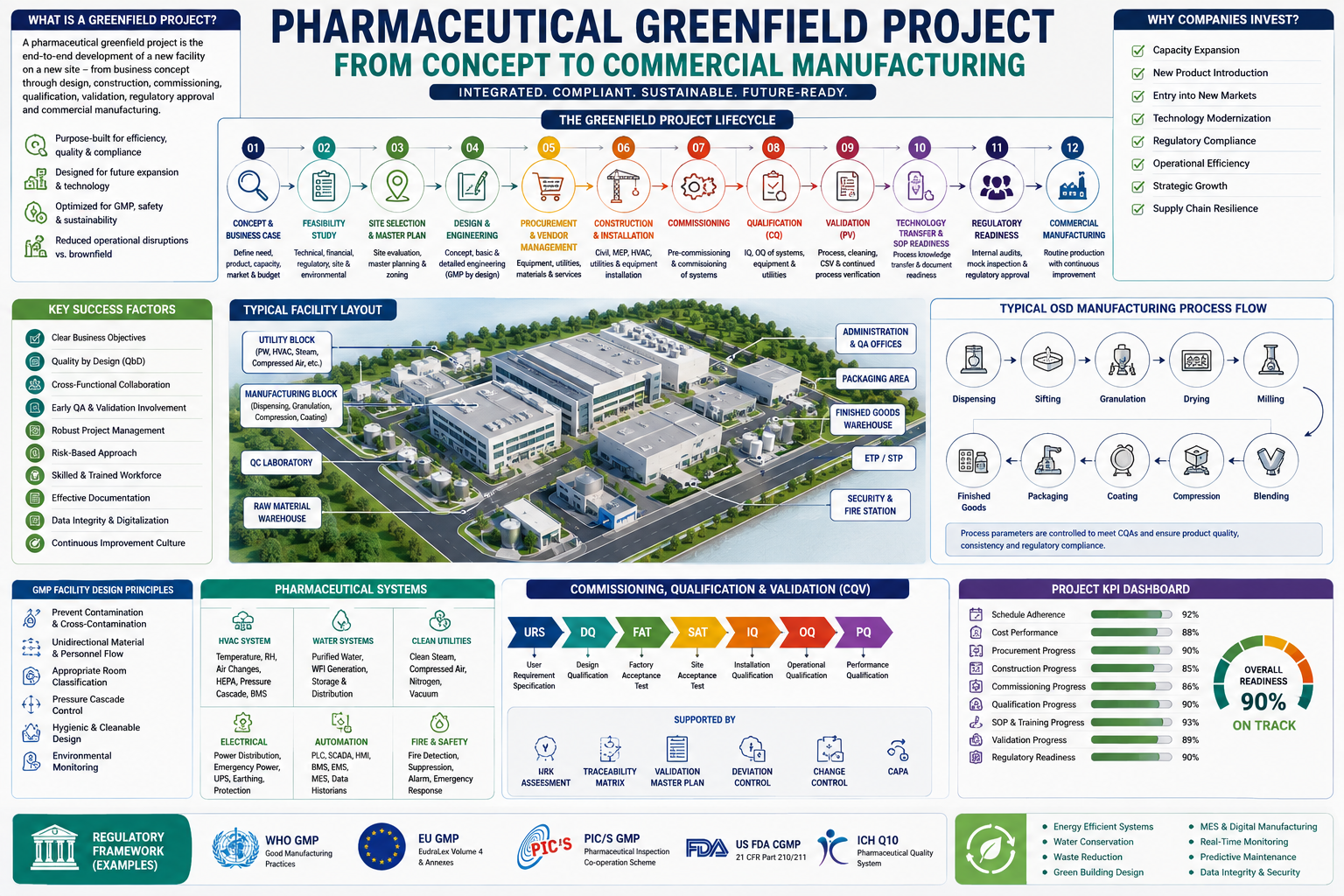
A pharmaceutical greenfield project is much more than constructing a building and installing manufacturing equipment. It is the coordinated development of business strategy, site, process, facility, utilities, equipment, automation, quality systems, people, documentation, qualification, validation, regulatory readiness and ultimately a sustainable commercial operation.
The most important principle is:
A successful greenfield project is not one that merely reaches mechanical completion; it is one that reaches a state of controlled, qualified, validated and operationally sustainable commercial manufacturing.
WHO describes GMP as a system covering production and quality control, including premises, equipment, personnel, defined and validated processes, and documentation. For facilities targeting markets such as the EU or US, the applicable jurisdiction-specific GMP requirements must be incorporated into the project design rather than added after construction. EU GMP Volume 4, for example, includes requirements covering premises/equipment, documentation, production, quality control, computerized systems and qualification/validation.
1. Introduction
What is a Pharmaceutical Greenfield Project?
A Pharmaceutical Greenfield Project is the development of a new pharmaceutical manufacturing facility on a new site or substantially undeveloped site, starting from business concept and progressing through feasibility, site selection, design, construction, equipment procurement, commissioning, qualification, validation, regulatory readiness and commercial manufacturing.
A typical lifecycle is:
Business Need → Feasibility → Site Selection → Master Planning → URS → Concept Design → Basic Engineering → Detailed Engineering → Procurement → Construction → Installation → Commissioning → Qualification → Validation → Technology Transfer → GMP Readiness → Regulatory Approval/Inspection → Commercial Manufacturing
The exact sequence is not always linear. Good project teams deliberately overlap activities.
For example:
- Technology transfer begins before construction is complete.
- SOP development starts before qualification is finished.
- Equipment URS development precedes vendor selection.
- Validation planning begins during design.
- Regulatory strategy is established during the business case.
- Manufacturing and QA personnel should participate in design reviews.
Greenfield vs Brownfield
A greenfield project offers a clean opportunity to design the facility around the intended process. However, it also removes the advantage of existing infrastructure and operational experience.
A brownfield project modifies or expands an existing facility. It can be faster in some cases but introduces constraints from existing buildings, utilities, operations and interfaces.
Why Companies Invest in Greenfield Facilities
Common drivers include:
- Capacity expansion
- New product introduction
- Entry into a new therapeutic segment
- Export-market expansion
- Technology modernization
- Vertical integration
- Replacement of obsolete facilities
- Dedicated containment or specialized manufacturing
- Strategic geographic expansion
- Reduction of manufacturing cost
- Supply-chain resilience
2. What Is a Pharmaceutical Greenfield Project?
| Project Type | Definition | Typical Advantage | Typical Challenge |
|---|---|---|---|
| Greenfield | New facility developed essentially from the beginning | Maximum design flexibility | High CAPEX and execution risk |
| Brownfield | Modification/expansion of existing facility | Existing infrastructure available | Interface and operational constraints |
| Expansion | Addition of capacity to existing operation | Faster than complete new development in some cases | Utility and process integration |
| Retrofit | Modification of existing system/facility to meet new requirements | Extends useful life | Existing design limitations |
| Revamp | Major modification to improve existing capability | Performance improvement | Shutdown and integration risk |
The fundamental difference is that a greenfield project gives the team an opportunity to establish the facility architecture, material/personnel flows, utilities and digital infrastructure correctly from the start.
3. Project Objectives and Business Case
Before an architect draws the first room, management should answer:
Why are we building this plant?
A proper business case should establish:
Product Portfolio
Define:
- Products
- Dosage forms
- Strengths
- Batch sizes
- Annual volumes
- Campaign strategy
- Market destinations
- Regulatory markets
- Product potency/toxicity
- Cleaning requirements
- Special containment requirements
Manufacturing Capacity
Capacity should not simply be stated as “X million tablets/year.”
A meaningful capacity model considers:
Annual output = Batch size × Number of batches × Yield × Effective operating capacity
Effective capacity must account for:
- Planned maintenance
- Changeovers
- Cleaning
- Line clearance
- Quality holds
- Rejects
- Material shortages
- Equipment downtime
- Campaign scheduling
CAPEX
Major CAPEX categories include:
- Land
- Site development
- Civil works
- Architecture
- HVAC
- Utilities
- Manufacturing equipment
- Packaging equipment
- QC laboratory
- Warehouse
- Electrical systems
- Automation
- IT
- Fire protection
- ETP/STP
- Validation
- Consultancy
- Contingency
OPEX
Evaluate:
- Manpower
- Energy
- Water
- HVAC
- Maintenance
- Consumables
- Calibration
- Cleaning
- Waste treatment
- Validation/requalification
- IT licenses
- Security
- Insurance
Business Case Questions
Before approval, management should know:
- What products will be manufactured?
- What is the target capacity?
- Which markets will be served?
- What GMP standard is required?
- What is the target commercial date?
- What CAPEX is acceptable?
- What future expansion is expected?
- What utilities will be required?
- What manpower will be required?
- What is the expected return on investment?
4. Project Feasibility Study
A feasibility study should cover five major dimensions.
Technical Feasibility
Evaluate:
- Manufacturing technology
- Equipment availability
- Process complexity
- Capacity
- Automation
- Containment
- Cleaning strategy
- Utility requirements
- Waste generation
Financial Feasibility
Assess:
- CAPEX
- OPEX
- Working capital
- Product contribution
- Revenue
- Payback
- ROI
- Sensitivity analysis
Regulatory Feasibility
Determine:
- Target markets
- Applicable GMP regulations
- Manufacturing licence requirements
- Environmental permissions
- Fire approvals
- Building approvals
- Utility permissions
- Product-specific requirements
Regulatory expectations depend on the product, dosage form and market. For example, a non-sterile OSD facility and an aseptic facility cannot be designed using the same GMP design assumptions.
Environmental Feasibility
Consider:
- Water availability
- Wastewater
- Air emissions
- Hazardous waste
- Noise
- Energy consumption
- Local environmental permissions
- Biodiversity/ecological constraints
Infrastructure Feasibility
Assess:
- Roads
- Power
- Water
- Fuel
- Internet
- Logistics
- Airports/ports
- Workforce
- Emergency services
5. Site Selection
Site selection is one of the decisions that is extremely expensive to reverse.
Site Selection Checklist
| Parameter | Key Question |
|---|---|
| Land | Is sufficient land available? |
| Expansion | Is future expansion possible? |
| Water | Is reliable water available? |
| Electricity | Is grid capacity adequate? |
| Fuel | Is fuel infrastructure available? |
| Roads | Can heavy equipment reach the site? |
| Logistics | Is the location commercially practical? |
| Flooding | Is the site vulnerable to flooding? |
| Seismicity | What structural design basis applies? |
| Environment | Are environmental permissions feasible? |
| Workforce | Can qualified manpower be recruited? |
| Security | Can site security be adequately controlled? |
| Fire response | Are emergency services accessible? |
| Waste | Can waste be legally managed? |
| Community | Are there significant community constraints? |
A common greenfield mistake is selecting inexpensive land and discovering later that power, water, drainage, access roads or environmental permissions become project-critical constraints.
6. Master Planning
The master plan should consider not only today’s facility but the future pharmaceutical campus.
Typical zones include:
- Main manufacturing block
- Raw-material warehouse
- Packaging-material warehouse
- Finished-goods warehouse
- QC laboratory
- QA offices
- Administration
- Utility block
- Engineering workshop
- ETP/STP
- Boiler/thermal utility area
- Electrical substation
- DG/emergency power
- Waste storage
- Security
- Fire station/fire systems
- Parking
- Employee facilities
- Future expansion zone
Conceptual Zoning
A practical arrangement may follow:
Gate → Security → Administration → Warehouse → Dispensing → Manufacturing → Packaging → Finished Goods → Dispatch
Utilities should generally be positioned so that distribution distances, maintenance access and safety risks are controlled.
Future expansion should be protected from day one.
7. User Requirement Specification — URS
URS is one of the most important project documents.
A weak URS creates downstream problems in:
Design → Procurement → Installation → Commissioning → Qualification → Validation → Operation
URS should be prepared for:
- Facility
- Manufacturing equipment
- Packaging equipment
- HVAC
- PW/WFI
- Clean steam
- Compressed air
- Nitrogen
- BMS
- EMS
- PLC/SCADA
- Laboratory systems
- Warehouse systems
- IT infrastructure
A Good URS Should Define
- Intended use
- Capacity
- Product contact requirements
- Materials of construction
- GMP requirements
- Cleaning requirements
- Safety
- Automation
- Data requirements
- Alarm requirements
- Documentation
- Qualification expectations
- Maintenance requirements
- Calibration
- Cybersecurity where applicable
- Vendor support
URS should be risk-based and sufficiently specific to define intended use without unnecessarily dictating vendor design solutions.
8. Concept Design and Basic Engineering
This is where pharmaceutical engineering begins to translate the process into a facility.
The design team develops:
- Process flow diagrams
- Material flow
- Personnel flow
- Equipment layouts
- Room data sheets
- Room classifications
- HVAC zoning
- Pressure cascade
- Utility architecture
- Waste flow
- Clean/dirty segregation
- Process architecture
- Automation philosophy
Material Flow
For an OSD facility:
Raw Materials → Sampling → Dispensing → Manufacturing → Bulk Storage → Packaging → Finished Goods
Material movement should minimize:
- Cross-contamination risk
- Mix-up risk
- Unnecessary movement
- Backtracking
- Uncontrolled personnel interaction
Personnel Flow
Typical movement:
Entry → Change Room → Personnel Airlock → Manufacturing Area
The exact arrangement depends on facility design and GMP risk assessment.
9. Detailed Engineering
Detailed engineering converts approved concepts into construction-ready information.
Architectural
- Room dimensions
- Wall systems
- Doors
- Windows
- Ceilings
- Floors
- Finishes
- Airlocks
- Pass boxes
- Material/personnel movement
Civil/Structural
- Foundations
- Equipment loads
- Vibration
- Platforms
- Mezzanines
- Pipe supports
- Equipment access
- Drainage
HVAC
- AHU sizing
- Airflow
- Filtration
- Temperature/RH
- Pressure cascade
- Exhaust
- Fresh air
- Return air
- Zoning
Electrical
- Connected load
- Demand load
- Transformers
- MCC
- Distribution
- Emergency power
- UPS
- Earthing
- Lightning protection
Automation
- PLC
- SCADA
- HMI
- BMS
- EMS
- Historian
- Network architecture
- Data storage
Other Systems
- Fire protection
- CCTV
- Access control
- Public address
- Security
- IT infrastructure
- Building management
- Environmental monitoring
10. GMP Facility Design
GMP facility design should begin with product and process risks, not with architectural aesthetics.
WHO GMP emphasizes suitable premises, equipment, personnel, defined processes and documented controls. FDA CGMP requirements similarly include requirements concerning buildings, facilities, equipment, production controls and quality oversight under 21 CFR Part 211.
Key GMP Design Principles
- Prevent contamination
- Prevent cross-contamination
- Prevent mix-ups
- Provide adequate space
- Enable cleaning
- Enable maintenance
- Control personnel movement
- Control material movement
- Provide appropriate environmental control
- Protect product quality
- Provide appropriate segregation
Hygienic Design
Consider:
- Smooth cleanable surfaces
- Appropriate floor/wall junctions
- Minimized ledges
- Accessible equipment
- Appropriate drainage
- Controlled utility penetrations
- Cleanable ceilings
- Appropriate door arrangements
Regulatory Requirement vs Best Practice
This distinction is critical.
Regulatory requirement: something explicitly required by applicable legislation/GMP.
Guidance: regulatory agency expectation or published recommendation.
Industry best practice: engineering approach that improves reliability, maintainability or control but may not itself be a statutory requirement.
A project should never claim that an engineering preference is a universal GMP requirement without evidence.
11. OSD Manufacturing Process Design
For an oral solid dosage facility, a typical manufacturing process is:
Dispensing → Sifting → Granulation → Drying → Milling → Blending → Compression → Coating → Bulk Holding → Packaging → Finished Goods
Not every product requires every step.
Capacity Calculation
For example, assume hypothetically:
- Batch size = 500 kg
- Average tablet weight = 500 mg
The theoretical tablet quantity is:
500 kg ÷ 0.5 g = 1,000,000 tablets/batch
If actual yield is 97%:
1,000,000 × 0.97 = 970,000 tablets/batch
Annual output then depends on:
- Number of batches
- Equipment availability
- Changeover
- Cleaning
- Maintenance
- Yield
- Campaign strategy
This is why capacity calculations should be based on effective manufacturing hours, not equipment nameplate capacity alone.
12. Pharmaceutical HVAC System
HVAC is one of the most critical engineering systems in a pharmaceutical facility.
HVAC Design Basis
The HVAC design should consider:
- Product characteristics
- Personnel load
- Equipment heat load
- Room classification
- Temperature
- Relative humidity
- Pressure relationships
- Fresh-air requirements
- Exhaust requirements
- Containment
- Cross-contamination
- Cleaning requirements
- Energy consumption
Typical HVAC Architecture
Fresh Air → Pre-filtration → Cooling/Heating → Dehumidification → HEPA filtration where applicable → Supply → Room → Return/Exhaust
The actual architecture depends on the facility and risk assessment.
Airflow Visualization
Smoke studies/airflow visualization can be used where appropriate to demonstrate airflow patterns and identify undesirable airflow behavior.
For sterile facilities, additional requirements and expectations apply. FDA notes that ISO cleanroom standards alone are not sufficient to demonstrate CGMP compliance for aseptic processing; applicable CGMP requirements and relevant guidance must also be considered.
HVAC Qualification
Typical activities may include:
- Installation verification
- Airflow measurement
- Air changes where specified by design
- Pressure differential verification
- Temperature/RH mapping
- Filter integrity testing where applicable
- Airflow visualization where justified
- Recovery testing where applicable
- Alarm verification
- BMS/EMS interface verification
Acceptance criteria should come from the approved design basis, applicable standards and risk assessment—not invented universal values.
13. Pharmaceutical Utilities
Utilities must be designed as GMP-supporting systems, not merely engineering services.
| Utility | Typical Design Focus | Commissioning/Qualification Focus |
|---|---|---|
| PW | Generation, storage, distribution | Flow, temperature/control, sampling, monitoring |
| WFI | Generation, storage, distribution | System integrity, quality and microbial/endotoxin controls as applicable |
| Clean Steam | Steam quality and generation | Quality, pressure, distribution |
| Compressed Air | Capacity, filtration, quality | Pressure, dew point, oil/particulate/microbial quality as applicable |
| Nitrogen | Purity, pressure, capacity | Purity and distribution |
| Chilled Water | Cooling capacity | Flow, temperature, controls |
| Hot Water | Temperature and circulation | Temperature/control |
| Vacuum | Capacity and contamination control | Performance |
| Electrical | Reliability and capacity | Protection, distribution, backup |
| Emergency Power | Critical-load support | Transfer and load testing |
Utility Lifecycle
Design → URS → Engineering → Procurement → Installation → Commissioning → Qualification → Monitoring → Maintenance → Requalification where required
The exact qualification and monitoring strategy must be based on intended use, risk and applicable GMP requirements.
WHO publishes dedicated guidance covering pharmaceutical water systems and GMP validation/qualification concepts.
14. Equipment Selection and Procurement
The equipment lifecycle should be:
URS → Vendor Identification → Technical Evaluation → Commercial Evaluation → Vendor Selection → PO → Design Review → FAT → Delivery → Installation → SAT → Qualification
Vendor Evaluation
Assess:
- Technical capability
- GMP experience
- References
- Documentation quality
- Service support
- Spare availability
- Automation capability
- Data-integrity controls
- Delivery capability
- Lifecycle cost
FAT
Factory Acceptance Testing can verify selected design and functional requirements before shipment.
Typical checks:
- Equipment construction
- Components
- Instrumentation
- Controls
- Alarms
- Interlocks
- Documentation
- Functional operation
SAT
SAT verifies equipment at the installation site after transportation and installation.
15. Project Management
A professional greenfield project needs a formal project-management framework.
Core Components
- Project charter
- Project organization
- Work Breakdown Structure
- Master schedule
- Procurement schedule
- Construction schedule
- Commissioning schedule
- CQV schedule
- Budget
- Risk register
- Change-control system
- Document control
- Progress reporting
- Contractor management
Critical Path
Typical critical-path activities may include:
Design Approval → Long-lead Procurement → Building Completion → HVAC/Utilities → Equipment Installation → Commissioning → Qualification → Validation → Regulatory Readiness
A delay in one critical activity can move the commercial manufacturing date.
Sample RACI Matrix
| Activity | Engineering | QA | Production | Validation | EHS | Supply Chain |
|---|---|---|---|---|---|---|
| Facility URS | R | A/C | C | C | C | I |
| Equipment URS | R | A/C | C | C | C | I |
| Design Review | R | A/C | C | C | C | I |
| Vendor Selection | R | C | C | C | C | A/R |
| FAT | R | C | C | C | C | A |
| Installation | A/R | C | C | C | C | I |
| Commissioning | A/R | C | C | R | C | I |
| Qualification | C | A | C | R | C | I |
| SOP Approval | C | A | R | C | C | I |
| Operational Readiness | R | A | R | R | R | C |
R = Responsible, A = Accountable, C = Consulted, I = Informed
The exact RACI should be customized to the company’s governance model.
16. Construction Phase
Construction activities include:
Civil
- Excavation
- Foundations
- Structural work
- Flooring
- Roofing
- Walls
- Drainage
Cleanroom
- Panels
- Doors
- Ceilings
- Coving
- Sealants
- Penetrations
MEP
- HVAC
- Electrical
- Plumbing
- Fire protection
- Process utilities
Equipment
- Positioning
- Anchoring
- Alignment
- Utility connections
- Instrumentation
Construction Quality Controls
Maintain:
- Approved drawings
- Material approvals
- Inspection requests
- Test reports
- Weld records where applicable
- Pressure tests
- Insulation inspection
- Cable testing
- Calibration records
- As-built drawings
- Punch lists
A major project mistake is allowing construction teams to make undocumented field changes.
17. Commissioning
The terms are often confused.
Construction Completion
The installation is physically complete.
Mechanical Completion
Defined systems/equipment are installed according to approved requirements and ready for further testing, subject to project-specific completion criteria.
Pre-Commissioning
Examples:
- Flushing
- Cleaning
- Pressure testing
- Electrical checks
- Loop checks
- Instrument calibration
- Rotation checks
Commissioning
Demonstrates that systems operate as intended.
Qualification
Provides documented evidence that GMP-relevant systems/equipment meet predefined requirements for their intended use.
18. Qualification and Validation Strategy
A traditional lifecycle can be represented as:
URS → DQ → FAT → SAT → IQ → OQ → PQ
However, modern pharmaceutical projects should not treat this as an inflexible paperwork sequence.
A science- and risk-based CQV strategy can integrate commissioning and qualification activities where appropriate.
ISPE’s Baseline Guide Volume 5 specifically addresses Commissioning & Qualification as an industry framework.
Core Documents
| Document | Typical Purpose |
|---|---|
| URS | Defines intended requirements |
| Risk Assessment | Identifies critical risks |
| DQ | Demonstrates design meets intended requirements |
| FAT | Verification at vendor |
| SAT | Verification at site |
| IQ | Installation verification |
| OQ | Operational verification |
| PQ | Performance under intended operating conditions |
| Traceability Matrix | Links requirements to verification |
| Protocol | Defines test methodology/acceptance criteria |
| Deviation | Controls unexpected results |
| Final Report | Summarizes execution and conclusion |
| VMP | Defines overall validation strategy |
EU GMP Annex 15 specifically addresses qualification and validation, while the EU GMP framework also incorporates QRM principles.
When Documents Should Begin
A mature project begins validation planning during design, not after construction.
19. Computerized Systems and Digitalization
Modern greenfield plants increasingly use:
- PLC
- HMI
- SCADA
- BMS
- EMS
- MES
- LIMS
- eQMS
- eDMS
- SAP
- Data historians
CSV Lifecycle
Planning → Intended Use → Risk Assessment → Requirements → Design → Configuration → Testing → Validation → Release → Operation → Change Control → Periodic Review/Retirement
For systems affecting GMP records or regulated processes, applicable computerized-system requirements must be addressed.
EU GMP Annex 11 covers computerized systems. The European Commission’s current Volume 4 page identifies Annex 11 and Annex 15 among the GMP annexes.
Data Integrity
The system should address:
- User access
- Unique accounts
- Role-based privileges
- Audit trails
- Electronic signatures where applicable
- Backup
- Restore
- Disaster recovery
- Time synchronization
- Data retention
- Cybersecurity
- Periodic review
ALCOA+ principles are commonly used as a framework for reliable data.
20. Regulatory and GMP Readiness
A plant should be inspected internally before the regulator arrives.
Readiness Areas
Facility
- Rooms complete
- Finishes acceptable
- Flows established
- Environmental controls operational
Equipment
- Installed
- Commissioned
- Qualified
- Calibrated
Documentation
- SOPs approved
- BMR/BPR ready
- Specifications approved
- Forms available
Quality
- QMS operational
- Deviations system operational
- CAPA system operational
- Change control operational
- Training system operational
Validation
- VMP approved
- Qualification completed as required
- Process validation strategy established
- Cleaning validation strategy established
- Computerized systems addressed
WHO’s GMP framework emphasizes that manufacturing processes, premises, equipment, personnel and documentation must be appropriately controlled.
21. Technology Transfer
Technology transfer can originate from:
- R&D
- Existing manufacturing site
- cm/CDMO
Transfer Package
Should address, as applicable:
- Product composition
- Manufacturing process
- Process parameters
- CQAs
- cps
- Specifications
- Analytical methods
- Batch records
- Cleaning procedures
- Packaging
- Stability information
- Historical deviations
- Yield information
- Equipment differences
The receiving site must understand not only what to manufacture, but why the process works.
ICH Q10 emphasizes product/process knowledge management across the product lifecycle, including technology transfer and process validation.
22. SOP and Documentation System
Documentation should be developed well before startup.
Typical Documentation
Quality
- Quality Manual
- SOPs
- Deviations
- CAPA
- Change Control
- Risk Management
- Audit procedures
Production
- BMR/BPR
- Line clearance
- Cleaning procedures
- Process instructions
- Logbooks
Engineering
- Preventive maintenance
- Breakdown maintenance
- Calibration
- Utilities
- Equipment operation
QC
- Specifications
- STPs
- Sampling procedures
- Laboratory SOPs
Validation
- VMP
- Protocols
- Reports
- Traceability
- Risk assessments
EHS
- Emergency procedures
- PPE
- Chemical handling
- Fire procedures
- Incident management
23. Manpower Planning
A new plant should recruit critical leadership and specialist personnel before startup, not after.
Typical Functions
- Plant Head
- Production
- QA
- QC
- Engineering
- Validation/CQV
- Warehouse
- Supply Chain
- EHS
- Regulatory Affairs
- IT
- Finance
- HR
- Maintenance
Example Organization
Plant Head
→ Production Head
→ QA Head
→ QC Head
→ Engineering Head
→ Validation/CQV Head
→ Warehouse/Supply Chain Head
→ EHS Head
→ IT
→ HR/Admin
→ Finance
→ Regulatory Affairs
Staffing should be based on:
- Number of shifts
- Product portfolio
- Batch size
- Automation
- Laboratory workload
- Warehouse volume
- Regulatory market
- Maintenance strategy
24. Training and Readiness
Training should start before commercial operation.
Training Matrix
| Training | Audience |
|---|---|
| GMP | All GMP personnel |
| SOP | Relevant users |
| Equipment | Operators/engineering |
| Data Integrity | GMP users |
| Cleanroom Behavior | Manufacturing/support |
| Safety | All relevant personnel |
| Emergency Response | Relevant teams |
| Fire Safety | All personnel |
| Process Training | Production/QA/QC |
| Validation | Validation/engineering/QA |
| Computerized Systems | System users/admins |
Training should demonstrate not only attendance but competence where appropriate.
25. Trial Runs and Engineering Batches
Before commercial manufacturing, projects commonly execute staged trials.
Dry Runs
Check:
- Equipment sequence
- Material movement
- Operator movement
- SOP usability
- Interlocks
- Controls
Water Trials
Useful for:
- Cleaning systems
- Utility systems
- Process simulations where applicable
Engineering Batches
Can verify:
- Process parameters
- Equipment performance
- Yield
- Material flow
- Operator practices
Validation Activities
Depending on product/process:
- Process validation
- Cleaning validation
- Hold-time studies
- Analytical method validation/verification
- Computerized system validation
- Performance qualification
For sterile products, media fills/aseptic process simulations may be applicable; they should not be treated as universal requirements for non-sterile OSD manufacturing.
26. Operational Readiness
Mechanical completion ≠ GMP readiness ≠ commercial readiness.
A plant is operationally ready when the facility can reliably perform its intended operation under an effective quality system.
Operational Readiness Checklist
| Area | Readiness Question |
|---|---|
| Facility | Is the facility complete and suitable? |
| Equipment | Is equipment qualified and available? |
| Utilities | Are critical utilities reliable? |
| QA | Is the quality system operational? |
| QC | Can required testing be performed? |
| Production | Are trained operators available? |
| Warehouse | Can materials be controlled? |
| Engineering | Is maintenance support ready? |
| Validation | Are required activities complete/approved? |
| Documentation | Are controlled documents available? |
| Training | Are personnel trained? |
| EHS | Are safety systems operational? |
| Regulatory | Are licensing/inspection commitments addressed? |
27. Common Greenfield Project Risks
| Risk | Consequence | Preventive Action | Corrective Action |
|---|---|---|---|
| Poor URS | Design mismatch | Cross-functional URS review | Controlled change |
| Wrong site | Infrastructure problems | Detailed feasibility | Infrastructure upgrade |
| Unrealistic schedule | Startup delay | Integrated schedule | Recovery plan |
| Procurement delay | Construction idle time | Long-lead identification | Alternate supplier |
| Contractor weakness | Quality/schedule problems | Prequalification | Corrective action |
| Design changes | Cost/time increase | Design freeze | Change control |
| Utility mismatch | Production limitations | Load calculations | Capacity augmentation |
| HVAC issues | Qualification failure | Early design review | Redesign/balancing |
| Equipment delay | Critical-path delay | Procurement tracking | Expediting |
| Documentation gaps | GMP delay | Document master plan | Dedicated documentation team |
| Poor manpower planning | Startup instability | Early recruitment | Temporary specialist support |
| Validation failures | Release delay | Risk-based CQV | Deviation/CAPA |
| Regulatory gaps | Inspection findings | Mock inspection | Remediation |
28. Critical Success Factors
The most important success factors are:
- Clear business objectives
- Correct site selection
- Strong project governance
- Cross-functional leadership
- High-quality URS
- Process-driven facility design
- Early QA involvement
- Early validation involvement
- Realistic schedule
- Long-lead procurement control
- Strong contractor management
- Effective change control
- Integrated commissioning/CQV planning
- Early technology transfer
- Early SOP development
- Early manpower recruitment
- Robust training
- Strong document control
- Regulatory strategy from project initiation
- Operational-readiness governance
29. Greenfield Project Timeline
The following is illustrative only. Actual timelines vary substantially by product, capacity, site, jurisdiction, construction complexity, procurement strategy and regulatory pathway.
| Stage | Major Activities | Key Deliverables | Responsible Function | Typical Dependency |
|---|---|---|---|---|
| Concept | Business need | Concept note | Management | Business strategy |
| Feasibility | Technical/financial/site study | Feasibility report | Project/Finance | Product portfolio |
| Site | Site evaluation | Site decision | Management/Engineering | Feasibility |
| Master Planning | Site zoning | Master plan | Engineering | Site |
| URS | Requirements | Approved URS | User/QA/Engineering | Business/process |
| Concept Design | Process/facility concept | Concept package | Engineering | URS |
| Basic Engineering | Engineering basis | Design package | Engineering | Concept |
| Detailed Design | IFC drawings | Construction package | Engineering | Basic engineering |
| Procurement | Vendor selection | POs | Supply Chain | Approved specifications |
| Construction | Civil/MEP | Completed facility | Projects | Design |
| Installation | Equipment/utilities | Installed systems | Engineering | Construction/procurement |
| Commissioning | Functional testing | Commissioning records | Engineering/CQV | Installation |
| Qualification | IQ/OQ/PQ as applicable | Qualification reports | CQV/QA | Commissioning |
| Validation | Process/cleaning/CSV | Validation reports | QA/Validation | Qualification/tech transfer |
| Readiness | SOP/training/mock audit | Readiness package | Plant/QA | Validation |
| Regulatory | Inspection/licensing | Regulatory clearance | Regulatory/QA | Readiness |
| Startup | Engineering/validation batches | Approved manufacturing process | Production/QA | Readiness |
| Commercial | Routine production | Released product | Plant | All prerequisites |
These timelines are project-management estimates, not regulatory deadlines.
30. CAPEX and Cost Control
Major CAPEX Categories
| Category | Typical Scope |
|---|---|
| Land | Land acquisition/development |
| Civil | Building and infrastructure |
| HVAC | AHUs, ducts, controls |
| Utilities | PW, steam, compressed air, chilled water |
| Equipment | Manufacturing/packaging |
| Electrical | Transformer, MCC, distribution |
| Automation | PLC/SCADA/BMS/EMS |
| Laboratory | QC instruments |
| Warehouse | Storage systems |
| IT | Network/server/software |
| Validation | CQV and validation |
| Consultancy | Engineering/project consultants |
| Contingency | Risk allowance |
Cost-Control Methods
- Freeze requirements early
- Avoid uncontrolled scope changes
- Use competitive bidding
- Identify long-lead equipment
- Track committed vs actual cost
- Use earned-value concepts where appropriate
- Control variations
- Review contractor claims
- Protect contingency
- Conduct value engineering without compromising GMP
Never use cost reduction to remove a control that protects product quality, personnel safety or regulatory compliance.
31. Greenfield Project KPI Dashboard
| KPI | Formula/Method |
|---|---|
| Schedule Adherence | Actual progress ÷ Planned progress × 100 |
| Cost Variance | Budget − Actual/Forecast |
| Engineering Completion | Approved deliverables ÷ Planned deliverables × 100 |
| Procurement Completion | POs/deliveries completed ÷ Planned × 100 |
| Construction Progress | Earned progress ÷ Planned progress × 100 |
| Punch Closure | Closed punches ÷ Total punches × 100 |
| FAT Completion | Completed FATs ÷ Planned FATs × 100 |
| SAT Completion | Completed SATs ÷ Planned SATs × 100 |
| Qualification Completion | Approved qualification packages ÷ Planned × 100 |
| SOP Completion | Approved SOPs ÷ Planned SOPs × 100 |
| Training Completion | Trained personnel ÷ Planned personnel × 100 |
| Validation Completion | Completed validation deliverables ÷ Planned × 100 |
| Regulatory Readiness | Readiness score against approved checklist |
A good dashboard should show trend, owner, due date and recovery action, not merely percentages.
32. Hypothetical Example: New OSD Tablet Manufacturing Facility
All figures in this example are hypothetical and intended for project-planning illustration only.
Assume a company plans a new non-sterile OSD facility.
Illustrative Assumptions
- Product: Tablets
- Manufacturing: Granulation, compression and coating
- Packaging: Blister/bottle
- Multiple products
- Target annual output: 1.0 billion tablets
- Two-shift manufacturing model
- Future expansion planned
- Export markets included
Facility Concept
Major areas:
- Raw-material warehouse
- Sampling
- Dispensing
- Granulation
- Drying
- Milling
- Blending
- Compression
- Coating
- Bulk storage
- Packaging
- Finished goods
- QC laboratory
- QA
- Utilities
- Engineering
- ETP
- Administration
Major Equipment
Potential equipment:
- Vibro sifter
- Rapid mixer granulator
- Fluid-bed dryer
- Multimill
- Blender
- Tablet compression machine
- Coating machine
- Metal detector
- Checkweigher
- Blister machine
- car-toner
- Coding/serialization equipment where applicable
Utility Architecture
Potential systems:
Electrical → HVAC → Chilled Water → Compressed Air → PW → Process Utilities → Manufacturing
Project Sequence
- Business approval
- Site selection
- Feasibility
- Master planning
- URS
- Design
- Procurement
- Construction
- Equipment installation
- Commissioning
- Qualification
- Technology transfer
- Validation
- Training
- Regulatory readiness
- Engineering/validation batches
- Commercial production
33. Greenfield vs Brownfield
| Parameter | Greenfield | Brownfield |
|---|---|---|
| CAPEX | Usually higher | Often lower |
| Timeline | Potentially longer | Can be shorter |
| Design flexibility | Very high | Limited |
| Existing utilities | Usually unavailable | Available |
| Existing infrastructure | Minimal | Significant |
| Operational disruption | Low during construction | Potentially high |
| Legacy constraints | Low | High |
| Expansion | Can be planned from beginning | May be constrained |
| Technology | New | May require integration |
| GMP design | Can be purpose-designed | Existing limitations |
| Risk | Construction/interface risk | Integration/legacy risk |
| Startup | New operation | Existing operation can support |
| Knowledge transfer | Must be established | Existing site knowledge available |
34. Role of QA, Engineering, Production and Validation
Project Engineering
Owns:
- Design
- Engineering
- Contractors
- Construction
- Utilities
- Equipment installation
- Commissioning
QA
Owns/oversees:
- GMP requirements
- Quality governance
- Documentation
- Change control
- Deviations
- CAPA
- Qualification/validation approval
- Quality risk management
- Readiness
Production
Owns:
- Process requirements
- Equipment usability
- Manufacturing flow
- Operator requirements
- Process performance
- SOPs
- Training
QC
Owns:
- Laboratory design requirements
- Analytical methods
- Specifications
- Testing capability
- Laboratory systems
Validation/CQV
Owns:
- CQV strategy
- Qualification planning
- Protocols
- Execution
- Traceability
- Validation reports
EHS
Owns:
- Safety
- Environmental compliance
- Hazard assessment
- Emergency systems
- Waste management
IT
Owns:
- Infrastructure
- Network
- Cybersecurity
- Applications
- System lifecycle support
Supply Chain
Owns:
- Procurement
- Vendor coordination
- Logistics
- Inventory
Finance
Owns:
- Budget
- CAPEX control
- Financial reporting
Regulatory Affairs
Owns:
- Regulatory strategy
- Licensing interface
- Submission support
- Regulatory commitments
35. Practical Lessons Learned
Lesson 1 — Freeze the Process Before Freezing the Building
If process assumptions continue changing, facility design will continuously change.
Lesson 2 — Involve QA at Concept Stage
Do not invite QA only when qualification protocols arrive.
Lesson 3 — Bring Validation Into Design
Late validation involvement produces expensive retrospective qualification work.
Lesson 4 — Design for Maintenance
A technically GMP-compliant system that cannot be maintained efficiently becomes an operational problem.
Lesson 5 — Protect Future Expansion
Reserve:
- Land
- Utility capacity
- Electrical capacity
- HVAC space
- Pipe corridors
- Equipment access
Lesson 6 — Long-Lead Equipment Controls the Schedule
Identify it during conceptual planning.
Lesson 7 — Documentation Is a Project Deliverable
Not an administrative afterthought.
Lesson 8 — Train Before Startup
The first commercial batch should not be the first time operators learn the process.
Lesson 9 — Mock the Inspection
A regulatory inspection should not be the first test of plant readiness.
Lesson 10 — Build Quality Into Design
WHO explicitly emphasizes that GMP controls quality throughout production rather than relying on final-product testing alone.
36. Final Greenfield Project Checklist
Business
- Business case approved
- Product portfolio defined
- Capacity defined
- Markets defined
- CAPEX approved
- Commercial target established
Site
- Site selected
- Utilities available
- Environmental feasibility completed
- Expansion land identified
- Logistics assessed
Engineering
- URS approved
- Master plan approved
- Concept design approved
- Basic engineering complete
- Detailed engineering complete
- Construction drawings approved
Procurement
- Vendor strategy approved
- Long-lead items identified
- POs released
- FAT schedule established
- Vendor documents received
Construction
- Civil complete
- Cleanrooms complete
- HVAC complete
- Utilities complete
- Electrical complete
- Fire systems complete
Equipment
- Installed
- Calibrated
- Commissioned
- Qualified as applicable
Quality
- QMS established
- SOPs approved
- Change control operational
- Deviation system operational
- CAPA system operational
Validation
- VMP approved
- Risk assessments completed
- Traceability established
- Qualification executed
- Process validation strategy established
- Cleaning validation strategy established
- CSV strategy established
People
- Organization approved
- Key personnel recruited
- Training completed
- Competency assessed
Regulatory
- Licensing requirements addressed
- Regulatory documentation ready
- Mock inspection completed
- Inspection observations addressed
Commercial
- Engineering runs complete
- Validation batches completed where required
- Product/process documentation approved
- QA release system ready
- Supply chain ready
- Plant Head authorizes operational readiness
37. Frequently Asked Questions
1. What is a pharmaceutical greenfield project?
It is the development of a new pharmaceutical manufacturing facility from concept through design, construction, commissioning, qualification, validation and commercial operation.
2. How long does a pharma greenfield project take?
There is no universal duration. A project may require several years depending on facility complexity, product type, capacity, regulatory jurisdiction, construction strategy and procurement requirements.
3. What is the role of QA?
QA establishes/oversees GMP expectations, quality governance, risk management, documentation, qualification/validation oversight, change control, deviations and readiness.
4. When should validation begin?
Validation planning should begin during project design, not after construction.
5. What is the difference between commissioning and qualification?
Commissioning demonstrates that engineering systems operate as intended. Qualification provides documented evidence that GMP-relevant facilities, systems and equipment meet predefined requirements for their intended use.
6. What is URS?
User Requirement Specification defines what the facility, equipment or system must achieve for its intended use.
7. What is CQV?
Commissioning, Qualification and Validation is an integrated approach for demonstrating that facilities, utilities, equipment and processes are suitable for intended use and capable of supporting controlled manufacturing.
8. What are the biggest greenfield risks?
Poor requirements, inadequate site feasibility, unrealistic schedule, procurement delays, uncontrolled changes, weak contractors, utility problems, late validation and insufficient manpower are among the major risks.
9. How is CAPEX controlled?
Through scope definition, approved budgets, procurement strategy, change control, cost forecasting, contractor management and disciplined project governance.
10. What is FAT?
Factory Acceptance Testing verifies agreed equipment requirements and functions at the vendor location before shipment.
11. What is SAT?
Site Acceptance Testing verifies equipment/system installation and functionality at the manufacturing site.
12. When should SOP preparation start?
SOP development should begin early enough to allow review, approval, training and implementation before the corresponding operation starts.
13. What is operational readiness?
It is the state in which facility, equipment, utilities, people, procedures, quality systems, documentation and regulatory prerequisites are sufficiently ready for controlled operation.
14. What is technology transfer?
It is the structured transfer of product and process knowledge from development, an existing site or another organization to the receiving manufacturing site.
15. How can a greenfield project become GMP-ready?
By integrating GMP into business planning, design, construction, commissioning, qualification, validation, documentation, training and operational readiness rather than treating GMP as a final inspection exercise.
Recommended Project Governance Model
A particularly effective governance structure is:
Steering Committee
↓
Project Director
↓
Project Management Office
↓
Engineering | QA | CQV | Production | QC | EHS | IT | Supply Chain | Regulatory
↓
Design Consultants | EPC Contractors | Equipment Vendors | System Integrators
This avoids one of the most common greenfield failures: treating engineering, QA and validation as independent departments rather than one integrated project team.
Sustainability and Pharma 4.0 Opportunities
A modern greenfield project should consider sustainability during concept design.
Energy
- High-efficiency chillers
- Variable-frequency drives
- HVAC optimization
- Heat recovery
- Efficient motors
- LED lighting
- Solar integration where appropriate
- Energy monitoring
Water
- Water balance
- Utility optimization
- Condensate recovery
- Reuse opportunities where legally and technically appropriate
- Leak monitoring
Digital Manufacturing
Potential technologies include:
- MES
- Electronic batch records
- Digital SOPs
- eQMS
- LIMS
- Data historians
- Predictive maintenance
- Digital dashboards
- Advanced process monitoring
- AI-assisted analytics where appropriately validated and controlled
Digitalization should be introduced based on business value, data integrity, cybersecurity, lifecycle management and intended use, rather than simply adding technology for its own sake.
The EU is also actively updating its GMP framework in response to computerized systems and AI, illustrating why digital strategy needs to consider the regulatory lifecycle rather than just IT implementation.
The Most Important Greenfield Project Principle
A pharmaceutical plant should be designed backwards from the desired commercial operation:
Patient/Product Requirements
↓
Product & Process Understanding
↓
CQAs / cps / Risk
↓
Facility & Equipment Requirements
↓
Utilities & HVAC
↓
Automation & Data
↓
Construction
↓
Commissioning
↓
Qualification
↓
Process Validation
↓
Training & SOPs
↓
Regulatory Readiness
↓
Commercial Manufacturing
This is fundamentally different from:
“Build the building first and figure out GMP later.”
Conclusion
A Pharmaceutical Greenfield Project is a complete business-to-manufacturing transformation rather than simply a construction project.
The strongest projects integrate business strategy, process engineering, GMP facility design, equipment procurement, construction, utilities, automation, CQV, technology transfer, quality systems, manpower, training and regulatory strategy from the beginning.
The project should therefore be managed as one connected lifecycle:
Concept → Feasibility → Site → Master Plan → URS → Design → Procurement → Construction → Installation → Commissioning → Qualification → Validation → Technology Transfer → GMP Readiness → Regulatory Approval → Commercial Manufacturing
The difference between an expensive building and a successful pharmaceutical manufacturing facility is controlled execution, risk-based design, cross-functional ownership and operational readiness.
WHO’s GMP framework, EU GMP framework and FDA CGMP requirements all reinforce the broader principle that pharmaceutical quality must be built into the manufacturing system through appropriate premises, equipment, processes, personnel, controls and documentation.