
Introduction
A well-designed HVAC system in pharmaceutical industry is much more than a system for heating, ventilation and air conditioning. In pharmaceutical manufacturing, HVAC is a critical facility system that helps establish and maintain the environmental conditions required to protect products, processes, personnel and ultimately patients.
Temperature, relative humidity, airborne particles, airflow direction, pressure differentials, filtration and air distribution can directly influence pharmaceutical manufacturing operations. In an oral solid dosage (OSD) facility, for example, inadequate humidity control can affect powder flow, granulation, compression and coating. In sterile manufacturing, control of airflow, pressure, filtration and cleanroom conditions becomes even more critical.
WHO has specifically published GMP guidance for HVAC systems used with non-sterile pharmaceutical products, recognizing HVAC as an important component of pharmaceutical facility control.
The fundamental objective is therefore not simply to make a room comfortable. A pharmaceutical HVAC system should be designed, qualified, operated, monitored, maintained and controlled according to the intended process and contamination-control strategy.
This article provides a practical guide covering pharmaceutical HVAC design, AHUs, HEPA filtration, cleanrooms, temperature and humidity control, pressure cascades, qualification, validation, monitoring, maintenance, deviations, CAPA, audits and emerging Pharma 4.0 technologies.
What Is HVAC in the Pharmaceutical Industry?
HVAC stands for:
- H — Heating
- V — Ventilation
- AC — Air Conditioning
In pharmaceutical manufacturing, HVAC refers to the integrated system used to control and distribute air so that required environmental conditions can be achieved and maintained.
A pharmaceutical HVAC system may control:
- Temperature
- Relative humidity
- Air cleanliness
- Airborne particulate concentration
- Airflow direction
- Airflow quantity
- Room pressure
- Pressure differentials
- Fresh-air supply
- Exhaust
- Filtration
- Contamination control
The exact HVAC configuration depends on the product, process, facility design, containment strategy, cleanroom classification and applicable regulatory requirements.
WHO’s GMP framework emphasizes that pharmaceutical manufacturing requires suitable premises, equipment, defined processes, validation and documentation to minimize risks to product quality and patients.
Why HVAC Is Critical in Pharmaceutical Manufacturing
The pharmaceutical manufacturing environment can affect the quality of the finished product. HVAC therefore becomes an important engineering control within the overall pharmaceutical quality system.
Major objectives of pharmaceutical HVAC include:
- Maintaining specified environmental conditions
- Controlling airborne contamination
- Supporting prevention of cross-contamination
- Maintaining appropriate pressure relationships
- Controlling temperature and humidity
- Providing appropriate filtration
- Supporting cleanroom performance
- Protecting product and process
- Supporting personnel protection where required
- Providing controlled airflow
- Supporting regulatory compliance
- Maintaining a controlled manufacturing environment
Example: Tablet manufacturing
Consider a tablet manufacturing area.
If humidity becomes excessive:
High RH → Powder characteristics change → Granulation/compression behavior may change → Process performance may deteriorate → Product quality may be affected
Similarly, uncontrolled airflow or pressure relationships can increase the potential for unwanted movement of dust or contaminants between areas.
Therefore, HVAC performance should be considered as part of the overall contamination-control and process-control strategy.
How Does a Pharmaceutical HVAC System Work?
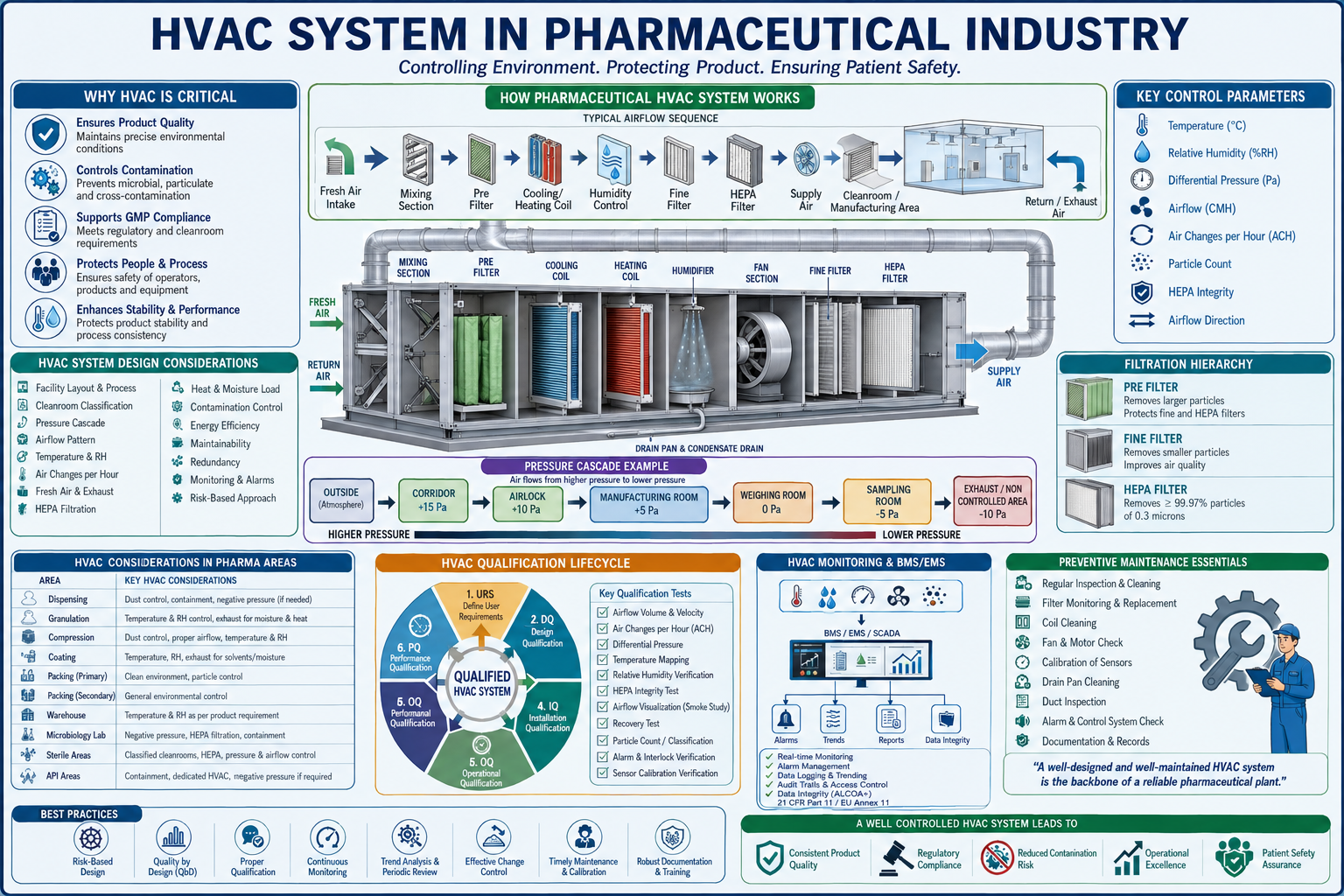
A simplified HVAC airflow sequence can be represented as:
Fresh Air + Return Air → Mixing → Pre-filtration → Cooling/Heating → Humidity Control → Fine Filtration → Fan → Final Filtration/HEPA where applicable → Supply Air → Manufacturing Area → Return/Exhaust
The actual configuration varies considerably.
A typical system may include:
- Fresh-air intake
- Return-air connection
- Mixing box
- Pre-filter
- Fine filter
- Cooling coil
- Heating coil
- Humidification/dehumidification equipment
- Fan
- Supply duct
- Terminal filters
- Supply diffusers
- Return-air grilles
- Exhaust system
- Sensors and transmitters
- BMS/EMS
The HVAC design should be based on the specific environmental and process requirements rather than applying a single configuration to every pharmaceutical area.
Major Functions of a Pharmaceutical HVAC System
A pharmaceutical HVAC system can perform several interconnected functions.
1. Temperature Control
Temperature can affect:
- Product stability
- Powder properties
- Granulation
- Compression
- Coating
- Microbial growth
- Personnel comfort
- Equipment performance
The required temperature range should be established from product and process requirements rather than assuming a universal pharmaceutical value.
2. Relative Humidity Control
Humidity can significantly influence OSD manufacturing.
For example:
- Powders may absorb moisture.
- Granules can change physical properties.
- Tablet compression behavior may change.
- Coating performance may be affected.
- Microbial proliferation can be influenced by environmental conditions.
3. Air Cleanliness
Filtration and controlled airflow help control airborne particulate contamination.
ISO 14644-1 classifies cleanrooms and clean zones based on airborne particle concentration. It does not, by itself, characterize viable microorganisms or other properties of particles.
4. Pressure Control
Pressure differentials help establish controlled airflow between adjacent spaces.
5. Airflow Control
HVAC determines:
- How much air enters an area
- Where air enters
- Where air leaves
- The direction of airflow
- How air is distributed
6. Contamination Control
HVAC is an engineering control that can support the facility’s contamination-control strategy.
Pharmaceutical HVAC System Design
Effective HVAC system design for pharmaceutical industry applications begins with understanding the process.
A good design should consider:
Facility considerations
- Building layout
- Room classification
- Personnel movement
- Material movement
- Product flow
- Waste movement
- Equipment arrangement
- Maintenance access
Process considerations
- Product characteristics
- Dust generation
- Moisture sensitivity
- Temperature sensitivity
- Cross-contamination risk
- Containment requirements
- Process heat load
- Process moisture load
Environmental considerations
- Temperature
- Relative humidity
- Pressure
- Airflow
- Air cleanliness
- Fresh air
- Exhaust
- Filtration
Engineering considerations
- AHU capacity
- Fan selection
- Duct sizing
- Coil capacity
- Filter selection
- Control philosophy
- Instrumentation
- BMS/EMS
- Energy consumption
- Maintainability
- Redundancy where justified
GMP considerations
The design should be supported by:
- URS
- Risk assessment
- Design review
- Qualification strategy
- Approved specifications
- Drawings
- Operating procedures
- Maintenance strategy
Major Components of a Pharmaceutical HVAC System
| Component | Function | Pharmaceutical Application | Key Considerations |
|---|---|---|---|
| AHU | Handles and conditions air | Manufacturing areas | Capacity, hygiene, maintainability |
| Pre-filter | Removes larger particles | Protects downstream filters | Pressure drop, replacement |
| Fine filter | Higher-level particulate filtration | Controlled environments | Efficiency and integrity |
| HEPA filter | High-efficiency particulate filtration | Cleanrooms/critical areas | Integrity, installation, replacement |
| Cooling coil | Removes sensible/latent heat | Temperature/RH control | Capacity, cleanliness |
| Heating coil | Raises air temperature | Environmental control | Capacity and control |
| Humidifier | Adds moisture | Areas requiring humidity control | Hygiene and control |
| Dehumidification system | Removes moisture | Humidity-sensitive processes | Dew point/control |
| Fan | Moves air | Entire HVAC system | Capacity, vibration, efficiency |
| Damper | Controls airflow | Supply/return/exhaust | Position and control |
| Ducting | Transports air | Distribution system | Leakage, cleanliness |
| Diffuser | Distributes supply air | Manufacturing rooms | Air distribution |
| VAV | Variable airflow control | Dynamic systems | Control stability |
| CAV | Constant airflow | Stable applications | Flow balancing |
| Sensors | Measure parameters | HVAC control/monitoring | Calibration |
| DP transmitter | Measures pressure difference | Cleanrooms/airlocks | Accuracy and alarm |
| BMS | Building monitoring/control | Facility management | Security and data |
| EMS | Environmental monitoring | Critical environmental parameters | Alarm/trending |
| PLC/SCADA | Automation/control | Automated HVAC systems | Validation/data integrity |
Air Handling Unit (AHU) in Pharmaceutical HVAC
The Air Handling Unit (AHU) is one of the most important components of a pharmaceutical HVAC system.
An AHU receives air, conditions it and supplies it to the required areas.
A typical AHU may contain:
- Fresh-air section
- Return-air section
- Mixing section
- Pre-filter
- Fine filter
- Cooling coil
- Heating coil
- Humidification/dehumidification arrangement
- Fan
- Instrumentation
- Drain pan
- Condensate drainage
- Access doors
- Insulation
AHU working principle
A simplified sequence is:
Air Intake → Mixing → Filtration → Cooling/Heating → Humidity Adjustment → Fan → Final Filtration → Supply
The exact sequence depends on the HVAC design.
Important AHU design considerations
The AHU should be:
- Hygienically designed
- Accessible for maintenance
- Easy to inspect
- Suitable for cleaning
- Properly insulated
- Protected against unwanted moisture accumulation
- Designed to minimize contamination risks
- Appropriately instrumented
Drain pans and condensate drainage deserve particular attention because standing water can become a potential contamination concern.
HVAC Airflow and Pressure Cascade
Pressure cascade is an important concept in pharmaceutical HVAC.
The basic principle is to establish pressure relationships between rooms so that air moves in the intended direction when doors or openings permit airflow.
A simplified example could be:
Corridor → Airlock → Manufacturing Room
with each area having an appropriately established pressure relationship.
However, the actual pressure strategy depends on:
- Product
- Process
- Containment requirements
- Cross-contamination risk
- Personnel protection
- Facility layout
- Cleanroom classification
- Applicable GMP requirements
Positive-pressure rooms
A room may be maintained at a higher pressure relative to an adjacent area to help reduce ingress of air from the less-controlled area.
Negative-pressure rooms
Negative pressure may be appropriate when containment is a key requirement, for example where hazardous or highly potent materials are handled.
A positive-pressure strategy should therefore not automatically be considered appropriate for every pharmaceutical area.
Airlocks in Pharmaceutical HVAC
Airlocks are controlled spaces positioned between areas with different environmental conditions.
Common examples include:
- Personnel airlocks
- Material airlocks
- Equipment airlocks
- Pass-through arrangements
Airlocks can help manage:
- Personnel movement
- Material movement
- Pressure differentials
- Airflow direction
- Contamination transfer
For sterile manufacturing, the current EU GMP Annex 1 is particularly important; the European Commission states that the revised Annex 1 has been fully applicable since 25 August 2024.
Temperature and Relative Humidity Control
Temperature and RH control is particularly important in OSD manufacturing.
Impact of temperature
Temperature can influence:
- Product stability
- Granulation behavior
- Coating
- Powder characteristics
- Equipment performance
- Personnel comfort
Impact of relative humidity
RH can influence:
- Powder flow
- Electrostatic behavior
- Granule characteristics
- Tablet compression
- Coating
- Microbial growth
- Product stability
Important GMP principle
There is no single universal temperature or RH specification applicable to every pharmaceutical manufacturing room.
Limits should be established based on:
- Product requirements
- Process requirements
- Material characteristics
- Facility design
- Equipment requirements
- Qualification data
- Stability considerations
- Approved specifications
- Applicable regulatory requirements
HEPA Filtration in Pharmaceutical HVAC
HEPA filtration is an important component of many controlled pharmaceutical environments.
What is a HEPA filter?
A High-Efficiency Particulate Air filter is designed to remove very small airborne particles with high efficiency according to its specified performance classification.
HEPA filters can be installed:
- In AHUs
- At terminal supply points
- In cleanroom ceilings
- In air-handling systems
- In specialized containment systems
HEPA filter vs pre-filter vs fine filter
| Filter | Primary Function |
|---|---|
| Pre-filter | Removes larger particles and protects downstream filters |
| Fine filter | Provides additional particulate removal |
| HEPA filter | High-efficiency filtration for controlled/critical applications |
The filtration architecture should be selected based on the required air cleanliness and contamination-control strategy.
HEPA integrity testing
HEPA filters should be appropriately tested for integrity/leakage according to the applicable qualification and testing standard.
Typical activities may include:
- Upstream challenge
- Downstream scanning
- Leak detection
- Filter installation verification
- Documentation of results
A failed HEPA integrity test should trigger an appropriate investigation and corrective action based on the potential impact.
Cleanroom HVAC System
A pharmaceutical cleanroom HVAC system is designed to control environmental conditions within a classified or controlled area.
Key parameters include:
- Airborne particle concentration
- Airflow
- Pressure differential
- Temperature
- Relative humidity
- Filtration
- Airflow pattern
- Recovery characteristics
ISO 14644-1:2015 specifies classification of air cleanliness by airborne particle concentration for cleanrooms and clean zones. It does not classify viable microorganisms.
This distinction is important.
ISO classification ≠ complete pharmaceutical GMP environmental-control strategy.
Pharmaceutical cleanroom requirements may additionally involve:
- Microbiological monitoring
- Process requirements
- Product-specific considerations
- Contamination-control strategy
- Personnel practices
- Cleaning
- Gowning
- Facility design
HVAC System for Different Pharmaceutical Areas
| Area | Important HVAC Considerations |
|---|---|
| Dispensing | Dust control, containment, temperature/RH |
| Granulation | Temperature/RH, dust control, process heat/moisture |
| Compression | Dust management, pressure relationships, temperature/RH |
| Coating | Temperature, RH, exhaust and process heat/moisture |
| Primary packing | Product protection and environmental conditions |
| Secondary packing | General environmental control |
| Warehouse | Product-specific storage conditions |
| Sampling | Controlled environment and contamination prevention |
| Microbiology laboratory | Room-specific containment and environmental requirements |
| QC laboratory | Process-specific environmental control |
| Sterile manufacturing | Classified environment, HEPA filtration, pressure/airflow control |
| API manufacturing | Process-specific containment and environmental control |
| OSD manufacturing | Dust, temperature, RH and cross-contamination control |
These are general considerations. The final HVAC design must be based on the process, product, risk assessment and applicable regulatory requirements.
HVAC Qualification and Validation
HVAC system qualification demonstrates that the installed system is capable of performing as intended.
A typical lifecycle includes:
URS → DQ → FAT/SAT where applicable → IQ → OQ → PQ → Continued Verification/Periodic Review
The exact lifecycle and documentation should follow the site’s validation master plan and applicable regulatory framework.
Qualification stages
| Stage | Objective | Typical Activities | Documentation |
|---|---|---|---|
| URS | Define requirements | User/process requirements | URS |
| DQ | Verify design | Design review against URS | DQ protocol/report |
| FAT | Verify equipment before shipment | Functional/design checks | FAT report |
| SAT | Verify installation at site | Site checks | SAT report |
| IQ | Verify correct installation | Installation verification | IQ protocol/report |
| OQ | Verify operation | Operating-range testing | OQ protocol/report |
| PQ | Demonstrate performance | Performance under defined conditions | PQ protocol/report |
Qualification should be risk-based and supported by documented acceptance criteria.
EU GMP Volume 4 includes Annex 15 on qualification and validation.
HVAC Qualification Tests
Depending on system design and qualification strategy, HVAC testing can include:
1. Airflow volume measurement
Confirms that the required air volume is delivered.
2. Air velocity measurement
Determines airflow velocity at specified locations.
3. Air changes per hour
ACH can be calculated as:
ACH = Total room supply air volume per hour ÷ Room volume
For example, if:
- Room volume = 500 m³
- Supply air = 10,000 m³/hour
Then:
ACH = 10,000 ÷ 500 = 20 air changes/hour
ACH should not be treated as a standalone indicator of cleanroom performance. It must be evaluated together with airflow pattern, contamination control and other applicable requirements.
4. Differential pressure verification
Confirms the pressure relationship between rooms.
5. Temperature verification
Confirms temperature performance against approved specifications.
6. Relative humidity verification
Confirms humidity control.
7. HEPA integrity testing
Confirms filter installation integrity and identifies leaks.
8. Airflow visualization
Smoke studies can help demonstrate whether airflow follows the intended pattern.
9. Recovery testing
Evaluates how quickly a controlled room returns toward its defined clean condition after a disturbance, according to the applicable test methodology.
10. Particle classification
Determines airborne particle concentration for applicable cleanroom classification.
11. Alarm verification
Confirms that critical alarms activate appropriately.
12. Interlock verification
Confirms correct operation of door or equipment interlocks where installed.
13. Airflow direction verification
Confirms that airflow moves according to the design intent.
14. Sensor calibration verification
Ensures monitoring instruments provide reliable measurements.
Airflow Visualization or Smoke Study
Airflow visualization is an important tool for understanding airflow behavior.
A properly designed smoke study can demonstrate:
- Airflow direction
- Turbulence
- Dead zones
- Air stagnation
- Potential ingress
- Potential cross-contamination pathways
- Impact of equipment
- Impact of personnel movement
For sterile applications, airflow visualization has particular significance because airflow patterns can directly support the contamination-control strategy.
The study should have:
- Approved protocol
- Defined test conditions
- Defined locations
- Appropriate smoke source
- Recording/visual evidence
- Acceptance criteria
- Approved report
- Investigation of abnormalities
HVAC Monitoring System: BMS, EMS and SCADA
Modern pharmaceutical HVAC systems frequently use automation and monitoring technologies.
BMS — Building Management System
BMS generally manages building and utility systems such as:
- HVAC
- Chillers
- Pumps
- Fans
- Energy systems
- Alarms
EMS — Environmental Monitoring System
EMS can be used to monitor critical environmental parameters such as:
- Temperature
- RH
- Differential pressure
- Other defined environmental parameters
SCADA
SCADA can provide:
- Monitoring
- Control
- Visualization
- Data logging
- Alarm management
- Trends
The exact architecture varies from facility to facility.
HVAC Data Integrity
When HVAC monitoring systems generate regulated electronic records, computerized-system controls become important.
Areas to consider include:
- User access
- Password management
- Audit trails where applicable
- Data backup
- Data retention
- Time synchronization
- System security
- Change control
- Validation
- Electronic records
- Electronic signatures where applicable
FDA’s Part 11 guidance explains the scope and application of requirements for electronic records and electronic signatures and emphasizes consideration of whether regulated records are maintained electronically.
Therefore, simply installing a BMS or EMS does not automatically make the system GMP compliant. The intended use, electronic records, data flows, controls and risk must be assessed.
HVAC Calibration
Critical HVAC instruments may include:
- Temperature sensors
- RH sensors
- Differential-pressure transmitters
- Pressure gauges
- Airflow instruments
- Particle counters
- Other critical measuring devices
Calibration should provide:
- Traceability
- Defined acceptance criteria
- Approved procedures
- Calibration records
- Identification of instrument status
- Handling of failed calibration
- Impact assessment when necessary
Calibration frequency
There is no universal requirement that every HVAC instrument must be calibrated at one fixed interval.
Frequency should consider:
- Instrument criticality
- Manufacturer recommendation
- Historical performance
- Risk assessment
- Regulatory requirements
- Site procedures
- Failure history
HVAC Preventive Maintenance
Preventive maintenance helps maintain reliable HVAC performance.
| Component | Maintenance Activity | Frequency | Key Checks |
|---|---|---|---|
| AHU | Inspection/cleaning | Site-defined | Internal cleanliness |
| Fan | Inspection | Site-defined | Noise, vibration, bearings |
| Pre-filter | Inspection/replacement | Based on DP/PM program | Pressure drop |
| Fine filter | Inspection/replacement | Site-defined | Differential pressure |
| HEPA filter | Integrity/condition | Qualification/PM strategy | Leakage/integrity |
| Cooling coil | Cleaning | Site-defined | Fouling |
| Heating coil | Inspection | Site-defined | Performance |
| Damper | Functional check | Site-defined | Position/control |
| Ducting | Inspection | Risk-based | Leakage/damage |
| Sensors | Calibration | Calibration program | Accuracy |
| DP transmitter | Calibration | Calibration program | Accuracy |
| Drain pan | Cleaning | Site-defined | Water accumulation |
| BMS/EMS | Functional review | Site-defined | Alarms/data |
Maintenance intervals should be established using equipment criticality, manufacturer recommendations, site experience and historical performance.
HVAC Cleaning
HVAC cleaning should address areas such as:
- AHU interior
- Filters
- Coils
- Drain pans
- Fan sections
- Ducts where required
- Supply/return components
- Accessible surfaces
Cleaning should be documented.
Records may include:
- Date
- Equipment identification
- Area
- Cleaning procedure
- Personnel
- Materials used
- Inspection
- Post-maintenance verification
Following significant maintenance, appropriate verification should be performed before returning the system to normal GMP operation.
Common HVAC Deviations
| Deviation | Possible Cause | Potential Impact | Investigation/CAPA |
|---|---|---|---|
| High temperature | Cooling failure | Product/process impact | Check coil, chiller, controls |
| Low temperature | Control failure | Process impact | Check sensors/control logic |
| High RH | Dehumidification problem | Powder/process impact | Check cooling/dehumidification |
| Low RH | Excessive drying | Product/process impact | Check humidity controls |
| Low DP | Fan/airflow issue | Contamination risk | Check airflow and doors |
| High DP | Excess supply/exhaust imbalance | Process/door issue | Balance system |
| HEPA failure | Filter damage/leak | Cleanroom impact | Integrity test/investigate |
| Low airflow | Fan/filter/duct problem | Environmental impact | Check pressure and fan |
| High airflow | Control malfunction | Process/pressure impact | Check dampers/VFD |
| AHU failure | Mechanical/electrical fault | Environmental excursion | Follow emergency SOP |
| Sensor failure | Instrument fault | Monitoring/control impact | Calibration/replacement |
| BMS alarm | System/control issue | Possible environmental excursion | Investigate alarm |
| Power failure | Electrical interruption | HVAC shutdown | Emergency response |
| Airflow reversal | Pressure imbalance | Contamination risk | Investigate cascade |
HVAC Troubleshooting Guide
Problem 1: High Relative Humidity
Possible causes
- Cooling coil performance problem
- Insufficient dehumidification
- Excessive fresh-air load
- High moisture generation
- Control-system failure
- Sensor error
Immediate action
- Assess product/process impact
- Check current RH trend
- Verify sensor status
- Check AHU operation
- Follow applicable deviation/emergency procedure
Investigation
Review:
- Historical trend
- Coil performance
- AHU condition
- Outdoor conditions
- Fresh-air volume
- Control logic
- Sensor calibration
Problem 2: Low Differential Pressure
Possible causes:
- Fan failure
- Filter blockage
- Door opening
- Damper malfunction
- Exhaust imbalance
- Leakage
- Control failure
Investigation should determine whether the excursion affected adjacent areas or product/process conditions.
Problem 3: Low Airflow
Possible causes include:
- Dirty filter
- Fan problem
- VFD issue
- Damper position
- Duct blockage
- Control failure
The investigation should evaluate both immediate correction and potential impact on qualified conditions.
HVAC GMP Documentation
A robust HVAC documentation package may include:
Design documents
- URS
- Design specifications
- HVAC drawings
- Duct layouts
- Airflow diagrams
- Pressure cascade diagrams
- Equipment specifications
- Control philosophy
Qualification documents
- DQ
- FAT
- SAT
- IQ
- OQ
- PQ
- Qualification reports
- Test records
Operational documents
- SOPs
- Logbooks
- Alarm records
- Environmental monitoring records
- Trend reports
Maintenance documents
- Preventive maintenance records
- Breakdown maintenance
- Filter replacement records
- Calibration records
- Cleaning records
Quality documents
- Deviations
- CAPA
- Change controls
- Risk assessments
- Periodic reviews
- Investigation reports
Documentation is fundamental to GMP because it provides evidence that systems are controlled and operated consistently.
HVAC Change Control
Any significant change to a pharmaceutical HVAC system should be evaluated through the site’s formal change-control process.
Examples include:
- AHU replacement
- Fan replacement
- HEPA filter specification change
- Duct modification
- Room pressure modification
- Airflow modification
- Control logic modification
- Sensor replacement
- BMS/EMS software change
- Room classification change
A change assessment should consider:
Change → Risk Assessment → Impact Assessment → Required Testing → Qualification/Requalification → Documentation → Approval → Implementation
The required qualification should be proportionate to the change and its potential impact.
HVAC Requalification
Requalification may become necessary following:
- Major HVAC modification
- AHU replacement
- Significant duct modification
- Major maintenance
- Facility modification
- Changes affecting airflow
- Changes affecting pressure cascade
- HEPA replacement where required by the qualification strategy
- Significant deviation
- Room classification changes
- Periodic qualification activities
There should not be an assumed universal requalification interval for every pharmaceutical HVAC system.
The frequency and scope should be determined by:
- Applicable regulatory requirements
- Site procedures
- Qualification strategy
- Risk assessment
- System criticality
- Historical performance
- Changes
- Maintenance history
HVAC Audit and Regulatory Inspection
During an inspection or GMP audit, HVAC systems may be evaluated from multiple perspectives.
Engineering
- AHU condition
- Filter condition
- Fan condition
- Ducting
- Controls
- Maintenance
Qualification
- IQ/OQ/PQ status
- Qualification reports
- Acceptance criteria
- Deviations during qualification
- Requalification
Quality
- Deviations
- CAPA
- Change controls
- Risk assessments
- Periodic reviews
Environmental control
- Temperature
- RH
- Differential pressure
- Particle monitoring
- Airflow
Data integrity
- Electronic records
- Access control
- Audit trails where applicable
- Backup
- Data retention
- System validation
Documentation
Auditors may ask questions such as:
“How do you know this room is maintained within its qualified state?”
A strong answer should be supported by:
- Monitoring data
- Qualification
- Calibration
- Maintenance
- Trend analysis
- Change control
- Deviation management
Common HVAC Audit Observations
| Observation | Risk | Likely Root Cause | Corrective/Preventive Action |
|---|---|---|---|
| Qualification overdue | Loss of assurance | Weak planning | Qualification schedule |
| Calibration overdue | Measurement uncertainty | Poor tracking | Automated/controlled calibration system |
| Uninvestigated DP excursion | Contamination risk | Weak deviation system | Investigation/CAPA |
| Poor filter records | Traceability issue | Documentation gap | Controlled filter register |
| Missing trend review | Drift not identified | Weak monitoring | Periodic trend review |
| Inadequate PM | Equipment failure | Poor maintenance strategy | Risk-based PM |
| Uncontrolled BMS access | Data-integrity risk | Access weakness | Role-based access |
| Unassessed HVAC change | Qualification risk | Weak change control | Formal impact assessment |
| Inadequate smoke study documentation | Airflow assurance gap | Weak protocol/report | Controlled visualization study |
| Repeated HVAC alarms | System reliability issue | Root cause not addressed | Trend + CAPA |
These are illustrative examples, not claims about findings from a particular regulator.
HVAC Risk Management
HVAC risk management should focus on parameters that can affect product quality, contamination control and patient safety.
A typical FMEA may consider:
Failure Mode → Cause → Effect → Severity → Occurrence → Detectability → Risk Priority → Control
Example HVAC FMEA
| Failure Mode | Cause | Effect | Risk | Control |
|---|---|---|---|---|
| High RH | Dehumidification failure | Powder/process impact | High | RH monitoring/alarm |
| Low DP | Fan failure | Airflow contamination risk | High | DP monitoring |
| HEPA leak | Filter damage | Particle contamination | High | Integrity testing |
| Sensor failure | Calibration drift | Incorrect monitoring | Medium/High | Calibration |
| AHU failure | Electrical fault | Environmental excursion | High | Alarm/emergency procedure |
The exact risk ranking should be based on the site’s approved methodology.
HVAC Energy Efficiency and Sustainability
HVAC systems can consume significant energy in pharmaceutical facilities.
Energy-saving approaches may include:
- Variable-frequency drives
- Efficient fans
- Optimized control strategies
- Appropriate HVAC zoning
- Heat recovery where suitable
- Energy monitoring
- Efficient motors
- Preventive maintenance
- BMS optimization
- Appropriate air volume control
However:
Energy efficiency must never compromise validated GMP conditions or contamination control.
Reducing airflow or environmental controls simply to reduce energy consumption can be unacceptable if it compromises product or process requirements.
The correct approach is to optimize the system while maintaining its required qualified state.
Pharma 4.0 and Smart HVAC
The next generation of pharma HVAC systems is increasingly connected to digital technologies.
IoT sensors
Connected sensors can provide continuous information on:
- Temperature
- RH
- Pressure
- Equipment status
- Energy consumption
Predictive maintenance
Historical data can help identify:
- Fan deterioration
- Increasing filter pressure drop
- Abnormal vibration
- Cooling performance degradation
AI-based optimization
AI and advanced analytics may help identify:
- Energy inefficiencies
- Abnormal trends
- Equipment degradation
- Recurring alarms
- Potential failures
AI should be implemented within an appropriately controlled computerized-system framework where its outputs influence GMP decisions.
Digital twins
A digital representation of the HVAC system can potentially help engineers simulate:
- Airflow
- Energy consumption
- Equipment performance
- Pressure relationships
- Failure scenarios
Smart alarm management
Instead of simply generating hundreds of alarms, intelligent systems can prioritize:
- Critical alarms
- Persistent alarms
- Recurring alarms
- Alarm patterns
This can improve maintenance effectiveness.
Fictional Case Study: High RH in a Tablet Manufacturing Area
Note: This is an illustrative fictional case study and does not represent an actual pharmaceutical facility.
Problem
A tablet compression area experienced repeated high-RH alarms during production.
Initial observation
The approved operating limit was exceeded for a defined period.
Immediate actions
The team:
- Assessed product/process impact.
- Checked RH sensor status.
- Reviewed HVAC trends.
- Verified AHU operation.
- Checked cooling-coil performance.
- Opened a deviation according to site procedure.
Investigation
The investigation found:
- Increasing AHU supply-air temperature
- Reduced cooling performance
- Higher coil approach temperature
- Increased filter differential pressure
- No evidence of sensor failure
Root cause
The investigation identified degradation in HVAC cooling performance associated with reduced heat-transfer efficiency and inadequate maintenance.
CAPA
Corrective action
- Restore cooling performance
- Clean/inspect the affected components
- Verify RH control
Preventive action
- Review preventive-maintenance frequency
- Introduce trend-based monitoring
- Establish an early-warning indicator
- Train engineering personnel
Verification
The team performed:
- Temperature verification
- RH verification
- Trend review
- Appropriate HVAC performance checks
Lesson learned
A single HVAC alarm is an event.
Repeated alarms are a trend and should trigger deeper investigation.
Practical HVAC Checklist for Pharmaceutical Facilities
Use the following checklist during routine HVAC review:
Environmental parameters
- ☐ Temperature
- ☐ Relative humidity
- ☐ Differential pressure
- ☐ Airflow
- ☐ Air changes
- ☐ Particle monitoring where applicable
Filtration
- ☐ Pre-filter condition
- ☐ Fine-filter condition
- ☐ HEPA integrity
- ☐ Filter differential pressure
- ☐ Filter replacement records
AHU
- ☐ Fan condition
- ☐ Cooling coil
- ☐ Heating coil
- ☐ Drain pan
- ☐ Condensate drainage
- ☐ Internal cleanliness
- ☐ Dampers
- ☐ VFD/control system
Monitoring
- ☐ BMS/EMS alarms
- ☐ Trends
- ☐ Sensor calibration
- ☐ Data backup
- ☐ Access control
- ☐ Audit trail where applicable
Quality
- ☐ Qualification status
- ☐ Deviations
- ☐ CAPA
- ☐ Change controls
- ☐ Risk assessments
- ☐ Requalification
Maintenance
- ☐ Preventive maintenance
- ☐ Breakdown maintenance
- ☐ Cleaning
- ☐ Calibration
- ☐ Filter replacement
Documentation
- ☐ SOPs
- ☐ Logbooks
- ☐ Qualification reports
- ☐ Calibration certificates
- ☐ PM records
- ☐ Environmental records
- ☐ Trend reports
- ☐ Training records
Career Opportunities in Pharmaceutical HVAC
Pharmaceutical HVAC knowledge creates opportunities across engineering, validation, facility management and quality functions.
1. HVAC Engineer
Typical responsibilities include:
- HVAC operation
- Troubleshooting
- Maintenance
- Air balancing
- Energy management
2. Utility Engineer
May manage:
- HVAC
- Chillers
- Compressed air
- Steam
- Water systems
3. Validation Engineer
Responsibilities may include:
- DQ
- IQ
- OQ
- PQ
- Qualification protocols
- Test execution
- Reports
4. Facility Engineer
May manage:
- HVAC
- Building systems
- Utilities
- Facility maintenance
5. QA Validation Professional
Focus areas can include:
- Qualification review
- Validation compliance
- Change control
- Deviations
- CAPA
6. Engineering Manager
May be responsible for:
- HVAC
- Utilities
- Projects
- Maintenance
- Compliance
- Engineering teams
Important skills
Professionals working with pharmaceutical HVAC should understand:
- GMP
- HVAC fundamentals
- AHUs
- Cleanrooms
- HEPA filtration
- Pressure cascade
- Temperature/RH
- Qualification
- Validation
- Calibration
- Risk management
- CAPA
- Change control
- BMS/EMS
- Data integrity
- Energy management
Pharmaceutical HVAC Interview Questions and Answers
1. What is HVAC?
HVAC stands for Heating, Ventilation and Air Conditioning. In pharmaceutical manufacturing, it controls environmental conditions such as temperature, humidity, airflow, pressure and air cleanliness.
2. Why is HVAC important in pharma?
Because environmental conditions can affect product quality, contamination control, process performance and GMP compliance.
3. What is an AHU?
An Air Handling Unit conditions and distributes air to designated areas.
4. What is a HEPA filter?
A high-efficiency particulate filter used where high levels of airborne particulate control are required.
5. What is differential pressure?
It is the pressure difference between two spaces. It can be used to establish controlled airflow direction between adjacent areas.
6. What is pressure cascade?
A planned sequence of pressure relationships between rooms designed to control airflow direction.
7. What is HVAC qualification?
Documented evidence demonstrating that the HVAC system is installed and operates and performs according to predefined requirements.
8. What is IQ?
Installation Qualification verifies that equipment and associated components are installed according to approved specifications.
9. What is OQ?
Operational Qualification verifies that the system operates as intended across specified operating ranges.
10. What is PQ?
Performance Qualification demonstrates that the system consistently performs effectively under defined operating conditions.
11. What is an air-change rate?
It expresses how many equivalent room-volume air replacements occur per hour based on the specified airflow and room volume.
12. Why is RH important in tablet manufacturing?
Humidity can influence powder properties, granulation, compression, coating and product stability.
13. What is an airflow visualization study?
It is a study used to visualize airflow patterns and assess whether airflow behaves as intended.
14. What is HVAC requalification?
Requalification provides documented evidence that a previously qualified system continues to meet applicable requirements following defined intervals, changes or events as determined by the qualification strategy.
15. What is BMS?
A Building Management System monitors and/or controls building systems such as HVAC.
16. What is EMS?
An Environmental Monitoring System is used to monitor defined environmental parameters and manage associated alarms/data according to its intended use.
17. What can cause low differential pressure?
Possible causes include fan failure, filter problems, damper malfunction, door opening, leakage or an imbalance between supply and exhaust.
18. Why are HEPA filters integrity-tested?
To verify that the installed filter and its sealing arrangement do not have unacceptable leakage.
19. How should HVAC changes be managed?
Through formal change control, including impact assessment, risk assessment and qualification/requalification where required.
20. What is the most important principle in pharmaceutical HVAC?
The HVAC system should consistently maintain the environmental conditions required by the product, process and contamination-control strategy and remain in a controlled, qualified state.
Frequently Asked Questions
What is an HVAC system in the pharmaceutical industry?
An HVAC system in pharmaceutical industry applications controls temperature, humidity, airflow, air cleanliness, pressure and ventilation to maintain suitable manufacturing conditions.
Why is HVAC important in pharmaceutical manufacturing?
HVAC helps control environmental conditions and contamination risks that can affect product quality and manufacturing processes.
What are the main components of a pharma HVAC system?
Major components can include AHUs, fans, filters, HEPA filters, cooling/heating coils, ducts, dampers, diffusers, sensors, control systems and monitoring systems.
What is AHU in pharmaceutical HVAC?
AHU means Air Handling Unit. It receives, filters, conditions and distributes air to designated areas.
What is the role of HEPA filters?
HEPA filters provide high-efficiency particulate filtration where required by the facility’s contamination-control and air-cleanliness strategy.
What is differential pressure in a cleanroom?
Differential pressure is the pressure difference between two areas and can be used to help control the direction of airflow.
What is HVAC qualification?
HVAC qualification is documented verification that the HVAC system has been appropriately installed and operates and performs according to predefined requirements.
What are DQ, IQ, OQ and PQ?
They are Design Qualification, Installation Qualification, Operational Qualification and Performance Qualification.
What tests are performed during HVAC qualification?
Depending on the system, tests can include airflow, pressure differential, temperature, RH, HEPA integrity, airflow visualization, recovery, particle classification, alarms and interlocks.
How are temperature and humidity controlled?
Through combinations of cooling, heating, humidification, dehumidification, airflow control and automated control systems.
How often should HVAC systems be requalified?
There is no single universal interval applicable to every system. Frequency and scope should be established using applicable requirements, qualification strategy, risk assessment, system criticality, changes and historical performance.
What are common HVAC deviations?
Common examples include high/low temperature, high/low RH, abnormal differential pressure, low airflow, HEPA leakage, AHU failure and sensor failure.
What is the difference between BMS and EMS?
BMS generally focuses on building and utility system monitoring/control, while EMS is commonly used for defined environmental monitoring. The actual scope depends on facility architecture and intended use.
What is airflow visualization?
Airflow visualization is a study that makes airflow patterns visible so that direction, turbulence and potential undesirable airflow behavior can be evaluated.
What are common HVAC audit observations?
Examples include overdue calibration, incomplete qualification, inadequate maintenance records, unresolved alarms, weak trend review, uncontrolled changes and inadequate documentation.
Regulatory and Standards Perspective
HVAC requirements should never be interpreted from a single document in isolation.
For non-sterile pharmaceutical HVAC, WHO has dedicated guidance addressing HVAC design and GMP considerations.
For cleanroom particle classification, ISO 14644-1:2015 remains the relevant ISO classification standard listed by ISO; it classifies airborne cleanliness by particle concentration and should not be confused with a complete pharmaceutical GMP classification system.
For EU GMP, EudraLex Volume 4 includes requirements covering premises and equipment, qualification and validation, computerized systems and sterile manufacturing. The European Commission currently lists Annex 1 for sterile medicinal products as fully applicable since 25 August 2024 and Annex 15 for qualification and validation.
For electronic HVAC records and computerized monitoring systems used within applicable FDA-regulated contexts, 21 CFR Part 11 should be assessed according to the nature and intended use of the electronic records and signatures.
Important distinction
A pharmaceutical facility should distinguish between:
Regulatory requirement
A requirement established by applicable law/regulation or regulatory guidance.
Industry standard
A recognized technical standard such as ISO 14644.
Engineering practice
A technically appropriate design or operating approach.
Site requirement
A requirement established through URS, risk assessment, process knowledge, qualification and approved procedures.
This distinction prevents the common mistake of presenting an engineering practice as a universal GMP requirement.
Suggested Original Visuals for This Article
1. Pharmaceutical HVAC System Flow Diagram
Format: Landscape
ALT: Pharmaceutical HVAC system flow diagram showing AHU, filtration, cooling, HEPA and cleanroom airflow
2. AHU Schematic
ALT: Air handling unit schematic for pharmaceutical HVAC showing filters, cooling coil, fan and supply air
3. Pressure Cascade Diagram
ALT: Pharmaceutical cleanroom HVAC pressure cascade showing corridor, airlock and manufacturing room
4. Cleanroom Airflow Diagram
ALT: Pharmaceutical cleanroom HVAC airflow pattern showing supply, HEPA filtration and return air
5. HEPA Filtration Diagram
ALT: HEPA filter arrangement in pharmaceutical HVAC system for cleanroom air filtration
6. HVAC Qualification Lifecycle
ALT: HVAC qualification lifecycle showing URS, DQ, FAT, SAT, IQ, OQ and PQ
7. HVAC Monitoring Architecture
ALT: Pharmaceutical HVAC monitoring architecture showing sensors, BMS, EMS and SCADA
8. HVAC Troubleshooting Flowchart
ALT: Pharmaceutical HVAC troubleshooting flowchart for temperature, humidity, airflow and pressure deviations
Suggested Internal Linking Strategy for Pharma Manufacturing Hub
Use contextual internal links rather than forcing keywords.
| Article Topic | Suggested Anchor Text | Suggested Placement |
|---|---|---|
| GMP | pharmaceutical GMP principles | Introduction |
| Cleanroom | pharmaceutical cleanroom | Cleanroom section |
| Qualification | equipment qualification in pharma | Qualification section |
| Validation | pharmaceutical validation | Qualification section |
| CAPA | CAPA in pharmaceutical industry | Deviations |
| FMEA | FMEA in pharmaceutical manufacturing | Risk Management |
| Root Cause Analysis | root cause analysis in pharma | Deviations |
| OSD Manufacturing | oral solid dosage manufacturing | HVAC applications |
| Data Integrity | pharmaceutical data integrity | BMS/EMS |
| CSV | computer system validation | Monitoring |
| Environmental Monitoring | pharmaceutical environmental monitoring | Cleanroom section |
| Pharmaceutical Utilities | pharmaceutical utility systems | HVAC design |
Use the actual URLs of your existing Pharma Manufacturing Hub articles rather than creating URLs that do not yet exist.
Conclusion
A properly designed and controlled HVAC system in pharmaceutical industry operations is an essential part of maintaining a suitable manufacturing environment. Its role extends far beyond heating and cooling: it supports control of temperature, humidity, airflow, pressure, airborne contamination and environmental conditions.
For pharmaceutical facilities, HVAC performance should be managed throughout its lifecycle:
URS → Design → Qualification → Operation → Monitoring → Maintenance → Change Control → Requalification → Continuous Improvement
The most effective HVAC strategy combines sound engineering with GMP principles, risk management and reliable documentation.
For OSD manufacturing, particular attention should be given to temperature, humidity, dust control, airflow and cross-contamination prevention. For sterile manufacturing, the contamination-control strategy becomes even more stringent, with cleanroom classification, HEPA filtration, pressure relationships, airflow visualization and environmental/process monitoring playing important roles.
The objective should not be to design the most complicated HVAC system. It should be to design a fit-for-purpose, maintainable, controllable and qualified system that consistently protects product and process quality.
As pharmaceutical manufacturing moves toward Pharma 4.0, HVAC systems are also becoming increasingly connected through sensors, BMS/EMS platforms, advanced analytics, predictive maintenance and potentially AI-assisted optimization. The challenge will be to achieve these benefits while maintaining validated controls, data integrity and GMP compliance.
Ultimately, a pharmaceutical HVAC system is not merely an engineering utility—it is a critical component of the pharmaceutical manufacturing control strategy.
Author’s Note
About the Author:
Ramesh Palav — Pharmaceutical manufacturing professional and technical content creator with extensive experience in pharmaceutical manufacturing, qualification, validation, GMP compliance, quality systems, OSD manufacturing and continuous improvement.
Authoritative References
- WHO — GMP guidelines for HVAC systems for non-sterile pharmaceutical products
- WHO — Guidelines on HVAC systems for non-sterile pharmaceutical products
- ISO — ISO 14644-1 Cleanrooms and associated controlled environments
- European Commission — EudraLex Volume 4 GMP Guidelines
- FDA — Part 11 Electronic Records and Electronic Signatures
- WHO — Quality Assurance of Pharmaceuticals, GMP Compendium, 10th Edition
Editorial note: Regulatory requirements can differ according to product type, market, facility design and intended use. This article should be used as an educational technical reference, not as a substitute for applicable regulations, approved site procedures, qualification protocols or regulatory advice.