Gas Chromatography (GC) is one of the most important analytical techniques used in pharmaceutical manufacturing and quality control laboratories for the separation, identification, and quantitative determination of volatile and semi-volatile compounds. GC is particularly important for residual solvent testing, impurity analysis, raw material testing, stability studies, and process control.
In pharmaceutical manufacturing, controlling residual solvents is essential because certain organic solvents used during synthesis, extraction, granulation, coating, and cleaning processes can remain in pharmaceutical materials. Excessive levels may affect product safety, quality, stability, and regulatory compliance. GC provides highly sensitive and selective analysis and is therefore widely used to demonstrate compliance with applicable pharmacopeial and ICH requirements.
What is Gas Chromatography?
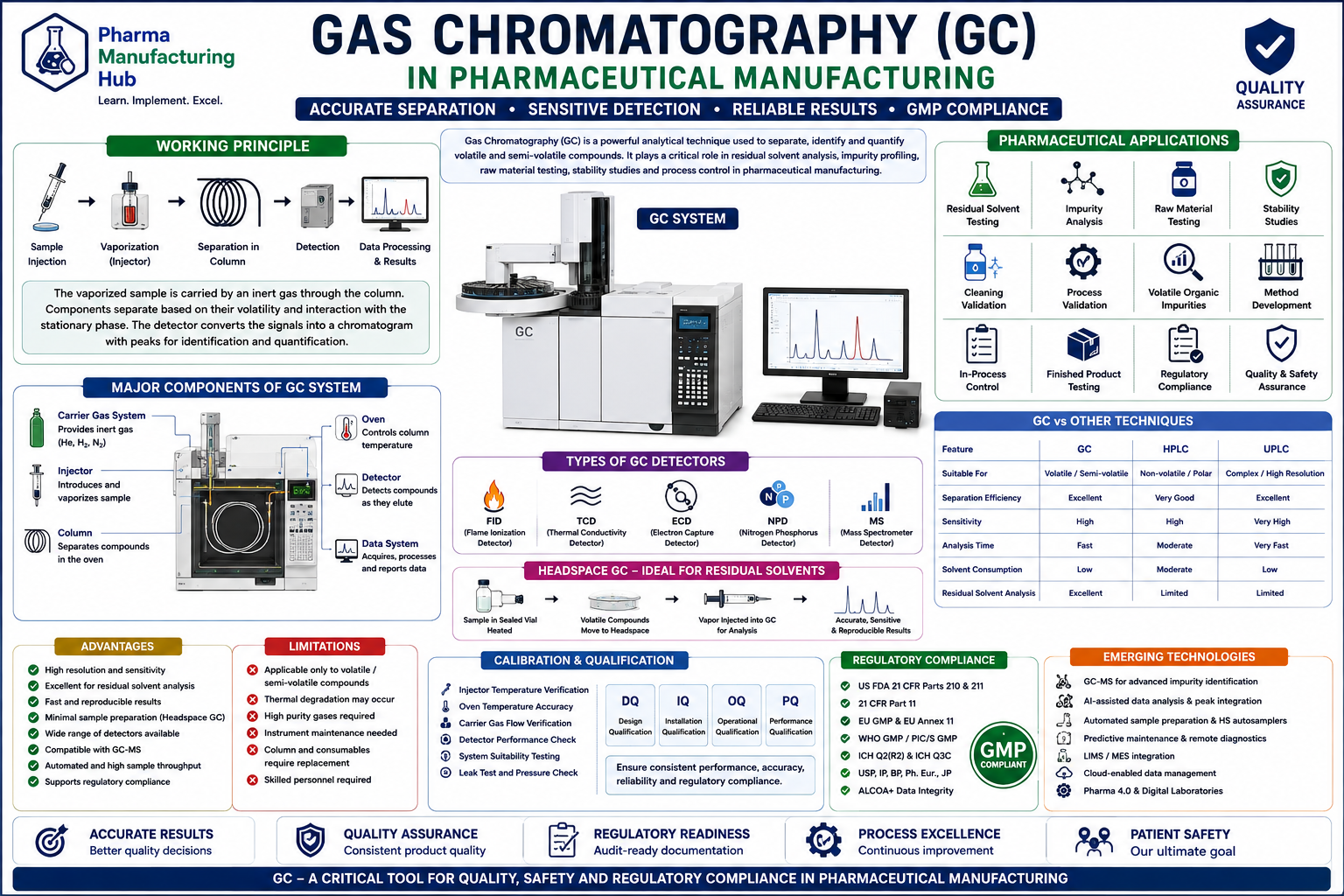
Gas Chromatography is a chromatographic technique in which a volatile sample is vaporized and transported through a chromatographic column by an inert carrier gas. Components of the sample separate according to their interaction with the stationary phase inside the column and their volatility.
The separated compounds reach the detector at different times. These times are called retention times and can be used for identification. The detector response, generally represented by peak area, is used for quantitative analysis.
A typical GC system consists of:
- Carrier gas system
- Gas purification system
- Injector
- Chromatographic column
- Oven
- Detector
- Data acquisition system
- Chromatography software
Working Principle of GC
The GC analytical process begins with preparation of the sample and carrier gas.
The carrier gas, commonly helium, hydrogen, or nitrogen, transports the vaporized sample through the chromatographic column.
The basic workflow is:
Sample Injection → Vaporization → Separation → Detection → Data Processing → Result
The sample is introduced into the heated injector where it vaporizes. The carrier gas carries the vapor through the column. Different components interact differently with the stationary phase and therefore travel through the column at different rates.
When compounds exit the column, the detector generates electrical signals. The chromatography data system converts these signals into a chromatogram containing individual peaks.
Retention time helps identify compounds, while peak area or peak height is used for quantification.
Major Components of a GC System
1. Carrier Gas System
The carrier gas transports the sample through the column.
Common gases include:
- Helium
- Hydrogen
- Nitrogen
High-purity gases and appropriate gas purification systems are essential for reliable pharmaceutical analysis.
2. Injector
The injector introduces and vaporizes the sample.
Common configurations include:
- Split injection
- Splitless injection
- Headspace injection
- Direct injection
For pharmaceutical residual solvent analysis, headspace GC is particularly important because it minimizes direct introduction of non-volatile matrix components into the chromatographic system.
3. Chromatographic Column
The column is responsible for separating sample components.
Common column types include:
- Capillary columns
- Packed columns
Modern pharmaceutical laboratories predominantly use capillary columns because they provide excellent resolution and sensitivity.
4. Oven
The GC oven controls column temperature.
It may operate under:
- Isothermal conditions
- Temperature-programmed conditions
Accurate temperature control is essential for reproducible retention times and chromatographic separation.
5. Detector
Common GC detectors include:
- Flame Ionization Detector (FID)
- Thermal Conductivity Detector (TCD)
- Electron Capture Detector (ECD)
- Nitrogen-Phosphorus Detector (NPD)
- Mass Spectrometric Detector (MS)
FID is widely used for many organic compounds, while GC-MS provides substantially greater identification capability and selectivity.
Pharmaceutical Applications of GC
GC has a particularly important role in pharmaceutical quality control.
Residual Solvent Testing
One of the most important applications is determining residual solvents in:
- APIs
- Excipients
- Drug substances
- Drug products
- Intermediates
Residual solvent testing supports compliance with ICH Q3C and applicable pharmacopoeial requirements.
Raw Material Testing
GC can be used to identify and quantify volatile components in incoming raw materials.
Impurity Analysis
GC can detect volatile and semi-volatile impurities generated during:
- API synthesis
- Manufacturing
- Storage
- Degradation
Stability Studies
GC can help monitor changes in volatile impurities and degradation products during stability studies.
Cleaning Validation
Where appropriate, GC can be used to detect volatile organic residues associated with manufacturing or cleaning processes.
Process Validation
GC results can support demonstration of consistent control of residual solvents and other volatile process-related substances.
Headspace GC in Pharmaceutical Manufacturing
Headspace Gas Chromatography (HS-GC) is one of the most widely used GC techniques in pharmaceutical laboratories for residual solvent analysis.
Instead of injecting the entire sample directly into the GC, the sample is placed in a sealed vial and heated. Volatile compounds migrate from the sample into the gas phase above the sample, known as the headspace.
A portion of this vapor is then injected into the GC.
Advantages include:
- Reduced matrix interference
- Improved column life
- Cleaner injections
- Excellent repeatability
- High sensitivity for volatile compounds
- Ideal for residual solvent analysis
Major GC Manufacturers and Platforms
Leading manufacturers of pharmaceutical GC systems include:
- Agilent Technologies
- Shimadzu
- Thermo Fisher Scientific
- PerkinElmer
- JEOL
- SCION Instruments
Representative platforms include Agilent 8890 GC systems, Shimadzu Nexis GC-2030 systems, and Thermo Scientific TRACE series instruments. Model selection should always be based on current manufacturer specifications, validated analytical requirements, detector requirements, software compliance, service availability, and regulatory expectations.
Calibration and Qualification
Reliable GC performance requires regular calibration and qualification.
Important performance checks include:
- Injector temperature verification
- Oven temperature accuracy
- Detector performance
- Carrier gas flow verification
- Injection precision
- Retention time repeatability
- Detector response
- System pressure
- Leak testing
A pharmaceutical GC system may undergo:
DQ → IQ → OQ → PQ
where:
- DQ: Design Qualification
- IQ: Installation Qualification
- OQ: Operational Qualification
- PQ: Performance Qualification
Routine System Suitability Testing (SST) confirms that the chromatographic system remains suitable for the intended analytical method.
GC Method Validation
GC analytical procedures should be appropriately validated in accordance with applicable regulatory requirements and ICH Q2(R2) principles.
Typical validation characteristics include:
- Specificity
- Accuracy
- Precision
- Repeatability
- Intermediate precision
- Linearity
- Range
- Limit of Detection (LOD)
- Limit of Quantitation (LOQ)
- Robustness
- System suitability
For residual solvent methods, particular attention should be given to low-level detection, specificity, carryover, and matrix effects.
GMP and Data Integrity
GC systems used in regulated pharmaceutical laboratories should support appropriate data integrity controls.
Important requirements include:
- Unique user accounts
- Role-based access
- Secure electronic records
- Audit trails
- Electronic signatures where applicable
- Controlled methods
- Data backup
- Result traceability
- Chromatographic raw-data retention
Compliance may involve:
- US FDA 21 CFR Parts 210 & 211
- 21 CFR Part 11
- EU GMP
- EU Annex 11
- WHO GMP
- PIC/S GMP
- ICH Q2(R2)
- ICH Q3C
- USP
- IP
- BP
- Ph. Eur.
- JP
The overall data lifecycle should support ALCOA+ data integrity principles.
Advantages of GC
GC provides:
- Excellent separation efficiency
- High sensitivity
- Excellent reproducibility
- Accurate quantification
- High selectivity
- Rapid analysis
- Excellent residual solvent capability
- Automated sample processing
- Headspace analysis capability
- GC-MS compatibility
- Integration with laboratory data systems
Limitations
GC is not suitable for every pharmaceutical compound.
Important limitations include:
- Samples must generally be volatile or capable of being derivatized.
- Thermally unstable compounds may degrade during injection.
- High-purity gases are required.
- Columns require maintenance and periodic replacement.
- Injector liners and septa are consumable components.
- Skilled analysts are required for troubleshooting and method development.
Emerging Technologies
Modern GC systems are increasingly incorporating automation, AI, machine learning, advanced chromatography software, and Pharma 4.0 connectivity.
Emerging capabilities include:
- Automated method optimization
- AI-assisted chromatogram review
- Automated peak integration
- Predictive maintenance
- Instrument health monitoring
- Remote diagnostics
- Automated system suitability evaluation
- LIMS integration
- Electronic laboratory workflows
- Cloud-enabled data management
GC-MS and high-resolution mass spectrometry further expand the ability to identify unknown impurities and degradation products.
Conclusion
Gas Chromatography (GC) is an essential analytical instrument in pharmaceutical manufacturing, particularly for residual solvent testing, volatile impurity analysis, raw material characterization, stability studies, and process monitoring. Its excellent separation capability, sensitivity, reproducibility, and compatibility with headspace sampling make it a critical technology for pharmaceutical quality control laboratories.
A reliable GC program requires more than simply purchasing a high-performance instrument. Pharmaceutical organizations must establish scientifically sound analytical methods, appropriate calibration and qualification programs, validated procedures, trained analysts, preventive maintenance, system suitability testing, and robust data integrity controls.
With the development of headspace automation, GC-MS, AI-assisted data analysis, predictive maintenance, LIMS integration, and Pharma 4.0 technologies, GC is evolving into a highly connected analytical platform. Its continued application will remain essential for ensuring that pharmaceutical products meet stringent quality, safety, and regulatory requirements throughout the product lifecycle.
For pharmaceutical professionals, QC analysts, validation engineers, analytical scientists, production teams, auditors, and students, understanding the working principle, components, applications, validation, calibration, GMP requirements, and emerging technologies of GC is essential for achieving analytical excellence and maintaining a robust pharmaceutical quality system.