High-Performance Liquid Chromatography (HPLC) is one of the most important analytical techniques used in the pharmaceutical industry. It plays a critical role in ensuring the quality, safety, efficacy, and regulatory compliance of pharmaceutical products. From raw material testing to finished product analysis, HPLC is considered the gold standard for quantitative and qualitative analysis of Active Pharmaceutical Ingredients (APIs), impurities, degradation products, preservatives, and dissolution samples.
Unlike simple analytical techniques, HPLC can separate, identify, and accurately quantify multiple compounds present in a complex pharmaceutical sample. Its exceptional sensitivity, precision, and reproducibility make it indispensable in pharmaceutical research, quality control (QC), quality assurance (QA), process validation, stability studies, cleaning validation, and regulatory submissions.
What is HPLC?
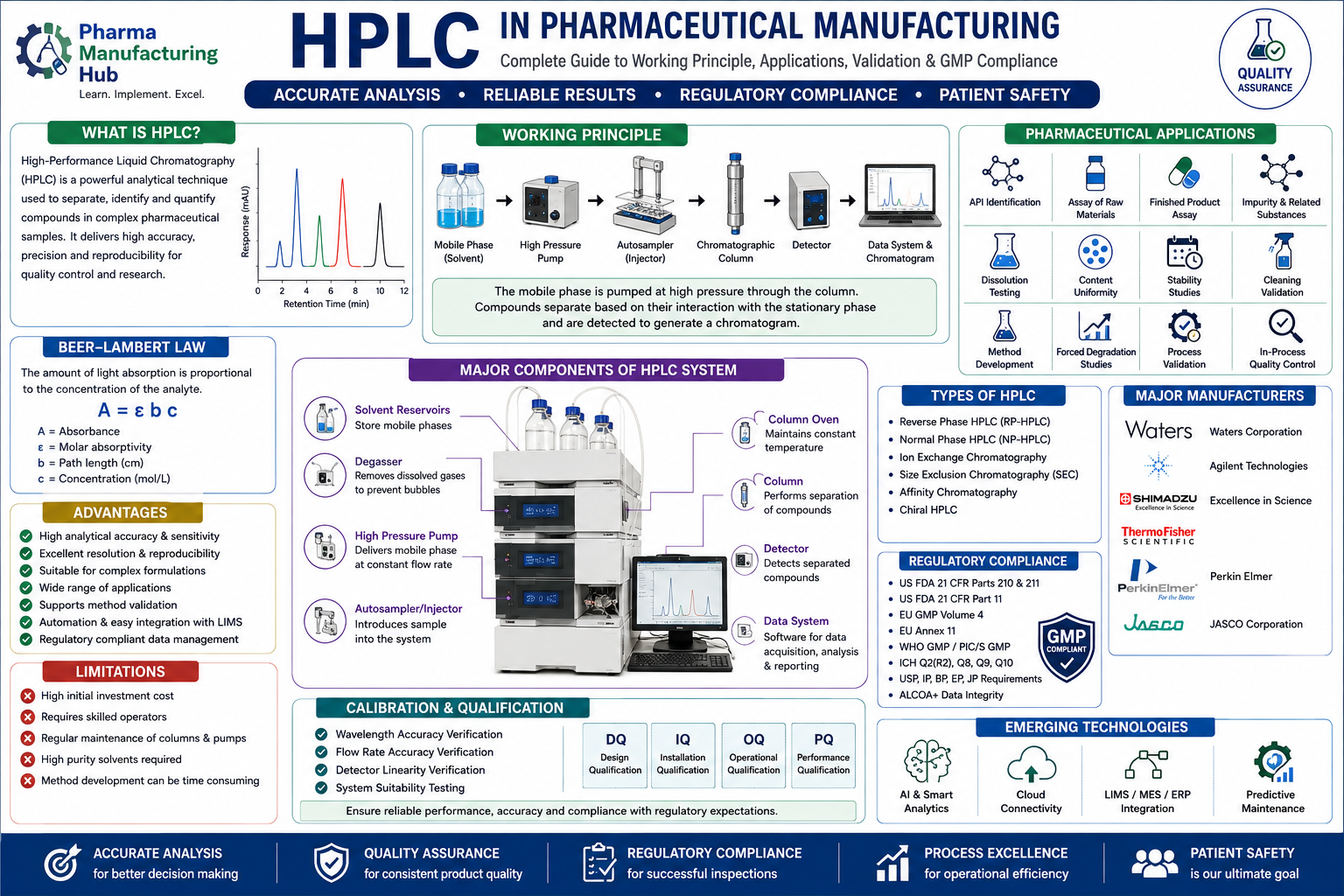
High-Performance Liquid Chromatography (HPLC) is an advanced chromatographic technique that separates compounds based on their interaction with a stationary phase packed inside a chromatographic column and a mobile phase pumped through the column under high pressure.
Different compounds travel through the column at different rates depending on their chemical properties, producing individual peaks on a chromatogram. These peaks are used to identify compounds by retention time and quantify them by peak area or peak height.
Modern HPLC systems provide high-resolution separation, automated sample analysis, electronic data management, and regulatory-compliant reporting, making them one of the most widely used analytical instruments in GMP-regulated laboratories.
Working Principle
The HPLC process consists of several sequential steps:
- The mobile phase (solvent) is prepared, filtered, and degassed.
- A high-pressure pump delivers the mobile phase through the system at a constant flow rate.
- An autosampler or manual injector introduces the sample into the mobile phase.
- The sample enters the chromatographic column containing the stationary phase.
- Components separate according to their polarity, molecular size, or chemical interaction with the stationary phase.
- As each component exits the column, it passes through a detector, such as a UV detector, Photodiode Array (PDA), Fluorescence Detector (FLD), or Refractive Index (RI) detector.
- The detector converts the signal into a chromatogram, and chromatography software calculates retention time, peak area, peak height, and analyte concentration.
The technique is based on chromatographic separation principles and delivers accurate, reproducible analytical results suitable for routine quality control and advanced research.
Major Components of an HPLC System
A typical pharmaceutical HPLC system consists of the following components:
- Solvent Reservoirs: Store mobile phases.
- Degasser: Removes dissolved gases to prevent bubble formation.
- High-Pressure Pump: Delivers mobile phase at a constant flow rate.
- Autosampler/Injector: Introduces the sample into the system.
- Chromatographic Column: Performs compound separation.
- Column Oven: Maintains consistent temperature for improved reproducibility.
- Detector: Detects separated compounds.
- Data Acquisition Software: Processes chromatograms and generates reports.
Each component contributes to accurate separation, reliable quantification, and regulatory-compliant documentation.
Types of HPLC
Several HPLC techniques are used depending on analytical requirements:
- Reverse Phase HPLC (RP-HPLC)
- Normal Phase HPLC (NP-HPLC)
- Ion Exchange Chromatography
- Size Exclusion Chromatography (SEC)
- Affinity Chromatography
- Chiral HPLC
Among these, Reverse Phase HPLC is the most commonly used method in pharmaceutical analysis because it is suitable for a wide range of APIs and finished dosage forms.
Pharmaceutical Applications
HPLC is extensively used throughout the pharmaceutical product lifecycle.
Common applications include:
- API identification
- Assay of raw materials
- Finished product assay
- Related substances and impurity profiling
- Dissolution testing
- Content uniformity
- Stability studies
- Forced degradation studies
- Cleaning validation
- Residual solvent analysis (with appropriate methods)
- Process validation
- Method development
- Method validation
- Technology transfer
- In-process quality control (IPQC)
Because of its versatility, HPLC supports both routine laboratory testing and advanced pharmaceutical research.
Major Manufacturers
Leading manufacturers of pharmaceutical HPLC systems include:
- Waters Corporation
- Agilent Technologies
- Shimadzu
- Thermo Fisher Scientific
- PerkinElmer
- Hitachi High-Tech
- JASCO
- KNAUER
- Bio-Rad Laboratories
These companies offer systems ranging from routine QC instruments to advanced UHPLC/HPLC platforms with integrated compliance software.
Calibration and Qualification
Reliable HPLC performance depends on regular calibration, qualification, and system suitability testing.
Routine verification includes:
- Pump flow rate accuracy
- Injector precision
- Detector wavelength accuracy
- Detector linearity
- Column oven temperature verification
- System pressure verification
- Leak testing
Pharmaceutical laboratories also perform:
- Design Qualification (DQ)
- Installation Qualification (IQ)
- Operational Qualification (OQ)
- Performance Qualification (PQ)
Before routine sample analysis, System Suitability Testing (SST) verifies that the chromatographic system performs according to validated method requirements.
Method Validation
Analytical methods developed using HPLC should be validated according to ICH Q2(R2) guidelines.
Typical validation parameters include:
- Specificity
- Accuracy
- Precision
- Repeatability
- Intermediate Precision
- Linearity
- Range
- Detection Limit (LOD)
- Quantitation Limit (LOQ)
- Robustness
- System Suitability
Method validation demonstrates that the analytical procedure consistently produces reliable and reproducible results.
GMP and Regulatory Compliance
HPLC laboratories must comply with international pharmaceutical regulations, including:
- US FDA 21 CFR Parts 210 & 211
- FDA 21 CFR Part 11
- EU GMP Volume 4
- EU Annex 11
- WHO GMP
- PIC/S GMP
- ICH Q2(R2), Q8, Q9, and Q10
- USP, IP, BP, EP, and JP requirements
Modern HPLC software supports:
- Electronic records
- Electronic signatures
- Audit trails
- User authentication
- Role-based access control
- Secure data storage
- Data backup and recovery
These features ensure compliance with ALCOA+ data integrity principles and facilitate successful regulatory inspections.
Advantages
HPLC offers numerous advantages in pharmaceutical analysis:
- High analytical accuracy
- Excellent sensitivity
- Superior resolution
- Quantitative and qualitative analysis
- Excellent repeatability
- Automated operation
- Wide application range
- Suitable for complex formulations
- Supports regulatory compliance
- Compatible with LIMS and cads (Chromatography Data Systems)
These advantages make HPLC one of the most reliable analytical techniques in pharmaceutical quality control.
Limitations
Despite its versatility, HPLC has certain limitations:
- High initial investment cost
- Requires skilled analysts
- Regular maintenance of pumps, seals, and columns
- High-purity solvents are required
- Columns are consumable and require periodic replacement
- Method development can be time-consuming for complex samples
Proper training, preventive maintenance, and validated procedures help minimize these limitations.
Emerging Technologies
The latest HPLC systems are increasingly integrated with Artificial Intelligence (AI) and Pharma 4.0 technologies. Advanced chromatography software can automatically monitor system performance, predict maintenance requirements, detect chromatographic anomalies, and generate audit-ready reports.
Cloud-enabled chromatography platforms allow secure data sharing across multiple manufacturing sites, while integration with Laboratory Information Management Systems (LIMS), Manufacturing Execution Systems (MES), and Enterprise Resource Planning (ERP) systems improves workflow efficiency, traceability, and compliance. AI-assisted peak integration, automated trend analysis, and predictive diagnostics are transforming HPLC into a smarter and more connected analytical platform.
Conclusion
High-Performance Liquid Chromatography (HPLC) is the cornerstone of pharmaceutical analytical testing and one of the most powerful tools available for ensuring product quality, regulatory compliance, and patient safety. Its ability to accurately separate, identify, and quantify pharmaceutical compounds makes it indispensable for raw material testing, assay, impurity profiling, dissolution testing, stability studies, cleaning validation, and process validation.
With advanced automation, robust chromatography software, comprehensive qualification procedures, and compliance with global GMP regulations, HPLC continues to support modern pharmaceutical manufacturing and quality systems. As laboratories adopt AI, cloud computing, and Pharma 4.0 technologies, HPLC is evolving into an intelligent analytical platform that enables faster decision-making, predictive quality assurance, and data-driven continuous improvement.
For pharmaceutical professionals, quality control analysts, validation engineers, researchers, and regulatory auditors, a thorough understanding of HPLC is essential for maintaining analytical excellence and producing safe, effective, and high-quality pharmaceutical products.