
Part 1: Introduction, Fundamentals, Scientific Principles, and Working Mechanism
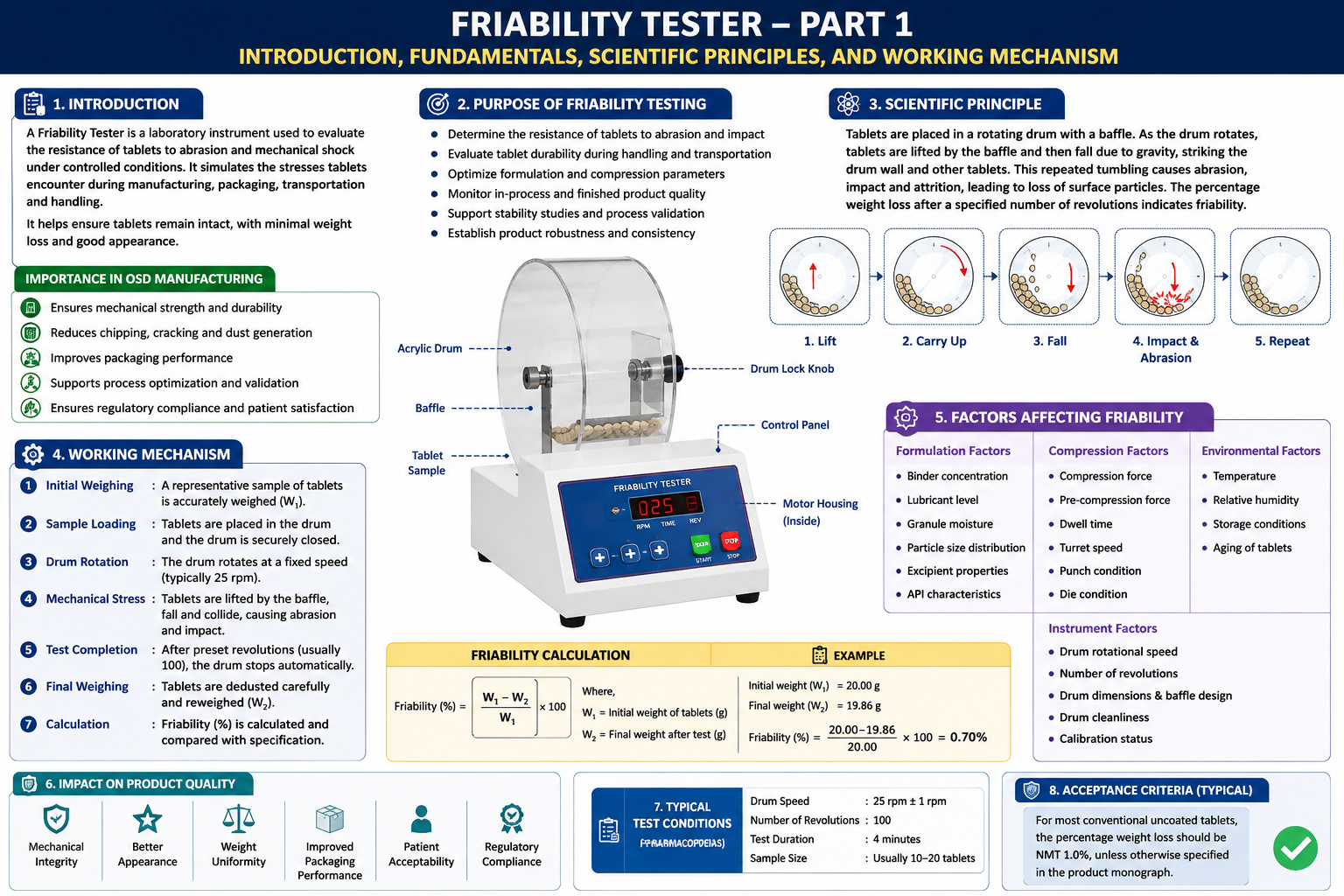
Chapter Overview
Tablet friability is one of the most important physical quality attributes in pharmaceutical manufacturing. During production, tablets experience repeated mechanical stresses while passing through dedusters, metal detectors, conveyors, coating machines, blister packing lines, bottle filling machines, transportation systems, warehouses, and finally patient handling. If tablets lack sufficient mechanical strength, they may chip, crack, abrade, or break, resulting in quality defects, product rejection, and regulatory concerns.
A Friability Tester is a standardized laboratory instrument used to determine the resistance of tablets to abrasion, impact, and mechanical shock under controlled conditions. The instrument simulates handling stresses by rotating tablets inside a transparent drum, causing them to repeatedly tumble and fall. The resulting percentage weight loss indicates the tablet’s ability to withstand normal manufacturing and distribution processes.
Modern friability testers incorporate programmable controls, automatic timing, digital displays, audit trails, electronic data management, and connectivity features to support GMP compliance and data integrity.
1. Introduction
What is Tablet Friability?
Tablet friability refers to the tendency of a tablet to lose particles from its surface due to abrasion, shock, or repeated mechanical impact. It is expressed as the percentage weight loss after tablets are subjected to a specified number of rotations under standardized conditions.
Friability testing provides an indication of the tablet’s mechanical durability during:
- Manufacturing
- Packaging
- Transportation
- Storage
- Distribution
- Patient handling
Unlike hardness testing, which measures the force required to fracture a tablet, friability testing evaluates the tablet’s resistance to surface wear and minor impacts encountered during routine handling.
Why is Friability Testing Important?
Friability testing is performed to ensure tablets possess sufficient mechanical integrity without compromising disintegration and dissolution characteristics.
Tablets with excessive friability may exhibit:
- Chipped edges
- Broken corners
- Surface erosion
- Excessive dust generation
- Tablet cracking
- Reduced appearance quality
- Weight variation
- Product loss during packaging
Such defects can lead to:
- Batch rejection
- Packaging inefficiencies
- Customer complaints
- Stability concerns
- Regulatory observations
- Product recalls in severe cases
Importance in Oral Solid Dosage Manufacturing
Friability testing plays an important role throughout the product lifecycle.
Formulation Development
During development, friability testing helps optimize:
- Binder concentration
- Granulation method
- Lubricant level
- Compression force
- Excipient selection
Process Development
Engineers use friability data to establish robust compression parameters and evaluate process capability.
Commercial Manufacturing
Routine in-process testing confirms consistent tablet strength throughout production.
Finished Product Testing
Quality Control laboratories perform friability testing before batch release to verify compliance with approved specifications.
Stability Studies
Friability testing evaluates whether tablets maintain mechanical integrity throughout their shelf life.
Process Validation
Friability results demonstrate that the manufacturing process consistently produces tablets with acceptable resistance to abrasion and impact.
Importance During Manufacturing
Friability testing is performed during several manufacturing stages.
| Manufacturing Stage | Purpose |
|---|---|
| Formulation Development | Optimize tablet composition |
| Granulation Development | Assess compressibility |
| Compression Setup | Optimize compression force |
| In-Process Control | Monitor consistency |
| Process Validation | Demonstrate reproducibility |
| Finished Product Testing | Batch release |
| Stability Testing | Evaluate long-term durability |
| Technology Transfer | Compare manufacturing sites |
Regulatory Importance
Friability testing is recognized worldwide as an essential physical quality test.
Relevant regulations and guidance include:
- USP General Chapter <1216> Tablet Friability
- European Pharmacopoeia (Ph. Eur.)
- Indian Pharmacopoeia (IP)
- British Pharmacopoeia (BP)
- Japanese Pharmacopoeia (JP)
- WHO GMP
- US FDA cGMP (21 CFR Parts 210 & 211)
- EU GMP
- PIC/S GMP Guide
- ICH Q8 (Pharmaceutical Development)
- ICH Q9 (Quality Risk Management)
- ICH Q10 (Pharmaceutical Quality System)
Manufacturers are expected to establish scientifically justified acceptance criteria and maintain validated control throughout the product lifecycle.
Impact on Product Quality
Friability influences several Critical Quality Attributes (CQAs).
Mechanical Integrity
Low friability ensures tablets retain their shape during handling and packaging.
Appearance
Reduced friability minimizes:
- Edge chipping
- Surface scratches
- Powdering
- Cosmetic defects
This is especially important for coated and branded products.
Weight Uniformity
Excessive abrasion causes weight loss, which may contribute to content variability if severe.
Packaging Performance
Tablets with low friability move efficiently through:
- Dedusters
- Conveyors
- Coating pans
- Bottle fillers
- Blister packaging equipment
without generating excessive breakage or dust.
Patient Acceptability
Intact tablets improve:
- Ease of handling
- Consumer confidence
- Product appearance
- Dose reliability
2. Purpose of Friability Testing
The primary purpose of friability testing is to determine a tablet’s resistance to abrasion and mechanical shock.
Additional objectives include:
- Evaluating mechanical durability
- Optimizing formulation
- Assessing compression quality
- Monitoring manufacturing consistency
- Supporting process validation
- Investigating tablet damage
- Demonstrating regulatory compliance
- Establishing product robustness
- Supporting stability programs
Product Attributes Evaluated
Friability testing provides information on:
- Mechanical durability
- Abrasion resistance
- Edge strength
- Surface integrity
- Resistance to handling damage
- Compression consistency
- Tablet robustness
- Manufacturing capability
3. Scientific Principle of Friability Testing
Fundamental Principle
The friability tester evaluates a tablet’s ability to resist mechanical stress by repeatedly lifting and dropping tablets inside a rotating drum.
As the drum rotates:
- Tablets are lifted by a curved internal baffle.
- They are carried upward.
- Gravity causes them to fall.
- Tablets strike the drum wall and other tablets.
- Repeated impacts and abrasion remove weak surface particles.
After a specified number of revolutions, the tablets are dedusted and reweighed. The percentage loss in weight represents the friability of the sample.
Scientific Basis
Friability testing combines three principal mechanisms:
Abrasion
Surface particles are removed due to rubbing between:
- Tablet and drum wall
- Tablet and tablet
- Tablet and baffle
Impact
Repeated free-fall inside the rotating drum generates impact forces that may chip weak tablets.
Attrition
Small particles detach progressively from tablet surfaces through repeated mechanical contact.
Engineering Principle
The drum rotates at a controlled speed, ensuring consistent mechanical energy is applied to each tablet.
Standard conditions are typically:
- Rotation speed: 25 rpm
- Number of revolutions: 100
- Test duration: 4 minutes
These conditions provide a standardized basis for comparing tablet durability across batches and products.
Mathematical Expression
Tablet friability is calculated using the following equation:Friability (%)=W1W1−W2×100
Where:
- W₁ = Initial weight of tablets
- W₂ = Final weight after testing
Example Calculation
Initial tablet weight = 20.00 g
Final tablet weight = 19.86 g
Weight loss = 0.14 g20.0020.00−19.86×100=0.70%
Since the result is below the commonly accepted limit for conventional tablets, the batch would typically meet the friability specification, provided there are no cracked or broken tablets.
4. Working Mechanism
Modern friability testers operate through a controlled sequence of mechanical actions.
Step 1 – Sample Weighing
A representative sample of tablets is accurately weighed using a calibrated analytical balance.
Step 2 – Sample Loading
The tablets are placed inside the transparent acrylic drum.
The drum includes a curved internal baffle that lifts the tablets during rotation.
Step 3 – Drum Rotation
The motor rotates the drum at the programmed speed.
As the drum rotates:
- Tablets rise with the baffle.
- Tablets reach a predetermined height.
- Gravity causes them to fall.
- Repeated impacts simulate manufacturing stresses.
Step 4 – Mechanical Stress
During the test, tablets experience:
- Rolling
- Sliding
- Falling
- Impact
- Abrasion
- Collision with other tablets
This closely simulates real manufacturing and distribution conditions.
Step 5 – Test Completion
After the programmed number of revolutions, the instrument stops automatically.
The tablets are removed and dedusted to eliminate loose powder before final weighing.
Step 6 – Final Weighing
The tablets are reweighed using the same calibrated balance.
The percentage weight loss is calculated and compared with the product specification.
Factors Affecting Friability
Several formulation and process variables influence friability results.
Formulation Factors
- Binder concentration
- Lubricant level
- Granule moisture content
- Particle size distribution
- Excipient characteristics
- API properties
- Granule density
Compression Factors
- Compression force
- Pre-compression force
- Dwell time
- Turret speed
- Punch condition
- Die condition
Environmental Factors
- Temperature
- Relative humidity
- Storage conditions
- Aging of tablets
Instrument-Related Factors
- Drum rotational speed
- Number of revolutions
- Drum dimensions
- Baffle design
- Drum cleanliness
- Calibration status
Relationship Between Hardness and Friability
Although related, hardness and friability measure different aspects of tablet quality.
| Hardness | Friability |
|---|---|
| Measures crushing strength | Measures resistance to abrasion |
| Compression force required to break a tablet | Percentage weight loss after tumbling |
| Expressed in Newtons (N) | Expressed as % weight loss |
| Evaluates fracture resistance | Evaluates surface durability |
| Determined by hardness tester | Determined by friability tester |
A tablet may exhibit high hardness yet still show poor friability if the formulation lacks sufficient particle bonding. Therefore, both tests are necessary to comprehensively assess tablet mechanical properties.
Part 1 Summary
This first part introduced the fundamentals of friability testing, including its importance in OSD manufacturing, scientific principles, regulatory significance, and working mechanism. It also explained the calculation of friability and the formulation, process, environmental, and equipment factors that influence test results.
Part 2: Construction, Components, Functional Description, Types of Friability Testers, and Engineering Design
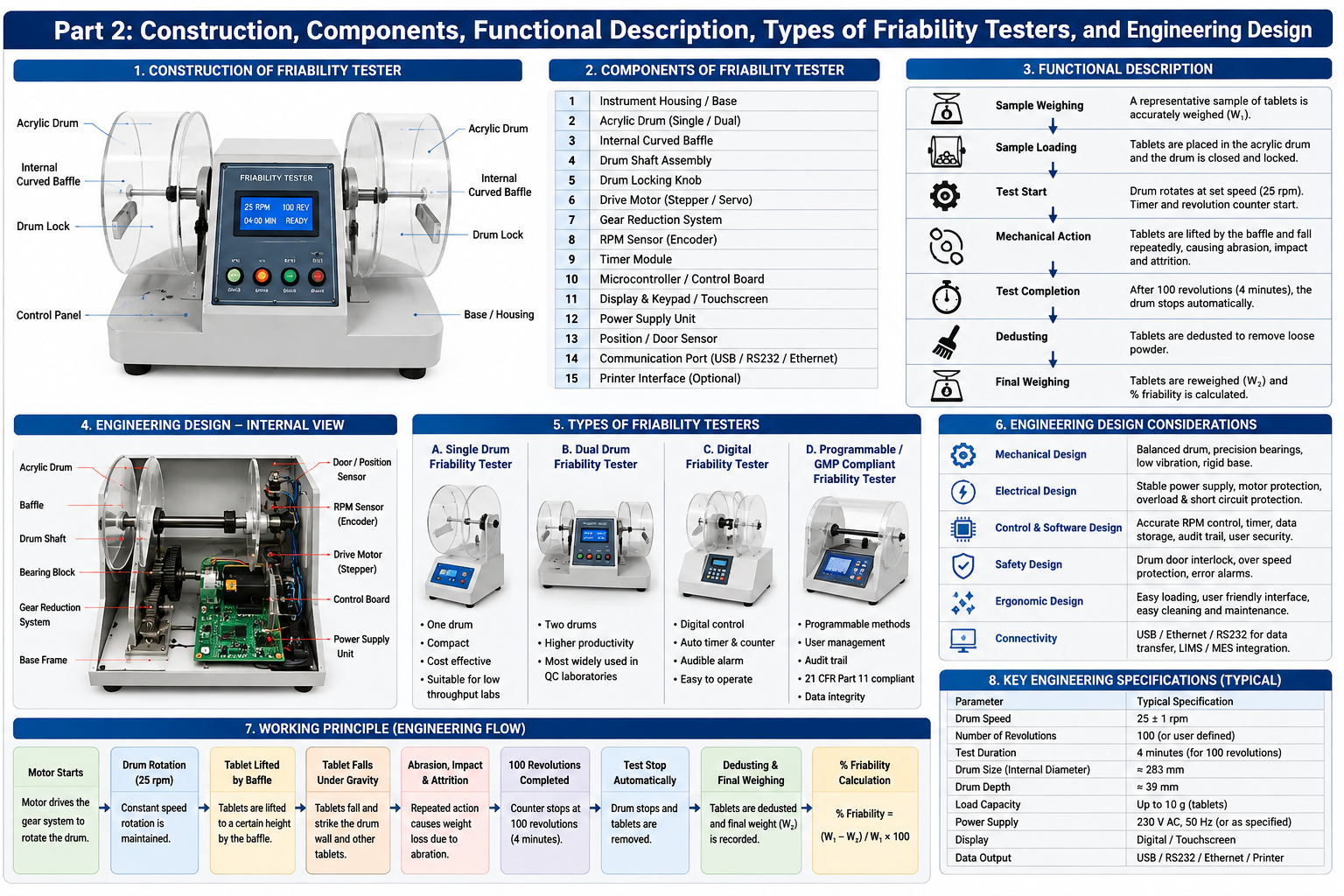
5. Construction of a Friability Tester
Overview
A Friability Tester is a precision electromechanical laboratory instrument designed to evaluate the resistance of tablets to abrasion, impact, and mechanical shock under standardized conditions. The instrument rotates one or two transparent drums at a controlled speed, allowing tablets to tumble repeatedly and simulating the stresses encountered during pharmaceutical manufacturing, packaging, transportation, and handling.
Modern friability testers integrate precision mechanical assemblies, electronic controls, programmable software, digital displays, and data management systems to ensure accurate, repeatable, and GMP-compliant testing.
A typical friability tester consists of the following major assemblies:
- Instrument Housing
- Acrylic Test Drum(s)
- Internal Curved Baffle
- Drum Shaft Assembly
- Drive Motor
- Gear Reduction System
- Drum Locking Mechanism
- Digital Speed Controller
- Timer Module
- Microprocessor-Based Controller
- Human Machine Interface (HMI)
- RPM Sensor
- Drum Position Sensor
- Electronic Memory
- USB/Ethernet Communication Port
- Printer Interface (optional)
- Power Supply Unit
General Construction Layout
                ┌───────────────────────────────┐
                │      Touchscreen / Display    │
                └─────────────┬─────────────────┘
                              │
                     Embedded Controller
                              │
        ┌─────────────────────┼─────────────────────┐
        │                     │                     │
    Timer Module         RPM Sensor          Memory Module
        │
   Speed Controller
        │
   Drive Motor
        │
  Gear Reduction System
        │
     Drum Shaft
        │
 Acrylic Drum with Curved Baffle
        │
      Tablet Sample
        │
    Drum Rotation
        │
 Abrasion & Impact Simulation
5.1 Instrument Housing
Function
The housing provides structural support for all internal components while protecting the instrument from environmental contamination and accidental damage.
Construction Materials
Most pharmaceutical-grade instruments are manufactured using:
- SS304 Stainless Steel
- SS316 Stainless Steel (premium models)
- Powder-coated steel
- Engineering-grade polymers (covers)
The exterior is designed to comply with GMP cleaning requirements with smooth, crevice-free surfaces.
5.2 Acrylic Drum
Function
The rotating drum is the primary testing chamber where tablets undergo abrasion and impact.
It simulates handling conditions encountered during manufacturing and distribution.
Construction
Typical drum materials include:
- Transparent acrylic (PMMA)
- Polycarbonate (selected models)
Transparency allows operators to visually observe tablet movement during testing.
Standard Drum Dimensions
| Parameter | Typical Value |
|---|---|
| Internal Diameter | Approximately 283 mm |
| Drum Depth | Approximately 39 mm |
| Wall Thickness | 4–8 mm |
| Material | Transparent Acrylic |
Dimensions should conform to the applicable pharmacopoeial requirements and the manufacturer’s validated design.
5.3 Curved Internal Baffle
The curved baffle is permanently fixed inside the drum.
Function
As the drum rotates:
- Tablets are lifted by the baffle.
- They reach a specified height.
- Gravity causes them to fall.
- Repeated impact and abrasion occur.
The baffle ensures that every tablet experiences a consistent mechanical challenge throughout the test.
Design Features
- Smooth finish
- Rounded edges
- Uniform height
- Precision alignment
- Permanent attachment
5.4 Drum Shaft Assembly
The shaft supports the rotating drum and transmits torque from the motor.
Construction Material
Typically manufactured from:
- Stainless steel
- Hardened alloy steel
Requirements
- High rigidity
- Minimal vibration
- Excellent concentricity
- Corrosion resistance
5.5 Drive Motor
The motor provides the rotational force required to rotate the drum at a constant speed.
Modern systems generally use:
Stepper Motor
Advantages:
- Excellent speed control
- High positioning accuracy
- Reliable operation
- Low maintenance
Applications:
- Routine QC laboratories
- Semi-automatic systems
Servo Motor
Premium systems may employ servo motors for:
- Closed-loop speed control
- High rotational stability
- Minimal speed variation
- Long operating life
5.6 Gear Reduction System
The gear reduction mechanism converts motor speed into the required drum rotation speed.
Functions
- Torque multiplication
- Speed reduction
- Smooth drum rotation
- Reduced vibration
Common drive systems include:
- Spur gears
- Timing belts
- Direct drive systems
- Planetary gear assemblies
5.7 RPM Sensor
Modern friability testers continuously monitor drum speed.
Typical sensor technologies include:
- Optical encoder
- Hall-effect sensor
- Magnetic encoder
Purpose
The RPM sensor verifies:
- Drum speed
- Rotation count
- Test completion
- Motor performance
If the drum speed deviates from the programmed value, the instrument generates an alarm.
5.8 Timer Module
The timer controls test duration.
Standard test conditions are:
| Parameter | Typical Setting |
|---|---|
| Drum Speed | 25 rpm |
| Number of Revolutions | 100 |
| Test Duration | 4 minutes |
Modern instruments allow programmable settings for specialized applications.
5.9 Human Machine Interface (HMI)
The HMI enables user interaction with the instrument.
Typical display functions include:
- Start/Stop
- RPM setting
- Revolution count
- Timer
- Test status
- Alarm messages
- User login
- Calibration menu
- Historical data
- System settings
Premium instruments use color touchscreen displays with multilingual interfaces.
5.10 Embedded Controller
The embedded controller acts as the “brain” of the friability tester.
Responsibilities
- Motor control
- RPM regulation
- Revolution counting
- Timer control
- Alarm management
- User authentication
- Data storage
- Communication
- Audit trail management (advanced models)
5.11 Communication Interfaces
Modern instruments support:
- USB
- Ethernet
- RS-232
- Printer connection
- Barcode reader integration
- LIMS connectivity
- MES integration (selected models)
These interfaces facilitate secure data transfer and electronic record management.
5.12 Internal Software
Advanced software performs:
- Instrument control
- Test parameter management
- Result storage
- Audit trail generation
- User management
- Electronic signatures
- Statistical analysis
- Report generation
- Data export
High-end systems comply with:
- 21 CFR Part 11
- EU Annex 11
- ALCOA+ principles
- GAMP 5 guidance
6. Functional Description of Each Component
| Component | Function | Importance |
|---|---|---|
| Housing | Supports and protects components | Instrument stability |
| Acrylic Drum | Test chamber | Simulates handling conditions |
| Internal Baffle | Lifts tablets | Produces repeated impacts |
| Shaft Assembly | Transfers motor torque | Smooth rotation |
| Drive Motor | Rotates drum | Constant test speed |
| Gear System | Speed reduction | Uniform motion |
| RPM Sensor | Monitors speed | Test accuracy |
| Timer | Controls duration | Standardized testing |
| Controller | Coordinates operation | Reliable performance |
| HMI | User interaction | Ease of operation |
| Memory | Stores results | Data integrity |
| USB/Ethernet | Data transfer | LIMS/MES integration |
7. Types of Friability Testers
Friability testers are classified according to the number of drums, automation level, and data management capabilities.
7.1 Single Drum Friability Tester
Characteristics
- One rotating drum
- Compact design
- Suitable for routine testing
- Low maintenance
- Economical
Applications
- Small laboratories
- Academic institutions
- Research laboratories
- Pilot plants
Advantages
- Lower cost
- Easy operation
- Small footprint
- Simple maintenance
Limitations
- Lower throughput
- One sample at a time
- Limited productivity
7.2 Dual Drum Friability Tester
The most widely used configuration in commercial pharmaceutical laboratories.
Advantages
- Two simultaneous tests
- Increased productivity
- Reduced analysis time
- Suitable for routine QC
Applications
- Commercial manufacturing
- Contract laboratories
- Stability studies
- Validation batches
7.3 Digital Friability Tester
Digital models incorporate:
- Microprocessor control
- Electronic timer
- Digital RPM display
- Automatic revolution counting
- Audible alarms
- Result memory
7.4 Programmable Friability Tester
Premium systems provide:
- Multiple test methods
- User-defined RPM
- Programmable revolutions
- Password protection
- Audit trail
- Electronic signatures
- Data export
7.5 GMP-Compliant Friability Tester
Designed for regulated pharmaceutical environments.
Features
- 21 CFR Part 11 compliance
- EU Annex 11 compliance
- Secure user management
- Audit trail
- Electronic records
- Electronic signatures
- LIMS integration
- Barcode compatibility
8. Engineering Design Considerations
Modern friability testers are designed to ensure precision, repeatability, and long-term reliability.
Mechanical Design
- Balanced rotating drum
- Low vibration
- Precision bearings
- High-quality shaft alignment
- Durable drive system
Electrical Design
- Stable power supply
- Motor protection
- Overload protection
- Surge protection
- EMC compliance
Software Design
- Password-protected access
- Configurable test methods
- Alarm handling
- Audit trail
- Secure data storage
- Automatic backups (advanced systems)
Ergonomic Design
- Easy drum loading
- Simple control panel
- Intuitive software
- Easy cleaning
- Minimal operator fatigue
Engineering Workflow
Tablet Loading
        │
        ▼
Drum Rotation at Controlled Speed
        │
        ▼
Tablet Lifted by Internal Baffle
        │
        ▼
Tablet Falls Under Gravity
        │
        ▼
Impact + Abrasion + Attrition
        │
        ▼
100 Revolutions Completed
        │
        ▼
Drum Stops Automatically
        │
        ▼
Tablet Dedusting
        │
        ▼
Final Weighing
        │
        ▼
% Friability Calculation
Advantages of Modern Friability Testers
- High repeatability
- Accurate RPM control
- Automated timing
- Programmable test methods
- Reduced operator error
- GMP-compliant documentation
- Secure electronic records
- Improved laboratory productivity
- Integration with digital quality systems
Part 2 Summary
This section explained the construction, major components, engineering design, and types of friability testers used in pharmaceutical quality control. Understanding the function of each component and the instrument’s mechanical architecture is essential for accurate operation, maintenance, calibration, and regulatory compliance.
Part 3: Major Manufacturers, Latest Models, Technical Specifications, Model Comparison, Selection Guide, and Emerging Technologies.
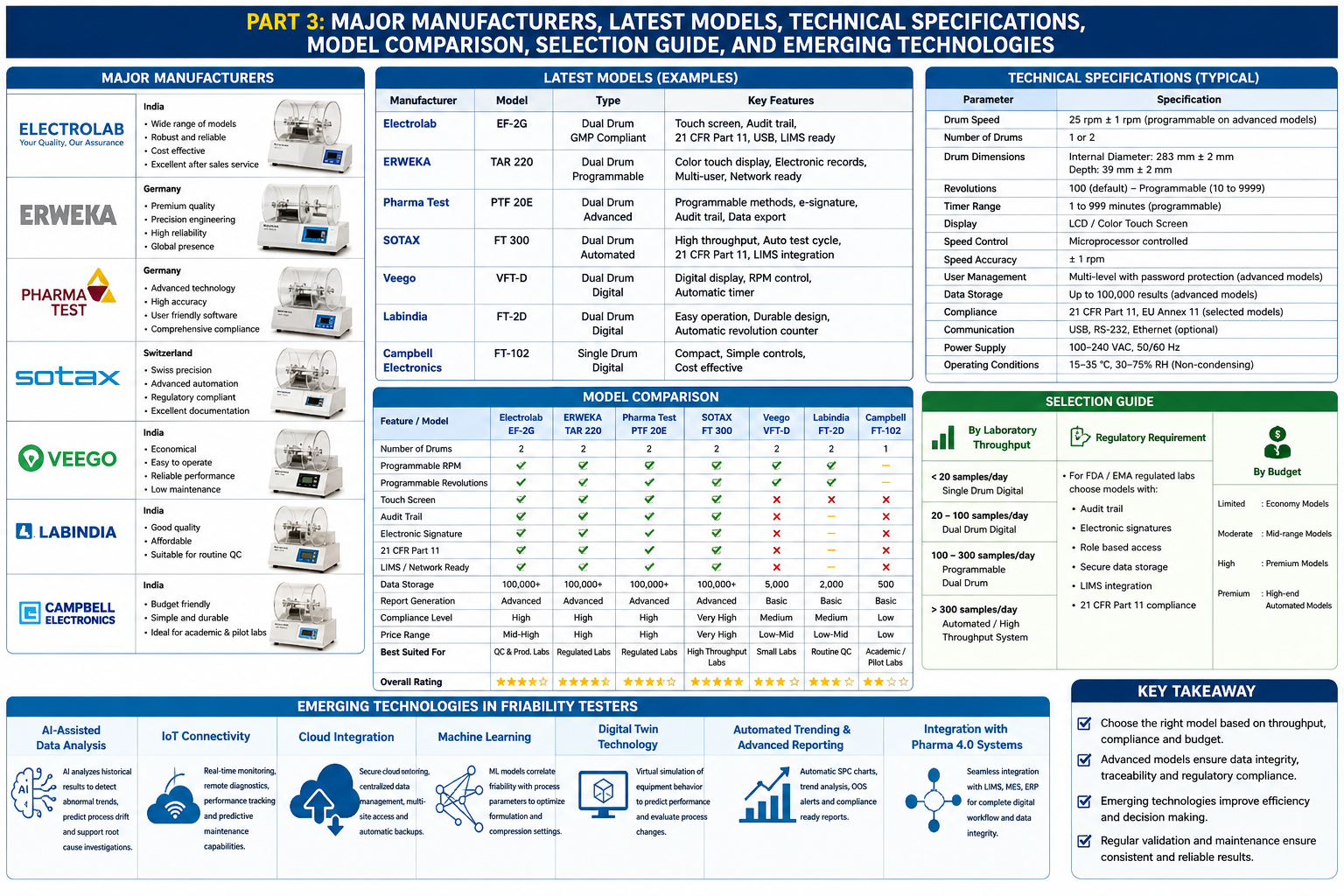
9. Major Manufacturers of Friability Testers
Several globally recognized manufacturers produce pharmaceutical friability testers designed to meet GMP, pharmacopoeial, and regulatory requirements. The selection of a manufacturer depends on laboratory workload, regulatory expectations, required automation, software functionality, service support, and budget.
The following companies are among the most widely used in the pharmaceutical industry.
9.1 Electrolab
Company Overview
Electrolab is one of the world’s leading manufacturers of pharmaceutical testing instruments and has a strong presence in India, Asia, Europe, the Middle East, Africa, and Latin America.
The company manufactures a complete range of physical testing instruments for pharmaceutical quality control.
Headquarters
- Mumbai, India
Major Advantages
- Competitive pricing
- Excellent repeatability
- Robust construction
- Wide service network
- User-friendly software
- GMP-compliant design
Typical Applications
- Production QC laboratories
- Commercial manufacturing
- Stability laboratories
- Contract testing laboratories
Representative Models
| Model | Description |
|---|---|
| EF-2 | Dual drum digital friability tester |
| EF-2W | Dual drum with programmable features |
| EF-2G | GMP-compliant advanced model |
Major Features
- Dual acrylic drums
- Automatic revolution counting
- Digital timer
- RPM display
- Programmable methods
- USB communication (selected models)
- Audit trail support (advanced models)
9.2 ERWEKA
Company Overview
ERWEKA is a German manufacturer recognized for precision engineering and long-term reliability.
Headquarters
- Germany
Major Strengths
- Premium build quality
- Excellent speed accuracy
- Long equipment life
- Comprehensive validation documentation
- Global service network
Representative Models
| Model | Description |
|---|---|
| TAR II | Dual drum friability tester |
| TAR 220 | Advanced programmable model |
Key Features
- Programmable revolutions
- Precision motor control
- Large touchscreen
- Electronic records
- Statistical reporting
- Network connectivity
9.3 Pharma Test
Company Overview
Pharma Test specializes in high-performance pharmaceutical testing equipment used extensively in Europe and North America.
Headquarters
- Germany
Major Strengths
- Precision engineering
- Advanced automation
- High repeatability
- Excellent software platform
- GMP-ready documentation
Representative Models
| Model | Description |
|---|---|
| PTF 10E | Digital friability tester |
| PTF 20E | Dual drum programmable tester |
| PTF Auto Series | Fully automated system |
Major Features
- Automatic test completion
- Touchscreen operation
- Electronic signatures
- Audit trail
- LIMS connectivity
- User management
9.4 SOTAX
Company Overview
SOTAX is a Swiss manufacturer known worldwide for pharmaceutical testing systems including dissolution, disintegration, hardness, and friability testing.
Headquarters
- Switzerland
Advantages
- Swiss precision
- High automation
- Advanced software
- Global validation support
- Premium engineering
Representative Models
| Model | Description |
|---|---|
| FT 2 | Digital friability tester |
| FT 300 | Automated high-throughput system |
Features
- Programmable methods
- Automatic drum positioning
- Electronic documentation
- Touchscreen interface
- Multi-language software
9.5 Veego Instruments
Headquarters
- India
Specialization
- Pharmaceutical quality control instruments
- Physical testing equipment
- Laboratory instruments
Advantages
- Affordable pricing
- Reliable operation
- Easy maintenance
- Suitable for routine QC laboratories
Representative Models
- VFT Series
- VFT Dual Drum
- VFT Digital
9.6 Labindia
Company Overview
Labindia supplies pharmaceutical laboratory equipment throughout India and international markets.
Advantages
- Cost-effective
- Easy-to-use interface
- Good local support
- Reliable operation
Representative Models
- FT Series
- Digital Friability Tester
- Dual Drum Models
9.7 Campbell Electronics
Campbell Electronics manufactures pharmaceutical quality control equipment suitable for educational institutions, pilot plants, and routine laboratory applications.
Advantages
- Economical
- Simple operation
- Compact design
- Low maintenance
Global Manufacturer Comparison
| Company | Country | Market Position |
|---|---|---|
| SOTAX | Switzerland | Premium |
| ERWEKA | Germany | Premium |
| Pharma Test | Germany | Premium |
| Electrolab | India | Mid to Premium |
| Labindia | India | Mid-range |
| Veego | India | Economy to Mid-range |
| Campbell Electronics | India | Economy |
10. Available Instrument Configurations
Friability testers are available in different configurations to suit various laboratory requirements.
Manual Models
Characteristics
- Basic controls
- Manual parameter setting
- Mechanical or digital timer
- Suitable for educational laboratories
Digital Models
Features include:
- Digital display
- Automatic revolution counting
- Electronic timer
- Audible alarms
- Improved repeatability
Programmable Models
Designed for regulated environments.
Capabilities include:
- User-defined RPM
- Adjustable test duration
- Method storage
- User authentication
- Audit trail
- Electronic signatures
GMP-Compliant Models
These systems provide:
- 21 CFR Part 11 compliance
- EU Annex 11 compliance
- Role-based access
- Electronic records
- Audit trail
- Secure data backup
- LIMS integration
High-Throughput Systems
Suitable for large pharmaceutical laboratories.
Typical features include:
- Dual drum operation
- Barcode integration
- Batch management
- Automatic report generation
- Enterprise software connectivity
11. Technical Specifications
The following table summarizes typical specifications of modern friability testers.
| Parameter | Typical Specification |
|---|---|
| Drum Speed | 25 rpm (programmable on advanced models) |
| Speed Accuracy | ±1 rpm |
| Drum Diameter | Approximately 283 mm |
| Drum Width | Approximately 39 mm |
| Number of Drums | 1 or 2 |
| Timer Range | 1–999 minutes |
| Revolution Counter | 1–9999 |
| Display | LCD or color touchscreen |
| User Levels | Administrator, Supervisor, Analyst |
| Data Storage | Up to 100,000 results (advanced models) |
| Communication | USB, Ethernet, RS-232 |
| Printer Support | Yes |
| Barcode Reader | Optional |
| Audit Trail | Available on GMP models |
| Electronic Signature | Available on GMP models |
| Power Supply | 100–240 VAC, 50/60 Hz |
| Operating Temperature | 15–35°C |
| Relative Humidity | 30–75% RH (non-condensing) |
12. Comparison of Leading Manufacturers
| Manufacturer | Build Quality | Automation | Software | Audit Trail | Price Category | Best Application |
|---|---|---|---|---|---|---|
| SOTAX | Excellent | Excellent | Advanced | Yes | Premium | Global QC & R&D |
| ERWEKA | Excellent | Excellent | Advanced | Yes | Premium | Validation & Stability |
| Pharma Test | Excellent | Excellent | Advanced | Yes | Premium | Regulatory Laboratories |
| Electrolab | Very Good | Very Good | Good | Yes (selected models) | Mid-range | Routine QC |
| Labindia | Very Good | Good | Good | Optional | Mid-range | Commercial Manufacturing |
| Veego | Good | Basic | Basic | Limited | Economy | Small QC Labs |
| Campbell Electronics | Good | Basic | Basic | No | Economy | Academic & Pilot Plants |
13. Selection Guide
Selecting a friability tester should be based on laboratory requirements rather than purchase price alone.
Laboratory Throughput
| Daily Workload | Recommended System |
|---|---|
| <20 samples | Single Drum Digital |
| 20–100 samples | Dual Drum Digital |
| 100–300 samples | Programmable Dual Drum |
| >300 samples | High-Throughput Automated System |
Regulatory Requirements
For facilities inspected by:
- US FDA
- EMA
- MHRA
- PMDA
- TGA
The instrument should include:
- Audit trail
- Electronic signatures
- Role-based access
- Secure backup
- Time-stamped records
- Data integrity controls
- LIMS compatibility
Budget-Based Selection
| Budget | Recommendation |
|---|---|
| Limited | Campbell Electronics, Veego |
| Moderate | Labindia, Electrolab |
| High | ERWEKA, Pharma Test |
| Premium | SOTAX |
14. Emerging Technologies
Modern pharmaceutical laboratories are rapidly adopting digital technologies that improve efficiency, traceability, and process understanding.
AI-Assisted Data Analysis
Artificial Intelligence can analyze historical friability results to:
- Detect abnormal trends
- Predict process drift
- Support root cause investigations
- Recommend process adjustments
Internet of Things (IoT)
IoT-enabled friability testers allow:
- Real-time monitoring
- Centralized data collection
- Remote diagnostics
- Predictive maintenance
Cloud Connectivity
Cloud-enabled systems support:
- Automatic data backup
- Multi-site access
- Secure report sharing
- Enterprise-wide trend analysis
Digital Twin Technology
Digital twins can simulate equipment behavior, allowing engineers to evaluate the impact of process changes on tablet durability without interrupting production.
Machine Learning
Machine learning models can correlate friability results with:
- Compression force
- Granule moisture
- Particle size distribution
- Tablet hardness
- Dissolution behavior
This supports improved process optimization and risk management.
Automated Trending
Modern software automatically generates:
- Control charts
- Statistical Process Control (SPC) reports
- Trend analyses
- Capability indices (Cp, Cpk)
- Out-of-specification alerts
Integration with Pharma 4.0
Advanced friability testers increasingly integrate with:
- Laboratory Information Management Systems (LIMS)
- Manufacturing Execution Systems (MES)
- Enterprise Resource Planning (ERP)
- Electronic Laboratory Notebooks (ELN)
These integrations improve workflow efficiency, data integrity, and regulatory compliance.
Part 3 Summary
This section reviewed the leading manufacturers of friability testers, representative models, technical specifications, comparison of major brands, instrument configurations, selection criteria, and emerging technologies. Selecting the right friability tester requires balancing laboratory workload, regulatory expectations, automation needs, software capabilities, and long-term service support.
Part 4: Operating Procedure, Calibration, Qualification (DQ, IQ, OQ, PQ), Validation, GMP Documentation, Maintenance, Cleaning, and Safety.
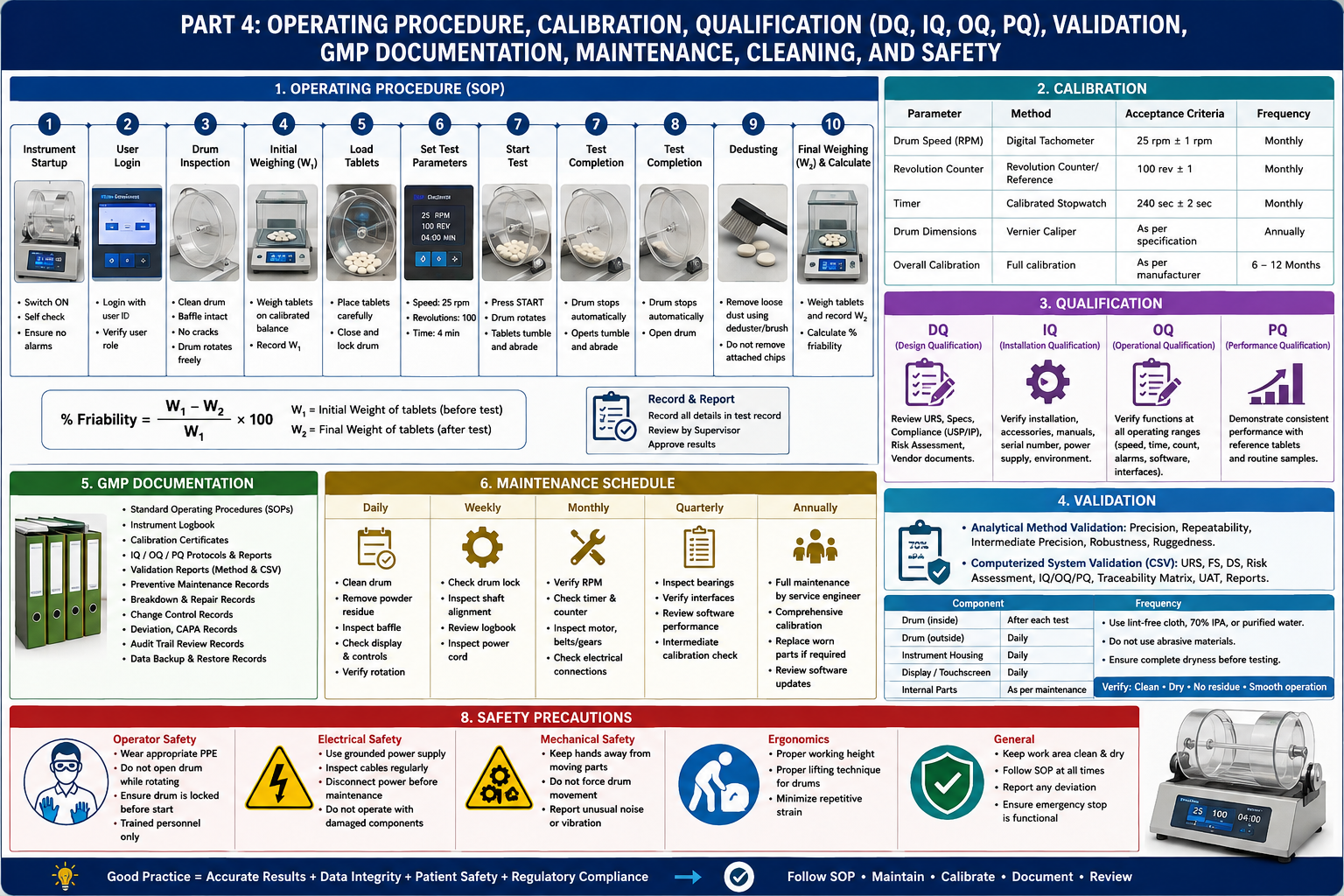
15. Standard Operating Procedure (SOP)
15.1 Objective
To establish a standardized procedure for operating the Friability Tester to accurately determine the percentage weight loss of tablets after controlled tumbling while ensuring repeatable results, GMP compliance, data integrity, and operator safety.
15.2 Scope
This SOP applies to:
- Research & Development (R&D)
- Process Development
- In-Process Quality Control (IPQC)
- Finished Product Testing
- Stability Studies
- Process Validation
- Technology Transfer
- Commercial Manufacturing
- Contract Testing Laboratories
15.3 Responsibilities
| Department | Responsibility |
|---|---|
| QC Analyst | Perform friability testing and document results |
| QC Supervisor | Review and approve test results |
| QA Department | Verify GMP compliance and documentation |
| Engineering | Preventive maintenance and repairs |
| Calibration Team | Instrument calibration |
| Validation Team | Qualification (DQ, IQ, OQ, PQ) |
| Production | Provide representative tablet samples |
16. Pre-Operational Checks
Before starting the test, verify the following:
| Check | Acceptance Criteria |
|---|---|
| Instrument cleanliness | No powder or tablet residue |
| Drum integrity | Clean, transparent, free from cracks |
| Baffle condition | Securely fixed, no damage |
| Calibration status | Valid calibration label |
| Qualification status | Current IQ/OQ/PQ |
| Display | No error messages |
| Timer | Functional |
| RPM setting | Correct |
| Power supply | Stable |
| Environmental conditions | Within specification |
17. Environmental Requirements
Friability testing should be conducted under controlled laboratory conditions.
| Parameter | Recommended Range |
|---|---|
| Temperature | 20–25°C |
| Relative Humidity | 40–60% RH |
| Vibration | Minimal |
| Airflow | No direct air drafts |
| Lighting | Adequate for inspection |
Environmental control minimizes variability in tablet weight and mechanical behavior.
18. Sample Preparation
Representative sampling is essential for obtaining meaningful friability results.
Sample Selection
Tablets selected for testing should:
- Be representative of the batch
- Be free from visible defects unrelated to manufacturing
- Be clean and dry
- Have reached room temperature before testing
Sample Quantity
The sample size should comply with the applicable pharmacopoeial or approved internal method.
Typically:
- Tablets are weighed together as the initial sample.
- The total sample weight should generally be sufficient to ensure reliable measurement.
- The number of tablets depends on tablet unit weight and the approved testing procedure.
19. Operating Procedure
Step 1 – Instrument Startup
- Switch on the instrument.
- Allow self-diagnostics to complete.
- Verify that no alarms are displayed.
- Confirm the instrument is within calibration validity.
Step 2 – User Authentication
For GMP-compliant systems:
- Log in using an authorized user ID.
- Verify user role (Analyst, Supervisor, Administrator).
- Ensure audit trail functionality is active.
Step 3 – Drum Inspection
Verify that:
- Drum is clean.
- Baffle is intact.
- Drum rotates freely.
- No cracks are present.
- Drum locking mechanism functions correctly.
Step 4 – Initial Weighing
Using a calibrated analytical balance:
- Record the initial weight (W₁) of the tablet sample.
- Document the weight to the required decimal precision.
Step 5 – Load Tablets
- Open the drum.
- Carefully place the weighed tablets into the drum.
- Close and secure the drum properly.
Incorrect drum closure may result in inaccurate testing or equipment damage.
Step 6 – Program Test Parameters
Typical settings include:
| Parameter | Standard Setting |
|---|---|
| Drum Speed | 25 rpm |
| Number of Revolutions | 100 |
| Test Duration | 4 minutes |
Alternative settings may be used if justified in the approved analytical method.
Step 7 – Start Test
Press Start.
During operation:
- The drum rotates at the programmed speed.
- Tablets are lifted by the internal baffle.
- Tablets fall repeatedly under gravity.
- Mechanical abrasion and impact occur throughout the test.
Step 8 – Test Completion
After the programmed revolutions:
- Drum stops automatically.
- Open the drum.
- Carefully remove the tablets.
Step 9 – Dedusting
Remove loose powder using a tablet deduster or a soft brush.
Do not remove fragments that remain firmly attached to tablets.
Step 10 – Final Weighing
Reweigh the dedusted tablets.
Record the final weight (W₂).
Calculate: Friability (%)=W1W1−W2×100
Compare the result with the approved specification.
Step 11 – Documentation
Record:
- Product name
- Batch number
- Instrument ID
- Drum identification
- Operator
- Date
- Time
- Initial weight
- Final weight
- Percentage friability
- Observations
- Reviewer approval
Electronic records should comply with data integrity requirements.
20. Calibration
Objective
Calibration confirms that the friability tester operates within specified limits for speed, timing, and revolution counting.
Calibration Frequency
| Activity | Frequency |
|---|---|
| RPM Verification | Monthly or before use (per SOP) |
| Timer Verification | Monthly |
| Revolution Counter Verification | Monthly |
| Comprehensive Calibration | Every 6–12 months |
| After Repair | Before returning to service |
| After Relocation | Before reuse |
Calibration Parameters
Drum Speed
Verify using a calibrated tachometer.
Typical acceptance criterion:
25 rpm ±1 rpm (or as specified by the manufacturer).
Revolution Counter
Verify the displayed revolution count against the actual number of rotations.
Timer
Verify using a calibrated stopwatch or certified timing device.
Drum Dimensions
Periodically inspect:
- Drum diameter
- Drum width
- Baffle dimensions
- Drum alignment
against manufacturer specifications.
Calibration Documentation
Calibration records should include:
- Instrument ID
- Calibration date
- Reference standards
- Results
- Acceptance criteria
- Adjustments performed
- Calibration status
- Next due date
- Reviewer approval
21. Qualification
Qualification demonstrates that the instrument is suitable for its intended use.
21.1 Design Qualification (DQ)
Confirm that the selected friability tester satisfies the User Requirement Specification (URS).
Typical DQ activities include:
- Review of vendor specifications
- Compliance with USP/Ph. Eur./IP requirements
- Evaluation of software functionality
- Review of documentation
- Assessment of service support
- Spare parts availability
21.2 Installation Qualification (IQ)
Verify correct installation.
Typical IQ Checklist
| Verification Item | Status |
|---|---|
| Instrument model | Verified |
| Serial number | Verified |
| Drum dimensions | Verified |
| Power supply | Verified |
| Installation location | Approved |
| User manuals | Available |
| Calibration certificates | Available |
| Software version | Documented |
| Environmental conditions | Acceptable |
21.3 Operational Qualification (OQ)
Demonstrate that the instrument functions correctly throughout its operating range.
Typical OQ tests include:
- Drum speed verification
- Timer accuracy
- Revolution counting
- Alarm functionality
- Display operation
- User access control
- Audit trail
- Communication ports
- Software functionality
21.4 Performance Qualification (PQ)
Confirm consistent performance under routine laboratory conditions.
PQ activities typically include:
- Testing reference tablets
- Repeatability studies
- Reproducibility between analysts
- Verification using production samples
- Long-term performance monitoring
22. Validation Considerations
Analytical Method Validation
Method suitability should evaluate:
- Precision
- Repeatability
- Intermediate precision
- Robustness
- Ruggedness
- Measurement uncertainty
Computerized System Validation (CSV)
For software-controlled instruments, validation should address:
- User Requirement Specification (URS)
- Functional Specification (FS)
- Design Specification (DS)
- Risk Assessment
- IQ/OQ/PQ
- Traceability Matrix
- User Acceptance Testing (UAT)
A lifecycle approach consistent with GAMP 5 is recommended.
23. GMP Documentation
The following documents should be maintained:
- Standard Operating Procedure (SOP)
- Instrument Logbook
- Calibration Procedure
- Calibration Certificates
- IQ/OQ/PQ Protocols and Reports
- Validation Reports
- Preventive Maintenance Records
- Breakdown Records
- Change Control Records
- Deviation Reports
- CAPA Records
- Audit Trail Reviews
- Backup and Restore Records
24. Preventive Maintenance
Routine preventive maintenance ensures reliable operation and minimizes downtime.
Daily
- Clean drum(s)
- Remove powder residue
- Inspect baffle
- Verify display and controls
- Check drum rotation
Weekly
- Inspect shaft alignment
- Check drum locking mechanism
- Review instrument logbook
- Inspect power cord
Monthly
- Verify RPM
- Inspect drive motor
- Check belts or gears (if applicable)
- Inspect electrical connections
Quarterly
- Inspect bearings
- Review software performance
- Verify communication interfaces
- Intermediate operational checks
Annually
- Full preventive maintenance by qualified service personnel
- Comprehensive calibration
- Replace worn components if required
- Review software updates
- Verify regulatory compliance
25. Cleaning Procedure
Proper cleaning prevents cross-contamination and ensures reliable performance.
Cleaning Materials
- Lint-free cloth
- Purified water (where appropriate)
- 70% Isopropyl Alcohol (IPA), if compatible with manufacturer recommendations
- Neutral laboratory detergent for external surfaces
Avoid abrasive cleaning materials that may scratch the acrylic drum.
Cleaning Frequency
| Component | Frequency |
|---|---|
| Drum interior | After each test |
| Drum exterior | Daily |
| Instrument housing | Daily |
| Display | Daily |
| Internal components | As per maintenance schedule |
Cleaning Verification
Confirm:
- No visible powder
- No tablet fragments
- Drum transparency maintained
- Smooth drum rotation
- Normal instrument operation
26. Safety Precautions
Operator Safety
- Wear appropriate PPE.
- Do not open the drum while it is rotating.
- Ensure the drum is securely locked before starting the test.
- Operate only after receiving appropriate training.
Electrical Safety
- Use a properly grounded power supply.
- Inspect cables regularly.
- Disconnect power before maintenance.
- Do not operate with damaged electrical components.
Mechanical Safety
- Keep hands away from moving parts.
- Verify drum locking before operation.
- Report abnormal vibration or noise immediately.
Ergonomics
- Position the instrument at a comfortable working height.
- Use proper lifting techniques when handling larger drums.
- Minimize repetitive strain through appropriate workstation design.
Part 4 Summary
This section provided a comprehensive guide to the operation and lifecycle management of friability testers, including standard operating procedures, calibration, qualification (DQ, IQ, OQ, PQ), validation considerations, GMP documentation, preventive maintenance, cleaning, and safety practices. Consistent adherence to these procedures ensures accurate and reproducible friability results while supporting regulatory compliance and long-term instrument reliability.
Part 5: GMP Requirements, Regulatory Compliance, Applications, Acceptance Criteria, Troubleshooting, Audit Readiness, AI Integration, FAQs, Interview Questions, and Key Takeaways
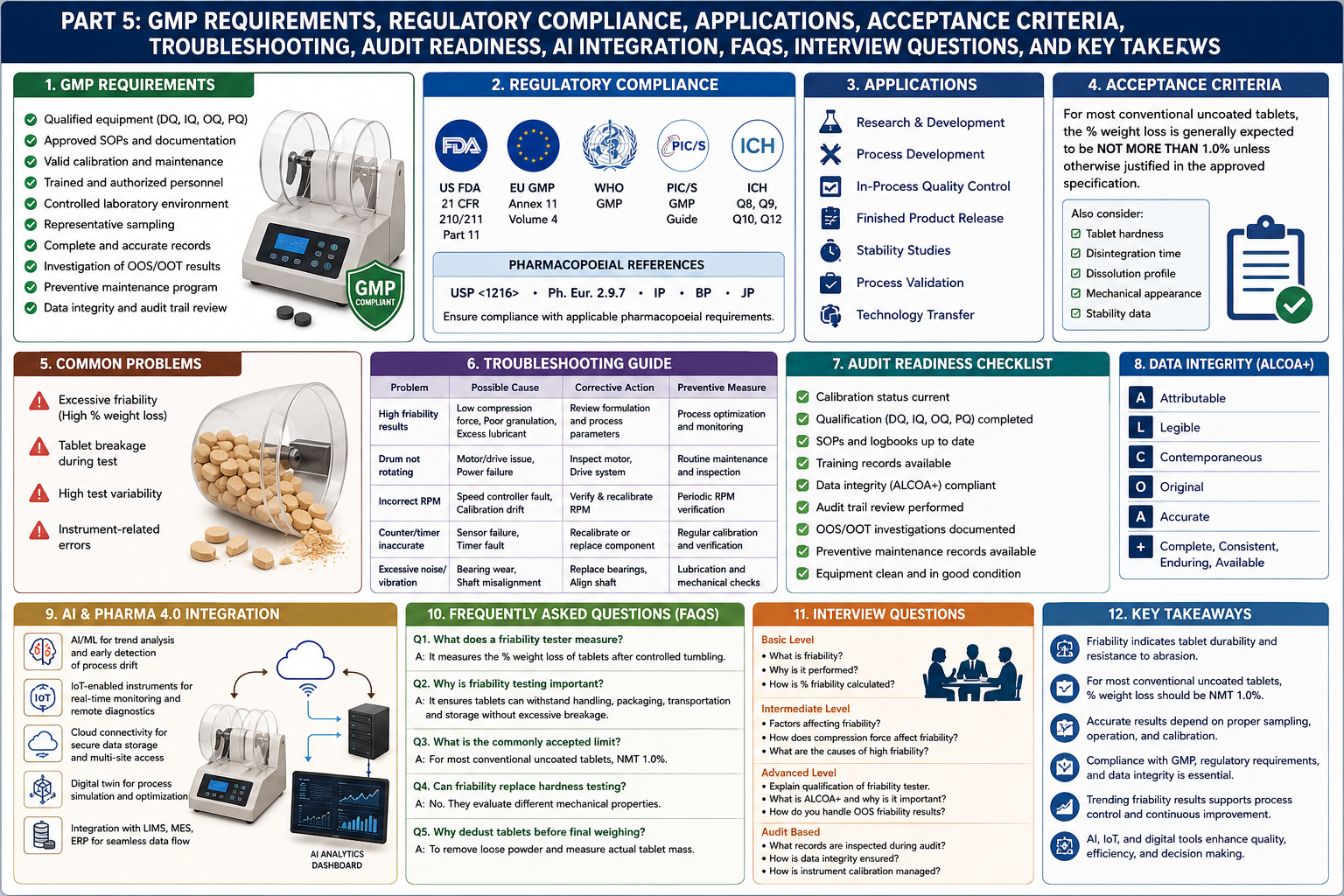
27. GMP Requirements for Friability Testing
Friability testing is a Critical Quality Control (QC) activity used to verify the mechanical durability of tablets. It provides assurance that tablets can withstand routine handling during manufacturing, packaging, transportation, storage, and patient use without unacceptable weight loss, chipping, or breakage.
A GMP-compliant friability testing program should include:
- Qualified equipment (DQ, IQ, OQ, PQ)
- Approved Standard Operating Procedures (SOPs)
- Valid calibration status
- Trained personnel
- Controlled laboratory environment
- Representative sampling procedures
- Complete documentation
- Investigation of Out-of-Specification (OOS) and Out-of-Trend (OOT) results
- Preventive maintenance program
- Secure electronic records (where applicable)
- Audit trail review
- Periodic performance verification
Applicable Regulations and Guidelines
Friability testing should align with the principles described in:
- US FDA 21 CFR Parts 210 & 211
- 21 CFR Part 11 (Electronic Records and Electronic Signatures)
- EU GMP Volume 4
- EU Annex 11 (Computerized Systems)
- WHO GMP
- PIC/S Guide to GMP
- ICH Q8 (Pharmaceutical Development)
- ICH Q9 (Quality Risk Management)
- ICH Q10 (Pharmaceutical Quality System)
- ICH Q12 (Lifecycle Management)
- USP General Chapter <1216> Tablet Friability
- European Pharmacopoeia (Ph. Eur.)
- Indian Pharmacopoeia (IP)
- British Pharmacopoeia (BP)
- Japanese Pharmacopoeia (JP)
28. Data Integrity Requirements
Computerized friability testers should comply with ALCOA+ principles.
ALCOA+ Principles
| Principle | Requirement |
|---|---|
| Attributable | Record the identity of the analyst performing the test. |
| Legible | Ensure results remain readable throughout the retention period. |
| Contemporaneous | Capture data at the time of testing. |
| Original | Preserve original electronic records. |
| Accurate | Ensure measurements reflect actual test results. |
| Complete | Include all data, including failed or repeated tests. |
| Consistent | Maintain correct chronological sequencing of records. |
| Enduring | Retain records securely for the required retention period. |
| Available | Ensure records are retrievable during inspections and audits. |
21 CFR Part 11 Compliance
Advanced friability testers should support:
- Unique user IDs and passwords
- Role-based user access
- Electronic signatures
- Secure audit trails
- Time-stamped records
- Data backup and recovery
- Controlled software configuration
- Protection against unauthorized changes
29. Applications of Friability Testing
Friability testing is performed throughout the pharmaceutical product lifecycle.
Research and Development (R&D)
- Formulation optimization
- Binder selection
- Lubricant optimization
- Granulation development
- Compression force optimization
Process Development
- Process parameter optimization
- Evaluation of tablet robustness
- Design Space development
Commercial Manufacturing
Routine in-process testing confirms:
- Compression consistency
- Tablet durability
- Manufacturing process stability
- Batch uniformity
Finished Product Release
QC laboratories perform friability testing before batch release according to approved product specifications.
Stability Studies
Friability testing monitors mechanical integrity throughout the product shelf life and can identify changes associated with moisture uptake, aging, or packaging performance.
Process Validation
Friability data demonstrate that the compression process consistently produces tablets meeting predefined quality requirements.
Technology Transfer
Comparative friability results support process equivalence between manufacturing sites.
30. Acceptance Criteria
Acceptance criteria are established during pharmaceutical development and validated for each product. They should be based on formulation characteristics, intended use, and regulatory expectations.
For most conventional uncoated tablets, the percentage weight loss after the friability test is generally expected to be not more than 1.0%, unless otherwise justified in the approved product specification or applicable pharmacopoeia.
Acceptance criteria should also consider:
- Tablet hardness
- Disintegration time
- Dissolution profile
- Mechanical appearance
- Stability data
Relationship Between Friability and Other Quality Attributes
| Parameter | Effect of High Friability | Effect of Low Friability |
|---|---|---|
| Appearance | Chipping and abrasion | Good appearance |
| Packaging | Increased breakage | Improved handling |
| Weight Uniformity | Possible weight loss | Maintained weight |
| Dust Generation | Increased | Minimal |
| Customer Complaints | Higher likelihood | Reduced likelihood |
| Product Yield | Lower | Higher |
31. Common Problems
1. Excessive Friability
Possible Causes
- Insufficient binder
- Low compression force
- Poor granulation
- Excess lubricant
- Low moisture content
- Worn punches
Impact
- Tablet breakage
- High dust generation
- Packaging losses
- Batch rejection
2. Tablet Breakage During Test
Possible Causes
- Weak formulation
- Inadequate compression
- Excessive porosity
- Damaged tablets before testing
3. High Test Variability
Possible Causes
- Non-representative sampling
- Inconsistent weighing
- Drum contamination
- Incorrect RPM
- Environmental fluctuations
4. Instrument-Related Errors
Possible causes include:
- Incorrect drum speed
- Faulty revolution counter
- Timer malfunction
- Drum damage
- Motor wear
- Calibration overdue
32. Troubleshooting Guide
| Problem | Possible Cause | Root Cause | Corrective Action | Preventive Measure |
|---|---|---|---|---|
| High friability results | Low compression force | Weak tablets | Review compression parameters | Process monitoring |
| Drum not rotating | Motor or drive issue | Mechanical failure | Inspect motor and drive system | Scheduled maintenance |
| Incorrect RPM | Speed controller fault | Calibration drift | Verify and recalibrate | Routine RPM verification |
| Revolution counter inaccurate | Sensor malfunction | Faulty encoder | Replace or recalibrate sensor | Preventive inspection |
| Timer inaccurate | Internal timer fault | Electronic failure | Verify with calibrated stopwatch | Periodic timer verification |
| Excessive noise | Bearing wear | Mechanical deterioration | Replace bearings | Preventive lubrication (where applicable) |
| Drum vibration | Shaft misalignment | Mechanical wear | Realign or replace shaft | Routine mechanical inspection |
| Display malfunction | Software or hardware issue | Controller fault | Restart or service instrument | Software validation and updates |
33. Audit Checklist
During internal or regulatory inspections, auditors typically verify:
Instrument Status
- Calibration current
- Qualification complete
- Preventive maintenance performed
- Instrument identification available
Documentation
- Approved SOP
- Instrument logbook
- Calibration certificates
- IQ/OQ/PQ documentation
- Validation reports
- Maintenance records
- Deviation records
- CAPA records
Software
- User access control
- Audit trail functionality
- Electronic signatures
- Data backup procedures
Data Integrity
- No unexplained deleted records
- Accurate date and time settings
- Audit trail review
- Secure data storage
34. Regulatory Inspection Expectations
Inspectors frequently ask:
- How was the friability acceptance limit established?
- How is representative sampling performed?
- How is the drum speed verified?
- How often is the instrument calibrated?
- How are OOS results investigated?
- How are electronic records protected?
- How is the audit trail reviewed?
- What preventive maintenance is performed?
- How is analyst training documented?
- How are repeat tests justified?
All responses should be supported by approved procedures and documented evidence.
35. Pharma 4.0 and AI Integration
Modern pharmaceutical laboratories increasingly integrate friability testing into digital quality systems.
Artificial Intelligence (AI)
AI applications include:
- Trend analysis
- Early detection of process drift
- Predictive quality analytics
- Root cause investigation support
- Compression parameter optimization
Internet of Things (IoT)
IoT-enabled instruments can:
- Transmit results in real time
- Enable remote diagnostics
- Support predictive maintenance
- Integrate with centralized quality dashboards
Cloud Connectivity
Cloud-based platforms facilitate:
- Secure data backup
- Multi-site access
- Automated reporting
- Enterprise-wide trend analysis
Machine Learning
Machine learning algorithms can correlate friability with:
- Compression force
- Tablet hardness
- Moisture content
- Granule characteristics
- Dissolution performance
This enhances process understanding and supports continuous improvement.
Digital Twin Technology
Digital twins of tablet compression and testing systems allow simulation of process changes and equipment performance before implementation, reducing development time and operational risk.
36. Advantages
- Standardized pharmacopoeial method
- Simple operation
- High repeatability
- Reliable assessment of tablet durability
- Supports formulation development
- Detects compression issues
- Improves process consistency
- Facilitates GMP compliance
- Integrates with digital laboratory systems
- Supports regulatory inspections
37. Limitations
- Destructive test
- Evaluates only mechanical durability
- Does not measure crushing strength
- Sensitive to sample preparation and weighing accuracy
- Requires periodic calibration
- Specialized formulations may require product-specific evaluation criteria
38. Frequently Asked Questions (Selected)
Q1. What does a friability tester measure?
It measures the percentage weight loss of tablets after controlled tumbling, indicating their resistance to abrasion and mechanical shock.
Q2. Why is friability testing important?
It verifies that tablets can withstand routine manufacturing, packaging, transportation, and handling without excessive damage.
Q3. What is the commonly accepted friability limit for conventional uncoated tablets?
For most conventional uncoated tablets, the percentage weight loss is generally expected to be not more than 1.0%, unless otherwise justified in the approved specification.
Q4. Can friability testing replace hardness testing?
No. Friability evaluates resistance to abrasion and impact, while hardness testing measures crushing strength. Both tests provide complementary information.
Q5. Why should tablets be dedusted before final weighing?
Loose powder generated during testing should be removed to ensure the final weight reflects only the remaining tablet mass.
Q6. How often should RPM be verified?
Verification frequency should follow the approved calibration program and risk assessment, typically at defined intervals or after maintenance activities.
Q7. Can coated tablets be tested?
Yes. However, acceptance criteria should be established during product development because coating characteristics can influence results.
Q8. What should be done if the instrument fails calibration?
The instrument should be removed from service, investigated, recalibrated or repaired as necessary, and requalified before routine use.
39. Interview Questions
Basic
- What is tablet friability?
- Why is friability testing performed?
- How is friability calculated?
- What is the purpose of the drum baffle?
- What is the commonly accepted limit for conventional uncoated tablets?
Intermediate
- Explain the working principle of a friability tester.
- How does compression force affect friability?
- Why is representative sampling important?
- What factors influence friability?
- How do you investigate excessive friability?
Advanced
- Explain ALCOA+ in relation to friability testing.
- Describe risk-based calibration.
- Discuss qualification of a friability tester (DQ, IQ, OQ, PQ).
- Explain computerized system validation for friability testers.
- How can friability data support Continued Process Verification (CPV)?
Audit-Based
- Which records should be available during an inspection?
- How is calibration traceability maintained?
- How is audit trail review managed?
- How are OOS friability results investigated?
- What evidence demonstrates the instrument remains in a qualified state?
40. Key Takeaways
- Friability is a Critical Quality Attribute (CQA) that evaluates a tablet’s resistance to abrasion and mechanical shock.
- For most conventional uncoated tablets, the percentage weight loss is generally expected to be not more than 1.0%, unless otherwise justified in the approved specification.
- Reliable friability testing requires qualified equipment, validated procedures, representative sampling, accurate weighing, routine calibration, and preventive maintenance.
- Modern friability testers support electronic records, audit trails, and connectivity, helping laboratories comply with GMP and data integrity requirements.
- Trending friability results as part of Continued Process Verification (CPV) helps detect process drift and maintain consistent product quality.
- Integration with AI, IoT, and Pharma 4.0 technologies enhances predictive maintenance, digital quality management, and data-driven decision-making.
Conclusion
The Friability Tester is an indispensable instrument for assessing the mechanical durability of tablets in pharmaceutical manufacturing. It provides objective evidence that tablets can withstand the mechanical stresses encountered during production, packaging, transportation, storage, and patient handling. When combined with robust qualification, calibration, maintenance, and data integrity practices, friability testing supports formulation development, process optimization, batch release, regulatory compliance, and continuous quality improvement.
This completes Friability Tester, providing a comprehensive technical reference suitable for pharmaceutical manufacturing professionals, QA/QC laboratories, validation engineers, auditors, regulatory inspectors, and academic training.
About the Author
Ramesh Suresh Palav
Pharmaceutical Manufacturing & GMP Compliance Expert | Qualification & Validation Specialist | OSD Manufacturing Professional | Founder – Pharma Manufacturing Hub