
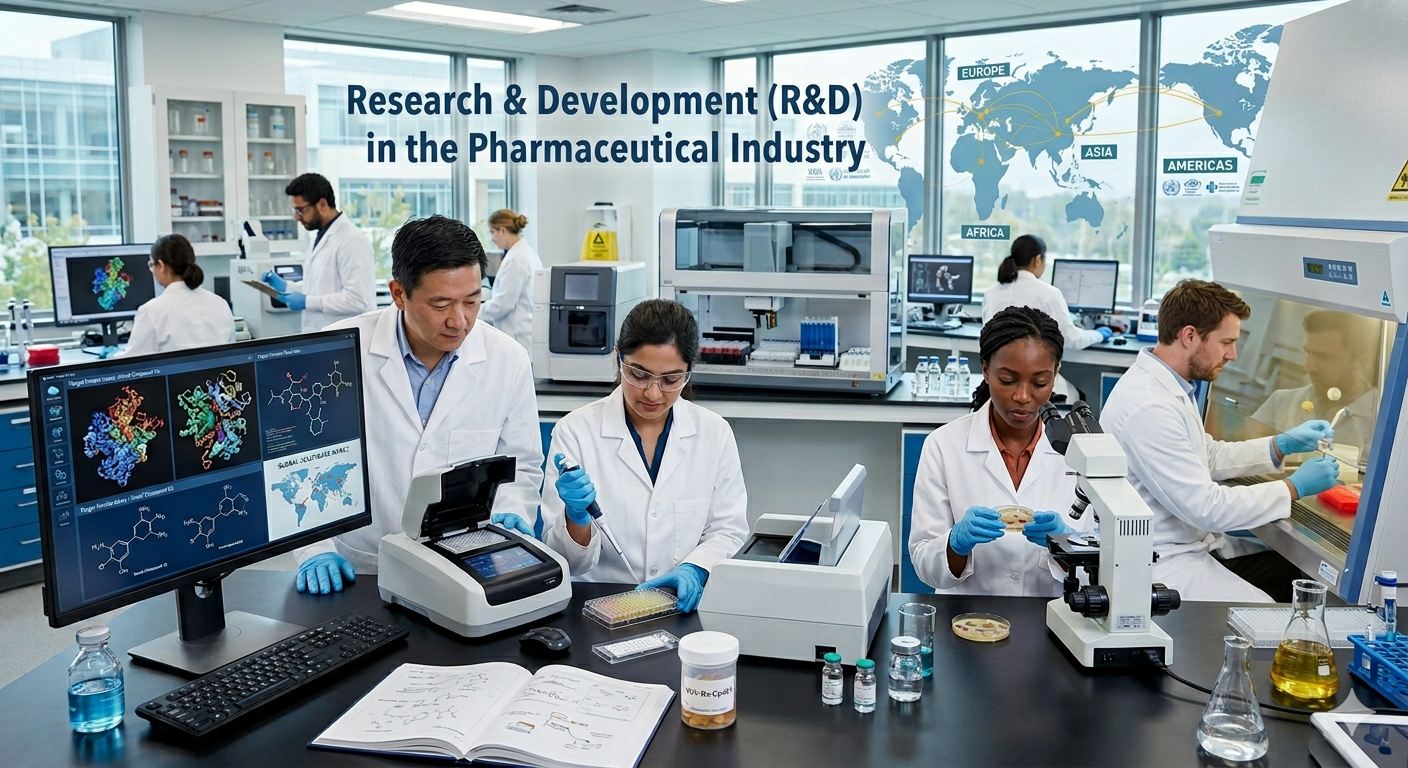
Introduction to Pharmaceutical R&D
Research & Development (R&D) in the pharmaceutical industry refers to the scientific, technical, and regulatory activities involved in discovering, developing, testing, and commercializing new medicines and healthcare products. Pharmaceutical R&D is the backbone of innovation that transforms scientific discoveries into life-saving therapies.
The pharmaceutical industry continuously invests billions of dollars in R&D to address unmet medical needs, improve patient outcomes, and combat emerging diseases. From discovering new molecules to developing vaccines and advanced therapies, pharmaceutical R&D plays a critical role in advancing global healthcare systems.
Modern pharmaceutical companies rely heavily on innovation to remain competitive and compliant with evolving healthcare demands. R&D departments integrate chemistry, biology, biotechnology, engineering, clinical sciences, and regulatory knowledge to create safe, effective, and high-quality pharmaceutical products.
Over the years, pharmaceutical research has evolved significantly:
| Era | Key Development |
|---|---|
| Traditional Era | Herbal and natural medicines |
| Chemical Era | Synthetic drug development |
| Biotechnology Era | Monoclonal antibodies and recombinant products |
| Digital Era | AI-driven drug discovery and personalized medicine |
Today, pharmaceutical R&D combines advanced analytics, artificial intelligence, genomics, and automation to accelerate drug development and improve therapeutic precision.
Objectives of Pharmaceutical R&D
The primary objective of pharmaceutical R&D is to develop medicines that improve human health while ensuring safety, efficacy, and quality.
Key Objectives
1. Development of Safe and Effective Medicines
Pharmaceutical R&D focuses on identifying therapeutic compounds that can treat diseases with minimal adverse effects.
2. Improvement of Existing Formulations
Existing products are continuously optimized to improve:
- Stability
- Patient compliance
- Bioavailability
- Shelf life
- Ease of administration
3. Discovery of New Therapeutic Molecules
Researchers identify new active pharmaceutical ingredients (APIs) to address unmet medical needs.
4. Enhancing Patient Compliance
Innovative dosage forms such as sustained-release tablets, transdermal patches, and orally disintegrating tablets improve patient adherence.
5. Reduction of Side Effects
Advanced formulation technologies help reduce toxicity and adverse reactions.
6. Improving Bioavailability
Novel delivery systems enhance drug absorption and therapeutic effectiveness.
Major Areas of Pharmaceutical R&D
1. Drug Discovery Research
Drug discovery involves identifying potential molecules that can treat diseases.
Functions
- Target identification
- Lead molecule screening
- Molecular optimization
- Pharmacological evaluation
Industrial Applications
- Oncology drugs
- Antiviral therapies
- Cardiovascular medicines
2. Preformulation Studies
Preformulation studies evaluate the physical and chemical properties of drug substances before formulation development.
Key Studies
- Solubility analysis
- Particle size determination
- Hygroscopicity testing
- Compatibility studies
Importance
These studies help select suitable excipients and manufacturing processes.
3. Formulation Development
Formulation scientists design dosage forms such as:
- Tablets
- Capsules
- Injectables
- Suspensions
- Ointments
Responsibilities
- Excipient selection
- Optimization studies
- Scale-up trials
- Stability assessment
4. Analytical Method Development
Analytical scientists develop validated methods for drug analysis.
Techniques Used
- HPLC
- GC
- UV Spectroscopy
- FTIR
Applications
- Assay testing
- Impurity profiling
- Dissolution testing
- Stability analysis
5. Process Development
Process development focuses on designing robust and scalable manufacturing processes.
Objectives
- Process optimization
- Yield improvement
- Cost reduction
- Validation readiness
6. Clinical Research
Clinical research evaluates drug safety and efficacy in humans.
Activities
- Clinical trial design
- Subject monitoring
- Data analysis
- Adverse event reporting
7. Biotechnology & Biosimilars
Biotechnology research develops products derived from living systems.
Examples
- Monoclonal antibodies
- Recombinant insulin
- Vaccines
- Biosimilars
8. Novel Drug Delivery Systems (NDDS)
NDDS improves targeted drug delivery and therapeutic efficiency.
Examples
- Liposomes
- Nanoparticles
- Transdermal systems
- Controlled-release formulations
9. Stability Studies
Stability studies determine product shelf life under environmental conditions.
Conditions Evaluated
- Temperature
- Humidity
- Light exposure
Guidelines
Conducted according to ICH stability protocols.
10. Regulatory Documentation & Filing
Regulatory teams prepare submissions for health authorities.
Documents
- ANDA
- NDA
- CTD
- DMF
Drug Development Process
1. Drug Discovery
Scientists identify disease targets and screen thousands of compounds to find promising candidates.
2. Preclinical Studies
Preclinical testing includes:
- Toxicology studies
- Animal studies
- Pharmacokinetics
- Pharmacodynamics
Purpose
To evaluate safety before human trials.
3. Clinical Trials
Phase I
- Conducted in healthy volunteers
- Evaluates safety and dosage
Phase II
- Conducted in patients
- Assesses efficacy and side effects
Phase III
- Large patient population
- Confirms effectiveness and safety
Phase IV
- Post-marketing surveillance
- Monitors long-term effects
4. Regulatory Approval
Regulatory authorities review:
- Safety data
- Efficacy data
- Manufacturing quality
- Stability information
5. Commercial Manufacturing
After approval:
- Technology transfer occurs
- Manufacturing scale-up begins
- Validation batches are produced
6. Post-Marketing Surveillance
Continuous monitoring ensures product safety after market launch.
R&D Department Structure in Pharma Companies
| Role | Responsibilities |
|---|---|
| R&D Scientists | Drug research and innovation |
| Formulation Scientists | Dosage form development |
| Analytical Researchers | Method development and validation |
| Clinical Research Associates | Clinical trial coordination |
| Regulatory Affairs Professionals | Submission and compliance |
| Quality Assurance Teams | GMP and quality oversight |
| Technology Transfer Teams | Scale-up and commercialization |
Equipment and Technologies Used in Pharma R&D
HPLC (High-Performance Liquid Chromatography)
Used for:
- Assay testing
- Impurity analysis
- Stability testing
GC (Gas Chromatography)
Used for volatile compound analysis and residual solvent testing.
UV Spectrophotometer
Measures drug concentration using UV absorbance.
Dissolution Apparatus
Evaluates drug release profiles from dosage forms.
Stability Chambers
Maintain controlled temperature and humidity conditions.
FTIR (Fourier Transform Infrared Spectroscopy)
Used for:
- Functional group identification
- Compatibility studies
Particle Size Analyzer
Determines particle distribution affecting dissolution and bioavailability.
Lyophilizer
Used for freeze-drying injectable products and biologics.
Tablet Compression Machine
Compresses granules into tablets under controlled parameters.
Granulation Equipment
Used for wet granulation and dry granulation processes.
AI & Digital Technologies in Pharma Research
Artificial intelligence is revolutionizing pharmaceutical R&D through:
- Predictive analytics
- Molecular modeling
- Clinical data analysis
- Automation
- Digital twins
Importance of R&D in the Pharmaceutical Industry
Innovation and New Drug Discovery
R&D drives continuous innovation in therapies and treatment options.
Improved Healthcare Systems
Advanced medicines improve disease management and reduce hospitalization.
Better Patient Outcomes
Modern formulations improve efficacy and reduce side effects.
Disease Prevention and Treatment
Vaccines and preventive medicines reduce disease burden globally.
Global Pharmaceutical Growth
R&D investments contribute to industrial expansion and market competitiveness.
Personalized Medicine
Precision therapies target individual genetic profiles.
Vaccine Development
Rapid vaccine development became critical during global pandemics.
Rare Disease Treatment
Advanced biotechnology enables treatment for orphan diseases.
Impact of Pharmaceutical R&D on Society
Impact on Global Health
Pharmaceutical innovation has significantly reduced mortality rates worldwide.
Increased Life Expectancy
Modern medicines have extended average human lifespan.
Better Treatment Accessibility
Generic medicines improve affordability and accessibility.
Economic Contribution
The pharmaceutical sector contributes substantially to GDP and exports.
Employment Generation
R&D creates opportunities in:
- Research
- Manufacturing
- Regulatory affairs
- Quality assurance
- Clinical research
Technological Advancement
Pharma R&D drives innovation in biotechnology, automation, and digital healthcare.
Regulatory and Compliance Requirements in Pharma R&D
GMP (Good Manufacturing Practices)
Ensures products are consistently manufactured and controlled.
GLP (Good Laboratory Practices)
Maintains integrity and reliability of laboratory studies.
GCP (Good Clinical Practices)
Protects patient rights and ensures ethical clinical research.
ICH Guidelines
International standards for:
- Stability studies
- Validation
- Risk management
- Quality systems
US FDA Requirements
The US FDA regulates:
- Drug approvals
- Manufacturing compliance
- Clinical studies
EMA Regulations
European Medicines Agency oversees pharmaceutical compliance in Europe.
WHO Guidelines
WHO promotes global pharmaceutical quality standards.
Data Integrity Practices
Key principles include:
- ALCOA+
- Traceability
- Accuracy
- Electronic record compliance
Documentation and Validation
Critical activities:
- Process validation
- Method validation
- Cleaning validation
- Equipment qualification
Challenges in Pharmaceutical R&D
| Challenge | Impact |
|---|---|
| High Research Cost | Increased financial risk |
| Long Development Timeline | Delayed commercialization |
| Clinical Trial Failures | Loss of investment |
| Regulatory Complexity | Compliance burden |
| Patent Expiry | Competitive pressure |
| Market Competition | Pricing challenges |
| Risk Management | Uncertain outcomes |
Developing a new drug may require over 10 years and billions of dollars in investment.
Emerging Trends in Pharma R&D
Artificial Intelligence in Drug Discovery
AI accelerates molecule screening and predictive modeling.
Personalized Medicine
Therapies are increasingly tailored to individual genetic profiles.
Gene Therapy
Gene editing technologies are transforming treatment approaches.
Biopharmaceuticals
Biologics dominate modern therapeutic pipelines.
Continuous Manufacturing
Continuous processes improve efficiency and product consistency.
Automation in R&D Labs
Robotics improve laboratory productivity and reduce errors.
Digital Transformation
Digital systems improve:
- Data management
- Clinical monitoring
- Regulatory compliance
Career Opportunities in Pharmaceutical R&D
Required Qualifications
Educational Background
- B.Pharm
- M.Pharm
- Pharm.D
- MSc
- Biotechnology
- PhD
Technical Skills Needed
Essential Skills
- GMP knowledge
- Analytical techniques
- Documentation practices
- Problem-solving
- Data interpretation
Career Growth Opportunities
| Entry-Level | Mid-Level | Senior-Level |
|---|---|---|
| Research Associate | Scientist | Senior Scientist |
| Analyst | Team Lead | R&D Manager |
| Trainee | Project Manager | Director R&D |
Salary Prospects
Salary varies depending on:
- Qualification
- Experience
- Company
- Country
- Specialization
Biotechnology and clinical research professionals often receive competitive compensation packages.
Best Certifications and Training Programs
Recommended certifications:
- GMP Certification
- Clinical Research Certification
- Regulatory Affairs Training
- Validation Programs
- Data Integrity Training
Future Scope of Pharmaceutical R&D
The future of pharmaceutical R&D is highly promising due to:
- Rising healthcare demand
- Aging population
- Emerging diseases
- Biotech innovation
- AI integration
Best Practices in Pharmaceutical Research
Maintain Strong Documentation
Ensure accurate and traceable records.
Follow Regulatory Guidelines
Strict compliance prevents regulatory observations.
Implement Quality by Design (QbD)
QbD improves product and process understanding.
Ensure Data Integrity
Reliable data supports regulatory acceptance.
Encourage Cross-Functional Collaboration
Effective coordination improves project success.
Invest in Continuous Training
Updated knowledge enhances productivity and compliance.
Key Takeaways
- Pharmaceutical R&D is the foundation of healthcare innovation.
- Drug development involves extensive scientific and regulatory processes.
- Compliance with GMP, GLP, GCP, and ICH guidelines is essential.
- AI and biotechnology are transforming modern pharmaceutical research.
- Pharmaceutical R&D contributes significantly to global health and economic development.
- Career opportunities in pharma research continue to expand globally.
Future Outlook of the Pharmaceutical R&D Industry
The pharmaceutical R&D industry is expected to witness unprecedented growth driven by:
- Artificial intelligence
- Genomics
- Precision medicine
- Advanced biologics
- Digital healthcare integration
Future pharmaceutical research will focus on faster drug development, improved therapeutic targeting, reduced healthcare costs, and enhanced patient-centered treatments.
Emerging technologies such as machine learning, automation, and gene editing will continue reshaping pharmaceutical innovation and global healthcare delivery.
FAQs on Pharmaceutical R&D
What is pharmaceutical R&D?
Pharmaceutical R&D involves discovering, developing, testing, and commercializing medicines and healthcare products.
Why is R&D important in the pharmaceutical industry?
R&D enables the development of innovative therapies that improve patient outcomes and healthcare systems.
What are the major stages of drug development?
The major stages include discovery, preclinical studies, clinical trials, regulatory approval, manufacturing, and post-marketing surveillance.
What qualifications are required for a career in pharma R&D?
Common qualifications include B.Pharm, M.Pharm, MSc, Biotechnology, Pharm.D, and PhD.
What is the role of AI in pharmaceutical R&D?
AI helps accelerate drug discovery, optimize clinical trials, and improve predictive analytics.
What are NDDS in pharmaceuticals?
Novel Drug Delivery Systems (NDDS) are advanced technologies designed to improve targeted and controlled drug delivery.
What regulations govern pharmaceutical R&D?
Major regulations include GMP, GLP, GCP, ICH guidelines, US FDA regulations, EMA standards, and WHO guidelines.
Conclusion
Research & Development (R&D) is the driving force behind pharmaceutical innovation and modern healthcare advancement. From discovering new therapeutic molecules to developing advanced biologics and personalized medicines, pharmaceutical R&D continues to transform the global healthcare landscape.
The pharmaceutical research sector not only improves patient outcomes but also contributes significantly to economic growth, employment generation, and technological advancement. Despite challenges such as high development costs, stringent regulations, and lengthy timelines, the future of pharmaceutical R&D remains exceptionally promising.
With the integration of artificial intelligence, biotechnology, automation, and digital transformation, pharmaceutical companies are entering a new era of scientific innovation and healthcare excellence. Continuous investment in research, regulatory compliance, and technological advancement will remain essential for shaping the future of global healthcare.
About the Author
Ramesh Palav is a pharmaceutical manufacturing professional with 21+ years of experience in Oral Solid Dosage manufacturing, production operations, GMP compliance, qualification, validation, QMS and operational excellence. Through Pharma Manufacturing Hub, he shares practical industry knowledge with pharmaceutical professionals, students and manufacturing leaders.
Published on : 08/07/2026.