
18.1 Introduction
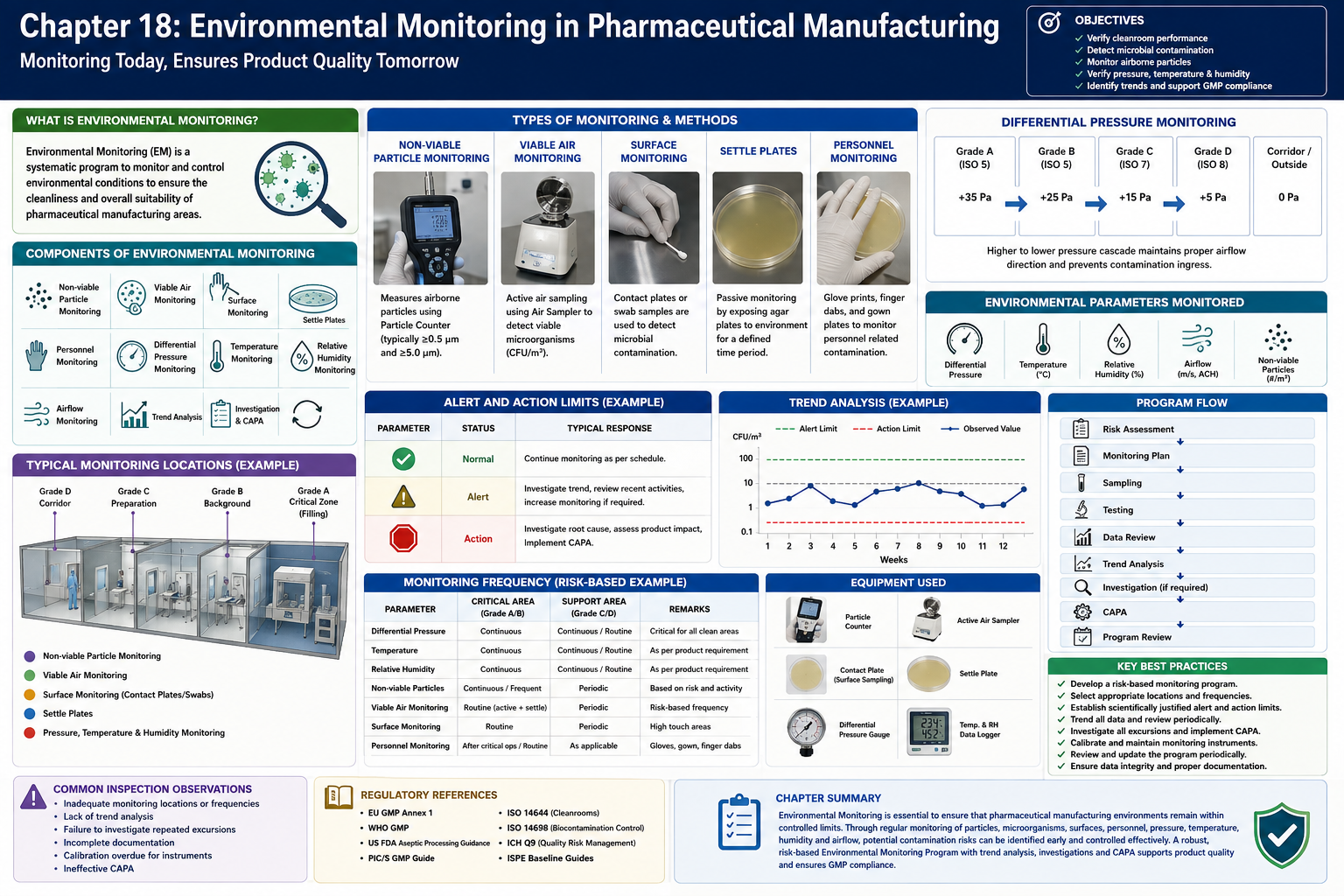
Environmental Monitoring (EM) is a systematic program used to verify that pharmaceutical manufacturing environments remain in a state of control. It provides documented evidence that cleanrooms, controlled environments, HVAC systems, and contamination control measures continue to perform as designed and qualified.
An effective Environmental Monitoring Program (EMP) is a fundamental requirement of pharmaceutical Good Manufacturing Practices (GMP) and is a key element of a facility’s Contamination Control Strategy (CCS). Environmental monitoring supports product quality by detecting adverse environmental trends before they impact manufacturing operations.
Environmental monitoring is particularly critical in:
- Sterile pharmaceutical manufacturing
- Injectable manufacturing
- Biotechnology facilities
- Cell and gene therapy facilities
- Vaccine manufacturing
- Oral Solid Dosage (OSD) manufacturing (risk-based)
- Active Pharmaceutical Ingredient (API) manufacturing (risk-based)
18.2 Objectives of Environmental Monitoring
The objectives are to:
- Verify cleanroom performance.
- Confirm HVAC effectiveness.
- Detect microbial contamination.
- Monitor airborne particulate levels.
- Verify pressure differentials.
- Monitor temperature and humidity.
- Identify contamination trends.
- Support batch release decisions where applicable.
- Demonstrate GMP compliance.
18.3 Regulatory Requirements
Environmental monitoring programs should comply with:
| Guideline | Requirement |
|---|---|
| EU GMP Annex 1 | Environmental and process monitoring |
| WHO GMP | Cleanroom monitoring |
| US FDA Aseptic Processing Guidance | Environmental monitoring |
| PIC/S GMP Guide | Environmental control |
| ISO 14644 | Particle monitoring and cleanroom testing |
| ISO 14698 | Biocontamination control |
| ICH Q9 | Risk-based monitoring |
| ISPE Baseline Guides | Monitoring strategies |
18.4 Components of an Environmental Monitoring Program (EMP)
A comprehensive EMP includes:
- Non-viable particle monitoring
- Viable air monitoring
- Surface monitoring
- Personnel monitoring
- Differential pressure monitoring
- Temperature monitoring
- Relative humidity monitoring
- Airflow verification
- Trend analysis
- Investigation and CAPA
18.5 Environmental Monitoring Strategy
The monitoring strategy should be developed using Quality Risk Management (ICH Q9) and should consider:
- Product type
- Process risk
- Cleanroom grade
- Manufacturing activity
- Historical data
- Critical interventions
- Personnel movement
- HVAC design
Monitoring frequencies and locations should be periodically reviewed based on risk and performance trends.
18.6 Non-Viable Particle Monitoring
Purpose
To monitor airborne particles generated by:
- Personnel
- Equipment
- HVAC systems
- Manufacturing activities
Equipment
- Optical Particle Counter
- Continuous Particle Monitoring System
- Portable Particle Counter
Typical Particle Sizes
- ≥0.5 µm
- ≥5.0 µm
18.7 Typical Monitoring Locations
Particle monitoring should be performed at locations such as:
- Filling zones
- Laminar airflow workstations
- Grade B background
- Solution preparation rooms
- Dispensing booths
- Compression rooms (risk-based)
- Coating rooms (risk-based)
Sampling locations should be justified through documented risk assessment.
18.8 Viable Air Monitoring
Viable monitoring detects microorganisms suspended in air.
Equipment
- Active Air Sampler
- Microbial Air Sampler
Typical Microorganisms
- Bacteria
- Yeasts
- Molds
Results are typically expressed as Colony Forming Units (CFU) per sampled air volume.
18.9 Surface Monitoring
Surface monitoring verifies cleaning and disinfection effectiveness.
Methods
- Contact Plates
- Swab Sampling
Typical Monitoring Points
- Equipment surfaces
- Filling machines
- Work tables
- Pass boxes
- Airlocks
- Door handles
- Gloves
- Walls (risk-based)
18.10 Settle Plates
Settle plates provide passive monitoring of microorganisms that settle from the air.
Applications
- Grade A
- Grade B
- Grade C
- Grade D
Advantages
- Simple operation
- Low cost
- Useful for trend analysis
Settle plates should complement, not replace, active air sampling.
18.11 Personnel Monitoring
Personnel are a major source of contamination.
Typical monitoring includes:
- Glove prints
- Finger dab plates
- Sleeve contact plates
- Gown contact plates
Personnel monitoring is especially important following critical aseptic operations.
18.12 Differential Pressure Monitoring
Pressure monitoring confirms proper airflow direction.
Typical monitoring points:
- Grade A/B
- Grade B/C
- Grade C/D
- Manufacturing room to corridor
- Airlocks
- Pass boxes
Critical pressure differentials are commonly monitored continuously.
18.13 Temperature Monitoring
Temperature affects:
- Product stability
- Equipment performance
- Operator comfort
- Process consistency
Typical monitoring methods:
- Building Management System (BMS)
- Data loggers
- Calibrated temperature sensors
18.14 Relative Humidity Monitoring
Humidity affects:
- Powder flow
- Tablet compression
- Capsule integrity
- Electrostatic charge
- Microbial growth
Typical monitoring:
- Continuous sensors
- Portable calibrated hygrometers
- BMS integration
18.15 Airflow Monitoring
Airflow should be periodically verified to ensure proper cleanroom performance.
Typical tests:
- Air velocity measurement
- Air volume measurement
- Airflow visualization (smoke studies)
- Air changes per hour (ACH)
18.16 Environmental Monitoring Frequencies
The frequency of monitoring should be risk-based.
| Parameter | Typical Frequency* |
|---|---|
| Differential Pressure | Continuous (critical areas) |
| Temperature | Continuous or scheduled |
| Relative Humidity | Continuous or scheduled |
| Non-viable Particles | Continuous or periodic (risk-based) |
| Viable Air Monitoring | Per schedule based on risk |
| Surface Monitoring | Per schedule based on risk |
| Personnel Monitoring | After critical operations or per program |
*Monitoring frequency should be defined by product risk, process criticality, and applicable regulatory guidance.
18.17 Alert and Action Limits
Alert and action limits should be scientifically established based on:
- Cleanroom grade
- Historical environmental data
- Process capability
- Risk assessment
- Regulatory expectations
Example
| Status | Typical Response |
|---|---|
| Normal | Continue monitoring |
| Alert | Investigate trend and increase oversight if needed |
| Action | Investigate root cause, assess product impact, implement CAPA |
Facility-specific limits should be approved and periodically reviewed.
18.18 Trend Analysis
Environmental monitoring data should be trended to identify:
- Gradual deterioration
- Seasonal variation
- Equipment problems
- Cleaning effectiveness
- Personnel performance
- HVAC performance
Typical tools include:
- Control charts
- Statistical trend analysis
- Monthly and annual reports
- CAPA tracking
18.19 Environmental Monitoring Program Flow
Risk Assessment
        │
Monitoring Plan
        │
Sampling
        │
Testing
        │
Data Review
        │
Trend Analysis
        │
Investigation (if required)
        │
CAPA
        │
Program Review
18.20 Monitoring in OSD Manufacturing
Typical monitoring:
| Parameter | Monitoring |
|---|---|
| Temperature | Yes |
| Relative Humidity | Yes |
| Differential Pressure | Yes |
| Dust | Risk-based |
| Particles | Risk-based |
| Microbiology | Based on product and process risk |
18.21 Monitoring in Sterile Manufacturing
Typical monitoring includes:
- Continuous non-viable particle monitoring in critical areas.
- Active viable air sampling.
- Settle plates.
- Contact plates.
- Personnel monitoring.
- Pressure monitoring.
- Temperature and humidity monitoring.
Monitoring should be integrated with aseptic operations and reviewed before batch disposition where appropriate.
18.22 Monitoring in API Manufacturing
Typical monitoring:
- Temperature
- Relative humidity
- Dust levels
- Solvent vapor concentration
- Pressure differential
- Occupational exposure (where required)
Microbiological monitoring is generally performed only when justified by the product or process.
18.23 Qualification of Environmental Monitoring Systems
Monitoring systems should undergo lifecycle qualification.
Qualification Activities
Design Qualification (DQ)
        │
Installation Qualification (IQ)
        │
Operational Qualification (OQ)
        │
Performance Qualification (PQ)
Typical Tests
- Sensor calibration
- Alarm verification
- Data integrity verification
- Software validation (where applicable)
- Data backup verification
18.24 Common Inspection Observations
Regulatory agencies frequently identify:
- Inadequate sampling locations.
- Insufficient monitoring frequency.
- Missing trend analysis.
- Failure to investigate repeated excursions.
- Poor environmental monitoring documentation.
- Inadequate personnel monitoring.
- Incomplete CAPA implementation.
- Lack of periodic program review.
- Calibration overdue for monitoring instruments.
18.25 Best Practices
- Develop a risk-based Environmental Monitoring Program (EMP).
- Define scientifically justified sampling locations and frequencies.
- Trend all environmental data routinely.
- Investigate alert and action level excursions promptly.
- Integrate EM results with the Contamination Control Strategy (CCS).
- Periodically review monitoring plans based on process changes and historical performance.
- Ensure calibration, maintenance, and qualification of all monitoring instruments.
- Train personnel on sampling techniques and data integrity requirements.
18.26 Case Study – Environmental Monitoring in a Sterile Injectable Facility
Facility
Sterile Injectable Manufacturing Plant
Monitoring Program
| Parameter | Strategy |
|---|---|
| Grade A Filling Zone | Continuous particle monitoring and routine viable monitoring |
| Grade B Background | Routine viable and non-viable monitoring |
| Grade C Preparation | Scheduled monitoring |
| Personnel | Glove and gown monitoring |
| Differential Pressure | Continuous |
| Temperature & RH | Continuous |
Results
- Stable environmental conditions.
- Early detection of adverse trends.
- Improved contamination control.
- Successful regulatory inspections.
- Enhanced sterility assurance.
18.27 Environmental Monitoring Audit Checklist
| Checkpoint | Status |
|---|---|
| Environmental Monitoring Program approved | ☐ |
| Sampling locations risk assessed | ☐ |
| Monitoring frequencies justified | ☐ |
| Alert and action limits established | ☐ |
| Trend reports available | ☐ |
| Excursions investigated | ☐ |
| Instruments calibrated | ☐ |
| Personnel monitoring completed | ☐ |
| CAPA implemented where required | ☐ |
| Periodic program review documented | ☐ |
Chapter Summary
Environmental Monitoring is a critical verification tool that demonstrates continued control of pharmaceutical manufacturing environments. By monitoring airborne particles, microorganisms, surfaces, personnel, pressure differentials, temperature, humidity, and airflow, manufacturers can detect emerging contamination risks before they affect product quality. A risk-based Environmental Monitoring Program integrated with the facility’s Contamination Control Strategy, supported by trending, investigations, and CAPA, is essential for maintaining GMP compliance and ensuring the consistent manufacture of safe, effective, and high-quality pharmaceutical products.
Key Takeaways
- Environmental Monitoring verifies that pharmaceutical manufacturing areas remain in a validated state of control.
- Programs should include non-viable particles, viable microorganisms, surfaces, personnel, pressure, temperature, humidity, and airflow as appropriate to the process.
- Sampling plans, frequencies, and limits should be established using Quality Risk Management and periodically reviewed.
- Trend analysis, prompt investigation of excursions, and effective CAPA strengthen contamination control and regulatory compliance.
- Qualified monitoring systems, calibrated instruments, and trained personnel are essential for a robust Environmental Monitoring Program.
Next Chapter
Chapter 19 – Validation Requirements for Pharmaceutical Cubicle Classification, covering Design Qualification (DQ), Installation Qualification (IQ), Operational Qualification (OQ), Performance Qualification (PQ), airflow visualization (smoke studies), HEPA filter integrity testing, air velocity measurement, recovery testing, particle count classification, pressure mapping, temperature and humidity mapping, documentation, and lifecycle validation for pharmaceutical manufacturing facilities.
About the Author
Ramesh Palav is a pharmaceutical manufacturing professional with 21+ years of experience in Oral Solid Dosage manufacturing, production operations, GMP compliance, qualification, validation, QMS and operational excellence. Through Pharma Manufacturing Hub, he shares practical industry knowledge with pharmaceutical professionals, students and manufacturing leaders.