
17.1 Introduction
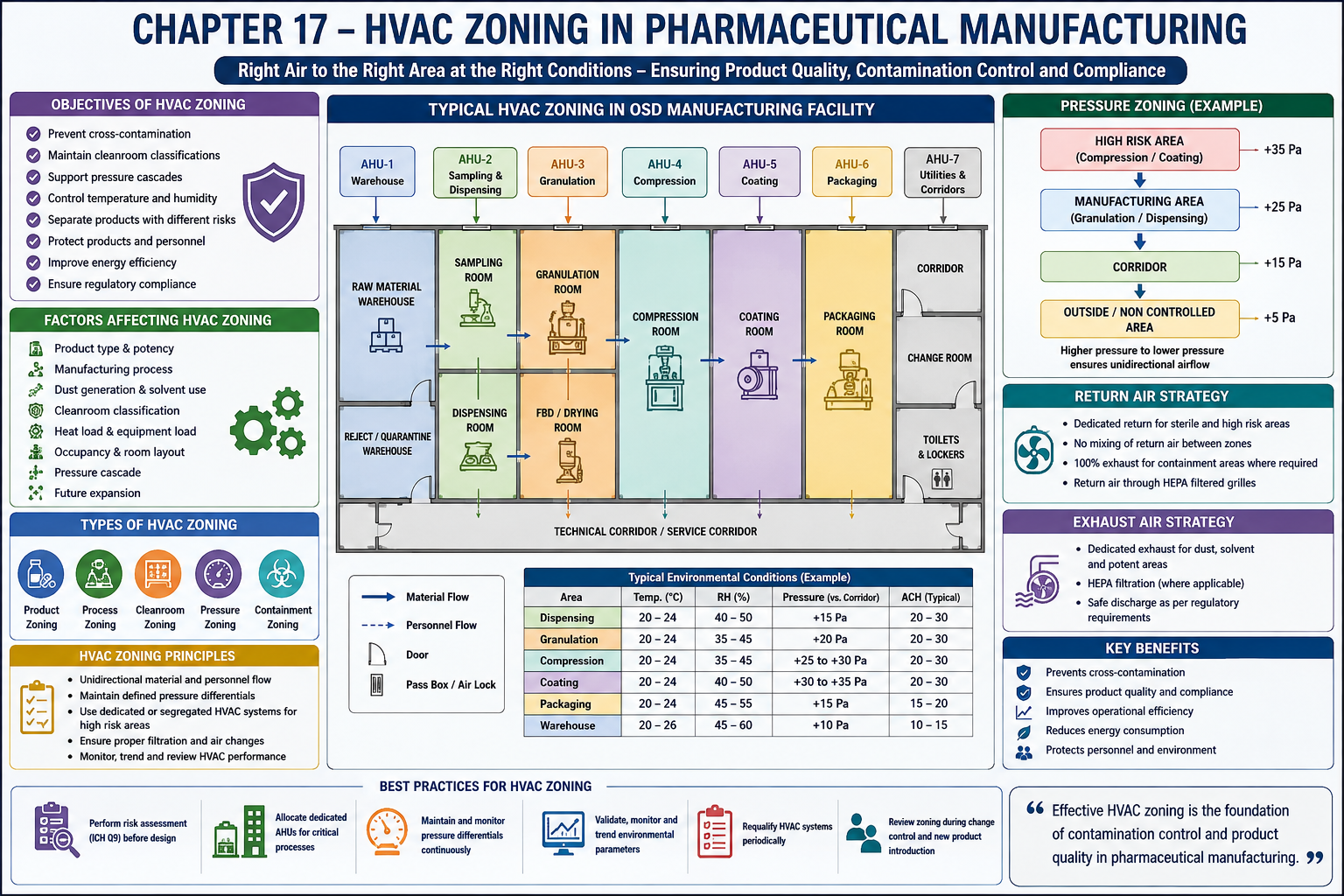
HVAC zoning is one of the most critical engineering principles in pharmaceutical facility design. An effective zoning strategy ensures that each manufacturing area receives the appropriate environmental conditions based on the product, manufacturing operation, contamination risk, cleanroom classification, and regulatory requirements.
A poorly designed HVAC zoning system can result in:
- Cross-contamination
- Pressure cascade failures
- Product quality issues
- Environmental monitoring excursions
- Increased operating costs
- Regulatory observations
- Product recalls
Conversely, a scientifically designed HVAC zoning strategy improves contamination control, energy efficiency, operational flexibility, and lifecycle compliance.
HVAC zoning should be developed during the facility design stage using Quality Risk Management (ICH Q9) and integrated into the facility’s Contamination Control Strategy (CCS).
17.2 Objectives of HVAC Zoning
The objectives of HVAC zoning are to:
- Prevent cross-contamination.
- Maintain cleanroom classifications.
- Support pressure cascades.
- Control temperature and humidity.
- Separate products with different risks.
- Protect personnel and products.
- Improve HVAC efficiency.
- Simplify maintenance and qualification.
- Ensure regulatory compliance.
17.3 Regulatory Requirements
HVAC zoning should comply with:
| Guideline | HVAC Zoning Requirement |
|---|---|
| WHO GMP | Environmental control and segregation |
| US FDA 21 CFR Parts 210 & 211 | Adequate ventilation and contamination prevention |
| EU GMP Volume 4 | HVAC and premises design |
| EU GMP Annex 1 | Sterile facility zoning |
| PIC/S GMP Guide | HVAC segregation |
| ISPE Baseline Guides | Risk-based HVAC design |
| ISO 14644 | Cleanroom zoning |
| ICH Q9 | Quality Risk Management |
| ICH Q10 | Pharmaceutical Quality System |
17.4 What is HVAC Zoning?
HVAC zoning is the division of a pharmaceutical facility into independent environmental control areas served by one or more Air Handling Units (AHUs) designed to maintain specified:
- Temperature
- Relative Humidity (RH)
- Pressure Differential
- Air Changes per Hour (ACH)
- Air Cleanliness
- Airflow Direction
Each zone is managed according to the product and process requirements.
17.5 Factors Affecting HVAC Zoning
HVAC zones should be established considering:
- Product type
- Manufacturing process
- Dust generation
- Sterility requirements
- Product potency
- Solvent usage
- Cleanroom classification
- Pressure cascade
- Occupancy
- Heat load
- Equipment load
- Maintenance accessibility
- Future expansion
17.6 Types of HVAC Zoning
             HVAC ZONING
                  │
     ┌────────────┼─────────────┐
     │            │             │
 Product      Process      Cleanroom
  Zoning       Zoning        Zoning
     │            │             │
     └────────────┼─────────────┘
                  │
           Pressure Zoning
                  │
          Containment Zoning
17.7 Product-Based Zoning
Different products may require different HVAC zones based on contamination risk.
| Product Type | Typical HVAC Strategy |
|---|---|
| Tablets | Shared or dedicated (risk-based) |
| Capsules | Shared or dedicated (risk-based) |
| Sterile Injectables | Dedicated HVAC |
| Vaccines | Dedicated HVAC |
| Hormones | Dedicated HVAC |
| Cytotoxic Products | Dedicated HVAC |
| Beta-Lactams | Dedicated HVAC with complete segregation |
| Penicillins | Dedicated building or highly segregated facilities, as required by applicable GMP |
| Cephalosporins | Segregated facilities based on risk assessment and regulatory expectations |
17.8 Process-Based Zoning
Each manufacturing process can require its own HVAC zone.
Example:
AHU-1
Warehouse

AHU-2
Sampling

AHU-3
Dispensing

AHU-4
Granulation

AHU-5
Compression

AHU-6
Coating

AHU-7
Packaging
This arrangement minimizes contamination transfer between operations.
17.9 Cleanroom Zoning
Cleanroom classification often determines HVAC zoning.
| Area | Typical HVAC Zone |
|---|---|
| Grade A | Dedicated |
| Grade B | Dedicated |
| Grade C | Dedicated or grouped (risk-based) |
| Grade D | Grouped where appropriate |
| Controlled OSD Areas | Process-based zoning |
| Warehouses | Separate zone |
17.10 AHU Zoning
Air Handling Units are typically allocated according to process risk.
Example
AHU-1 → Warehouse

AHU-2 → Dispensing

AHU-3 → Granulation

AHU-4 → Compression

AHU-5 → Sterile Suite

AHU-6 → Packaging

AHU-7 → Utility Areas
Dedicated AHUs reduce the risk of contamination between manufacturing operations.
17.11 Dedicated HVAC Systems
Dedicated HVAC systems are generally recommended for:
- Sterile manufacturing
- HPAPI manufacturing
- Cytotoxic facilities
- Hormonal products
- Penicillin manufacturing
- Certain cephalosporin facilities
- Biological products
- Vaccine production
Advantages
- Reduced cross-contamination risk
- Independent qualification
- Better pressure control
- Simplified maintenance planning
17.12 Shared HVAC Systems
Shared HVAC systems may be appropriate for:
- Conventional OSD manufacturing
- Packaging areas
- Warehouses
- Administrative areas
Their suitability should be justified through documented Quality Risk Management.
17.13 Return Air Zoning
Return air design significantly affects contamination control.
Return Air Options
| Strategy | Typical Application |
|---|---|
| Dedicated Return | Sterile areas |
| Shared Return | Low-risk OSD areas (risk-based) |
| No Return (100% Exhaust) | Potent products, hazardous materials, solvent handling areas where required |
Return air should not compromise product quality or personnel safety.
17.14 Fresh Air Zoning
Fresh air requirements depend on:
- Occupancy
- Solvent use
- Heat load
- Process emissions
- Cleanroom classification
Typical fresh air sources include:
- Treated Fresh Air Unit (TFA)
- Dedicated outdoor air system
- Central fresh air plant
17.15 Exhaust Air Zoning
Dedicated exhaust systems are commonly required for:
- Potent APIs
- Cytotoxic manufacturing
- Solvent handling
- Dust collectors
- Chemical weighing rooms
Typical Exhaust Flow
Manufacturing Room
        │
Local Exhaust
        │
Dust Collector
        │
HEPA Filter (where applicable)
        │
Safe Discharge
17.16 Pressure Zoning
Pressure zoning supports directional airflow.
Example:
Critical Area
   +35 Pa
      │
Manufacturing
   +25 Pa
      │
Corridor
   +15 Pa
      │
Outside
    +5 Pa
For containment facilities, pressure gradients are reversed to prevent hazardous material escape.
17.17 Containment Zoning
Containment zoning is essential for hazardous products.
Typical containment products:
- HPAPIs
- Hormones
- Cytotoxic drugs
- Sensitizing compounds
Typical layout:
General Corridor
        │
Airlock
        │
Containment Room
        │
Equipment Isolator
Each zone should be evaluated for occupational exposure and containment performance.
17.18 HVAC Zoning for OSD Manufacturing
| Area | AHU Strategy |
|---|---|
| Dispensing | Dedicated or grouped |
| Granulation | Dedicated |
| Compression | Dedicated |
| Coating | Dedicated |
| Packaging | Shared (risk-based) |
The final arrangement depends on product mix, process risk, and operational requirements.
17.19 HVAC Zoning for Sterile Manufacturing
| Area | Recommended HVAC |
|---|---|
| Grade A | Dedicated UDAF system |
| Grade B | Dedicated AHU |
| Grade C | Dedicated or grouped (risk-based) |
| Grade D | Dedicated or grouped (risk-based) |
Airflow and pressure relationships should support aseptic processing and contamination control.
17.20 HVAC Zoning for API Manufacturing
Typical zoning:
AHU-1
Reaction

AHU-2
Drying

AHU-3
Milling

AHU-4
Packaging
Solvent-handling and potent API operations often require dedicated exhaust and HVAC systems.
17.21 Building Management System (BMS)
Modern HVAC zoning is typically managed using a Building Management System.
Typical monitored parameters:
- Temperature
- Relative humidity
- Differential pressure
- Fan status
- Filter status
- Alarm conditions
- Energy consumption
17.22 Qualification of HVAC Zones
Each HVAC zone should undergo lifecycle qualification.
Design Qualification (DQ)
        │
Installation Qualification (IQ)
        │
Operational Qualification (OQ)
        │
Performance Qualification (PQ)
Qualification should confirm that each zone consistently meets predefined acceptance criteria.
17.23 Qualification Tests
| Test | Purpose |
|---|---|
| HEPA Integrity Test | Verify filtration efficiency |
| Air Velocity Test | Verify airflow |
| Air Volume Test | Verify supply and return volumes |
| Differential Pressure Test | Verify pressure zoning |
| Particle Count | Confirm cleanroom classification |
| Temperature Mapping | Verify temperature uniformity |
| Humidity Mapping | Verify RH control |
| Airflow Visualization | Confirm airflow patterns |
| Recovery Test | Demonstrate environmental recovery |
17.24 Common Inspection Observations
Inspectors frequently observe:
- Shared HVAC without documented risk assessment.
- Incorrect pressure zoning.
- Unbalanced supply and return air.
- Inadequate segregation of potent products.
- Poor HVAC documentation.
- Missing requalification records.
- Improper exhaust routing.
- Lack of trend analysis for environmental data.
17.25 Best Practices
- Design HVAC zones using documented Quality Risk Management (QRM).
- Assign dedicated HVAC systems for sterile, potent, and high-risk operations where justified.
- Minimize cross-contamination through appropriate zoning and pressure cascades.
- Continuously monitor critical HVAC parameters via a validated BMS or equivalent system.
- Validate and periodically requalify all HVAC zones.
- Review zoning after process changes, new product introductions, or facility modifications.
- Optimize energy use without compromising contamination control.
17.26 Case Study – HVAC Zoning in a Multi-Product OSD Facility
Facility
Multi-product tablet manufacturing plant
HVAC Arrangement
| AHU | Area Served |
|---|---|
| AHU-1 | Warehouse |
| AHU-2 | Sampling & Dispensing |
| AHU-3 | Granulation |
| AHU-4 | Compression |
| AHU-5 | Coating |
| AHU-6 | Packaging |
| AHU-7 | Utilities and Corridors |
Environmental Conditions
| Area | Temperature | RH | Pressure |
|---|---|---|---|
| Dispensing | 22°C | 45% | +15 Pa |
| Granulation | 22°C | 45% | +20 Pa |
| Compression | 22°C | 40% | +30 Pa |
| Coating | 22°C | 45% | +35 Pa |
| Packaging | 22°C | 50% | +15 Pa |
Benefits
- Effective dust containment.
- Stable pressure cascades.
- Reduced cross-contamination risk.
- Improved HVAC maintenance flexibility.
- Successful GMP inspections.
17.27 HVAC Zoning Audit Checklist
| Checkpoint | Status |
|---|---|
| HVAC zoning documented | ☐ |
| AHU allocation justified | ☐ |
| Dedicated HVAC for high-risk products | ☐ |
| Pressure zoning verified | ☐ |
| Return air strategy documented | ☐ |
| Exhaust systems qualified | ☐ |
| BMS monitoring operational | ☐ |
| HVAC qualification current | ☐ |
| Requalification schedule established | ☐ |
| Change control implemented for zoning modifications | ☐ |
Chapter Summary
HVAC zoning is a cornerstone of pharmaceutical facility design, providing the environmental segregation necessary to protect products, personnel, and processes. By strategically assigning Air Handling Units, controlling pressure relationships, separating high-risk operations, and integrating HVAC performance with the facility’s Contamination Control Strategy, manufacturers can achieve robust contamination control, operational efficiency, and regulatory compliance. A risk-based HVAC zoning approach supports lifecycle performance and adapts to evolving manufacturing requirements.
Key Takeaways
- HVAC zoning should be based on product, process, and contamination risk rather than convenience alone.
- Dedicated HVAC systems are generally appropriate for sterile, potent, highly sensitizing, and other high-risk manufacturing operations.
- Pressure zoning, return air strategy, and exhaust system design are integral to contamination control.
- Building Management Systems (BMS) provide continuous oversight of critical HVAC parameters.
- Regular qualification, requalification, monitoring, and review ensure sustained environmental control and GMP compliance.
Next Chapter
Chapter 18 – Environmental Monitoring in Pharmaceutical Manufacturing, covering non-viable particle monitoring, viable microbial monitoring, air sampling, settle plates, contact plates, personnel monitoring, environmental monitoring programs, alert and action limits, trend analysis, qualification, and regulatory expectations for pharmaceutical manufacturing facilities.
About the Author
Ramesh Palav is a pharmaceutical manufacturing professional with 21+ years of experience in Oral Solid Dosage manufacturing, production operations, GMP compliance, qualification, validation, QMS and operational excellence. Through Pharma Manufacturing Hub, he shares practical industry knowledge with pharmaceutical professionals, students and manufacturing leaders.