
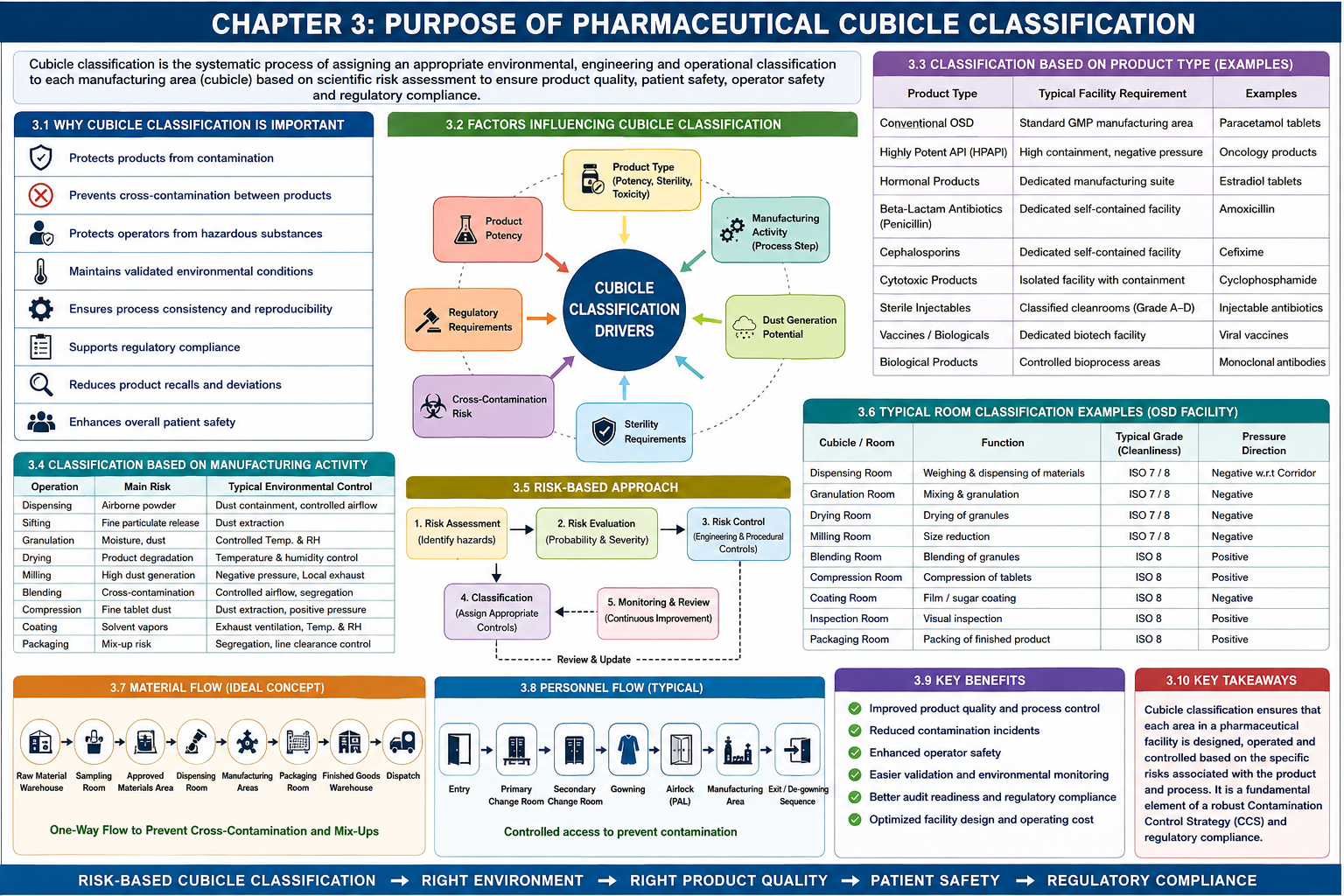
3.1 Introduction
Pharmaceutical manufacturing involves a wide variety of dosage forms, manufacturing technologies, active pharmaceutical ingredients (APIs), excipients, and packaging operations. Each manufacturing activity presents a unique contamination risk profile that must be controlled through appropriate facility design and environmental controls.
Pharmaceutical cubicle classification is the systematic process of assigning a manufacturing area (cubicle or room) an appropriate environmental, engineering, and operational classification based on scientific risk assessment. This classification determines the required level of cleanliness, pressure differential, HVAC performance, air filtration, personnel gowning, material flow, and validation requirements.
Cubicle classification is a cornerstone of Good Manufacturing Practices (GMP) and forms an integral part of the Contamination Control Strategy (CCS) described in EU GMP Annex 1. It ensures that each manufacturing operation is performed in an environment that is fit for its intended purpose while minimizing risks to product quality, patient safety, personnel, and the environment.
3.2 Objectives of Cubicle Classification
The primary objectives are to:
- Protect products from contamination.
- Prevent cross-contamination between products.
- Protect operators from hazardous substances.
- Maintain validated environmental conditions.
- Ensure process consistency and reproducibility.
- Support regulatory compliance.
- Optimize facility operations.
- Facilitate qualification and environmental monitoring.
- Reduce product recalls and deviations.
- Enhance overall patient safety.
3.3 Why Pharmaceutical Cubicles Are Classified
Each manufacturing operation has different environmental requirements. For example:
- Dispensing generates airborne dust.
- Compression creates fine particulate matter.
- Sterile filling requires an aseptic environment.
- Cytotoxic manufacturing requires containment.
- Packaging has relatively lower cleanliness requirements.
Applying the same environmental controls to all operations would either be insufficient or unnecessarily costly. Risk-based cubicle classification ensures that each area receives the level of control appropriate to its specific risks.
3.4 Scientific Basis of Cubicle Classification
Classification is based on understanding the relationship between:
- Product characteristics
- Manufacturing process
- Equipment design
- Airflow patterns
- Human intervention
- Environmental conditions
- Cleaning effectiveness
- Contamination pathways
A comprehensive Quality Risk Management (QRM) assessment should identify hazards and determine the controls needed for each cubicle.
3.5 Classification Based on Product Type
Product characteristics have a significant influence on cubicle design.
| Product Type | Typical Facility Requirement | Example |
|---|---|---|
| Conventional OSD | Standard GMP manufacturing area | Paracetamol tablets |
| Highly Potent API (HPAPI) | High containment, negative pressure | Oncology products |
| Hormonal Products | Dedicated manufacturing suite | Estradiol tablets |
| Beta-Lactam Antibiotics | Dedicated self-contained facility | Amoxicillin |
| Cephalosporins | Dedicated self-contained facility | Cefixime |
| Cytotoxic Products | Dedicated containment facility | Cyclophosphamide |
| Sterile Products | Classified cleanrooms (Grades A–D) | Injectable antibiotics |
| Vaccines | Dedicated biotechnology facility | Viral vaccines |
| Biological Products | Controlled bioprocess areas | Monoclonal antibodies |
Design Principle: As product potency or contamination risk increases, facility segregation and engineering controls become more stringent.
3.6 Classification Based on Manufacturing Activity
Each manufacturing step presents different contamination and containment challenges.
| Operation | Main Risk | Typical Environmental Control |
|---|---|---|
| Sampling | Dust generation | Local extraction, controlled airflow |
| Dispensing | Airborne powder | Dust containment booth, pressure control |
| Sifting | Fine particulate release | Dust extraction |
| Granulation | Moisture and dust | Controlled temperature and RH |
| Drying | Product degradation | Temperature and humidity control |
| Milling | High dust generation | Negative pressure and extraction |
| Blending | Cross-contamination | Controlled airflow and segregation |
| Compression | Fine tablet dust | Dust extraction and positive pressure |
| Coating | Solvent vapors (if applicable) | Ventilation and exhaust |
| Packaging | Mix-up risk | Line clearance and segregation |
3.7 Classification Based on Dust Generation
Dust is one of the most significant contamination sources in pharmaceutical manufacturing.
| Dust Generation Level | Example Operation | Design Considerations |
|---|---|---|
| Low | Visual inspection | Standard HVAC |
| Moderate | Blending | Controlled airflow |
| High | Dispensing | Dust extraction, pressure control |
| Very High | Milling | Dedicated containment, HEPA exhaust |
High-dust operations may require:
- Negative pressure relative to adjacent areas.
- Local exhaust ventilation (LEV).
- High-efficiency dust collectors.
- Dedicated cleaning procedures.
- Enhanced environmental monitoring.
3.8 Classification Based on Product Potency
Highly potent compounds pose risks to operators and adjacent manufacturing areas.
| Potency Category | Typical Approach |
|---|---|
| Non-potent | Standard GMP facility |
| Potent | Enhanced containment |
| Highly Potent (HPAPI) | Dedicated containment suite |
| Cytotoxic | Isolated facility with dedicated HVAC |
Containment strategies may include:
- Isolators
- Restricted Access Barrier Systems (RABS)
- Glove boxes
- Negative-pressure cubicles
- Dedicated air handling systems
- HEPA-filtered exhaust
3.9 Classification Based on Sterility Requirements
Sterile manufacturing requires the highest level of environmental control.
| Operation | Typical EU GMP Grade |
|---|---|
| Aseptic Filling | Grade A |
| Background to Filling | Grade B |
| Solution Preparation | Grade C |
| Equipment Preparation | Grade D |
Key controls include:
- HEPA-filtered unidirectional airflow.
- Strict gowning procedures.
- Continuous environmental monitoring.
- Frequent cleaning and disinfection.
- Validated aseptic processes.
3.10 Classification Based on Cross-Contamination Risk
Cross-contamination can occur through:
- Airborne particles
- Personnel movement
- Material transfer
- Shared equipment
- Utilities
- Cleaning failures
Risk level determines facility design.
| Risk Level | Typical Control Measures |
|---|---|
| Low | Standard segregation |
| Moderate | Pressure cascade, dedicated equipment where appropriate |
| High | Dedicated cubicles, enhanced cleaning, separate HVAC |
| Critical | Dedicated facility, validated containment systems |
3.11 Classification Based on Regulatory Requirements
Regulatory agencies require facility classifications that are scientifically justified and documented.
| Regulatory Body | Key Expectation |
|---|---|
| WHO GMP | Premises suitable for intended operations |
| US FDA | Adequate design to prevent contamination |
| EU GMP | Risk-based facility design and contamination control |
| PIC/S | Scientific justification for segregation |
| ISPE | Engineering best practices |
| ISO 14644 | Cleanroom classification and testing |
Documentation should include:
- User Requirements Specification (URS)
- Design Qualification (DQ)
- Quality Risk Management (QRM)
- Contamination Control Strategy (CCS)
- HVAC design calculations
- Pressure cascade drawings
- Room classification rationale
3.12 Relationship Between Cubicle Classification and HVAC Design
Cubicle classification directly determines HVAC design parameters.
| Classification Factor | HVAC Implication |
|---|---|
| Cleanliness Grade | HEPA filter efficiency and location |
| Product Potency | Exhaust filtration and containment |
| Dust Generation | Air changes per hour and extraction |
| Sterility | Unidirectional airflow where required |
| Temperature Sensitivity | Tight temperature control |
| Moisture Sensitivity | Relative humidity control |
| Pressure Strategy | Positive or negative pressure cascade |
3.13 Relationship with Material and Personnel Flow
Cubicle classification influences facility layout by defining:
- Dedicated personnel entry routes.
- Material airlocks (MALs).
- Personnel airlocks (PALs).
- Waste exit pathways.
- Gowning and de-gowning areas.
- Segregated storage locations.
Typical Flow Concept
Raw Material Warehouse
          │
          ▼
     Sampling Room
          │
          ▼
      Dispensing
          │
          ▼
     Manufacturing
          │
          ▼
      Packaging
          │
          ▼
 Finished Goods Warehouse
The design should minimize crossing of personnel, materials, and waste streams.
3.14 Benefits of Proper Cubicle Classification
Effective cubicle classification provides:
- Improved product quality.
- Reduced contamination incidents.
- Enhanced operator safety.
- Better process control.
- Simplified environmental monitoring.
- Easier validation and qualification.
- Improved operational efficiency.
- Greater audit readiness.
- Lower recall risk.
- Increased regulatory confidence.
3.15 Common Industry Mistakes
Frequently observed deficiencies include:
- Using identical room classifications for different manufacturing operations.
- Inadequate consideration of dust generation.
- Poor pressure cascade design.
- Shared HVAC without documented risk assessment.
- Insufficient segregation of potent products.
- Inadequate personnel or material flow.
- Lack of periodic review of room classifications following process changes.
3.16 Best Practices
- Perform a documented Quality Risk Management (QRM) assessment before assigning room classifications.
- Base classifications on product characteristics, process risks, and contamination potential.
- Review classifications whenever new products or equipment are introduced.
- Integrate cubicle classification with the facility’s Contamination Control Strategy (CCS).
- Verify design intent through HVAC qualification, airflow visualization, environmental monitoring, and periodic requalification.
3.17 Case Study – OSD Tablet Manufacturing
Scenario: A facility manufactures conventional immediate-release tablets.
Risk Assessment Findings:
- Dispensing and milling generate significant dust.
- Compression produces fine particulate matter.
- Coating requires controlled temperature and humidity.
- Packaging presents low particulate risk but high mix-up risk.
Resulting Cubicle Classification:
| Cubicle | Key Design Features |
|---|---|
| Dispensing | Dust extraction, controlled airflow |
| Milling | Local exhaust, pressure control |
| Granulation | Temperature and RH control |
| Compression | Positive pressure to protect product, dust extraction at equipment |
| Coating | Controlled temperature, RH, and exhaust |
| Packaging | Segregated lines, line clearance controls |
This risk-based approach supports GMP compliance while avoiding unnecessary over-classification.
3.18 Chapter Summary
Pharmaceutical cubicle classification is a structured, risk-based process that aligns facility design with product characteristics, manufacturing activities, contamination risks, and regulatory expectations. Rather than applying uniform controls across all areas, GMP requires manufacturers to implement environmental and engineering measures that are proportionate to the risks associated with each operation. When integrated with HVAC design, pressure cascades, material and personnel flows, and a comprehensive Contamination Control Strategy, cubicle classification becomes a fundamental element in achieving product quality, patient safety, and sustainable regulatory compliance.
Key Takeaways
- Cubicle classification should always be based on documented Quality Risk Management (QRM).
- Product type, manufacturing activity, potency, dust generation, sterility, and cross-contamination risk are the primary classification drivers.
- HVAC design, pressure differentials, and facility layout must support the intended room classification.
- Scientific justification and documentation are essential for regulatory acceptance.
- A well-designed cubicle classification system reduces contamination risks, improves operational efficiency, and strengthens inspection readiness.
Next Chapter
Chapter 4 – Types of Pharmaceutical Cubicles, which will provide a detailed engineering and GMP review of manufacturing cubicles (dispensing, granulation, compression, coating, capsule filling, inspection, and packaging) and support cubicles (sampling, washing, equipment hold, change rooms, airlocks, and pass boxes), including their design objectives, environmental controls, and operational requirements.
About the Author
Ramesh Palav is a pharmaceutical professional with 20+ years of industry experience in manufacturing, GMP, quality systems, validation, compliance, and operational excellence. Through Pharma Manufacturing Hub, he shares practical insights on pharmaceutical careers, manufacturing, quality, validation, Pharma 4.0, AI, and professional development.
His goal is to help students, freshers, experienced professionals, and career-break professionals build the knowledge and skills needed to succeed in the pharmaceutical industry.