
Part 2
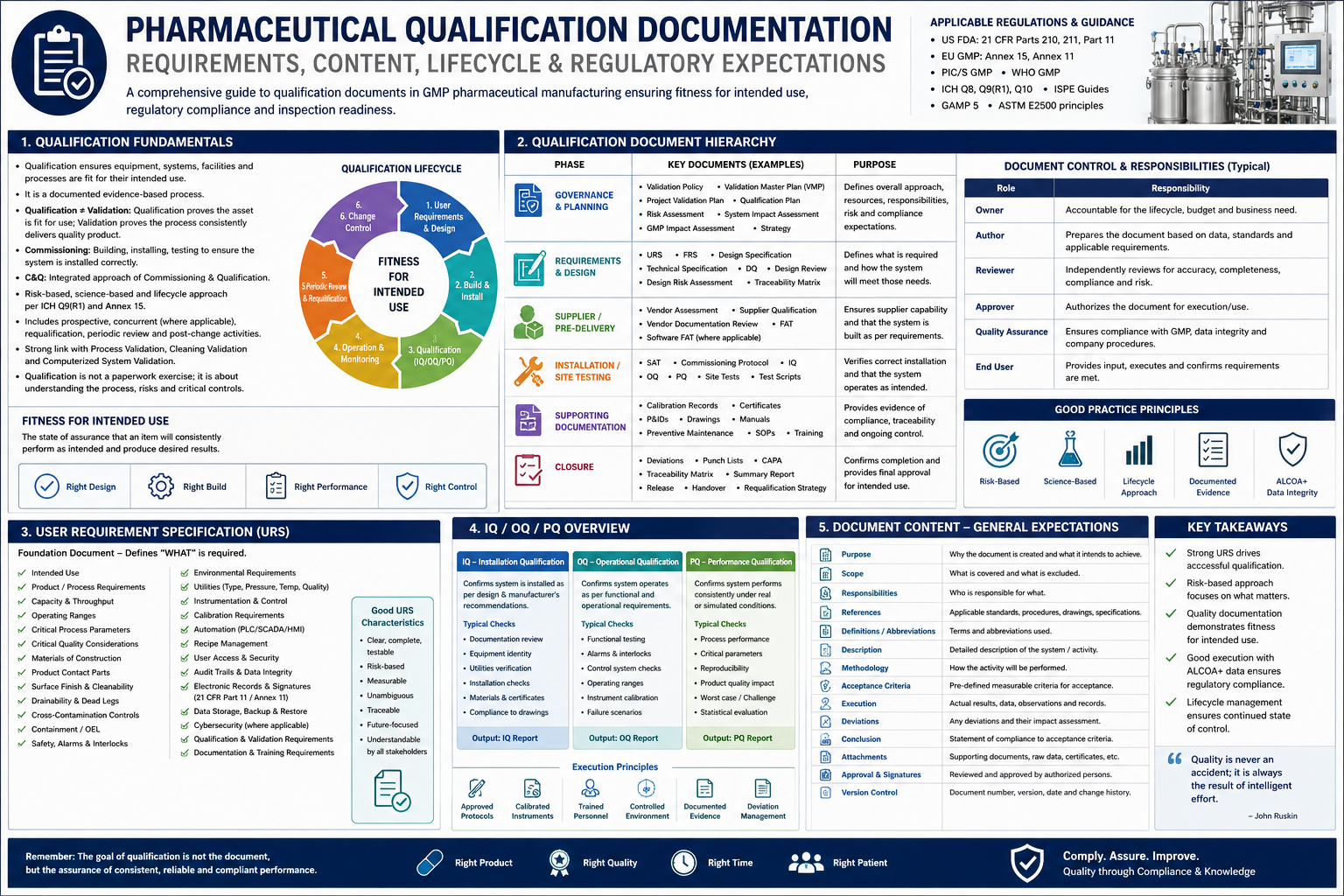
A critical principle applies throughout:
Not every document listed below is universally mandated by regulation as a separately titled document.
The required package depends on the system’s intended use, GMP impact, complexity, risk, applicable regulations, company Pharmaceutical Quality System (PQS), and project strategy. Documents may also be combined where this produces an equally clear, controlled, and traceable evidence package.
2.1 Purpose of the Qualification Document Hierarchy
Qualification documentation should create an evidence chain rather than a collection of independent protocols.
The hierarchy should answer five fundamental questions:
| Question | Principal Evidence |
|---|---|
| What are we trying to achieve? | Intended Use / URS |
| What could affect GMP performance? | Impact & Risk Assessments |
| How will requirements be achieved? | Design specifications / DQ |
| How do we know they were achieved? | FAT/SAT/IQ/OQ/PQ |
| How do we know nothing important was missed? | Traceability / Summary Report |
| How will the state be maintained? | Change Control / PM / Calibration / Periodic Review / Requalification |
The preferred evidence chain is:
Business Need
↓
Validation Policy / VMP
↓
Project or Qualification Strategy
↓
System Definition
↓
URS
↓
Impact Assessment
↓
Risk Assessment
↓
Design Specifications
↓
DQ / Design Review
↓
Supplier Qualification / Vendor Assessment
↓
FAT
↓
Installation
↓
SAT / Commissioning
↓
IQ
↓
OQ
↓
PQ
↓
Traceability
↓
Qualification Summary Report
↓
SOP + Training Readiness
↓
QA/GMP Release
↓
Lifecycle Control
↓
Requalification / Periodic Review
↓
Retirement
2.2 Four-Level Qualification Documentation Model
A practical pharmaceutical hierarchy can be organized into four levels.
| Level | Document Category | Examples |
|---|---|---|
| Level 1 | Corporate/Site Governance | Validation Policy, VMP |
| Level 2 | Project/System Planning | Project Validation Plan, Qualification Plan, Impact Assessment, Risk Assessment |
| Level 3 | Requirements & Verification | URS, DQ, FAT, SAT, IQ, OQ, PQ |
| Level 4 | Evidence & Lifecycle Records | Raw data, calibration records, deviations, reports, traceability, release, periodic review |
This hierarchy creates vertical traceability from policy to execution evidence.
2.3 Governance and Planning Documents
2.3.1 Validation Policy
Definition
A Validation Policy is a high-level company or site document establishing the organization’s overall philosophy and governance for qualification and validation.
Purpose
It defines how the organization intends to control validation activities across its GMP operations.
GMP rationale
A pharmaceutical manufacturer requires an organized and controlled validation system. The precise title “Validation Policy” is generally an organizational choice rather than a universal requirement for a separately titled document.
Typical owner
Quality Assurance / Validation Governance
Typical author
- Validation
- QA
- Corporate Quality
- Site Quality
Typical reviewers
- Engineering
- Production
- QC
- IT/Automation
- Quality Systems
Typical approver
Senior Quality management according to the company’s document-management system.
Minimum content
A robust policy may define:
- purpose;
- scope;
- regulatory framework;
- validation philosophy;
- lifecycle approach;
- risk-based methodology;
- roles and responsibilities;
- qualification categories;
- validation categories;
- computerized-system approach;
- data-integrity principles;
- change control;
- deviation management;
- requalification;
- periodic review;
- document retention;
- retirement/decommissioning.
Typical deficiency
A policy states:
“All GMP equipment shall undergo IQ/OQ/PQ.”
This may be too simplistic because it does not explain how qualification scope is determined according to intended use and risk.
2.4 Validation Master Plan — VMP
The VMP is one of the most important site-level validation governance documents.
Purpose
The VMP describes the site’s overall validation/qualification strategy and provides a structured framework for controlling validation activities.
Typical lifecycle position
Site/Project Planning
Typical owner
Validation/QA depending on the company’s PQS.
Typical preparation
Validation/CQV.
Typical review
Cross-functional review involving, as appropriate:
- QA;
- Production;
- Engineering;
- QC;
- IT;
- Automation;
- Utilities;
- Validation.
Typical approval
QA and designated site management functions according to the PQS.
Recommended VMP Structure
1. Introduction
Purpose and validation philosophy.
2. Site description
Overview of:
- manufacturing operations;
- dosage forms;
- buildings;
- production areas;
- laboratories;
- warehouses;
- major utilities.
3. Scope
Define systems covered by the VMP.
4. Validation organization
Define responsibilities.
5. Qualification strategy
Define the approach to:
- facilities;
- utilities;
- equipment;
- HVAC;
- computerized/automated systems.
6. Process validation strategy
Define lifecycle expectations.
7. Cleaning validation strategy
8. Analytical validation strategy
Where relevant.
9. Computerized system strategy
10. Risk management
Explain how risk influences qualification effort.
11. Documentation
Define documentation hierarchy.
12. Deviations
Define handling requirements.
13. Change control
Define lifecycle control.
14. Requalification
Define triggers and periodic requirements where applicable.
15. Periodic review
16. Validation schedule/status
17. Document retention
18. Retirement/decommissioning
2.5 Project Validation Plan
Large projects frequently require a project-specific validation plan.
Examples:
- new manufacturing facility;
- brownfield expansion;
- new granulation suite;
- new packaging line;
- HVAC upgrade;
- purified-water system;
- major automation implementation.
Purpose
Translate the high-level VMP strategy into a project-specific execution strategy.
Typical contents
- project description;
- project boundaries;
- systems/equipment list;
- GMP-impact methodology;
- risk methodology;
- document strategy;
- C&Q strategy;
- supplier involvement;
- FAT/SAT approach;
- commissioning leverage strategy;
- IQ/OQ/PQ strategy;
- CSV/automation strategy;
- responsibilities;
- schedule;
- deliverables;
- acceptance/release strategy;
- change management;
- deviation management;
- turnover requirements.
2.6 Qualification Plan
A Qualification Plan is typically system- or project-specific.
Example
Qualification Plan — Tablet Compression Machine CM-101
It may establish:
- qualification scope;
- system boundaries;
- URS reference;
- risk-assessment approach;
- FAT strategy;
- SAT strategy;
- IQ strategy;
- OQ strategy;
- PQ requirements;
- automation testing;
- supplier-document leverage;
- responsibilities;
- prerequisites;
- deviation management;
- traceability;
- final-release requirements.
Best practice
The plan should answer:
What evidence will be generated to demonstrate this particular system is fit for intended use?
2.7 System Boundary Definition
Before qualification begins, define exactly what constitutes the system.
Consider a tablet compression machine.
The boundary may include:
Incoming power
↓
Compression machine
↓
PLC/HMI
↓
Deduster interface
↓
Metal detector interface
↓
Reject system
↓
Data/network interface
The qualification team must determine which items belong inside the system boundary and which are separately qualified systems.
Why important
Poor boundary definition can produce:
- duplicated testing;
- missing interface testing;
- ownership gaps;
- unqualified components;
- incomplete change assessment.
2.8 System Impact Assessment
A System Impact Assessment determines whether and how a system can affect GMP operations.
Potential impacts include:
- product quality;
- patient safety;
- identity;
- strength;
- purity;
- critical process parameters;
- critical quality attributes;
- contamination control;
- environmental conditions;
- GMP records;
- electronic records;
- data integrity.
Example classification
| System | Potential GMP Impact |
|---|---|
| Compression machine | Significant/direct |
| Purified-water system | Significant/direct |
| Product-contact blender | Significant/direct |
| Critical HVAC system | Significant |
| Office air conditioner | Normally no direct GMP impact |
| Administrative printer | Depends on intended use |
These classifications must be based on actual intended use, not equipment names alone.
2.9 GMP Impact Assessment
A GMP Impact Assessment asks:
Could the system or function affect a GMP requirement or GMP-controlled activity?
A practical assessment may examine:
| Question | Yes/No | Rationale |
|---|---|---|
| Product contact? | ||
| Controls CPP? | ||
| Influences CQA? | ||
| Generates GMP data? | ||
| Stores GMP records? | ||
| Controls contamination? | ||
| Controls environmental conditions? | ||
| Controls critical utility? | ||
| Performs automated decisions? | ||
| Controls reject decisions? |
The output influences qualification scope.
2.10 Quality Risk Assessment
Once GMP impact has been identified, risk assessment helps determine what requires verification and how much assurance is appropriate.
Risk assessment should consider:
Failure Mode
↓
Potential GMP Consequence
↓
Existing Design/Process Controls
↓
Risk Evaluation
↓
Required Risk Control
↓
Qualification Verification
↓
Residual Risk
Example
For a compression machine:
Failure mode: Reject mechanism fails.
Potential effect: Nonconforming tablets may not be removed.
Control: Automated reject mechanism with confirmation logic.
Qualification action: Challenge reject functionality during OQ.
The risk assessment therefore directly drives testing.
2.11 Validation / Qualification Strategy
The strategy document defines the overall verification philosophy.
It may determine:
- what requires DQ;
- which supplier documents will be reviewed;
- FAT scope;
- SAT scope;
- commissioning leverage;
- IQ scope;
- OQ scope;
- PQ requirements;
- CSV requirements;
- critical testing;
- traceability;
- requalification strategy.
A strategy is particularly useful for complex systems where a simple IQ/OQ/PQ approach is insufficient.
2.12 Requirements and Design Documentation
The next level converts intended use into technical requirements.
The relationship is approximately:
URS
↓
Functional Requirements
↓
Design/Technical Specifications
↓
Configuration
↓
Verification
2.13 User Requirement Specification — URS
The URS defines what the user needs from the system.
Purpose
Translate business, process, GMP, quality, safety, operational, maintenance, and data requirements into testable requirements.
Typical owner
User department.
Typical authors
Cross-functional team involving:
- Production/User;
- Engineering;
- Validation;
- QA;
- Automation;
- IT;
- EHS;
- Maintenance.
Typical approvers
Defined by the PQS; usually includes the user and QA with relevant technical approval.
Minimum URS Content
Typical categories include:
Process
- capacity;
- operating range;
- load;
- speed;
- critical parameters.
Mechanical
- materials of construction;
- product-contact parts;
- surface finish;
- cleanability.
Utilities
- electricity;
- compressed air;
- vacuum;
- water;
- HVAC/environmental requirements.
Instrumentation
- sensors;
- ranges;
- accuracy requirements;
- calibration.
Automation
- PLC;
- HMI;
- SCADA;
- recipes;
- alarms;
- interlocks.
Data integrity
Where applicable:
- access control;
- audit trails;
- records;
- retention;
- backup;
- restore;
- time synchronization.
Documentation
- drawings;
- manuals;
- certificates;
- software documents;
- spare-parts documentation.
Qualification
- FAT;
- SAT;
- commissioning;
- qualification support.
Each requirement should ideally have a unique identifier:
URS-001
URS-002
URS-003
This supports traceability.
2.14 Functional Requirement Specification — FRS
The FRS describes how the system is expected to function to meet user requirements.
Example:
URS
The system shall prevent operation when the main safety guard is open.
Functional requirement
The FRS may define:
Opening the main guard shall cause the safety circuit to remove the applicable machine enable and prevent machine operation until defined reset conditions are satisfied.
The exact technical solution belongs in subsequent design documentation.
2.15 Design Specification
The Design Specification defines how the system will technically meet the requirements.
It may describe:
- mechanical architecture;
- electrical architecture;
- control philosophy;
- instrumentation;
- piping;
- automation;
- interfaces;
- safety;
- data handling.
The document may be produced by the vendor, engineering contractor, system integrator, or internal engineering team.
2.16 Technical Specification
A Technical Specification provides detailed technical requirements for procurement, fabrication, configuration, or implementation.
Typical content:
- dimensions;
- construction;
- materials;
- motor ratings;
- instrumentation;
- electrical standards;
- utility consumption;
- control requirements;
- environmental requirements;
- documentation requirements.
Depending on project structure, technical specifications may overlap with or form part of design specifications.
2.17 Hardware Design Specification
For automated systems, the HDS may define:
- PLC hardware;
- CPU;
- I/O modules;
- HMI;
- servers;
- industrial PCs;
- network equipment;
- communication interfaces;
- storage devices;
- UPS arrangements;
- printers where applicable.
The need and depth depend on system complexity and risk.
2.18 Software Design Specification
An SDS may define:
- software architecture;
- program modules;
- sequences;
- control logic;
- recipes;
- alarms;
- interlocks;
- user roles;
- interfaces;
- calculations;
- data handling.
Again, a separately titled SDS is not automatically required for every piece of pharmaceutical equipment.
2.19 Design Qualification — DQ
DQ verifies that the proposed design is suitable for its intended purpose and appropriately addresses applicable requirements.
A strong DQ asks:
Does the proposed design adequately satisfy the approved requirements and identified GMP-critical needs before installation?
DQ may verify
- URS compliance;
- process capability;
- materials;
- cleanability;
- containment;
- utility requirements;
- instrumentation;
- automation;
- data integrity;
- maintenance;
- safety;
- documentation;
- qualification provisions.
DQ output
Accepted
or
Accepted subject to defined actions
or
Not accepted — redesign required
Open critical issues should not simply disappear into project punch lists without appropriate assessment.
2.20 Design Review
Design Review is a broader engineering activity and may support DQ.
Participants can include:
- User;
- Engineering;
- Validation;
- QA;
- Maintenance;
- Automation;
- EHS;
- Vendor.
Design review may cover:
- P&IDs;
- layouts;
- accessibility;
- product flow;
- personnel flow;
- maintainability;
- utility loads;
- instrumentation;
- safety;
- cleaning.
DQ vs Design Review
They may overlap, but conceptually:
Design Review: technical multidisciplinary review.
DQ: documented qualification conclusion that design is suitable against relevant requirements.
2.21 Design Risk Assessment
Design risk assessment identifies potential failures before fabrication or implementation.
For example:
| Design Feature | Potential Failure | GMP Impact | Design Control |
|---|---|---|---|
| Product-contact surface | Unsuitable material | Contamination | Defined material specification |
| Reject system | Failure to reject | Defective tablets continue | Reject confirmation |
| HMI access | Unauthorized changes | Process/data risk | Role-based access |
| Recipe | Wrong parameter | Product-quality risk | Controlled recipe management |
This assessment can significantly improve both design and subsequent testing.
2.22 Requirement Traceability Matrix
The Traceability Matrix establishes the connection between requirements and evidence.
Example:
| URS | Risk | Design | FAT | IQ | OQ | PQ | Status |
|---|---|---|---|---|---|---|---|
| URS-001 | RA-04 | DS-12 | FAT-05 | IQ-03 | — | — | Pass |
| URS-002 | RA-08 | SDS-07 | FAT-22 | — | OQ-14 | — | Pass |
| URS-003 | RA-12 | DS-15 | — | IQ-09 | OQ-18 | PQ-04 | Pass |
Traceability prevents the common problem:
A requirement exists, but nobody can demonstrate where it was verified.
2.23 Supplier and Pre-Delivery Documentation
Before equipment arrives at site, supplier-related documentation may provide significant qualification value.
2.24 Vendor Assessment
Vendor assessment evaluates whether the supplier is capable of providing a system suitable for its intended GMP application.
Potential considerations:
- experience;
- quality system;
- technical capability;
- documentation practices;
- software development controls;
- change management;
- testing capabilities;
- service/support;
- calibration controls;
- subcontractor management.
The depth should be risk-based.
A simple mechanical item and a complex GMP computerized system should not automatically receive identical supplier assessments.
2.25 Supplier Qualification
Supplier qualification is the organization’s formal process for determining whether a supplier is acceptable for the relevant supply/service.
It can involve:
- questionnaires;
- document review;
- audit;
- performance history;
- technical evaluation;
- quality agreement where applicable.
Do not confuse:
Supplier Qualification
with
Equipment Qualification.
They address different risks.
2.26 Vendor Documentation Review
Before FAT, the qualification/project team should identify required vendor documentation.
A typical Vendor Document Requirement List may include:
- GA drawing;
- P&ID;
- electrical drawing;
- pneumatic diagram;
- instrument list;
- component list;
- material certificates;
- surface-finish certificates;
- calibration certificates;
- manuals;
- spare-parts list;
- software versions;
- alarm list;
- I/O list;
- functional descriptions;
- certificates;
- test reports.
Documents should be reviewed for adequacy rather than merely counted.
2.27 Factory Acceptance Test — FAT
FAT is normally performed at the supplier’s facility before shipment.
Purpose
Verify important aspects of fabrication, functionality, controls, and performance while correction is still relatively easy.
Typical FAT scope
Mechanical
- construction;
- dimensions;
- components;
- product-contact parts;
- movement.
Electrical
- panels;
- wiring;
- motors;
- safety circuits.
Instrumentation
- sensor identification;
- ranges;
- basic functionality.
Automation
- PLC;
- HMI;
- recipes;
- alarms;
- interlocks;
- sequences;
- user access.
FAT evidence
May include:
- approved test protocol;
- executed tests;
- raw data;
- printouts;
- screenshots;
- deviations;
- punch list;
- report.
Final disposition
Accepted for shipment
Accepted with defined punch-list actions
or
Not accepted
2.28 Can FAT Be Leveraged During Qualification?
Potentially yes.
But supplier testing should not be accepted merely because it is called FAT.
Before relying upon FAT evidence, assess:
- Was the test predefined?
- Was the configuration representative?
- Were acceptance criteria appropriate?
- Were instruments suitable?
- Was evidence retained?
- Were deviations documented?
- Were changes made after FAT?
- Can the result be traced to requirements?
- Was execution adequately controlled?
- Does transport/site installation invalidate the evidence?
Example
Material certificates reviewed at FAT may not need to be recreated during IQ.
But a safety interlock affected by site installation may need site verification.
2.29 Site Acceptance Test — SAT
SAT is performed after equipment arrives at the manufacturing site.
Typical purpose
Confirm:
- shipment condition;
- site installation;
- utility connections;
- basic operation;
- site-specific configuration;
- communication;
- FAT punch-list closure;
- absence of unacceptable transport damage.
Typical SAT checks
- equipment identification;
- shipment damage;
- utilities;
- electrical supply;
- compressed air;
- network connection;
- safety;
- instruments;
- PLC/HMI communication;
- basic alarms;
- basic interlocks;
- basic operation.
SAT can bridge FAT/commissioning and formal qualification.
2.30 Commissioning Protocol
A commissioning protocol or test package may contain:
- installation checks;
- loop checks;
- motor checks;
- valve checks;
- utility verification;
- startup;
- sequence checks;
- alarm tests;
- functional tests.
Where commissioning evidence is intended for qualification leverage, its documentation quality should be planned accordingly.
2.31 Installation Qualification — IQ
IQ provides documented verification that the equipment/system is installed appropriately against approved specifications and requirements.
IQ answers:
Did we receive and install the correct system, components and configuration?
Typical IQ Sections
Equipment identification
- equipment ID;
- manufacturer;
- model;
- serial number;
- location.
Installation
- physical installation;
- anchoring;
- accessibility;
- orientation.
Components
- motors;
- pumps;
- valves;
- filters;
- critical components.
Materials
- product-contact materials;
- certificates;
- surface finish where relevant.
Utilities
- electricity;
- compressed air;
- vacuum;
- water;
- steam;
- gases.
Instrumentation
- instrument ID;
- manufacturer;
- model;
- range;
- calibration status.
Documentation
- manuals;
- drawings;
- P&IDs;
- electrical diagrams;
- certificates.
Automation
- PLC version;
- HMI version;
- firmware;
- network identification.
Maintenance
- lubrication;
- spare parts;
- PM requirements.
As-built verification
Confirm documentation reflects actual installed configuration.
2.32 Operational Qualification — OQ
OQ provides documented evidence that the system operates as intended throughout predefined operating conditions/ranges.
OQ asks:
Does the installed system function correctly, including under appropriately challenged conditions?
Typical OQ tests include:
- start/stop;
- operating sequences;
- operating ranges;
- setpoints;
- control loops;
- alarms;
- interlocks;
- emergency stop;
- failure conditions;
- power failure/recovery;
- recipes;
- user access;
- data handling;
- audit trails where applicable;
- reports;
- backup/restore where applicable.
OQ should not be limited to proving normal operation.
Appropriate critical functions should be challenged.
2.33 Performance Qualification — PQ
PQ provides documented evidence that the equipment/system performs effectively and reproducibly under routine or appropriately simulated operating conditions.
Typical considerations:
- trained operators;
- approved procedures;
- normal operating conditions;
- load configurations;
- minimum/maximum loads;
- appropriate materials;
- sampling;
- reproducibility;
- defined acceptance criteria.
Important distinction
Equipment PQ and process validation may overlap operationally, but the qualification strategy should define their respective objectives and boundaries.
2.34 Supporting Qualification Documentation
A qualification package extends far beyond IQ/OQ/PQ protocols.
Supporting evidence can be essential.
Calibration Records
Should establish:
- instrument identification;
- calibration status;
- calibration range;
- reference standards;
- results;
- calibration date;
- due date.
A calibration sticker alone does not establish suitability for intended use.
Material Certificates
May support verification of:
- stainless-steel grade;
- elastomer type;
- product-contact material;
- construction material.
Instrument Certificates
May include:
- calibration certificates;
- conformity certificates;
- manufacturer documentation.
Welding Documentation
For relevant piping systems, documentation may include:
- welder qualifications;
- weld maps;
- weld logs;
- inspection records;
- boroscope records where justified.
The exact requirements depend on the system and applicable engineering/GMP strategy.
Passivation Documentation
Relevant stainless-steel systems may require documented evidence of appropriate passivation depending on system design and service.
Pressure / Leak Testing
Potentially relevant to:
- process piping;
- utility piping;
- pressure vessels;
- gas systems.
Acceptance criteria should derive from applicable design/engineering requirements.
2.35 Drawings
Important controlled drawings may include:
- P&IDs;
- equipment layouts;
- utility drawings;
- electrical drawings;
- pneumatic drawings;
- network diagrams;
- process-flow diagrams.
Critical requirement
The final qualification package should rely upon appropriate as-built/as-configured information, not outdated design drawings.
2.36 Equipment Manuals
Typical manuals:
- installation manual;
- operation manual;
- maintenance manual;
- troubleshooting manual;
- software manual.
Vendor manuals support qualification but generally do not replace site SOPs.
2.37 Spare Parts List
The spare-parts strategy should identify critical parts necessary to maintain equipment reliability and configuration.
Particularly important:
- critical sensors;
- controllers;
- PLC modules;
- drives;
- seals;
- filters;
- product-contact components.
2.38 Preventive Maintenance Requirements
Qualification should establish the maintenance baseline.
Examples:
- lubrication intervals;
- belt inspection;
- filter replacement;
- sensor inspection;
- mechanical inspection;
- backup-battery replacement;
- safety-device checks.
The qualified state depends on continued maintenance.
2.39 SOPs
Before routine GMP release, relevant SOPs should be available according to intended operation.
Potential SOPs:
- operation;
- cleaning;
- setup;
- changeover;
- maintenance;
- calibration;
- breakdown handling;
- alarm response;
- user management;
- backup/restore;
- audit-trail review;
- recipe management.
2.40 Training Records
Personnel involved in PQ and routine operation should be appropriately trained.
Training may cover:
- operation;
- cleaning;
- safety;
- data handling;
- alarm response;
- recipe management;
- GMP documentation.
Training status becomes part of operational readiness.
2.41 Closure Documentation
Qualification is not complete merely because protocol testing has ended.
The closure stage is critical.
2.42 Qualification Deviations
Any departure from:
- approved protocol;
- expected result;
- acceptance criterion;
- approved procedure;
- planned test method
should be appropriately documented and assessed according to the applicable procedure.
A typical lifecycle is:
Observation
↓
Documentation
↓
Initial Assessment
↓
Impact Assessment
↓
Investigation
↓
Correction/CAPA
↓
Approved Re-test where necessary
↓
QA Review
↓
Closure
2.43 Punch Lists
Punch lists typically document outstanding project items.
Examples:
- missing label;
- documentation correction;
- minor paint damage;
- outstanding drawing;
- component adjustment.
Critical caution
A punch list must not be used to hide qualification failures.
Every open item should be evaluated for:
- GMP impact;
- safety impact;
- qualification impact;
- release impact.
Critical issues should be resolved before GMP release unless a formally justified and approved disposition establishes otherwise.
2.44 Qualification Discrepancy Report
Some organizations distinguish a qualification discrepancy from a general quality-system deviation.
A discrepancy may document:
- unexpected test result;
- test execution issue;
- documentation problem;
- acceptance-criteria failure.
Whether it is subsequently escalated into the formal deviation/CAPA system depends on the PQS and significance.
2.45 CAPA
Not every qualification deviation automatically requires CAPA.
CAPA may be appropriate when investigation identifies:
- systemic weakness;
- significant root cause;
- recurring problem;
- design deficiency;
- procedural failure;
- training deficiency;
- broader GMP risk.
This distinction prevents CAPA systems from becoming overloaded with minor isolated corrections.
2.46 Final Traceability Matrix
Before closure, the traceability matrix should demonstrate that relevant requirements have been addressed.
Example:
| URS | Critical? | Risk | Design | FAT | IQ | OQ | PQ | Final Status |
|---|---|---|---|---|---|---|---|---|
| URS-001 | Yes | RA-01 | DS-04 | FAT-03 | IQ-06 | — | — | Verified |
| URS-002 | Yes | RA-04 | SDS-08 | FAT-12 | — | OQ-11 | — | Verified |
| URS-003 | Yes | RA-07 | SDS-10 | FAT-15 | — | OQ-18 | PQ-04 | Verified |
| URS-004 | No | — | DS-15 | — | IQ-17 | — | — | Verified |
Any unverified requirement should be identified and dispositioned rather than silently omitted.
2.47 Qualification Summary Report — QSR
The QSR evaluates the complete qualification package.
It should not merely state:
“All tests passed. Equipment is qualified.”
A robust report evaluates:
- qualification scope;
- protocols executed;
- test results;
- deviations;
- failures;
- re-tests;
- change controls;
- punch-list status;
- traceability;
- outstanding risks;
- SOP status;
- training status;
- restrictions;
- final conclusion.
Recommended QSR Structure
- Document identification
- Objective
- Scope
- System description
- Qualification strategy
- Protocols executed
- Test summary
- Deviations
- Re-tests
- Change controls
- Punch-list status
- Traceability status
- Outstanding risks
- SOP readiness
- Training readiness
- Calibration/PM readiness
- Restrictions
- Conclusion
- Recommended qualification status
- Approvals
2.48 Qualification / GMP Release
Qualification completion and GMP release should be distinguished.
A machine may have completed OQ but still not be ready for routine GMP production.
Before release, verify as applicable:
Qualification complete
Deviations appropriately dispositioned
Calibration active
PM active
SOPs approved
Personnel trained
Cleaning controls established
Computerized controls ready
Outstanding risks acceptable
=
GMP Operational Readiness
The formal release mechanism is defined by the company’s PQS.
2.49 Handover Documentation
The project team should formally transfer the system into routine operational ownership.
A turnover package may contain:
- approved qualification documents;
- as-built drawings;
- manuals;
- certificates;
- calibration records;
- software/configuration baseline;
- spare-parts list;
- PM requirements;
- warranties;
- open-item status;
- training evidence;
- backup copies;
- licenses where relevant.
2.50 Requalification Strategy
The initial qualification package should define or link to how future qualification status will be managed.
Possible triggers include:
- major maintenance;
- relocation;
- critical component replacement;
- software modification;
- operating-range change;
- repeated failure;
- adverse trend;
- significant process change.
The scope should normally follow:
Trigger
↓
Impact Assessment
↓
Risk Assessment
↓
Affected Requirements
↓
Required Verification
↓
Requalification Evidence
↓
Approval
2.51 Master Qualification Document Matrix
| Document | Primary Purpose | Typical Stage | Status |
|---|---|---|---|
| Validation Policy | Governance | Corporate/site | Good-practice/PQS dependent |
| VMP | Site validation strategy | Planning | Common GMP validation governance document |
| Project Validation Plan | Project strategy | Planning | Conditional |
| Qualification Plan | System qualification strategy | Planning | Conditional |
| System Boundary | Define system scope | Planning | Commonly necessary concept |
| System Impact Assessment | Determine impact | Planning | Risk-based methodology |
| GMP Impact Assessment | Determine GMP relevance | Planning | Risk-based methodology |
| Risk Assessment | Identify/control risk | Throughout | Core QRM activity where appropriate |
| URS | Define user requirements | Requirements | Fundamental for significant GMP systems |
| FRS | Define functionality | Design | Conditional |
| Design Specification | Define solution | Design | Conditional |
| HDS | Hardware design | Design | Conditional |
| SDS | Software design | Design | Conditional |
| DQ | Verify design suitability | Design | Applicable based on system/strategy |
| Design Review | Multidisciplinary review | Design | Good practice |
| Vendor Assessment | Supplier capability | Procurement | Risk-dependent |
| FAT | Supplier-site verification | Pre-delivery | Conditional |
| SAT | Site verification | Installation | Conditional |
| Commissioning | Engineering verification | Startup | Common engineering activity |
| IQ | Installation verification | Qualification | Common qualification stage |
| OQ | Operational verification | Qualification | Common qualification stage |
| PQ | Performance verification | Qualification | Where applicable |
| Traceability Matrix | Demonstrate coverage | Throughout/closure | Strong good practice |
| Deviations | Document departures | Execution | Required when applicable |
| Punch List | Track open project items | Execution | Project-dependent |
| Summary Report | Final assessment | Closure | Common/expected |
| GMP Release | Operational authorization | Release | PQS-dependent mechanism |
| Handover | Transfer ownership | Release | Good practice |
| Periodic Review | Maintain control | Lifecycle | Risk/system dependent |
| Requalification | Re-establish/confirm status | Lifecycle | Event/period dependent |
| Retirement Plan/Record | Controlled decommissioning | End of life | Risk/system dependent |
The terminology “mandatory” should only be applied after considering the applicable regulatory framework and internal PQS rather than treating every industry document name as a universal legal requirement.
2.52 Document Ownership Model
A practical responsibility model is:
| Document | User | Engineering | Validation | QA | Automation/IT | Vendor |
|---|---|---|---|---|---|---|
| URS | Lead | Support | Support | Review | Support | Input |
| Impact Assessment | Support | Support | Lead | Approve/Review | Support | — |
| Risk Assessment | Participate | Participate | Facilitate | Review | Participate | Input |
| DQ | Participate | Lead | Support | Review | Participate | Input |
| FAT | Participate | Lead | Support | Oversight as defined | Participate | Execute/Support |
| SAT | Participate | Lead | Support | Oversight | Participate | Support |
| IQ | Support | Participate | Lead/Execute | Review/Approve | Participate | Support |
| OQ | Participate | Support | Lead/Execute | Review/Approve | Participate | Support |
| PQ | Lead/Participate | Support | Support | Review/Approve | Support | Support |
| QSR | Input | Input | Lead | Approve | Input | — |
This is an illustrative model only. Actual responsibilities should follow the company’s PQS.
2.53 Document Approval Gates
A mature qualification project establishes approval gates.
Gate 1 — Requirements Freeze
URS approved
↓
Proceed to final design.
Gate 2 — Design Acceptance
DQ/design review acceptable
↓
Proceed to fabrication/configuration.
Gate 3 — FAT Acceptance
FAT complete + critical issues resolved
↓
Release for shipment.
Gate 4 — Installation Readiness
SAT/commissioning sufficiently complete
↓
Proceed to IQ/OQ as defined.
Gate 5 — Qualification Execution
Approved protocol + prerequisites complete
↓
Execute.
Gate 6 — Qualification Closure
Testing + deviations + traceability complete
↓
Approve QSR.
Gate 7 — GMP Release
Qualification + SOPs + training + PM + calibration + required controls ready
↓
Release for routine GMP operation
2.54 Example — Tablet Compression Machine Document Hierarchy
A practical document chain could look like this:
Governance
VMP
↓
Project
Qualification Plan — Compression Machine
↓
Requirements
URS-CM-001
↓
Impact
System/GMP Impact Assessment
↓
Risk
Compression Machine FMEA
↓
Design
Design Specification
Electrical Drawings
Software/Functional Description
↓
DQ
DQ-CM-001
↓
Supplier
Vendor Assessment
↓
FAT
FAT-CM-001
↓
Site
SAT-CM-001
↓
Qualification
IQ-CM-001
↓
OQ-CM-001
↓
PQ-CM-001
↓
Closure
RTM-CM-001
↓
QSR-CM-001
↓
Operational readiness
SOPs
Training
Calibration
PM
↓
QA/GMP Release
↓
Lifecycle
Change Control
Periodic Review
Requalification
2.55 Example of Requirement-to-Evidence Flow
Consider one requirement:
URS-CM-045
The compression machine shall prevent operation of the turret when the designated main safety guard is open.
The evidence chain could be:
URS-CM-045
↓
Risk Assessment RA-017
Guard/interlock failure assessed for operator/system risk and applicable GMP impact.
↓
Design Specification DS-112
Safety interlock architecture defined.
↓
FAT Test FAT-8.4
Basic interlock function challenged at vendor.
↓
SAT
Verify site installation did not compromise safety circuit.
↓
OQ Test OQ-6.8
Challenge guard interlock in installed configuration.
↓
Actual Result
Opening the designated guard produces the specified response and prevents operation according to approved acceptance criteria.
↓
Traceability Matrix
URS-CM-045 → RA-017 → DS-112 → FAT-8.4 → OQ-6.8
↓
Verified
That is what a defensible qualification evidence chain looks like.
2.56 Common Document-Hierarchy Deficiencies
| Deficiency | GMP/Quality Concern | Better Control |
|---|---|---|
| URS generated after purchase | Retrospective requirements | Approve requirements before design/procurement decisions |
| URS not linked to tests | Missing verification | RTM |
| DQ treated as signature exercise | Design risks missed | Requirement-based review |
| FAT copied into OQ | Duplicate testing | Leverage strategy |
| Vendor certificates accepted blindly | Evidence reliability unknown | Document review |
| IQ based on design drawings | Installed configuration unclear | As-built verification |
| OQ only tests normal operation | Failure controls not challenged | Risk-based challenge testing |
| PQ performed before training | Routine performance questionable | Training prerequisite |
| Re-test without investigation | Potential data-integrity concern | Controlled deviation |
| QSR ignores open issues | False qualification conclusion | Formal disposition |
| SOPs missing at release | Operational control weak | Readiness checklist |
| No lifecycle strategy | Qualified state deteriorates | Change/review/requalification controls |
2.57 Inspector’s View of the Document Hierarchy
An inspector may effectively move through the documentation in either direction.
Forward traceability
“Show me the URS.”
↓
“Which requirement is critical?”
↓
“What risk did you identify?”
↓
“How did the design address it?”
↓
“Where was it tested?”
↓
“Show me the raw evidence.”
Reverse traceability
The inspector may instead begin with an observed machine function:
“What does this reject button do?”
↓
“Is this function GMP critical?”
↓
“Where is that established?”
↓
“Show me the qualification test.”
↓
“Show me the requirement.”
↓
“Show me changes made since qualification.”
A strong qualification system should survive both forward and reverse traceability.
2.58 Qualification Documentation Pyramid
The overall documentation structure can be visualized as:
                    ┌────────────────────────┐
                    │   VALIDATION POLICY    │
                    └────────────┬───────────┘
                                 │
                    ┌────────────▼───────────┐
                    │          VMP           │
                    └────────────┬───────────┘
                                 │
              ┌──────────────────▼──────────────────┐
              │ PROJECT / QUALIFICATION STRATEGY   │
              └──────────────────┬──────────────────┘
                                 │
                    ┌────────────▼───────────┐
                    │     URS / INTENDED USE │
                    └────────────┬───────────┘
                                 │
              ┌──────────────────▼──────────────────┐
              │ IMPACT + QUALITY RISK ASSESSMENT   │
              └──────────────────┬──────────────────┘
                                 │
                    ┌────────────▼───────────┐
                    │ DESIGN / DQ / REVIEW   │
                    └────────────┬───────────┘
                                 │
                 ┌───────────────▼───────────────┐
                 │ FAT → SAT → COMMISSIONING    │
                 └───────────────┬───────────────┘
                                 │
                       ┌─────────▼─────────┐
                       │   IQ → OQ → PQ    │
                       └─────────┬─────────┘
                                 │
                 ┌───────────────▼───────────────┐
                 │ DEVIATIONS + TRACEABILITY    │
                 └───────────────┬───────────────┘
                                 │
                 ┌───────────────▼───────────────┐
                 │ QUALIFICATION SUMMARY REPORT │
                 └───────────────┬───────────────┘
                                 │
                 ┌───────────────▼───────────────┐
                 │ SOP + TRAINING + GMP RELEASE │
                 └───────────────┬───────────────┘
                                 │
              ┌──────────────────▼──────────────────┐
              │ MAINTAINING THE QUALIFIED STATE    │
              │ Change / PM / Calibration / Review │
              └──────────────────┬──────────────────┘
                                 │
                       ┌─────────▼──────────┐
                       │  REQUALIFICATION  │
                       └────────────────────┘
2.59 Golden Rule for Qualification Documentation
A qualification package is strong when every important requirement can answer:
Why does this requirement exist?
URS / GMP / Process Need
↓
What could happen if it fails?
Risk Assessment
↓
How was it addressed?
Design
↓
How was it verified?
FAT / SAT / IQ / OQ / PQ
↓
What evidence proves the result?
Raw Data / Record / Certificate / Electronic Evidence
↓
Were problems appropriately managed?
Deviation / CAPA / Re-test
↓
Is everything accounted for?
Traceability Matrix
↓
Can the system be released?
Qualification Summary + Operational Readiness
↓
How will it remain controlled?
Change Control + Calibration + PM + Monitoring + Periodic Review + Requalification
Part 2 — Key Takeaway
The pharmaceutical qualification-document hierarchy should not be viewed as:
URS + DQ + IQ + OQ + PQ = Qualification
A more complete lifecycle model is:
Governance → Intended Use → Requirements → Impact → Risk → Design → Supplier Assurance → Commissioning → Qualification Testing → Deviations → Traceability → Qualification Conclusion → GMP Operational Readiness → Lifecycle Control
The value of the documentation lies in the connections between documents.
A strong qualification package allows the organization—and an inspector—to move seamlessly from:
Requirement → Risk → Design → Test → Raw Evidence → Deviation → Traceability → Qualified State
That evidence chain is the foundation for Part 3 — User Requirement Specification (URS), where the URS can be developed in detail, including GMP requirements, mechanical/process requirements, automation, PLC/SCADA/HMI, recipe management, audit trails, electronic records, data integrity, FAT/SAT requirements, poor-vs-good URS examples, and a practical pharmaceutical URS template.
About the Author
Ramesh Palav is a pharmaceutical professional with 20+ years of industry experience in manufacturing, GMP, quality systems, validation, compliance, and operational excellence. Through Pharma Manufacturing Hub, he shares practical insights on pharmaceutical careers, manufacturing, quality, validation, Pharma 4.0, AI, and professional development.
His goal is to help students, freshers, experienced professionals, and career-break professionals build the knowledge and skills needed to succeed in the pharmaceutical industry.