
Ensuring Trustworthy Electronic Records, Secure Automation, and Regulatory Compliance in Pharmaceutical Manufacturing
Series: Part 13 of 20
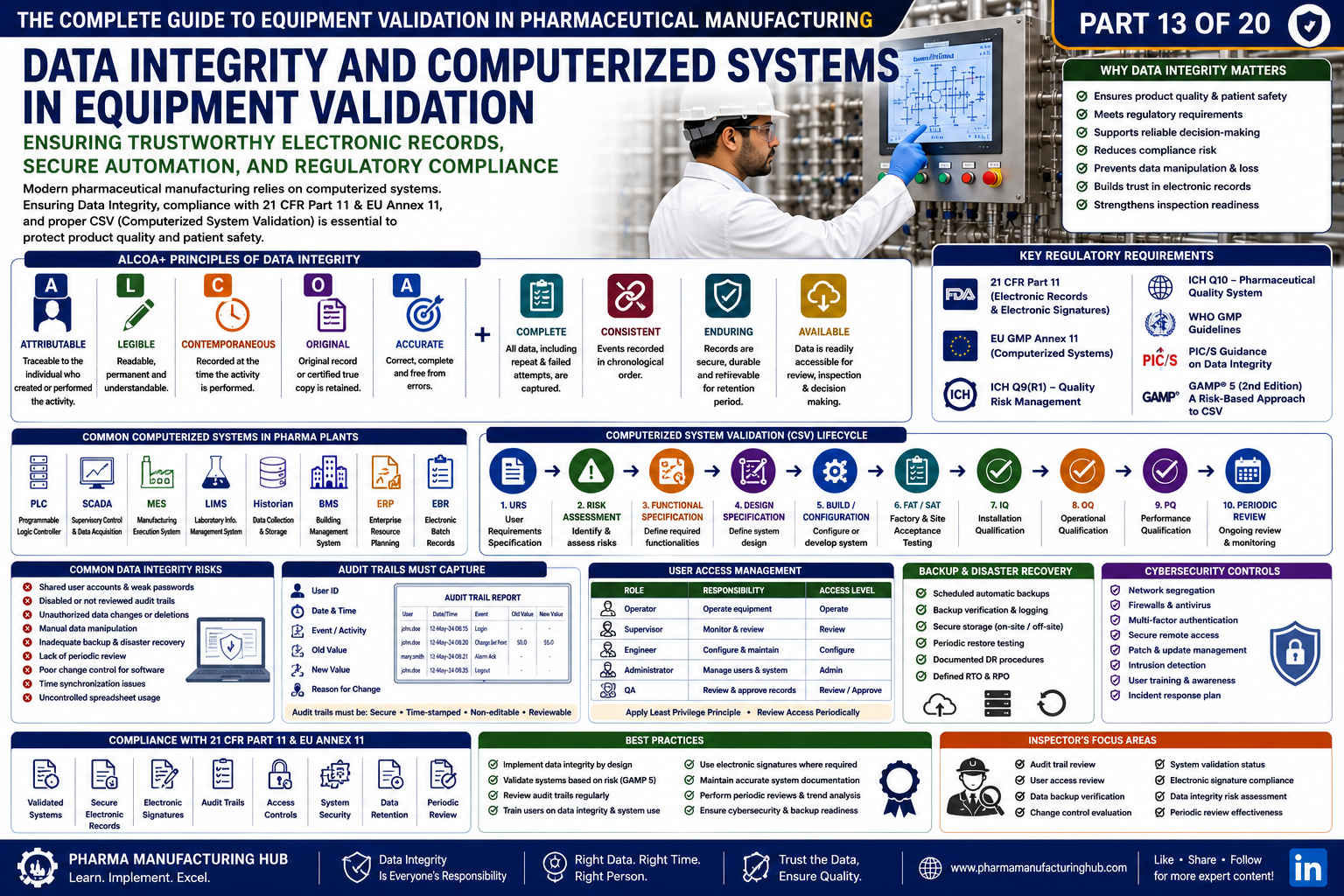
Introduction
The pharmaceutical industry has undergone a major transformation over the past two decades. Modern manufacturing facilities now rely heavily on automation, computerized systems, digital sensors, Manufacturing Execution Systems (MES), Supervisory Control and Data Acquisition (SCADA), Programmable Logic Controllers (PLCs), Enterprise Resource Planning (ERP), Industrial Internet of Things (IIoT), cloud-based data management, and artificial intelligence.
While these technologies have significantly improved manufacturing efficiency, product quality, and regulatory compliance, they have also introduced new challenges related to data integrity, cybersecurity, electronic records, software validation, and system security.
Today, regulatory agencies such as the US FDA, EMA, MHRA, WHO, and PIC/S consider Data Integrity one of the most critical aspects of GMP compliance. During inspections, regulators frequently focus on whether computerized systems generate complete, accurate, secure, and traceable records that can be trusted throughout the product lifecycle.
This article explores the principles of Data Integrity, Computerized System Validation (CSV), 21 CFR Part 11, EU Annex 11, ALCOA+, audit trails, electronic signatures, cybersecurity, and best practices for validating computerized equipment used in pharmaceutical manufacturing.
What is Data Integrity?
Data Integrity refers to the completeness, consistency, accuracy, and reliability of data throughout its entire lifecycle.
In pharmaceutical manufacturing, data integrity ensures that manufacturing, testing, qualification, calibration, maintenance, and quality records can be trusted when making decisions affecting product quality and patient safety.
Data Integrity applies to:
- Electronic records
- Paper records
- Hybrid systems
- Automation systems
- Laboratory systems
- Validation records
- Maintenance records
- Calibration records
Why Data Integrity is Critical
Poor data integrity may result in:
- Product recalls
- Batch rejection
- Warning letters
- Import alerts
- Regulatory observations
- Loss of customer confidence
- Patient safety risks
Data Integrity is therefore fundamental to every Pharmaceutical Quality System (PQS).
ALCOA Principles
The foundation of pharmaceutical data integrity is the ALCOA principle.
| Principle | Meaning |
|---|---|
| A – Attributable | Data can be traced to the individual who generated it. |
| L – Legible | Data is readable, permanent, and understandable. |
| C – Contemporaneous | Data is recorded at the time the activity is performed. |
| O – Original | Original records or verified true copies are maintained. |
| A – Accurate | Data is complete, correct, and free from errors. |
ALCOA+ Principles
Modern regulatory expectations extend ALCOA to ALCOA+.
Additional principles include:
- Complete – All data, including repeat measurements and failed attempts, are retained.
- Consistent – Events are recorded in chronological order.
- Enduring – Records remain durable and retrievable throughout the retention period.
- Available – Data is readily accessible for review, inspection, and decision-making.
Together, these principles help ensure reliable and trustworthy records.
Regulatory Requirements
Key regulations and guidance include:
- 21 CFR Part 11 – Electronic Records and Electronic Signatures
- EU GMP Annex 11 – Computerized Systems
- 21 CFR Parts 210 & 211 – Current Good Manufacturing Practice
- ICH Q9(R1) – Quality Risk Management
- ICH Q10 – Pharmaceutical Quality System
- WHO GMP
- PIC/S Data Integrity Guidance
- MHRA GXP Data Integrity Guidance
- GAMP 5 (Second Edition) – Computerized System Validation
Computerized Systems in Pharmaceutical Manufacturing
Common systems include:
- PLC (Programmable Logic Controller)
- SCADA (Supervisory Control and Data Acquisition)
- MES (Manufacturing Execution System)
- DCS (Distributed Control System)
- Historian Systems
- LIMS (Laboratory Information Management System)
- ERP (Enterprise Resource Planning)
- Electronic Batch Records (EBR)
- Building Management System (BMS)
- Environmental Monitoring Systems
Each system should be assessed for its impact on product quality and validated as appropriate.
Computerized System Validation (CSV)
CSV provides documented evidence that computerized systems perform consistently and are fit for their intended use.
A typical CSV lifecycle includes:
User Requirements (URS)
        │
        ▼
Risk Assessment
        │
        ▼
Functional Specification
        │
        ▼
Design Specification
        │
        ▼
Configuration / Development
        │
        ▼
Factory Acceptance Test (FAT)
        │
        ▼
Site Acceptance Test (SAT)
        │
        ▼
IQ
        │
        ▼
OQ
        │
        ▼
PQ
        │
        ▼
Periodic Review
        │
        ▼
Retirement
PLC Validation
Programmable Logic Controllers (PLCs) control many critical manufacturing operations.
Typical validation activities include:
- Program version verification
- Input/output verification
- Logic testing
- Alarm verification
- Interlock testing
- Emergency stop testing
- Backup verification
- Recovery testing
SCADA Validation
SCADA systems require verification of:
- Screen navigation
- Alarm handling
- Trend recording
- Data storage
- Audit trails
- User access
- Security settings
- Communication with PLCs
- Backup and restore
MES Validation
Manufacturing Execution Systems should be validated for:
- Electronic batch records
- Recipe management
- Material traceability
- Workflow management
- Batch release interfaces
- Integration with ERP and LIMS
- Electronic signatures
Audit Trails
An audit trail is a secure, computer-generated record of system activities.
Audit trails should capture:
- User identity
- Date and time
- Activity performed
- Original value
- New value
- Reason for change (where applicable)
Audit trails should be enabled, protected from alteration, and periodically reviewed.
Electronic Records
Electronic records should:
- Be accurate and complete.
- Be protected against unauthorized changes.
- Be backed up regularly.
- Remain retrievable throughout the retention period.
- Be attributable to authorized users.
Examples include:
- Calibration records
- Qualification protocols
- Batch records
- Maintenance records
- Environmental monitoring data
- Alarm histories
Electronic Signatures
Electronic signatures should be:
- Unique to each user.
- Secure.
- Linked to the corresponding electronic record.
- Protected against misuse.
Organizations should establish procedures for user account management, password policies, and signature authorization.
User Access Management
Access should follow the principle of least privilege.
Typical roles include:
| Role | Access |
|---|---|
| Operator | Operate equipment |
| Supervisor | Review records |
| Engineer | Configure equipment |
| Administrator | Manage users and system settings |
| QA | Review and approve data |
Access should be periodically reviewed and updated.
Backup and Disaster Recovery
A comprehensive backup strategy should include:
- Scheduled backups
- Verification of backup completion
- Secure storage
- Off-site or redundant storage (where applicable)
- Periodic restoration testing
- Disaster recovery procedures
The ability to restore validated data should be demonstrated.
Cybersecurity
Cybersecurity is increasingly important in pharmaceutical manufacturing.
Common controls include:
- Firewalls
- Network segmentation
- Antivirus software
- Multi-factor authentication (where appropriate)
- Patch management
- Secure remote access
- Intrusion detection
- Password management
Cybersecurity controls should be balanced with validated system requirements.
Data Integrity Risks
Common risks include:
- Shared user accounts
- Weak passwords
- Disabled audit trails
- Inadequate backups
- Unauthorized software changes
- Manual data manipulation
- Time synchronization issues
- Lack of periodic review
- Poor change control
Risk assessments should identify and mitigate these vulnerabilities.
Data Review
Periodic data review should evaluate:
- Audit trail entries
- Alarm history
- Failed login attempts
- Unauthorized changes
- Electronic signatures
- Backup logs
- System performance trends
Documented review demonstrates ongoing oversight.
Documentation Requirements
A complete CSV and data integrity package should include:
- User Requirement Specification (URS)
- Risk Assessment
- Functional Specification
- Design Specification
- Configuration Records
- IQ/OQ/PQ Protocols
- Test Scripts
- Validation Reports
- Backup Procedures
- User Access Matrix
- Audit Trail Review Records
- Change Controls
- Periodic Review Reports
Inspector’s Perspective
Regulatory inspectors frequently evaluate computerized systems in detail.
Common inspection questions include:
- Are audit trails enabled and reviewed?
- Are user accounts unique?
- Are passwords adequately controlled?
- How are software changes managed?
- Are electronic records backed up?
- Has the system been validated?
- Are electronic signatures compliant?
- How is cybersecurity managed?
- Are obsolete user accounts disabled promptly?
Organizations that demonstrate strong governance over computerized systems are better prepared for regulatory inspections.
Expert Tips
Expert Tip 1: Design computerized systems with data integrity in mind from the beginning. Preventive controls are more effective than corrective actions after implementation.
Expert Tip 2: Perform periodic reviews of user access, audit trails, backup logs, and security patches to maintain the validated state of computerized systems.
Expert Tip 3: Integrate change control, risk assessment, and Computerized System Validation (CSV) whenever software, PLC logic, SCADA configuration, or MES workflows are modified.
Common Pitfalls
Avoid these common issues:
- Shared usernames and passwords.
- Disabled or ignored audit trails.
- Infrequent backup verification.
- Lack of documented restoration testing.
- Uncontrolled software changes.
- Inadequate user training.
- Missing periodic reviews.
- Failure to remove inactive user accounts.
- Poor documentation of electronic signature controls.
Frequently Asked Questions (FAQs)
1. What is ALCOA+?
ALCOA+ is a set of internationally recognized data integrity principles ensuring that pharmaceutical records are Attributable, Legible, Contemporaneous, Original, Accurate, Complete, Consistent, Enduring, and Available.
2. What is Computerized System Validation (CSV)?
CSV provides documented evidence that computerized systems consistently perform as intended and are suitable for their intended use.
3. What is the purpose of an audit trail?
An audit trail records who performed an action, what was changed, when it occurred, and, where appropriate, why the change was made.
4. Why are unique user accounts required?
Unique accounts ensure accountability and support the “Attributable” principle of ALCOA+.
5. Does every software update require validation?
The validation impact should be assessed through change control. Significant updates may require regression testing or partial requalification.
6. Why are backups important?
Backups protect electronic records against data loss and support disaster recovery.
7. What is the role of cybersecurity in GMP?
Cybersecurity protects validated systems and electronic records from unauthorized access, manipulation, and loss.
8. Which systems commonly require CSV?
PLCs, SCADA, MES, LIMS, Electronic Batch Records, Building Management Systems, and other computerized systems that impact product quality or GMP activities.
Key Takeaways
- Data Integrity is essential to ensuring that pharmaceutical records are accurate, complete, secure, and trustworthy throughout their lifecycle.
- ALCOA+, 21 CFR Part 11, EU Annex 11, and GAMP 5 provide the foundation for managing electronic records and computerized systems in GMP environments.
- Computerized System Validation (CSV) should follow a lifecycle approach that includes risk assessment, qualification, change control, periodic review, and retirement.
- Strong governance of user access, audit trails, electronic signatures, backups, cybersecurity, and documentation supports regulatory compliance and protects product quality.
Coming Up in Part 14
Validation Failures, Regulatory Inspection Findings, and Continuous Improvement: Learning from Deviations to Build a Stronger Validation Program
In Part 14, we will examine common equipment validation failures, FDA 483 observations, MHRA and EU GMP inspection findings, root cause investigations, CAPA implementation, deviation management, recurring failure trends, inspection readiness strategies, and continuous improvement practices that help pharmaceutical manufacturers strengthen their validation programs and reduce regulatory risk.
About the Author
Ramesh Palav is a pharmaceutical professional with 20+ years of industry experience in manufacturing, GMP, quality systems, validation, compliance, and operational excellence. Through Pharma Manufacturing Hub, he shares practical insights on pharmaceutical careers, manufacturing, quality, validation, Pharma 4.0, AI, and professional development.
His goal is to help students, freshers, experienced professionals, and career-break professionals build the knowledge and skills needed to succeed in the pharmaceutical industry.