
Managing Equipment Changes While Maintaining GMP Compliance and the Validated State
Series: Part 12 of 20
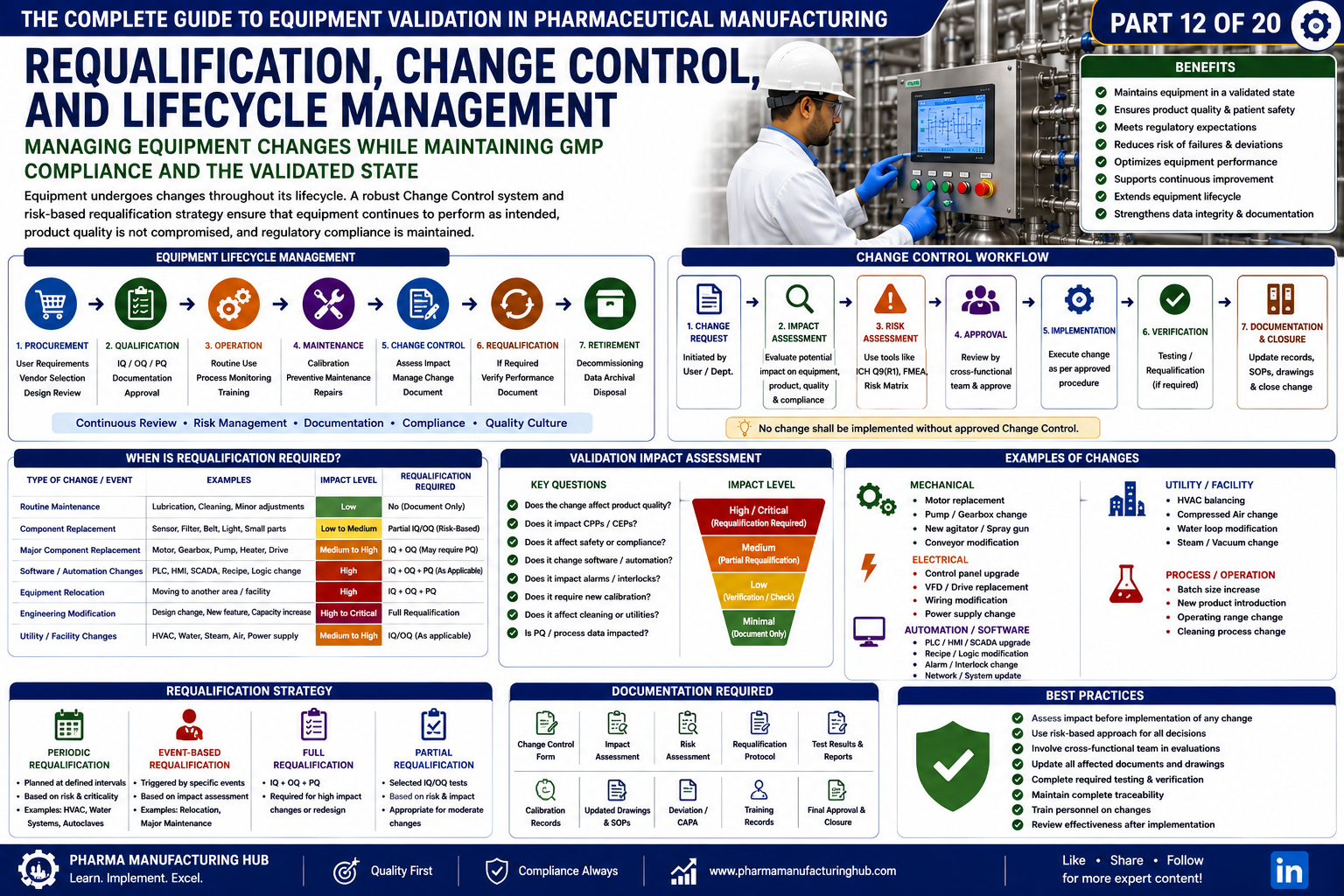
Introduction
Equipment qualification is not completed when Performance Qualification (PQ) is approved. Pharmaceutical manufacturing equipment undergoes continuous changes throughout its operational life, including maintenance, software updates, replacement of critical components, capacity improvements, automation upgrades, and process optimization.
Without a structured Change Control and Requalification Program, these modifications can compromise equipment performance, product quality, patient safety, and regulatory compliance.
International regulations including US FDA 21 CFR Parts 210 & 211, EU GMP Annex 15, ICH Q9(R1), ICH Q10, WHO GMP, PIC/S, MHRA, and ISPE Baseline Guides require manufacturers to maintain equipment in a continuous state of validation by assessing every change and determining its validation impact.
This article explains how to manage equipment changes, perform validation impact assessments, determine requalification requirements, and maintain equipment throughout its lifecycle using a science- and risk-based approach.
Why Requalification is Necessary
Equipment performance changes over time because of:
- Mechanical wear
- Aging components
- Software upgrades
- Engineering modifications
- Utility changes
- Increased production demands
- Preventive maintenance activities
- Replacement of critical parts
- Environmental changes
- Continuous improvement initiatives
Requalification ensures that these changes do not adversely affect equipment performance or product quality.
Equipment Lifecycle Management
Equipment Purchase
        │
        ▼
Qualification (IQ/OQ/PQ)
        │
        ▼
Routine Manufacturing
        │
        ▼
Calibration & Preventive Maintenance
        │
        ▼
Change Control
        │
        ▼
Validation Impact Assessment
        │
        ▼
Requalification (If Required)
        │
        ▼
Periodic Review
        │
        ▼
Retirement
Lifecycle management ensures equipment remains compliant from installation to decommissioning.
What is Requalification?
Requalification is the documented process of confirming that previously qualified equipment continues to operate within approved specifications following a significant event or at predefined intervals.
The objective is to demonstrate that the validated state has been maintained despite changes.
Objectives of Requalification
Requalification aims to:
- Maintain the validated state.
- Verify equipment performance after changes.
- Confirm continued compliance with GMP.
- Prevent adverse effects on product quality.
- Support regulatory inspection readiness.
- Provide documented evidence of ongoing suitability.
Types of Requalification
1. Periodic Requalification
Performed at predefined intervals based on:
- Equipment criticality
- Historical performance
- Risk assessment
- Regulatory expectations
Examples:
- HVAC Systems
- Purified Water Systems
- Autoclaves
- Lyophilizers
- Sterilization Equipment
2. Event-Based Requalification
Triggered after specific events such as:
- Major maintenance
- Equipment relocation
- Software upgrades
- PLC modifications
- Utility changes
- Process changes
- Engineering modifications
When is Requalification Required?
Typical triggers include:
| Event | Requalification Required? |
|---|---|
| Routine lubrication | Usually No |
| Preventive maintenance | Risk-based |
| Motor replacement | Usually Yes |
| Gearbox replacement | Yes |
| PLC software upgrade | Yes |
| HMI upgrade | Yes |
| Sensor replacement | Risk-based |
| Product-contact part replacement | Usually Yes |
| Equipment relocation | Yes |
| Capacity increase | Yes |
| Utility modification | Risk-based |
| Major engineering modification | Yes |
The decision should always be supported by a documented validation impact assessment.
Change Control
What is Change Control?
Change Control is the formal GMP process used to evaluate, approve, implement, verify, and document changes before they are introduced into a validated system.
No significant equipment modification should occur without an approved change control process.
Objectives of Change Control
Change control ensures:
- Product quality is protected.
- Patient safety is maintained.
- Regulatory compliance is preserved.
- Risks are assessed.
- Documentation is updated.
- Appropriate qualification activities are completed.
Typical Equipment Changes
Examples include:
Mechanical Changes
- Motor replacement
- Pump replacement
- Gearbox replacement
- Bearing replacement
- New agitator
- New spray gun
- Conveyor modification
Electrical Changes
- VFD replacement
- MCC upgrade
- Power supply changes
- New control panel
- Wiring modifications
Automation Changes
- PLC upgrade
- HMI upgrade
- SCADA update
- Recipe modification
- Alarm modification
- Network changes
Utility Changes
- Compressed air pressure changes
- Water loop modifications
- HVAC balancing
- Steam supply modification
- Vacuum system upgrade
Process Changes
- Increased batch size
- New product introduction
- New operating range
- Modified cleaning process
- Different operating sequence
Change Control Workflow
Change Request
      │
      ▼
Impact Assessment
      │
      ▼
Risk Assessment
      │
      ▼
Approval
      │
      ▼
Implementation
      │
      ▼
Qualification Testing
      │
      ▼
Documentation Update
      │
      ▼
Final Approval
Validation Impact Assessment
Validation impact assessment determines whether the proposed change affects the validated state.
Questions include:
- Does the change affect product quality?
- Does it modify Critical Process Parameters (CPPs)?
- Does it alter Critical Equipment Parameters (CEPs)?
- Does it impact software?
- Does it affect alarms or interlocks?
- Does it require new calibration?
- Does it require requalification?
Risk-Based Decision Making
Each change should be evaluated using:
- ICH Q9(R1)
- FMEA
- Risk Matrix
- Engineering assessment
- Historical data
- Process knowledge
Higher-risk changes require more extensive qualification.
Requalification Strategy
The extent of requalification depends on the nature of the change.
Example
| Type of Change | Qualification Required |
|---|---|
| Label replacement | Documentation only |
| Calibration adjustment | Calibration verification |
| Sensor replacement | Partial IQ/OQ |
| PLC upgrade | IQ + OQ |
| Equipment relocation | IQ + OQ + PQ |
| Major redesign | Full qualification lifecycle |
This approach prevents unnecessary testing while maintaining compliance.
Documentation Requirements
A complete requalification package should include:
- Approved Change Control
- Validation Impact Assessment
- Risk Assessment
- Revised URS (if applicable)
- Updated Drawings
- Calibration Records
- Test Protocols
- IQ/OQ/PQ Results
- Deviation Reports
- CAPA
- Final Requalification Report
Equipment Relocation
Equipment relocation requires special attention because it may affect:
- Mechanical alignment
- Utility connections
- Environmental conditions
- Calibration status
- Operating performance
Typical activities include:
- New IQ
- Utility verification
- Calibration
- Selected OQ tests
- PQ (where appropriate)
Software and Automation Upgrades
Automation changes should follow a structured validation approach.
Examples:
- PLC firmware updates
- SCADA upgrades
- HMI revisions
- Recipe management changes
- User access modifications
Verification may include:
- Software installation checks
- Functional testing
- Alarm verification
- Audit trail review
- Electronic records testing
- Backup and recovery testing
Where applicable, computerized system validation principles and data integrity requirements should be applied.
Periodic Review
Periodic reviews help confirm that equipment remains in a validated state.
Typical review topics include:
- Calibration compliance
- Preventive maintenance completion
- Breakdown history
- Deviations
- CAPA effectiveness
- Change controls
- Qualification status
- Trend analysis
- Regulatory updates
Review frequency should be justified based on risk and equipment criticality.
Maintaining the Validated State
Maintaining validation requires integration of:
- Preventive Maintenance
- Calibration
- Change Control
- Risk Assessment
- Deviation Management
- CAPA
- Training
- SOP Review
- Periodic Review
- Reliability Monitoring
These elements work together to ensure sustained GMP compliance.
Example Requalification Scenario
Equipment
Tablet Compression Machine
Change
Replacement of the main compression motor.
Risk Assessment
Medium to High
Validation Impact
- Compression force affected
- Turret speed affected
- Motor control affected
Qualification Required
- Motor installation verification (IQ)
- Speed verification (OQ)
- Compression force verification (OQ)
- Product qualification batches (PQ if justified)
Documentation
- Change Control
- Risk Assessment
- IQ/OQ Protocols
- Calibration Records
- OQ Results
- Final Approval
Inspector’s Perspective
Regulatory inspectors commonly review:
- Change control procedures.
- Validation impact assessments.
- Risk assessment methodology.
- Requalification justification.
- Updated drawings and SOPs.
- Calibration following changes.
- Qualification evidence after modifications.
- Closure of change controls.
Inspectors expect every significant change to be scientifically justified, appropriately assessed, and fully documented.
Expert Tips
Expert Tip 1: Evaluate validation impact before implementing any engineering or software change. Early assessment prevents unnecessary downtime and avoids qualification gaps.
Expert Tip 2: Use a cross-functional review team—including Engineering, Validation, Production, Quality Assurance, Automation, and Maintenance—to assess changes from multiple perspectives.
Expert Tip 3: Maintain an equipment history file linking change controls, requalification activities, maintenance records, deviations, CAPA, and periodic reviews. This provides complete lifecycle traceability and simplifies regulatory inspections.
Common Pitfalls
Avoid these common mistakes:
- Implementing equipment modifications before change control approval.
- Assuming component replacement does not require validation assessment.
- Failing to update engineering drawings and SOPs.
- Inadequate documentation of validation impact.
- Not recalibrating instruments after significant maintenance.
- Poor linkage between change control and risk assessment.
- Closing change controls before qualification activities are completed.
- Incomplete review of software changes and data integrity implications.
Frequently Asked Questions (FAQs)
1. What is the difference between change control and requalification?
Change control manages and evaluates the proposed modification, while requalification verifies that the equipment continues to perform acceptably after the change.
2. Does every maintenance activity require requalification?
No. Routine maintenance generally does not require full requalification, but the validation impact should be assessed and documented.
3. When should equipment be requalified?
Requalification may be periodic or triggered by significant events such as relocation, software upgrades, major repairs, utility modifications, or engineering changes.
4. Why is validation impact assessment important?
It determines whether a change could affect product quality, equipment performance, or regulatory compliance, guiding the extent of testing required.
5. Are software upgrades subject to change control?
Yes. PLC, HMI, SCADA, recipe management, and other automation changes should be managed through change control and validated where appropriate.
6. Should engineering drawings be updated after equipment changes?
Yes. Controlled documents such as P&IDs, electrical drawings, SOPs, and maintenance manuals should always reflect the current equipment configuration.
7. How does periodic review support lifecycle management?
Periodic review evaluates equipment performance, calibration, maintenance, deviations, and changes to confirm the equipment remains in a validated state.
8. What documents should be included in a requalification package?
Typical documents include the approved change control, risk assessment, validation impact assessment, updated drawings, qualification protocols and reports, calibration records, deviations, CAPA, and final approval.
Key Takeaways
- Requalification confirms that qualified equipment continues to meet approved performance requirements after significant changes or at defined intervals.
- A robust change control system ensures that equipment modifications are scientifically evaluated, risk-assessed, documented, and appropriately qualified before routine use.
- Validation impact assessments determine the scope of testing required and help avoid both under-qualification and unnecessary requalification.
- Integrating change control, calibration, preventive maintenance, periodic review, and risk management into equipment lifecycle management supports continuous GMP compliance and long-term operational excellence.
Coming Up in Part 13
Data Integrity and Computerized Systems in Equipment Validation: ALCOA+, 21 CFR Part 11, EU Annex 11, PLC, SCADA, MES, Audit Trails, and Cybersecurity
In Part 13, we will explore data integrity principles, ALCOA+, electronic records, electronic signatures, 21 CFR Part 11, EU Annex 11, PLC, SCADA, MES, Historian systems, audit trails, backup and disaster recovery, cybersecurity controls, and computerized system validation (CSV) to ensure that pharmaceutical manufacturing equipment remains compliant in today’s increasingly digital manufacturing environment.
About the Author
Ramesh Palav is a pharmaceutical professional with 20+ years of industry experience in manufacturing, GMP, quality systems, validation, compliance, and operational excellence. Through Pharma Manufacturing Hub, he shares practical insights on pharmaceutical careers, manufacturing, quality, validation, Pharma 4.0, AI, and professional development.
His goal is to help students, freshers, experienced professionals, and career-break professionals build the knowledge and skills needed to succeed in the pharmaceutical industry.