
Demonstrating Consistent Equipment Performance Under Routine Manufacturing Conditions
Series: Part 7 of 20
Introduction
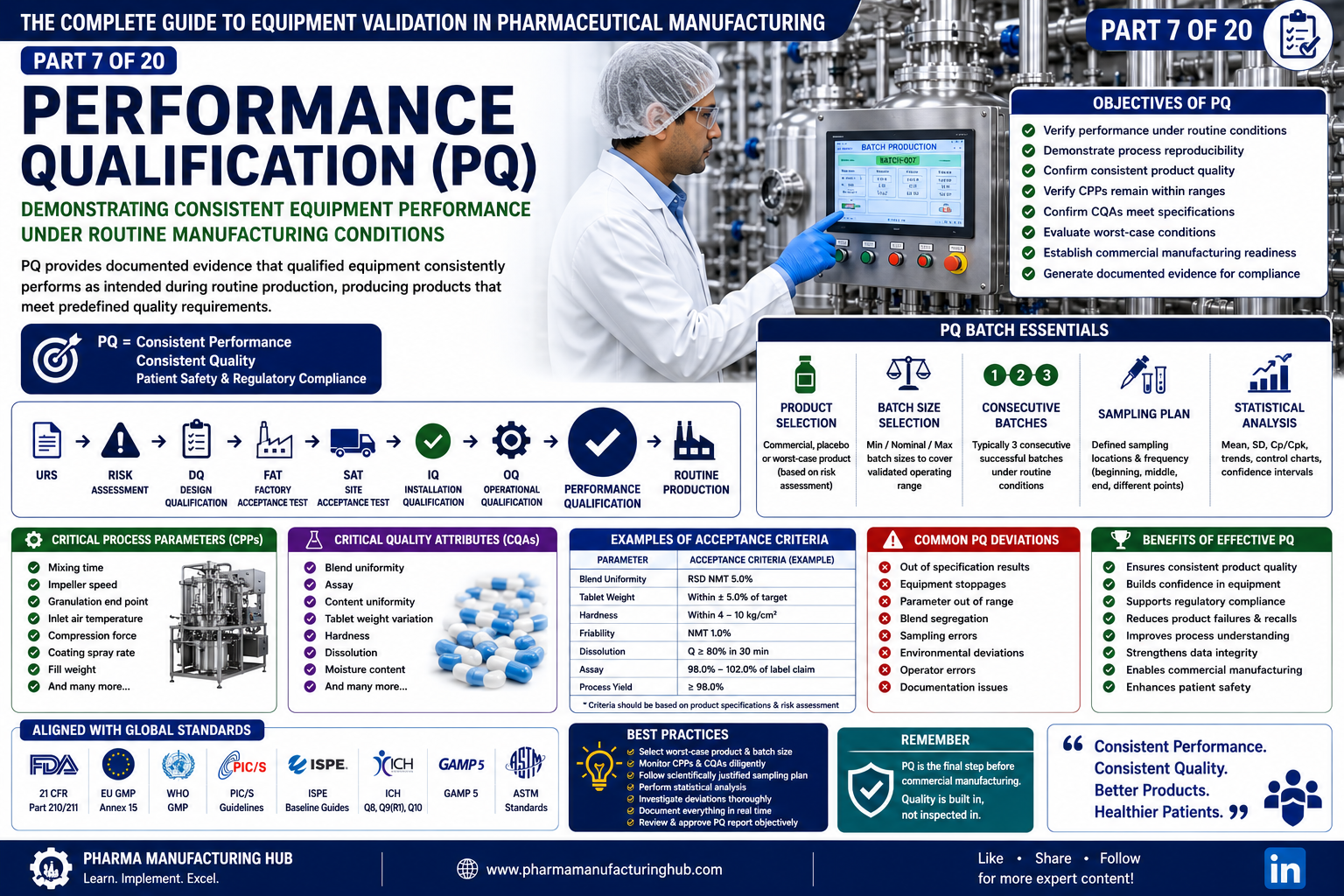
After successfully completing Installation Qualification (IQ) and Operational Qualification (OQ), the final stage of equipment qualification is Performance Qualification (PQ). While IQ demonstrates that equipment has been installed correctly and OQ confirms that it operates within predefined limits, PQ provides documented evidence that the equipment consistently performs as intended during routine manufacturing operations.
Performance Qualification is where engineering and validation meet real production. Unlike OQ, which often uses simulated conditions or engineering tests, PQ is performed using actual manufacturing processes, commercial products, or scientifically justified placebo batches under routine operating conditions.
Regulatory authorities including the US FDA, EMA, WHO, MHRA, PIC/S, and guidance documents such as EU GMP Annex 15, ICH Q8, ICH Q9(R1), ICH Q10, and ISPE Baseline Guides expect manufacturers to demonstrate that qualified equipment consistently produces products meeting predefined quality specifications.
What is Performance Qualification (PQ)?
Performance Qualification (PQ) is the documented verification that qualified equipment consistently performs according to its intended use under normal production conditions while manufacturing products that meet predefined quality requirements.
PQ demonstrates that:
- Equipment performs consistently.
- Product quality is maintained.
- Process parameters remain under control.
- Critical Quality Attributes (CQAs) are achieved.
- Manufacturing is reproducible.
- Commercial production can begin with confidence.
Objectives of Performance Qualification
The primary objectives of PQ are to:
- Verify performance under routine production conditions.
- Demonstrate process reproducibility.
- Confirm consistent product quality.
- Verify Critical Process Parameters (CPPs).
- Confirm Critical Quality Attributes (CQAs).
- Evaluate worst-case conditions.
- Establish commercial manufacturing readiness.
- Generate documented evidence for regulatory compliance.
Position of PQ in the Qualification Lifecycle
URS
 │
Risk Assessment
 │
DQ
 │
FAT
 │
SAT
 │
IQ
 │
OQ
 │
▼
Performance Qualification (PQ)
 │
Commercial Manufacturing
 │
Continued Process Verification
PQ represents the final qualification milestone before routine production.
Regulatory Expectations
Regulators expect PQ to provide evidence that:
- Equipment consistently performs as intended.
- Commercial manufacturing conditions are representative.
- Product quality remains within specifications.
- Sampling plans are scientifically justified.
- Acceptance criteria are predefined.
- Statistical analysis supports conclusions.
- Deviations are investigated and resolved.
PQ Prerequisites
Before initiating PQ, confirm that:
- IQ has been approved.
- OQ has been approved.
- Operators are trained.
- SOPs are approved.
- Cleaning validation (where applicable) is complete.
- Calibration is current.
- Preventive maintenance is up to date.
- Utilities are qualified.
- Raw materials are approved.
- Risk assessments are current.
Selection of Product for PQ
The product selected should represent routine commercial manufacturing.
Common options include:
Commercial Product
Preferred option because it reflects actual production conditions.
Placebo Batch
May be appropriate when:
- API is unavailable.
- Product is high value.
- Safety concerns exist.
Worst-Case Product
Often selected based on:
- Highest potency
- Highest viscosity
- Largest batch size
- Most difficult to mix
- Longest processing time
- Greatest cleaning challenge
Selection should be justified through documented risk assessment.
Batch Size Selection
PQ should evaluate representative commercial batch sizes.
Typical approaches include:
| Batch Type | Purpose |
|---|---|
| Minimum Batch | Lower operating limit |
| Nominal Batch | Routine production |
| Maximum Batch | Worst-case capacity |
Where multiple batch sizes are manufactured, qualification should cover the validated operating range.
Consecutive Batch Requirements
Industry practice commonly requires three consecutive successful batches manufactured under routine operating conditions.
The batches should demonstrate:
- Repeatability
- Consistency
- Product quality
- Process stability
Any deviation should be evaluated for impact on qualification.
Critical Process Parameters (CPPs)
PQ verifies that CPPs remain within validated operating ranges.
Examples:
| Equipment | CPP |
|---|---|
| Blender | Mixing time |
| Granulator | Impeller speed |
| Fluid Bed Dryer | Inlet air temperature |
| Tablet Press | Compression force |
| Coating Machine | Spray rate |
| Capsule Filler | Fill weight |
Monitoring CPPs helps ensure process consistency.
Critical Quality Attributes (CQAs)
PQ also confirms that product CQAs consistently meet specifications.
Examples:
- Blend uniformity
- Tablet weight
- Hardness
- Friability
- Dissolution
- Moisture content
- Assay
- Content uniformity
- Microbial limits (where applicable)
Sampling Plan
Sampling should be based on:
- Product characteristics.
- Equipment design.
- Risk assessment.
- Statistical justification.
- Regulatory expectations.
Typical sampling locations include:
- Beginning of batch
- Middle of batch
- End of batch
- Different equipment discharge points
- Multiple packaging locations (if applicable)
Statistical Analysis
Statistical evaluation strengthens PQ conclusions.
Common analyses include:
- Mean
- Standard deviation
- Process capability (Cp/Cpk)
- Trend analysis
- Control charts
- Variability assessment
- Confidence intervals
Statistics should support evidence of consistent performance.
Acceptance Criteria
Acceptance criteria should be:
- Based on product specifications.
- Scientifically justified.
- Approved before PQ execution.
- Objective and measurable.
Example
| Parameter | Acceptance Criteria |
|---|---|
| Blend Uniformity | Meets specification |
| Tablet Weight | Within approved limits |
| Hardness | Within validated range |
| Dissolution | Meets pharmacopeial requirements |
| Yield | ≥ predefined target |
Documentation During PQ
Typical documentation includes:
- Approved PQ Protocol
- Batch Manufacturing Records (BMR)
- Equipment Logbook
- Calibration Records
- Cleaning Records
- Sampling Records
- Laboratory Results
- Statistical Evaluation
- Deviations
- CAPA (if required)
- PQ Report
PQ Protocol Structure
A comprehensive PQ protocol generally includes:
- Purpose
- Scope
- Responsibilities
- Equipment Description
- Product Details
- Batch Size
- CPPs
- CQAs
- Sampling Plan
- Acceptance Criteria
- Statistical Methods
- Deviation Handling
- Approval Signatures
Example PQ Checklist
Equipment
- Qualified equipment used
- Calibration current
- Maintenance current
- Cleaning verified
Production
- Approved BMR
- Approved SOPs
- Trained operators
- Correct batch size
Quality
- Sampling completed
- Laboratory testing complete
- Product meets specifications
- Deviations investigated
Documentation
- Raw data reviewed
- Statistical analysis completed
- Final report approved
PQ Report
The final PQ report should summarize:
- Objective
- Equipment qualified
- Products manufactured
- Number of batches
- CPP performance
- CQA results
- Deviations
- CAPA
- Statistical analysis
- Conclusion
- Recommendation for commercial release
Common PQ Deviations
Examples include:
- Blend segregation
- Weight variation
- Equipment stoppages
- Alarm activations
- Out-of-specification laboratory results
- Sampling errors
- Operator error
- Utility interruptions
Each deviation should be assessed to determine its impact on qualification status.
Continued Process Verification (CPV)
Qualification does not end after PQ.
Routine monitoring should include:
- Trending of CPPs
- Trending of CQAs
- Equipment performance review
- OEE monitoring
- Calibration compliance
- Preventive maintenance
- Deviation trends
- CAPA effectiveness
CPV ensures that the equipment remains in a validated state throughout its lifecycle.
PQ vs Process Validation
| Performance Qualification | Process Validation |
|---|---|
| Focuses on equipment performance | Focuses on manufacturing process |
| Equipment qualification stage | Product lifecycle stage |
| Confirms equipment capability | Confirms process consistency |
| Supports process validation | Includes equipment, process, and product |
Although closely related, PQ is one component of the broader process validation strategy.
Inspector’s Perspective
During inspections, regulators frequently review PQ records to confirm that commercial manufacturing is supported by robust qualification evidence.
Inspectors commonly verify:
- Approved PQ protocol.
- Product and batch selection rationale.
- Sampling plans.
- Statistical evaluations.
- Laboratory test results.
- Deviation investigations.
- Traceability to URS and risk assessments.
- Final approval for commercial use.
Evidence of consistent product quality over consecutive batches is a key indicator of an effective qualification program.
Expert Tips
Expert Tip 1: Select the product and batch size for PQ using a documented risk assessment. Worst-case conditions often provide the strongest evidence of equipment capability.
Expert Tip 2: Coordinate closely with Production and Quality Control to ensure sampling, testing, and documentation occur in real time during PQ execution.
Expert Tip 3: Use statistical tools such as trend analysis and process capability studies to support conclusions rather than relying solely on pass/fail criteria.
Common Pitfalls
Avoid these frequent mistakes:
- Beginning PQ before OQ approval.
- Using non-representative products or batch sizes without justification.
- Inadequate sampling plans.
- Poor documentation of CPPs and CQAs.
- Ignoring minor deviations without formal assessment.
- Lack of statistical analysis.
- Incomplete final reports or approval records.
Frequently Asked Questions (FAQs)
1. What is the purpose of Performance Qualification?
To demonstrate that qualified equipment consistently performs under routine manufacturing conditions while producing products that meet predefined quality requirements.
2. Why are three consecutive batches commonly used?
Three successful consecutive batches provide confidence in process repeatability and equipment consistency. The exact number should be justified based on product complexity, risk, and regulatory expectations.
3. Can placebo batches be used for PQ?
In some cases, yes. Placebo batches may be appropriate when justified by risk assessment, although commercial products are generally preferred.
4. What is the difference between OQ and PQ?
OQ verifies equipment operation under controlled test conditions, whereas PQ confirms consistent performance during routine manufacturing with actual products or justified surrogates.
5. What are CPPs and CQAs?
Critical Process Parameters (CPPs) are operating variables that influence product quality, while Critical Quality Attributes (CQAs) are measurable characteristics that determine whether the product meets quality specifications.
6. Why is statistical analysis important during PQ?
Statistical analysis provides objective evidence of process consistency, identifies variability, and supports scientifically justified conclusions.
7. What happens if a deviation occurs during PQ?
The deviation should be documented, investigated, risk-assessed, and resolved. Its impact on qualification should be evaluated before approving commercial production.
8. Does qualification end after PQ?
No. Continued Process Verification (CPV), calibration, preventive maintenance, change control, and periodic review are required to maintain the validated state throughout the equipment lifecycle.
Key Takeaways
- Performance Qualification (PQ) demonstrates that qualified equipment consistently produces products meeting predefined quality requirements under routine manufacturing conditions.
- PQ evaluates representative products, batch sizes, Critical Process Parameters (CPPs), Critical Quality Attributes (CQAs), sampling plans, and statistical evidence.
- Successful PQ provides the documented confidence needed for commercial manufacturing and regulatory compliance.
- Continued Process Verification (CPV) is essential to maintain equipment performance and ensure long-term compliance after qualification.
Coming Up in Part 8
Qualification Strategies for Pharmaceutical Manufacturing Equipment: Mixers, Granulators, Fluid Bed Dryers, Tablet Presses, Coating Machines, Capsule Fillers, Blenders, Mills, Sieves, Packaging Equipment, and More
In Part 8, we will explore qualification approaches for individual categories of pharmaceutical manufacturing equipment, including equipment-specific IQ, OQ, and PQ considerations, critical process parameters, common validation challenges, acceptance criteria, practical checklists, and regulatory expectations for each major equipment type.
About the Author
Ramesh Palav is a pharmaceutical manufacturing professional with 21+ years of industry experience across pharmaceutical manufacturing, GMP compliance, qualification and validation, CSV, quality systems, production operations, and digital transformation.
With hands-on experience in OSD/tablet manufacturing, Granulation, Compression and Coating, he has worked extensively with GMP, regulatory audits, QMS, CAPA, FMEA, deviation management, root-cause analysis, validation, data integrity, and pharmaceutical technology systems.
Through Pharma Manufacturing Hub, he shares practical, experience-driven knowledge on pharmaceutical manufacturing, GMP, ERP, Pharma 4.0, AI, digital transformation, quality systems, validation, and pharma careers, helping professionals and students understand complex pharmaceutical concepts in a simple and practical way.