
Verifying Equipment Performance Before Installation and Before Qualification
Series: Part 4 of 20
Introduction
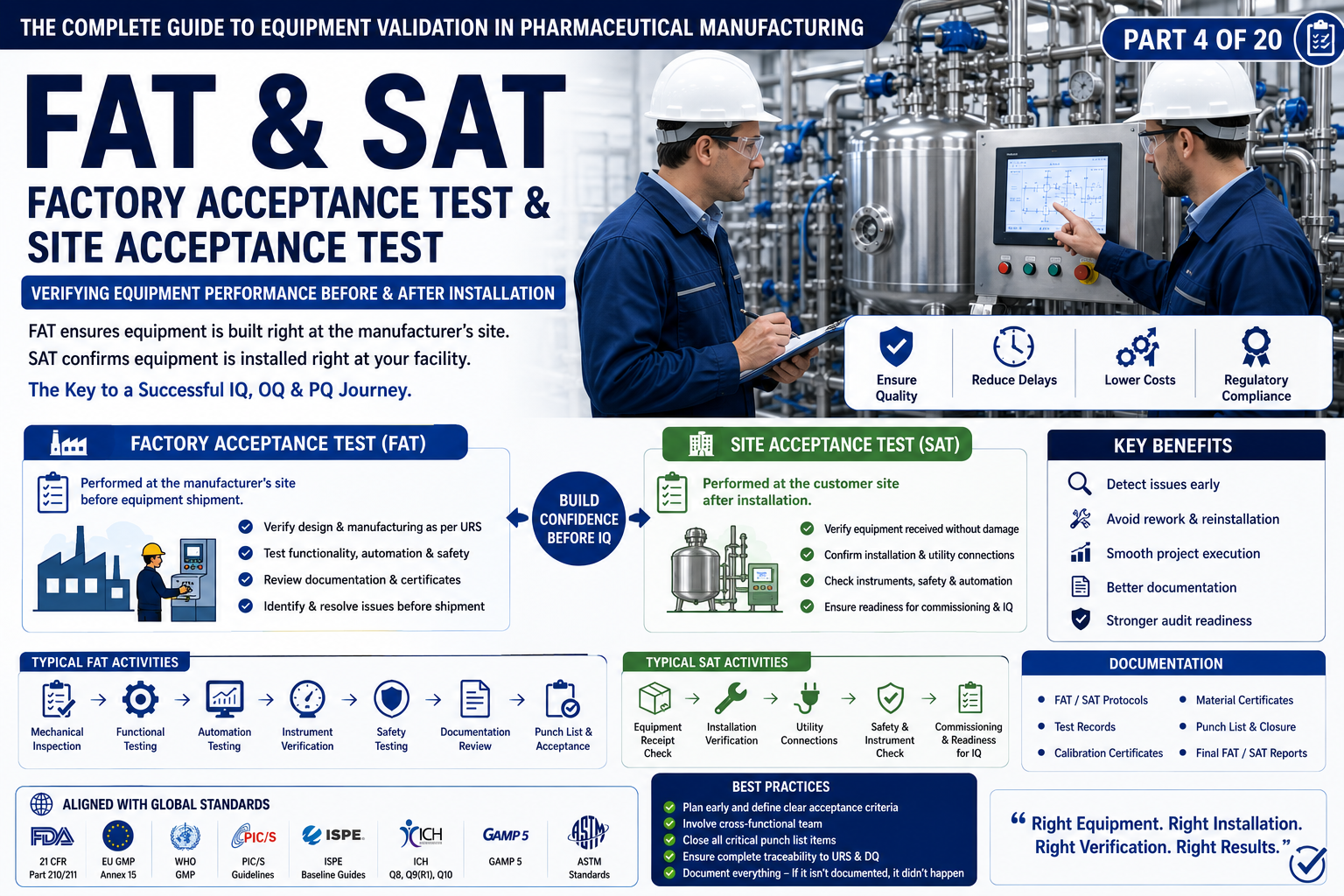
After completing the User Requirement Specification (URS) and Design Qualification (DQ), the next critical milestones in the pharmaceutical equipment validation lifecycle are the Factory Acceptance Test (FAT) and the Site Acceptance Test (SAT).
These activities ensure that equipment is verified before shipment and after installation, significantly reducing project risks, minimizing costly modifications, shortening qualification timelines, and ensuring readiness for Installation Qualification (IQ).
Many equipment-related deviations identified during IQ or OQ can be prevented if a thorough FAT and SAT are performed.
In this article, we will explore the objectives, planning, execution, documentation, acceptance criteria, common deficiencies, and industry best practices for FAT and SAT in accordance with FDA, EU GMP Annex 15, WHO GMP, PIC/S, ISPE Baseline Guides, ASTM, and GAMP 5.
What is Factory Acceptance Test (FAT)?
A Factory Acceptance Test (FAT) is a documented verification performed at the equipment manufacturer’s facility before shipment to confirm that the equipment has been manufactured according to the approved design and complies with the User Requirement Specification (URS).
FAT provides confidence that:
- Equipment has been built correctly.
- Functional requirements are met.
- Major defects are identified before shipment.
- Documentation is complete.
- Customer expectations are satisfied.
Objectives of FAT
The primary objectives are to:
- Verify compliance with the URS.
- Confirm equipment functionality.
- Review construction quality.
- Test automation and control systems.
- Identify defects before shipment.
- Reduce installation delays.
- Minimize rework at the manufacturing site.
- Ensure documentation completeness.
Benefits of FAT
| Benefit | Impact |
|---|---|
| Early issue detection | Reduces costly modifications |
| Improved project timeline | Shortens qualification schedule |
| Better equipment quality | Fewer installation issues |
| Reduced validation deviations | Faster IQ/OQ completion |
| Lower project cost | Less rework after shipment |
| Higher confidence | Smooth commissioning |
FAT Lifecycle
Approved URS
      │
      ▼
Design Qualification
      │
      ▼
Factory Manufacturing
      │
      ▼
Factory Acceptance Test
      │
      ▼
Punch List Closure
      │
      ▼
Customer Approval
      │
      ▼
Shipment
FAT Planning
Successful FAT begins with proper planning.
The FAT plan should define:
- Scope
- Responsibilities
- Schedule
- Test procedures
- Acceptance criteria
- Documentation requirements
- Witnessing requirements
- Deviation handling
- Approval process
FAT Team
A multidisciplinary team typically includes:
- Equipment Manufacturer
- Customer Engineering
- Validation Team
- Production Representative
- Quality Assurance
- Automation Engineer
- Maintenance Engineer
- Procurement Representative (if applicable)
FAT Documentation
Typical FAT documentation includes:
- FAT Protocol
- Approved URS
- DQ Report
- Equipment Drawings
- P&ID
- Electrical Drawings
- Instrument List
- Software Documentation
- Material Certificates
- Calibration Certificates
- Test Records
- Punch List
- FAT Report
Typical FAT Activities
1. Equipment Identification
Verify:
- Equipment name
- Model number
- Serial number
- Nameplate
- Manufacturer details
2. Mechanical Inspection
Inspect:
- Dimensions
- Construction quality
- Surface finish
- Weld quality
- Product-contact parts
- Hygienic design
- Accessibility
- Drainability
3. Material Verification
Confirm:
- SS316L certificates
- Elastomer certificates
- Surface finish certificates
- Welding documentation
- Material traceability
4. Functional Testing
Verify:
- Motors
- Drives
- Valves
- Pumps
- Actuators
- Mixers
- Conveyors
- Agitators
5. Automation Testing
Review:
- PLC functionality
- HMI screens
- SCADA communication
- Alarm handling
- Recipe management
- User access levels
- Audit trail
- Electronic records
6. Instrument Verification
Confirm operation of:
- Pressure transmitters
- Temperature sensors
- Load cells
- Flow meters
- RPM sensors
- Level sensors
- Vacuum gauges
7. Safety Testing
Verify:
- Emergency stop
- Interlocks
- Door switches
- Safety guards
- Pressure relief devices
- Alarms
- Lockout provisions
8. Documentation Review
Ensure availability of:
- Operation Manual
- Maintenance Manual
- Spare Parts List
- Lubrication Instructions
- Calibration Procedures
- Electrical Drawings
- Software Backup
FAT Acceptance Criteria
Acceptance criteria should be:
- Based on the approved URS.
- Measurable.
- Scientifically justified.
- Clearly documented.
- Approved before execution.
Example
| Test | Acceptance Criteria |
|---|---|
| Motor rotation | Correct direction |
| PLC communication | No communication errors |
| Alarm response | < 2 seconds |
| HMI display | All screens functional |
| Emergency stop | Stops equipment immediately |
FAT Punch List
A punch list documents outstanding issues that must be resolved before shipment or before SAT.
Examples include:
- Missing labels
- Incorrect wiring
- Software bug
- Calibration pending
- Missing documentation
- Cosmetic defects
Each item should include:
- Description
- Responsible person
- Target completion date
- Closure evidence
Common FAT Deficiencies
- Incomplete documentation
- Missing calibration certificates
- Incorrect material certificates
- Software issues
- Alarm failures
- Interlock failures
- Poor weld quality
- Missing spare parts
- Inadequate operator manuals
What is Site Acceptance Test (SAT)?
The Site Acceptance Test (SAT) is the documented verification performed after equipment installation at the manufacturing site to confirm that the equipment has been transported, installed, connected, and integrated correctly, and is ready for Installation Qualification (IQ).
Objectives of SAT
SAT confirms:
- Equipment arrived without damage.
- Installation is complete.
- Utilities are connected.
- Equipment powers up correctly.
- Safety systems function.
- Automation interfaces operate.
- Equipment is ready for commissioning and IQ.
SAT Lifecycle
Equipment Shipment
       │
       ▼
Receipt Inspection
       │
       ▼
Installation
       │
       ▼
Utility Connections
       │
       ▼
Site Acceptance Test
       │
       ▼
Commissioning
       │
       ▼
Installation Qualification
SAT Activities
1. Equipment Receipt Verification
Check:
- Shipping damage
- Packing list
- Equipment identification
- Missing components
2. Installation Verification
Verify:
- Equipment location
- Leveling
- Anchoring
- Accessibility
- Orientation
3. Utility Verification
Confirm correct connections for:
- Electrical supply
- Compressed air
- Nitrogen
- Vacuum
- Chilled water
- Steam
- Purified water
4. Instrument Verification
Check:
- Installation
- Tag numbers
- Calibration labels
- Wiring
- Signal integrity
5. Automation Verification
Confirm:
- PLC communication
- Network connectivity
- SCADA interface
- MES integration (where applicable)
- Recipe transfer
- User access
6. Safety Verification
Inspect:
- Emergency stop
- Guarding
- Safety switches
- Fire protection interfaces
- Pressure relief devices
7. Commissioning Activities
Commissioning demonstrates that systems operate correctly under no-load or simulated conditions before formal qualification.
Typical commissioning includes:
- Motor rotation checks
- Valve stroke testing
- Pump priming
- Sensor verification
- Utility flushing
- Leak testing
- Dry run
FAT vs SAT Comparison
| Parameter | FAT | SAT |
|---|---|---|
| Location | Vendor site | Customer site |
| Timing | Before shipment | After installation |
| Objective | Verify manufacturing | Verify installation |
| Witnessed by | Customer & Vendor | Customer |
| Utilities | Simulated | Actual site utilities |
| Shipment damage | Not applicable | Verified |
| IQ readiness | Partial | Complete |
FAT/SAT Documentation Package
A complete package includes:
- Approved Protocol
- Attendance Record
- Test Results
- Calibration Certificates
- Instrument List
- Drawings
- Punch List
- Deviations
- Corrective Actions
- Final Report
- Approval Signatures
Roles and Responsibilities
| Activity | Vendor | Customer |
|---|---|---|
| Equipment fabrication | ✔ | |
| FAT execution | ✔ | Witness |
| Documentation | ✔ | Review |
| Shipment | ✔ | |
| Installation | Support | ✔ |
| SAT execution | Support | ✔ |
| Utility connections | ✔ | |
| Final acceptance | ✔ |
Inspector’s Perspective
Inspectors commonly review FAT and SAT records to determine whether equipment was adequately evaluated before qualification.
Key areas of interest include:
- Approved FAT/SAT protocols.
- Traceability to URS and DQ.
- Resolution of punch list items.
- Calibration status.
- Utility verification.
- Evidence that deficiencies were corrected before IQ.
A well-documented FAT and SAT reduce the likelihood of significant deviations during qualification.
Expert Tips
Expert Tip 1: Perform as many functional and automation tests as possible during FAT. Correcting issues at the vendor site is significantly less expensive than after installation.
Expert Tip 2: Ensure all critical instruments are calibrated before FAT to avoid repeating tests during SAT.
Expert Tip 3: Close all critical punch list items before shipment. Only minor cosmetic issues should remain open, with documented action plans.
Common Pitfalls
Avoid these frequent mistakes:
- Conducting FAT without an approved protocol.
- Incomplete witness participation.
- Ignoring software and automation testing.
- Shipping equipment before closing critical punch list items.
- Inadequate verification of utilities during SAT.
- Missing calibration labels.
- Poor documentation of deviations.
- Assuming SAT replaces IQ (it does not).
Practical FAT/SAT Checklist
FAT Checklist
- Approved protocol available
- URS traceability confirmed
- Mechanical inspection completed
- Functional testing executed
- Automation tested
- Safety verified
- Documentation reviewed
- Punch list generated and addressed
- Final approval obtained
SAT Checklist
- Equipment received without damage
- Installed as per layout
- Utilities connected
- Calibration verified
- Automation integrated
- Safety systems operational
- Commissioning completed
- Ready for IQ
Frequently Asked Questions (FAQs)
1. What is the difference between FAT and SAT?
FAT verifies equipment at the vendor’s facility before shipment, while SAT confirms correct installation and readiness at the customer’s site.
2. Is FAT mandatory?
Although not explicitly mandated by all regulations, FAT is considered a GMP best practice and is strongly recommended for critical equipment.
3. Can IQ begin without SAT?
Ideally, SAT should be successfully completed before IQ to ensure the equipment is properly installed and functioning.
4. Who approves FAT and SAT reports?
Typically, representatives from Engineering, Quality Assurance, Validation, and the equipment supplier approve the reports.
5. Should automation be tested during FAT?
Yes. PLC logic, HMI, SCADA interfaces, alarms, interlocks, and user access should be thoroughly tested before shipment.
6. What is a punch list?
A punch list is a controlled record of deficiencies identified during FAT or SAT that must be corrected before equipment acceptance.
7. Does SAT include commissioning?
Yes. SAT often overlaps with commissioning activities to verify installation and basic functionality before IQ.
8. Why are FAT and SAT important?
They reduce project risks, identify issues early, improve documentation quality, and accelerate successful IQ, OQ, and PQ execution.
Key Takeaways
- Factory Acceptance Test (FAT) verifies that equipment has been manufactured according to the approved URS and DQ before shipment.
- Site Acceptance Test (SAT) confirms that equipment has been correctly installed, connected, and integrated at the manufacturing site.
- Thorough FAT and SAT activities significantly reduce qualification deviations, project delays, and implementation costs.
- Comprehensive documentation, traceability, calibrated instruments, and effective punch list management are essential for regulatory compliance and successful equipment qualification.
Coming Up in Part 5
Installation Qualification (IQ): Verifying Correct Installation and Building the Foundation for Operational Excellence
In Part 5, we will cover the complete Installation Qualification process, including equipment identification, utility verification, material certificates, P&ID review, calibration, instrumentation, safety systems, documentation requirements, protocol structure, sample IQ checklists, and global GMP expectations in detail.
About the Author
Ramesh Palav is a pharmaceutical manufacturing professional with 21+ years of industry experience across pharmaceutical manufacturing, GMP compliance, qualification and validation, CSV, quality systems, production operations, and digital transformation.
With hands-on experience in OSD/tablet manufacturing, Granulation, Compression and Coating, he has worked extensively with GMP, regulatory audits, QMS, CAPA, FMEA, deviation management, root-cause analysis, validation, data integrity, and pharmaceutical technology systems.
Through Pharma Manufacturing Hub, he shares practical, experience-driven knowledge on pharmaceutical manufacturing, GMP, ERP, Pharma 4.0, AI, digital transformation, quality systems, validation, and pharma careers, helping professionals and students understand complex pharmaceutical concepts in a simple and practical way.