
Building the Foundation for Successful Equipment Validation
Series: Part 3 of 20
Introduction
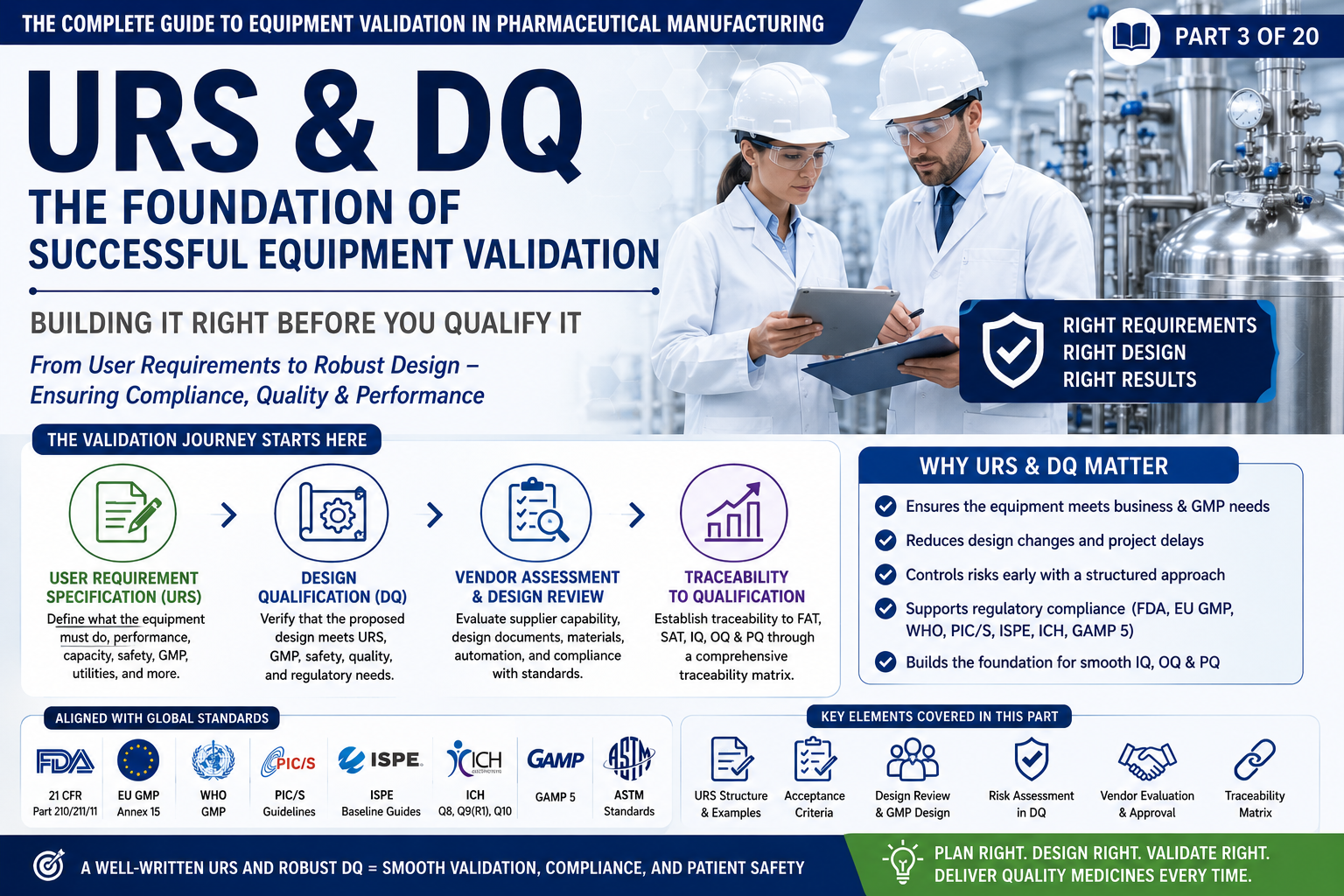
The success of every pharmaceutical equipment qualification project is determined long before Installation Qualification (IQ), Operational Qualification (OQ), or Performance Qualification (PQ) begins. It starts with a clear understanding of what the equipment must achieve and how it will be designed to meet those expectations.
This is accomplished through two foundational stages:
- User Requirement Specification (URS)
- Design Qualification (DQ)
A poorly written URS often leads to equipment that does not fully meet business or GMP requirements, while an inadequate DQ can result in expensive redesigns, qualification delays, deviations, and regulatory observations. Conversely, a well-defined URS and a robust DQ create the blueprint for a successful validation lifecycle.
This article explains how to prepare a scientifically justified URS, perform an effective Design Qualification, assess suppliers, establish traceability, and ensure compliance with FDA, EU GMP Annex 15, WHO GMP, PIC/S, ISPE, and GAMP 5.
What is a User Requirement Specification (URS)?
A User Requirement Specification (URS) is a controlled document that clearly defines what the user expects the equipment to do without prescribing how the manufacturer should design it.
The URS is the starting point of the equipment lifecycle and forms the basis for:
- Vendor selection
- Design Qualification
- Factory Acceptance Test (FAT)
- Site Acceptance Test (SAT)
- IQ, OQ, and PQ protocols
- Risk Assessments
- Traceability Matrix
Simply stated:
The URS defines the “WHAT”; the supplier determines the “HOW”.
Why is the URS Important?
A comprehensive URS helps ensure that:
- Equipment meets process needs.
- GMP requirements are incorporated from the outset.
- Vendors understand expectations.
- Qualification activities are focused and traceable.
- Future modifications are minimized.
- Validation costs and timelines are controlled.
Without a strong URS, the qualification process becomes reactive rather than planned.
Objectives of a Good URS
A well-written URS should:
- Clearly define intended use.
- Describe operational requirements.
- Specify capacity and performance.
- Include GMP expectations.
- Address safety and ergonomics.
- Define automation and software needs.
- Identify utilities.
- Include cleaning and maintenance requirements.
- State regulatory compliance expectations.
- Establish measurable acceptance criteria.
Characteristics of a Good URS
| Good URS | Poor URS |
|---|---|
| Clear and specific | Vague and ambiguous |
| Measurable | Subjective |
| Testable | Impossible to verify |
| Risk-based | Overly generic |
| User-focused | Design-prescriptive |
| Traceable | No linkage to testing |
| Approved | Uncontrolled |
Typical Structure of a URS
A robust URS generally includes the following sections:
- Document Control
- Purpose
- Scope
- Intended Use
- Equipment Description
- Process Requirements
- Capacity Requirements
- Product Characteristics
- Materials of Construction
- Utility Requirements
- Automation Requirements
- Software Requirements
- Data Integrity Requirements
- Cleaning Requirements
- Maintenance Requirements
- Safety Requirements
- Environmental Requirements
- Documentation Requirements
- FAT/SAT Expectations
- Qualification Requirements
- Acceptance Criteria
- References
- Approval Page
Example URS Requirements
Example: Tablet Compression Machine
| Requirement | Example |
|---|---|
| Capacity | 350,000 tablets/hour |
| Product | Round and oblong tablets |
| Tooling | B & D tooling compatible |
| Compression Force | 5–100 kN |
| Turret Speed | Variable |
| Data Recording | Electronic |
| Audit Trail | Required |
| Recipe Storage | Minimum 200 recipes |
| User Levels | Administrator, Supervisor, Operator |
| Cleaning | Tool-less dismantling |
| Material | SS316L product contact parts |
| Compliance | 21 CFR Part 11, Annex 11 |
Each requirement should later be verified through qualification testing.
Common URS Mistakes
Avoid the following:
- Copying URS from another project without review.
- Including supplier design solutions.
- Missing GMP requirements.
- Ignoring maintenance accessibility.
- Omitting cleaning expectations.
- Failing to define acceptance criteria.
- Lack of cross-functional input.
Traceability Matrix
Every URS requirement should be traceable through the qualification lifecycle.
URS Requirement
        │
        ▼
Risk Assessment
        │
        ▼
Design Qualification (DQ)
        │
        ▼
Factory Acceptance Test (FAT)
        │
        ▼
Site Acceptance Test (SAT)
        │
        ▼
Installation Qualification (IQ)
        │
        ▼
Operational Qualification (OQ)
        │
        ▼
Performance Qualification (PQ)
A traceability matrix demonstrates that every critical requirement has been verified.
What is Design Qualification (DQ)?
Design Qualification (DQ) is the documented verification that the proposed equipment design is suitable for its intended purpose and satisfies the approved URS before fabrication or procurement.
DQ ensures that:
- User requirements are addressed.
- GMP principles are incorporated.
- Risks are identified and mitigated.
- The supplier’s design is acceptable.
- Qualification can proceed with confidence.
Objectives of Design Qualification
DQ aims to confirm that:
- Equipment design meets the URS.
- Materials are appropriate.
- Utilities are correctly sized.
- Cleaning is feasible.
- Maintenance access is adequate.
- Safety requirements are incorporated.
- Automation meets business needs.
- Data integrity controls are included.
DQ Review Team
Design Qualification should involve a multidisciplinary team, including:
- Engineering
- Validation
- Quality Assurance
- Production
- Maintenance
- Automation/IT
- EHS (Environment, Health & Safety)
- Procurement
- Vendor representatives (where appropriate)
Key Elements of Design Qualification
1. Design Review
Evaluate:
- Mechanical design
- Process flow
- Equipment layout
- Accessibility
- Ergonomics
- Material compatibility
2. Material of Construction
Confirm:
- Product-contact parts are SS316L where appropriate.
- Surface finish meets hygienic requirements.
- Welds are documented.
- Certificates of material are available.
- Elastomers are compatible with process chemicals.
3. GMP Design Review
Assess whether the design supports:
- Prevention of contamination
- Easy cleaning
- Drainability
- No dead legs
- Smooth internal surfaces
- Hygienic construction
- Product segregation
4. Utility Assessment
Verify availability and suitability of:
- Electrical power
- Compressed air
- Purified water
- Clean steam
- Nitrogen
- Vacuum
- HVAC connections
5. Automation Review
For automated equipment, evaluate:
- PLC architecture
- HMI design
- SCADA integration
- Recipe management
- User access levels
- Alarm handling
- Audit trails
- Electronic signatures
- Backup and recovery
6. Safety Review
Ensure compliance with safety standards by verifying:
- Emergency stop buttons
- Safety interlocks
- Guarding
- Lockout/Tagout provisions
- Pressure relief devices
- Electrical protection
- Operator ergonomics
7. Vendor Assessment
Before procurement, assess the supplier’s capability by reviewing:
- GMP experience
- Quality Management System
- Previous installations
- Technical expertise
- Documentation practices
- Service and support
- Spare parts availability
Example DQ Checklist
| Item | Status |
|---|---|
| URS reviewed | ✔ |
| Process requirements met | ✔ |
| Materials verified | ✔ |
| Utility requirements confirmed | ✔ |
| Automation reviewed | ✔ |
| Cleaning design acceptable | ✔ |
| Safety features included | ✔ |
| Documentation available | ✔ |
| FAT planned | ✔ |
| Risks mitigated | ✔ |
Risk Assessment During DQ
Risk assessment should identify potential design failures before equipment manufacture.
Common tools include:
- FMEA (Failure Mode and Effects Analysis)
- Risk Matrix
- HACCP
- Fault Tree Analysis
Example Risks
| Risk | Mitigation |
|---|---|
| Dead leg in piping | Redesign piping layout |
| Inadequate drainage | Increase slope and drain points |
| Incorrect material | Specify SS316L |
| Software failure | Redundant backup and validation |
| Cross-contamination | Improve sealing and segregation |
URS to Qualification Traceability
| URS Requirement | Verification Stage |
|---|---|
| Equipment Capacity | OQ / PQ |
| Material Certificates | IQ |
| Utilities | IQ |
| Alarm Function | OQ |
| Recipe Management | OQ |
| Product Performance | PQ |
| Cleaning Design | DQ / PQ (Cleaning Validation) |
Maintaining traceability simplifies audits and demonstrates complete verification of user requirements.
Inspector’s Perspective
Regulatory inspectors often review the URS and DQ early in an inspection to determine whether the qualification program has a sound engineering and quality foundation.
Inspectors typically expect to see:
- Approved URS with version control.
- Evidence of cross-functional review.
- Documented Design Qualification.
- Risk assessments linked to design decisions.
- Traceability from URS through IQ, OQ, and PQ.
- Vendor assessment records.
- Scientific justification for acceptance criteria.
Incomplete or poorly controlled URS documents are a frequent cause of inspection observations.
Expert Tips
Expert Tip 1: Write the URS from the user’s perspective. Define what the equipment must accomplish, not how it should be engineered.
Expert Tip 2: Involve Production, QA, Engineering, Maintenance, and Automation teams during URS preparation to capture operational and compliance requirements early.
Expert Tip 3: Establish a traceability matrix at the start of the project and update it throughout the lifecycle. This significantly improves audit readiness and simplifies qualification.
Common Pitfalls
Avoid these common mistakes during URS and DQ:
- Copying requirements from unrelated projects without evaluation.
- Omitting GMP, safety, or data integrity requirements.
- Defining subjective or untestable acceptance criteria.
- Failing to assess supplier capabilities before procurement.
- Ignoring maintainability and cleanability during design review.
- Performing DQ after equipment fabrication instead of before.
- Poor communication between engineering, QA, and validation teams.
Frequently Asked Questions (FAQs)
1. What is the purpose of a URS?
To define the functional, operational, quality, safety, and regulatory requirements that equipment must satisfy.
2. Who prepares the URS?
The URS is typically prepared by a cross-functional team led by Engineering or the User Department with input from QA, Validation, Production, Maintenance, and Automation.
3. What is Design Qualification (DQ)?
DQ is the documented verification that the proposed equipment design meets the approved URS and is suitable for its intended use.
4. Is DQ mandatory?
While regulations may not prescribe a specific DQ format, FDA, EU GMP Annex 15, and ISPE guidance strongly support design review and qualification as part of the lifecycle approach.
5. What is the difference between URS and DQ?
The URS defines user expectations, whereas DQ verifies that the supplier’s design fulfills those expectations.
6. Why is a traceability matrix important?
It demonstrates that every user requirement has been addressed and verified during qualification, providing clear evidence during audits.
7. Should software requirements be included in the URS?
Yes. Automation, data integrity, user access, audit trails, and electronic record requirements should be specified for computerized equipment.
8. When should DQ be completed?
Ideally before equipment fabrication or procurement, allowing design issues to be corrected early and reducing project costs.
Key Takeaways
- The User Requirement Specification (URS) is the foundation of the equipment qualification lifecycle and defines what the equipment must achieve.
- Design Qualification (DQ) confirms that the proposed design satisfies the approved URS and incorporates GMP, safety, quality, and engineering best practices.
- Cross-functional collaboration, supplier assessment, risk management, and traceability are critical to successful URS and DQ execution.
- A well-prepared URS and DQ reduce project risk, minimize qualification deviations, improve regulatory compliance, and support efficient IQ, OQ, and PQ activities.
Coming Up in Part 4
Factory Acceptance Test (FAT) & Site Acceptance Test (SAT): Verifying Equipment Before and After Installation
In Part 4, we will cover FAT and SAT planning, protocol development, vendor and customer responsibilities, commissioning activities, utility verification, documentation, acceptance criteria, common deficiencies, and practical checklists to ensure equipment is ready for Installation Qualification (IQ).
About the Author
Ramesh Palav is a pharmaceutical manufacturing and quality professional with 21+ years of industry experience across pharmaceutical manufacturing, GMP, qualification and validation, QMS, compliance, CSV, audits, and operational excellence. With hands-on experience in OSD manufacturing, digital transformation and Pharma 4.0, he is passionate about strengthening pharmaceutical education, developing industry-ready talent, and promoting collaboration between academia and the pharmaceutical industry.