
Table of Contents
- Introduction
- Cleaning Validation Report
- Trending of Cleaning Validation Data
- Continued Process Verification (CPV)
- Revalidation Strategy
- Change Control
- Deviation Management
- CAPA
- OOS and OOT Handling
- Annual Product Review (APR/PQR)
- Audit Readiness
- Practical Case Study
- Trending Dashboard Example
- Best Practices
- Common Industry Mistakes
- Key Takeaways
- Continue to Part 4C
Introduction
Successfully completing three consecutive cleaning validation runs does not mark the end of the cleaning validation lifecycle. Regulatory agencies expect manufacturers to demonstrate that validated cleaning procedures continue to perform effectively throughout the life of the equipment.
This concept is known as Continued Process Verification (CPV) or Continued Cleaning Verification.
Global regulatory authorities including the US FDA, EMA, MHRA, WHO-GMP, and PIC/S emphasize a lifecycle approach to validation. Manufacturers are expected to monitor cleaning performance, evaluate trends, investigate failures, manage changes, and periodically review validation data to ensure the cleaning process remains in a validated state.
Cleaning Validation Report
Purpose
The Cleaning Validation Report is the final document that summarizes the execution and outcome of the validation study. It provides documented evidence that the approved cleaning procedure consistently meets predefined acceptance criteria.
The report should clearly answer the following questions:
- Was the protocol executed as approved?
- Were all validation runs successful?
- Did analytical results meet acceptance limits?
- Were deviations adequately investigated?
- Can the cleaning procedure be approved for routine use?
Typical Contents of a Validation Report
| Section | Description |
|---|---|
| Objective | Purpose of the study |
| Scope | Equipment and products covered |
| References | Protocols, SOPs, regulations |
| Equipment Details | Equipment IDs and descriptions |
| Validation Runs | Summary of executed runs |
| Sampling Results | Swab and rinse data |
| Analytical Results | HPLC, TOC, Conductivity, Microbiology |
| Deviations | Investigation and disposition |
| Conclusion | Pass/Fail decision |
| Approvals | QA, Validation, Production |
The report should be reviewed and approved by all relevant functions before routine manufacturing resumes.
Trending of Cleaning Validation Data
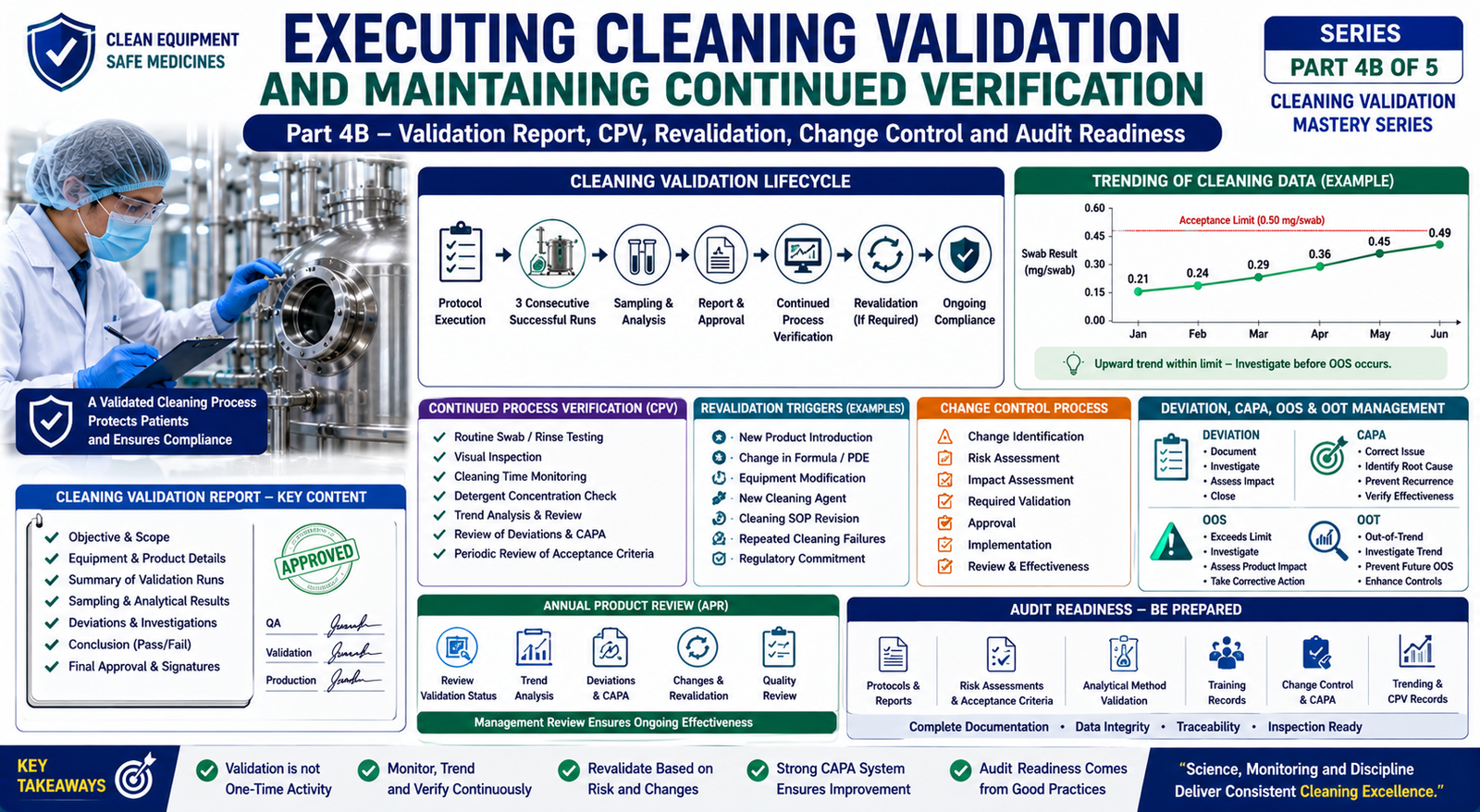
Cleaning validation should not rely on isolated results. Trending helps identify gradual changes before they become significant quality issues.
Typical parameters monitored include:
- Swab residue levels
- Rinse residue concentrations
- Recovery percentages
- Cleaning cycle duration
- Cleaning agent consumption
- Repeat cleaning frequency
- Microbial counts
- Visual inspection failures
Trend analysis supports proactive decision-making and continual improvement.
Example Trend Table
| Month | Average Swab Result (mg/swab) | Acceptance Limit | Status |
|---|---|---|---|
| January | 0.21 | ≤0.50 | Pass |
| February | 0.24 | ≤0.50 | Pass |
| March | 0.29 | ≤0.50 | Pass |
| April | 0.36 | ≤0.50 | Pass |
| May | 0.45 | ≤0.50 | Monitor |
| June | 0.49 | ≤0.50 | Investigation Recommended |
Although all results meet specifications, the upward trend may indicate deterioration in cleaning effectiveness and should be investigated.
Continued Process Verification (CPV)
What is CPV?
Continued Process Verification is the ongoing assurance that a validated cleaning process continues to operate within its approved parameters during routine manufacturing.
Rather than treating validation as a one-time activity, CPV promotes continuous monitoring throughout the equipment lifecycle.
Typical CPV Activities
- Routine swab verification
- Rinse sample testing
- Visual inspection
- Cleaning time monitoring
- Detergent concentration verification
- Review of deviations
- Trend analysis
- Periodic review of acceptance criteria
- Annual quality review
CPV ensures that cleaning remains effective despite changes in products, equipment, or manufacturing practices.
Revalidation Strategy
When is Revalidation Required?
Cleaning validation should be reviewed whenever changes may affect cleaning effectiveness.
Typical triggers include:
- New product introduction
- Highly potent products
- Equipment modification
- New cleaning agent
- Cleaning SOP revision
- Analytical method changes
- Product formulation changes
- Major maintenance
- Repeated cleaning failures
- Regulatory commitments
Not every change requires full revalidation; a documented risk assessment should determine the extent of additional validation.
Revalidation Decision Matrix
| Change | Revalidation Required? |
|---|---|
| Editorial SOP update | No |
| New API with lower PDE | Yes |
| Replacement of identical gasket | Usually No |
| New equipment design | Yes |
| New cleaning detergent | Yes |
| Analytical method upgrade | Risk Assessment Required |
| Equipment relocation | Risk Assessment Required |
Change Control
Every modification affecting cleaning validation must be managed through the site’s formal Change Control system.
Typical changes include:
- Equipment modifications
- Cleaning parameter adjustments
- New detergents
- Process improvements
- Product transfers
- Automation upgrades
- Software changes
- CIP program modifications
Each change should include:
- Risk assessment
- Impact assessment
- Required validation activities
- Approval
- Implementation
- Effectiveness review
Deviation Management
Despite careful planning, unexpected events can occur during cleaning validation.
Examples include:
- Incorrect cleaning cycle
- Sampling error
- Instrument failure
- Analytical error
- Operator error
- Utility interruption
- Documentation error
Every deviation should be:
- Documented.
- Investigated.
- Assessed for impact.
- Corrected.
- Closed with QA approval.
CAPA (Corrective and Preventive Action)
CAPA ensures that failures are not only corrected but prevented from recurring.
Corrective Actions
- Repeat cleaning
- Retrain operators
- Repair equipment
- Revise cleaning procedures
Preventive Actions
- Improve SOPs
- Optimize cleaning parameters
- Increase operator competency
- Enhance monitoring
- Upgrade equipment design
An effective CAPA system strengthens the overall cleaning validation program and supports regulatory compliance.
OOS and OOT Handling
Out-of-Specification (OOS)
An OOS result occurs when analytical results exceed established acceptance criteria.
Examples:
- Swab result above MACO limit
- Excessive detergent residue
- High microbial count
Immediate actions:
- Quarantine equipment
- Initiate investigation
- Assess product impact
- Implement CAPA
- Repeat validation if required
Out-of-Trend (OOT)
OOT results remain within specification but show an unexpected trend.
Examples include:
- Gradually increasing residue levels
- Rising microbial counts
- Longer cleaning cycle durations
OOT results often provide early warning before failures occur.
Annual Product Review (APR/PQR)
Cleaning validation data should be incorporated into the Annual Product Review (APR) or Product Quality Review (PQR).
The review should assess:
- Validation status
- Deviations
- OOS/OOT trends
- Revalidation activities
- CAPA effectiveness
- Customer complaints (if relevant)
- Inspection observations
- Opportunities for improvement
APR/PQR ensures senior management maintains oversight of cleaning validation performance.
Audit Readiness
Cleaning validation is a frequent focus during GMP inspections.
Inspectors typically review:
- Validation Master Plan
- Risk assessments
- Cleaning validation protocols
- Validation reports
- Analytical method validation
- Recovery studies
- Trend reports
- Deviations
- CAPA records
- Change controls
- Training records
Maintaining organized, inspection-ready documentation demonstrates a mature Pharmaceutical Quality System.
Practical Case Study
A pharmaceutical manufacturer observed an increasing trend in detergent residues during routine verification.
Investigation Findings:
- Cleaning agent concentration remained unchanged.
- Water temperature during cleaning had decreased due to a malfunctioning heat exchanger.
- Reduced temperature affected detergent efficiency.
Corrective Action:
- Repair heat exchanger.
- Repeat cleaning validation.
- Revise preventive maintenance schedule.
- Retrain operators on monitoring cleaning temperatures.
Following implementation, residue levels returned to historical averages and the validation state was restored.
Trending Dashboard Example
| KPI | Target | Current Status |
|---|---|---|
| Swab Pass Rate | 100% | 99.8% |
| Rinse Pass Rate | 100% | 100% |
| Visual Inspection Pass Rate | 100% | 100% |
| Cleaning Deviations | <2/year | 1 |
| CAPA Effectiveness | >95% | 98% |
| Revalidation On Time | 100% | 100% |
| OOS Events | 0 | 0 |
| OOT Events | <3/year | 2 |
Such dashboards support management review and continuous improvement initiatives.
Best Practices
✔ Review validation data periodically.
✔ Monitor long-term trends.
✔ Perform risk-based revalidation.
✔ Integrate cleaning validation into CPV programs.
✔ Maintain effective change control.
✔ Investigate deviations promptly.
✔ Verify CAPA effectiveness.
✔ Keep documentation inspection-ready.
Common Industry Mistakes
❌ Treating cleaning validation as a one-time activity.
❌ Ignoring OOT trends.
❌ Delayed deviation investigations.
❌ Weak change control processes.
❌ Failure to perform periodic reviews.
❌ Poor documentation practices.
❌ Lack of management oversight.
Key Takeaways
- Cleaning validation follows a lifecycle approach.
- Validation reports provide documented evidence of compliance.
- CPV ensures cleaning remains effective during routine manufacturing.
- Trend analysis helps identify issues before failures occur.
- Revalidation should be driven by documented risk assessment.
- Strong change control and CAPA systems support sustained compliance.
- Audit readiness depends on complete, accurate, and well-maintained documentation.
Looking Ahead
In Part 4C, we’ll complete this article with:
- Documentation Best Practices
- Common Documentation Errors
- Frequently Asked Questions (FAQs)
- Key Regulatory References
- Final Conclusion
- Internal Links to Part 5
- Featured Image Prompt
- Infographic Prompt
- LinkedIn Post
- Social Media Caption
- Image Alt Text
About the Author
Ramesh Palav is a pharmaceutical manufacturing and quality professional with 21+ years of industry experience across pharmaceutical manufacturing, GMP, qualification and validation, QMS, compliance, CSV, audits, and operational excellence. With hands-on experience in OSD manufacturing, digital transformation and Pharma 4.0, he is passionate about strengthening pharmaceutical education, developing industry-ready talent, and promoting collaboration between academia and the pharmaceutical industry.