
The pharmaceutical manufacturing industry is rapidly adopting advanced digital technologies to improve product quality, patient safety, regulatory compliance, and manufacturing efficiency. Among these technologies, Artificial Intelligence (AI)-powered visual inspection systems are emerging as one of the fastest-growing innovations in pharmaceutical quality control and manufacturing operations.
Visual inspection is a critical quality assurance activity used to identify visible defects in pharmaceutical products, including injectable products, tablets, capsules, medical devices, packaging components, and containers. Traditionally, visual inspection has depended heavily on trained human inspectors or conventional automated inspection machines based on predefined rules.
However, manual inspection is influenced by operator fatigue, environmental conditions, inspection duration, defect complexity, and human variability. Conventional automated inspection systems can also generate high numbers of false rejects because they may have difficulty distinguishing between acceptable product variations and genuine quality defects.
AI-powered visual inspection systems are changing this approach.
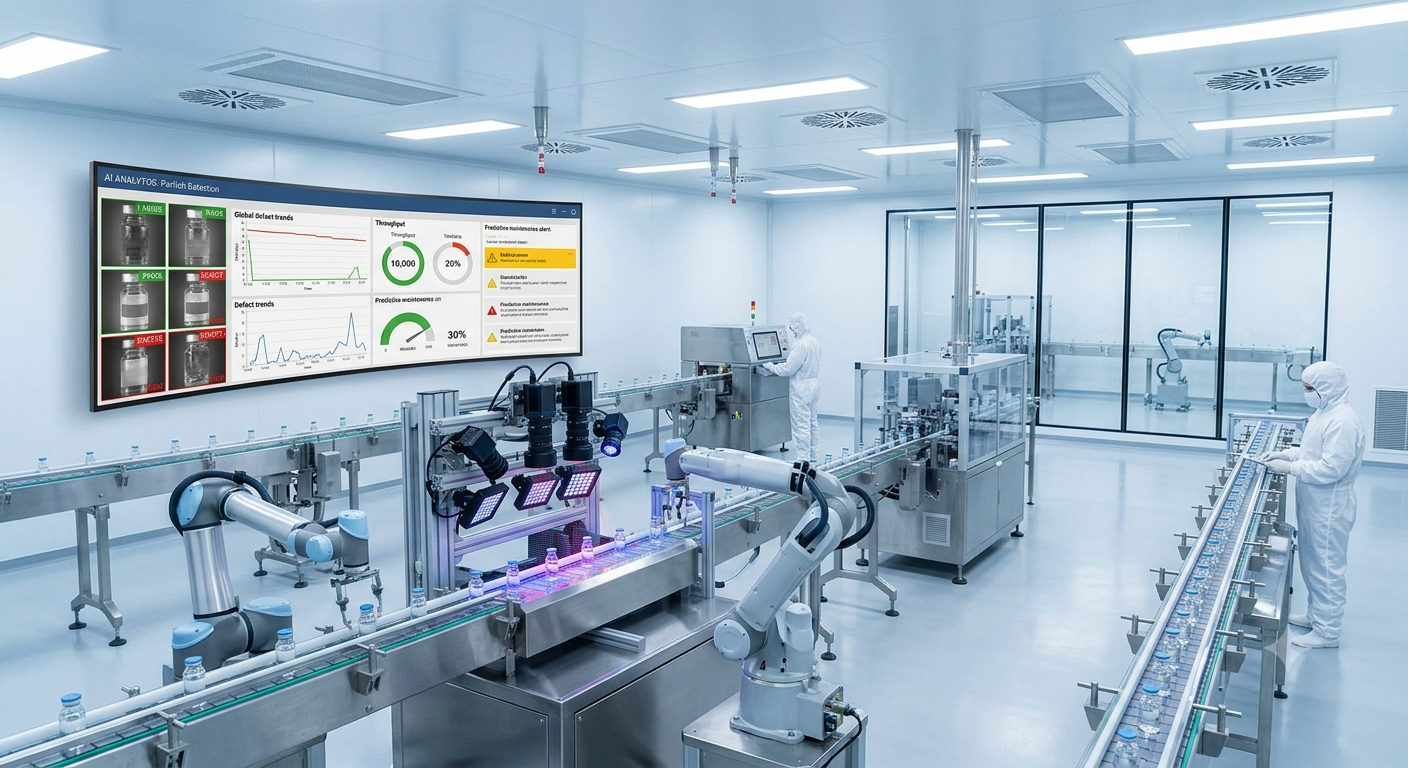
By combining machine vision, high-resolution cameras, advanced sensors, deep learning algorithms, robotics, automation, and data analytics, modern inspection platforms can detect defects with greater consistency, analyze large volumes of inspection data, reduce unnecessary product rejection, and generate valuable insights for continuous process improvement.
What Are AI-Powered Visual Inspection Systems?
AI-powered visual inspection systems are advanced automated inspection platforms that use artificial intelligence and machine learning algorithms to identify, classify, and analyze product defects.
A typical system includes high-speed cameras, controlled lighting systems, sensors, product handling mechanisms, image-processing software, AI algorithms, inspection data management platforms, and automated rejection mechanisms.
During inspection, multiple images of the product are captured under controlled conditions.
The AI algorithm analyzes these images and compares product characteristics against previously trained datasets containing acceptable products and known defect categories.
Based on the analysis, the system classifies the product as acceptable, defective, or requiring further evaluation.
Unlike conventional rule-based inspection systems, AI-powered platforms can continuously improve defect recognition when appropriately trained, validated, monitored, and maintained.
The objective is not simply to automate inspection but to transform visual inspection data into actionable manufacturing intelligence.
Why Visual Inspection Is Critical in Pharmaceutical Manufacturing
Visual inspection plays an important role in protecting patients from defective pharmaceutical products.
Injectable products require particularly stringent inspection controls because visible particles, cracks, cosmetic defects, container closure problems, filling abnormalities, and foreign materials may affect product quality or patient safety.
Typical defects identified during pharmaceutical visual inspection include:
- Visible particles in injectable products.
- Cracked or damaged vials.
- Container closure defects.
- Incorrect fill levels.
- Product discoloration.
- Scratches and cosmetic defects.
- Broken tablets.
- Tablet chipping and capping.
- Coating defects.
- Black spots and contamination.
- Incorrect embossing or printing.
- Missing tablets in blister packs.
- Damaged packaging components.
- Foreign materials.
The effectiveness of the inspection process depends on the ability of the system to consistently detect relevant defects while avoiding unnecessary rejection of acceptable products.
AI-powered visual inspection technologies are designed to improve this balance.
Limitations of Traditional Manual Visual Inspection
Manual visual inspection continues to be used across many pharmaceutical manufacturing operations. However, the process has several inherent limitations.
Human inspection performance can vary depending on operator experience, fatigue, concentration, inspection speed, defect complexity, lighting conditions, and the duration of repetitive inspection activities.
Two trained inspectors may evaluate the same borderline defect differently.
The probability of detecting very small or complex defects may also decrease when inspectors perform repetitive tasks for extended periods.
Manual inspection requires extensive qualification, training, periodic evaluation, and supervision.
Additionally, inspection results generated through manual processes provide limited opportunities for large-scale data analytics.
AI-powered inspection systems can help pharmaceutical manufacturers address these challenges by providing standardized inspection conditions, automated defect classification, consistent decision-making, and digital inspection records.
How AI-Powered Visual Inspection Systems Work
Modern AI-powered visual inspection systems generally operate through several integrated stages.
1. Product Presentation
Products are transported into the inspection area using automated handling systems.
Depending on the application, products may be rotated, positioned, illuminated, or moved at controlled speeds to ensure complete surface inspection.
For injectable products, specialized handling mechanisms may rotate containers to detect visible particles suspended within the product.
2. Image Acquisition
High-resolution industrial cameras capture multiple images of the product.
Different lighting techniques may be used to highlight specific defect characteristics.
Backlighting, directional lighting, infrared imaging, ultraviolet imaging, and hyperspectral imaging technologies may be incorporated depending on the inspection application.
3. Image Processing
The captured images undergo preprocessing.
Software algorithms may remove background noise, adjust contrast, identify product boundaries, and highlight potential abnormalities.
4. AI-Based Defect Detection
Deep learning algorithms analyze the processed images.
The AI model identifies patterns associated with known defects.
The system may classify defects according to predefined categories such as critical, major, minor, cosmetic, or acceptable product variation.
5. Product Classification
Based on the inspection results, the system automatically determines whether the product should be accepted or rejected.
Borderline products may be routed for additional inspection or human review.
6. Data Collection and Analytics
Every inspection generates valuable manufacturing data.
Inspection results can be stored in centralized databases and analyzed to identify defect trends, process deviations, equipment problems, recurring abnormalities, and potential manufacturing risks.
This capability transforms visual inspection from a simple quality-control activity into a powerful source of process intelligence.
Applications in Injectable Product Manufacturing
Injectable pharmaceutical manufacturing is one of the most important applications of automated visual inspection technologies.
Products such as vials, ampoules, prefilled syringes, cartridges, and infusion containers require reliable inspection systems.
AI-powered systems can detect visible particles, fibers, glass fragments, container cracks, stopper defects, cosmetic abnormalities, fill-level variations, container closure problems, and foreign materials.
Traditional inspection machines may struggle to differentiate genuine particles from acceptable visual phenomena such as air bubbles, reflections, container markings, or product movement.
Machine learning algorithms can be trained to recognize these differences.
This capability can significantly reduce false rejection rates while maintaining appropriate defect detection sensitivity.
Applications in Tablet Manufacturing
AI-powered visual inspection is also expanding rapidly in oral solid dosage manufacturing.
High-speed tablet manufacturing lines produce thousands of tablets every minute. Inspecting every tablet manually is practically impossible.
AI-based inspection systems installed on tablet presses, coating machines, dedusting systems, conveyors, and packaging lines can continuously evaluate product appearance.
Common tablet defects detected by AI-powered systems include:
- Capping.
- Lamination.
- Chipping.
- Cracks.
- Black spots.
- Foreign particles.
- Color variations.
- Coating defects.
- Surface abnormalities.
- Incorrect embossing.
- Broken tablets.
- Dimensional variations.
Real-time defect detection allows manufacturers to identify manufacturing problems earlier and take corrective action before large quantities of defective products are produced.
Reducing False Rejects Through Artificial Intelligence
One of the major advantages of AI-powered inspection systems is their potential to reduce false rejects.
False rejection occurs when acceptable pharmaceutical products are incorrectly classified as defective.
High false rejection rates increase manufacturing losses, inspection workload, investigation requirements, and production costs.
Conventional inspection machines generally operate using predefined thresholds.
Products falling outside these limits may automatically be rejected even when the observed variation does not represent a meaningful quality defect.
AI algorithms can evaluate multiple product characteristics simultaneously and identify complex relationships between visual patterns.
This allows systems to distinguish more effectively between genuine defects and acceptable product variations.
Reducing false rejects can improve yield, reduce manufacturing waste, increase equipment efficiency, and lower the overall cost of pharmaceutical production.
Improving GMP Compliance and Data Integrity
AI-powered inspection systems can strengthen pharmaceutical quality systems when implemented within an appropriate GMP framework.
Modern inspection platforms can automatically generate electronic inspection records containing product information, batch numbers, inspection parameters, defect classifications, rejection decisions, system alarms, audit trails, user activities, and inspection trends.
These records can improve traceability and facilitate deviation investigations, complaint investigations, batch review, and regulatory inspections.
Electronic records generated by computerized inspection systems should be managed according to applicable regulatory expectations for data integrity and computerized systems.
Pharmaceutical companies must ensure appropriate controls for access management, audit trails, electronic records, system security, backup, disaster recovery, change control, and periodic system review.
AI-powered inspection systems should also be designed and operated according to the principles of ALCOA+ data integrity, ensuring that records are attributable, legible, contemporaneous, original, accurate, complete, consistent, enduring, and available.
Predictive Quality Analytics
Perhaps the most transformative capability of AI-powered inspection systems is predictive quality analytics.
Traditional visual inspection primarily identifies defective products after defects have already occurred.
AI-based analytics can go further.
By continuously analyzing inspection data, process parameters, equipment performance, environmental conditions, and historical manufacturing information, AI platforms can identify patterns that may indicate developing manufacturing problems.
For example, an increasing trend in tablet chipping could indicate deterioration of compression tooling.
Increasing coating defects could indicate problems with spray guns, atomization pressure, coating solution properties, airflow, or product-bed temperature.
Increasing cosmetic defects in injectable containers could indicate problems with filling equipment, container handling systems, washing machines, depyrogenation tunnels, or upstream suppliers.
Predictive analytics allows manufacturing teams to investigate potential problems before they develop into significant deviations, batch failures, or product quality events.
Integration with Pharma 4.0 Technologies
AI-powered visual inspection systems are an important component of the Pharma 4.0 manufacturing environment.
Inspection platforms can be integrated with Manufacturing Execution Systems (MES), Laboratory Information Management Systems (LIMS), Electronic Quality Management Systems (eQMS), Supervisory Control and Data Acquisition (SCADA) platforms, Enterprise Resource Planning (ERP) systems, historians, and advanced analytics platforms.
Integration allows inspection information to be combined with manufacturing process data.
For example, tablet defect trends can be correlated with compression force, turret speed, feeder speed, tablet weight, hardness, granule properties, and environmental conditions.
This connected manufacturing environment enables faster root-cause analysis and better process understanding.
Regulatory and Validation Considerations
The implementation of AI-powered inspection technologies requires careful regulatory planning.
Pharmaceutical manufacturers must demonstrate that inspection systems are suitable for their intended use and consistently perform according to approved requirements.
Important lifecycle activities may include:
- User Requirements Specification (URS).
- Quality and data integrity risk assessments.
- Supplier assessment.
- Design review and qualification.
- Factory Acceptance Testing (FAT).
- Site Acceptance Testing (SAT).
- Installation Qualification (IQ).
- Operational Qualification (OQ).
- Performance Qualification (PQ).
- Computer System Validation (CSV).
- AI model development and training documentation.
- Dataset governance.
- Challenge-set development.
- Defect library management.
- Algorithm performance evaluation.
- Access control and cybersecurity assessment.
- Audit trail verification.
- Backup and recovery testing.
- Change control.
- Periodic review.
- Continued performance monitoring.
One of the most important considerations is AI model lifecycle management.
Manufacturers must define how models are trained, tested, approved, deployed, monitored, changed, retrained, and retired.
Uncontrolled changes to algorithms or training datasets could create significant compliance risks.
Therefore, strong governance and change-control processes are essential.
Challenges in Implementing AI-Powered Visual Inspection
Despite the benefits, implementation presents several challenges.
The effectiveness of an AI inspection system depends heavily on the quality and representativeness of training data.
Manufacturers require sufficient images of acceptable products and relevant defect categories.
Rare defects may be difficult to collect in sufficient quantities.
Another challenge is explaining AI-based decisions.
Regulated manufacturers must understand the basis of critical inspection decisions and establish appropriate controls over algorithm performance.
Integration with legacy manufacturing equipment and information systems can also be technically complex.
Additional challenges include cybersecurity, infrastructure requirements, system validation, workforce training, data storage, defect-library governance, model drift, vendor dependency, and regulatory uncertainty surrounding continuously learning AI systems.
Successful implementation therefore requires collaboration between Production, Engineering, Quality Assurance, Quality Control, Automation, Information Technology, Data Science, Validation, and Regulatory Affairs teams.
Future of AI-Powered Visual Inspection
The future of pharmaceutical visual inspection will move toward increasingly intelligent, connected, and autonomous quality-control systems.
Future inspection technologies are expected to incorporate advanced deep learning models, edge computing, digital twins, robotics, hyperspectral imaging, explainable AI, predictive maintenance, process analytical technology, and real-time manufacturing analytics.
Inspection systems will increasingly move beyond simply answering the question:
“Is this product defective?”
Future systems will also help answer:
“Why did this defect occur?”
“Is the defect rate increasing?”
“Which process parameter is contributing to the problem?”
“When is the equipment likely to require maintenance?”
“What manufacturing adjustment could prevent future defects?”
This transition represents an important evolution from automated quality inspection toward predictive and eventually prescriptive quality management.
Conclusion
AI-powered visual inspection systems are becoming an important technology for modern pharmaceutical manufacturing.
By combining artificial intelligence, machine vision, automation, and advanced analytics, these systems can improve defect detection, reduce false rejects, strengthen inspection consistency, enhance data integrity, and generate valuable manufacturing intelligence.
The technology is particularly valuable for high-speed production environments such as injectable manufacturing and oral solid dosage manufacturing, where large quantities of products must be inspected reliably.
However, successful implementation requires much more than installing advanced cameras and AI software.
Pharmaceutical manufacturers must establish appropriate system validation, data governance, defect-library management, algorithm lifecycle controls, computerized system controls, change management, cybersecurity, and continued performance monitoring.
The greatest long-term opportunity lies in connecting visual inspection data with manufacturing process information.
When AI-powered inspection platforms are integrated with MES, SCADA, eQMS, LIMS, equipment data, and advanced analytics platforms, visual inspection can evolve from a product rejection mechanism into a strategic tool for continuous process improvement and predictive quality management.
As the pharmaceutical industry progresses toward Pharma 4.0 and increasingly digital manufacturing operations, AI-powered visual inspection systems are expected to play an important role in creating smarter factories, reducing manufacturing losses, improving process understanding, strengthening quality systems, and ultimately protecting patient safety.
For pharmaceutical professionals, understanding AI-powered visual inspection technologies, their validation requirements, data integrity implications, and integration with modern manufacturing systems will become increasingly important.
The future of pharmaceutical quality control is moving from manual detection to automated inspection—and from automated inspection toward intelligent, predictive, and data-driven quality management.
About the Author
Ramesh Palav is a seasoned professional in GxP Quality, Computer System Validation (CSV), Data Integrity, and Pharmaceutical IT Compliance. He has extensive experience in implementing and managing GxP computerized systems, risk-based validation, audit trails, data integrity, and regulatory compliance. Through his articles and professional insights, he aims to share practical knowledge and help pharmaceutical and life-sciences professionals strengthen quality, compliance, and data integrity.