
Introduction
The pharmaceutical industry is undergoing a significant transformation in the way medicines are manufactured. Traditionally, pharmaceutical products, particularly oral solid dosage forms such as tablets and capsules, have been produced using batch manufacturing processes. In batch manufacturing, raw materials pass through individual manufacturing stages such as dispensing, granulation, drying, milling, blending, compression, and coating. Each manufacturing step is completed before the material is transferred to the next processing stage.
Although batch manufacturing has supported the pharmaceutical industry for decades, it has several limitations. Long manufacturing cycle times, intermediate material storage, extensive manual handling, large manufacturing areas, process variability, and delays associated with laboratory testing can affect manufacturing efficiency.
Continuous manufacturing offers an alternative approach.
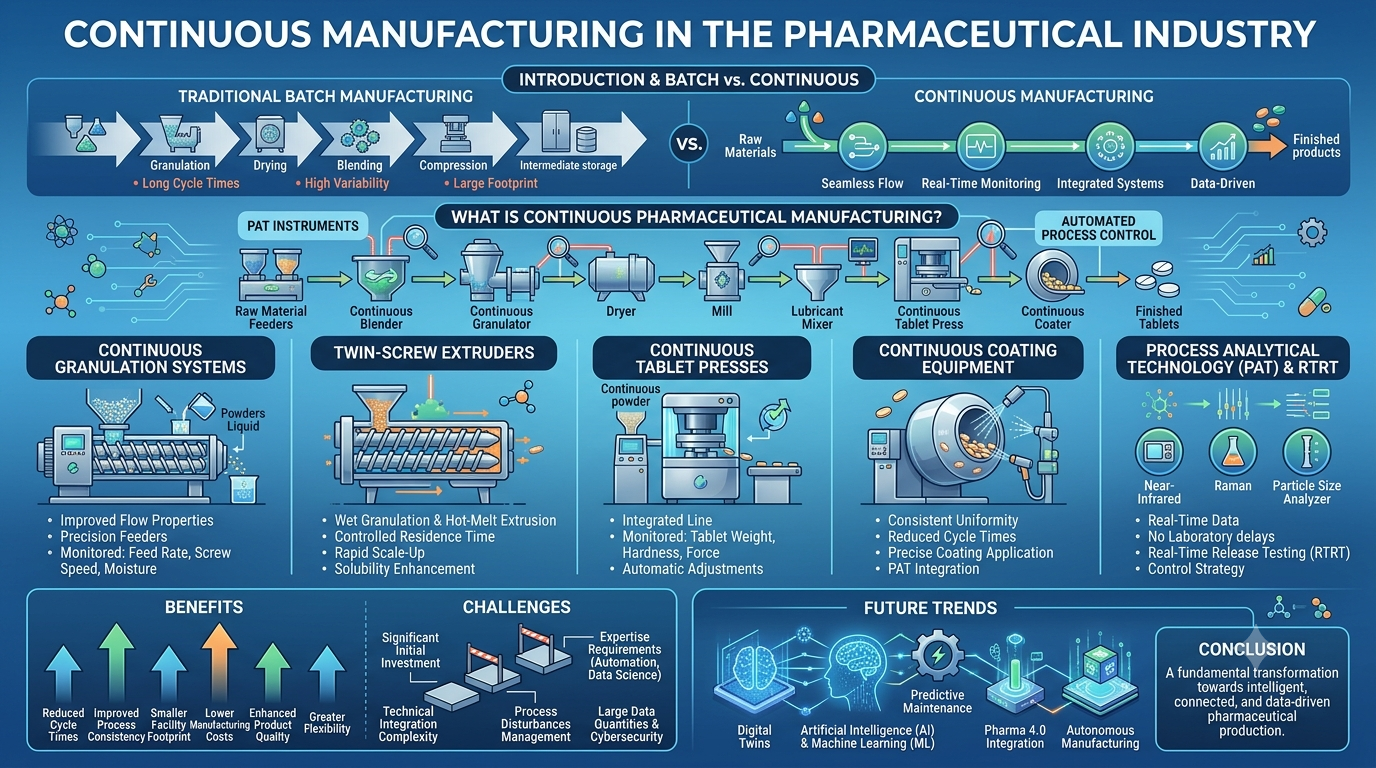
In continuous pharmaceutical manufacturing, raw materials are continuously fed into an integrated production system, processed through interconnected equipment, monitored using advanced analytical technologies, and converted into finished pharmaceutical products.
Pharmaceutical companies are increasingly investing in technologies such as continuous granulators, twin-screw extruders, continuous tablet presses, continuous coating systems, Process Analytical Technology (PAT), automated process control systems, and Real-Time Release Testing (RTRT).
These technologies can reduce manufacturing cycle times, improve process consistency, decrease equipment footprint, enhance product quality, and support data-driven pharmaceutical manufacturing.
Continuous manufacturing is therefore becoming an important component of Pharma 4.0 and the future of pharmaceutical production.
What Is Continuous Pharmaceutical Manufacturing?
Continuous manufacturing is a production approach in which raw materials continuously enter the manufacturing process while finished or intermediate products are continuously produced.
Unlike traditional batch manufacturing, production does not necessarily stop between individual processing stages.
For example, a continuous tablet manufacturing line may integrate:
Raw material feeding → Continuous blending → Continuous granulation → Drying → Milling → Lubrication → Tablet compression → Tablet coating → Process monitoring → Product release.
The entire manufacturing system can operate as an integrated production line controlled through advanced automation systems.
Sensors and analytical instruments continuously monitor critical process parameters and critical quality attributes.
Process data are collected and analyzed in real time, enabling manufacturers to identify process deviations and implement corrective actions quickly.
The implementation of continuous manufacturing requires an integrated combination of equipment, automation, PAT instruments, process models, data management systems, and advanced process control strategies.
Why Pharmaceutical Companies Are Investing in Continuous Manufacturing
Pharmaceutical manufacturers operate in an increasingly competitive and highly regulated environment.
Companies must manufacture high-quality medicines while controlling production costs, reducing manufacturing cycle times, maintaining regulatory compliance, and responding quickly to market demand.
Traditional pharmaceutical manufacturing facilities may require several days or even weeks to complete manufacturing, laboratory testing, quality review, and batch release activities.
Continuous manufacturing can significantly shorten this timeline.
Integrated manufacturing systems eliminate several intermediate processing and material transfer activities.
Automated process monitoring allows manufacturers to understand process performance continuously.
The major drivers behind investments in continuous manufacturing include:
Reduced manufacturing cycle times.
Improved process consistency.
Smaller manufacturing facility footprint.
Reduced work-in-process inventory.
Lower material handling requirements.
Improved process understanding.
Enhanced automation.
Reduced manufacturing costs.
Improved product quality.
Greater manufacturing flexibility.
Faster response to changes in market demand.
Potential implementation of Real-Time Release Testing.
Continuous manufacturing therefore represents both a technological transformation and a strategic manufacturing opportunity.
1. Continuous Granulation Systems
Granulation is one of the most important operations in pharmaceutical tablet manufacturing.
The primary purpose of granulation is to improve powder flow properties, content uniformity, compressibility, and tablet manufacturing performance.
Traditional granulation processes are performed using batch equipment such as high-shear granulators and fluid bed processors.
Continuous granulation systems perform granulation operations without repeatedly loading, processing, discharging, and cleaning individual manufacturing batches.
Raw materials are continuously introduced into the equipment using precision feeders.
The powders are mixed and granulated under controlled processing conditions.
The granules may subsequently pass through integrated drying, milling, and blending systems.
Important process parameters include:
Material feed rate.
Liquid addition rate.
Screw speed.
Granulation temperature.
Residence time.
Specific mechanical energy.
Granule moisture content.
Particle size distribution.
Continuous monitoring of these parameters allows manufacturers to maintain consistent granule quality.
Advanced systems may integrate Near-Infrared Spectroscopy, moisture sensors, particle size analyzers, and other PAT technologies.
Continuous granulation equipment can significantly reduce manufacturing cycle times while improving process control.
2. Twin-Screw Extruders
Twin-screw extrusion is one of the most important enabling technologies for continuous pharmaceutical manufacturing.
A twin-screw extruder consists of two rotating screws operating inside a controlled barrel.
Raw materials are continuously introduced into the equipment through gravimetric feeders.
The rotating screws transport, mix, shear, compress, and process the pharmaceutical materials.
Depending on the manufacturing application, twin-screw extruders can be used for wet granulation, hot-melt extrusion, continuous mixing, and preparation of pharmaceutical formulations.
Twin-screw granulation offers several advantages.
The equipment provides efficient mixing and controlled material residence time.
Processing conditions can be modified by changing screw configuration, screw speed, feed rate, liquid addition rate, and barrel temperature.
The technology also supports rapid process development and manufacturing scale-up.
Process parameters monitored during twin-screw extrusion may include:
Screw speed.
Material feed rate.
Liquid-to-solid ratio.
Barrel temperature.
Motor torque.
Product temperature.
Residence time distribution.
Specific mechanical energy.
These parameters can significantly influence product quality.
Therefore, pharmaceutical companies use advanced sensors and PAT technologies to monitor and control the extrusion process.
Twin-screw extrusion is particularly valuable for continuous wet granulation and hot-melt extrusion processes used to improve the solubility and bioavailability of poorly soluble drug substances.
3. Continuous Tablet Presses
Tablet compression is a critical manufacturing operation in oral solid dosage manufacturing.
Traditional rotary tablet presses operate continuously during batch manufacturing. However, their integration with upstream and downstream continuous manufacturing equipment creates a complete continuous tablet manufacturing process.
Continuous tablet presses receive a controlled flow of final blend from upstream equipment.
The tablet press converts the powder or granules into tablets while continuously monitoring manufacturing parameters.
Modern tablet presses may monitor:
Tablet weight.
Compression force.
Pre-compression force.
Main compression force.
Tablet thickness.
Tablet hardness.
Turret speed.
Feeder speed.
Ejection force.
Machine vibration.
Rejected tablet quantities.
Advanced control systems can automatically adjust operating parameters based on process measurements.
For example, if tablet weight begins to move away from the established control range, the equipment control system may automatically adjust the dosing parameters.
Modern tablet presses can also integrate with Manufacturing Execution Systems, SCADA platforms, electronic batch records, and centralized data historians.
These capabilities improve process visibility, equipment performance monitoring, data integrity, and regulatory compliance.
4. Continuous Coating Equipment
Tablet coating is another important pharmaceutical manufacturing operation.
Traditional tablet coating is typically performed using batch coating systems.
A predetermined quantity of tablets is loaded into a coating machine, processed, dried, inspected, and discharged.
Continuous tablet coating systems allow tablets to continuously enter the coating equipment, receive controlled coating application, undergo drying, and exit the equipment.
Important process parameters include:
Tablet feed rate.
Spray rate.
Atomization air pressure.
Pattern air pressure.
Inlet air temperature.
Exhaust air temperature.
Product temperature.
Airflow.
Coating weight gain.
Tablet residence time.
Continuous coaters provide several potential benefits.
They can reduce coating cycle times, improve heat and mass transfer, reduce equipment footprint, and provide consistent coating uniformity.
Advanced continuous coating equipment can integrate PAT technologies to monitor coating thickness, moisture levels, and product quality.
Automatic process control systems can adjust operating parameters to maintain consistent product quality.
Continuous coating systems are particularly valuable when integrated into end-to-end continuous tablet manufacturing platforms.
5. Process Analytical Technology in Continuous Manufacturing
Process Analytical Technology is one of the fundamental components of continuous pharmaceutical manufacturing.
PAT involves the use of analytical instruments, sensors, process analyzers, and data analysis technologies to understand and control pharmaceutical manufacturing processes.
Traditional pharmaceutical manufacturing often relies heavily on laboratory testing of samples collected during or after manufacturing.
Continuous manufacturing requires faster process information.
PAT technologies can provide real-time or near-real-time information regarding material properties and product quality.
Common PAT technologies include:
Near-Infrared Spectroscopy.
Raman Spectroscopy.
Particle size analyzers.
Moisture sensors.
Machine vision systems.
Temperature sensors.
Pressure sensors.
Flow meters.
Torque monitoring.
Process imaging technologies.
PAT instruments generate large quantities of manufacturing data.
Advanced software platforms analyze this data and determine whether the manufacturing process remains within the validated operating conditions.
The integration of PAT, automation, and process control enables manufacturers to move toward advanced pharmaceutical manufacturing.
6. Real-Time Release Testing (RTRT)
One of the most significant potential benefits of continuous manufacturing is the implementation of Real-Time Release Testing.
Traditional pharmaceutical manufacturing relies heavily on laboratory testing of finished products before a batch can be released.
Samples are collected and analyzed for quality attributes such as assay, content uniformity, dissolution, moisture, and other product specifications.
These activities can require significant time.
RTRT uses process data, PAT measurements, process models, and scientifically established control strategies to evaluate product quality during manufacturing.
Instead of relying exclusively on end-product testing, manufacturers continuously monitor the process and product quality.
Successful implementation of RTRT requires:
Comprehensive process understanding.
Quality Risk Management.
Validated PAT instruments.
Reliable process models.
Advanced process control systems.
Data integrity controls.
Equipment qualification.
Computer System Validation.
Defined material diversion strategies.
Robust deviation management systems.
Regulatory approval.
RTRT can significantly reduce product release timelines.
However, implementation requires substantial scientific knowledge, process development, validation, and regulatory engagement.
Integration of Continuous Manufacturing Equipment
The greatest benefits of continuous manufacturing are achieved when individual equipment systems are integrated into a complete manufacturing platform.
An integrated continuous tablet manufacturing line may contain:
Loss-in-weight feeders.
Continuous blenders.
Twin-screw granulators.
Continuous dryers.
Milling systems.
Lubrication systems.
Continuous tablet presses.
Continuous coaters.
PAT instruments.
Material diversion systems.
Automated sampling systems.
SCADA systems.
Manufacturing Execution Systems.
Electronic Batch Records.
Data historians.
Advanced Process Control systems.
The entire manufacturing system operates as an interconnected process.
Equipment data, process parameters, alarms, events, quality information, and PAT measurements are continuously collected.
Advanced control systems analyze the information and maintain the manufacturing process within the established control strategy.
Equipment Qualification and Validation Challenges
Continuous manufacturing introduces new challenges for pharmaceutical qualification and validation professionals.
Traditional equipment qualification often focuses on individual equipment systems.
Continuous manufacturing requires validation of an integrated manufacturing platform.
Important qualification and validation considerations include:
User Requirements Specifications.
Design Qualification.
Supplier qualification.
Factory Acceptance Testing.
Site Acceptance Testing.
Installation Qualification.
Operational Qualification.
Performance Qualification.
Computer System Validation.
PAT instrument validation.
Automation system validation.
Data integrity assessments.
Interface verification.
Alarm management.
Electronic records and electronic signatures.
Process model validation.
Material traceability.
Residence Time Distribution studies.
Material diversion strategies.
Continued Process Verification.
Change control management.
Validation professionals must understand the interaction between equipment, automation, software, PAT instruments, manufacturing processes, and quality systems.
Benefits of Continuous Manufacturing Equipment
Continuous manufacturing equipment offers several potential benefits to pharmaceutical manufacturers.
The most significant advantage is reduced manufacturing cycle time.
Processes that previously required several days may potentially be completed within hours.
Integrated equipment reduces material transfer activities and work-in-process inventory.
Continuous process monitoring improves manufacturing visibility.
Smaller equipment systems can reduce facility footprint and capital investment requirements.
Automated control systems can improve process consistency.
PAT technologies provide greater understanding of manufacturing processes.
Continuous manufacturing can also provide greater manufacturing flexibility.
Production quantities may be adjusted by modifying equipment operating time rather than changing equipment size.
These advantages make continuous manufacturing particularly attractive for modern pharmaceutical manufacturing facilities.
Challenges of Continuous Manufacturing
Despite its advantages, continuous manufacturing presents several challenges.
The initial investment in advanced equipment, automation, PAT instruments, and software systems can be significant.
Companies require employees with expertise in process engineering, automation, data science, PAT, validation, and regulatory compliance.
Equipment integration can be technically complex.
Managing process disturbances and material diversion requires scientifically justified strategies.
Large quantities of process data must be securely collected, analyzed, reviewed, and maintained.
Data integrity and cybersecurity therefore become increasingly important.
Companies transitioning from established batch manufacturing processes must also manage organizational and cultural change.
Successful implementation requires collaboration between Production, Quality Assurance, Engineering, Validation, Automation, IT, Regulatory Affairs, and Process Development teams.
The Future of Continuous Pharmaceutical Manufacturing
The future of continuous manufacturing will be closely connected with digital transformation and Pharma 4.0 technologies.
Future manufacturing systems are expected to increasingly integrate artificial intelligence, machine learning, digital twins, predictive maintenance, advanced process control, cloud computing, smart sensors, and autonomous manufacturing technologies.
Artificial intelligence systems may analyze manufacturing data and predict process disturbances before product quality is affected.
Digital twins may allow pharmaceutical manufacturers to simulate equipment performance and optimize operating conditions.
Predictive maintenance systems may identify early indications of equipment failure.
Advanced robotics may reduce manual material handling and operator intervention.
Integration between continuous manufacturing equipment, PAT, MES, eQMS, LIMS, and enterprise systems could create highly connected pharmaceutical manufacturing facilities.
The long-term objective is the development of intelligent manufacturing systems capable of continuously monitoring, analyzing, controlling, and optimizing pharmaceutical production.
Conclusion
Continuous manufacturing equipment represents one of the most important technological developments in modern pharmaceutical manufacturing.
Continuous granulators, twin-screw extruders, continuous tablet presses, continuous coating systems, Process Analytical Technology, advanced process control systems, and Real-Time Release Testing are transforming the traditional pharmaceutical production model.
These technologies can reduce manufacturing cycle times, improve process consistency, decrease facility footprint, enhance manufacturing flexibility, and strengthen process understanding.
However, successful implementation requires more than purchasing advanced equipment.
Pharmaceutical companies must develop strong capabilities in process development, automation, equipment qualification, Computer System Validation, PAT, data integrity, Quality Risk Management, regulatory compliance, and continued process verification.
As pharmaceutical manufacturing moves toward Pharma 4.0, continuous manufacturing will increasingly become an important component of intelligent, connected, and data-driven production facilities.
For pharmaceutical professionals working in Production, Engineering, Qualification, Validation, Quality Assurance, Automation, and Digital Manufacturing, developing expertise in continuous manufacturing technologies will provide valuable opportunities for future career growth.
Continuous manufacturing is not simply a new method of producing pharmaceutical products. It represents a fundamental transformation in how medicines are developed, manufactured, monitored, controlled, and released to patients.
About the Author
Ramesh Palav is a seasoned professional in GxP Quality, Computer System Validation (CSV), Data Integrity, and Pharmaceutical IT Compliance. He has extensive experience in implementing and managing GxP computerized systems, risk-based validation, audit trails, data integrity, and regulatory compliance. Through his articles and professional insights, he aims to share practical knowledge and help pharmaceutical and life-sciences professionals strengthen quality, compliance, and data integrity.
Pingback: The Pharma Factory of 2030 is Coming: Are Pharma Professionals Ready?