
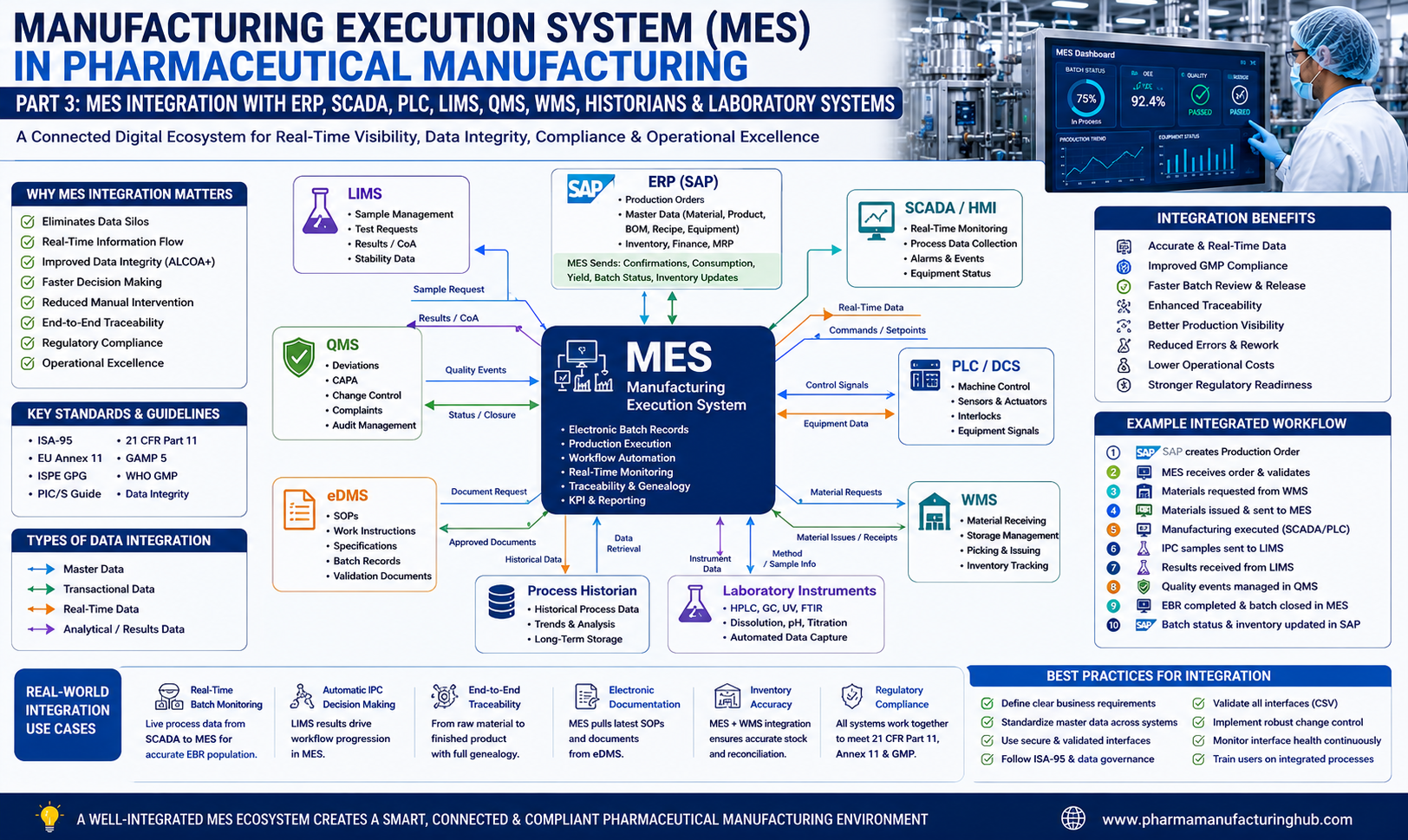
Part 3: MES Integration with ERP, SCADA, PLC, LIMS, QMS, WMS, Historians, and Laboratory Systems
Executive Summary
A Manufacturing Execution System (MES) delivers its greatest value when it is seamlessly integrated with enterprise business systems, shop-floor automation, laboratory applications, and quality management platforms. Rather than operating as a standalone application, MES serves as the digital hub that connects planning, production, quality, maintenance, warehousing, and analytics into a unified manufacturing ecosystem.
This article explains how MES integrates with SAP ERP, SCADA, PLCs, Distributed Control Systems (DCS), Laboratory Information Management Systems (LIMS), Quality Management Systems (QMS), Electronic Document Management Systems (eDMS), Warehouse Management Systems (WMS), process historians, barcode/RFID technologies, and laboratory instruments to enable real-time visibility, data integrity, and regulatory compliance.
Table of Contents
- Why MES Integration Matters
- Digital Manufacturing Ecosystem
- MES and ERP (SAP) Integration
- MES with SCADA and PLC
- MES with DCS
- MES with LIMS
- MES with QMS
- MES with eDMS
- MES with WMS
- MES with Process Historians
- Barcode & RFID Integration
- Laboratory Instrument Integration
- End-to-End Integration Architecture
- Integration Best Practices
- Key Takeaways
1. Why MES Integration Matters
A pharmaceutical manufacturing site typically operates multiple computerized systems. If these systems are disconnected, organizations often face:
- Duplicate data entry
- Manual transcription errors
- Delayed information flow
- Limited production visibility
- Inconsistent master data
- Increased compliance risks
- Longer batch release cycles
MES eliminates these silos by creating a connected digital environment where information flows automatically between systems.
Benefits of Integration
- Single source of truth
- Real-time production visibility
- Improved data integrity
- Faster decision-making
- Reduced manual intervention
- Enhanced traceability
- Better regulatory compliance
- Increased operational efficiency
2. Digital Manufacturing Ecosystem
A modern pharmaceutical manufacturing environment consists of interconnected systems.
                    Enterprise Level
               ┌───────────────────────┐
               │ ERP (SAP / Oracle)    │
               └──────────┬────────────┘
                          │
                    Production Orders
                          │
               ┌──────────▼───────────┐
               │ Manufacturing        │
               │ Execution System     │
               │ (MES)                │
               └──────┬─────┬─────────┘
                      │     │
      ┌───────────────┘     └───────────────────┐
      ▼                                         ▼
  SCADA / DCS                             LIMS / QMS
      │                                         │
      ▼                                         ▼
     PLCs                               Laboratory Data
      │
      ▼
 Manufacturing Equipment
MES acts as the central orchestration layer, ensuring that planning, execution, automation, quality, and reporting remain synchronized.
3. MES Integration with ERP (SAP)
The Enterprise Resource Planning (ERP) system manages business operations such as production planning, procurement, inventory, finance, and sales. MES translates these business plans into executable manufacturing activities.
Typical Information Sent from ERP to MES
- Production orders
- Product master data
- Material master
- Bill of Materials (BOM)
- Recipes
- Equipment master
- Resource availability
- Batch quantities
- Planned schedules
Information Returned from MES to ERP
- Batch completion
- Material consumption
- Yield
- Scrap
- Production confirmations
- Inventory updates
- Equipment utilization
- Batch status
SAP–MES Workflow
SAP Creates Production Order
            │
            ▼
MES Receives Order
            │
Material Verification
            │
Production Execution
            │
Batch Completion
            │
Inventory Update
            │
SAP Updates Stock & Financial Records
Business Benefits
- Accurate inventory
- Reduced planning errors
- Real-time production status
- Improved supply chain visibility
- Faster order fulfillment
4. MES Integration with SCADA
Supervisory Control and Data Acquisition (SCADA) provides supervisory monitoring and control of manufacturing equipment.
Data Collected by SCADA
- Temperature
- Pressure
- Humidity
- Mixing speed
- Motor current
- Equipment status
- Alarms
- Production counters
MES Uses SCADA Data To:
- Populate Electronic Batch Records
- Verify Critical Process Parameters (CPPs)
- Generate deviations
- Monitor equipment health
- Support Review by Exception (RBE)
SCADA–MES Data Flow
Equipment
      │
      ▼
 PLC / DCS
      │
      ▼
SCADA
      │
Real-Time Data
      ▼
MES
      │
Electronic Batch Record
5. MES Integration with PLC
Programmable Logic Controllers (PLCs) perform real-time control of manufacturing equipment.
Typical PLC Signals
- Start/Stop status
- Valve position
- Motor speed
- Machine interlocks
- Batch counters
- Process alarms
- Sensor values
MES communicates with PLCs (typically through SCADA or OPC UA) to:
- Verify machine readiness
- Collect production data
- Confirm process completion
- Capture equipment events
- Trigger workflow progression
6. MES Integration with DCS
Distributed Control Systems (DCS) are commonly used for continuous and utility processes.
Typical pharmaceutical applications include:
- Purified Water (PW)
- Water for Injection (WFI)
- Clean Steam
- HVAC
- Solvent systems
- Biopharmaceutical processes
MES receives:
- Utility availability
- Critical process parameters
- Alarm history
- Equipment operating status
This integration ensures that manufacturing only proceeds when supporting utilities meet predefined specifications.
7. MES Integration with LIMS
The Laboratory Information Management System (LIMS) manages laboratory testing and analytical data.
Typical Data Exchange
From MES to LIMS
- Sample requests
- Batch details
- Product information
- Test requirements
From LIMS to MES
- Analytical results
- Certificate of Analysis (CoA)
- IPC approvals
- Release status
- Out-of-Specification (OOS) notifications
Example Workflow
Blend Complete
      │
      ▼
MES Generates Sample Request
      │
      ▼
LIMS Performs Testing
      │
      ▼
Results Approved
      │
      ▼
MES Allows Next Manufacturing Step
8. MES Integration with QMS
Quality Management Systems manage quality events throughout the product lifecycle.
Integrated quality processes include:
- Deviations
- CAPA
- Change Control
- Non-Conformance
- Risk Assessment
- Training
- Audit Findings
- Customer Complaints
Example
If an IPC result fails:
MES detects failure
↓
QMS automatically creates deviation
↓
Investigation initiated
↓
CAPA assigned
↓
Manufacturing resumes only after approval
This closed-loop process improves quality oversight and regulatory compliance.
9. MES Integration with eDMS
Electronic Document Management Systems store controlled GMP documents.
Examples:
- SOPs
- Batch records
- Validation protocols
- Specifications
- Work Instructions
- Cleaning procedures
MES links operators directly to the latest approved documents, ensuring that manufacturing follows current procedures and reducing the risk of using obsolete documentation.
10. MES Integration with WMS
Warehouse Management Systems control inventory movements.
MES exchanges:
- Material requests
- Material reservations
- Picking instructions
- Material issues
- Returns
- Reconciliation
- Finished goods transfer
Benefits
- Accurate inventory
- Reduced stock discrepancies
- FEFO/FIFO compliance
- Improved warehouse efficiency
11. MES Integration with Process Historians
A process historian stores high-frequency time-series process data from manufacturing equipment.
Typical data includes:
- Temperature trends
- Pressure profiles
- Humidity
- Mixing speeds
- Energy consumption
- Equipment runtime
MES references historian data to:
- Trend process performance
- Investigate deviations
- Support process validation
- Enable predictive maintenance
12. Barcode System Integration
Barcode technology is fundamental to modern pharmaceutical MES implementations.
Typical Barcode Applications
- Raw materials
- Intermediate containers
- Finished products
- Equipment IDs
- Operator IDs
- Sampling containers
- Packaging components
Workflow
Scan Material
      │
Verify Batch Number
      │
Verify Expiry
      │
Verify Status
      │
Allow Dispensing
If verification fails, MES blocks the transaction and alerts the operator.
13. RFID Integration
Radio Frequency Identification (RFID) enables contactless identification and tracking.
Applications include:
- Pallet tracking
- Equipment movement
- Warehouse automation
- Cold chain monitoring
- Asset management
- Personnel tracking (where permitted by company policy)
Advantages
- Faster identification
- Reduced scanning effort
- Improved inventory accuracy
- Enhanced traceability
14. Laboratory Instrument Integration
MES and LIMS may integrate with laboratory instruments such as:
- HPLC
- UPLC
- GC
- UV-Visible Spectrophotometers
- FTIR
- Dissolution Testers
- Particle Size Analyzers
- pH Meters
- Moisture Analyzers
Benefits include:
- Automatic data capture
- Reduced transcription errors
- Improved data integrity
- Faster result availability
- Enhanced audit readiness
15. End-to-End MES Integration Architecture
                    ERP (SAP)
                        │
        Production Orders / Inventory
                        │
                        ▼
                Manufacturing
             Execution System (MES)
     ┌──────────────┼───────────────┐
     ▼              ▼               ▼
  SCADA/DCS       LIMS            QMS
     │              │               │
     ▼              ▼               ▼
    PLCs      Laboratory      Deviations,
     │        Instruments      CAPA, Change
     ▼
Manufacturing Equipment

Additional Connected Systems
────────────────────────────────
• eDMS
• WMS
• Barcode
• RFID
• Historian
• BI Dashboards
This architecture supports end-to-end digital manufacturing, connecting business planning, shop-floor execution, quality oversight, and enterprise reporting.
16. Integration Technologies
Common technologies used for MES integration include:
| Technology | Typical Use |
|---|---|
| OPC UA | Equipment and automation communication |
| REST APIs | Modern application integration |
| SOAP Web Services | Enterprise system integration |
| SQL Databases | Data exchange and reporting |
| MQTT | Industrial IoT messaging |
| ISA-95 B2MML | Standardized manufacturing information exchange |
| CSV/Flat Files | Legacy system integration (where appropriate) |
Choosing the right integration method depends on system capabilities, security requirements, and long-term maintainability.
17. Integration Challenges
Common challenges include:
- Legacy equipment without digital interfaces
- Inconsistent master data
- Custom integration complexity
- Network security concerns
- Validation effort
- Vendor interoperability
- Change management
- Downtime during migration
18. Best Practices for MES Integration
- Define clear business objectives.
- Follow ISA-95 principles.
- Standardize master data across systems.
- Minimize custom interfaces where possible.
- Use secure communication protocols.
- Validate all interfaces under a risk-based CSV approach.
- Establish robust change control procedures.
- Monitor interface health continuously.
- Maintain complete audit trails.
- Train users on integrated workflows.
Key Takeaways
- MES is the digital hub connecting enterprise systems, manufacturing equipment, laboratories, and quality processes.
- Integration with ERP, SCADA, PLCs, DCS, LIMS, QMS, eDMS, WMS, historians, barcode systems, RFID, and laboratory instruments enables seamless information flow across the pharmaceutical value chain.
- Real-time integration reduces manual data entry, strengthens data integrity, accelerates batch release, and improves operational visibility.
- Adhering to standards such as ISA-95 and using secure, validated integration technologies supports compliance with GMP and digital transformation goals.
- A well-designed integration strategy is fundamental to building a connected, inspection-ready, and future-ready pharmaceutical manufacturing environment.
Coming in Part 4
The next part of this guide will cover:
- Electronic Batch Record (EBR) Deep Dive
- Traditional Batch Record vs EBR
- Review by Exception (RBE)
- Digital Signatures & Audit Trails
- Regulatory Compliance (21 CFR Part 11, EU Annex 11, WHO GMP, PIC/S)
- ALCOA+ Principles
- Computer System Validation (CSV)
- GAMP 5 Lifecycle
- Data Integrity Best Practices
- Inspection Readiness and Common Regulatory Expectations
About the Author
Ramesh Palav is a seasoned professional in GxP Quality, Computer System Validation (CSV), Data Integrity, and Pharmaceutical IT Compliance. He has extensive experience in implementing and managing GxP computerized systems, risk-based validation, audit trails, data integrity, and regulatory compliance. Through his articles and professional insights, he aims to share practical knowledge and help pharmaceutical and life-sciences professionals strengthen quality, compliance, and data integrity.