
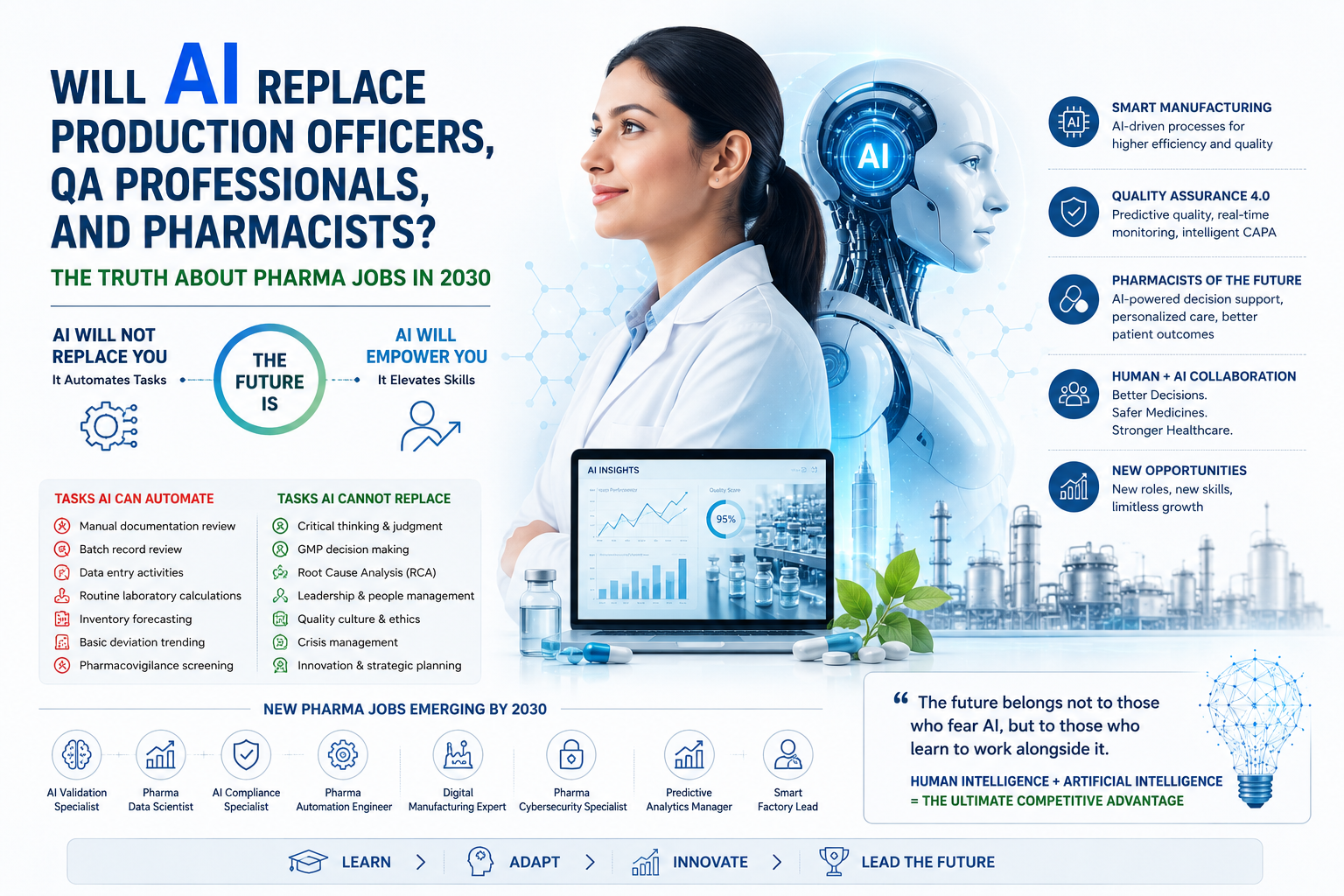
The Biggest Question Facing the Pharmaceutical Workforce
Artificial Intelligence (AI) is no longer a futuristic concept. It is already transforming pharmaceutical manufacturing, quality systems, laboratories, supply chains, regulatory affairs, and healthcare delivery.
Across the pharmaceutical industry, professionals are asking a critical question:
“Will AI take my job?”
For Production Officers, QA professionals, QC analysts, pharmacists, validation engineers, and regulatory specialists, the concern is understandable. Every day, headlines announce new breakthroughs in Artificial Intelligence, Machine Learning, robotics, automation, predictive analytics, and digital transformation.
However, the reality is far more nuanced—and far more promising.
The future of pharmaceutical careers will not be defined by humans versus machines.
It will be defined by humans working alongside intelligent technologies to achieve unprecedented levels of quality, compliance, productivity, and patient safety.
The truth is simple:
AI will change pharmaceutical jobs dramatically, but it is unlikely to replace the professionals who are willing to evolve with it.
The AI Revolution Has Already Started
The pharmaceutical industry is entering the era of Pharma 4.0.
What began as isolated automation projects has evolved into enterprise-wide digital transformation initiatives powered by:
- Artificial Intelligence (AI)
- Machine Learning (ML)
- Internet of Things (IoT)
- Digital Twins
- Robotics
- Advanced Analytics
- Cloud Computing
- Real-Time Data Monitoring
Leading pharmaceutical companies are already implementing AI-driven systems for:
- Predictive maintenance
- Process optimization
- Quality monitoring
- Supply chain forecasting
- Clinical trial management
- Pharmacovigilance
- Regulatory documentation
Global organizations such as Pfizer, Novartis, Roche, Merck, Johnson & Johnson, AstraZeneca, and GSK have invested heavily in AI-driven digital ecosystems.
The objective is not simply automation.
The objective is creating smarter, faster, safer, and more compliant pharmaceutical operations.
Why AI Adoption Is Accelerating
Several industry pressures are driving AI implementation:
Increasing Regulatory Expectations
Regulators expect greater data integrity, process understanding, and risk management.
Cost Pressures
Companies must reduce operational costs while maintaining product quality.
Complex Manufacturing Processes
Modern biologics, cell therapies, and personalized medicines require advanced process control.
Workforce Challenges
Many organizations face shortages of highly skilled pharmaceutical talent.
Demand for Faster Decisions
Traditional manual review systems cannot keep pace with today’s data volumes.
AI helps address all of these challenges simultaneously.
Jobs Most Likely to Be Automated
One uncomfortable reality must be acknowledged:
Some pharmaceutical tasks are highly repetitive, rule-based, and data-intensive.
These activities are prime candidates for automation.
1. Manual Batch Record Review
AI can rapidly identify:
- Missing entries
- Incomplete signatures
- Data inconsistencies
- Process deviations
Tasks that previously required hours may soon take minutes.
2. Data Entry Activities
Routine transcription and documentation tasks are already being automated through intelligent systems.
3. Repetitive QA Checks
AI-powered quality platforms can continuously monitor:
- Environmental data
- Process parameters
- Equipment performance
- Compliance trends
4. Basic Deviation Trending
Machine learning algorithms can identify patterns that humans often overlook.
5. Inventory Forecasting
AI systems outperform traditional forecasting methods by analyzing:
- Demand fluctuations
- Market trends
- Production schedules
- Supplier performance
6. Routine Laboratory Calculations
Many QC calculations can be automatically performed with greater speed and consistency.
7. Pharmacovigilance Screening
AI can review thousands of adverse event reports significantly faster than manual teams.
Jobs That AI Cannot Easily Replace
Despite impressive technological advances, pharmaceutical operations still require uniquely human capabilities.
These skills remain difficult to automate.
GMP Decision-Making
Regulatory compliance often involves ambiguity.
AI can provide recommendations.
Humans remain accountable for decisions.
Quality Culture Development
Quality culture is built through:
- Leadership
- Coaching
- Communication
- Accountability
No algorithm can replace human influence.
Root Cause Analysis (RCA)
AI can identify correlations.
Humans determine causation.
Complex investigations require critical thinking and contextual understanding.
CAPA Effectiveness Evaluation
Determining whether a CAPA truly prevents recurrence often requires experience and judgment.
Regulatory Inspections
Inspectors evaluate:
- Organizational behavior
- Quality mindset
- Leadership commitment
These human factors cannot be delegated to AI.
Crisis Management
During recalls, contamination events, or supply disruptions, organizations require leaders who can make difficult decisions under uncertainty.
Innovation
Innovation emerges from creativity, curiosity, and strategic thinking.
These remain fundamentally human strengths.
How Production Officers Will Work in 2030
The Production Officer of 2030 will look very different from today’s manufacturing professional.
Instead of spending most of their time on paperwork, they will focus on process intelligence.
Future Responsibilities
AI-Assisted Manufacturing
Operators will receive real-time recommendations from intelligent systems.
Digital Batch Manufacturing
Paper records will largely disappear.
Electronic systems will capture and verify activities automatically.
Predictive Process Control
AI will identify process drift before deviations occur.
Real-Time Decision Making
Production teams will use dashboards providing instant operational insights.
Process Optimization
Professionals will spend more time improving processes rather than documenting them.
What This Means
Production roles are not disappearing.
They are becoming more analytical, technical, and strategic.
How QA Professionals Will Evolve
Quality Assurance is undergoing one of the largest transformations in pharmaceutical history.
Traditional QA models focused heavily on retrospective review.
Future QA will focus on prediction and prevention.
AI-Enabled Quality Oversight
AI systems will continuously monitor:
- Manufacturing data
- Laboratory data
- Environmental monitoring
- Equipment performance
Predictive Quality Systems
Future systems will identify potential failures before they occur.
Intelligent CAPA Platforms
AI-powered systems will:
- Recommend investigations
- Suggest corrective actions
- Track effectiveness trends
Digital Audits
Audit preparation will become significantly more efficient through automated data analysis.
Continuous Process Verification
Real-time quality monitoring will replace many retrospective review activities.
The New QA Professional
Future QA leaders will become:
- Risk managers
- Data analysts
- Strategic quality advisors
- Digital quality experts
The Future of Pharmacists
Pharmacy practice is also entering a major transformation phase.
AI will enhance—but not eliminate—the role of pharmacists.
Clinical Decision Support
AI systems can rapidly evaluate:
- Drug interactions
- Patient history
- Treatment options
Personalized Medicine
AI will help tailor therapies based on:
- Genetics
- Biomarkers
- Individual patient profiles
Digital Healthcare Integration
Future pharmacists will work within connected healthcare ecosystems.
Enhanced Patient Counseling
Patients still need empathy, trust, communication, and human guidance.
These remain core pharmacist strengths.
Human vs Algorithm
Patients may trust algorithms.
But they trust healthcare professionals even more.
The pharmacist remains the bridge between technology and patient care.
New Pharma Jobs Being Created
While some roles will decline, entirely new career opportunities are emerging.
By 2030, demand is expected to rise for:
AI Validation Specialist
Validating AI models used in GMP environments.
Pharma Data Scientist
Transforming operational data into business intelligence.
Digital Quality Manager
Managing AI-enabled quality systems.
AI Compliance Specialist
Ensuring regulatory compliance of AI technologies.
Pharma Automation Engineer
Developing and maintaining smart manufacturing systems.
Digital Manufacturing Expert
Leading Pharma 4.0 implementation projects.
Pharma Cybersecurity Specialist
Protecting critical manufacturing and quality systems.
Predictive Analytics Manager
Driving proactive operational decisions.
Smart Factory Lead
Managing fully connected pharmaceutical operations.
Skills Every Pharma Professional Must Learn Before 2030
Career success will increasingly depend on adaptability.
The most valuable professionals will combine pharmaceutical expertise with digital capabilities.
Essential Future Skills
AI Literacy
Understanding how AI works and where it adds value.
Data Analytics
Interpreting data-driven insights.
Statistical Thinking
Using data for informed decision-making.
Digital Quality Systems
Working effectively with electronic platforms.
Automation Technologies
Understanding robotics and smart manufacturing.
Process Understanding
Deep technical expertise remains critical.
Critical Thinking
The ability to challenge assumptions.
Problem Solving
Finding practical solutions to complex challenges.
Leadership
Leading people through change.
Communication
Translating technical insights into business actions.
Biggest Myths About AI Replacing Pharma Professionals
Myth 1: AI Will Replace All Pharma Jobs
Reality:
AI replaces tasks, not entire professions.
Myth 2: Only IT Professionals Need AI Skills
Reality:
Every pharmaceutical function will be impacted.
Myth 3: Experience Alone Will Protect Careers
Reality:
Experience plus adaptability creates long-term career security.
Myth 4: AI Is Only for Large Companies
Reality:
Digital transformation is rapidly spreading across companies of all sizes.
Myth 5: AI Makes Human Expertise Irrelevant
Reality:
Human expertise becomes even more valuable when combined with AI insights.
Case Study: The Future Quality Professional
Consider two QA Managers in 2030.
Manager A
- Uses traditional approaches
- Avoids digital tools
- Relies solely on manual reviews
Manager B
- Uses AI-driven quality analytics
- Predicts quality risks
- Focuses on strategic quality improvement
Who creates greater value?
Who becomes more influential?
Who advances faster?
The answer is obvious.
Technology amplifies expertise.
It does not replace it.
Career Advice for Freshers
- Learn GMP fundamentals first.
- Build digital literacy early.
- Become comfortable with data analytics.
- Understand automation concepts.
- Develop problem-solving skills.
The combination of pharmaceutical science and digital knowledge will create exceptional career opportunities.
Career Advice for Executives and Managers
- Embrace continuous learning.
- Invest in AI awareness.
- Lead digital transformation initiatives.
- Build data-driven teams.
- Focus on strategic thinking.
Future leaders will be those who successfully integrate people, processes, and technology.
Career Advice for Industry Leaders
Organizations should focus on:
- Workforce reskilling
- Digital capability development
- AI governance
- Human-AI collaboration models
- Future workforce planning
The companies that invest in people alongside technology will outperform those that invest in technology alone.
The Winning Formula
The pharmaceutical workforce revolution is not about replacing people.
It is about elevating human performance.
The professionals who thrive in 2030 will be those who:
- Learn continuously
- Embrace technology
- Develop digital skills
- Strengthen critical thinking
- Lead change confidently
The future belongs to professionals who understand both pharmaceutical science and intelligent technology.
Because the ultimate truth is:
“AI Will Not Replace Pharma Professionals. Pharma Professionals Who Use AI Will Replace Those Who Don’t.”
Final Thoughts
Artificial Intelligence will undoubtedly transform pharmaceutical manufacturing, quality systems, laboratories, regulatory operations, and healthcare.
Some tasks will disappear.
Many responsibilities will evolve.
Entirely new career paths will emerge.
But the pharmaceutical industry will always need professionals who can think critically, exercise judgment, lead people, solve problems, ensure compliance, and protect patient safety.
Technology alone cannot achieve these goals.
Human expertise remains indispensable.
The future belongs not to those who fear AI, but to those who learn to work alongside it. In Pharma 2030, human intelligence plus artificial intelligence will be the ultimate competitive advantage.
About the Author
Ramesh Palav is a GxP Compliance and Computer System Validation (CSV) professional with experience in pharmaceutical manufacturing, quality systems, data integrity, and digital transformation. He is passionate about helping organizations adopt compliant, efficient, and practical digital solutions while maintaining regulatory expectations and patient safety.