
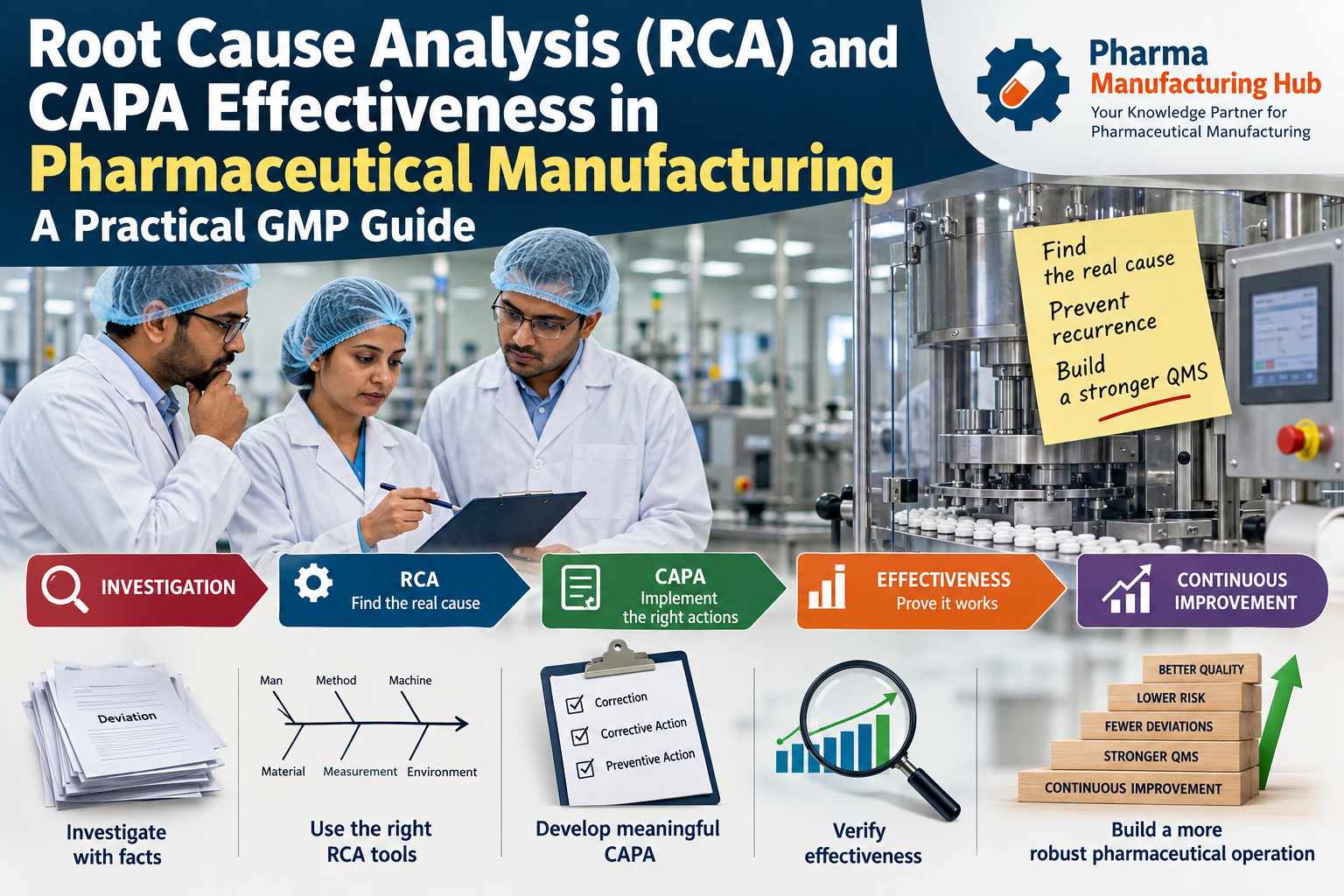
By Ramesh Palav | Pharma Manufacturing Hub
1. Introduction
A deviation is usually visible. The reason behind the deviation is not.
A tablet compression machine stops unexpectedly. A coating process produces tablets with unacceptable appearance. An HVAC parameter moves outside its established range. A batch record contains a documentation error. An OOS result is generated in the laboratory. An auditor identifies a recurring GMP weakness.
The immediate problem can often be identified within minutes or hours.
The difficult question is:
Why did it happen, and what needs to change so that it does not happen again?
This is where Root Cause Analysis (RCA) and Corrective and Preventive Action (CAPA) become important parts of the Pharmaceutical Quality System.
A good investigation should do more than explain what happened. It should establish the facts, understand the causal chain, determine the underlying cause or most likely cause where appropriate, assess the impact and risk, and identify actions proportionate to the problem.
ICH Q10 identifies the CAPA system as one of the core elements of the Pharmaceutical Quality System and links CAPA with investigations arising from complaints, product rejections, non-conformances, recalls, deviations, audits and regulatory findings. It also connects CAPA with process performance monitoring, quality risk management, knowledge management and continual improvement.
EU GMP Chapter 1 similarly emphasizes structured investigations, root-cause determination, risk-based effort, appropriate CAPA, and monitoring of CAPA effectiveness. It also specifically cautions against accepting human error without considering whether process, procedural or system-related factors have been overlooked.
From a practical manufacturing perspective, one principle is worth remembering:
Closing a CAPA is not the same as proving CAPA effectiveness.
A CAPA may be completed in the electronic QMS, documents may be attached, training may be recorded and the workflow may show “Closed.”
But has the problem actually been controlled?
That is the question that matters.
2. What is Root Cause Analysis?
Root Cause Analysis is a structured approach used to understand why a problem occurred and identify the underlying causes that need to be addressed to prevent recurrence.
In pharmaceutical manufacturing, RCA may form part of investigations involving:
- Deviations
- OOS and OOT results
- Manufacturing failures
- Equipment breakdowns
- Utility failures
- Environmental excursions
- Customer complaints
- Product quality complaints
- Audit observations
- Data integrity events
- Documentation errors
- Validation failures
- Recurring process problems
- Yield or rejection deterioration
- Cleaning failures
RCA should not be treated simply as a form to be completed after a deviation.
It is a thinking process.
A useful investigation distinguishes between several levels of causation.
Symptom
What was observed?
Example:
Tablet weight variation increased during compression.
Immediate cause
What directly produced the event?
Example:
Compression force and feeder performance became unstable.
Contributing cause
What factors made the problem more likely?
Example:
Feeder condition had deteriorated and preventive maintenance did not adequately address the failure mode.
Root cause
What underlying condition allowed the failure to occur and remain uncontrolled?
Example:
The equipment maintenance strategy did not adequately address the critical feeder component’s failure mechanism, and no defined performance trend trigger existed for early intervention.
The terminology may differ between organizations, but the principle remains the same:
Do not stop at the first plausible explanation.
3. Why “Operator Error” is Often Not Enough
One of the most common investigation conclusions in pharmaceutical manufacturing is:
“Operator failed to follow the SOP.”
Sometimes that may genuinely be the cause.
But the investigation should continue with additional questions.
- Was the SOP clear?
- Was the procedure practical?
- Was the operator adequately trained?
- Was the training effective?
- Was the task performed under normal working conditions?
- Was the equipment functioning correctly?
- Was the display or alarm clear?
- Was there an abnormal workload?
- Were instructions available at the point of use?
- Had similar errors occurred previously?
- Did other operators make the same mistake?
- Was the process design dependent on memory?
- Were there adequate controls to detect the error?
EU GMP Chapter 1 specifically indicates that where human error is suspected or identified, investigators should ensure that process, procedural and system-based problems have not been overlooked.
This does not mean that operators cannot make mistakes.
They can.
The important point is that an investigation should determine why the error was possible, why it was not prevented, and why the existing system did not detect it earlier.
4. What is CAPA?
CAPA stands for:
Corrective Action and Preventive Action.
In practical QMS terms, CAPA is a structured mechanism for addressing identified quality problems and preventing recurrence or reducing the likelihood of similar problems.
It is useful to distinguish four concepts.
| Term | Practical meaning | Example |
|---|---|---|
| Correction | Immediate action to fix the existing problem | Replacing a damaged component |
| Corrective Action | Action addressing the cause of an existing problem | Revising maintenance strategy |
| Preventive Action | Action intended to prevent potential problems or address systemic risk | Extending the improvement to similar equipment |
| Effectiveness Check | Verification that the action achieved its intended result | Reviewing subsequent batches for recurrence |
FDA’s quality systems guidance describes CAPA as a systematic approach involving correction, prevention of recurrence and addressing causes of potential quality problems.
Example
Suppose a compression machine experiences repeated feeder failures.
Correction:
Replace the failed feeder component.
Corrective Action:
Determine why the component repeatedly failed and modify the maintenance or equipment-control strategy.
Preventive/Systemic Action:
Review similar compression machines to determine whether the same vulnerability exists.
Effectiveness Check:
Review equipment performance over a defined monitoring period and verify that the identified failure has not recurred.
Simply replacing the component and closing the deviation is not a robust CAPA.
5. When Should RCA and CAPA Be Initiated?
Not every minor event needs the same level of investigation or a formal CAPA.
The depth of investigation should be appropriate to the risk, complexity, recurrence and potential impact of the event.
EU GMP Chapter 1 explicitly states that the level of effort, formality and documentation should be commensurate with risk.
Potential triggers include:
Manufacturing deviations
Examples:
- Process parameter excursion
- Incorrect material addition
- Compression failure
- Granulation endpoint issue
- Coating parameter deviation
- Yield loss
- Unexpected rejection
Laboratory events
Examples:
- OOS
- OOT
- Invalid analytical result
- Instrument malfunction
- Recurring analytical variation
Equipment and utilities
Examples:
- HVAC excursion
- Purified Water failure
- Compressed air issue
- Equipment breakdown
- Calibration failure
- Repeated alarm
- Utility pressure fluctuation
Quality-system events
Examples:
- Audit observation
- Recurring documentation error
- Data integrity concern
- SOP failure
- Training-system weakness
- Complaint recurrence
Trends
Sometimes no single event appears severe enough to trigger a major investigation.
But the trend tells a different story.
For example:
- Three similar minor deviations in six months
- Increasing tablet rejection
- Increasing equipment downtime
- Recurring documentation corrections
- Repeated environmental monitoring alerts
Trend analysis can reveal a systemic issue that individual investigations may miss.
6. Writing an Effective Problem Statement
A weak problem statement makes a weak investigation more likely.
Consider:
“Compression machine had a problem.”
This does not provide enough information.
A better statement would be:
“During compression of Batch XXX on [date], tablet weight variation exceeded the established operating range for approximately 18 minutes, resulting in increased tablet rejection.”
The second statement identifies:
- What happened
- When it happened
- Where it happened
- What parameter was affected
- How long the event continued
- What the consequence was
A good problem statement should be:
- Factual
- Specific
- Measurable where possible
- Free from assumptions
- Based on available evidence
Avoid writing the suspected cause into the problem statement.
For example:
“Operator failed to adjust the compression force.”
This is already an assumption.
A better statement is:
“Compression force remained outside the established operating range during the identified period.”
The investigation should determine why.
7. RCA Investigation Process: Step by Step
A practical investigation can follow the sequence below.
Step 1: Define the Problem
Clearly document:
- What happened?
- When?
- Where?
- Which product/batch/equipment?
- What parameter was affected?
- What was the expected condition?
- What was the actual condition?
Step 2: Contain the Problem
Before spending time on RCA, control the immediate risk.
Depending on the situation, this could include:
- Holding affected material
- Stopping the process
- Segregating affected batches
- Informing QA
- Checking equipment condition
- Restricting further use of equipment
- Preserving electronic records and physical evidence
Containment is not the root cause.
It is immediate risk control.
Step 3: Collect Evidence
Investigation quality depends heavily on evidence.
Review relevant information such as:
- BMR/BPR
- Equipment logbooks
- Machine alarms
- SCADA/HMI data
- Batch process parameters
- Laboratory records
- Calibration records
- Preventive maintenance records
- Cleaning records
- Training records
- SOPs
- Previous deviations
- Change controls
- Validation documents
- Complaint history
- Environmental monitoring data
- Trend reports
Avoid relying exclusively on interviews.
People remember events differently, especially when an investigation is performed several days after the event.
Step 4: Establish a Timeline
Create a simple timeline:
Before event → Event → Detection → Immediate response → Investigation → Correction
A timeline often reveals relationships that are difficult to see in narrative writing.
For example:
8:30 AM – Batch started
9:15 AM – Feeder alarm occurred
9:18 AM – Operator adjusted setting
9:30 AM – Weight variation observed
9:40 AM – QA informed
10:00 AM – Machine stopped
This raises useful questions:
- Why did the first alarm occur?
- Why was the adjustment required?
- Was the adjustment within SOP limits?
- Was the alarm previously observed?
- Did the equipment trend indicate deterioration?
Step 5: Identify Potential Causes
Consider multiple categories.
Man
- Training
- Competency
- Human factors
- Workload
- Shift conditions
Machine
- Equipment condition
- Design
- Wear
- Calibration
- Preventive maintenance
Method
- SOP
- Process parameters
- Sequence
- Standardization
Material
- Raw material variability
- Supplier variation
- Material properties
Measurement
- Instrument accuracy
- Sampling
- Calibration
- Data recording
Environment
- Temperature
- Humidity
- HVAC
- Pressure differential
- Environmental conditions
8. RCA Tools Used in Pharmaceutical Manufacturing
No RCA tool is universally appropriate.
The investigation team should select the method according to the complexity and risk of the problem.
8.1 5 Why Analysis
The 5 Why technique repeatedly asks:
Why did this happen?
Example:
Problem: Compression machine stopped repeatedly.
Why?
→ Feeder motor overheated.
Why?
→ Motor was operating under abnormal load.
Why?
→ Feeder movement became restricted.
Why?
→ Component wear increased friction.
Why?
→ The preventive maintenance strategy did not identify this wear condition early enough.
The number five is not sacred.
Sometimes three questions are enough.
Sometimes ten are required.
The objective is not to reach the fifth “why.” The objective is to understand the causal chain.
8.2 Fishbone / Ishikawa Diagram
Fishbone analysis helps teams examine multiple categories of possible causes.
Typical categories include:
- Man
- Machine
- Method
- Material
- Measurement
- Environment
It is particularly useful during brainstorming.
Its limitation is that listing possible causes does not prove them.
A possible cause is not automatically a root cause.
Evidence must support the conclusion.
8.3 Fault Tree Analysis
Fault Tree Analysis starts with an undesired event and works backward toward possible causes.
It is particularly useful for:
- Equipment failures
- Utility failures
- Safety-related events
- Complex system failures
- Automation failures
It helps visualize relationships between multiple causal events.
8.4 Pareto Analysis
Pareto analysis helps identify the major contributors to recurring problems.
For example, if equipment downtime is categorized into:
- Feeder failure
- Punch failure
- Sensor failure
- Electrical fault
- Changeover
- Cleaning
Historical data may show that a small number of failure categories account for a significant proportion of downtime.
That information can then guide deeper RCA.
8.5 Process Mapping
Process mapping is particularly useful when the problem involves:
- Multiple departments
- Documentation flow
- Material movement
- Batch release
- Sampling
- Approval workflows
- Electronic systems
It can reveal where controls are missing.
8.6 Trend Analysis
Trend analysis is extremely valuable in pharmaceutical investigations.
A single deviation may look isolated.
Ten similar deviations over twelve months tell a different story.
Trend:
Event → Event → Event → Event
may indicate a systemic weakness rather than independent incidents.
8.7 FMEA and Risk Assessment
FMEA can be used to systematically evaluate:
- Failure modes
- Effects
- Causes
- Existing controls
- Risk
- Recommended actions
Risk assessment should support investigation and CAPA decisions rather than becoming a mathematical exercise.
ICH Q10 identifies Quality Risk Management as an important enabler of the Pharmaceutical Quality System.
9. Common RCA Mistakes
Mistake 1: Stopping at “Operator Error”
This is perhaps one of the most common weak conclusions.
Mistake 2: No Evidence
The investigation says:
“Root cause was identified as equipment failure.”
But there is no:
- Maintenance evidence
- Component examination
- Trend data
- Alarm history
- Technical assessment
The conclusion becomes difficult to defend.
Mistake 3: Copy-Paste Investigations
If three deviations have almost identical investigation language, auditors may reasonably question whether each investigation was actually performed independently.
Mistake 4: Mechanical Use of 5 Why
5 Why is a tool, not a substitute for investigation.
Mistake 5: Ignoring History
Previous deviations may contain the answer.
Mistake 6: CAPA Does Not Address Root Cause
If the root cause is equipment design weakness but the CAPA is “retrain operator,” the CAPA does not logically address the cause.
Mistake 7: No Effectiveness Criteria
A CAPA is assigned without defining how success will be measured.
That makes effectiveness difficult to demonstrate later.
10. How to Identify the True Root Cause
Consider a tablet compression example.
Observation
Tablet weight variation increased.
Possible causes
- Granule flow variation
- Feeder issue
- Compression setting
- Punch condition
- Machine speed
- Sampling problem
- Operator intervention
The investigation should progressively narrow the possibilities using evidence.
Suppose the evidence shows:
- Granule properties were within established requirements.
- Sampling was performed correctly.
- Compression settings were within approved parameters.
- Feeder vibration increased.
- Inspection found abnormal bearing wear.
- Maintenance records showed no defined inspection criterion for this wear mode.
- Similar failures had occurred previously.
Now the investigation is moving beyond the symptom.
The immediate cause may be:
Feeder instability caused by bearing deterioration.
The systemic/root cause may be:
The preventive maintenance program did not adequately identify the relevant failure mode or define an appropriate inspection/control mechanism.
That distinction is important because the CAPA must address the appropriate level.
11. CAPA Development: From Root Cause to Action
A strong CAPA should have a logical chain:
Problem → Evidence → Root Cause → Action → Expected Result → Effectiveness Check
If any link is weak, the CAPA may not deliver the intended outcome.
Possible CAPA actions include:
- SOP revision
- Equipment modification
- Preventive maintenance improvement
- Alarm modification
- Automation
- Process redesign
- Additional process controls
- Training
- Competency assessment
- Supplier action
- Specification review
- Sampling improvement
- Monitoring enhancement
- Validation/requalification
- Risk-control improvement
Why retraining is often insufficient
Suppose an operator incorrectly records a machine parameter.
Training may be appropriate.
But what if:
- The form is confusing?
- Two parameters have similar names?
- The electronic interface is poorly designed?
- The operator must manually transcribe information?
- The SOP is ambiguous?
- The same error has occurred across several shifts?
Training alone does not solve the system weakness.
A mature investigation asks:
Why was the error possible?
rather than only:
Who made the error?
12. CAPA Effectiveness: The Most Important Part
A CAPA can be implemented and still be ineffective.
Consider this example:
A recurring equipment problem occurs.
CAPA:
“Preventive maintenance SOP revised.”
The document is revised.
Training is completed.
The CAPA is closed.
But the equipment fails again two months later.
Was the CAPA effective?
Clearly, implementation occurred.
Effectiveness is questionable.
This is why two separate questions should always be asked:
CAPA Implementation
Was the planned action completed?
CAPA Effectiveness
Did the action achieve its intended result?
The second question requires objective evidence.
FDA inspection correspondence has repeatedly emphasized the importance of effective root-cause evaluation, appropriate CAPA and processes for evaluating CAPA effectiveness, including in recent inspection findings.
13. How to Define CAPA Effectiveness Criteria
A good effectiveness criterion should be:
- Specific
- Measurable
- Relevant
- Time-bound where appropriate
- Based on objective evidence
Example: Equipment Failure
Weak criterion:
CAPA implemented successfully.
Better criterion:
No recurrence of the identified feeder-related failure during the defined monitoring period across an appropriate number of batches, while equipment performance remains within established acceptance criteria.
Example: Tablet Weight Variation
Weak:
Monitor tablet weight.
Better:
Tablet weight remains within established process control limits for the defined monitoring period, with no recurrence attributable to the identified cause.
Example: Documentation Error
Weak:
Operators retrained.
Better:
No recurrence of the identified documentation error across the defined number of applicable batch records following implementation of the revised control.
Example: HVAC Excursion
Weak:
HVAC repaired.
Better:
HVAC parameters remain within established operating limits during the defined monitoring period, with no recurrence of the identified failure mode.
Example: Coating Defect
Weak:
SOP revised.
Better:
No recurrence of the identified coating defect across the defined number of subsequent batches, with critical coating process parameters remaining within established ranges.
The exact criteria should always be appropriate to the specific process and risk.
14. CAPA Effectiveness Check: Practical Workflow
A practical effectiveness review can follow this sequence.
Step 1 – Review the original problem
What exactly was the CAPA intended to solve?
Step 2 – Review the root cause
Does the implemented action actually address it?
Step 3 – Review implementation evidence
Examples:
- Revised SOP
- Engineering modification
- Maintenance record
- Training record
- Validation report
- Change control
- Updated specification
- System configuration
Step 4 – Review post-CAPA data
Look for:
- Recurrence
- Trends
- Deviations
- Complaints
- OOS/OOT
- Equipment failures
- Audit observations
- Process performance
Step 5 – Compare with effectiveness criteria
Was the predefined target achieved?
Step 6 – Make the decision
Possible outcomes:
Effective
or
Not effective
or
Partially effective / additional action required
Step 7 – Document the rationale
Do not simply write:
“CAPA found effective.”
Explain why.
15. What Happens if CAPA is Ineffective?
An ineffective CAPA should not simply be closed because the original target date has arrived.
Depending on the situation, the organization may need to:
- Reopen the investigation
- Expand the investigation scope
- Reassess the root cause
- Review historical data
- Perform additional risk assessment
- Introduce additional corrective actions
- Modify the original CAPA
- Initiate a new CAPA
- Evaluate related products/processes/equipment
An ineffective CAPA is not necessarily a failure of the QMS.
What matters is how the organization responds to the information.
In fact, a failed effectiveness check can provide valuable evidence that the original understanding of the problem was incomplete.
16. CAPA Effectiveness Metrics
Organizations should monitor CAPA performance using meaningful indicators.
Useful metrics include:
CAPA recurrence rate
How often similar issues recur after CAPA closure.
Repeat deviation rate
Whether the same or similar deviations continue.
CAPA effectiveness failure rate
Percentage of CAPAs that fail effectiveness checks.
CAPA overdue rate
Useful for management oversight, but it should not be the only performance indicator.
Average CAPA closure time
Helpful for understanding workflow efficiency.
But fast closure is not necessarily good closure.
Complaint recurrence
Can identify ineffective quality actions.
OOS recurrence
Can indicate unresolved process or laboratory-system problems.
Equipment failure recurrence
Particularly useful for engineering and maintenance CAPAs.
Audit observation recurrence
Repeated findings can indicate systemic CAPA weaknesses.
Investigation right-first-time
Measures whether investigations are accepted without repeated QA rework.
A mature organization should avoid creating a culture where:
“Close CAPA quickly”
becomes more important than:
“Solve the problem properly.”
17. Four Practical Pharmaceutical Case Studies
Case Study 1: Tablet Compression – Weight Variation
Problem
Repeated tablet weight variation was observed during compression.
Immediate Action
Compression was stopped and affected tablets were segregated for assessment.
Investigation
The team reviewed:
- Granule properties
- Compression parameters
- Feeder performance
- Machine speed
- Punch condition
- Sampling
- Equipment history
Inspection identified abnormal feeder movement.
Root Cause
Evidence indicated deterioration of a feeder component combined with inadequate preventive-maintenance controls for the specific failure mode.
CAPA
- Replace affected component
- Review PM strategy
- Define inspection criteria
- Review similar machines
- Update maintenance documentation
- Train maintenance personnel
Effectiveness Criteria
No recurrence of the identified failure during the predefined monitoring period and acceptable compression performance across the specified number of batches.
Effectiveness Evidence
Subsequent batch records and equipment performance data demonstrated stable operation.
Conclusion
The important point was not simply replacing the component. The sustainable improvement came from addressing the maintenance-control weakness.
Case Study 2: Coating – Recurring Appearance Defects
Problem
A recurring tablet appearance defect was observed during coating.
Potential Causes
- Spray rate
- Atomization
- Pan speed
- Inlet air conditions
- Exhaust performance
- Coating suspension properties
- Nozzle condition
- Operator adjustment
Investigation
Historical batch data showed that the defect was associated with a particular operating range.
Equipment inspection also identified inconsistent nozzle performance.
Root Cause
The investigation identified nozzle condition and insufficient control of the relevant maintenance/inspection requirement as significant contributors.
CAPA
- Nozzle inspection criteria revised
- Preventive maintenance frequency reviewed
- Operator inspection requirements strengthened
- Process monitoring improved
Effectiveness Criteria
No recurrence across the defined monitoring batches while critical coating parameters remain controlled.
Effectiveness Evidence
Subsequent batch trend data demonstrated stable coating performance.
Case Study 3: HVAC – Repeated Environmental Excursion
Problem
Repeated temperature/RH excursions occurred in a manufacturing area.
Immediate Action
The area was assessed, affected operations were evaluated and Engineering/QA initiated investigation.
Investigation
The team reviewed:
- HVAC alarms
- Differential pressure
- AHU performance
- Filter condition
- Damper operation
- Sensor calibration
- Maintenance history
- Environmental trends
Root Cause
Investigation identified a combination of equipment-control weakness and inadequate preventive monitoring.
CAPA
- Corrective engineering work
- Sensor/control verification
- PM improvement
- Alarm review
- Trend monitoring
Effectiveness Criteria
HVAC parameters remain within established operating ranges during the predefined monitoring period without recurrence of the identified failure mode.
Effectiveness Evidence
Environmental monitoring and HVAC trend data demonstrated sustained control.
Conclusion
The effectiveness assessment was based on actual system performance rather than merely completion of the repair.
Case Study 4: Documentation/Data Integrity – Repeated Documentation Errors
Problem
Repeated corrections were observed in manual manufacturing records.
Investigation
The team reviewed:
- BMR format
- SOP instructions
- Training
- Operator interviews
- Previous documentation errors
- Shift patterns
- Recording sequence
The investigation found that two similar fields appeared close together and the recording instruction was not sufficiently clear.
Root Cause
The problem was not simply “operator carelessness.”
The documentation design and instruction created an avoidable opportunity for error.
CAPA
- Redesign the affected form
- Improve instructions
- Add an appropriate verification control
- Train personnel on the revised format
- Review similar forms
Effectiveness Criteria
No recurrence of the identified documentation error across the predefined number of applicable records during the monitoring period.
Effectiveness Evidence
Subsequent records were reviewed and demonstrated consistent completion without recurrence.
Lesson
Good CAPA often improves the system instead of simply reminding people to be more careful.
18. RCA and CAPA During GMP Audits
During a GMP audit, an investigator should be prepared to demonstrate more than a closed CAPA record.
Auditors may examine:
- Problem definition
- Investigation scope
- Evidence
- Root-cause rationale
- Risk assessment
- Historical data
- CAPA appropriateness
- Implementation evidence
- Effectiveness evidence
- Recurrence
- Trending
- Quality-unit oversight
- Management review
EU GMP Chapter 1 states that significant deviations with potential quality impact should be investigated and documented, with a structured approach aimed at determining root cause and effective CAPA activity.
FDA quality-system guidance similarly frames CAPA and quality systems as part of an overall approach to pharmaceutical CGMP rather than as isolated paperwork activities.
Recent FDA inspection findings also show continued attention to investigation quality, root-cause evaluation, CAPA effectiveness and investigation trending.
A useful audit-readiness question is:
“Show me how you know the CAPA worked.”
The answer should come from evidence.
19. Relationship Between RCA, CAPA, Risk Management and Continuous Improvement
These activities should not operate as independent systems.
A strong pharmaceutical QMS creates a logical flow:
Deviation / Complaint / Failure
↓
Investigation
↓
Root Cause Analysis
↓
Risk Assessment
↓
CAPA
↓
Implementation
↓
Effectiveness Check
↓
Trend Review
↓
Continuous Improvement
ICH Q10 places CAPA, process-performance and product-quality monitoring, change management and management review within the Pharmaceutical Quality System, supported by knowledge management and quality risk management.
This relationship is particularly important in manufacturing.
For example, a recurring equipment failure may initially appear to be an Engineering problem.
But the investigation may reveal:
- Maintenance strategy weakness
- Training gap
- Spare-parts issue
- Equipment design problem
- SOP weakness
- Validation concern
- Process-control weakness
The best CAPA therefore often requires cross-functional participation.
Production, QA, Engineering, Maintenance, Validation and sometimes QC should work from the same facts rather than defending departmental boundaries.
20. Practical RCA and CAPA Checklist
Before approving an investigation, ask:
Problem Definition
☐ Is the problem clearly defined?
☐ Is the statement factual?
☐ Are date, batch, equipment and process details available?
☐ Is the actual condition compared with the expected condition?
Evidence
☐ Were relevant records reviewed?
☐ Was equipment history reviewed?
☐ Was historical deviation data considered?
☐ Were relevant trends reviewed?
☐ Were interviews supported by documentary evidence?
RCA
☐ Were reasonable potential causes considered?
☐ Was the root cause supported by evidence?
☐ Were contributing factors considered?
☐ Were systemic factors evaluated?
☐ Was “operator error” investigated beyond the immediate human action?
CAPA
☐ Does the CAPA address the identified cause?
☐ Is the action specific?
☐ Is ownership defined?
☐ Is the due date realistic?
☐ Is change control required?
☐ Is validation/requalification required?
☐ Were similar systems or equipment evaluated?
Effectiveness
☐ Is the effectiveness criterion objective?
☐ Is the monitoring period appropriate?
☐ Is the required evidence defined?
☐ Is recurrence being assessed?
☐ Are relevant trends included?
☐ Is the closure decision scientifically justified?
21. Ten Golden Rules for Effective RCA and CAPA
Rule 1: Define the problem before looking for the cause.
A poorly defined problem produces a poorly focused investigation.
Rule 2: Follow the evidence.
Do not force the evidence to support a predetermined conclusion.
Rule 3: Do not automatically blame the operator.
Understand the system surrounding the human action.
Rule 4: Distinguish correction from corrective action.
Fixing the immediate problem does not necessarily eliminate its cause.
Rule 5: Do not use 5 Why mechanically.
Use the RCA method appropriate to the problem.
Rule 6: Look at history.
Previous deviations, complaints and equipment failures may provide important evidence.
Rule 7: Make CAPA proportional to risk.
Not every event needs a major system change.
Rule 8: Define effectiveness before implementing the CAPA.
If you do not know what success looks like, it becomes difficult to prove effectiveness.
Rule 9: Use objective evidence for closure.
“Looks good” is not an effectiveness criterion.
Rule 10: Treat recurrence as information.
If the problem returns, reassess the investigation rather than simply repeating the previous CAPA.
22. A Practical CAPA Effectiveness Template
A simple effectiveness assessment can contain the following fields:
| Field | Example |
|---|---|
| CAPA No. | CAPA-2026-XXX |
| Original Problem | Repeated compression feeder failure |
| Root Cause | Inadequate control of feeder component wear |
| CAPA | Revised PM and inspection strategy |
| Implementation Date | DD/MM/YYYY |
| Effectiveness Period | Defined monitoring period |
| Effectiveness Criteria | No recurrence during specified period |
| Evidence Reviewed | Batch/equipment/maintenance records |
| Recurrence | None observed |
| Trend | Stable |
| Risk Status | Acceptable based on assessment |
| Effectiveness Decision | Effective |
| QA Approval | As per site procedure |
The template should be adapted to the organization’s QMS and the risk of the specific issue.
23. The Difference Between Closing a CAPA and Solving a Problem
This distinction deserves emphasis.
A CAPA can be:
Administratively complete
without being:
Technically effective.
For example:
- SOP revised ✓
- Training completed ✓
- CAPA workflow completed ✓
But:
- Deviation recurs ✗
- Equipment continues failing ✗
- Complaints continue ✗
- Process trend remains unstable ✗
The CAPA should therefore be evaluated based on its intended outcome.
This is one of the most important mindset changes in mature pharmaceutical quality systems.
24. Frequently Asked Questions
1. What is RCA in pharmaceutical manufacturing?
Root Cause Analysis is a structured method used to determine why a deviation, failure, defect or other quality problem occurred and to identify causes that should be addressed.
2. What is CAPA?
CAPA is a systematic quality-system process used to address existing problems, prevent recurrence and address identified or potential systemic causes.
3. What is the difference between corrective action and preventive action?
Corrective action addresses the cause of an existing problem to prevent recurrence. Preventive actions are intended to address potential problems or systemic risks before they result in an undesirable event.
4. What is CAPA effectiveness?
CAPA effectiveness is the documented determination, using objective evidence, that the implemented action achieved its intended outcome.
5. How do you measure CAPA effectiveness?
Measurement depends on the problem. Examples include absence of recurrence, improved process performance, reduced defect rate, stable equipment performance or achievement of predefined quality indicators.
6. Why is operator error not always a root cause?
Because the human action may be only the immediate cause. Equipment design, SOP clarity, training, workload, process design and system controls may contribute to the event.
7. Which RCA tool is best for pharmaceutical investigations?
There is no universally best tool. 5 Why, Fishbone, Fault Tree Analysis, Pareto, process mapping, trend analysis and risk assessment each have different applications.
8. When should a CAPA be reopened?
A CAPA may need further action when the effectiveness check fails, the problem recurs, new evidence changes the understanding of the cause, or the original action does not adequately control the identified risk.
9. What evidence is required for CAPA effectiveness?
Evidence depends on the CAPA. It may include batch records, equipment data, deviation trends, complaint data, laboratory results, audit records, maintenance records, monitoring data or other objective performance information.
10. What are common CAPA mistakes?
Common weaknesses include inadequate root-cause analysis, excessive reliance on retraining, poor problem definition, weak evidence, CAPAs disconnected from root causes, undefined effectiveness criteria and closure based primarily on completion rather than outcome.
25. Conclusion
Root Cause Analysis and CAPA are sometimes treated as QMS documentation requirements.
They are much more valuable than that.
A well-executed investigation can reveal weaknesses in equipment, process design, procedures, training, maintenance, measurement systems, materials and organizational controls.
More importantly, it can convert an individual failure into an opportunity to improve the system.
The objective of RCA is not to find someone to blame.
The objective is to understand what happened.
The objective of CAPA is not simply to complete an action.
The objective is to address the cause and reduce the likelihood of recurrence.
And the objective of a CAPA effectiveness check is not to satisfy a workflow requirement.
It is to answer one fundamental question:
Did the action actually work?
An investigation is not successful merely because the deviation is closed.
A CAPA is successful when there is objective evidence that the underlying cause has been addressed and the risk of recurrence has been meaningfully reduced.
That is the difference between CAPA administration and effective pharmaceutical quality management.
In a mature pharmaceutical organization, every significant investigation should ultimately contribute to a stronger process, better product and more robust Pharmaceutical Quality System.
References
- ICH Q10 — Pharmaceutical Quality System
- FDA — Quality Systems Approach to Pharmaceutical CGMP Regulations
- EU GMP — EudraLex Volume 4
- EU GMP Chapter 1 — Pharmaceutical Quality System
Author
Ramesh Palav is a pharmaceutical manufacturing professional with 21+ years of industry experience in Oral Solid Dosage manufacturing, Production, GMP compliance, qualification, validation, QMS, CAPA, deviation management, root-cause analysis and operational excellence.
Through Pharma Manufacturing Hub, he shares practical, experience-based knowledge to help pharmaceutical professionals understand manufacturing, GMP, quality systems, validation, operational excellence and emerging pharmaceutical technologies.