
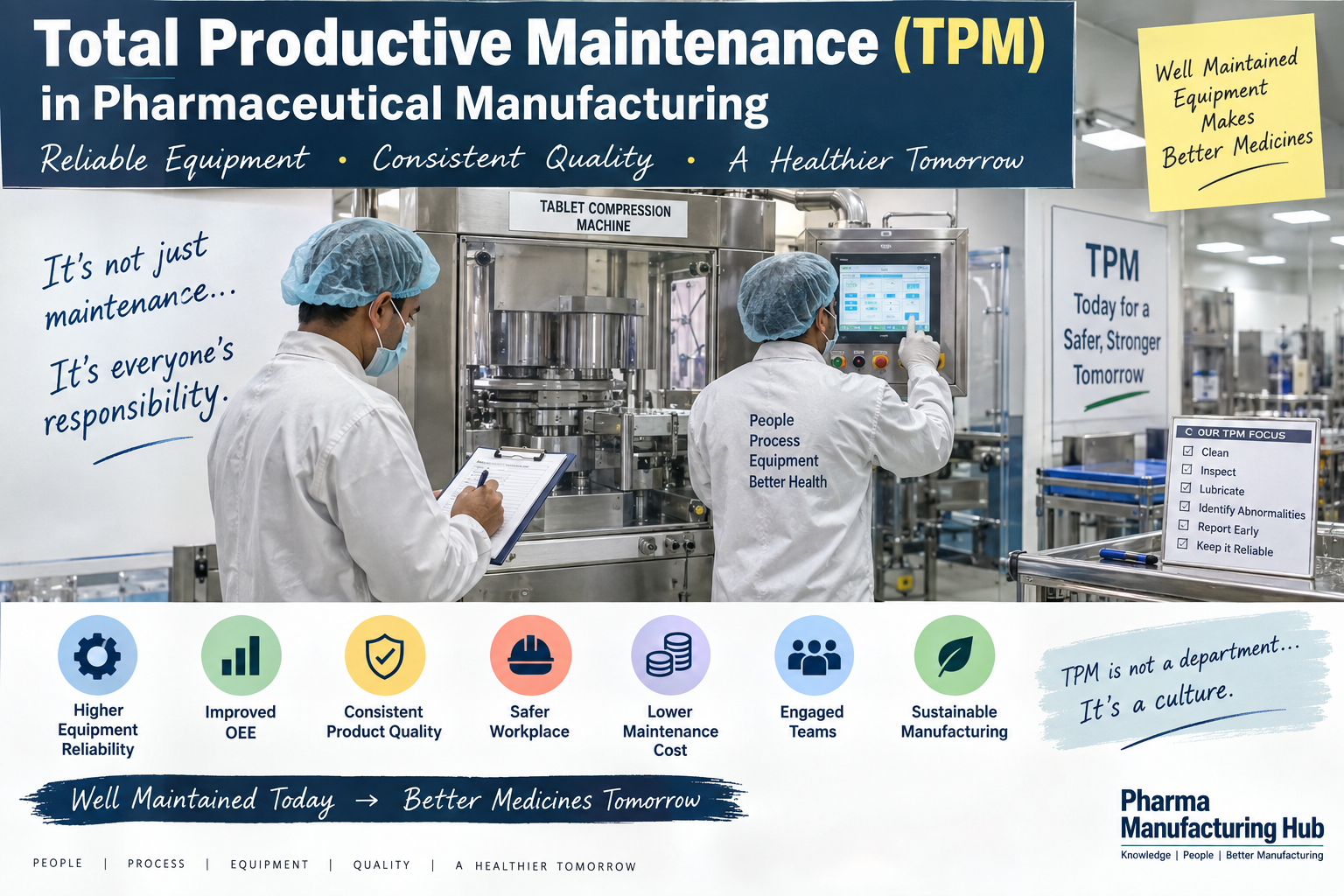
Introduction: When a Machine Stops, the Problem Is Bigger Than Maintenance
Imagine a tablet manufacturing batch is running according to plan.
The raw materials are released. The granulation process is completed. The blend has been approved. Line clearance is complete. Operators are ready, documentation is in place and QA has given the required clearance.
Then the compression machine stops.
At first, it looks like a routine maintenance problem.
A sensor is checked. A feeder is adjusted. A loose connection is tightened. The machine is restarted.
After some time, it stops again.
The same problem has occurred several times during the month.
This is where the difference between traditional maintenance thinking and Total Productive Maintenance (TPM) becomes clear.
Traditional thinking often asks:
“How quickly can we repair the machine?”
TPM asks a different question:
“Why is this machine repeatedly developing the same problem, and what can we change so that the problem does not keep coming back?”
That difference is fundamental.
In pharmaceutical manufacturing, equipment reliability directly influences production continuity, batch execution, product quality, employee safety, maintenance cost and delivery performance. Equipment cleaning and maintenance are also part of GMP expectations. For example, U.S. 21 CFR 211.67 requires equipment to be cleaned and maintained at appropriate intervals to prevent malfunctions or contamination that could affect product quality, with written procedures and records.
TPM therefore should not be viewed simply as another maintenance program.
It is a manufacturing reliability philosophy in which production, engineering, quality and other functions work together to prevent equipment-related losses while maintaining GMP requirements.
For an OSD facility, this can have a direct impact on granulators, fluid-bed dryers, blenders, tablet compression machines, coating machines, dedusting systems, metal detectors, inspection equipment, packing machines and supporting utilities.
1. What Is Total Productive Maintenance?
Total Productive Maintenance (TPM) is a structured approach to maximizing equipment effectiveness by involving the people who operate, maintain, improve and manage the equipment.
The word “Total” is important.
TPM is not the responsibility of Engineering alone.
Production operators, maintenance technicians, engineers, QA, validation, automation, EHS, stores and management may all have roles depending on the equipment and activity involved.
At its core, TPM focuses on several principles:
- Prevent equipment deterioration.
- Detect abnormalities early.
- Reduce unplanned downtime.
- Improve equipment availability.
- Improve operating performance.
- Reduce quality losses.
- Involve operators in basic equipment care.
- Eliminate recurring failures.
- Use data to make maintenance decisions.
- Build equipment reliability into the manufacturing culture.
Traditional maintenance versus TPM
| Traditional approach | TPM approach |
|---|---|
| Machine breaks → maintenance repairs | Abnormality identified → problem prevented |
| Maintenance owns equipment reliability | Reliability is a cross-functional responsibility |
| Focus on repair | Focus on prevention and elimination of losses |
| Reactive | Proactive |
| Maintenance history | Maintenance + production loss analysis |
| Repair the symptom | Investigate the root cause |
| Fixed PM frequency | Risk- and history-informed maintenance |
| Equipment is Engineering’s responsibility | Operators participate in basic care |
This does not mean breakdown maintenance disappears.
Breakdowns will still happen.
The objective is to reduce avoidable failures, reduce their frequency and reduce their impact.
2. Why TPM Matters in Pharmaceutical Manufacturing
Pharmaceutical manufacturing is different from many general manufacturing environments.
A machine is not simply producing a physical component. It is participating in a process that must consistently produce a medicinal product meeting defined quality requirements.
Consider a compression machine.
Its performance can influence:
- Tablet weight
- Hardness
- Thickness
- Compression force
- Machine speed
- Rejection
- Tablet defects
- Yield
- Batch cycle time
Similarly, a coating machine can influence:
- Spray performance
- Pan operation
- Inlet/outlet air conditions
- Coating uniformity
- Process time
- Product quality
A fluid-bed dryer can influence drying performance, while HVAC systems can influence environmental conditions and process control.
Therefore, equipment reliability has a broader impact than simply keeping production running.
WHO describes GMP as part of quality assurance intended to ensure that products are consistently produced and controlled to appropriate quality standards, with suitable premises, equipment and documented processes.
This creates a practical connection:
Reliable equipment → stable process → consistent operation → fewer interruptions → better control → stronger manufacturing performance.
But there is an important qualification:
TPM must never become a reason to compromise GMP requirements simply to improve production numbers.
If an interlock is creating downtime, bypassing it is not TPM.
If a machine modification is needed, implementing it without appropriate assessment is not TPM.
If maintenance records are incomplete, hiding the problem is not TPM.
Good TPM operates inside the pharmaceutical quality system, not outside it.
3. TPM and GMP – The Pharmaceutical Connection
One of the most important aspects of TPM implementation in pharma is understanding where equipment reliability meets GMP.
A TPM program may include activities such as:
- Cleaning
- Inspection
- Lubrication
- Tightening
- Preventive maintenance
- Condition monitoring
- Abnormality tagging
- Equipment restoration
- Spare-parts replacement
- Root-cause analysis
- Kaizen
However, pharmaceutical equipment is also subject to controlled procedures, documentation, qualification, calibration and quality-system requirements.
U.S. GMP requirements specifically address equipment cleaning and maintenance, including maintenance schedules, procedures, inspection and records.
FDA also emphasizes the importance of appropriate cleaning and maintenance to prevent malfunctions or contamination that could affect drug product quality.
The European Commission’s EudraLex Volume 4 separately identifies GMP requirements covering premises and equipment, documentation, production and the pharmaceutical quality system.
Practical GMP considerations for TPM
Equipment cleanliness
Operators may perform routine cleaning and inspection according to approved procedures.
But cleaning activities involving product-contact parts, difficult-to-clean locations or validated cleaning processes must remain aligned with the site’s approved procedures.
Lubrication
Lubrication is not simply “put grease wherever there is movement.”
The correct lubricant, quantity, frequency and application method must be defined.
Where there is a possibility of product contamination, the material and method require appropriate control.
Preventive maintenance
Maintenance should be planned based on equipment requirements, manufacturer recommendations, history, risk and site procedures.
Qualification status
A maintenance intervention can sometimes affect a qualified system or equipment.
The question should therefore be:
“Did this maintenance activity change anything that could affect the qualified state or validated process?”
If yes, the site’s change-control, qualification or validation procedures may need to be considered.
Documentation
A completed maintenance activity without proper documentation is not a successful GMP maintenance activity.
The record should demonstrate what was done, by whom, when and, where required, what was checked after completion.
4. The Eight Pillars of TPM in Pharmaceutical Manufacturing
The traditional TPM framework is commonly described using eight pillars. Their application in a pharmaceutical plant needs to be adapted to the site’s equipment, quality system and risk profile.
4.1 Autonomous Maintenance
Autonomous Maintenance gives operators responsibility for basic equipment care and early abnormality detection.
It does not mean turning production operators into maintenance technicians.
For example, a compression-machine operator may be trained to identify:
- Abnormal noise
- Unusual vibration
- Powder accumulation
- Loose covers
- Leakage
- Abnormal temperature
- Sensor abnormalities
- Damaged guards
- Lubrication-related indications
- Repeated minor stoppages
The operator reports or escalates the abnormality through the defined system.
The maintenance technician then performs activities requiring technical competence.
The objective is simple:
Find abnormalities before they become failures.
4.2 Planned Maintenance
Planned Maintenance focuses on preventing equipment failures through structured maintenance.
It can include:
- Preventive maintenance
- Predictive maintenance
- Condition-based maintenance
- Inspection
- Calibration
- Component replacement
- Overhauling
- Lubrication
- Reliability improvement
The key is not to create a huge maintenance calendar.
The objective is to perform the right maintenance at the right frequency for the right equipment.
A high-criticality compression machine may deserve a very different maintenance strategy from a non-critical utility or support system.
4.3 Focused Improvement / Kaizen
Focused Improvement addresses recurring losses.
Suppose a compression machine has ten different stoppage reasons.
A Pareto analysis may show that three reasons account for most of the downtime.
Instead of working on all ten simultaneously, the TPM team can focus on the major contributors.
Tools such as:
- Pareto analysis
- 5 Why
- Fishbone analysis
- FMEA
- Root Cause Analysis
- Kaizen
- Loss-tree analysis
can be used according to the problem.
The objective is not merely to close an action.
The objective is to remove or control the source of the loss.
4.4 Quality Maintenance
Quality Maintenance focuses on preventing equipment conditions from contributing to quality defects.
Consider a tablet press.
A mechanical condition could contribute to unstable operation. A sensor issue could generate incorrect machine responses. A feeder problem could contribute to process variability.
The TPM question becomes:
“What equipment condition must be controlled so that the process consistently operates within its intended parameters?”
Quality Maintenance therefore connects equipment condition with process quality.
4.5 Early Equipment Management
Reliability should ideally be designed into equipment rather than added after installation.
When purchasing or designing new equipment, pharmaceutical companies can consider:
- Cleanability
- Accessibility
- Maintainability
- Spare-parts availability
- Safety
- Automation
- Alarm management
- Data requirements
- Changeover requirements
- Cleaning requirements
- Qualification requirements
- Ergonomics
A machine that is difficult to clean, inspect or maintain can create problems for years.
Early Equipment Management tries to avoid those problems before they become part of daily operations.
4.6 Training and Education
TPM cannot succeed without competent people.
Training should cover more than operating instructions.
Operators should understand:
- Basic equipment functions
- Normal versus abnormal conditions
- Early warning signs
- Basic inspection
- Cleaning requirements
- Safety precautions
- Escalation procedures
Maintenance personnel need appropriate technical skills, while QA and validation teams need sufficient understanding to assess the GMP impact of equipment interventions.
4.7 Safety, Health and Environment
A reliable machine is not necessarily a safe machine.
TPM must incorporate:
- Machine guarding
- Interlocks
- Emergency stops
- Lockout/tagout or applicable energy-isolation procedures
- Ergonomics
- Dust control
- Noise
- Electrical safety
- Compressed-air safety
- Chemical handling
Production targets must never override safety requirements.
4.8 TPM in Administration
TPM principles can also be applied to administrative processes.
Examples include reducing delays in:
- Maintenance work-order approval
- Spare-parts procurement
- Change control
- Engineering documentation
- Calibration scheduling
- Training
- Vendor support
- Purchase orders
A production machine can be mechanically available but still remain unavailable to production because a spare part, approval or document is pending.
That is also a loss.
5. Autonomous Maintenance in Pharma: What Operators Should Actually Do
One of the most misunderstood aspects of TPM is Autonomous Maintenance.
The concept should be implemented carefully in a GMP environment.
Operators can typically be trained to:
- Clean according to approved procedures.
- Inspect accessible components.
- Identify abnormalities.
- Check defined operating conditions.
- Report leaks.
- Identify unusual noise.
- Observe vibration.
- Check equipment status.
- Identify damaged guards.
- Escalate recurring minor stoppages.
Operators should not independently:
- Modify machine logic.
- Bypass interlocks.
- Change critical settings without authorization.
- Perform unauthorized repairs.
- Replace components requiring qualified maintenance personnel.
- Modify validated systems.
- Alter PLC/SCADA programs.
- Change equipment design without approved controls.
The principle is:
Operators own the condition of the equipment; qualified technical personnel own technical intervention.
6. Planned Maintenance: Moving Beyond “Fix It When It Breaks”
Breakdown maintenance is sometimes necessary, but relying heavily on it creates an unstable manufacturing environment.
A better maintenance strategy considers different approaches.
Preventive Maintenance
Maintenance performed at predetermined intervals.
Examples:
- Lubrication
- Inspection
- Component replacement
- Cleaning
- Adjustment
Predictive Maintenance
Maintenance decisions supported by condition information.
Examples include:
- Vibration monitoring
- Thermal monitoring
- Oil analysis where applicable
- Motor condition monitoring
Condition-Based Maintenance
Maintenance triggered by the observed condition of the equipment rather than simply by calendar time.
Breakdown Maintenance
Repair after failure.
It still has a role, particularly for equipment where the risk and consequences of failure are acceptable and appropriate controls exist.
The important point is that maintenance strategy should be risk-based and evidence-based, not based simply on habit.
7. TPM and OEE
OEE is one of the most commonly discussed metrics in TPM.
The basic relationship is:
OEE = Availability × Performance × Quality
For example, consider an illustrative compression-machine shift:
- Availability = 90%
- Performance = 92%
- Quality = 98%
OEE:
0.90 × 0.92 × 0.98 = 81.1%
The value itself is less important than understanding what is causing the losses.
Availability losses
Examples:
- Equipment breakdown
- Long setup
- Changeover
- Maintenance intervention
Performance losses
Examples:
- Reduced machine speed
- Minor stoppages
- Frequent machine adjustments
- Waiting for stable operation
Quality losses
Examples:
- Rejected tablets
- Startup rejects
- Process-related defects
The TPM team should ask:
“What loss is preventing the equipment from delivering its intended performance?”
One warning is necessary.
OEE must never become a target that encourages GMP or safety shortcuts.
Running a machine faster while creating more rejects is not improvement.
Reducing cleaning time below the approved procedure is not improvement.
Bypassing an alarm to increase availability is not improvement.
A good TPM program improves performance within controlled operating conditions.
8. Practical TPM Example: Tablet Compression Machine
Consider the following illustrative example.
A tablet compression machine is experiencing repeated stoppages.
The initial complaints include:
- Feeder stoppage
- Sensor alarms
- Punch-related interruptions
- Ejection problems
- Occasional tablet-weight variation
- Frequent operator adjustments
The first response may be to repair each issue separately.
TPM takes a broader approach.
Step 1: Collect data
Record:
- Date
- Time
- Product
- Machine
- Stop reason
- Duration
- Component involved
- Action taken
- Recurrence
Step 2: Create a Pareto analysis
Suppose the data shows that most downtime comes from:
- Feeder-related stoppages
- Sensor alarms
- Ejection-related problems
Now the team has a direction.
Step 3: Investigate the feeder issue
Use:
- 5 Why
- Fishbone analysis
- Inspection
- Historical data
- Maintenance records
The team may discover that what appears to be an isolated feeder failure is associated with another underlying condition, such as improper adjustment, component wear, powder accumulation or an inconsistent maintenance practice.
The actual cause must be established through evidence rather than assumed.
Step 4: Define corrective actions
Potential actions could include:
- Standardized inspection
- Improved cleaning/inspection points
- Component replacement
- Updated maintenance frequency where justified
- Operator training
- Visual standards
- Improved spare-parts control
Step 5: Verify effectiveness
The team should then trend:
- Failure frequency
- Downtime
- MTBF
- MTTR
- OEE
- Quality-related losses
The objective is not to show that the team completed an action.
The objective is to demonstrate that the loss has been reduced or controlled.
9. TPM and the Six Big Losses
The classic six big equipment losses provide a useful framework for pharmaceutical manufacturing.
| Six Big Loss | Pharmaceutical Example | Impact | TPM Response |
|---|---|---|---|
| Equipment failure | Compression machine breakdown | Lost production time | Planned maintenance + RCA |
| Setup & adjustment | Long product changeover | Reduced availability | SMED/standardized changeover |
| Idling & minor stoppages | Repeated sensor or feeder stops | Hidden productivity loss | Abnormality elimination |
| Reduced speed | Machine running below intended rate | Performance loss | Condition analysis + optimization |
| Process defects | Tablet defects or equipment-related rejects | Quality loss | Quality maintenance + RCA |
| Reduced yield/start-up losses | Initial rejects after startup | Material/time loss | Standard startup + process control |
The six-loss approach is particularly useful because many plants focus heavily on major breakdowns while overlooking hundreds of small stoppages.
A machine that stops for two minutes many times per shift can lose significant productive time without ever appearing as a “major breakdown.”
10. TPM KPIs That Matter
TPM requires measurement, but measurement should drive action rather than create paperwork.
OEE
Provides an integrated view of availability, performance and quality losses.
MTBF – Mean Time Between Failures
Useful for understanding how frequently failures occur.
Increasing MTBF can indicate improved reliability, provided the calculation and failure definitions are consistently applied.
MTTR – Mean Time To Repair
Shows how long equipment remains under repair.
A high MTTR can indicate:
- Poor troubleshooting
- Lack of spares
- Difficult equipment access
- Skill gaps
- Poor maintenance planning
Preventive Maintenance Compliance
Measures whether planned PM activities are completed as scheduled.
However, 100% PM completion alone does not prove reliability.
A plant can have excellent PM compliance and still suffer repeated failures if the PM strategy itself is ineffective.
Repeat Breakdown Rate
This is a very useful management indicator.
If the same equipment repeatedly fails for the same reason, the organization should ask whether the root cause has actually been eliminated.
Equipment Availability
Measures the proportion of planned production time for which equipment is available for operation according to the site’s defined methodology.
Maintenance Cost
Cost should be evaluated alongside reliability, quality and production impact rather than in isolation.
11. TPM and Digital Pharmaceutical Manufacturing
The next evolution of TPM is increasingly connected with digital manufacturing.
Technologies may include:
- SCADA/HMI
- MES
- CMMS/EAM
- IoT sensors
- Condition monitoring
- Data historians
- Analytics
- AI-based anomaly detection
- Predictive maintenance
- Digital twins
Imagine a critical motor.
Instead of waiting for the motor to fail, condition-monitoring data may indicate a developing abnormality.
The maintenance team can investigate the condition, assess risk and determine an appropriate intervention.
This changes the question from:
“When will it fail?”
to:
“What evidence tells us that the equipment condition is changing?”
Digital systems can also help connect production losses with maintenance information.
For example:
Machine alarm → downtime record → maintenance work order → component history → recurring failure analysis → improvement action.
That creates a much stronger reliability-management system.
12. TPM, Data Integrity and Computerized Systems
Digital TPM introduces another important pharmaceutical consideration: data integrity.
Maintenance information may exist in:
- CMMS
- EAM
- SCADA
- PLC systems
- MES
- Electronic logbooks
- Calibration systems
- eDMS
- eQMS
Where electronic records fall within applicable regulatory requirements, appropriate controls are needed.
FDA’s Part 11 guidance discusses electronic records and signatures and emphasizes controls such as authorized access, system checks, authority checks, appropriate documentation controls and electronic-signature requirements within its scope.
The important lesson is:
Digitizing a maintenance process does not automatically make it compliant.
A computerized system may require appropriate validation, access control, audit-trail review where applicable, security, data governance and documented procedures based on its intended use and regulatory context.
FDA’s Part 11 guidance also recommends a documented, risk-based approach considering the system’s impact on product quality, safety and record integrity.
13. Practical TPM Implementation Roadmap for a Pharma Plant
TPM should not be implemented by simply putting TPM posters on the shop floor.
A sustainable implementation can follow a staged approach.
Step 1 – Management commitment
Leadership must establish TPM as a business and manufacturing priority.
Step 2 – Identify critical equipment
Classify equipment according to factors such as:
- Product impact
- Process criticality
- Safety
- Availability
- Quality impact
- Failure consequences
- Redundancy
Step 3 – Establish the baseline
Understand current:
- OEE
- Downtime
- Breakdown frequency
- MTBF
- MTTR
- Maintenance cost
- Repeat failures
Step 4 – Analyze breakdown history
Do not rely only on memory.
Use actual maintenance and production records.
Step 5 – Identify chronic losses
Use Pareto analysis and loss mapping.
Step 6 – Introduce Autonomous Maintenance
Train operators on appropriate basic care and abnormality identification.
Step 7 – Strengthen Planned Maintenance
Review whether current PM tasks and frequencies are actually controlling failure modes.
Step 8 – Develop people
Train operators, technicians and engineers in equipment basics, troubleshooting and problem-solving.
Step 9 – Launch Focused Improvement
Select high-impact chronic problems and conduct structured investigations.
Step 10 – Measure results
Trend the selected KPIs.
Step 11 – Standardize
If an improvement works, update the appropriate:
- SOP
- Work instruction
- PM procedure
- Checklist
- Training
- Maintenance standard
Step 12 – Sustain
TPM is not a project with an end date.
It becomes part of daily management.
14. Common TPM Implementation Mistakes
1. Treating TPM as an Engineering project
Production involvement is essential.
2. Focusing only on OEE
OEE is an indicator, not the TPM program itself.
3. Creating excessive paperwork
A TPM checklist should help identify abnormalities, not become another document nobody uses effectively.
4. Ignoring small losses
Minor stoppages can accumulate into substantial productivity losses.
5. Performing PM without evaluating effectiveness
Completing every PM task does not automatically mean the equipment is reliable.
6. Ignoring repeat breakdowns
A repeated failure should trigger deeper investigation.
7. Poor spare-parts planning
A technically simple repair can become a major downtime event when the required spare is unavailable.
8. Weak training
Operators need to understand what “normal” looks like before they can identify abnormal conditions.
9. No management review
TPM needs leadership attention and cross-functional accountability.
10. Ignoring GMP
An improvement that creates a compliance risk is not a successful pharmaceutical manufacturing improvement.
15. TPM in a GMP Environment: What to Avoid
Some practices may appear to improve equipment availability but are unacceptable or require formal assessment.
Bypassing alarms or interlocks
An alarm or interlock may be part of the equipment control and safety strategy.
It should never simply be bypassed to improve OEE.
Unauthorized modifications
Mechanical or software modifications may require formal assessment.
Incorrect lubrication
Incorrect lubricant or uncontrolled application can create contamination or equipment risks.
Poor documentation
“Repair completed” is not an adequate substitute for the required maintenance record.
Uncontrolled software changes
PLC, SCADA or HMI changes may require appropriate change control, testing and computerized-system controls depending on the system and change.
Unapproved spare parts
Replacement components should meet defined requirements and site procedures.
Failure to assess qualification impact
A maintenance intervention affecting critical equipment or systems may require an assessment of qualification/validation impact.
Inadequate post-maintenance verification
The equipment should be appropriately checked before being returned to routine operation.
Depending on the situation, activities may involve:
- Deviation
- CAPA
- Change Control
- Qualification
- Validation
- Calibration
- Engineering assessment
- QA review
The exact requirement depends on the site’s procedures, equipment and regulatory framework.
16. Roles of Different Functions in TPM
| Function | Typical TPM Contribution |
|---|---|
| Production | Equipment operation, basic care, abnormality detection, loss identification |
| Engineering/Maintenance | Preventive maintenance, troubleshooting, reliability improvement |
| QA | GMP oversight and quality-system assessment |
| QC | Support where equipment/process issues affect analytical or quality requirements |
| Validation | Qualification/validation impact assessment |
| EHS | Safety and environmental controls |
| IT/Automation | Digital systems, PLC/SCADA and computerized-system support |
| Stores/Warehouse | Spare-parts availability and inventory control |
| Management | Strategy, resources, priorities and governance |
The exact division of responsibilities should always follow the site’s approved procedures.
17. Building a TPM Culture
The biggest TPM transformation is cultural.
A traditional mindset says:
“If the machine stops, call maintenance.”
A TPM culture encourages people to think:
“Something is not normal. Let’s identify it before it becomes a failure.”
That requires:
Ownership
People take responsibility for the condition of equipment within their defined roles.
Communication
Operators should be comfortable reporting abnormalities.
Visual management
Equipment conditions, maintenance status and recurring losses should be visible.
Daily management
TPM should be connected with daily production and engineering reviews.
Recognition
People who identify and eliminate recurring losses should receive appropriate recognition.
Kaizen
Small improvements should become part of normal manufacturing practice.
Leadership involvement
Management should ask not only:
“Did we achieve the production target?”
but also:
“What equipment losses prevented us from achieving better performance?”
18. Practical TPM Checklist for Pharmaceutical Manufacturing
A simple shop-floor checklist can include:
Equipment condition
- Is the equipment physically intact?
- Are abnormal noises or vibrations present?
- Are there visible leaks?
- Are guards and safety devices intact?
- Are alarms functioning as intended?
Cleaning
- Is cleaning performed according to approved procedures?
- Are difficult-to-clean areas being inspected?
- Is equipment protected after cleaning?
Lubrication
- Is the correct lubricant being used?
- Is lubrication performed according to the approved procedure?
- Is there any risk of product contamination?
Maintenance
- Is preventive maintenance current?
- Are repeat failures being reviewed?
- Are overdue work orders controlled?
- Are critical spares available?
GMP
- Are maintenance activities documented?
- Has qualification/validation impact been considered where applicable?
- Is change control required?
- Are equipment status labels/records correct?
Performance
- What are the major downtime losses?
- What is the equipment availability?
- What are the major minor-stoppage causes?
- What is the trend of OEE?
People
- Are operators trained?
- Do operators know normal equipment conditions?
- Are abnormalities being escalated promptly?
19. TPM Implementation Maturity Model
A practical maturity model can help a plant understand where it currently stands.
| Level | Characteristics |
|---|---|
| Level 1 – Reactive | Equipment is primarily repaired after failure. |
| Level 2 – Preventive | Planned maintenance is established and basic equipment history is available. |
| Level 3 – Proactive | Root causes, chronic losses and operator involvement receive greater attention. |
| Level 4 – Predictive | Condition monitoring and equipment data increasingly influence maintenance decisions. |
| Level 5 – Integrated / Digital TPM | Production, maintenance, quality and digital systems are connected through structured reliability management. |
The objective is not to achieve a particular “level” for presentation purposes.
The objective is to create a system in which equipment reliability continuously improves while GMP, safety and quality remain protected.
20. TPM and Pharma Manufacturing Excellence
TPM becomes particularly powerful when it is integrated with other improvement systems.
For example:
TPM + OEE + Kaizen + RCA + FMEA + SMED + 5S + QMS + Data Analytics
can create a much stronger operational-excellence framework.
Consider a tablet compression line.
5S can improve workplace organization.
SMED can reduce changeover losses.
TPM can improve equipment reliability.
OEE can quantify the losses.
RCA can address recurring failures.
FMEA can help identify and assess potential failure modes.
QMS can provide the appropriate framework for deviations, CAPA and change control.
These systems should not operate as independent initiatives.
They should support the same objective:
A reliable, capable and controlled manufacturing process.
21. The Future of TPM in Pharmaceutical Manufacturing
The future of TPM will increasingly combine human expertise with digital information.
A maintenance engineer may have access to years of equipment history.
A production manager may be able to see real-time equipment losses.
A CMMS may automatically generate maintenance work based on defined conditions.
Sensors may identify changes in vibration or temperature.
Analytics may identify recurring failure patterns.
AI may eventually assist with anomaly detection and troubleshooting recommendations.
But technology does not eliminate the need for experienced people.
A sensor can identify an abnormal signal.
It takes a competent professional to understand:
What does this signal mean?
What is the risk?
What should we inspect?
Can the equipment continue operating?
Does the condition affect product quality?
Is a GMP assessment required?
What is the appropriate corrective action?
That is why the future of TPM is not simply “more automation.”
It is better decisions supported by better information.
22. Key Takeaways for Pharmaceutical Manufacturing Professionals
- TPM is more than preventive maintenance.
- Equipment reliability is a shared manufacturing responsibility.
- Operators can play a major role in early abnormality detection.
- Repeated breakdowns should trigger root-cause investigation.
- OEE should be used to understand losses, not to justify shortcuts.
- TPM activities must operate within the pharmaceutical quality system.
- Maintenance documentation is part of controlled GMP execution.
- Digital TPM can strengthen condition monitoring and predictive maintenance.
- Spare-parts management is an important part of equipment reliability.
- Sustainable TPM requires leadership, training, discipline and continuous improvement.
23. Frequently Asked Questions
What is TPM in pharmaceutical manufacturing?
TPM, or Total Productive Maintenance, is a structured approach to improving equipment effectiveness by preventing failures, reducing losses and involving production, maintenance and other relevant functions in equipment reliability.
What are the eight pillars of TPM?
The commonly used eight pillars are Autonomous Maintenance, Planned Maintenance, Focused Improvement, Quality Maintenance, Early Equipment Management, Training and Education, Safety/Health/Environment, and TPM in Administration.
How does TPM improve OEE?
TPM addresses equipment losses that influence availability, performance and quality. Reducing breakdowns, minor stoppages, speed losses and equipment-related quality losses can improve OEE.
What is Autonomous Maintenance?
Autonomous Maintenance involves trained operators performing defined basic equipment-care and inspection activities and identifying abnormalities early. It does not authorize operators to perform uncontrolled technical interventions.
How does TPM support GMP?
TPM can support equipment reliability, cleaning, maintenance, documentation and prevention of equipment-related problems. However, TPM does not replace GMP procedures, qualification, validation, change control or quality-system requirements.
What is the difference between TPM and preventive maintenance?
Preventive maintenance is a maintenance strategy involving planned activities to reduce the likelihood of failure. TPM is broader and includes preventive maintenance along with operator involvement, focused improvement, quality maintenance, training, safety and other elements.
Can TPM eliminate equipment breakdowns completely?
No maintenance strategy can guarantee that equipment will never fail. TPM aims to reduce avoidable failures, detect deterioration earlier, improve maintainability and reduce the impact of failures.
What KPIs should be used for TPM?
Common indicators include OEE, MTBF, MTTR, equipment availability, breakdown frequency, repeat breakdowns, preventive-maintenance compliance, maintenance cost and spare-parts performance.
How can digital technology support TPM?
CMMS/EAM, SCADA, MES, condition monitoring, sensors, analytics and other digital technologies can provide equipment information that supports maintenance planning, loss analysis and predictive or condition-based maintenance.
Can TPM be implemented in a GMP pharmaceutical plant?
Yes. TPM can be integrated into pharmaceutical manufacturing provided that equipment interventions, documentation, cleaning, qualification, validation, computerized systems, change control and other applicable GMP requirements remain appropriately controlled.
Conclusion: TPM Is About Reliability, Not Just Maintenance
A pharmaceutical plant does not become reliable simply because it has a preventive-maintenance calendar.
Reliability comes from understanding equipment, identifying abnormalities early, eliminating recurring losses, maintaining equipment properly and developing people who take ownership of the process.
That is the real strength of TPM.
In an OSD manufacturing environment, the difference can be seen across the entire process—from granulation and drying to blending, compression, coating and packing. It can also extend to HVAC, utilities, automation and other systems that support manufacturing.
But there is an important principle to remember:
The objective of TPM is not to keep a machine running at any cost. The objective is to keep it running reliably, safely and within its approved operating and GMP requirements.
When Production, Engineering, QA, Validation, EHS, Automation and Management work together, equipment reliability becomes part of the manufacturing culture rather than something addressed only after a breakdown.
The ultimate goal is straightforward:
Fewer failures.
Less downtime.
Better equipment performance.
More stable processes.
Consistent quality.
Safer operations.
Stronger GMP compliance.
Sustainable manufacturing performance.
That is where TPM moves beyond a maintenance program and becomes a foundation for pharmaceutical manufacturing excellence.
References
For readers who want to explore the regulatory and GMP aspects further:
- WHO – Good Manufacturing Practices
- WHO – Quality Assurance of Pharmaceuticals, GMP and Inspection Compendium
- European Commission – EudraLex Volume 4 GMP Guidelines
- FDA – Part 11: Electronic Records and Electronic Signatures
- FDA – CGMP Questions and Answers: Equipment
- 21 CFR 211.67 – Equipment Cleaning and Maintenance
About the Author
Ramesh Palav is a pharmaceutical manufacturing professional with more than two decades of experience in Oral Solid Dosage manufacturing, including tablet manufacturing, GMP compliance, qualification, validation, QMS, audits, operational excellence and continuous improvement. Through Pharma Manufacturing Hub, he shares practical insights on pharmaceutical manufacturing, technology, quality, compliance and industry trends.