
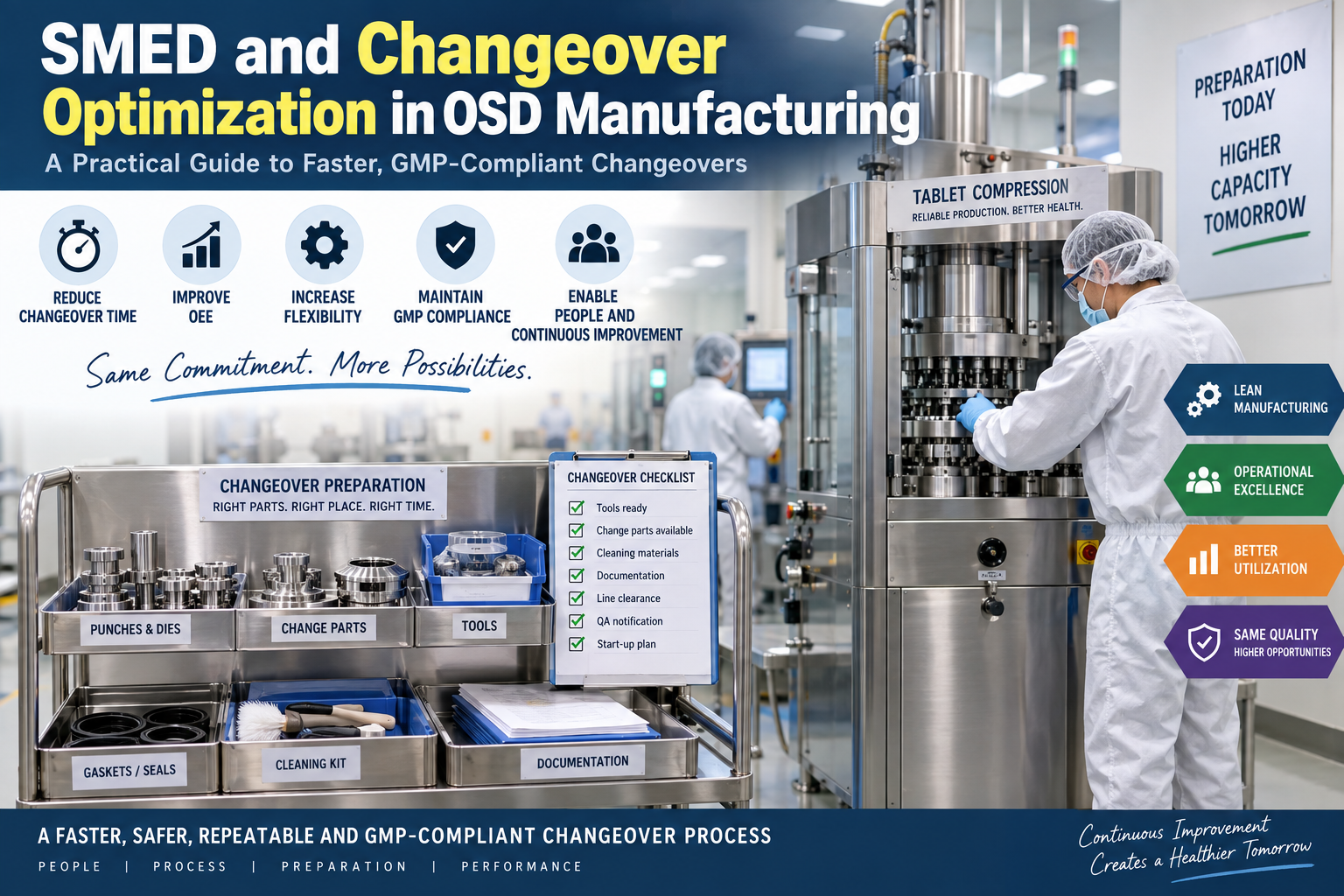
By Ramesh Palav | Pharma Manufacturing Hub
Introduction
In pharmaceutical manufacturing, a machine can be technically capable of producing hundreds of thousands or even millions of tablets in a shift, but that capacity is of little value if a significant part of the available time is lost between batches.
This is particularly relevant in Oral Solid Dosage (OSD) manufacturing, where production frequently involves multiple products, strengths, pack sizes, tooling configurations and cleaning requirements. A tablet compression machine may spend a substantial amount of time waiting for cleaning, tooling, change parts, line clearance, documentation, equipment checks and start-up activities before the next batch can actually run.
This is where changeover optimization becomes an important part of Operational Excellence.
Single-Minute Exchange of Die, commonly known as SMED, provides a structured way of looking at changeovers. The basic philosophy is simple: understand every activity involved in a changeover, distinguish activities that require the equipment to be stopped from those that can be completed while it is still running, eliminate unnecessary steps, simplify the remaining work and standardize the improved method.
However, pharmaceutical manufacturing requires an important qualification.
SMED in pharma is not about making people work faster or shortening GMP activities simply to achieve a lower number on a stopwatch.
The objective is to make the changeover faster, safer, repeatable, predictable and GMP-compliant.
A well-designed changeover improvement can release hidden equipment capacity without adding another machine or increasing working hours. Industry guidance has also recognized changeover reduction as an important opportunity for improving manufacturing productivity.
What is SMED?
SMED was developed within the Toyota Production System and is associated with reducing setup and changeover time through systematic analysis of setup activities.
The traditional approach is often summarized into four practical stages:
- Understand the existing changeover.
- Separate internal and external activities.
- Convert internal activities to external activities wherever feasible.
- Simplify, standardize and continuously improve the remaining activities.
Internal and external activities
This distinction is fundamental.
Internal activity means the activity can only be performed when the equipment is stopped.
External activity means the activity can be performed before the equipment is stopped or after it has been released for production.
Consider a tablet compression machine.
Preparing the next product’s tooling, checking tooling identification, preparing cleaning materials, arranging documentation and verifying availability of required change parts may potentially be performed before the machine stops.
Removing product-contact components from the machine, cleaning certain machine parts or installing specific components may require equipment stoppage.
The objective of SMED is therefore not simply:
“Do everything faster.”
It is:
“Do only what needs to happen during downtime, and prepare everything else before downtime begins.”
That difference can completely change the way a manufacturing team looks at a changeover.
Why Changeover Matters in OSD Manufacturing
Changeover time directly influences equipment availability.
For example, suppose a compression machine is scheduled for several products during a week. Every additional hour spent on changeover is an hour in which the machine is unavailable for productive manufacturing.
The impact goes beyond the machine itself.
Long changeovers can affect:
- Production schedule adherence
- Batch completion
- Equipment utilization
- OEE
- Campaign planning
- Labour utilization
- Warehouse movement
- QA availability
- Cleaning team workload
- Engineering support
- Manufacturing capacity
- Delivery commitments
A common mistake is to look only at the machine.
In reality, changeover is a cross-functional process.
A production operator may be ready, but the required change parts are still in the washing area.
The change parts may be ready, but the cleaning record has not been completed.
The cleaning record may be complete, but line clearance is pending.
Line clearance may be complete, but the next product’s tooling has not been checked.
The equipment may finally be ready, but the first few minutes of operation are spent adjusting the machine.
The stopwatch may show “changeover time,” but the real problem is often a combination of waiting, searching, movement, preparation and variation.
That is exactly where SMED becomes useful.
Why SMED in Pharmaceutical Manufacturing is Different
A pharmaceutical manufacturing line cannot be treated like an automotive production line.
In automotive manufacturing, reducing setup time may involve rapidly replacing dies, fixtures or tooling.
In pharmaceutical manufacturing, the changeover may involve:
- Product removal
- Cleaning
- Cleaning verification
- Line clearance
- Product-contact-part replacement
- Tooling changes
- Documentation
- Material reconciliation
- Equipment status identification
- QA involvement
- Cross-contamination controls
- Environmental requirements
- Equipment inspection
- Start-up checks
- In-process controls
- Validation considerations
The pharmaceutical industry therefore has another dimension:
Quality and compliance cannot become casualties of productivity improvement.
EU GMP Chapter 5 specifically addresses measures to prevent cross-contamination and emphasizes validated cleaning effectiveness, cleaning records and cleaning-status controls. It also states that significant manufacturing changes that may affect product quality or reproducibility should be appropriately validated.
Similarly, FDA’s process-validation framework emphasizes maintaining manufacturing processes in a state of control throughout their lifecycle rather than treating validation as a one-time exercise.
Therefore, a pharmaceutical SMED project has to ask two questions simultaneously:
How can we reduce time?
and
How can we reduce time without increasing quality or compliance risk?
Where is Changeover Time Actually Lost?
Before trying to improve a changeover, observe one.
Not the SOP.
Not the presentation.
Not the theoretical process map.
Go to the shop floor.
Watch the actual changeover.
This is the essence of Gemba.
You may discover that the biggest delays have nothing to do with the equipment itself.
For example:
- Operator searches for a spanner.
- Change parts are stored in another room.
- Cleaning accessories are not prepared.
- Required documents are printed at the last minute.
- Tooling identification takes longer than expected.
- One person performs an activity while three others wait.
- QA is called only after everything is complete.
- Engineering discovers a minor equipment issue during setup.
- A cleaning trolley is shared between several areas.
- Change parts are available but their status is unclear.
- Operators repeatedly walk between the machine and storage area.
- Start-up parameters are checked only after the machine is restarted.
None of these problems necessarily requires expensive technology.
They require process discipline and better preparation.
Mapping the Current Changeover
A proper SMED project begins with understanding the current state.
A useful approach is to conduct a detailed changeover study using:
- Gemba observation
- Time study
- Process mapping
- Operator interviews
- Activity classification
- Spaghetti diagrams
- Manpower mapping
- Waiting-time analysis
- Equipment downtime analysis
- Documentation review
- Changeover checklists
Where permitted by site procedures, video recording can also be useful because it allows the team to review movements and waiting periods that are easy to miss during live observation.
The team should capture the changeover from:
Last acceptable unit of Product A
to:
First acceptable and stable unit of Product B.
That definition is important.
If the machine restarts after 120 minutes but requires another 20 minutes to stabilize production, the real changeover impact is not simply 120 minutes.
The start-up and ramp-up losses must also be understood.
An ISPE Pharmaceutical Engineering article describes changeover in terms of cleanup, setup and startup, highlighting that startup losses can include machine adjustment, jams, rejects and other instability before normal production performance is achieved.
Illustrative Changeover Timeline
Consider an illustrative tablet compression changeover:
| Activity | Current Time |
|---|---|
| Product removal | 15 min |
| Cleaning | 45 min |
| Change-part preparation | 20 min |
| Tooling removal | 20 min |
| Tooling installation | 25 min |
| Equipment inspection | 10 min |
| Line clearance | 15 min |
| Documentation | 10 min |
| Trial/start-up | 20 min |
| Waiting/other losses | 20 min |
| Total | 200 min |
The important observation is that not all 200 minutes necessarily represent the same type of work.
Some activities may be genuinely required.
Some may be performed in parallel.
Some may be moved outside the equipment downtime window.
Some may be eliminated.
Some may be simplified.
That is where the SMED exercise begins.
Internal vs External Activities in OSD
Consider preparation for a compression-machine changeover.
Activities that may potentially be external
Depending on site procedures and equipment design:
- Verify next product documentation
- Prepare cleaning materials
- Prepare change-part trolley
- Check tooling availability
- Inspect punches and dies
- Verify tooling identification
- Prepare approved tools
- Check gaskets and accessories
- Stage product-contact parts
- Review machine setup parameters
- Prepare required labels/status cards
- Confirm manpower
- Confirm QA availability
- Confirm engineering support where required
These activities should be completed before the machine stops wherever this is technically, procedurally and GMP appropriate.
Activities that may remain internal
Examples may include:
- Removing remaining product from equipment
- Dismantling specified product-contact parts
- Cleaning the machine
- Removing installed tooling
- Installing required components
- Performing equipment-specific checks
- Completing activities that require equipment to be safely stopped
The classification must be based on the actual equipment, approved procedures and risk assessment.
A task should not be moved from internal to external merely because it saves time.
Safety and GMP requirements come first.
SMED in Tablet Compression
Tablet compression is an excellent area for changeover optimization because it often combines cleaning, tooling, mechanical setup, inspection and start-up activities.
A typical compression changeover may involve:
- Punches and dies
- Turret-related components
- Feed frame
- Hopper
- Product-contact parts
- Deduster
- Metal detector
- IPC equipment
- Dust extraction connections
- Guards
- Scrapers
- Change parts
- Tooling inspection
- Machine settings
- Cleaning
- Line clearance
- Trial compression
- In-process checks
A practical SMED project starts by observing the entire sequence.
For example, instead of waiting until the machine stops to search for punches and dies, the next product’s tooling can be prepared and checked in advance, provided the site’s procedures permit this.
Instead of allowing operators to search for cleaning accessories after dismantling begins, a standardized cleaning kit can be prepared.
Instead of having several people independently collect tools, one standardized changeover trolley can contain the required items.
Instead of one person performing every task sequentially, appropriately trained personnel can execute compatible activities in parallel.
The result is not simply “faster work.”
It is better-organized work.
Coating Changeover Optimization
Coating equipment can also provide significant opportunities for SMED.
A coating changeover may involve:
- Removal of previous product
- Cleaning of the coating pan
- Spray guns
- Solution-related components
- Product-contact components
- Hoses
- Filters
- Exhaust-related checks
- Inspection
- Line clearance
- Equipment status
- Start-up checks
One important area is preparation.
If the next product’s approved coating solution, equipment accessories, cleaning materials and required documentation are not ready when the previous batch finishes, the coating machine may remain idle unnecessarily.
At the same time, the team must distinguish preparation activities from activities that require controlled conditions or equipment status.
The question should therefore be:
“What can be safely and compliantly prepared before the equipment becomes available for changeover?”
rather than:
“How can we clean the machine faster?”
That distinction prevents many poor improvement decisions.
Granulation and FBD Changeovers
Granulation and Fluid Bed Dryer operations can involve substantial cleaning and component handling.
Potential changeover elements include:
- Product-contact containers
- Impeller
- Chopper
- Filter bags
- Product-contact screens
- Gaskets
- Spray components where applicable
- Cleaning accessories
- Drying components
- Equipment inspection
- Status labeling
- Cleaning verification
One practical opportunity is change-part readiness.
If the next set of cleaned and approved components is available before equipment shutdown, the operator does not have to wait for another department to complete preparation.
However, component status must always be clear.
A changeover improvement is not successful if it creates uncertainty about whether a component is:
- Clean
- Under cleaning
- Awaiting inspection
- Released for use
- Rejected
- Damaged
- Under maintenance
Visual status management becomes extremely valuable here.
Cleaning Optimization Without Compromising GMP
This is perhaps the most sensitive area of pharmaceutical SMED.
There is a major difference between:
optimizing cleaning
and
shortening cleaning without scientific justification.
The first is good Operational Excellence.
The second can create unnecessary risk.
Cleaning optimization may include:
- Better cleaning sequence
- Improved equipment accessibility
- Standardized cleaning tools
- Point-of-use cleaning kits
- Elimination of unnecessary movement
- Better equipment design
- Defined cleaning responsibilities
- Parallel preparation activities
- Visual cleaning standards
- Improved training
- Appropriate cleaning verification
But if the proposed change alters the validated cleaning process, equipment configuration, cleaning agents, contact time, sequence or other critical parameters, it must be evaluated through the site’s change-control and validation framework.
EU GMP emphasizes validated cleaning effectiveness and appropriate cleaning records/status controls, while FDA’s process-validation framework emphasizes science- and risk-based lifecycle management of manufacturing processes.
The right question is therefore not:
“Can we reduce cleaning from 45 minutes to 30 minutes?”
The better question is:
“What is driving the 45 minutes, and can we remove non-value-added time while maintaining the demonstrated effectiveness of the cleaning process?”
That is a much more mature Operational Excellence question.
Parallel Processing: One of the Biggest Opportunities
Traditional changeovers often follow a sequential pattern:
Activity A → Activity B → Activity C → Activity D
SMED asks:
Which activities can safely happen at the same time?
For example:
While Production completes one activity, appropriately trained personnel may prepare the next activity.
Potential participants include:
- Production
- QA
- Engineering
- Warehouse
- Cleaning personnel
- Documentation support
But parallel processing needs clear role definitions.
Otherwise, three people can end up standing around one machine trying to help one operator.
That is not parallel processing.
It is congestion.
The objective is to create a planned changeover team, with each person knowing:
- What to do
- When to do it
- What information is required
- What completion looks like
- Who verifies it
- What happens if an abnormality is identified
Change Parts and Tool Management
A surprising amount of changeover time can be lost simply because the required tools or components are not ready.
A practical solution is the changeover trolley.
Depending on the equipment, it may contain:
- Approved tools
- Change parts
- Gaskets
- Cleaning accessories
- Identification materials
- Checklists
- Equipment-specific accessories
The contents should be standardized.
Point-of-use storage can reduce walking and searching.
Tool identification can reduce selection errors.
Tool-condition checks can prevent discovering damaged tools during the changeover.
For equipment where technically appropriate, quick-release mechanisms or simplified fastening arrangements can also be considered—but only after engineering, safety, GMP and validation implications are evaluated.
The philosophy is simple:
The operator should not spend valuable equipment downtime looking for something that should have been ready before the machine stopped.
5S and Visual Management
SMED works particularly well with 5S.
Consider a compression room where punches, dies, change parts and tools have no fixed locations.
The operator knows where everything is—but only after years of experience.
That is not a robust system.
A better arrangement provides:
- Defined locations
- Identification
- Visual status
- Tool shadow boards where appropriate
- Dedicated changeover kits
- Standard storage
- Clean/dirty segregation
- Easy identification of missing items
The objective of 5S is not to make the room look attractive.
It is to make the correct action easy to identify and execute.
Digital Tools and SMED
Digitalization can further support changeover optimization.
Examples include:
- MES
- Electronic batch records
- eQMS
- Electronic logbooks
- SCADA/HMI
- Digital checklists
- OEE dashboards
- Equipment status monitoring
- Manufacturing analytics
For example, an OEE dashboard may show that a compression machine consistently loses 18–25 minutes during changeover.
But the dashboard only tells you where the loss occurs.
The shop-floor study tells you why it occurs.
This distinction is important.
Digital systems should support the improvement process—not replace observation.
Digitalization can also reduce administrative waiting by making information available at the point of work, provided appropriate controls for data integrity, access, review and validated system operation are maintained.
For GMP-related computerized systems, appropriate validation, access controls, change management and reliable records remain essential.
SMED and OEE
OEE is generally considered through three major components:
Availability × Performance × Quality
Changeover primarily affects availability because the equipment is not producing during planned setup/changeover time.
Consider an illustrative example.
Suppose a machine has 480 scheduled minutes in a shift.
If changeover consumes 120 minutes:
Available production time = 480 − 120 = 360 minutes
If SMED reduces the changeover to 80 minutes:
Available production time = 480 − 80 = 400 minutes
That creates:
40 additional minutes of potential production availability.
But there is an important qualification.
Those 40 minutes are potential capacity, not automatically 40 additional minutes of saleable production.
If the machine then experiences increased rejects, poor setup, slower running speed or more deviations, the apparent improvement may disappear.
Therefore, SMED should always be connected with:
- Availability
- Performance
- Quality
- First-time-right production
- Changeover-related deviations
- Start-up rejects
The goal is productive availability, not simply a lower changeover number.
SMED and Production Planning
Changeover optimization should not begin and end inside the production department.
Production planning has a major influence on the number of changeovers.
Suppose a machine is scheduled:
Product A → Product B → Product A → Product C → Product B
The number of changeovers may be significantly higher than if compatible campaigns are grouped more intelligently.
Campaign planning can consider:
- Product family
- Strength
- Equipment configuration
- Cleaning requirements
- Cross-contamination risk
- Customer demand
- Inventory
- Expiry considerations
- Batch size
- Schedule commitments
However, reducing the number of changeovers should not become an excuse for excessively large campaigns or excessive inventory.
The optimum solution comes from balancing manufacturing efficiency with supply requirements and quality risk.
People Are at the Centre of SMED
One of the biggest mistakes in Lean implementation is treating operators as the problem.
In reality, experienced operators often know exactly where changeover time is being lost.
Ask them:
“What is the most frustrating part of this changeover?”
You may hear:
- “The tools are never ready.”
- “The change parts come late.”
- “We wait for clearance.”
- “The cleaning trolley is shared.”
- “This component is difficult to dismantle.”
- “The SOP doesn’t match what actually happens.”
- “We always have to make the same adjustment.”
These comments are valuable improvement data.
Operators should therefore be involved in:
- Current-state mapping
- Problem identification
- Improvement workshops
- Trial implementation
- Standard work development
- Training
- Post-implementation review
SMED should not be communicated as:
“Management wants you to complete the same work faster.”
It should be communicated as:
“Let’s remove the unnecessary work and waiting that makes your job difficult.”
That difference has a significant effect on employee acceptance.
Common Mistakes in SMED Implementation
1. Focusing only on the stopwatch
A shorter changeover is not automatically a better changeover.
Quality, safety and repeatability must also be considered.
2. Cutting cleaning time without justification
This is one of the most dangerous approaches.
Cleaning optimization must remain scientifically justified and compliant with approved procedures and validation requirements.
3. Ignoring QA
QA should not be treated as an external department that appears only at the end.
Quality involvement should be designed into the improved process.
4. Ignoring operator feedback
A theoretical process designed from an office may fail on the shop floor.
5. Poor preparation
A changeover starts long before the machine stops.
6. Lack of change parts
A machine cannot be changed efficiently if the required parts are unavailable.
7. Treating every changeover as identical
Different products can have different cleaning, tooling and setup requirements.
8. Optimizing one department while creating another bottleneck
Saving 15 minutes in production but creating a 30-minute delay in QA or engineering is not an improvement.
9. Complicated standard work
If the improved procedure is too complicated, operators will struggle to follow it consistently.
10. Failure to sustain
A successful pilot can disappear within months if the new method is not standardized, trained, measured and reviewed.
A Practical SMED Implementation Roadmap for an OSD Plant
A structured implementation can follow these steps.
Step 1 – Select the equipment
Choose an equipment/changeover combination with meaningful downtime.
Step 2 – Establish the baseline
Measure actual changeover performance over multiple events rather than relying on one observation.
Step 3 – Observe the real changeover
Go to the shop floor.
Step 4 – Map every activity
Capture every movement, waiting period, inspection and documentation step.
Step 5 – Separate internal and external activities
Identify what genuinely requires equipment downtime.
Step 6 – Convert internal activities
Move appropriate preparation activities outside the downtime window.
Step 7 – Simplify remaining activities
Improve tools, sequence, access, movement and standard work.
Step 8 – Introduce parallel work
Coordinate trained personnel to perform compatible tasks simultaneously.
Step 9 – Standardize
Update procedures, checklists and visual standards through the site’s appropriate document-control process.
Step 10 – Train
Train all relevant personnel.
Step 11 – Monitor
Track changeover time and quality-related indicators.
Step 12 – Sustain
Review performance periodically and continue identifying improvement opportunities.
Illustrative OSD Case Study: Tablet Compression Changeover
Important: The following example is illustrative and does not represent actual company performance.
Consider a tablet compression machine with an initial average changeover duration of approximately 180 minutes.
A cross-functional team observes several changeovers and identifies the following losses:
| Activity | Before Improvement |
|---|---|
| Product removal | 15 min |
| Cleaning | 45 min |
| Tooling/change-part preparation | 20 min |
| Tooling removal | 20 min |
| New tooling installation | 25 min |
| Equipment inspection | 10 min |
| Line clearance | 15 min |
| Documentation/waiting | 10 min |
| Start-up and adjustment | 20 min |
| Total | 180 min |
The team does not immediately try to reduce cleaning time.
Instead, it asks why the 180 minutes is required.
Several opportunities are identified:
- Tooling can be prepared before machine stoppage.
- Changeover tools can be standardized.
- Cleaning materials can be staged.
- Certain compatible activities can be performed in parallel.
- Personnel responsibilities can be defined before changeover.
- Documentation can be prepared in advance.
- Change-part identification can be improved.
- Start-up parameters can be standardized within approved limits.
- Recurring adjustment causes can be investigated.
An illustrative future-state model might look like:
| Activity | Before | Potential Future State* |
|---|---|---|
| Product removal | 15 | 12 |
| Cleaning | 45 | 45 |
| Tooling/change-part preparation | 20 | 5 |
| Tooling removal | 20 | 15 |
| Tooling installation | 25 | 18 |
| Equipment inspection | 10 | 8 |
| Line clearance | 15 | 12 |
| Documentation/waiting | 10 | 4 |
| Start-up/adjustment | 20 | 11 |
| Total | 180 | 130 |
*Illustrative only; actual achievable times depend on equipment, product, procedure, personnel, cleaning requirements and site controls.
The important point is that the hypothetical improvement did not come primarily from asking operators to clean faster.
It came from:
better preparation + better sequencing + parallel activities + improved tooling management + reduced waiting + standardization.
That is the essence of SMED.
Measuring the Right KPIs
A mature SMED program should not rely on one KPI.
Useful measures include:
Changeover performance
- Total changeover time
- Internal setup time
- External preparation time
- Equipment downtime
- Changeover variation
Quality
- Changeover-related deviations
- Start-up rejects
- First-time-right performance
- Cleaning-related observations
- Product mix-up events
Operational performance
- OEE availability
- Schedule adherence
- Equipment utilization
- Productive hours recovered
Sustainability
- Repeatability
- Standard-work compliance
- Training compliance
- Number of recurring changeover problems
A particularly useful KPI is changeover variation.
Suppose one changeover takes 100 minutes, another 135 minutes and another 180 minutes.
Even if the average looks acceptable, the variability indicates that the process is not yet robust.
The target should therefore be:
Fast + stable + compliant.
GMP and Regulatory Considerations
Every SMED project in pharmaceutical manufacturing should include an appropriate quality and risk assessment.
Potential considerations include:
- GMP impact assessment
- Change control
- Cleaning validation impact
- Equipment qualification impact
- Process validation impact
- SOP revision
- Training
- Data integrity
- Cross-contamination risk
- Product quality impact
- Safety assessment
The extent of assessment should be proportionate to the nature and risk of the proposed change.
FDA’s process-validation guidance uses a lifecycle approach and emphasizes process understanding, qualification and continued monitoring of process performance.
ICH Q8/Q9/Q10 principles also support risk-based approaches and continual improvement of manufacturing processes and control strategies.
For changes involving computerized systems or electronic records, the validated state and appropriate change-control mechanisms must also be maintained.
The key principle is simple:
Operational Excellence cannot operate outside the Pharmaceutical Quality System.
It must operate inside it.
SMED as Part of Operational Excellence
SMED should not be treated as an isolated Lean project.
It connects naturally with:
- 5S
- Kaizen
- OEE
- TPM
- Standard Work
- Visual Management
- Root Cause Analysis
- FMEA
- Problem Solving
- Autonomous Maintenance
- Continuous Improvement
For example:
5S reduces searching.
TPM improves equipment reliability.
Standard Work reduces variation.
SMED reduces changeover losses.
OEE measures the overall equipment impact.
FMEA helps identify risks.
Root Cause Analysis addresses recurring problems.
Together, these methods form a stronger Operational Excellence system.
The Future of Changeover Optimization
The next generation of changeover optimization will increasingly use manufacturing data.
Potential applications include:
AI-assisted analytics
Historical changeover data can be analyzed to identify recurring delays and correlations.
Predictive maintenance
Equipment condition monitoring can help prevent mechanical problems discovered during changeover.
Digital work instructions
Operators can access equipment-specific instructions at the point of work.
Computer vision
Where appropriately validated and controlled, vision systems may assist with identification or verification activities.
Real-time OEE
Teams can identify changeover losses more quickly.
Digital twins
Future manufacturing environments may use digital models to test sequencing and capacity scenarios before implementing them on the shop floor.
But technology should not become the first answer.
If the problem is simply that the operator has to walk 30 meters to collect a tool, an AI system is probably not the solution.
Fix the process first. Digitize where digitalization adds real value.
Practical Takeaways for OSD Manufacturing Professionals
If you are starting a SMED project in an OSD plant, begin with five questions:
1. What is the actual changeover time?
Measure it from a clearly defined start point to a clearly defined end point.
2. Where is the waiting?
Look beyond equipment operation.
3. What can be prepared before the machine stops?
This is the heart of SMED.
4. What activities can safely happen in parallel?
Build a coordinated changeover team.
5. Are we reducing time without increasing risk?
This is the most important question in pharmaceutical manufacturing.
Conclusion
Changeover optimization is often described as a Lean Manufacturing exercise.
In OSD pharmaceutical manufacturing, it is much more than that.
It is an opportunity to improve capacity, reliability, scheduling, operator effectiveness, equipment utilization and operational discipline—while maintaining the controls required for pharmaceutical manufacturing.
The most successful SMED projects do not begin with the question:
“How can we make operators work faster?”
They begin with:
“Why does this changeover take so long?”
That question leads the team to waiting, searching, unnecessary movement, poor preparation, unclear responsibilities, inefficient sequencing, equipment design issues and recurring startup problems.
Once those causes are understood, the improvement becomes much more logical.
Prepare before the machine stops.
Separate internal and external activities.
Eliminate unnecessary movement.
Improve change-part and tool management.
Use parallel activities where appropriate.
Standardize the improved method.
Involve the people who perform the work.
And most importantly, never compromise GMP, safety, product quality or validated processes simply to achieve a better changeover number.
In pharmaceutical manufacturing, the objective of SMED is not simply a faster changeover. The objective is a changeover that is faster, safer, repeatable, predictable, GMP-compliant and sustainable.
That is how changeover optimization moves from a Lean project to a genuine Operational Excellence capability.
Frequently Asked Questions
1. What is SMED in pharmaceutical manufacturing?
SMED, or Single-Minute Exchange of Die, is a structured methodology for reducing equipment setup and changeover time by separating internal and external activities, eliminating unnecessary steps and simplifying the remaining activities.
2. Can SMED be applied to tablet compression machines?
Yes. Tablet compression provides several opportunities involving tooling preparation, change-part management, cleaning preparation, parallel activities, setup standardization and startup optimization, provided GMP, safety and equipment requirements are maintained.
3. Does SMED mean reducing cleaning time?
No. SMED does not mean shortening validated cleaning activities without justification. The focus should be on removing non-value-added waiting, movement and preparation losses while maintaining demonstrated cleaning effectiveness.
4. How does SMED improve OEE?
Reducing changeover downtime can increase equipment availability. However, the improvement must also maintain performance and quality; otherwise, increased startup losses or rejects can offset the availability gain.
5. What is the biggest challenge in implementing SMED in pharma?
One of the biggest challenges is balancing productivity improvement with GMP, quality, safety and validated-state requirements. Successful implementation therefore requires Production, QA, Engineering, Planning and other relevant functions to work together.
References
- FDA — Process Validation: General Principles and Practices
- European Commission — EU GMP Chapter 5: Production
- FDA — Q8, Q9 & Q10 Pharmaceutical Quality System principles
- ISPE Pharmaceutical Engineering — How to Develop and Implement a Quick Changeover Program
- FDA — Q12: Pharmaceutical Product Lifecycle Management
About the Author
Ramesh Palav is a pharmaceutical manufacturing professional with 21+ years of experience in Oral Solid Dosage (OSD) manufacturing, specializing in tablet production, GMP, qualification, validation, QMS, operational excellence, and continuous improvement. Through Pharma Manufacturing Hub, he shares practical insights on pharmaceutical manufacturing, Lean practices, Pharma 4.0, digital transformation, compliance, and industry careers.