
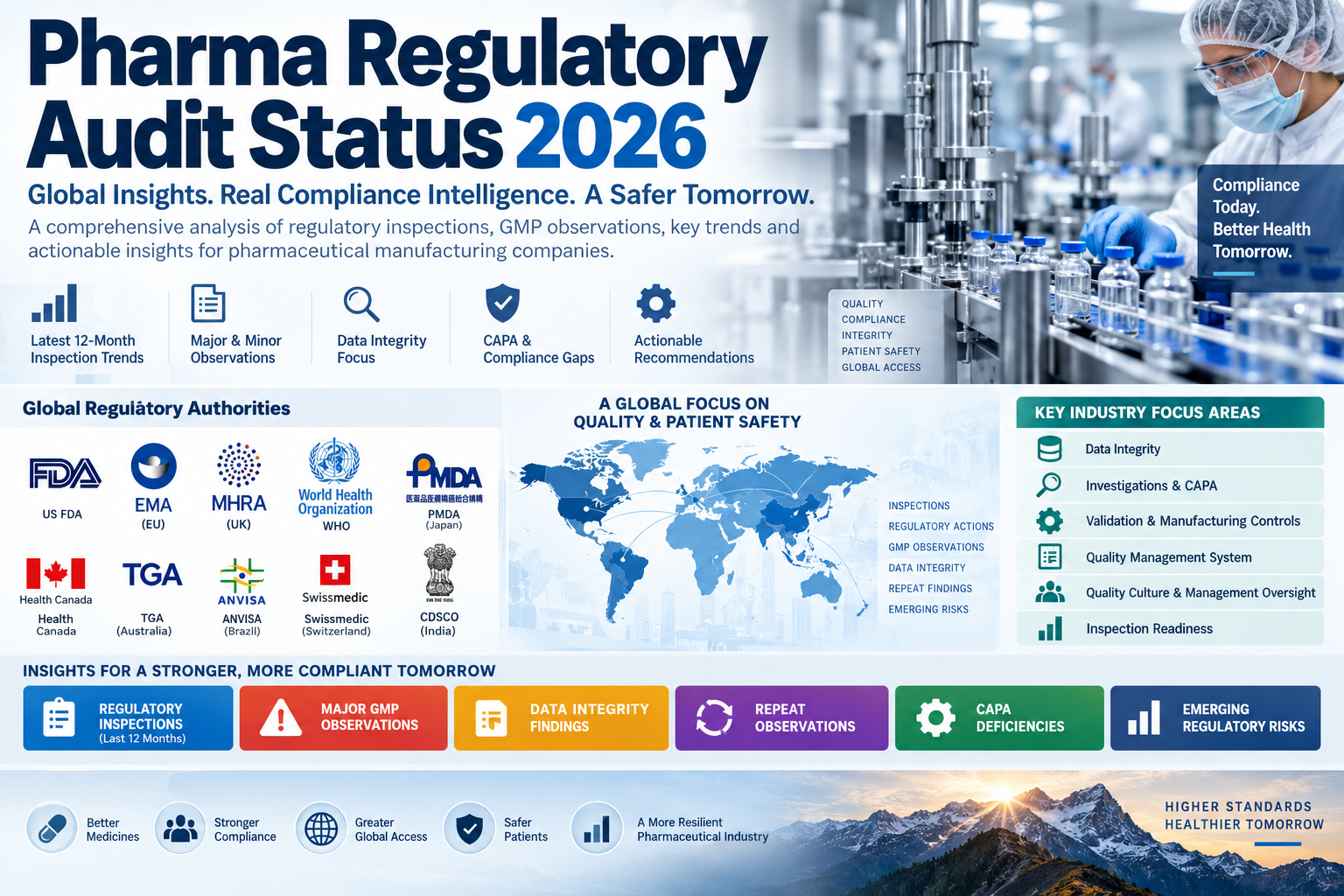
Global Pharmaceutical GMP Inspection & Regulatory Compliance Analysis — Last 12 Months
Analysis period: 7 September 2025 to 7 September 2026
1. Executive Summary
The Pharma Regulatory Audit Status 2026 landscape shows a clear shift from traditional checklist-style GMP auditing toward deep-dive, risk-based assessment of the pharmaceutical quality system.
The most significant pattern from the publicly available evidence is that regulators are increasingly testing whether a company’s quality system actually controls risk, rather than merely whether SOPs exist.
Five themes stand out:
- Data integrity remains a high-risk regulatory issue.
- Investigation quality and scientifically defensible root-cause analysis are receiving intense scrutiny.
- Repeat observations are particularly serious because they indicate ineffective CAPA and weak management oversight.
- Quality Unit independence and authority are being examined as systemic controls.
- Inspectors are increasingly connecting individual GMP failures to broader product/patient risk.
FDA’s 2025–26 Indian-company warning letters provide particularly strong evidence. Public cases involve inadequate investigations, data integrity, OOS handling, cleaning, stability, quality-unit oversight, process validation, supplier controls, environmental monitoring and inadequate CAPA.
At the European level, the EudraGMDP public database recorded serious GMP non-compliance reports involving Indian manufacturers including Aculife Healthcare and Ananta Medicare in 2026.
MHRA’s current public GMP database also shows recent inspections of Indian sites including Cipla, Mankind Pharma, Medley Pharmaceuticals, Zenara Pharma and Geno Pharmaceuticals, with Geno recorded as Non Compliant following its 23 June 2026 inspection.
WHO’s public inspection-report database demonstrates continuing international GMP inspection activity across Indian API and finished-product facilities, including Hetero, IPCA, Mangalam, MSN, Neuland, SCL Lifesciences, Solara, Strides and Mylan during the period.
Overall conclusion
Regulatory scrutiny: INCREASING
Data integrity scrutiny: HIGH / INCREASING
Investigation & CAPA scrutiny: HIGH / INCREASING
Quality-culture scrutiny: INCREASING
Repeat-finding risk: HIGH
Indian export-site risk exposure: HIGH
2. Regulatory Audit Landscape — Last 12 Months
2.1 What changed?
The inspection environment is increasingly characterized by:
- risk-based inspection planning;
- electronic-record review;
- retrospective data review;
- employee interviews;
- tracing deviations through CAPA;
- examination of recurring failures;
- supplier qualification;
- process-validation lifecycle management;
- laboratory-system scrutiny;
- management oversight;
- inspection of actual practices rather than merely SOP content.
FDA’s inspection framework uses NAI, VAI and OAI as final inspection classifications. NAI means acceptable compliance; VAI means objectionable conditions exist but voluntary correction is considered sufficient; OAI indicates an unacceptable state of compliance.
A Form FDA 483, therefore, should not automatically be interpreted as equivalent to a Warning Letter or OAI. The final FDA classification can take account of the firm’s response and other evidence.
3. Publicly Documented Indian Regulatory Cases
3.1 FDA — Indian facilities
The following table represents publicly documented FDA enforcement/inspection cases identified during the defined period. It is deliberately not presented as a complete list of every FDA inspection.
| Company / Site | Location | FDA inspection | Area | Public outcome | Key deficiencies |
|---|---|---|---|---|---|
| Somerset Therapeutics | Bengaluru, Karnataka | 10–21 Feb 2025 | Finished pharmaceuticals | Warning Letter, Sept 2025 | Investigations, media-fill contamination, environmental monitoring, electronic data |
| Seema International | New Delhi | 15–21 May 2025 | API | Warning Letter, Nov 2025 | Cleaning, stability, repeat deficiencies, QU oversight |
| Cdymax India Pharma | Jigani, Karnataka | 21–25 Apr 2025 | API | Warning Letter, Nov 2025 | OOS investigations/CAPA |
| Chemspec Chemicals | Navi Mumbai, Maharashtra | 28 Jul–1 Aug 2025 | API | Warning Letter, Dec 2025 | Quality-unit oversight and CGMP controls |
| Zydus Lifesciences | Baddi, Himachal Pradesh | Records review following Aug/Nov 2025 activity | Finished pharmaceuticals | Warning Letter, Jun 2026 | Significant CGMP violations |
| Umendra Life Sciences | Bavla, Gujarat | Records review | OTC drugs | Warning Letter, Jun 2026 | CGMP deficiencies |
| Gopaldas Visram | Navi Mumbai | Records request | OTC drugs | Warning Letter, Jun 2026 | CGMP deficiencies |
| Wizcure Pharmaa | Bhiwadi, Rajasthan | Regulatory review/inspection | Finished drugs | Warning Letter / Import Alert | CGMP deficiencies |
| Shimoga Chemicals | Sangli, Maharashtra | 19–23 Jan 2026 | API | Warning Letter + Import Alert | Data integrity, OOS, sampling, validation, cleaning, stability, QU |
| Almon Healthcare | Ahmedabad, Gujarat | 9–13 Feb 2026 | API | Warning Letter | Raw-material identity testing, deliberate mislabelling, QU controls |
| BioMylz | Bengaluru, Karnataka | 4–9 Feb 2026 | Finished pharmaceuticals | Warning Letter | CGMP + drug listing deficiencies |
| Dabur India | Silvassa | 12–16 Jan 2026 | OTC drugs | Warning Letter + Import Alert | Quality-unit authority and production-record controls |
| Auriga Research | Bengaluru | 4–6 Feb 2026 | Contract testing laboratory | Warning Letter | Laboratory CGMP deficiencies |
Evidence
Somerset’s FDA inspection produced findings around inadequate investigations, media-fill contamination, environmental monitoring and electronic data retention.
Seema International was cited for inadequate cleaning, a repeat cleaning deficiency, inadequate stability testing and inadequate Quality Unit oversight. FDA subsequently placed its products on Import Alert 66-40.
Cdymax was cited for inadequate OOS investigation and CAPA.
Chemspec was cited for Quality Unit failures in ensuring API/intermediate CGMP compliance.
Shimoga’s January 2026 inspection generated particularly broad findings: unreported HPLC injections, inadequate electronic-data review, inadequate sampling, lack of method verification, inadequate process validation, cleaning deficiencies, weak investigations, stability-program deficiencies and insufficient training. FDA subsequently noted a voluntary recall and Import Alert 66-40.
Almon Healthcare’s inspection identified deliberate acceptance of mislabeled raw materials and failure to perform required identity testing.
Dabur’s inspection focused on the authority and effectiveness of its Quality Unit and production-record oversight.
Auriga Research, a contract testing laboratory, was inspected by FDA in February 2026 and subsequently received a Warning Letter concerning significant laboratory CGMP violations.
4. EU / EudraGMDP Regulatory Status
The European GMP system provides an important complementary view because national competent authorities publish GMP certificates and non-compliance reports through EudraGMDP.
During the period, the public database recorded:
Aculife Healthcare Private Limited
Unit 9, Village Sachana, Ahmedabad, Gujarat
- Inspection end: 14 July 2026
- Non-compliance report: 24 August 2026
- Authority: Malta Medicines Authority
- Status: Does not comply with EU GMP
- Report: MT/003NCR/2026
The report explicitly states that the inspection identified serious GMP non-compliance.
Ananta Medicare Limited
Sri Ganganagar, Rajasthan
- Inspection end: 9 July 2026
- Non-compliance report: 6 August 2026
- Authority: Portugal’s National Authority of Medicines and Health Products
- Status: Does not comply with EU GMP
- Report: FT094/MH/001/2024/NCR
The EudraGMDP database is maintained by EMA but populated with information supplied by national competent authorities, so the relevant national authority remains the primary source for the individual finding.
5. MHRA Inspection Status
MHRA’s public GMP database provides a useful real-time picture of UK GMP oversight.
Recent Indian inspections include:
| Site | Location | Inspection date | Public status |
|---|---|---|---|
| Flamingo Pharmaceuticals | Taloja, Maharashtra | 8 Sep 2025 | GMPC |
| Zenara Pharma | Hyderabad | 23 Sep 2025 | GMPC |
| Medley Pharmaceuticals | Daman | 30 Oct 2025 | GMPC |
| Mankind Pharma Unit III | Paonta Sahib | 12 Jan 2026 | GMPC |
| Cipla | Kurkumbh, Pune | 15 Jun 2026 | GMPC |
| Geno Pharmaceuticals | Goa | 23 Jun 2026 | Non Compliant |
These records demonstrate that UK regulators continue to conduct inspections of Indian manufacturing facilities, while the Geno case demonstrates that inspection can result in an explicit non-compliance statement.
The Geno Pharmaceuticals non-compliance statement confirms that the latest inspection, conducted on 23 June 2026, found the site not compliant with applicable GMP requirements.
6. WHO Inspection Activity
WHO Prequalification’s public inspection system shows substantial continuing activity involving Indian pharmaceutical manufacturers.
Examples from the period include:
API / manufacturing sites
- Mangalam Drugs & Organics — Vapi — 7–10 Oct 2025
- IPCA Laboratories — Ratlam — 6–8 Oct 2025
- Hetero Labs Unit IX — Anakapalli — 17–21 Nov 2025
- Hetero Labs Unit III — Narasapuram — 29–30 Nov 2025
- Solara Active Pharma — Cuddalore — 11–13 Dec 2025
- MSN Pharmachem — Telangana — 2–4 Feb 2026
- SCL Lifesciences — Punjab — 16–19 Mar 2026
- Strides Pharma Science — Bengaluru — 2 May 2026
- Neuland Labs — Hyderabad — 8 Jun 2026
- Mylan/Matoda — Ahmedabad — 3 Jul 2026
WHO also records finished-product and API inspections/desk assessments involving Indian companies such as Cipla, Mepro, Mylan, Micro Labs and others.
Important: A WHOPIR listing establishes that an inspection/report was publicly issued; it should not be interpreted automatically as “zero deficiencies.” WHO explains that its inspections are sampling exercises focused on the products/activities relevant to the prequalification assessment.
7. Regulatory Authority-wise Assessment
| Authority | Public evidence in period | Overall regulatory signal |
|---|---|---|
| US FDA | Numerous Indian warning letters/enforcement cases | High scrutiny |
| EMA/EU NCAs | Serious GMP non-compliance reports including Indian sites | High scrutiny |
| MHRA | Multiple Indian-site GMP inspections; one recent non-compliant site | High |
| WHO PQT | Continuing inspections across Indian API/FPP sites | High / active |
| Health Canada | Public inspection system includes foreign GMP inspections | Active |
| ANVISA | Uses GMP certification/foreign regulatory evidence in decisions | Active |
| PMDA | GMP inspection framework continues internationally | Active |
| TGA | International GMP inspection/certification framework | Active |
| CDSCO | National Indian regulatory oversight | Important but public central inspection data are less granular |
Health Canada’s public inspection database illustrates the type of foreign-site inspection information available. For example, Galentic Pharma India had a foreign GMP inspection beginning 25 May 2026, shown as “Inspection in progress” in the public database at the time of retrieval.
8. Major vs Minor vs Critical Observations
A critical point for pharmaceutical management is that FDA’s NAI/VAI/OAI system is not equivalent to the EU/MHRA critical-major-minor deficiency terminology.
Classification framework
| Classification | Risk | Typical examples | Regulatory impact | Expected CAPA |
|---|---|---|---|---|
| Critical | Very high | Data falsification, uncontrolled contamination, serious sterility failure, deliberate concealment | Possible suspension, recall, import restrictions, major enforcement | Immediate containment + systemic remediation |
| Major | High | Inadequate investigation, significant validation failure, inadequate laboratory controls, repeat deviations | Significant compliance action possible | Root-cause-driven CAPA |
| Minor | Lower | Isolated documentation error, limited procedural deficiency | Normally corrective action | Local correction + preventive assessment |
European regulatory practice defines deficiencies based on their potential or actual impact on product/patient risk and degree of deviation from GMP.
FDA terminology
FDA uses:
- NAI — No Action Indicated
- VAI — Voluntary Action Indicated
- OAI — Official Action Indicated
These classifications apply at the inspection/project-area level and should not be confused with individual Form 483 observations.
Public-data limitation
For the Indian FDA Warning Letter cases reviewed here:
Critical observations: Not publicly disclosed.
Major observations: Not publicly disclosed as a numerical count.
Minor observations: Not publicly disclosed as a numerical count.
Therefore, assigning numerical major/minor counts to these FDA cases would be inappropriate.
9. Top 20 Recurring GMP Observation Categories
Based on the public cases reviewed, regulatory guidance and recurring themes across FDA/EU/MHRA/WHO material, the following categories represent the highest-priority inspection risks.
| Rank | Category | Trend | Risk |
|---|---|---|---|
| 1 | Data Integrity | ↑ | Critical |
| 2 | Investigations / RCA | ↑ | Critical |
| 3 | CAPA effectiveness | ↑ | Critical |
| 4 | Quality Unit oversight | ↑ | Critical |
| 5 | OOS/OOT management | ↑ | High |
| 6 | Process validation | ↑ | High |
| 7 | Cleaning validation | ↑ | High |
| 8 | Laboratory controls | ↑ | High |
| 9 | Stability programme | ↑ | High |
| 10 | Documentation practices | ↑ | High |
| 11 | Change control | ↑ | High |
| 12 | Environmental monitoring | ↑ | High |
| 13 | Computerized systems | ↑ | High |
| 14 | Supplier qualification | ↑ | High |
| 15 | Sampling controls | ↑ | High |
| 16 | Equipment qualification | → | Medium/High |
| 17 | Contamination control | ↑ | High |
| 18 | Training effectiveness | ↑ | Medium/High |
| 19 | Preventive maintenance | → | Medium |
| 20 | Management review / quality culture | ↑ | High |
This is an analytical ranking based on publicly available cases, not an official regulator-generated frequency ranking.
10. Data Integrity — Still One of the Biggest Risks
The evidence strongly supports the conclusion that data integrity remains a major regulatory priority.
FDA states that its data-integrity guidance was developed in response to increasing inspection findings involving data-integrity lapses and expects data to be reliable and accurate.
FDA’s framework emphasizes:
ALCOA
- Attributable
- Legible
- Contemporaneous
- Original
- Accurate
FDA also expects firms to implement risk-based controls to prevent and detect data-integrity problems.
Current high-risk areas
Inspectors increasingly examine:
- HPLC raw data
- GC data
- chromatographic audit trails
- deleted injections
- reprocessing
- reintegration
- aborted sequences
- electronic batch records
- LIMS
- CDS
- ERP
- administrator accounts
- shared passwords
- audit-trail review
- backup/restore
- data retention
- metadata
- paper/electronic reconciliation.
The Shimoga case is particularly instructive: FDA found unreported HPLC injections and inadequate review of electronic laboratory data, with an affected batch subsequently released to the U.S. market.
11. CAPA and Investigation Trends
The regulatory expectation is clearly moving from:
“Was CAPA opened?”
toward:
“Did the CAPA eliminate the root cause and prevent recurrence?”
Weak CAPA
Examples:
- retraining only;
- SOP revision only;
- “employee reminder”;
- disciplinary action without system correction;
- increased supervision without process redesign;
- repeating an audit without addressing root cause.
Strong CAPA
A robust CAPA should include:
- Problem definition
- Immediate containment
- Product impact assessment
- Root-cause analysis
- Systemic cause assessment
- Scope expansion
- Corrective action
- Preventive action
- Effectiveness criteria
- Post-CAPA monitoring
- Recurrence review
- Management oversight.
FDA’s Indian cases repeatedly demonstrate this expectation. Somerset’s investigation deficiencies included inadequate root-cause support and inadequate assessment of potentially affected products.
Glenmark’s case similarly illustrates the regulatory concern with insufficient scientific justification for root cause and inadequate validation before implementation of corrective process changes.
12. Auditor / Inspector Approach
12.1 Risk-based inspection
Inspectors increasingly connect:
Product risk + process complexity + inspection history + complaints + deviations + recalls + previous findings
to inspection depth.
WHO explicitly describes inspections as risk-focused sampling activities related to the product or activity being assessed.
12.2 Data-integrity deep dive
The auditor may move from:
“Show me the SOP.”
to:
“Show me the raw electronic data behind the result.”
Then:
- Who generated it?
- When?
- On which instrument?
- Was anything deleted?
- Were injections repeated?
- Who reviewed the audit trail?
- Who had administrator privileges?
- Was the result included in the report?
- Can you reproduce the history?
12.3 Quality culture
Increasingly important questions include:
- Does QA actually have authority?
- Can QA reject production decisions?
- Can employees report problems without fear?
- Does management override quality decisions?
- Are recurring deviations escalated?
- Are bad trends concealed or minimized?
FDA’s Dabur case directly illustrates regulatory attention to the Quality Unit’s authority and responsibilities.
13. Auditor Questioning Strategy
Production
- “Show me how you actually perform this step.”
- “What happens when this parameter goes outside the limit?”
- “Show me the last deviation.”
- “What changed since the last validation?”
- “What is your worst-case condition?”
QA
- “Show me the complete investigation.”
- “How did you establish root cause?”
- “What evidence proves the root cause?”
- “Why did you define the scope this way?”
- “How did you verify CAPA effectiveness?”
- “Show me evidence the problem has not recurred.”
QC
- “Show me the raw data.”
- “Show me the audit trail.”
- “Show me deleted/aborted injections.”
- “Who can modify analytical sequences?”
- “How are OOS results investigated?”
- “Can analysts repeat tests without QA authorization?”
IT / CSV
- “Who has administrator access?”
- “Show me user-access review.”
- “Show me audit-trail review.”
- “How are backups tested?”
- “Can records be deleted?”
- “How are former employees’ accounts disabled?”
14. Auditor Behaviour Matrix
| Approach | Auditor looks for | Evidence requested | Red flag |
|---|---|---|---|
| Risk-based | High-risk processes | QRM | Weak risk assessment |
| Data integrity | Electronic records | Raw data/audit trails | Missing history |
| Deep dive | Repeat deviations | 3–5 year history | Recurrence |
| Traceability | Batch history | Complete records | Gaps |
| Employee interview | Actual practice | Demonstration | SOP/practice mismatch |
| CAPA effectiveness | Sustained improvement | Effectiveness checks | Same problem returns |
| Management oversight | Governance | Management review | QA overridden |
| Laboratory focus | Analytical reliability | Raw data/OOS | Retesting |
| Validation focus | State of control | PPQ/CPV | Unvalidated changes |
| Supplier focus | Supply-chain risk | Qualification/audits | Poor oversight |
15. Major Regulatory Red Flags
| Red flag | Risk |
|---|---|
| Data manipulation/falsification | Critical |
| Missing raw data | Critical |
| Deliberate misrepresentation | Critical |
| Unauthorized electronic access | Critical |
| Uncontrolled computerized systems | Critical |
| Serious contamination/sterility failure | Critical |
| Repeat GMP findings | High |
| Ineffective CAPA | High |
| Inadequate investigations | High |
| Unvalidated process | High |
| Poor cleaning validation | High |
| Weak laboratory controls | High |
| Poor environmental monitoring | High |
| Inadequate supplier qualification | High |
| Incomplete batch records | High |
| Backdating | Critical/High |
| Shared credentials | High |
| Weak change control | High |
| Training gaps | Medium/High |
| Isolated documentation error | Medium/Low |
The Shimoga case illustrates how multiple individual deficiencies can combine into a much more serious systemic compliance problem.
16. Indian Pharma Industry — What Companies Should Learn
The central lesson
SOP compliance ≠ GMP compliance
A company can have:
- an approved SOP,
- trained employees,
- completed CAPAs,
- validation protocols,
- quality manuals,
and still fail an inspection if actual operations do not follow the documented system.
Common gap
SOP says:
Sampling occurs according to predefined locations and quantities.
Inspector finds:
Operators choose sampling locations arbitrarily.
That exact type of discrepancy appears in the Shimoga case.
17. Indian Export-Site Risk Areas
Indian companies supplying the U.S., EU, UK, WHO procurement systems or other regulated markets should particularly strengthen:
1. Data governance
Conduct independent data-integrity assessments.
2. Investigation quality
Require evidence-based RCA.
3. CAPA effectiveness
Track recurrence for at least several review cycles.
4. Laboratory controls
Audit electronic raw data, not merely printed reports.
5. Quality Unit authority
Ensure QA/QU can independently challenge production.
6. Supplier controls
Move beyond certificates and questionnaires.
7. Validation lifecycle
Connect PPQ with continued process verification.
8. Cleaning validation
Use scientific worst-case selection and HBEL-based risk assessment where applicable.
18. Inspection Readiness Scorecard
This should be used as an internal management framework, not as an official regulatory rating.
| Area | Weight | Score /10 | Weighted score | Risk |
|---|---|---|---|---|
| Data Integrity | 15% | — | — | — |
| Documentation | 10% | — | — | — |
| Deviations | 10% | — | — | — |
| CAPA | 10% | — | — | — |
| Change Control | 10% | — | — | — |
| Validation | 10% | — | — | — |
| Laboratory | 10% | — | — | — |
| Production | 10% | — | — | — |
| Training | 5% | — | — | — |
| Quality Culture | 10% | — | — | — |
| Total | 100% | /100 |
Rating
| Score | Interpretation |
|---|---|
| 90–100 | Inspection Ready |
| 75–89 | Generally Ready |
| 60–74 | Improvement Required |
| <60 | High Regulatory Risk |
Recommended formula
Readiness Score = Σ (Area Score ÷ 10 × Area Weight)
19. Management Dashboard
Because global regulators do not publish a common denominator for all inspections, the following dashboard should be interpreted as a public-evidence dashboard, not an industry-wide statistical census.
Publicly identified Indian regulatory signals
| Metric | Assessment |
|---|---|
| FDA Warning Letters identified | At least 13 during review period |
| FDA Form 483 observations | Not fully publicly disclosed |
| FDA Major/Minor counts | Not publicly disclosed |
| FDA Critical counts | Not publicly disclosed |
| EU serious non-compliance reports involving Indian sites | At least 2 identified |
| MHRA recent Indian GMP records | Multiple |
| MHRA recent Indian non-compliant site | Geno Pharmaceuticals |
| WHO Indian inspections/reports | Multiple |
| Data-integrity findings | Significant |
| Repeat findings | Significant |
| CAPA/investigation deficiencies | Significant |
| Regulatory import restrictions | Documented in multiple FDA cases |
The FDA cases include Import Alert actions involving companies such as Seema International and Shimoga Chemicals.
20. Five High-Value Case Studies
Case 1 — Shimoga Chemicals
Regulator: US FDA
Site: Sangli, Maharashtra
Inspection: 19–23 January 2026
Area: API / clomiphene citrate
Key findings
- unreported HPLC injections;
- inadequate electronic-data review;
- OOS data not properly investigated;
- inadequate sampling;
- lack of method verification;
- inadequate process validation;
- inadequate cleaning;
- stability-program deficiencies;
- inadequate training;
- Quality Unit deficiencies.
FDA also noted a voluntary recall and Import Alert 66-40.
Lesson
Data integrity + weak laboratory controls + weak investigations + inadequate validation can rapidly become a systemic regulatory failure.
Case 2 — Somerset Therapeutics
Regulator: US FDA
Site: Bengaluru
Inspection: 10–21 February 2025
Warning Letter: 4 September 2025
Key findings included inadequate investigations, media-fill contamination, environmental-monitoring concerns and electronic-data retention limitations.
Lesson
For sterile manufacturing, contamination investigations must be scientifically comprehensive and must address the possibility of undetected related failures.
Case 3 — Seema International
Regulator: US FDA
Site: New Delhi
Inspection: 15–21 May 2025
Findings included:
- inadequate equipment cleaning;
- repeat cleaning deficiency;
- inadequate stability programme;
- weak Quality Unit oversight;
- supplier qualification deficiencies;
- inadequate batch-record review.
FDA placed the firm’s drugs on Import Alert 66-40.
Lesson
Repeat observations are substantially more serious than isolated deficiencies.
Case 4 — Glenmark Pharmaceuticals
Regulator: US FDA
Site: Pithampur, Madhya Pradesh
Inspection: 3–14 February 2025
FDA highlighted inadequate investigation of dissolution failures and insufficient scientific evidence supporting root-cause conclusions and process changes.
Lesson
A technically sophisticated investigation can still fail if the scientific evidence does not actually prove the proposed root cause.
Case 5 — Almon Healthcare
Regulator: US FDA
Site: Ahmedabad, Gujarat
Inspection: 9–13 February 2026
FDA identified deliberate acceptance of mislabeled raw materials and failure to perform required identity testing.
Lesson
Supplier/material controls become extremely serious when commercial or licensing considerations influence quality decisions.
21. Regulatory Trend Analysis
| Category | Previous environment | Current signal | Direction |
|---|---|---|---|
| Data Integrity | Major concern | Deep electronic-data review | ↑ |
| CAPA | Action-oriented | Effectiveness-oriented | ↑ |
| Investigations | Event-specific | Systemic/root-cause focus | ↑ |
| Quality Culture | General GMP expectation | Direct management scrutiny | ↑ |
| Computerized Systems | CSV focus | Data lifecycle/security | ↑ |
| Laboratory Controls | Testing accuracy | Raw data integrity | ↑ |
| Supplier Management | Qualification | Lifecycle oversight | ↑ |
| Cleaning | Validation | Lifecycle/worst-case | ↑ |
| Validation | Initial qualification | Continued state of control | ↑ |
| Environmental Monitoring | Routine trending | Contamination-control strategy | ↑ |
| Training | Completion | Demonstrated competency | ↑ |
| Documentation | GDP | Traceability/electronic records | ↑ |
22. Top 10 Emerging Regulatory Risks
1. Electronic data integrity
Particularly audit trails, deleted data, access privileges and uncontrolled analytical systems.
2. Superficial CAPA
Regulators increasingly expect systemic remediation.
3. Repeat observations
Repeat findings demonstrate that previous CAPA failed.
4. Weak investigation science
“Likely root cause” without supporting evidence is increasingly vulnerable.
5. Quality Unit weakness
QA must have actual authority, not merely responsibility on paper.
6. Contract laboratories
The contract laboratory does not eliminate the manufacturer’s responsibility for data quality.
7. Supplier-related variability
Supplier qualification and ongoing performance monitoring are increasingly important.
8. Computerized-system governance
CSV alone is insufficient if data governance is weak.
9. Process-validation lifecycle
Validation must represent actual manufacturing conditions.
10. Shop-floor/SOP mismatch
What employees actually do may be more important than what the SOP says.
23. Why CAPA Effectiveness Is Becoming the Differentiator
A regulator may ask:
Problem: Repeated OOS results.
Weak response:
“Retrained analysts.”
Better response:
“Revised SOP.”
Strong response:
“Identified systemic laboratory/process cause, redesigned the process, validated the change, reviewed historical batches, assessed product impact, implemented electronic controls, monitored recurrence for defined periods and verified effectiveness.”
The distinction is critical.
FDA’s Shimoga letter explicitly requested systemic CAPA addressing QU oversight, laboratory investigations, adverse trends, manufacturing causes and effectiveness.
24. What QA Leadership Should Do Immediately
Within 30 days
Data Integrity
- conduct targeted DI assessment;
- review administrator access;
- review audit trails;
- identify shared accounts;
- verify backup/restore;
- identify deleted/reprocessed data.
Investigations
- sample the last 24–36 months of deviations/OOS;
- independently challenge RCA;
- identify weak “human error” conclusions.
CAPA
- review overdue CAPAs;
- identify repeat CAPAs;
- test effectiveness evidence.
Quality Unit
- verify independence and decision-making authority.
25. 30–90 Day Programme
Establish a Regulatory Inspection Readiness Programme comprising:
- Mock regulatory inspection
- Data-integrity audit
- Six-system GMP audit
- Product-quality-risk assessment
- CAPA effectiveness audit
- Deviation trend review
- OOS/OOT retrospective review
- Supplier-risk assessment
- Cleaning-validation review
- Validation lifecycle review
- Computerized-system review
- Employee interview programme.
26. 12-Month Forward Regulatory Risk Outlook
Expected to increase
Data integrity
Very high probability
Electronic records will remain a major inspection target.
Investigation quality
Very high
Regulators will increasingly ask whether root cause is scientifically demonstrated.
CAPA effectiveness
Very high
Repeat findings will remain a major escalation trigger.
Quality culture
High
Management oversight and QA independence will become increasingly visible during inspections.
Computerized systems
High
Expect deeper questioning around audit trails, access control, backups and data lifecycle.
Contract manufacturing / testing
High
Outsourcing will not transfer regulatory responsibility.
Contamination control
High
Especially for sterile and multi-product facilities.
Supplier controls
High
Regulators are increasingly interested in upstream contributors to product-quality failures.
27. Key Recommendations for Indian Pharmaceutical Companies
Priority 1 — Treat data as a GMP product
Every GMP site should be able to demonstrate:
Who → What → When → Why → Original data → Review → Decision
for critical data.
Priority 2 — Stop “training-only” CAPA
Training should be a component of CAPA, not the default root-cause solution.
Priority 3 — Establish repeat-observation governance
Create a corporate dashboard showing:
- repeat deviations;
- repeat OOS;
- repeat complaints;
- repeat audit findings;
- repeat CAPA;
- recurring equipment failures.
Priority 4 — Challenge investigations independently
QA should periodically select completed investigations and ask:
“If the regulator disagrees with our root cause, what evidence will we produce?”
Priority 5 — Perform retrospective data reviews
Particularly for:
- HPLC;
- GC;
- dissolution;
- microbiology;
- environmental monitoring;
- stability;
- LIMS;
- CDS;
- electronic batch records.
28. Overall Regulatory Risk Assessment
Global pharmaceutical manufacturing
Regulatory scrutiny: 🟥 HIGH
Indian export-oriented facilities
Regulatory scrutiny: 🟥 HIGH
Data integrity
Risk: 🟥 CRITICAL/HIGH
Repeat findings
Risk: 🟥 HIGH
CAPA effectiveness
Risk: 🟥 HIGH
Quality culture
Risk: 🟧 HIGH
Laboratory systems
Risk: 🟥 HIGH
Process/cleaning validation
Risk: 🟧 HIGH
29. Conclusion
The Pharma Regulatory Audit Status 2026 indicates that pharmaceutical inspections are becoming deeper, more evidence-driven and more systemic.
The regulator is increasingly asking not merely:
“Do you have a procedure?”
but:
“Show me that the procedure works.”
Not merely:
“Did you open CAPA?”
but:
“Show me that the problem has disappeared.”
Not merely:
“Show me the analytical result.”
but:
“Show me the complete electronic history behind that result.”
And not merely:
“What is your root cause?”
but:
“What scientific evidence proves that this is the root cause?”
The strongest message for Indian pharmaceutical manufacturers is therefore:
Inspection readiness must become a continuous quality-management discipline, not a pre-inspection activity.
The most important investment for the next 12 months is not another layer of SOPs. It is stronger data governance, better investigations, scientifically defensible CAPA, effective Quality Unit oversight, robust validation and a shop-floor culture in which actual practice consistently matches the pharmaceutical quality system.
30. Evidence & References
Primary regulatory sources
- US FDA — Inspection Classification Database — FDA explains NAI/VAI/OAI and warns that the database is not comprehensive.
- FDA — Data Integrity and Compliance With Drug CGMP
- European Commission — EudraLex Volume 4 GMP
- EMA/EudraGMDP — GMP Non-Compliance Database
- MHRA — GMP Public Database
- WHO — Public Inspection Reports
- WHO — Pharmaceutical Inspection Services
- MHRA — GxP Data Integrity Guidance
Important FDA enforcement cases
- FDA — Shimoga Chemicals Warning Letter
- FDA — Somerset Therapeutics Warning Letter
- FDA — Seema International Warning Letter
- FDA — Glenmark Pharmaceuticals Warning Letter
- FDA — Dabur India Warning Letter
- FDA — Almon Healthcare Warning Letter
- FDA — BioMylz Warning Letter
- FDA — Zydus Lifesciences Warning Letter
- FDA — Auriga Research Warning Letter
- FDA — Cdymax India Pharma Warning Letter
- FDA — Chemspec Chemicals Warning Letter
European evidence
- Aculife Healthcare — EU GMP non-compliance report, inspection ending 14 July 2026.
- Ananta Medicare — EU GMP non-compliance report, inspection ending 9 July 2026.
- Geno Pharmaceuticals — MHRA non-compliance following inspection on 23 June 2026.
About the Author
Ramesh Palav is a pharmaceutical industry professional and regulatory compliance content creator with a strong interest in GMP, regulatory affairs, quality assurance, pharmaceutical manufacturing, regulatory inspections, and industry trends. Through research-driven articles and practical industry insights, he aims to help pharmaceutical professionals, QA/QC teams, regulatory affairs specialists, manufacturing professionals, and industry leaders better understand evolving regulatory expectations and strengthen their compliance and inspection readiness.